That human rights NGOs are severely criticized is nothing new but that it comes from its own staff is rare. Still here is a report that states that “Amnesty International has had a “toxic” working environment going back as far as the 1990s”. This does not mean that AI is specially bad compared to other larger NGOs, just that there are very few other such public reports.
Kate Allen, Director of Amnesty International UK, wrote a blog post on 7 February 2019 in the Huffington post about the ‘Stansted 15’:
After nearly two long years the news is that the Stansted 15 will not be going to jail. On Wednesday, the 15 arrived at Chelmsford Crown Court with their bags packed for their anticipated prison stints. Given that they were staring down the barrel of a possible life sentence, they were contemplating the worst. ..a happy ending? Well, not really. [see also the recent: https://www.theguardian.com/uk-news/2019/feb/25/stansted-15-ordered-back-to-court-on-aggravated-trespass-charge]
This group of human rights defenders remain convicted of a serious terrorism-related offence. They were tried in relation to their attempt to prevent the deportation of a group of people at Stansted Airport in 2017. Their actions – which at no point harmed anyone – prevented the flight from leaving. Of the 60 individuals due to have been deported, at least two have since been granted permission to remain in the UK, with others still pursuing their claims.
Initially, we should recall, the Stansted 15 were charged with aggravated trespass, a relatively minor charge of the type that has often been used to prosecute people who have undertaken similar protests. But four months in, this was changed to “endangering safety at aerodromes” – a very serious terrorism-related charge which came onto the books following the Lockerbie bombings – and one which has a maximum penalty of life in prison.
….The way the Stansted 15 have been treated should be a matter of grave concern for anyone who cares about human rights in the UK. This case is a canary in the coalmine and we should be alert for the chilling effect this trial could have on peaceful protest in the UK….It’s easy to see how what has happened to them might give pause to others seeking to stand up against perceived injustice.
Throughout this case it’s been clear these are human rights defenders, motivated by conscience and compassion for their fellow humans.
Emma Hughes grew up in Epsom and was one of 15 activists who helped block a charter flight at Heathrow airport in March 2017. Emma Hughes is a charity worker who recently gave birth to a son, Fen. In December last year before learning of her sentence, she told the Surrey Comet that the trial and subsequent conviction, which she might have faced up to life imprisonment, had severely impacted her pregnancy. Hughes said: “My partner faces not just me going to jail but his first child as well. It’s very scary for everyone’s families as well as us.” 12 of the activists, including Hughes, received community service sentences, while three others were given suspended prison sentences.
[On the night of 28 March 2017, in a corner of Stansted Airport they locked themselves on the runway around a Titan Airways Boeing 767 plane due to deport around 50 people to Nigeria and Ghana. Using arm tubes and tripods, they stayed there for over eight hours, stopping it from taking off. After a grueling trial which ran from 1 October until 10 December 2018, 15 members of the campaign group End Deportations were found guilty by a jury of “intentional disruption of services at an aerodrome”. The conviction, under the 1990 Aviation and Maritime Security Act – a law passed in response to the 1988 Lockerbie bombing – centred around the apparent danger posed by the Stansted 15. The 15 are appealing their conviction and have called for their terror convictions to be quashed and hostile environment dismantled. In a statement, the Stansted 15 said: “The convictions will drastically limit our ability to work, travel and take part in everyday life. Yet, people seeking asylum in this country face worse than this: they are placed in destitution and their lives in limbo, by the Home Office’s vicious system every single day.
Raj Chada, Partner from Hodge Jones & Allen, who represented all 15 of the defendants said: “While we are relieved that none of our clients face a custodial sentence, today is still a sad day for justice. Our clients prevented individuals being illegally removed from the UK and should never have been charged under counter terrorism legislation. We maintain that this was an abuse of power by the Attorney General and the CPS and will continue to fight in the appeal courts to get these wrongful convictions overturned.”
Eleven of the people on the halted March 2017 flight are still in the UK and have been able to keep fighting their cases. The Stansted 15 have been described as‘heroes’ by one of those people, a man who has lived in the UK for over a decade. As he sat on the flight, waiting for it to leave, his mother and two children were also in Britain, as well as his pregnant partner. The delay to the flight meant that he was able to successfully appeal against his deportation and be at his partner’s side while she gave birth to their daughter. He wrote for the Guardian: “Without the Stansted 15 I wouldn’t have been playing football with my three-year-old in the park this week. It’s that simple. We now have a chance to live together as a family in Britain – and that is thanks to the people who laid down in front of the plane.”
reports that on 30 January 2019, Randy Felix Malayao, a human rights defender and peace consultant for the National Democratic Front of the Philippines (NDFP), was shot dead while he was asleep on bus in Aritao, Nueva Vizcaya.Randy Felix Malayao [https://www.frontlinedefenders.org/en/profile/randy-felix-malayao]was a human rights defender and peace advocate. Since 2008, he had served as a consultant on political and constitutional reforms for the NDFP, a coalition of groups that has long been engaging in peace negotiations with the Phillipine government. The human rights defender also participated in the peace talks in Europe in 2016, as a spokesperson during the formal negotiations. Other than his work with the NDFP, Randy Felix Malayao was also on the board of trustees of a local human rights organisation in Northern Luzon, the current vice president of the Makabayan coalition, and an active campaigner against human rights violations committed by the military in Cagayan Valley.
Following the death of the human rights defender, his work and character were targetted by a slew of unfounded allegationsfrom the Philippine National Police (PNP). They alleged that Randy Felix Malayao was a ranking officer of the Communist Party of the Philippines (CPP), that he embezzled funds from “the Party” and extorted money from the people, and that he had eloped with another activist who was already married. Randy Felix Malayao’s family denounced these allegations. Cristina Palabay, Secretary General of Filipino NGO Karapatan , also denounced the PNP’s allegations and reaffirmed that Randy Felix Malayao was not a member of the CPP.
Before his death, as a result of his human rights advocacy, Randy Felix Malayao had been hounded by suspected military personnel; abducted and tortured by political adversaries; spent four years in prison on trumped-up and politically-motivated charges; and was among the 650 individuals branded as terrorists by the Duterte administration in the proscription petition issued by the Department of Justice in February 2018. The eventual removal of his name from this list in January 2019 by the Manila Regional Trial Court Branch was supposed to have accorded Randy Felix Malayao a safer environment to carry out his work, but his murder proves that this was not the case. [see also: https://humanrightsdefenders.blog/2018/11/08/and-in-the-philippines-the-killing-of-human-rights-defenders-also-continues-with-benjamin-ramos/]
To show that harassment of HRDs continues unabated is shown by the Amnesty USA report that the Philippine Department of Justice has recommended ‘cyber libel’ charges against Maria Ressa, the editor of news outlet Rappler, together with one of its former reporters. Amnesty International’s Philippines Director, Butch Olano stated: “The latest harassment of Maria Ressa and her team comes as no surprise. Rappler’s fearless journalism has consistently exposed the so-called ‘war on drugs’ for what it really is: a deadly campaign that has led to thousands of unlawful killings of poor and marginalized people, including children. Critics, activists, and journalists alike have faced President Duterte’s wrath for speaking the truth”. It is all the more ridiculous given that the National Bureau of Investigation, which first reviewed the complaint, dismissed this claim as baseless last year.
Background: On May 29, 2012 Rappler published a story, written by former reporter Reynaldo Santos Jr., alleging that a car used by former Chief Justice Renato Corona during his impeachment trial belonged to a businessman, Wilfredo Keng, who has alleged ties to human trafficking and drug smuggling rings. On January 10, 2018, Keng filed a “cyber libel” complaint against Santos, Maria Ressa, and six members of Rappler’s board of directors under the Cybercrime Prevention Act of 2012. The National Bureau of Investigation subsequently dismissed the complaint because the report preceded the enactment of this law.
In a January 2019 decision obtained by Rappler this week, the Department of Justice revived the charges against Ressa and Santos, as well as Rappler Inc., on the grounds that the news article was updated in February 2014, and is therefore actionable. Maria Ressa and Rappler Inc are already facing charges of tax evasion which Amnesty has condemned as politically-motivated. Rappler has been a consistent critic of President Rodrigo Duterte and his administration, publishing detailed investigations into some of the thousands of extrajudicial executions committed by police and other unknown armed persons during drug-related operations.
Freedom House‘s annual report 2019, which in fact covers 2018!, is out. It concludes that in 2018Freedom in the Worldrecorded the 13th consecutive year of decline in global freedom. The reversal has spanned a variety of countries in every region, from long-standing democracies like the United States to consolidated authoritarian regimes like China and Russia. The overall losses are still shallow compared with the gains of the late 20th century, but the pattern is consistent and ominous. The report concludes with a special chapter on the US (see below). For other annual reports 2018, see: https://humanrightsdefenders.blog/tag/annual-report-2018/.
In states that were already authoritarian, earning Not Free designations from Freedom House, governments have increasingly shed the thin façade of democratic practice that they established in previous decades, when international incentives and pressure for reform were stronger. More authoritarian powers are now banning opposition groups or jailing their leaders, dispensing with term limits, and tightening the screws on any independent media that remain. Meanwhile, many countries that democratized after the end of the Cold War have regressed in the face of rampant corruption, antiliberal populist movements, and breakdowns in the rule of law. Most troublingly, even long-standing democracies have been shaken by populist political forces that reject basic principles like the separation of powers and target minorities for discriminatory treatment.
Some light shined through these gathering clouds in 2018. Surprising improvements in individual countries—including Malaysia, Armenia, Ethiopia, Angola, and Ecuador—show that democracy has enduring appeal as a means of holding leaders accountable and creating the conditions for a better life. Even in the countries of Europe and North America where democratic institutions are under pressure, dynamic civic movements for justice and inclusion continue to build on the achievements of their predecessors, expanding the scope of what citizens can and should expect from democracy. The promise of democracy remains real and powerful. Not only defending it but broadening its reach is one of the great causes of our time.
THE WAVE OF DEMOCRATIZATION ROLLS BACK
The end of the Cold War accelerated a dramatic wave of democratization that began as early as the 1970s. The fall of the Berlin Wall in 1989 and the Soviet Union’s collapse in 1991 cleared the way for the formation or restoration of liberal democratic institutions not only in Eastern Europe, but also in the Americas, sub-Saharan Africa, and Asia. Between 1988 and 2005, the percentage of countries ranked Not Free in Freedom in the World dropped by almost 14 points (from 37 to 23 percent), while the share of Free countries grew (from 36 to 46 percent). This surge of progress has now begun to roll back. Between 2005 and 2018, the share of Not Free countries rose to 26 percent, while the share of Free countries declined to 44 percent.
The reversals may be a result of the euphoric expansion of the 1990s and early 2000s. As that momentum has worn off, many countries have struggled to accommodate the political swings and contentious debates intrinsic to democracy. Rapidly erected democratic institutions have come under sustained attack in nations that remain economically fragile or are still riven by deep-seated class or ethnic conflicts. Of the 23 countries that suffered a negative status change over the past 13 years (moving from Free to Partly Free, or Partly Free to Not Free), almost two-thirds (61 percent) had earned a positive status change after 1988. For example, Hungary, which became Free in 1990, fell back to Partly Free this year after five consecutive years of decline and 13 years without improvement.
AN EBB TIDE IN ESTABLISHED DEMOCRACIES
With the post–Cold War transition period now over, another shift in the global order is challenging long-standing democracies, from within and without. A crisis of confidence in these societies has intensified, with many citizens expressing doubts that democracy still serves their interests. Of the 41 countries that were consistently ranked Free from 1985 to 2005, 22 have registered net score declines in the last five years.
The crisis is linked to a changing balance of power at the global level. The share of international power held by highly industrialized democracies is dwindling as the clout of China, India, and other newly industrialized economies increases. China’s rise is the most stunning, with GDP per capita increasing by 16 times from 1990 to 2017. The shift has been driven by a new phase of globalization that unlocked enormous wealth around the world. The distribution of benefits has been highly uneven, however, with most accruing to either the wealthiest on a global scale or to workers in industrializing countries. Low- and medium-skilled workers in long-industrialized democracies have gained relatively little from the expansion, as stable, well-paying jobs have been lost to a combination of foreign competition and technological change.
These developments have contributed to increasing anger and anxiety in Europe and the United States over economic inequality and loss of personal status. The center of the political spectrum, which dominated politics in the established democracies as the changes unfolded, failed to adequately address the disruption and dislocation they caused. This created political opportunities for new competitors on the left and right, who were able to cast existing elites as complicit in or benefiting from the erosion of citizens’ living standards and national traditions.
So far it has been antiliberal populist movements of the far right—those that emphasize national sovereignty, are hostile to immigration, and reject constitutional checks on the will of the majority—that have been most effective at seizing the open political space. In countries from Italy to Sweden, antiliberal politicians have shifted the terms of debate and won elections by promoting an exclusionary national identity as a means for frustrated majorities to gird themselves against a changing global and domestic order. By building alliances with or outright capturing mainstream parties on the right, antiliberals have been able to launch attacks on the institutions designed to protect minorities against abuses and prevent monopolization of power. Victories for antiliberal movements in Europe and the United States in recent years have emboldened their counterparts around the world, as seen most recently in the election of Jair Bolsonaro as president of Brazil.
These movements damage democracies internally through their dismissive attitude toward core civil and political rights, and they weaken the cause of democracy around the world with their unilateralist reflexes. For example, antiliberal leaders’ attacks on the media have contributed to increasing polarization of the press, including political control over state broadcasters, and to growing physical threats against journalists in their countries. At the same time, such attacks have provided cover for authoritarian leaders abroad, who now commonly cry “fake news” when squelching critical coverage.
Similarly, punitive approaches to immigration are resulting in human rights abuses by democracies—such as Australia’s indefinite confinement of seaborne migrants in squalid camps on the remote island of Nauru, the separation of migrant children from their detained parents by the United States, or the detention of migrants by Libyan militias at the behest of Italy—that in turn offer excuses for more aggressive policies towards migrants and refugees elsewhere in the world. Populist politicians’ appeals to “unique” or “traditional” national values in democracies threaten the protection of individual rights as a universal value, which allows authoritarian states to justify much more egregious human rights violations. And by unilaterally assailing international institutions like the United Nations or the International Criminal Court without putting forward serious alternatives, antiliberal governments weaken the capacity of the international system to constrain the behavior of China and other authoritarian powers.
The gravity of the threat to global freedom requires the United States to shore up and expand its alliances with fellow democracies and deepen its own commitment to the values they share. Only a united front among the world’s democratic nations—and a defense of democracy as a universal right rather than the historical inheritance of a few Western societies—can roll back the world’s current authoritarian and antiliberal trends. By contrast, a withdrawal of the United States from global engagement on behalf of democracy, and a shift to transactional or mercenary relations with allies and rivals alike, will only accelerate the decline of democratic norms.
THE COSTS OF FALTERING LEADERSHIP
There should be no illusions about what the deterioration of established democracies could mean for the cause of freedom globally. Neither America nor its most powerful allies have ever been perfect models—the United States ranks behind 51 of the 87 Free countries in Freedom in the World—and their commitment to democratic governance overseas has always competed with other priorities. But the post-Soviet wave of democratization did produce lasting gains and came in no small part because of support and encouragement from the United States and other leading democratic nations. Despite the regression in many newly democratized countries described above, two-thirds of the countries whose freedom status improved between 1988 and 2005 have maintained their new status to date.
That major democracies are now flagging in their efforts, or even working in the opposite direction, is cause for real alarm. The truth is that democracy needs defending, and as traditional champions like the United States stumble, core democratic norms meant to ensure peace, prosperity, and freedom for all people are under serious threat around the world.
For example, elections are being hollowed out as autocracies find ways to control their results while sustaining a veneer of competitive balloting. Polls in which the outcome is shaped by coercion, fraud, gerrymandering, or other manipulation are increasingly common. Freedom House’s indicators for elections have declined at twice the rate of overall score totals globally during the last three years.
In a related phenomenon, the principle of term limits for executives, which have a long provenance in democracies but spread around the world after the end of the Cold War, is weakening. According to Freedom House’s data, leaders in 34 countries have tried to revise term limits—and have been successful 31 times—since the 13-year global decline began. Attacks on term limits have been especially prominent in Africa, Latin America, and the former Soviet Union.
Freedom of expression has come under sustained attack, through both assaults on the press and encroachments on the speech rights of ordinary citizens. Freedom in the World data show freedom of expression declining each year over the last 13 years, with sharper drops since 2012. This year, press freedom scores fell in four out of six regions in the world. Flagrant violations, like the imprisonment of journalists Wa Lone and Kyaw Soe Oo for their investigative reporting in Myanmar, have become more widespread. Even more stark have been the declines in personal expression, as governments have cracked down on critical discussion among citizens, especially online. The explosion of criminal cases for “insulting the president” in Turkey—more than 20,000 investigations and 6,000 prosecutions in 2017 alone—is one of the most glaring examples of this global trend.
The offensive against freedom of expression is being supercharged by a new and more effective form of digital authoritarianism. As documented in Freedom House’s most recent Freedom on the Net. report, China is now exporting its model of comprehensive internet censorship and surveillance around the world, offering trainings, seminars, and study trips as well as advanced equipment that takes advantage of artificial intelligence and facial recognition technologies. As the internet takes on the role of a virtual public sphere, and as the cost of sophisticated surveillance declines, Beijing’s desire and capacity to spread totalitarian models of digitally enabled social control pose a major risk to democracy worldwide.
Another norm under siege is protection of the rights of migrants and refugees, including the rights to due process, to freedom from discrimination, and to seek asylum. All countries have the legitimate authority to regulate migration, but they must do so in line with international human rights standards and without violating the fundamental principles of justice provided by their own laws and constitutions. Antiliberal populist leaders have increasingly demonized immigrants and asylum seekers and targeted them for discriminatory treatment, often using them as scapegoats to marginalize any political opponents who come to their defense. In Freedom in the World, eight democracies have suffered score declines in the past four years alone due to their treatment of migrants. With some 257 million people estimated to be in migration around the world, the persistent assault on the rights of migrants is a significant threat to human rights and a potential catalyst for other attacks on democratic safeguards.
In addition to mistreating those who arrive in their territory in search of work or protection, a growing number of governments are reaching beyond their borders to target expatriates, exiles, and diasporas. Freedom House found 24 countries around the world—including heavyweights like Russia, China, Turkey, Iran, and Saudi Arabia—that have recently targeted political dissidents abroad with practices such as harassment, extradition requests, kidnapping, and even assassination. Saudi Arabia’s murder of journalist Jamal Khashoggi in Turkey put a spotlight on authoritarian regimes’ aggressive pursuit of prominent critics. Turkey itself, which has sought to keep Khashoggi’s murder on the front pages, has by its own account captured 104 of its citizens from 21 countries over the last two years in a global crackdown on perceived enemies of the state. Beijing’s growing apparatus for policing opinions and enforcing its views among Chinese citizens and communities overseas has led to outcomes including the forced repatriation of Uighurs from countries where they sought safety and the surveillance of Chinese students at foreign universities. Interpol’s notification system has become a tool for authoritarian governments to detain and harass citizens in exile. The normalization of such transnational violence and harassment would not just shut down the last refuges for organized opposition to many repressive regimes. It would also contribute to a broader breakdown in international law and order, a world of borderless persecution in which any country could be a hunting ground for spies and assassins dispatched by tyrants looking to crush dissent.
Most disturbingly, Freedom House’s global survey shows that ethnic cleansing is a growing trend. In 2005, Freedom in the World reduced the scores of just three countries for ethnic cleansing or other egregious efforts to alter the ethnic composition of their territory; this number has since grown to 11, and in some cases the scale or intensity of such activities has increased over time as well. In Syria and Myanmar, hundreds of thousands of civilians from certain ethnic and religious groups have been killed or displaced as world powers either fail to respond adequately or facilitate the violence. Russia’s occupation of Crimea has included targeted repression of Crimean Tatars and those who insist on maintaining their Ukrainian identity. China’s mass internment of Uighurs and other Muslims—with some 800,000 to 2 million people held arbitrarily in “reeducation” camps—can only be interpreted as a superpower’s attempt to annihilate the distinct identities of minority groups.
Even in a time of new threats to democracy, social movements around the world are expanding the scope of democratic inclusion. They are part of a multigenerational transformation in how the rights of women, of ethnic, sexual, and religious minorities, of migrants, and of people with disabilities are recognized and upheld in practice—not least in places where they were already constitutionally enshrined. Authoritarian and antiliberal actors fear these movements for justice and participation because they challenge unfair concentrations of status and power. The transformation may still be fragile and incomplete, but its underlying drive—to make good on the 20th century’s promise of universal human rights and democratic institutions—is profound.
In this sense, the current moment contains not only danger, but also opportunity for democracy. Those committed to human rights and democratic governance should not limit themselves to a wary defense of the status quo. Instead we should throw ourselves into projects intended to renew national and international orders, to make protections for human dignity even more just and more comprehensive, including for workers whose lives are disrupted by technological and economic change. Democracy requires continuous effort to thrive, and a constant willingness to broaden and deepen the application of its principles. The future of democracy depends on our ability to show that it is more than a set of bare-minimum defenses against the worst abuses of tyrants—it is a guarantee of the freedom to choose and live out one’s own destiny. We must demonstrate that the full promise of democracy can be realized, and recognize that no one else will do it for us.
There are length chapters on the following regions:
ASIA-PACIFIC: MILITARY INFLUENCE AND PERSECUTION OF MINORITIES
MIDDLE EAST AND NORTH AFRICA: REPRESSION GROWS AS DEMOCRACIES STUMBLE
SUB-SAHARAN AFRICA: HISTORIC OPENINGS OFFSET BY CREEPING RESTRICTIONS ELSEWHERE
There is a special and uneasily frank section on “The Struggle Comes Home: Attacks on Democracy in the United States” by By Mike Abramowitz the President of Freedom House
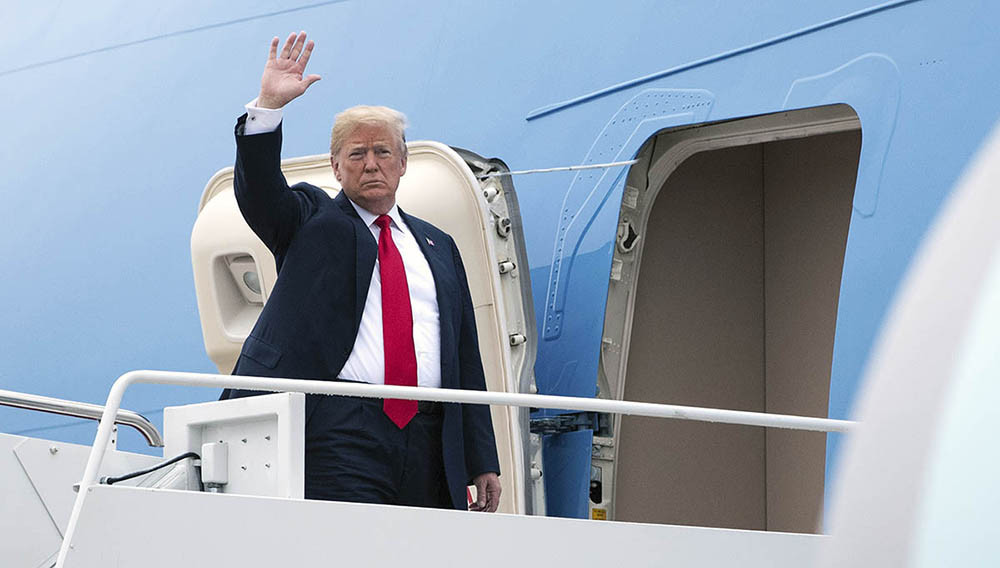
U.S. President Donald Trump Photo credit: Kevin Dietsch-Pool/Getty Images.
….And just as we have called out foreign leaders for undermining democratic norms in their countries, we must draw attention to the same sorts of warning signs in our own country. It is in keeping with our mission, and given the irreplaceable role of the United States as a champion of global freedom, it is a priority we cannot afford to ignore.
The great challenges facing US democracy did not commence with the inauguration of President Donald Trump. Intensifying political polarization, declining economic mobility, the outsized influence of special interests, and the diminished influence of fact-based reporting in favor of bellicose partisan media were all problems afflicting the health of American democracy well before 2017. Previous presidents have contributed to the pressure on our system by infringing on the rights of American citizens. Surveillance programs such as the bulk collection of communications metadata, initially undertaken by the George W. Bush administration, and the Obama administration’s overzealous crackdown on press leaks are two cases in point.
At the midpoint of his term, however, there remains little question that President Trump exerts an influence on American politics that is straining our core values and testing the stability of our constitutional system. No president in living memory has shown less respect for its tenets, norms, and principles. Trump has assailed essential institutions and traditions including the separation of powers, a free press, an independent judiciary, the impartial delivery of justice, safeguards against corruption, and most disturbingly, the legitimacy of elections. Congress, a coequal branch of government, has too frequently failed to push back against these attacks with meaningful oversight and other defenses.
We recognize the right of freely elected presidents and lawmakers to set immigration policy, adopt different levels of regulation and taxation, and pursue other legitimate aims related to national security. But they must do so according to rules designed to protect individual rights and ensure the long-term survival of the democratic system. There are no ends that justify nondemocratic means.
… While the United States suffered an unusual three-point drop on Freedom in the World’s 100-point scale for 2017, there was no additional net decline for 2018, and the total score of 86 still places the country firmly in the report’s Free category.
….The United States has already been weakened by declines in the rule of law, the conduct of elections, and safeguards against corruption, among other important indicators measured by Freedom in the World. The current overall US score puts American democracy closer to struggling counterparts like Croatia than to traditional peers such as Germany or the United Kingdom.
……In any democracy, it is the role of independent judges and prosecutors to defend the supremacy and continuity of constitutional law against excesses by elected officials, to ensure that individual rights are not abused by hostile majorities or other powerful interests, and to prevent the politicization of justice so that competing parties can alternate in office without fear of unfair retribution. While not without problems, the United States has enjoyed a strong tradition of respect for the rule of law.
President Trump has repeatedly shown disdain for this tradition. Late in 2018, after a federal judge blocked the administration’s plan to consider asylum claims only from those who cross the border at official ports of entry, the president said, “This was an Obama judge. And I’ll tell you what, it’s not going to happen like this anymore.”
The president has since urged the Department of Justice to prosecute his political opponents and critics. He has used his pardon power to reward political and ideological allies and encourage targets of criminal investigations to refuse cooperation with the government. He has expressed contempt for witnesses who are cooperating with law enforcement in cases that could harm his interests and praised those who remain silent. His administration’s harsh policies on immigrants and asylum seekers have restricted their rights, belittled our nation’s core ideals, and seriously compromised equal treatment under the law. In October 2018, the president went so far as to claim that he could unilaterally overturn the constitutional guarantee of birthright citizenship…
The president’s attacks on the judiciary and law enforcement, echoed by media allies, are eroding the public’s trust in the third branch of government and the rule of law. Without that trust, the outright politicization of justice could well ensue, threatening the very stability of our democracy. Any American is free to contest the wisdom of a judge’s ruling, but no one—least of all the president—should challenge the authority of the courts themselves or use threats and incentives to pervert the legal process.
This is followed by chapters on
DEMONIZING THE PRESS
SELF-DEALING AND CONFLICTS OF INTEREST
ATTACKING THE LEGITIMACY OF ELECTIONS
THE THREAT TO AMERICAN IDEALS ABROAD
NEITHER DESPAIR NOR COMPLACENCY: Ours is a well-established and resilient democracy, and we can see the effect of its antibodies on the viruses infecting it. The judiciary has repeatedly checked the power of the president, and the press has exposed his actions to public scrutiny. Protests and other forms of civic mobilization against administration policies are large and robust. More people turned out for the midterm elections than in previous years, and there is a growing awareness of the threat that authoritarian practices pose to Americans.
Yet the pressure on our system is as serious as any experienced in living memory. We cannot take for granted that institutional bulwarks against abuse of power will retain their strength, or that our democracy will endure perpetually. Rarely has the need to defend its rules and norms been more urgent. Congress must perform more scrupulous oversight of the administration than it has to date. The courts must continue to resist pressures on their independence. The media must maintain their vigorous reporting even as they defend their constitutional prerogatives. And citizens, including Americans who are typically reluctant to engage in the public square, must be alert to new infringements on their rights and the rule of law, and demand that their elected representatives protect democratic values at home and abroad.
Freedom House will also be watching and speaking out in defense of US democracy. When leaders like Mohammed bin Salman or Victor Orbán take actions that threaten human liberty, it is our mission to document their abuses and condemn them. We must do no less when the threats come from closer to home.
Every year the UN Secretary General publishes a Report on Reprisals against Human Rights Defenders. On 5 February 2019 Rene Wadlow (President of the Association of World Citizens) summarized it for Global Solutions, lists the main culprits and calls for more action by the NGO community.
On 23 January 2019, the U.N. Secretary-General Antonio Guterres in a statement listed States which had carried out reprisals or intimidation including killings, torture, and arbitrary arrests against individuals cooperating with the United Nations on human rights issues. He said, “The world owes it to these brave people standing up for human rights, who have responded to requests to provide information and to engage with the United Nations to ensure their rights to participate is respected. Punishing individuals for cooperating with the United Nations is a shameful practice that everyone must do more to stamp out.” …“Governments frequently charged human rights activists with terrorism or blamed them for cooperating with foreign entities or damaging the state’s reputation of security.”…
The information (provided mostly by NGOs) is collected at the U.N. High Commissioner’s Office in Geneva and is evaluated to see if the information fits into a pattern of continuing human rights violations or if it is an individual event.
Wadlow presents the States listed by broad geographic region rather than all together in alphabetical order as they are in the U.N. statement as other States in each region may also have human rights violation issues, often inter-related to the State named. Thus, the list of States is only those which the U.N. is aware that there have been reprisals against individuals who have given information to the U.N. units.
Middle East
Bahrain, Egypt, Israel, Saudi Arabia, Morocco
Africa
Cameroon, Democratic Republic of Congo, Djibouti, Mali, Rwanda, South Sudan
Asia
China, India, Maldives, Myanmar, Philippines, Thailand
Latin America
Colombia, Cuba, Guatemala, Guyana, Honduras, Trinidad and Tobago, Venezuela
Europe
Hungary, Russian Federation
Central Asia
Kyrgyzstan, Turkmenistan
The impact and increasingly higher profile of human rights informants has left them more and more exposed to a high risk of harassment, repression, arbitrary detention and extra-judicial executions. Governments are not the only actors. Depending on the country, there can be gangs, militias, paramilitary and other non-governmental groups who also menace people thought to be giving information to the U.N. or to international human rights organizations
The publication by the U.N. of its list is done with the hope that governments themselves will take positive action to protect. In some countries, internal security services or police-related “death squads” may act without the knowledge of the highest authorities of the State. In other States, there is little repression that does not come on orders of the higher authorities. There is a need for representatives of NGOs and also the media to be alert, especially for violations in States which are not otherwise in the news. Active networking remains crucial.
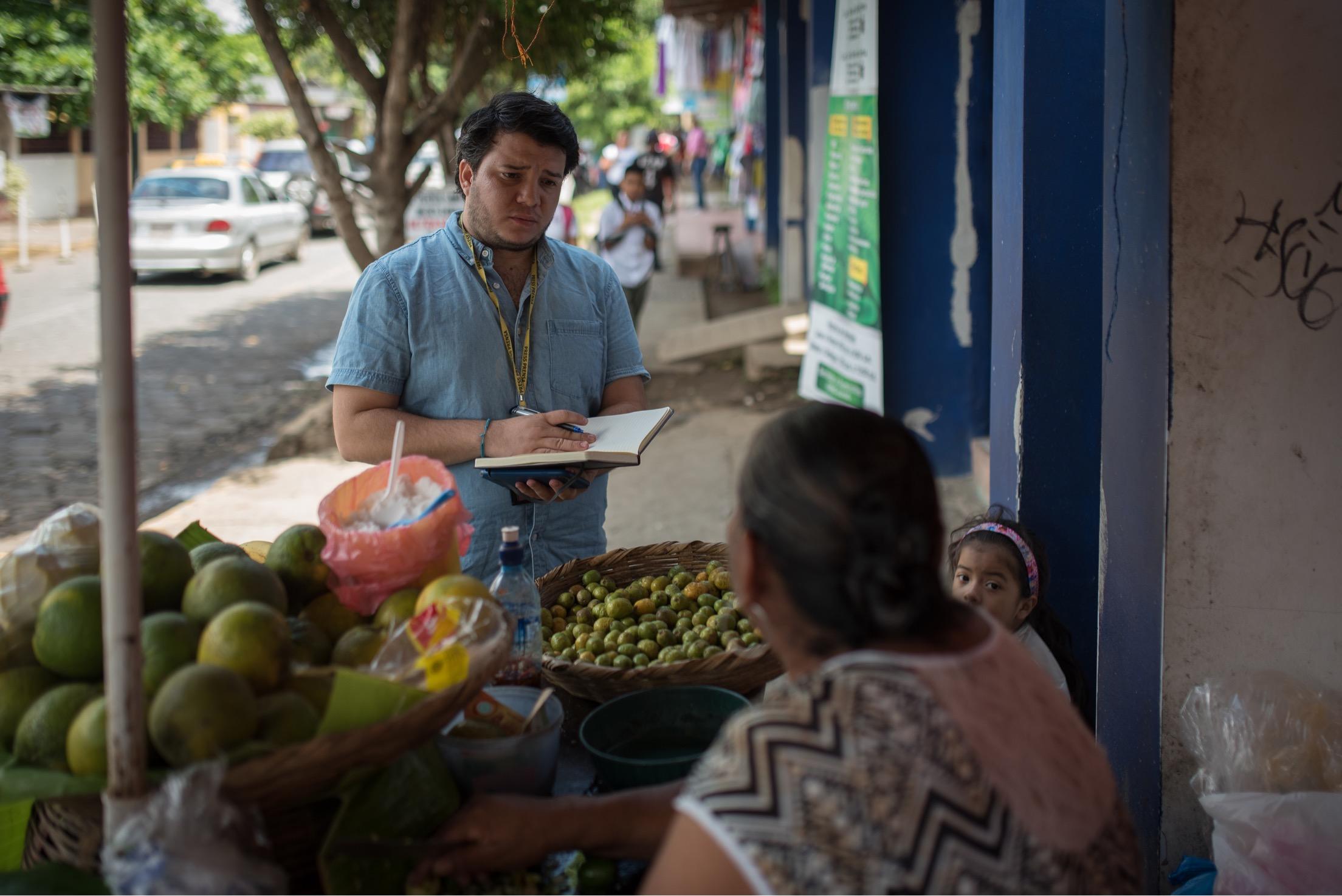
Nicaraguan journalist Wilfredo Miranda interviewing a witness to police repression in Masaya, Nicaragua, last summer. CREDIT COURTESY
Nicaragua’s human rights crisis see https://humanrightsdefenders.blog/2019/01/18/exceptional-response-by-international-ngos-to-human-rights-crisis-in-nicaragua/] has sent many journalists into exile. Among them is Wilfredo Ernesto Miranda, a young reporter for the respected Nicaraguan weekly newspaper Confidencial. Miranda came to Miami after being threatened with imprisonment for exposing the murders of protesters by pro-government forces in a May 2018 article titled “!Disparaban con Precisión – a Matar!” (“They Were Shooting Precisely – to Kill!”) “I was able to document close-range bullet wounds to the heads and throats of protesters that could only be execution-style shots,” Miranda told WLRN.
TheRey de Españaprize is one of the most prestigious journalism awards in Spain and Latin America. Miranda said he wanted to dedicate his Rey de España prize – awarded by a jury in Spain – to imprisoned Nicaraguan journalists Miguel Mora and Lucía Pineda, who face terrorism charges that human rights groups call absurd.
Behrouz Boochani in November, 2017. Picture: Jason Garman/Amnesty International
With one of the MEA 2019 final nominees being detained on Manus island in the same way [see: https://humanrightsdefenders.blog/2018/10/24/breaking-news-ennals-award-announces-its-3-finalists-for-2019/ ] it is relevant to note that another such detainee has won literary awards in Australia! Iranian-Kurdish journalist and poet Behrouz Boochaniwon the richest Australian Victorian Prize for Literature ($100,000) for his hellish first-hand account of life as a detainee on the island. His book, No Friend But The Mountains: Writing From Manus Prison, also won the $25,000 prize for nonfiction at Victorian Premier’s Literary Awards on 31 January 2019. (The eligibility criteria requiring that the authors be Australian citizens or permanent residents was overlooked to award the prize.
Mr Boochani told the Herald Sun from Manus Island, where he has been detained for more than five years, that the award was a victory for literature, resistance and humanity. But, he added: “I don’t want to celebrate this achievement while I still see many innocent people suffering around me.
No Friend But The Mountains.
“If I could be there to accept the award I would explain how this award is a morality failure for Australia,” Mr Boochani said. “It is not just a failure on the part of the Australian government but a historical and moral defeat for those parts of the society who have been silent in the face of a barbaric policy over these years…It’s a huge cause of shame for a government that did not recognise us as human beings and did not recognise our human rights. It’s a challenge against a system that has lied to the public over the past years.”.
On 1 February Keyvan Allahyari, University of Melbourne, followed up with a thoughtful piece on why “Behrouz Boochani’s literary prize cements his status as an Australian writer”
Other Australian authors have also used their voices to bring attention to the plight of asylum seekers. During her acceptance speech for her second Miles Franklin Award in August 2018, Michelle de Kretser chastised politicians for their treatment of refugees on Nauru and Manus Island. To illustrate her point, she read a list of names of asylum seekers who have died there in the past five years. It is tempting to dismiss such actions as gesture politics by an urban elite. But each individual action has served to raise awareness of the Australian government’s policy of “offshore processing” for asylum seekers, and to fuse artistic expression with political activism in a particularly forceful manner.
The author has been awarded the Anna Politkovskaya Award (for investigative journalism), the Amnesty International Award (Australian section) and Liberty Victoria’s Empty Chair Award. These humanitarian awards have confirmed Boochani’s rapidly acquired high profile in the literary field. Last night’s news topped all of that to make Boochani the first “non-Australian” author to win the Victorian Premier’s Literary Awards. The Victorian government established these awards in 1985 to honour Australian writing. The specific challenge this poses to the definition of “Australian writing” can be seen as an intervention by the literary community into the field of politics. If a non-citizen who has never set foot on mainland Australia can win, who counts as an Australian author?…
With no clear solution to the indefinite detention of asylum seekers on Manus and Nauru in sight, the paradox of Boochani’s award success can only contribute further to public debate over the tangled logic of indefinite detention. It shows how cultural practices and political activism can be reconfigured to correspond with the newly created literary currency associated with refugee writing. For now, at least, Boochani is an “Australian writer” because Australia is morally implicated in what he wrote and how he wrote it.
Now the regime of SaudiArabia hopes that it can buy its way to a better image with hosting sport events and Amnesty International has warned sports stars not to become a propaganda tool. Saudi Arabia said it has hired the former England captain, David Beckham, to lead an exhibition team against his former Real Madrid teammate Zinedine Zidane. The game, to be held later this year, is part of a £60-billion re-launch of the entertainment industry in Saudi Arabia, called the National Transformation Programme. According to an article in the Sun, it would earn Beckham an estimated £1million. [Beckham also has a lifetime endorsement deal worth £120million with Adidas which I think doesn’t sit well with Adidas’ claimed stance in favor of human rights – see e.g. https://humanrightsdefenders.blog/2018/12/13/first-time-major-companies-say-that-human-rights-defenders-are-essential-for-profitable-business/].
Announcing the match in front of big screen images of the football legends, Saudi sports minister Turki Al-Sheikh said: “This is an exhibition match including two big worldwide stars – Zinedine Zidane and David Beckham playing against each other…If God wills, you will see it this year in the Kingdom of Saudi Arabia.”
The UN children’s aid group UNICEF, for whom Beckham is a goodwill ambassador, has criticised the Saudi-led coalition saying its bombing attacks there have had catastrophic consequences for the local population. Saudi Arabia has detained more than a dozen women’s rights activists such as Loujain al-Hathloul who once appeared in a Vanity Fair. Loujain’s sister, Alia, has criticised US singer Mariah Carey for playing a concert on Thursday at the King Abdullah Economic City. She said: “My own baby sister said she is being whipped, beaten, electrocuted and harassed on a frequent basis.” She stated: “Remember, thanks to my sister @LoujainHathloul, you r able to perform in Saudi Arabia. I wish she can attend your concert. But she’s locked behind bars because she tried to improve women’s condition. Don’t forget to thank her on stage,” she wrote to Carey on Twitter. [but Mariah Carey is an old hand when it comes to selling her soul: see e.g. https://humanrightsdefenders.blog/2013/12/19/mariah-carey-needs-better-informed-staff-and-donate-her-1-million-fee-to-human-rights-defenders-in-angola/].
How difficult if not impossible it is to try and separate sports and politics can be illustrated by the recent case of soccer player, Hakeem al-Araibi, a Bahrain-born soccer player for a team in Australia has been held in detention in Thailand [see https://humanrightsdefenders.blog/2019/01/02/craig-foster-australian-footballer-and-human-rights-defender/]. Hannah Beech in the NYT on 31 January 2019 puts the question “Can Big Global Sports Come Around to Human Rights Advocacy?“
Hakeem al-Araibi, center, a former member of Bahrain’s national soccer team who has refugee status in Australia, at court in Bangkok in December.CreditCreditAthit Perawongmetha/Reuters
The global sports market is worth hundreds of billions of dollars a year. Now, this powerful industry is coming together to promote an unlikely cause: human rights. Since late November, a Bahrain-born soccer player for a minor team in Australia has been held in detention in Thailand. The player, Hakeem al-Araibi, 24, is not a famous athlete. He has no lucrative sponsors. But he has spoken out against one of the most powerful men in international soccer, who is also a member of the ruling family of Bahrain. His testimony of torture at the hands of Bahrain’s repressive government earned him refugee status in Australia, which determined that he faced credible threats of persecution should he return to the Gulf state. Still, over the past week, Mr. Araibi has collected an impressive list of supporters in the world of international sports.
Fatma Samoura, the secretary general of FIFA, has called for Thailand to return him to Australia “as a matter of urgency.”
Thomas Bach, the head of the International Olympic Committee, raised the issue with the United Nations High Commissioner for Refugees.
Praful Patel, of the Asian Football Confederation, issued a statement asking the Prime Minister of Thailand to ensure Mr. Araibi’s return to his adopted home.
[By the way, the head of the Asian Football Confederation is Sheikh Salman bin Ebrahim al-Khalifa, the Bahraini official whom Mr. Araibi accused of not stopping the persecution of athletes in his charge. Sheikh Salman also serves as a FIFA vice president.!]
Mary Harvey, the chief executive of the Center for Sports and Human Rights, said: “Hakeem is a historic test case, because it’s the first time that we’ve seen these big, powerful sports bodies all come together publicly to address the fate of a single person”. [see also: https://humanrightsdefenders.blog/2018/12/12/mary-harvey-her-goal-is-now-human-rights/]. The court ordered al-Araibi, who is in the Bangkok Remand Prison, to appear before it at 8.30am on Monday to answer whether or not he is willing to be extradited, lawyer Bergman said.
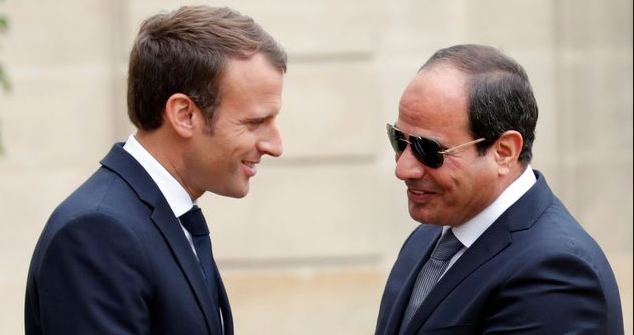
Emmanuel Macron lunched with Egyptianhuman rights defendersin Cairo on 29 January at the end of a three-day visit (for names see below). On Monday, the French president had visibly annoyed his Egyptian counterpart Abdul Fattah al-Sisi at a press conference, by saying that Sisi ought to restore civil rights and liberties for the good of his country. “Stability and lasting peace in Egypt go hand in hand with respecting individual rights and liberties within a state of law,” Macron said. “A dynamic, active, civil society remains the best rampart against extremism.” In response, President Sisi that “Egypt will not rise up with bloggers… Egypt will develop with efforts and patience.”
The French leader was even more forthright with French journalists in Cairo on Sunday night. He had given Sisi a list of political opponents including “journalists, homosexuals, men and women who have convictions” when Sisi visited Paris in October 2017. “Only two of them were freed,” Macron said. “That’s not enough. And things have got worse since.”
That the State does not have to do all the criminalisation of HRDs itself was shown a day after the meeting with the HRDs, when Egyptian lawyer Tarek Mahmoud filed a legal complaint against the heads of four of Egypt’s human rights organizations for “threatening national security”, according to local media reports. The complaint was filed on Wednesday against Mohamed Zaree, the director of the Cairo Institute for Human Rights Studies (CIHRS), Gamal Eid, the executive director of the Arabic Network for Human Rights Information, Mohamed Lotfy, the executive director of the Egyptian Commission for Rights and Freedoms, and Gasser Abdel-Razek, the executive director of the Egyptian Initiative for Personal Rights (EIPR). Tarek Mahmoud said in the complaint that the four men “provided French officials with false information on the political conditions in Egypt”. Mahmoud added that they were “insulting the Egyptian state and undermining the country’s national security, and collaborating with the terrorist Muslim Brotherhood group to achieve its goals of bringing down the Egyptian state.”
The Irish human rights group Frontline Defenders has presented a report on Egypt’s Attack on Labour Rights Defenders to French media in the run-up to Macron’s visit (with focus on the ill-treatment of workers at the Alexandria shipyard.).
Golf’s world number one Justin Rose should use his profile to highlight human rights issues and counter the “propaganda value” of this week’s Saudi International, according to Amnesty International.
Rose has defended his participation by the lame response: “I’m not a politician, I’m a pro golfer“. Human rights violating countries are well aware of the ‘sports-washing’ value of international sporting events, and the players need to understand this too. [ just see some the posts: https://humanrightsdefenders.blog/tag/sports-and-politics/]
AI UK’s director Kate Allen said. “We haven’t called on golfers to pull out of the Royal Greens event and it’s not for us to say who should be playing in these tournaments or whether countries like Saudi Arabia should be hosting them“.
“The point with this, like other sporting events in countries with atrocious human rights records, is to fully understand the context…By hosting the European Tour, Saudi Arabia is almost certainly hoping to use the glamour of elite golf and the lush panorama of the Royal Greens course to subtly rebrand the country.”
AI makes the concrete suggestion:”If each member of the European Tour tweeted their support for Loujain al-Hathloul and the other jailed women’s rights activists in Saudi Arabia, they could go a long way to countering their propaganda value to the Saudi government.”
 That human rights NGOs are severely criticized is nothing new but that it comes from its own staff is rare. Still here is a report that states that “Amnesty International has had a “toxic” working environment going back as far as the 1990s”. This does not mean that AI is specially bad compared to other larger NGOs, just that there are very few other such public reports.


 U.S. President Donald Trump Photo credit: Kevin Dietsch-Pool/Getty Images.



 Rose during the pro-am at Royal Greens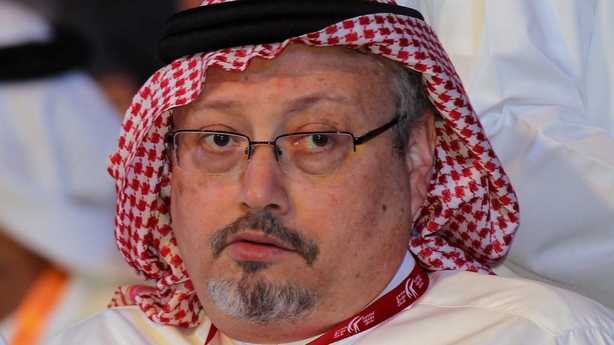
 Hans Thoolen on Human Rights Defenders and their awards