Archive for the 'Human Rights Defenders' Category

A sombre reminder: homicide a bigger killer than armed conflict and terrorism combined

December 8, 2023
Globally, homicide is a bigger killer than armed conflict and terrorism combined.

© Unsplash/David von Diemar

On Friday 8 December 2023 the UN Office on Drugs and Crime (UNODC) said that more people were killed due to homicide than armed conflict and terrorism combined in 2021, with an average of 52 lives lost per hour worldwide. The Global Study on Homicide analyzes the complex dynamics behind these violent deaths and includes a special section on how organized crime is driving death rates up in Latin America and the Caribbean.

The report examines homicides related to criminal activities and interpersonal conflict, as well as “socio-politically motivated homicides” such as the deliberate killing of human rights defenders, humanitarian workers and journalists.

UNODC chief Ghada Waly said the loss of thousands of lives each year to homicide is “a sombre reminder” of the collective failure of the international community to reduce all forms of violence by 2030, in line with the Sustainable Development Goals (SDGs). The report revealed that during the period from 2019 to 2021, an average of roughly 440,000 deaths worldwide were due to homicide – more than conflict-related or terrorist killings combined. 

UNODC said 2021 “was an exceptionally lethal year”, marked by 458,000 homicides.  The spike was in part linked to economic repercussions from the COVID-19 pandemic and to a rise in organized crime and gang-related and socio-political violence in several countries.

Organized crime accounted for 22 per cent of homicides globally, and 50 per cent in the Americas, where competition among organized crime groups and gangs can spark a sudden and sharp rise in “intentional homicides”, as has happened in Ecuador and Haiti.

The Americas also lead the world in highest regional homicide rate per capita, with 15 per 100,000 population in 2021, or 154,000 people.

Africa had the highest absolute number of homicides at 176,000, or 12.7 per 100,000 population, “and available data suggests that the homicide rate is not falling, even as decreases have been registered in other regions,” the report said.  Meanwhile rates in Asia, Europe and Oceania were far below the global per capita average of 5.8 per 100,000 population in 2021.

Firearms were used in most killings in the Americas in 2021, or roughly 75 per cent, whereas in Europe and Asia they were involved in 17 and 18 per cent of homicides, respectively. 

Men accounted for 81 per cent of homicide victims and 90 per cent of suspects, but women are more likely to be killed by family members or intimate partners. “Although they represent 19 per cent of homicide victims in total, they account for 54 per cent of all killings in the home and 66 per cent of all victims of intimate partner killings,” UNODC said. 

Aid workers under attack 

The data also showed that the deliberate killings of human rights defenders, environmental defenders, community leaders, journalists, and aid workers represented nine per cent of global homicides. “The threat has increased for humanitarian aid workers, who witnessed a higher average number of fatalities over the period 2017-2022 than 2010-2016,” the authors said. 
https://news.un.org/en/story/2023/12/1144392

UDHR@75: how to do better in the future – a view from the Open Society Foundations

December 7, 2023

On 5 December 2023, Natalie Samarasinghe – global director for advocacy at the Open Society Foundations. – wrote about strengthening human rights based on David Griffiths’ paper, Barometer in Context: Strengthening the Human Rights System.

….But this is not the whole story. The Open Society Barometer, a poll of over 36,000 people in a representative group of countries, found that most people believe in the value of human rights. Over 70 percent said that human rights “reflect the values I believe in” and are “a force for good” in the world.

Actors such as human rights lawyers, NGOs, and international organizations continue to provide hope, support, and redress to those seeking justice and protection. And they are joined by a growing cohort of others, from rural communities to indigenous peoples, political and social movements. They may not use the language of rights but their work is grounded in them. They cannot afford to have theoretical debates about the relevance of the UDHR. They need support and solutions.

To mark the UDHR’s anniversary, Open Society commissioned a paper on what those solutions might look like, written by David Griffiths, an advocate and policy expert with more than two decades of diverse experience across the human rights movement. His paper, Barometer in Context: Strengthening the Human Rights System, sets out a series of proposals for how to make this moment count, including prioritizing economic inequality and climate change, exposing the failure of authoritarians to deliver, defending civic space, rethinking migration, widening accountability, and strengthening the human rights system.

Drawing on 18 months of research and material from at least 65 interviews with people from all parts of the world, as well as the Open Society Barometer, these proposals provide inspiration for those of us approaching this anniversary with a heavy heart. It is vital that we avoid paralysis and gloom, which only plays into the hands of abusers and authoritarians.

We must become more creative in how we support those defending rights, whether they are in the courtroom or community center, or on the streets marching for debt relief and climate justice. We must invest in the leaders and tools of tomorrow, instead of playing catch-up with authoritarians, while doubling down on our backing for traditional actors and approaches that continue to deliver results.

And now more than ever, we must nurture a global movement—of the sort that was not possible in 1948—to reaffirm the simple truth that lies at the heart of the Declaration: that all human beings are equal, that every life has value.

https://www.opensocietyfoundations.org/voices/75-years-of-the-universal-declaration-of-human-rights

CIVICUS 2023: almost one third of humanity now lives in countries with ‘closed’ civic space

December 7, 2023

The CIVICUS Monitor, which tracks freedom of association, peaceful assembly and expression in 198 countries and territories, announced in a new report – “People Power Under Attack 2023” – that almost one third of humanity now lives in countries with ‘closed’ civic space.

This is the highest percentage –30.6% of the world’s population– living in the most restrictive possible environment since CIVICUS Monitor’s first report in 2018. Meanwhile, just 2.1% of people live in ‘open’ countries, where civic space is both free and protected, the lowest percentage yet and almost half the rate of six years ago.

We are witnessing an unprecedented global crackdown on civic space,” said CIVICUS Monitor lead researcher Marianna Belalba Barreto. “The world is nearing a tipping point where repression, already widespread, becomes dominant. Governments and world leaders must work urgently to reverse this downward path before it is too late.

The CIVICUS Monitor rates each country’s civic space conditions based on data collected throughout the year from country-focused civil society activists, regionally-based research teams, international human rights indices and the Monitor’s own in-house experts. The data from these four separate sources are then combined to assign each country a rating as either ‘open,’ ‘narrowed,’ ‘obstructed,’ ‘repressed’ or ‘closed.’

Seven countries saw their ratings drop this year. These include Venezuela and Bangladesh, each now rated ‘closed’ due to intensifications of existing crackdowns on activists, journalists and civil society.

Democratic countries slipped too. Europe’s largest democracy, Germany, fell from ‘open’ to ‘narrowed’ amid protest bans and targeting of environmental activists. Bosnia & Herzegovina also declined to ‘obstructed,’ the twelfth European country downgraded since 2018.

One of 2023’s most dramatic slides occurred in Senegal, once considered among West Africa’s most stable democracies. Senegal entered the ‘repressed’ category amid sustained government persecution of protesters, journalists and opposition ahead of February elections.

“The range of countries where authorities restricted citizen participation in 2023 shows clampdowns are not isolated incidents but are part of a global pattern,” said Belalba. “A global backslide requires a global response. If citizens are not able to freely gather, organise and speak out, the world will not be able to solve inequality, confront the climate crisis and bring an end to war and conflict.”

CIVICUS Monitor data shows that worldwide, authorities target people’s freedom of expression above all else. Half of all documented violations in 2023 targeted free speech, with incidents ranging from a bombing outside a journalist’s house in Indonesia, the arrest of the head of a radio station in Tunisia and police pepper-spraying a reporter covering a protest in the United States.

Our research also reveals that intimidation is the number one tactic to restrict citizen freedoms. Human rights defenders, activists and media experienced intimidation in at least 107 countries. Media in particular bear the brunt, with 64% of incidents targeting journalists.

Despite these alarming trends, People Power Under Attack 2023 highlights areas of progress too. Timor-Leste’s civic space moved up to the second best rating ‘narrowed’ from ‘obstructed,’ reflecting the country’s commitment to fundamental freedoms. Four other countries saw ratings improve, though they remain in ‘repressed’ or ‘obstructed’ zones.

The report also details bright spots where countries made steps toward opening societies. Among these, Fiji repealed a restrictive media law. The Kenyan courts recognised the right of LGBTQI+ people to associate. Even Tajikistan, rated ‘closed,’ created a national human rights strategy with civil society input. Still, these and other improvements remain halting and often disconnected compared to widespread repression.

“These small steps show that even amid unprecedented restrictions, civil society is pushing back,” said Belalba. “These courageous acts of resistance by active citizens and civil society organisations give us hope that the downward trend is not permanent and can be reversed.”

See also: https://humanrightsdefenders.blog/2022/01/18/2021-global-data-report-from-the-civicus-monitor/

To access the full CIVICUS Monitor report, please visit monitor.civicus.org

https://www.rfa.org/english/news/vietnam/vietnam-civicus-report-12072023001010.html

Meet Cyrine Hammemi, a human rights defender from Tunisia

December 7, 2023

Cyrine Hammemi is a human rights defender and a project manager at the Association for the Promotion of the Right to Difference (ADD) in Tunisia. Her work focuses on the human rights of persons belonging to minority groups, through alerts on discriminatory situations and the violence they suffered.

Speaking to ISHR, Cyrine discussed her journey into activism and her vision for an inclusive future. She shared the personal triggers that led her to become an activist and emphasised her hopes for a world where every individual can fully enjoy their rights without discrimination based on identity, gender, religion, or sexual orientation.

https://ishr.ch/defender-stories/human-rights-defenders-story-cyrine-hammemi-from-tunisia/

Mary Lawlor returns from Algeria visit

December 7, 2023

On 5 December 2023, Mary Lawlor, the UN Special Rapporteur on the situation of human rights defenders concluded her visit to Algeria with the observation: “While I welcome the evident reforms which have taken place over the past four years and the new emphasis on public consultation, I regret that some human rights defenders who work on sensitive issues face continued restrictions”.

The UN expert observed four main patterns of violations used to suppress human rights defenders: ongoing judicial harassment, dissolution of key human rights organisations, limitations on freedom of movement and intimidation and surveillance leading to severely negative impacts on their mental health and that of their families.

I was saddened that a handful of human rights defenders who attempted to travel to Tizi Ouzou, where I was holding meetings, were prevented from doing so and detained for 10 hours,” Lawlor said.

“Given Algeria’s recent history, robust laws relating to terrorism are clearly necessary,” the expert said. “However, it is disappointing that laws designed to prevent terrorism are instilling terror in human rights defenders through overly broad and vague definitions of what constitutes terrorism in the Penal Code.”

The Special Rapporteur noted that Article 87 bis of the Penal Code was one of the most frequently cited laws used to prosecute human rights defenders.

Despite this, the expert said there were many people working to protect and promote human rights with the full support of the government and the newly created consultative bodies in areas including women’s rights, children’s rights, healthcare, poverty relief and political participation. Based on this collaboration and experience, the Special Rapporteur believes the government is now better equipped to reach out to human rights defenders working on sensitive issues.

Lawlor welcomed the acquittal of three human rights defenders, Jamila Loukil, Kaddour Chouicha and Said Boudour, of terrorism charges in Dar El Baida court on Sunday. 

“I hope this acquittal will kickstart a review process of Article 87 bis, and I stand ready to assist the Algerian government in any way I can in this regard,” she said.

11 human rights NGOs had publicly expressed their wish that this visit be an opportunity to free imprisoned activists and for reforms to see the light of day.

On 6 December, following the public report of this visit, NGOs support the main measures recommended by the Special Rapporteur, namely that:
• The Algerian government must view Human Rights Defenders as allies and opportunities within society, not as threats. The signatories call for the repeal of all repressive laws and legislative provisions relating to the rights to freedom of association and peaceful assembly, and the adoption, on the basis of broad consultation with Algerian society, a regulatory framework complies with international standards notably respect for human rights in Algeria.
• Many civil society organizations are in danger of disappearing. This is already the case of the Algerian League for the Defense of Human Rights (LADDH) and the Rassemblement Actions Jeunesse (RAJ). Civil society organizations must have the freedom to adequately play their role.
• Several articles of law must also be reformed in accordance with international standards. This is the case of articles 79 and 87 bis of the Penal Code, relating to the attack on the integrity of the national territory and the fight against terrorism which are abusively used to imprison activists. The same goes for the Ban on Exiting the National Territory (ISTN) which is today used in a punitive manner to restrict the movement of human rights defenders in Algeria.

The signatories finally call on the Algerian government to release all prisoners of conscience and human rights defenders currently in prison

https://www.ohchr.org/en/press-releases/2023/12/algeria-continued-restrictions-human-rights-defenders-undermine-social

https://www.fidh.org/en/region/north-africa-middle-east/algeria/algeria-reactions-following-the-visit-of-the-special-rapporteur-on

European Bar Association gives 2023 award to three Chinese lawyers

December 5, 2023

Jailed Hong Kong, Chinese attorneys honored with human rights award

From right, jailed Hong Kong barrister Chow Hang-tung and Chinese rights attorneys Xu Zhiyong and Ding Jiaxi were honored with human rights awards by the Council of Bars and Law Societies of Europe. Credit: Reuters, AP, Reuters

Three jailed attorneys from Hong Kong and China have been honoured with Council of Bars and Law Societies of Europe human rights awards, as a Chinese court rejected appeals from two of them, upholding their original sentences for “subversion.”

For more on these CCBE human rights awards, see: https://www.trueheroesfilms.org/thedigest/awards/A3C73F81-6FCB-4DDD-9356-61C422713949

Jailed Hong Kong barrister Chow Hang-tung, who has been behind bars since September 2021, and Chinese rights attorneys Xu Zhiyong and Ding Jiaxi, who were jailed in April for attending a 2019 gathering of dissidents in the southeastern city of Xiamen, were given the awards in absentia in recognition of their work upholding human rights, the association said on its website. See: https://humanrightsdefenders.blog/2023/04/11/xu-zhiyong-and-ding-jiaxi-two-human-rights-defenders-in-china-sentenced/

The ceremony in Athens took place on Friday 24 November, the same day that a court in the eastern province of Shandong rejected appeals from Ding and Xu, who are currently serving 12- and 14-year jail terms handed down by the Linshu County People’s Court for “subversion of state power,” respectively.

Chow said in an acceptance speech sent from prison that the fight for democracy in China is part of ensuring that the law serves democratic and humanitarian values, rather than just the wishes of those willing to use force to bring others in law. See: https://www.ccbe.eu/fileadmin/speciality_distribution/public/documents/HUMAN_RIGHTS_AWARD/2023/EN_2023_HR_Speech_Chinese-Human-rights-lawyer-Hang-Tung-Chow.pdf

“The dignity of our profession … it is bound up with the dignity of the law, with whether the law reflects our autonomy or denies it,” wrote Chow, who organized now-banned annual vigils commemorating the 1989 Tiananmen massacre.

“In that sense the building of democratic institutions that alone can safeguard the law’s dignity is also a lawyer’s duty, which is why all three of us receiving this prize today are jailed for working for democracy in China, a fight that may seem unrelated to our profession but is in fact, central to it,” said Chow.

She is currently awaiting trial under a security law on charges of “subversion” amid an ongoing crackdown on dissent in Hong Kong.

“It is a fight we cannot waver from, even when knowing that the laws we served would likely condemn us,” she said, describing the fight as “the highest service a lawyer can offer her fellow men.”

Rights activist Patrick Poon said the fact that Chow was honored alongside Xu and Ding shows how little difference there is now between the judicial systems in Hong Kong and mainland China, following a years-long crackdown on political opposition and public dissent in the wake of the 2019 protest movement.

https://www.rfa.org/english/news/china/china-lawyers-awards-11272023160715.html

Celebrating 25 years of the UN Declaration on human rights defenders: take action

December 5, 2023
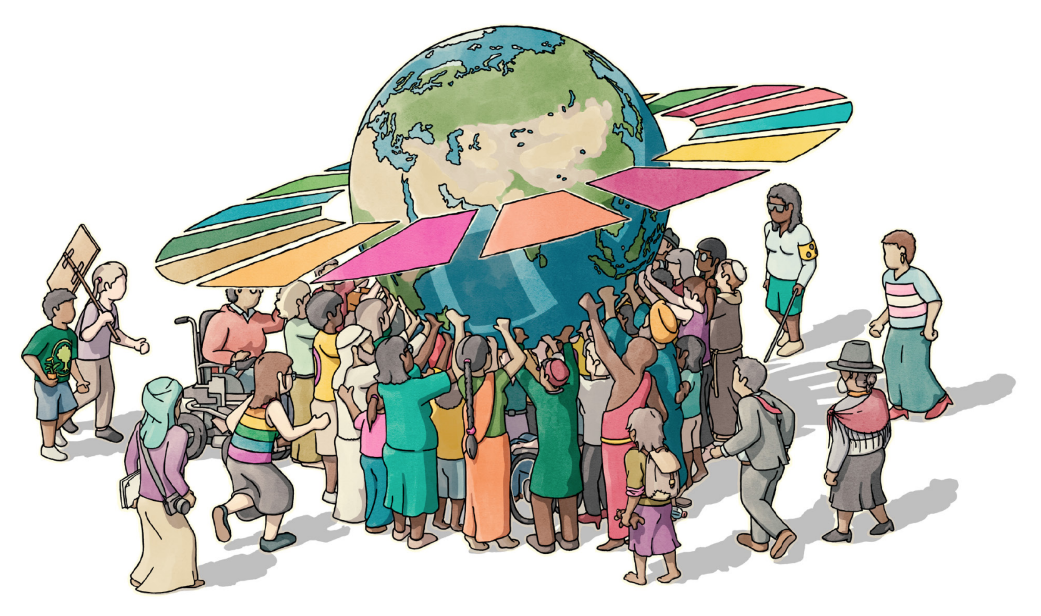
Human rights defenders world illustration

25 years ago, the United Nations adopted the Declaration on Human Rights Defenders. The declaration has been essential to protect those who defend human rights. It’s time to celebrate the Declaration, human rights defenders and all the contributions they have brought to our societies.

The Declaration is a landmark document that sets out the rights and responsibilities of States, human rights defenders, and all actors in society in ensuring a safe environment where defenders are recognised, valued, and encouraged to work for the promotion and protection of human rights.

As part of this celebration, Amnesty International, CIVICUS, Defend Defenders, FIDH, Forum Asia, Front line Defenders, Gulf Centre for Human Rights, ICNL, ILGA World, IM Defensoras, ISHR, MENA WHRD Coalition, OMCT, Peace Brigades International , Protect Defenders, Protection International and RFK Human Rights launched a collaborative project to analyse the contributions of the Declaration to defenders’ lives and work, as well as progress in international human rights law on the protection of defenders. 

What do we want to achieve? 

This project seeks to enhance the awareness of the Declaration and encourage greater dialogue on the protection needs of defenders

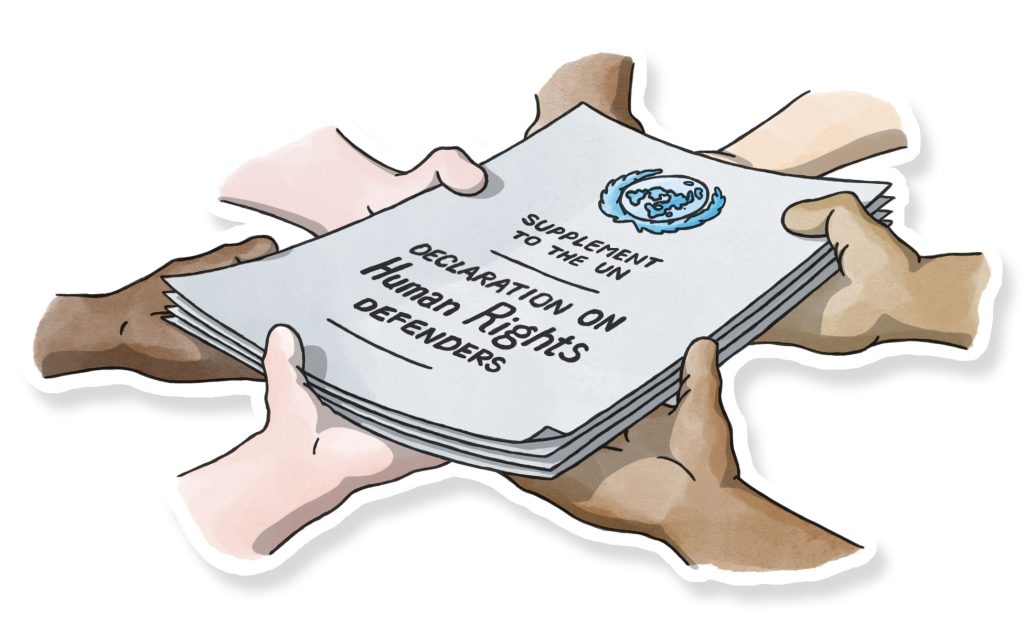
One of the outcomes of the project will be the creation of a supplement to the Declaration that will be a civil society-led document taking into account developments in international and regional jurisprudence relating to defenders over the past 25 years and evolutions of human rights movements, addressing key gaps and limitations in the Declaration, and reflecting defenders’ lived experiences and needs.

This supplement will guide change on the ground in the next 25 years, and beyond!

We need the input and voices from human rights defenders everywhere!

What can you do?

We are consulting online and offline with human rights defenders across the globe on changes in national, regional and global contexts in which they work, evolutions of human rights movements and activism, and defenders’ lived experiences and protection needs. We are also reviewing how international and regional jurisprudence in relation to human rights defenders has developed over the last 25 years. 

1. Add your voice

By sharing your experiences, insights, and recommendations, you can help shape the future of human rights and contribute to the protection and promotion of defenders’ rights.

Are you a human rights defender and want to contribute to the project?

Are you a human rights defender and want to contribute to the project?

Take the survey

2. Spread the word

Help us raise awareness about the UN Declaration on human rights defenders. Join the #Right2DefendRights social media campaign. 

Join the social media campaign!

Join the social media campaign!

Discover our #Right2DefendRights social media kit and post the content on your networks. Download the kit

3. Learn more about the Declaration

Learn more about the Declaration on Human Rights Defenders, its importance, content and application. Visit our online e-learning platform and take our 30 minutes course.

Take the e-course

Take the e-course

Visit our online e-learning platform and learn more about the Declaration.Learn more

4. Get in touch!

Let us know if there are convening of HRDs happening anywhere that we could do consultations around. Drop an email to Tess Mcevoy: t.mcevoy@ishr.ch

—————

And on Monday 11 December (10:00 – 12:00 EST) there will be an event “UDHR75 + HRDS25 = 100% HUMAN RIGHTS” at Ford Foundation Center for Social Justice, New York with HRDs speaking about their lived experiences, with:
Sukhgerel Dugersuren, OT Watch, Mongolia
Karina Sánchez, IM Defensoras, Mesoamerican Intiative of Women Human Rights Defenders, LAC
Sirley Muñoz, Somos Defensores, Colombia
Brenda Kugonza, Women Human Rights Defenders Network Uganda
Edita Burgos, Karapatan, Philippines
Moderation: Tess McEvoy, International Service for Human Rights

See also: https://humanrightsdefenders.blog/2023/06/20/side-event-on-the-25th-anniversary-of-the-un-declaration-on-human-rights-defenders/

https://docs.google.com/forms/d/e/1FAIpQLSfL3XYx_otZ2-iwL7YqGZJj5z5dzlOhNlyiifP5CYzGPtsISA/viewform

https://ishr.ch/25-years-un-declaration-on-human-rights-defenders/

Amnesty International website now accessible even in repressive countries

December 5, 2023
Amnesty International Logotype
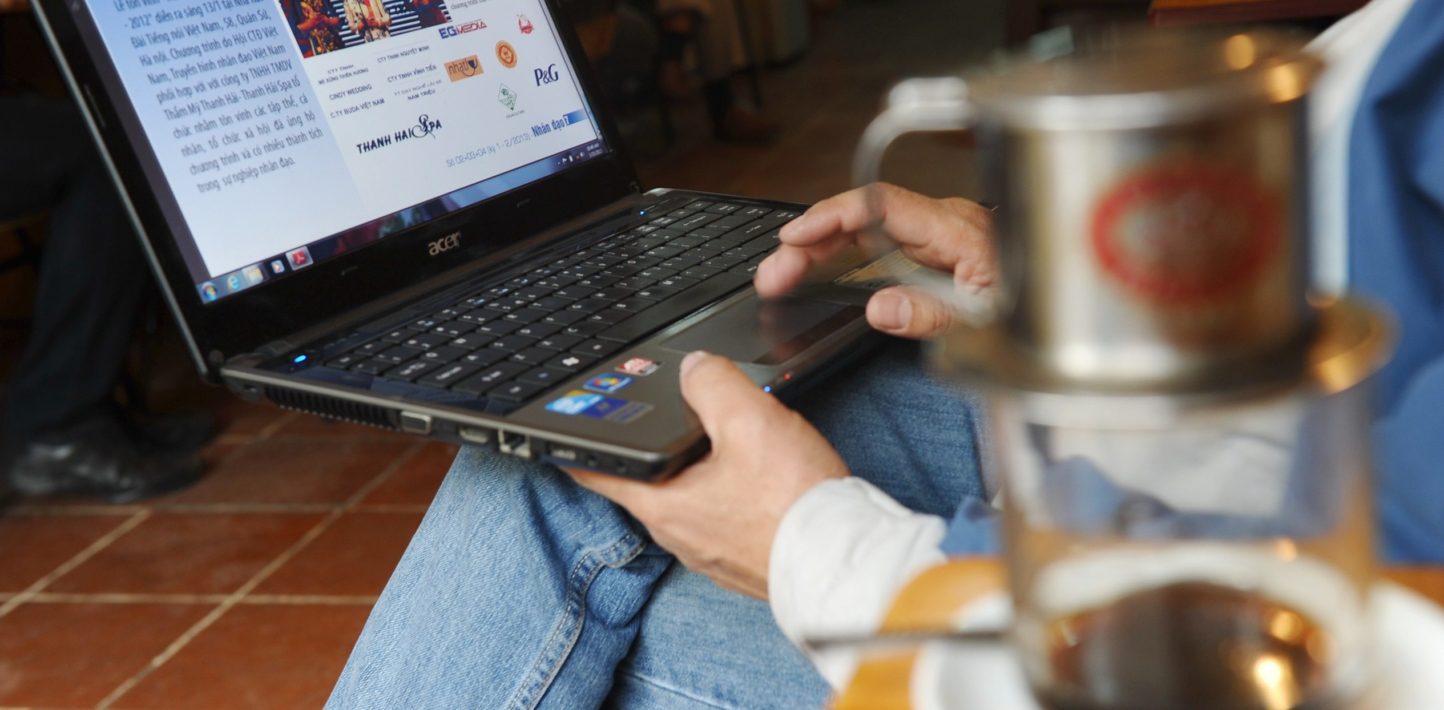
A person browsing information on a laptop.

On 5 December 2023 Amnesty International launched its global website as an .onion site on the Tor network, giving users greater access to its work exposing and documenting human rights violations in areas where government censorship and digital surveillance are rife.

In recent years, a number of countries including Algeria, China, Iran, Russia and Viet Nam have blocked Amnesty International websites.

By making Amnesty International’s website available as a secure .onion site on Tor, more people will be able to read our human rights research and engage with the vital work of speaking truth to power, and defending human rights.”Donncha Ó Cearbhaill, Head of Security Lab at Amnesty Tech.

However, audiences accessing the Amnesty.org website through Tor will be able to bypass attempts at censorship.

An .onion site is a website that is only accessible through Tor, a volunteer-run network of servers which encrypt and route internet traffic through multiple servers around the world, providing users with an added layer of privacy and anonymity.

The onion site provides a means for individuals around the world to exercise their rights to privacy, freedom of expression, freedom of peaceful assembly, and freedom of association in a safe and secure online environment,” said Donncha Ó Cearbhaill, Head of Security Lab at Amnesty Tech.

The new Amnesty onion site can be accessed using the Tor Browser through our secure onion address at: https://www.amnestyl337aduwuvpf57irfl54ggtnuera45ygcxzuftwxjvvmpuzqd.onion.

The browser must be downloaded and installed through the official Tor Project website.

How to access Amnesty websites using Tor

The Tor Project has a version of the Tor Browser for many common platforms, including Windows, Mac, Linux, and Android. Onion sites can also be accessed on iPhone through the Onion Browser app. In countries where the Tor network is blocked, visitors will also need to configure Tor bridges which help bypass attempts to block connections to the network.

Amnesty International is also making language-specific content published in Chinese, Farsi and Russian available on the Amnesty International Tor onion website.

We are thrilled that one of the most recognized human rights organizations has adopted an onion service to provide greater online protections for those seeking information, support and advocacy. Amnesty International’s choice to offer an onion version of their website underlines the critical role of this open-source privacy technology as an important tool in our shared work of advancing human rights,” said Isabela Fernandes, Executive Director, the Tor Project.

What are .onion sites?

Onion services never leave the Tor network. Their location and IP addresses are hidden, making it difficult to censor them or identify their operators. In addition, all traffic between users and onion services is end-to-end encrypted. As a result, users leave no metadata trail making it impossible for their identity or internet activity to be tracked.

Both Tor and virtual private networks (VPNs) can help internet users bypass website blocking and censorship.

Tor routes connection through a number of volunteer run and randomly assigned servers preventing anyone individual or organization from being able to track both the identity and internet activity of users while a VPN connects through a single privately owned server.

The Tor software was first released more than 20 years ago and is now developed and maintained by the Tor Project, a US-registered not-for-profit organization which is focused on advancing human rights and freedoms by creating and deploying free and open-source anonymity software and privacy technologies.

https://www.amnesty.org/en/latest/news/

Palestinian and Israeli peace defenders share hope for peace

December 5, 2023

On 4 December 2023 he Middle East Monitor published this rare event: Palestinian and Israeli peace activists share hope for peace and better future

Speaking at an interfaith peace vigil organised by Together for Humanity at Downing Street in London, UK, Palestinian peace activist Hamza Awad and Israeli peace activist Magen Inon emphasised the crucial importance of promoting peace and mourning the lives lost. In an interview with BBC News, they shared the success of the event in bringing people together during challenging times, and said they hope for a better future where their children could grow up not hating or fearing anyone.

MEA Laureate 2022 Daouda Diallo abducted

December 4, 2023

On 1 December, 2023, at about 4 p.m., four or more unidentified men abducted Diallo, the secretary-general of the Collective Against Impunity and Stigmatization of Communities (Collectif contre l’Impunité et la Stigmatisation des Communautés, CISC) in Burkina Faso’s capital, Ouagadougou. Diallo had just left the government’s passport office after a meeting with officers to renew his passport. The CISC issued a statement the same day saying that men in civilian clothes pushed Diallo into a vehicle and drove off. His whereabouts remain unknown.

Diallo, 41, winner of the 2022 Martin Ennals Award for Human Rights Defenders, has long been known for denouncing abuses by government security forces and for demanding accountability.[https://www.trueheroesfilms.org/thedigest/laureates/ca7f1556-8f73-4b48-b868-b93a3df9b4e1] In early November, the Burkinabe security forces used a sweeping emergency law aimed at silencing dissent and notified at least a dozen journalists, civil society activists, and opposition party members, including Diallo, that they would be conscripted to participate in government security operations across the country. Diallo spoke out against these politically motivated conscriptions.[see also: https://humanrightsdefenders.blog/2023/11/10/burkina-faso-emergency-law-targets-dissidents/]

On December 2, the United Nations special rapporteur on human rights defenders, Mary Lawlor, raised serious concerns about Diallo’s abduction. In a December 3 statement, The People’s Coalition for the Sahel, an alliance of civil society organizations, said that “the abduction of a prominent activist in broad daylight […] demands an immediate government response,” and called on the military authorities to take action.

Burkina Faso authorities should urgently and impartially investigate the abduction of Daouda Diallo and release him if he is in government custody,” said Ilaria Allegrozzi, senior Sahel researcher at Human Rights Watch. “We are deeply concerned for Diallo’s safety and the safety of everyone working to improve respect for human rights in Burkina Faso.”

Since it took power in an October 2022 coup, Burkina Faso’s military junta has increasingly cracked down on peaceful dissent and the media, shrinking the civic space in the country. National and international journalists, as well as civil society members, face increasing harassment, threats, and arbitrary arrests. On December 2, the military authorities announced the suspension of “all distribution methods” of the French newspaper Le Monde daily, claiming an article published on Le Monde’s website on December 1 about a deadly attack by an Islamist armed group on a military base in Djibo, Sahel region, on November 26, was “biased.”

On 4 December the Martin Ennals Foundation and several other NGOs addressed an urgent letter to the Représentant Permanent de Burkina Faso at the UN in Geneva.

https://www.hrw.org/news/2023/12/04/burkina-faso-prominent-rights-activist-abducted

https://abcnews.go.com/International/wireStory/burkina-faso-rights-defender-abducted-concerns-grow-alleged-105328313

https://www.voanews.com/a/burkina-faso-rights-defender-abducted/7381667.html

https://www.barrons.com/news/ngos-call-for-release-of-burkinabe-rights-defender-4d2b4f83