“Yuri Dmitriev has returned the human value back to the Russian state. He confronts the past and gives a new vision for the future, which today’s regime does not have,” says Secretary General of the Norwegian Helsinki Committee, Geir Hønneland, to the Barents Observer.
Explaining the reason behind the award, Hønneland says it is not only about Dmitriev as a historian. “His work has already inspired thousands of young and old people, who want to find their dearest in the darkest graves. It is about hope and common identity.”
Millions were killed during Soviet terror, but the victims of these atrocities and their living relatives have never been given real justice. This was what Yury Dmitriev was working on. In the forests of Karelia, tens of thousands of people were shot and killed without trial or conviction and buried in mass graves.
Ahval on 20 May 2021 reports that the European Parliament said the EU’s membership talks with Turkey should be formally suspended unless the country reverses its democratic backsliding.
Parliamentarians said they were alarmed by the “authoritarian nature of the presidential system” in Turkey in a report adopted on Wednesday. The resolution was probably the toughest and most critical yet of Turkey, said rapporteur Nacho Sánchez Amor.
“It reflects all that has unfortunately happened in the country in the last two years, in particular in the fields of human rights and rule of law, which remain the main concern for the European Parliament, and in its relations towards the EU and its members,” Amor said.
EU institutions should now make any positive agenda on Turkey conditional on democratic reform, he said.
Turkey began membership talks with the EU in October 2005. The negotiations were partly frozen a year later due to Turkey’s refusal to open its ports to ships from the Greek part of Cyprus. The EU informally approved a freeze in the membership process in 2016 citing a deterioration in democracy.
Turkey reacted angrily to the report, saying it was unacceptable in a period when relations with the EU were based on a positive agenda and a membership perspective.
The text contains “false allegations regarding human rights, democracy, the rule of law, our governmental system and political parties; and views Turkey’s effective, solution-oriented, humanitarian and enterprising foreign policy as a threat,” the Turkish Foreign Ministrysaid in a statement. See also my recent: https://humanrightsdefenders.blog/2021/03/22/turkey-arrests-and-backsliding-on-femicide/
EU lawmakers pointed to a “continued hyper-centralisation of power in the presidency” and called on Turkey’s relevant authorities to release all imprisoned human rights defenders, journalists, lawyers, academics and others, who it said the government had detained on unsubstantiated charges.
Turkey adopted a full presidential system of government at elections in 2018, awarding President Recep Tayyip Erdoğan vast executive powers, including the ability to rule by decree.
MEPS also highlighted Turkey’s “hostile” foreign policy, including towards Greece and Cyprus, and over its involvement in Syria, Libya, and the disputed region of Nagorno-Karabakh, which they said consistently collided with the EU’s priorities.
Lawmakers also urged Turkey to recognise the Armenian Genocide, which they said would pave the way for genuine reconciliation between the Turkish and Armenian people.
Mary Lawlor:Since taking up this role just over a year ago, Covid has meant that I have worked almost entirely online. This has been an opportunity to expand the ways we promote the work of Human Rights Defenders in online spaces.
So today, I am delighted to unveil my new website, which has been in the works for some time. At srdefenders.org, you’ll find the latest news and information about Human Rights Defenders and what my mandate is doing to protect them.
Matt Petras in the Shit.nes of 18 May 2021 reports how IFEX, a global freedom of expression network, partnered with the International Free Expression Project (IFEP) earlier this month to launch a street-level art exhibition in Pittsburgh displaying the faces and telling the stories of brave practitioners and defenders of free expression from around the world, including slain Maltese journalist Daphne Caruana [see: https://www.trueheroesfilms.org/thedigest/laureates/70b0bee4-9af2-40c6-a11e-5b9ad159b96f]
The exhibit, which draws from IFEX’s Faces of Free Expression series that profiles “changemakers,” can be seen by anyone walking by on the street, housed in street-level windows of the massive, historic former Pittsburgh Post-Gazette building. The PG, which has since relocated elsewhere in the city, has won Pulitzer Prizes for its journalism and continues to serve as the most prominent news outlet covering the Pittsburgh region for nearly a century. At an opening ceremony kicking off the exhibit’s launch, a small group, including beloved PG columnist Tony Norman, Pittsburgh Mayor Bill Peduto, and IFEP founder Greg Victor, gave small speeches lauding the ‘Faces of Free Expression’ project.
“Those honoured in the ‘Faces’ exhibit represent thousands of others from across the world who are fighting this struggle as well,” Victor said at the event.
Vietnamese singer Mai Khoi performed at the event. Khoi was already a popular musician in her home country when she became more and more of an activist as she experienced increased censorship of her music by the Vietnam government. Often compared to Lady Gaga and Pussy Riot, Khoi performs unique, exciting, and often politically charged pop music. [see: https://www.trueheroesfilms.org/thedigest/laureates/de4d9180-f67a-11e9-9715-b5590d668968]
Portrait illustrations, blurbs and quotes adorn several sets of vertical, rectangular windows facing the street in Downtown Pittsburgh. Most of the windows contain a single portrait or bit of text but the exhibit also boasts some larger spreads that incorporate clusters of nearby windows to create bigger images, such as a wonderful photo of Khoi against a black background, joined by a short biography for passers-by to read.
Jamal Khashoggi and Daphne Caruana Galizia are among the journalists and human rights defenders featured in the exhibition. Photo: Matt Petras.
The faces of the project represent just a small selection of the individuals responsible for the fight for freedom of expression.
“All of these people, they’ll say they didn’t do it alone, and they didn’t,” Game said. “It takes so many people, who get up every day in their work, to do this kind of advocacy, to address these kinds of challenges.”
IFEP hopes to incorporate its ‘Marketplace of Ideas’ proposal into the historic PG building, which would create a space for artists doing important work. “Being artists ourselves, having a place like this would be great,” Jones said.
Brown appreciated the exhibit and the goals outlined by IFEP for what it represents for his neighbourhood. “This is something Pittsburgh needs, being able to have your voice be heard and your expressions,” he said.
Yet the message of the ‘Faces of Free Expression’ exhibit extends far beyond the images and text on the wall that people can see on this street in Pittsburgh. “It shows this has a global impact,” Game said. “It brings the many free expression issues the world is facing to this wall in Pittsburgh.”
Two Chinese human rights lawyers serving jail sentences for “inciting subversion of state power,” Yu Wensheng (L) and Qin Yongpei (R), were permitted limited visits with their families, May 10, 2021. Yu Wensheng/Qin Yongpei
Jailed Chinese rights lawyer Yu Wensheng, who was held incommunicado for three years and sentenced to jail for “incitement to subvert state power,” was allowed a visit from relatives at the weekend, his wife said. Yu’s young son was allowed to visit his father in Nanjing Prison on May 9, along with his mother Xu Yan, Xu told RFA.
The couple’s son spoke with Yu by phone from behind a glass partition during the half-hour visit, Xu said.
“Yu Wensheng had a very good chat with our son,” she said. “Both them were laughing a lot, and there was no sense of strangeness.”
“Our son told his father that he missed him, and Yu was happy to hear that,” she said. “Yu told him that he had wanted to spend more time with him … and apologized for not being there longer than three years.”
Kathy Kiely published on 7 May 2021 in the Washington Post a very enlightening piece showing that “Representing countries with bad records on press freedom is big business.”:
….But even if Biden’s ambition to reestablish the White House as a champion of human rights is a welcome break from the Trump administration’s dictator-coddling, his efforts to pressure countries on freedom of expression are being systematically undermined in Washington, where some nations that are the worst offenders have powerful advocates. Representing those countries is a lucrative business here in the home of the First Amendment.
Sadly, there are far too many examples in the Justice Department’s foreign-agent registration database to present a complete list here. So my research assistant, Missouri journalism student Elise Mulligan, and I decided to focus on a few countries with pressing image problems when it comes to press freedoms.
Saudi Arabia: The oil-rich kingdom deserves top rank here for the enormity of both the fees and the crime involved. A few big-name influencers dropped the Saudis as clients immediately after the brazen October 2018 murder of journalist and Washington Post contributing op-ed writer Jamal Khashoggi in the Saudi Consulate in Istanbul. But others made a different choice. Since Khashoggi’s death, some two dozen U.S. firms have picked up more than $73 million in fees for representing Saudi interests, according to reports they have filed with the Justice Department. Chief among them was the kingdom’s longtime main lobbying firm, Qorvis, which said in a statement at the time of Khashoggi’s disappearance that “we take the situation seriously” and would “wait for all the facts to become known.”
Meanwhile, the crown prince continues to have his reputation as a visionary world leader burnished with news releases like the one prepared in January by Edelman hailing Neom, the futuristic city the prince has ordered up on the Red Sea. (Edelman took in $6.7 million from the Saudis since Khashoggi’s murder before completing its latest contracts in January, according to Foreign Agents Registration Act, or FARA, filings.) Or in a Hogan Lovells-produced release crediting the crown prince for “new efforts to combat extremist ideology and shut down hate speech.” This about a country that routinely makes female journalists the targets of misogynistic trolling campaigns.
Qorvis has collected more than $28 million from the Saudis since Khashoggi’s murder, filings with the Justice Department show. Firm President Michael Petruzzello has said the $18.8 million Qorvis reported receiving from the Saudis six months after the journalist’s death was for work “billed over several years and recently paid all at once.” But since then, the firm has picked up another $9 million working for the Saudis. It also has a contract to do work for the kingdom’s oxymoronically named Human Rights Commission. A bit of context: While the Saudis recently released from prison several female activists (who had asked for, among other things, the right to drive), the women are not permitted to leave the country. [see also: https://humanrightsdefenders.blog/2021/02/09/will-loujain-al-hathloul-be-released-on-thursday-11-february/]
Even more jaw-droppingly, some U.S. lobbying firms are producing materials flacking the Saudis’ humanitarian work in Yemen, such as a note from a Hogan Lovells partner to Capitol Hill staffers about “how the Kingdom of Saudi is leading regional efforts related to the current cease-fire and COVID mitigation in Yemen,” and a Brownstein Hyatt Farber Schreck flier for a Saudi-sponsored Capitol Hill conference on “protecting innocent lives” in Yemen by eradicating land mines. That all seems a bit like offering a Band-Aid to someone whose leg you just cut off, given the Saudi role in escalating Yemen’s civil war. According to the United Nations, the conflict has killed at least 233,000 people and left children starving.
At the same time, the blue-chip communications and public relations firm BCW Global has collected fees of more than $1 million for providing assistance to the nation’s central bank, headed by a Duterte ally. The work includes a glossy 70-page pamphlet (including plenty of photos of Duterte) touting the Philippine economy to investors, as well as news releases that highlight the accomplishments of “President Rodrigo Duterte’s economic team” and his “reform agenda.” All of that is intended to encourage investment in a country whose leader has drawn widespread condemnation for encouraging thousands of extrajudicial killings.
China: Global rainmakers Squire Patton Boggs continue to represent Beijing’s interests in Washington for a retainer of $55,000 a month, according to the firm’s most recent contract, dated last July. The firm’s January filing with the Justice Department reported payments of $330,000 from the Chinese Embassy for the previous six months of work, which included advice on “U.S. policy concerning Hong Kong, Taiwan, Xinjiang and Tibet,” among other places where Beijing has been trying to muzzle dissidents, and “matters pertaining to human rights,” according to the firm’s latest filing with the Justice Department’s foreign-agent registration database.
Chinese officials have been sanctioned by the U.S. government for human rights abuses against the country’s Muslim Uyghur minority in Xinjiang and against Buddhists in Tibet, among other concerns. They’re also no friend to journalists, unsurprisingly: The prison sentence handed to Hong Kong news publisher Jimmy Lai became the latest headline in China’s crackdown on press freedom. The most recent report from the Foreign Correspondents’ Club of China documents the expulsions of at least 18 foreign correspondents and numerous attempts to intimidate reporters working in Hong Kong and mainland China. Most concerning are the detentions of Chinese nationals, some of whom have been held for months with no word about the charges against them or their condition.
Of course, it is hopelessly silly to be writing any of this with an expectation that it’ll change this behavior. Anyone can lip-sync the patronizing lecture on realpolitik that Washington’s foreign policy establishment deploys to edify the ignoramus idealist who thinks Americans should stand up for our own values.
Former senator Norm Coleman — who, as a senior adviser for Hogan Lovells (post-Khashoggi murder take from Saudi Arabia: $6.8 million, according to records the firm has filed with the Justice Department), has been working his Hill contacts on the Saudis’ behalf — delivered a version of this lecture in interviews immediately after Khashoggi’s disappearance. The murder was “not a good deal at all” and “there needs to be accountability,” he said, but the “strategic relationship” between the Americans and the Saudis must be maintained: Iran must be contained. Israel must survive.
There are variations on this theme for almost every bad actor on the world stage: The Philippines is a strategic base for U.S. operations in South Asia. China? Think of all those customers for our soybeans and our movies! And, at various times, Washington has tried to enlist all three countries as allies in the war on terrorism.
But if we can’t stand up for free speech, life and liberty, what, exactly, are we fighting for? May 3 was World Press Freedom Day, which the United Nations has set aside to celebrate the work of journalists in promoting democracy, accountability and the rule of law. It seems a fitting moment to consider how socially and politically acceptable it has become in this country is to undermine all those things.Advertisement. See also: https://humanrightsdefenders.blog/2020/05/03/world-press-freedom-day-2020-a-small-selection-of-cases/
The firms that lobby for Saudi Arabia, the Philippines and China did not respond to repeated requests for comment. It would be interesting to ask them how they square their work for those clients with the work they like to highlight: accounts such as the Centers for Disease Control and Prevention and the Alzheimer’s Association (Qorvis); campaigns for worthy causes, such as the video Edelman made for Ikea to support equal rights for women (sadly lacking in Saudi Arabia). But it’s worth pointing out this work because these clients, along with other reputable brands that these lobbying firms represent — for instance, Major League Baseball’s commissioner’s office and the California State Teachers Association (Hogan Lovells) and Coca-Cola (BCW) — might want to think twice about being in the same stable as thugs like Rodrigo Duterte and Mohammed bin Salman.
It takes more than a president to support democracy. We all need to examine our wallets as well as our consciences and consider how each of us are standing up for it. Or — wittingly or unwittingly — are not.
On 7 May 2021 Mary Lawlor, the Special Rapporteur on the situation of human rights defenders, condemned a decision by a Cambodian court to sentence three environmental human rights defenders to jail terms of up to 20 months and urged the Government to release them immediately and unconditionally.
The convicted human rights defenders – Mr. Thun Ratha, Ms. Long Kunthea and Ms. Phuon Keoraksmey – are members of Mother Nature Cambodia (MNC), a non-governmental organization that advocates for the protection and preservation of Cambodia’s natural environment and supports local communities in defending those rights.
The three, who were sentenced by the Phnom Penh Municipal court on charges of incitement to create social chaos, had been in pre-trial detention for eight months before the conviction.
“The decision of the Cambodian court sentencing the three human rights defenders to prison terms is disgraceful and only reinforces the Government’s enduring policy to diminish civic space and dissenting voices,” said Mary Lawlor, the Special Rapporteur on the situation of human rights defenders.
“The verdict also shows how unable and unwilling the court is to uphold human rights and fundamental freedoms that the government has voluntarily accepted. I am concerned about the pattern of increasing prosecution of human rights defenders in Cambodia since July 2020,” Lawlor said. “The trial and conviction against the MNC human rights defenders clearly demonstrates a sustained intolerance and efforts to undermine the space for human rights defenders.”
“This decision is extremely worrying as States have the obligation to provide a safe and enabling environment in which environmental human rights defenders can operate free from threats, harassment, intimidation, criminalisation and violence,” emphasized the Special Rapporteur on human rights and the environment, Dr. David Boyd.
The three were arrested in September 2020 without warrants and were charged under articles 494 and 495 of Cambodia’s Penal Code. The charges carried a custodial sentence of between six months to two years and a fine of one to four million riels (approximately USD 250 to USD 1,000).
Lawlor expressed serious concerns about the lack of factual evidence underpinning the charges. The human rights defenders were convicted based on a number of Facebook posts on environmental matters and video clips which showed them raising human rights and environmental awareness in a factual and peaceful manner. No substantial evidence was cited that would prove how their actions had in fact or could potentially lead to “social chaos”.
“While the three human rights defenders may still file an appeal, I urge the Cambodian Government to immediately and unconditionally release them. No one should be criminalised for undertaking legitimate human rights work,” she said. “As highlighted in my last statement in November, I call on the United Nations system in Cambodia to support all human rights defenders who are exposed to risk.”
Not surprisingly the Cambodian government see it differently:
Cambodia’s permanent mission to the UN said Lawlor’s statement was false and misleading.
“Crime is crime and it cannot be justified because it is in pursuit of other aspirations,” the press release said.
The permanent mission’s statement said that Cambodia values all duly-registered NGOs that are operating within the boundaries of law and that, unfortunately, Professor Lawlor seems to be advocating the work of an unlawful organization that commits crimes in the name of environmentalism.
The mission said MNC had officially dissolved itself in 2017, but the organisation continued on illegally exploiting the environmental movement until today and that the self-proclaimed human rights defenders are not entitled to break the law with impunity.
It described Lawlor’s remarks as inappropriate and an interference in the national judicial system of a sovereign state, saying the demand for the government to arbitrarily release anyone is tantamount to an attack on the separation of powers and the independence of the judiciary that are guaranteed under the Constitution.
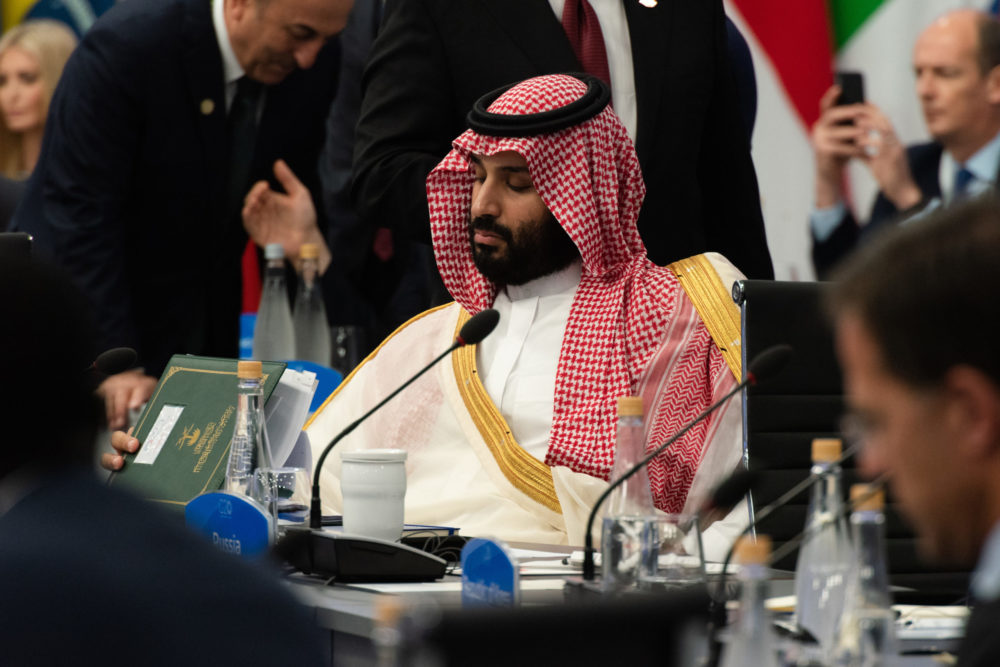
Mohammed bin Salman Editorial credit: Matias Lynch / Shutterstock.com
On 12 May 2021 5Pillars (RMS) announced the creation of a new NGO to deal with human rights in Saudi Arabia. The UK-based Standing Against Nefarious & Arbitrary Detention (SANAD) was aunched in an online conference, which focussed on human rights in Saudi Arabia, especially the freedom to criticise the regime and violations perpetrated against those who have been detained, imprisoned or even disappeared.
Bilal Ithkiran, the SANAD CEO, said the organisation would “seek to identify anyone who has been detained for criticising the regime and those who have been denied due process or have had their rights violated.”
He said SANAD hopes, via peaceful means, to develop an optimistic society that looks to the future in a professional manner.
Dr Sue Conlan, a human rights activist and lawyer, said SANAD aims to establish human rights in Saudi Arabia through media awareness and to collaborate with other similar organisations and bring about legal and civil proceedings where appropriate.
“We aim to build databases on human rights violations in Saudi Arabia and collate evidence and initiate legal proceedings against anyone involved in perpetrating human rights violations in Saudi Arabia,” she said.
Dr Saeed Al Ghamdi, an academic and chair of the trustees, said the organisation has launched “to support the the oppressed and push back the oppressors.” He said that the “human rights situation in Saudi Arabia is passing through a very difficult and painful time.”
He added that “the courts are dictated to by the regime” resulting in “prolonged sentences for a stance, an opinion, a tweet or a word they’ve said.”
Abdullah Al Ghamdi, a board member of SANAD, said the path ahead will be “difficult but it is not impossible.” But Al Ghamdi, whose mother is currently being unlawfully detained, ended on an optimistic note saying: “Victory will belong to those who are patient, resilient and steadfast.”
Finally, Fahad Al Ghuwaydi, who has been detained on three occasions in Saudi Arabia for his activism, said the Saudi government’s abuses can be broken down into four phases.
He said: “As a previous detainee myself, I know too well these four phases. I know all too well how they will follow you. How they will follow an individual before they’re detained. I know too well what happens inside the prisons and I know too well how you are denied your most basic of rights as a detainee. I also know too well the obsession that the detainee suffers after they are released from prison.”
Al Ghuwaydi concluded by demanding “the decreasing of pressure upon the people. We demand the release of the political detainees, who were detained oppressively.”
Amnesty International says repression of the rights to freedom of expression, association and assembly have intensified in Saudi Arabia.
“Among those harassed, arbitrarily detained, prosecuted and/or jailed were government critics, women’s rights activists, human rights defenders, relatives of activists, journalists, members of the Shi’a minority and online critics of government responses to the COVID-19 pandemic,” Amnesty says on its website.
“Virtually all known Saudi Arabian human rights defenders inside the country were detained or imprisoned at the end of the year. Grossly unfair trials continued before the Specialized Criminal Court (SCC) and other courts. Courts resorted extensively to the death penalty and people were executed for a wide range of crimes. Migrant workers were even more vulnerable to abuse and exploitation because of the pandemic, and thousands were arbitrarily detained in dire conditions, leading to an unknown number of deaths.”
On 12 May 2021, Carleton University’s Department of Law and Legal Studies welcomed human rights advocate Rehana Hashmi as the inaugural Activist in Residence (AiR). Hashmi will teach students and provide them with access to her first-hand experience and an international perspective.
“Carleton is one of the first in Canada to start this type of program to help protect human rights defenders. They can come, rest, reflect, recharge and do their work without being silenced.”
Building on the department’s successful participation in the Scholars at Risk initiative, the new AiR program provides a home base for human rights activists within an academic setting, particularly for those at-risk. Students and faculty will have the opportunity to learn from someone with personal, lived experience fighting to protect human rights.
As part of the AiR program, Hashmi is working on a series of video interviews with human rights defenders from around the world. “When they are in exile, there should be mechanisms to protect them,” says Hashmi. “The Activist in Residence program is one way to do this.”
Hashmi also teaches a fourth-year seminar on patriarchy, human rights and informal justice. Students learn how traditional patriarchal attitudes operate towards women and minorities seeking legal justice.
“Students in the course get to learn from many human rights defenders,” says Hashmi. “Through online learning, we have been able to bring in experts from around the world. Recently, mothers from Palestine and Israel presented in a JurisTalk about how they lost their children, but are still doing reconciliation work.
“Activists bring knowledge from the field to help students get a firsthand experience on how advocacy works. This knowledge narrows the gap between the Global North and Global South. Faculty and students benefit from stories from the field, but it also helps activists at-risk.”
After being exiled from her home city for her activist work, Hashmi became even more involved with activism, giving shelter to women who were beaten or had acid thrown on them. Through Sisters Trust Pakistan, Hashmi helped victims of domestic violence and women and girls to break free of religious fundamentalism and forced marriages. This was just one step in her journey to support and protect the vulnerable.
The challenges in Pakistan are more difficult for women like Hashmi who are fighting to defend human rights. Offenders target women’s children and extended families. Women can’t always leave when they are at-risk. They may have many obstacles including limited mobility, family and societal restrictions to consider
On 11 May 2021 Czech Radio announced that the annual One World festival of human rights documentary films got underway on Monday evening under the motto Connection Lost. The festival, which has moved entirely online due to Covid-19 restrictions, started by presenting its annual Homo Homini prize for human rights advocacy.
During the virtual opening ceremony on Monday evening, the People in Need foundation presented this year’s Homo Homini prize to four members of the Belarusian human rights organization Viasna, who have been persecuted for tracking detained protestors, documenting human rights violations and helping victims of police violence.
For the first time in the 25-year history of Homo Homini Award, it was presented to the same organization. People in Need director Šimon Pánek explained the decision to Czech Television: “15 years ago Ales Bialatski, founder of Viasna, received the Homo Homini Award. He saw what was happening at the time and put together a group of people to defend the rights of detainees. In the end, he himself ended up in prison.
“He was presented the award by Václav Havel, who said he hoped Belarus would live to see its 1989, but unfortunately, it hasn’t happened yet.
“For a while it looked as if Belarus has resigned, but the new generation of young people have not accepted the situation and despite the brutality of the regime, they have repeatedly taken to the streets.”
The festival, which runs until May 19, will present over a hundred films in 15 thematic categories, the main one focusing on technology and its impact both on the society and individuals. Some of the screenings will also be accompanied by live discussions as part of the One World Live Programme.



 Hans Thoolen on Human Rights Defenders and their awards
