Movies That Matter is pleased to announce that, contrary to its earlier message, there will be a second round of its grant programme this year. [see https://humanrightsdefenders.blog/2018/02/14/call-for-proposals-to-organize-human-rights-film-festivals-2018-19/] If you organise a film event to stimulate the discussion on human rights, social justice and freedom of expression, submit your project proposal! If you are interested in organising a human rights film event in Africa, Asia, Latin America, Eastern Europe or the Middle East, Movies That Matter offers financial assistance and advice to festival organisers in low-income countries and states where press freedom is limited.
The deadline is 14 October. Please note that projects starting before 1 January 2019 cannot be considered.
2018 is the year of the Human Rights Defenders! The Norwegian Human Rights Fund (NHRF) celebrates its 30th anniversary by showcasing some of the brave human rights defenders it supports through out the year. Iván Madero is a human rights defender from Colombia. Iván Madero Vergel is the director of CREDHOS, an organization that documents violations and accompanies human rights defenders. For him becoming a human rights defender was a natural response to the difficult circumstances in his hometown Barrancabermjea. For more than three decades he has been a leader that stands up for the rights of others. In this video, he tells how it is to work in a country where people who stand up for human rights are risking their lives:
“Migration is not a crime. Defending the rights of migrant people should not be criminalised,” said Azadi (pseudonym) in her interview with ISHR. Today, more than 68 million people around the world are refugees or internally displaced as a result of conflict or persecution. They seek a safer life and better future. “Migrant rights defenders want to show people on the move that another Europe exists: it’s the Europe of the civil society that tries to welcome them. The Europe of solidarity”, Azadi concluded.
The European Centre for Constitutional and Human Rights, ECCHR, uses the emancipatory potential of law in order to unmask unjust power relations and enforce social justice. Its goal is to change or re-create legal norms in the spirit of global justice. As part of its 10-year anniversary it created a new ECCHR department: the Institute for Legal Intervention.The Institute will complement ECCHR’s litigation and will encompass the Education Program, professional exchanges in transnational networks, cooperation with universities and dialogue with artists as well as cultural and social movements. The aim of the Institute is to initiate important legal debates, to foster young human rights lawyers and to deepen collaboration between disciplines.
All this thanks to the generous support of the Bertha Foundation. The Video clip above gives the details.
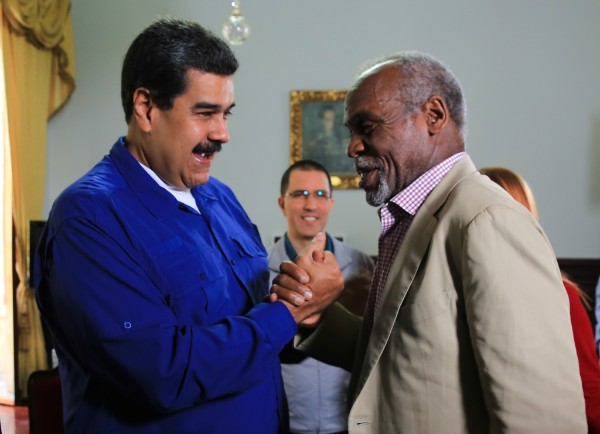
The way celebrities involve themselves in human rights (positively or negatively) has been a topic in this blog several times [see e.g. https://humanrightsdefenders.blog/2014/02/28/and-the-nominees-are-oscars-for-human-rights/ and recently https://humanrightsdefenders.blog/2017/11/10/helen-hunt-joins-list-of-celebrities-that-show-insensitivity-on-human-rights/]. Venezuela has played the game getting star power on its side, but the president of the New York based Human Rights Foundation, Thor Halvorssen, is quite right that when it concerns a UNICEF goodwill ambassador matters become more serious: “…the moment Danny Glover travels to Venezuela using the seal of the United Nations’ highest office that deals with children, then Glover’s statements deserve higher scrutiny,” Thus HRF’s demand that UNICEF should strip Danny Glover from its honorary Ambassadorship.
This Saturday in Caracas, Glover praised Maduro’s government for “advancing humanity through education, health, and other aspects that honor humankind.” Meanwhile, the dictatorship’s economic policies have brought over 30 million Venezuelans into the worst humanitarian crisis in the 200-year history of the country. In 2017, Venezuelans lost 24 pounds in average due to hunger and undernourishment and, according to NGO Caritas, 33% of Venezuela’s 10 million child population has stunted growth.
[HRF adds: “Danny Glover has behaved unspeakably in his support for the Venezuelan regime and his motivation is unbridled greed. Eleven years ago, Glover received close to 20 million dollars from the Venezuelan regime to produce a film that was never made, and the funds have yet to be returned to the Venezuelan people. The payment was a crude payoff, masked as a production budget, in order to ensure that Glover was a permanent public relations agent for the Venezuelan government. In doing so, Glover violated American laws regarding registration as a foreign agent. But most of all, he lost all credibility as a spokesperson for human rights,”]
Having just raised in this blog the question of the power of images [https://humanrightsdefenders.blog/2018/03/20/human-rights-films-call-for-action-or-entertainment/] it was interesting to note that the National Human Rights Commission (NHRC) of India has opened the entries for its fourth annual competition for short films on human rights. ”The aim of the award scheme is to encourage and acknowledge cinematic and creative efforts of the Indian citizens, irrespective of their age, towards the promotion and protection of human rights,’‘ the Commission said in an official statement on Monday.
The award carries a certificate along with prize money of Rs one lakh, Rs 75,000 and Rs 50,000 for the best first,second and third film respectively. Deadline 2 July 2018. The short films may be in any Indian languages with either sub-titles in English or in English language.
Read more at:
published on 24 November 2017 this video interview Sonia Acabal from Guatemala about the situation in her country, the women’s network Rednovi and what it means to be a women’s rights defender.
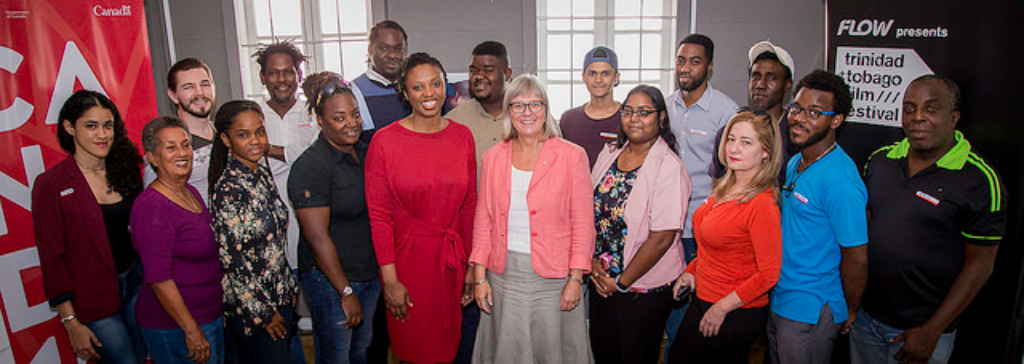
The trinidad+tobago film festival (ttff) and Canadian High Commission are teaming up to encourage the making of local short films on human rights issues, as part of a filmmakers development programme that began in 2017, reports Loop on 27 February 2018.
The ‘Human Rights on Film’ training programme encourages 14 filmmakers and writers who participated in a scriptwriting workshop with Canadian-Jamaican film professional, Annmarie Morais, last year, to put their training into practice. A panel of three judges, including a representative from The National Film Board of Canada and from the Canadian High Commission in Trinidad, will select the best three scripts. Trinidadian-born, National Film Board of Canada producer, Selwyn Jacobs, will then conduct a two-day workshop on how to move from the scriptwriting phase to production and post-production. The completed films will screen at ttff/18.
According to Annabelle Alcazar, Programme Director of the ttff: “This programme marries our interest in developing the skills of local filmmakers and writers, with advancing the conversations on human rights in Trinidad and Tobago. We are excited about this project and look forward to seeing how filmmakers rise to the challenge of using their artistic knowledge and skill to bring these important issues alive.”

 Hans Thoolen on Human Rights Defenders and their awards