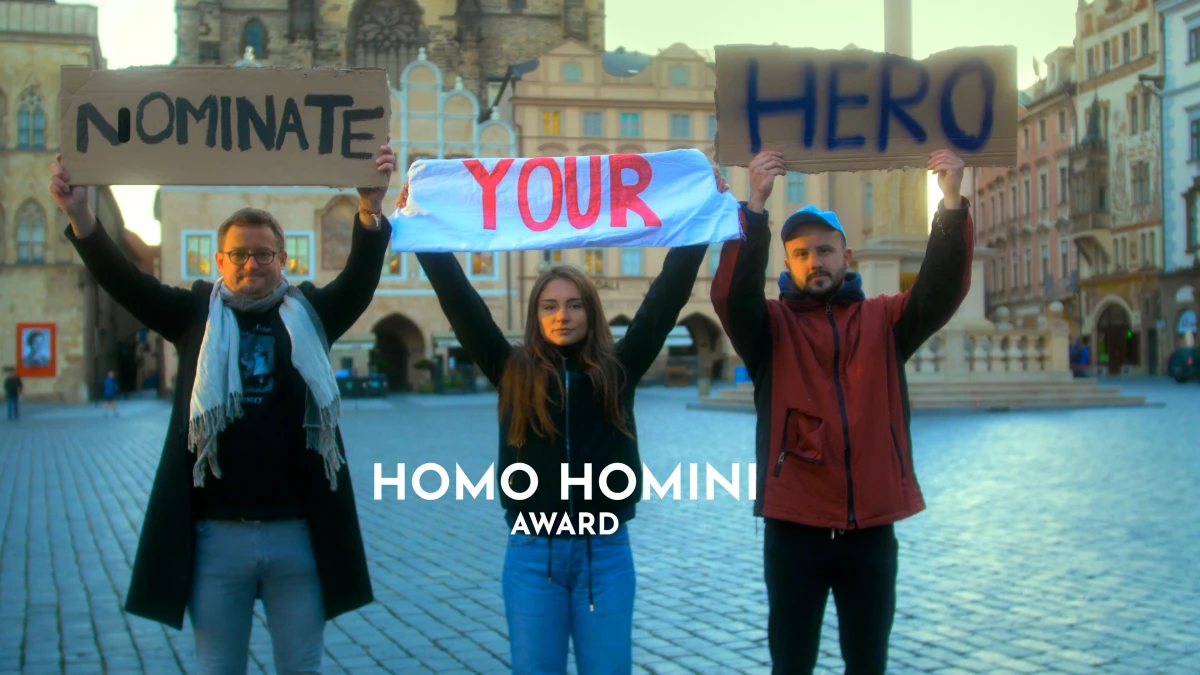
Since 2021, nominations are open to the public. As a result, not only organisations, but also individuals from all over the world may “nominate their heroes”. The deadline for nominations is 30 November, 2024.
The list of laureates includes famous names as well as relatively unknown individuals. Last year’s laureate is Abzaz Media, one of the last free media outlets in Azerbaijan.
Thirty two years ago, I and some other good friends of Martin Ennals decided to create an award in the name of this human rights pioneer [see: https://youtu.be/tAhUi2gOHmU?si=6RxI5TduzLfLeJym]. I am very proud and happy that in two weeks time I wil be in Geneva to participate in the 30th edition of the award ceremony. I very much hope that many others wil be able to join, in person or via the live-stream.
The Award was given out for the first time in 1994 to recognize, promote and protect human rights defenders at risk or from under-reported contexts. It culminates every year in a public ceremony in Geneva, co-hosted with the City of Geneva. Over the years, the Award has offered defenders a platform to issues that are of global concern and the connections to steer the movement for human rights and larger freedoms.
The Jury has recognized 53 defenders in the past 30 years, from 37 countries and from all walks of life: lawyers, journalists, academics, medical practitioners, religious practitioners, housewives, students and grassroots activists. Their voices have illustrated some of the most important human rights demands of the past decades: free and fair justice for violations committed by security forces; access to information and freedom of expression to denounce repressive practices and authorities; the fight against gender discrimination and the importance of women’s full and equal participation in society; the essential role of civil society in conflict and post conflict resolution; the role of businesses in exploiting natural resources against the rights to land of indigenous people; or the role of global powers in the violations of the right to life of migrants.
The 2024 Martin Ennals Award continues the legacy and will honour two outstanding human rights defenders who have made it their life mission to protect human rights in their communities and countries despite evolving in deeply repressive environments.
A public discussion with Jury members later in the evening of ceremony will also be the opportunity to showcase the issues that will shape the future of the Award.
Get to know the 2024 Laureates by joining our traditional Award ceremony on Thursday 21 November at 18:30 CET, in Salle communale de Plainpalais, Rue de Carouge 52, Geneva.
The ceremony, co-hosted together with the City of Geneva, is the opportunity to learn about the two 2024 Laureates: who they are, their aspirations and what they have been doing to bring human rights at the forefront. Their inspiring stories illustrate key human rights struggles that the world needs to hear, for peace, dignity and equality of all. The Award ceremony will be followed by a cocktail offered by the City of Geneva.
You cannot join in person? We got you! The ceremony and the debate will be livestreamed on our media platforms.
JURY INSIGHTS
A public discussion on current global issues
Festivities will continue on Thursday 21 November with a late-night discussion to celebrate the 30th anniversary of the Martin Ennals Award. Since 1994, it is the careful deliberations of the Jury that have led to the recognition of some of the most outstanding human rights defenders and organisations. The Foundation is pleased to offer a special opportunity to listen in the inner thoughts of leading organisations on the state of human rights in the world and how to reclaim them.
The one-hour discussion will start at 21:15 CET in Salle communale de Plainpalais, after the cocktail, and will be the occasion for a young human rights defender to ask everyone’s most burning questions!
Democratic leader María Corina Machado and exiled presidential candidate Edmundo González won the top human rights award for representing all Venezuelans who are “fighting for the restoration of freedom and democracy.” | Marcelo Perez del Carpio/Getty Images
The European Parliament on Thursday 24 October 2024 awarded the Sakharov Prize to Venezuela’s opposition leaders. Democratic leader María Corina Machado and exiled presidential candidate Edmundo González won the top human rights award for representing all Venezuelans who are “fighting for the restoration of freedom and democracy.”
The Venezuelan opposition leaders were nominated by the center-right European People’s Party (EPP) and the hard-right European Conservatives and Reformists (ECR). The far-right Patriots group rallied behind them after their original candidate, tech billionaire Elon Musk, failed to make the shortlist for the prestigious prize.
After Venezuela’s elections in late July, in which incumbent socialist President Nicolás Maduro declared victory for another term, the European Union’s foreign service said it would not recognize the results because the government had failed to release supporting voting records from polling stations.
The authoritarian Maduro’s disputed declaration of victory sparked massive opposition protests and a violent government crackdown that left more than two dozen people dead and nearly 200 injured.
Later, presidential candidate González — who fled to Madrid during the crackdown — was recognized by the European Parliament as the country’s legitimate leader.
Two other finalists made the shortlist. One was Gubad Ibadoghlu, a jailed Azerbaijani dissident and critic of the fossil fuel industry nominated by the Greens. The other finalist was a joint nomination of Israeli and Palestinian peace organizations Women Wage Peace and Women of the Sun. The groups, who announced a partnership in 2022, were nominated by the Socialists and the Renew group.
A Brazilian nun who has helped refugees and migrants for 40 years on Wednesday won the Nansen prize awarded every year by the U.N. High Commission for Refugees for outstanding work to protect internally displaced and stateless people.
Sister Rosita Milesi, 79, is a member of the Catholic order of the Scalabrini nuns, who are renowned for their service to refugees worldwide. Her parents were poor farmers from an Italian background in southern Brazil, and she became a nun at 19.
As a lawyer, social worker and activist, Milesi championed the rights and dignity of refugees and migrants of different nationalities in Brazil for four decades.
She is the second Brazilian to receive the award. Former Sao Paulo Archbishop Dom Paulo Evaristo Arns won the prize in 1985.
Milesi leads the Migration and Human Rights Institute (IMDH) in Brasilia, through which she has helped thousands of forced migrants and displaced people access essential services such as shelter, healthcare, education and legal assistance.
She coordinates RedeMIR, a national network of 60 organizations that operates throughout Brazil, including in remote border regions, to support refugees and migrants.
Japanese atomic bomb survivor movement Nihon Hidankyo won the Nobel Peace Prize 2024 in recognition of the organization’s efforts to achieve a world free of nuclear weapons.
The awards committee said that the grassroots movement had “worked tirelessly” to raise awareness about the catastrophic humanitarian consequences of using nuclear weapons.
A presentation of the Nobel Prizes will take place in Oslo, Norway on Dec. 10, a date which marks the anniversary of the death of Swedish inventor and philanthropist Alfred Nobel.
The Norwegian Nobel Committee said the grassroots movement, which was established in 1956 in response to the atomic bomb attacks of August 1945, had “worked tirelessly” to raise awareness about the catastrophic humanitarian consequences of using nuclear weapons.
“Gradually, a powerful international norm developed, stigmatising the use of nuclear weapons as morally unacceptable. This norm has become known as ‘the nuclear taboo’. The testimony of the Hibakusha – the survivors of Hiroshima and Nagasaki – is unique in this larger context,” it added.
Congratulations are in order for Nihon Hidankyo, the Japan Confederation of A- and H-Bomb Sufferers Organizations. The Nobel Peace Prize has for the first time in at least six years gone to a group of people who work to reduce warmaking, people who in fact seek to abolish nuclear weapons. Nihon Hidankyo has relentlessly done the work of educating the world, thanklessly, for many years. This prize should be celebrated far and wide.
In recent years, nuclear weapons have been the one strong point for the Nobel Committee, the one area of overlap between what they have treated as the purpose of the prize and the actual original purpose of the prize. In 2017, the prize was awarded to the International Campaign to Abolish Nuclear Weapons.
This year’s award is being given to Nihon Hidankyo “for its efforts to achieve a world free of nuclear weapons and for demonstrating through witness testimony that nuclear weapons must never be used again.”
2024 Right Livelihood Laureates face off against the marginalisation of Indigenous Peoples, Israel’s illegal settlements, dangerous development projects in Mozambique and human rights violations committed with impunity to demand a just future for all.
THE 2024 LAUREATES:
Joan Carling “For raising Indigenous voices in the face of the global ecological breakdown and her leadership in defending people, lands and culture.” Joan Carling is a Filipino Indigenous activist who has been defending the rights of Indigenous Peoples for more than 30 years. Her work spans grassroots and international levels, focusing on human rights, sustainable development, climate justice and the fight against land exploitation. [https://humanrightsdefenders.blog/2016/11/02/joan-carling-indigenous-land-rights-defender-from-the-philippines/]
Issa Amro / Youth Against Settlements “For their steadfast non-violent resistance to Israel’s illegal occupation, promoting Palestinian civic action through peaceful means.” Issa Amro is a Palestinian human rights activist who has dedicated his life to peaceful resistance against Israeli occupation in the West Bank city of Hebron. Together with the activist group he founded, Youth Against Settlements, he strives to create a future where Palestinians live freely and with dignity. [https://humanrightsdefenders.blog/tag/issa-amro/]
Anabela Lemos / Justiça Ambiental! “For empowering communities to stand up for their right to say no to exploitative mega-projects and demand environmental justice.” Anabela Lemos is a Mozambican environmental activist and Director of Justiça Ambiental! (JA!), an organisation committed to fighting corporate-led projects that displace communities, damage livelihoods and intensify climate change in Mozambique.
Forensic Architecture “For pioneering digital forensic methods to ensure justice and accountability for victims and survivors of human and environmental rights violations.” Forensic Architecture is a pioneering research agency dedicated to uncovering and documenting the truth about environmental and human rights violations using cutting-edge open-source investigation and digital modelling techniques.
“Amid the chaos of violence, greed and injustice that is affecting so many people around the world, the 2024 Right Livelihood Laureates reignite hope,” said Ole von Uexkull, Right Livelihood’s Executive Director.
Ms Machado is a co-founder and former leader of Venezuelan vote-monitoring and citizens’ rights group Súmate, a former member of Venezuela’s National Assembly and currently the National Co-ordinator of the Vente Venezuela political movement. Barred from running in Venezuela’s recent Presidential election, she went into hiding in August 2024, declaring that she feared for her life, her freedom, and that of her fellow citizens.
Opening the award ceremony, PACE President Theodoros Rousopoulos pointed out that today, 6 of the 11 previous winners of the Havel Prize are in prison, and urged their immediate release. “These individuals committed only one ‘crime’ – they simply wanted to make their voices heard, to share their vision of a just and free society.”
Making the award to Ms Corina Machado’s daughter Ana, the President underlined that the Council of Europe “stands alongside those who risk their lives to make our societies more democratic and just”.
Ms Corina Machado herself, addressing the Assembly remotely from Venezuela, said she was “deeply moved, honoured and grateful” to be the first Latin American to win the distinction. “I want to dedicate this recognition to the millions of Venezuelans who, every day, embody Havel’s values and ideas – some without even realising it.” Her movement had demonstrated “the victory of democrats over dictatorship” in Venezuela’s recent elections, she said, declaring: “Today our struggle continues, because the truth persists until it prevails.”
The two other shortlisted nominees were Azerbaijani human rights defender and activist Akif Gurbanov, who is currently in pre-trial detention in Baku, and Georgian feminist activist and human rights lawyer Babutsa Pataraia, who was present at the ceremony.
As part of the ceremony, the Assembly was also addressed by Russian opposition leader Vladimir Kara-Murza, who was being held in detention in Russia when he was awarded the Havel Prize in 2022. He was released in August of this year as part of a prisoner exchange.
36-year-old Luis Manuel Otero Alcántara is a Afro-Cuban self-taught artist. He comes from a poor and marginalized neighbourhood in Havana and uses sculptural and performance art to protest violations against freedom of expression. He has been arrested multiple times for his art and activism and is currently in prison.
Otero Alcántara is the general coordinator of the San Isidro Movement – a constellation of artists, journalists and academics promoting freedom of expression. It was established in 2018 as a reaction to Decree 349. The decree requires artists to obtain advance permission for public and private exhibitions and performances. Decree 349 is one of the legal instruments used to silence artists, musicians and performers who are critical to the Cuban government.
Otero Alcántara’s artivism has come at a high personal cost. Since 2016 he has been the subject of interrogations, political persecution and arrests, and his art has been confiscated and destroyed by state security officers.
Luis Manuel Otero Alcántara creates sculptures, drawings, and performative art. He is currently serving a five-year sentence in the high-security prison Guanajay outside of Havana.
Expressing oneself through art: A basic human right
Despite this, he continued his artivism through performance pieces to raise awareness of Cuba’s ongoing repression of independent artists and activists. Otero Alcántara was detained on July 11, 2021, after posting a video online of his planned participation in the protests. In 2022, he was convicted for “contempt, public disorder and insults to national symbols”. He is currently serving a five-year sentence in Guanajay maximum security prison outside Havana.
The Rafto prize 2024 aims to highlight the importance of the work of Luis Manuel Otero Alcántara and the basic human right to expressing oneself through art. We call upon the Cuban government to stop the persecution of artists and human rights defenders. We also urge them to free Otero Alcántara and all political prisoners in Cuba.
The selection panel of the Václav Havel Human Rights Prize, which rewards outstanding civil society action in defence of human rights in Europe and beyond, has announced the shortlist for the 2024 Award.
Meeting in Prague, the panel – made up of independent figures from the world of human rights and chaired by the President of the Parliamentary Assembly of the Council of Europe (PACE) Theodoros Rousopoulos – decided to shortlist the following three nominees, in alphabetical order:
Akif Gurbanov, Azerbaijan
The nominee is a human rights defender, political activist and active member of the Azerbaijani civil society. He is the co-founder of the Institute of Democratic Initiative (IDI) and of the Third Republic Platform. He was arrested in March 2024 in a wave of arrests targeting journalists and activists in the country.
María Corina Machado, Venezuela
The nominee is a leading political figure in Venezuela engaged in denouncing human rights abuses in her country and defending democracy and the rule of law. She is the co-founder of the Venezuelan volunteer civil organisation ‘Súmate’ for civil and political freedom, rights and citizen participation.
Babutsa Pataraia, Georgia
The nominee is a leading feminist activist and human rights lawyer in Georgia. She is the Director of ‘Sapari’, an NGO focusing on women’s rights and providing support for victims of violence since 2013. She has worked for over a decade to fight against feminicide, sexual violence against women, and sexual harassment.
Human Rights First announced a call for nominations for the 2024 Roger N. Baldwin Medal of Liberty Award. Nominations are due by September 23, 2024.
“Honoring those who champion human rights despite immense personal risk is at the heart of what we do,” said Human Rights First President and CEO Sue Hendrickson. “This award stands as a testament to the power of individuals to make a difference, even in the face of adversity.”