Author Archive

Santiago Canton leaves RFK to become Secretary for Human Rights in Buenos Aires

January 16, 2016

Santiago Canton will be leaving his post as Executive Director of RFK Partners for Human Rights at the end of this week as he has accepted the position of Secretary for Human Rights for Buenos Aires in Argentina. He started in 2012.Santiago Canton

[Santiago Canton is also an Adjunct Professor at American University’s Washington College of Law, the Georgetown University Law Center, and the Universidad de Buenos Aires. In 2013, Mr. Canton served as a member of the World Bank Panel of Experts on Human Rights, part of a process that reviewed the bank’s environmental and social safeguard policies. From 2001 to 2012, Mr. Canton was the Executive Secretary of the Inter-American Commission on Human Rights. In 1998, he was elected as the first Special Rapporteur for Freedom of Expression in the Inter-American System. From 1994 to 1998, Mr. Canton was Director for Latin America and the Caribbean for the National Democratic Institute for International Affairs. Mr. Canton was a political assistant to President Carter in democratic development programs in countries in Latin America. In 2005, Mr. Canton was awarded the Chapultepec Grand Prize for freedom of expression throughout the Americas.]

Human rights laureates call for end to torture and disappearances in Asia

January 15, 2016

The Asian Human Rights Commission (AHRC) in a press release of 18 December gave a short report of a meeting held on 12-14 December 2015, where 8 laureates of the Gwangju Prize for Human Rights, and human rights defenders from the Asian region participated in an international workshop on“Torture, Violence, and Enforced Disappearances in Asia” organized by Imparsial, IKOHI, and the May 18 Memorial Foundation, (Gwangju, South Korea). The speakers and the victims discussed the realities of human rights issues including torture and enforced disappearances and the implications for the justice institutions to address the problems: Read the rest of this entry »

Evaluations should allow also to find unexpected impacts of human rights work

January 15, 2016

Evaluations of human rights work should not just be results assessment, but instead, like (in line with Emma Naughton and Kevin Kelpin) as a learning process to discover un expected impacts. Muriel Asseraf in an article in Open Democracy on 22 October 2015, “Finding the unexpected impacts of human rights work“, argues just that in the context of Conectas in Brazil:

Only by understanding if advocacy strategies have been effective and why (or why not), can we understand whether it would make sense to replicate it. Last year, for the first time, Conectas and partner organizations from the Criminal Justice Network launched a large media campaign against the practice of invasive strip-searches for family members who visit their relatives in prison. The impact of the campaign was two-fold: in the state of Sao Paulo, where the campaign was launched, a law was passed to ban the practice, which in and of itself was a great victory. In addition, while not endorsing “human rights” directly, a new audience started to empathize with the situation of these women—grandmothers, mothers or daughters—who have to go through these humiliating treatments in order to visit their relatives in prison. By appealing to people’s understanding of the barbaric situation that prisoners’ relatives have to go through, as opposed to prisoners themselves, the campaign gathered unprecedented support. This impact was unexpected, and learning to identify it has helped us think about other human rights campaigns that could rally an even larger audience to our causes.

In fact, the unexpected lessons that we learn from our evaluation processes happen often. They are frequently surprising and always relevant, and they have informed our strategies and planning processes in ways both profound and constructive.

For example, another evaluation process helped us understand that Conectas’ use of international mechanisms was largely reinforced by how the international press covered the case. Resolutions and recommendations do impact official interlocutors, but if recommendations are somehow featured in international dailies, the reaction of government officials can be much more rapid….

Over time, we have raised our team’s awareness of the need to evaluate their work. Conectas now carries out rigorous planning processes: based on our five-year strategic plan, and our three-year tactical plan, our programs and areas develop annual operational plans that are reviewed twice a year during formal evaluations. The teams themselves conduct these evaluations because, as Naughton and Kelpin have also noted, they are the best suited to understand the subtleties and complexities of a particular situation, and to identify changes or unplanned impacts that others might not see.

During these evaluations, we try to consider not only the quality of the implementation of any given action—although that is also a critical part of the process—but more importantly the feedback of important stakeholders. Participants in our bi-annual Colloquium are asked to answer an opinion survey at the end of the event, as well as six months later in order to measure the impact of the event on their lives and work. Readers and contributors to the Sur Journal are also regularly questioned about how relevant and useful they find the articles for their work.

These survey results have at times been surprising, such as the finding that despite our many efforts to disseminate the print edition of the Sur Journal, the online version has a much larger following. As a result, we decided to transform it into a primarily online journal. The Colloquium surveys have also revealed important elements about the program and format of the meeting….

…. by remaining open to unexpected results, we hope to always evolve and adapt to what is around us. And we can only hope that each organization will do the same, in order to build a more complete view of the field and create more effective interventions.

Full article at: Finding the unexpected impacts of human rights work | openDemocracy

Assaults on Human Rights Defenders on the rise in Vietnam

January 14, 2016

The second half of 2015 saw an alarming rise in the number of violent attacks and threats against human rights defenders, petitioners, and their family members in Vietnam. The Stockholm-based NGO, Civil Rights Defenders published an overview:

Skärmavbild 2015-12-16 kl. 09.32.35

Between June and mid December 2015, at least 22 incidents of violent attacks were reported through out the country, affecting at least 42 persons (see timeline below). This is an increase from the January-May period, during which at least 14 attacks affecting 27 persons were recorded. Many of these attacks were perpetrated with impunity in broad daylight by police or plainclothes agents. In some cases, defenders’ family members or their private residence was targeted.

These blatant violations of the right to personal security are leaving behind a blood trail that is shockingly inimical to Vietnam’s status as a member of the UN Human Rights Council and a state party to numerous human rights treaties,” said Marie Månson, Human Rights Defenders at Risk Programme Director at Civil Rights Defenders. Vietnam abstained from a UN General Assembly draft resolution on the recognition and protection of human rights defenders.

There has been an increase of violent attacks against human rights defenders in Vietnam in the second half of 2015.

At least 28 defenders and petitioners are known to have been arbitrarily detained and questioned by police in the same period, including blogger Nguyen Ngoc Nhu Quynh, the recipient of the 2015 Civil Rights Defender of the Year Award. [see: https://thoolen.wordpress.com/2015/04/20/vietnamese-blogger-mother-mushroom-gets-civil-rights-defender-of-the-year-award-2015/

When its human rights record was reviewed in 2014 under the Universal Periodic Review (UPR), Vietnam agreed to implement numerous human rights recommendations, including to ensure a “favourable”, “friendly” and “safe and enabling” environment for human rights defenders and civil society actors. In a statement marking International Human Rights Day last week, deputy minister of foreign affairs Ha Kim Ngoc said that Vietnam “steadfastly pursues the policy of ensuring full enforcement of basic rights and freedom for each citizen.”

In addition to violent attacks, scores of human rights defenders and government critics remain in prison after being convicted in unfair trials under broad and vague provisions of the Penal Code. Several activists and bloggers are in detention awaiting trial, including blogger Nguyen Huu Vinh (aka Anh BaSam) and his assistant Nguyen Thi Minh Thuy, former prisoner of conscience Tran Anh Kim, and blogger Nguyen Dinh Ngoc (aka Nguyen Ngoc Gia).

Seriously flawed provisions often abused to prosecute activists remain intact in the recently revised Penal Code, adopted in late November and effective from 01st July 2016. The National Assembly is considering a draft law on associations that contains highly restrictive provisions and intrusive requirements inconsistent with the right to freedom of association.

Click here to download a timeline of harassments and attacks against human rights defenders in Vietnam.

In a statement released on 6 January, Civil Rights Defenders joins 25 human rights society groups in calling on the Vietnamese authorities to immediately release and drop charges against human rights defenders Mr Nguyễn Vãn Ðài and Ms Lê Thu Hà, who have been in police custody in Hanoi after their arrest three weeks ago. The police have charged Ðài, a former prisoner of conscience, and his colleague Hà with “anti-state propaganda” under Article 88 of the Penal Code, which carries a prison sentence of between three and 20 years.

The signatories have also highlighted concerns that the two defenders may be at risk of torture and other ill treatment in detention. Ðài was still recovering from injuries he sustained ten days before his arrest when he and three other activists were viciously attacked by stick-wielding, masked assailants in Nghe An province. The police have reportedly denied Ðài access to his lawyer and family members. Ðài and Hà’s arrests came a month before the 12th National Congress of the ruling Communist Party of Vietnam (CPV). Past party congresses were usually preceded by an escalation of crackdown on human rights advocates and dissidents.

Brave human rights defenders like Ðài and Hà do not belong behind bars and must be allowed to freely conduct their legitimate work defending and educating others about the rights guaranteed by the Vietnamese Constitution and by international law,” says Robert Hårdh, Executive Director of Civil Rights Defenders.

Source: Civil Rights Defenders – Assaults on Human Rights Defenders on the Rise in Vietnam

http://www.civilrightsdefenders.org/news/vietnam-must-end-arbitrary-detention-of-human-rights-defenders/

Saudi Arabia: Arrest and release of human rights defender Samar Badawi

January 13, 2016


US First Lady Michelle Obama (left) and Secretary of State Hillary Clinton (right) pose with Samar Badawi (centre) as she receives the 2012 International Women of Courage Award

Having just posted a lot about China, I would be amiss not to report the action by another serial offender, Saoudi Arabia:  Samar Badawi, an internationally known human rights defender was arrested by Saudi Arabia police on Tuesday, 12 January 2016, according to a report by Amnesty International. Later on she was transferred to Dhaban prison. And just now (13 January) Human Rights Watch reports that after questioning she has been released from Saudi custody.[http://www.middleeasteye.net/news/sister-jailed-saudi-blogger-raif-badawi-released-rights-group-1434471164#sthash.ThiFt7xz.dpuf]

In 2012, she was given an International Women of Courage Award. In December 2014, a Saudi Arabian judge imposed a travel ban on Samar. “Samar Badawi’s arrest today is yet another alarming setback for human rights in Saudi Arabia and demonstrates the extreme lengths to which the authorities are prepared to go in their relentless campaign to harass and intimidate human rights defenders into silent submission,” said Philip Luther, AI’S Director of the Middle East and North Africa Programme. “Just weeks after Saudi Arabia shocked the world by executing 47 people in a single day, including the Shi’a Muslim cleric Sheikh Nimr al-Nimr, it has once again demonstrated its utter disregard for human rights. Samar Badawi has been arrested purely for peacefully exercising her right to freedom of expression, she must be immediately and unconditionally released.”

According to AFP, Raif Badawi’s wife, Ensaf Haidar, who lives in Canada as a refugee said in her Twitter account that her sister-in-law was arrested on the charge of directing a Twitter account named “the Monitor of Human Rights in Saudi Arabia @WaleedAbulkhair.

Samar is the sister of Raif Badawi, a well-known blogger who was awarded the EU’s Sakharov Prize for Freedom of Thought (https://thoolen.wordpress.com/2015/10/29/saudi-blogger-raif-badawi-awarded-europes-sakharov-prize/). Moreover, Waleed Abulkhair, who is Samar’s ex-husband, is also serving a 15-year jail sentence.
 

The plight of human rights defenders in China: just two weeks into the new year

January 13, 2016

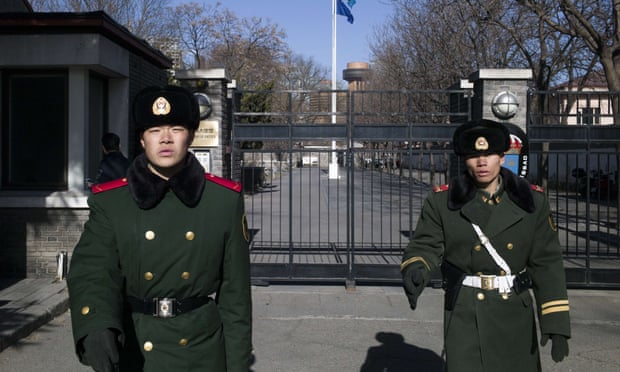
Perhaps one should be ‘grateful’ that China on 3 January 2016 decided to detain the Swedish human rights campaigner Peter Dahlin (first foreigner to be detained for ‘endangering state security’) as this helped international media the take note of the extraordinary crackdown by Chinese president Xi Jinping who is now widely considered to be China’s most authoritarian leader in decades. Here a short overview of the most notable cases in the first two weeks of 2016:

Paramilitary guards stand in front of the gates of Sweden’s embassy in Beijing on Wednesday
 Paramilitary guards stand in front of the gates of Sweden’s embassy in Beijing on Wednesday. Photograph: Fred Dufour/AFP/Getty Images

Read the rest of this entry »

5 Myths About the UN Human Rights Council (for US audience)

January 13, 2016

Read the rest of this entry »

Why did so many assume B’Tselem fire was arson?

January 13, 2016

Further to my post about the pressure under which human rights defenders in Israel have to work [https://thoolen.wordpress.com/2016/01/05/michael-sfardjan-israels-human…] this post by Chelsey Berlin (B’Tselem USA) “The blaze at B’Tselem’s Jerusalem office was an accident, but many of us assumed it was arson”  is telling:

In “Why Did We Assume B’Tselem Fire Was Arson?” she explains the context:  …..”For months, the message that human rights defenders are the problem in Israel has been repeatedly delivered with sledgehammer strength: In Tirtzu’s video labeling four human rights activists, including B’Tselem Executive Director Hagai El-Ad, “moles”; the government’s ongoing legislative crusade against organizations receiving foreign government funding, and last Thursday’s sensationalized report on an Israeli TV news program that aired false accusations against a B’Tselem field researcher. All this is done to hide the dire situation they expose, the real evil, which is the occupation, the human rights violations it produces in the occupied Palestinian territories and the fascism increasingly required of Israel to maintain it.“….

(When news broke on 10 January 2015 of a fire at B’Tselem’s Jerusalem office most feared the worst: arson. Since then, the smoke has cleared — literally — and a preliminary investigation has been concluded. The Jerusalem fire brigade has announced that the cause of the fire was likely an electrical fault.)

Source: Why Did We Assume B’Tselem Fire Was Arson? – Opinion – Forward.com

Profile of Sharon Hom, human rights defender working on China

January 12, 2016

The ISHR on 3 December 2015 carried a profile on Sharon Hom, human rights defender working on human rights in China.

Read the rest of this entry »

Thailand’s Supreme Court confirms sentence against human rights defender Chiranuch Premchaiporn

January 11, 2016


Frontline NEWlogo-2 full version - cropped

reports that on 23 December 2015, the Supreme Court confirmed the 2012 sentencing of human rights defender Ms Chiranuch Premchaiporn to eight months’ imprisonment, suspended for one year, and a fine of 20,000 baht, for failing to delete allegedly offensive comments about the Thai monarchy, which had been posted on the now-defunct Prachatai web forum.

Chiranuch Premchaiporn [https://frontlinedefenders.org/ChiranuchPremchaiporn] is executive director of Prachatai, an independent news website that reports on human rights, social and political issues in Thailand and Southeast Asia. She was the webmaster of the now defunct Prachatai web board which was set up to promote the exchange of information and opinion on Thai political and social issues. Chiranuch Premchaiporn was the recipient of the International Women’s Media Foundation Courage in Journalism Award in May 2011 and the Human Rights Watch Hellman/Hammet Award in September 2011.

The Supreme Court ruling confirmed the verdicts of the Court of Appeals and the Court of First Instance, which were made against the human rights defender in November 2013 and May 2012 respectively. Chiranuch Premchaiporn was convicted under Article 15 of the 2007 Computer Crime Act (CCA) for allowing the alleged offensive comments to remain on the Prachatai web forum for 20 days. Article 15 of the CCA states that any service provider intentionally supporting or consenting to the importation of illegal computer content, as provided for in Article 14 of the CCA, shall be subjected to the same penalty as that imposed upon a person committing an offence under Article 14.

Front Line Defenders expresses concern at the decision of the Supreme Court to confirm the sentence against Chiranuch Premchaiporn, and thus to continue the use of the Computer Crime Act to silence and intimidate human rights defenders in Thailand. Front Line Defenders fears for the potential chilling effect of the decision on the exercise of freedom of expression in Thailand, and the restrictive effect of this on the work of human rights defenders.