The document “The Situation of Human Rights Defenders – Item 3: Amnesty International’s Written Statement to the 34th Session of the UN Human Rights Council (27 February- 24 March 2017)” could of course be obtained directly from AI. However, I do it via: http://www.refworld.org/docid/58a195034.html, in order to highlight this very useful service provided by the documentation service of the UN High Commissioner for Refugees (UNHCR) which regularly gives links to documentation concerning countries of origin of refugees. The entry will look like this:
Title
The Situation of Human Rights Defenders – Item 3: Amnesty International’s Written Statement to the 34th Session of the UN Human Rights Council (27 February- 24 March 2017)
Amnesty International, The Situation of Human Rights Defenders – Item 3: Amnesty International’s Written Statement to the 34th Session of the UN Human Rights Council (27 February- 24 March 2017), 13 February 2017, available at: http://www.refworld.org/docid/58a195034.html %5Baccessed 13 February 2017]
Disclaimer
In their submission AI states in part:
In 1998 the international community adopted, by consensus, the Declaration on the Right and Responsibility of Individuals, Groups and Organs of Society to Promote and Protect Universally Recognized Human Rights and Fundamental Freedoms thereby recognising the importance that civil society actors play in the defence of the values that underpin human rights. The Declaration stresses that we all have a role to fulfil as human rights defenders and urges States particularly to protect human rights defenders from harm as a consequence of their work.
However, almost two decades after that historical moment human rights defenders continue to be harassed, tortured, jailed and killed for speaking out against injustice. During the protests against the Dakota Access Pipeline in the USA last year, the security forces used excessive and unnecessary force when arresting members of the Standing Rock Sioux Tribe and other Indigenous communities who oppose its construction.
Over 3,500 human rights defenders have been killed since the Declaration was adopted in 1998 and according to recent figures released by Frontline Defenders, the number of killings in 2016 marked an increase in the number reported in the previous year.
These killings usually occur after threats and warnings. Berta Cáceres, the leading indigenous, environmental and women’s rights defender from Honduras was killed in March 2016 despite enjoying a high national and international profile. In the aftermath of her killing, Honduras was under increased pressure to protect its human rights defenders, nonetheless, in October 2016, José Ángel Flores and Silmer Dionisio George of the Unified Movement of the Aguán were murdered, and currently international organization Global Witness, along with Honduran organizations MILPAH, COPINH and CEHPRODEC are facing a smear campaign against them for their work defending land, territory and environmental rights.
Amnesty International also continues to receive reports of human rights defenders being subjected to unfounded criminal proceedings, arbitrary detention and judicial harassment, which prevents them from speaking up against injustice, delegitimizes their causes and creates a chilling effect on activities that promote human rights. Human rights defender Narges Mohammadi is serving 22 years’ imprisonment after being convicted of national security related charges in Iran. Her conviction stems from her peaceful human rights activities, including her work to end the death penalty and her 2014 meeting with the former European Union (EU) High Representative for Foreign Affairs and Security Policy.
In Egypt civil society has been subjected to an unprecedented crackdown. In 2016, the authorities intensified a criminal inquiry into NGOs’ registration and foreign funding that could lead to criminal prosecution and sentences reaching up to life imprisonment. The authorities have also subjected NGO personnel to interrogation, freezing of personal and organizational assets, preventing leading human rights defenders from foreign travel, arbitrary arrest and detention.
Amnesty International notes with concern that the organisations, networks and methods people rely on to stand up for their communities are also attacked. Unions are threatened. Lawyers and activists in China have been ill- treated and sometimes tortured in detention. In Pakistan, human rights defenders are labeled as ‘foreign-agents’. In Viet Nam, attacks against human rights defenders are common, and include beatings and daily harassment and surveillance.
In other parts of the world, newspapers are closed down. Social media are banned and digital conversations monitored. Taking to the streets to protest is impossible.
In Turkey, against the backdrop of the failed military coup in 2016, unfair criminal prosecutions under criminal defamation and counter-terrorism laws targeted political activists, journalists and other critics of public officials or government policy. Over 180 media outlets have been arbitrarily shut down and 80 journalists remain in pre-trial detention.
States also repeatedly interfere with human rights defenders’ ability to communicate safely and expose human rights violations to regional and international human rights mechanisms, including this Council and its mechanisms. Recently the Special Rapporteur on the situation on the situation of human rights defenders noted, with great concern, the number of human rights defenders that received social media threats simply for meeting with him on his visit to Mexico at the beginning of this year.
In Burundi in January 2017, the Bujumbura Court of Appeal ruled to disbar three lawyers and suspend another. Each had contributed to a civil society report to the UN Committee against Torture prior to its review of the country in July 2016. The permanent closure of five human rights organizations and the suspension of five others was ordered in October 2016 on the allegation that they tarnished the image of the country. One of the suspended organizations was later banned following publication of a controversial report.
……..Amnesty International urges the Human Rights Council to:
Renew the mandate of the Special Rapporteur on the situation of human rights defenders and cooperate fully with it, including by encouraging swift and comprehensive responses to communications from the Special Rapporteur and acceptance of requests for country visits.
Reaffirm that protecting human rights is necessary for individuals to live in dignity, and that deepening respect for these fundamental freedoms lays the foundation for stable, safe and just societies;
Recognize the legitimacy of human rights defenders and applaud the role they play in the advancement of human rights, and urge States to facilitate and publicly support their work;
Urge States to adopt and implement legislation which recognises and protects human rights defenders;
Stress the urgent need for all States to establish national protection mechanisms for human rights defenders at risk;
Urge States effectively to address threats, attacks, harassment and intimidation against human rights defenders, including, where applicable, by thoroughly, promptly and independently investigating human rights violations and abuses against them and bringing alleged perpetrators to justice in fair trials without recourse to the death penalty, and providing effective remedies and adequate reparations to the victims;
Urge States to ensure that the criminal justice system or civil litigation is not misused to target nor harass human rights defenders;
Refrain from bringing criminal charges or, other judicial proceedings or taking administrative measures against human rights defenders because of the peaceful exercise of their rights;
Ensure that those who challenge injustice peacefully are not portrayed as threats to security, development or traditional values;
Emphasize the fact that human rights defenders who work on gender equality, women’s rights or LGBTIQ rights face particular risk of being subjected to certain forms of violence and other violations that need to be particularly addressed;
Pay particular attention to other groups who may be at risk, such as those who work for economic, social and cultural rights, defenders who work in the area of business and human rights; in an area exposed to internal conflict or a natural disaster; defenders living in isolated regions or conflict zones; and defenders working on past abuses, such as the families of victims of enforced disappearance;
Condemn any acts of intimidation or reprisals against human rights defenders who cooperate or seek to cooperate with international human rights mechanism;
Urge States to cooperate fully with the recently mandated Assistant Secretary-General for Human Rights to prevent, end and redress acts of reprisal and intimidation.
The International Film Festival and Forum on Human Rights (FIFDH) is an international event dedicated to film and human rights. For the past 15 years, the festival has taken place in the heart of Geneva, the human rights capital, parallel to the main session of the UN Human Rights Council in March. Each evening, the FIFDH provides high-level debates in which human rights violations are denounced and debated, wherever they occur, including those overlooked by the United Nations and not attract international attention. Diplomats, NGOs, victims, artists, philanthropists, activists, journalists, decision makers, and the general public are invited to debate their views in this unique setting. All the discussions are transmitted live online and have their own dedicated hashtags : you can submit questions and engage with the debate directly, wherever you are.
Prominent personalities who have participated in these debates include : Nobel Prize laureates Shirin Ebadi and Joseph Stiglitz, High Commissioners Navi Pillay and Zeid Ra’ad al Hussein, whistleblowers Edward Snowden, Julian Assange and Jesselyn Radack, doctor Denis Mukwege, activists Pussy Riot and the Yes Men, artists JR and Ai Weiwei, lawyers Fatou Bensouda, Carla del Ponte and Baltasar Garzon, diplomats Leila Shahid and Samantha Power, journalist Anna Politkovskaïa, as well as leading human rights thinkers Edgar Morin and Stéphane Hessel.
The FILM FESTIVAL runs two international competitions – fiction and documentary – offering a world class selection of films that challenge the ways in which we see the world, in the presence of filmmakers and artists turned protagonists. Two prestigious Juries award Le Grand Prix de Genève (10’000 €), Le Grand Prix Fiction (10’000 €) and the Prix Sergio Vieira de Mello (5000€).
The FIFDH reaches out to young people: more than half of its audience is younger than 35! We offer an ambitious and exciting programme of films and debates for school students. The Festival also schedules special screenings for students of the University of Geneva, the Graduate Institute and film schools, complete with workshops and dedicated Masterclasses.
Source: International Film Festival and Forum on Human Rights, Geneva
Victor Nanklan Touré is the president of NGO ‘Club Union Africaine Côte d’Ivoire’ which is mainly working on statelessness and land issues. A human rights advocate for over 15 years he participated in the civil society training organised in Banjul from 15 to 16 October 2016 by ISHR, the Office of the High Commissioner for Human Rights and the African Centre for Democracy and Human Rights Studies. On this occasion he presented his work to ISHR and shared a message towards African political leaders.
The interview mentioned above is unfortunately only available in French.
Trump’s executive order may be stalled in the courts for the moment but at some point in time a more restrictive policy towards refugees will come into being. One feature that is worrisome is that the administration expects to make more use of vetting by the very governments the refugees are trying to flee: “we look at how well these various countries can vet people.” That is what B. Shaw Drake of Human Rights First points out in his piece “Under Trump’s “Extreme Vetting,” Should Dictators Vet the Refugees they Create?“(10 February 2017):
There has been a slew of accusations coming from the Government Accountability Project (GAP) – a US based whistleblower NGO – against the UN and in particular the Office of the UN High Commissioner for Human Rights. The latest piece by Bea Edwards is entitled “Trouble at UN OHCHR: Investigate the High Commissioner” (9 February 2017). While I am most supportive of the OHCHR and its successive high commissioners including the current incumbent who has been vocal and courageous in taking on powerful adversaries [see: https://humanrightsdefenders.blog/tag/zeid-raad-al-hussein/ and especially https://humanrightsdefenders.blog/2016/09/14/un-high-commissioner-for-human-rights-states-may-shut-my-office-out-but-they-will-not-shut-us-up/], I have to admit that there are some worrying aspects, especially the latest accusation that a senior official “made a habit of providing the Chinese Government with the names of Chinese human rights activists who applied for accreditation to the sessions of the Human Rights Council before they traveled to Geneva“. UN Watch – known for its anti UN bias – took this issue and even linked it to the death of Cao Shunli [https://humanrightsdefenders.blog/tag/cao-shunli/]. The High Commissioner issued on 2 February 2017 a forceful statement entitled “UN rights office categorically rejects claims it endangered NGOs” (see http://www.ohchr.org/EN/NewsEvents/Pages/DisplayNews.aspx?NewsID=21139&LangID=E). In this statement it says that “Chinese authorities, and others, regularly ask the UN Human Rights Office, several days or weeks prior to Human Rights Council meetings, whether particular NGO delegates are attending the forthcoming session. The Office never confirms this information until the accreditation process is formally under way, and until it is sure that there is no obvious security risk.” I give both document below but must say that the UN statement leaves open the possibility that Governments are given the names of those who intend to attend before they have left their country. Read the rest of this entry »
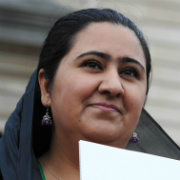
Iraqi lawmaker Vian Dakhil at the Lantos Human Rights Prize ceremony, 8 February 2017 – RNS photo
Last week I wrote about an award-winning human rights defender not being able to come and collect her award in the USA [https://humanrightsdefenders.blog/2017/02/01/yazidi-human-rights-laureate-may-be-banned-from-coming-to-washington-to-accept-award/]. Vian Dakhilmade it to Washington in the end. She had already received a visa to come to Washington to accept an award from the Tom Lantos Foundation when President Donald Trump’s executive order pausing immigration from seven Muslim-majority countries, including Iraq, was issued. After an arduous process involving the State Department and the Iraqi Embassy, she was granted an exemption to the travel ban so she could attend the award ceremony on 8 February. Her sister and translator was able to get a visa after a federal judge temporarily halted the implementation of the executive order. Read the rest of this entry »
2016 Human Rights Award Laureates: Andrea James and Glenn E. Martin (United States)
The Robert F. Kennedy Human Rights Award invites nominations of human rights defenders who are leading efforts to secure dignity for all people, especially those who have demonstrated an ongoing commitment to bringing justice and human rights to the people who need them the most, despite serious personal risk or sacrifice. Robert F. Kennedy Human Rights often forges strategic partnerships with the recipients of the Award and for this reason it is important to nominate someone who could find the support of Robert F. Kennedy Human Rights useful. For last year’s award see: https://humanrightsdefenders.blog/2016/12/14/2016-rfk-human-rights-award-went-to-two-criminal-reform-advocates-in-the-usa/Read the rest of this entry »
Andrea Ixchíu Hernandez is an indigenous rights defender working for several organisations in Guatemala. She talks – in English – to ISHR (International Service for Human Rights) about her work to build up community media so the voices of indigenous people are heard and the violations they face are publicly unveiled.
Physicians for Human Rights, an organization that for decades has documented war crimes and atrocities, will be awarded the Thomas J. Dodd Prize in International Justice and Human Rights, the University of Connecticut announced on 2 February 2017. “Physicians for Human Rights exemplifies the kind of work the Dodd Prize was created to honor,” former U.S. Sen. Christopher J. Dodd, the son of the Nuremberg prosecutor and senator for whom the awarded is named, said in a statement.”My father would recognize in PHR the same spirit that animated the Nuremberg Tribunals, but also would be amazed at PHR’s innovation and courage in seeking justice and accountability for the perpetrators of atrocities,”
Using forensic science, medicine and public health research, Physicians for Human Rights documents crimes against humanity in places across the world, including past issues in Bosnia and the Democratic Republic of the Congo, UConn said in announcing the award. The group also trains professionals worldwide to do the similar investigations and prevention, the announcement said. PHR shared the 1997 Nobel Peace Prize for work on the International Campaign to Ban Landmines.
PHR will be presented the award, which comes with a $100,000 prize, in November this year.
On 31 January 2017 Human Rights Watch published this video:
Two Bahrainis appear to be at imminent risk of execution despite the authorities’ failure to properly investigate their allegations of torture. Both Mohamed Ramadan and Husain Ali Moosa have disavowed confessions that they allege were the result of torture and that were used as evidence in a trial that violated international due process standards.
The January 15, 2017 executions of three other Bahrainis in a similar case have raised concerns that King Hamad bin Isa Al Khalifa will approve the executions of Ramadan and Moosa, who face the death penalty for a February 2014 bombing that resulted in the death of a policeman. Human Rights Watch analysis of their trial and appeal judgments found that their convictions were based almost exclusively on their confessions, which both men retracted.