Author Archive

Imprisoned Human Rights Defender Narges Mohammadi awarded APS’ Sakharov Prize 2018

October 28, 2017

Only yesterday I referred to the fact that there are 3 international awards with Sakharov in the name [https://humanrightsdefenders.blog/2017/10/27/european-parliaments-sakharov-prize-awarded-to-venezuela-opposition/], and now I see that on 27 October 2017 the American Physical Society (APS) has awarded Iranian human rights defender Narges Mohammadi its Sakharov Prize 2018. For more on the award see: http://trueheroesfilms.org/thedigest/awards/andrei-sakharov-prize-aps. Praising Mohammadi, APS has averred that she was awarded the prize “for her leadership in campaigning for peace, justice, and the abolition of the death penalty and for her unwavering efforts to promote the human rights and freedoms of the Iranian people, despite persecution that has forced her to suspend her scientific pursuits and endure lengthy incarceration.” [see also: https://humanrightsdefenders.blog/tag/narges-mohammadi/

An Indian researcher, Ravi Kuchimanchi has also been awarded the prize “for his continued research in physics while simultaneously advocating for global policies that reflect science; for leading sustainable development, human rights, and social justice efforts; and for creating a vibrant international volunteer movement that learns from, works with, and empowers communities in India.”

In 2011 Mohammadi won the 2011 Per Anger Prize for defending human rights in Iran. In September 2016, the Tehran Appeals Court upheld a 16-year prison sentence for “membership in the [now banned] Defenders of Human Rights Center,” “assembly and collusion against national security,” and one year for “propaganda against the state.”

Prominent human rights organizations have repeatedly called for Mohammadi’s immediate release.

Source: Imprisoned Human Rights Defender Awarded Sakharov Prize

European Parliament’s Sakharov prize awarded to Venezuela opposition

October 27, 2017

Only a week ago I mentioned the curiously collective award given to the South-Korean people [https://humanrightsdefenders.blog/2017/10/18/korean-people-win-friedrich-ebert-human-rights-award-for-candlelight-rallies/], and now the European Parliament has awarded its Sakharov Prize for Freedom of Thought to Venezuela‘s opposition-dominated National Assembly, as well as to political prisoners in the country.

Opposition MP Freddy Guevara in Caracas (picture-alliance/dpa/A. Cubillos)

The National Assembly in Venezuela was nominated for the award by the center-right European People’s Party (EPP) parliamentary grouping along with the Alliance of Liberals and Democrats for Europe (ALDE group). MEP Jose Ignacio Salafranca said “they are brave people who, despite being beaten or imprisoned, are not afraid and do not give up, but fight for their freedom and for their dignity.” Fellow MEP Guy Verhofstadt said the award supported “the fight of democratic forces in favor of a democratic Venezuela and against the Maduro regime.”

For more on the Sakharov Prize for Freedom of Thought: http://thedigestapp.trueheroesfilms.org/publicpage#/awards/BDE3E41A-8706-42F1-A6C5-ECBBC4CDB449/Sakharov-Prize-for-Freedom-of-Thought, where you can also learn more about the other two awards named after Sakharov.

Previous winners of the Sakharov Prize include Yazidi women [https://humanrightsdefenders.blog/2016/11/01/sakharov-prize-2016-went-ultimately-to-two-yazidi-women/] and Saudi blogger Raif Badawi [https://humanrightsdefenders.blog/2015/10/29/saudi-blogger-raif-badawi-awarded-europes-sakharov-prize/].

Source: Sakharov prize awarded to Venezuela opposition | News

Advice from one defender to another: what to do when your office is raided

October 25, 2017
 The Directorate of Criminal Investigations (CID) in Uganda has written to the Non-Government Organisation Bureau (established under the NGO Act of 2016 to register, regulate, and oversee all NGO operations in the country) about the three civil society organisations it is investigating. The CID is investigating ActionAid Uganda, the Uhuru Institute for Social Development and Great Lakes Institute of Strategic Studies (GLISS) for allegedly funding opposition projects that the government believe are intended to cause unrest in the country. Investigators have demanded from Non-Government Organisation Bureau work plans and budgets of the three organisations. The spokesman of CID, Mr Vicent Ssekate, said the detectives want to understand whether the three organisations are following the law. “After the search of the offices of these organisations, our investigators found evidence that we suspect doesn’t tally with their mandate they stipulated while registering with the NGO Bureau. The purpose of our letter to the bureau is to obtain officially what they committed themselves to do in Uganda,” Mr Ssekate said yesterday.

Two weeks ago, detectives raided ActionAid Uganda and GLISS on the same allegations. The offices of the two CSOs were searched and financial documents and mobile phones of the workers seized by detectives. Another CSO, Solidarity Uganda in Lira District, was raided and its workers arrested on September 21. All affected organisations deny allegations that they are funding projects to destabilise the country. Since the raids, police have not got back to the NGO managers on the offences they committed. The affected NGOs are still open, but their operations have been constrained since their financial departments were disrupted by the detectives.

Since then Arthur Larok, the country director of ActionAid Uganda, shared his view: Our offices were raided in Uganda. Here’s what to do if yours are, too. This may be useful advice for other NGOs in other countries:

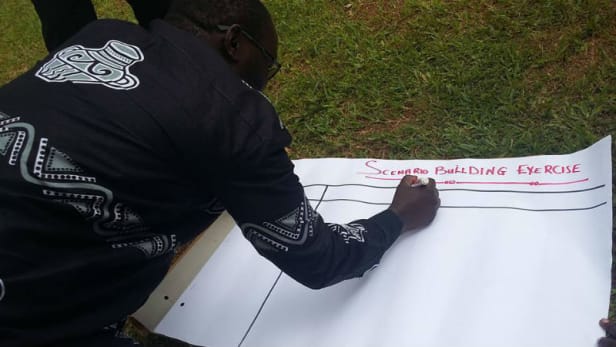
ActionAid Uganda leads a scenario building exercise. Photo by: ActionAid Uganda

The office raid appears to be part of a wider crackdown on legitimate protests against the plan to remove the presidential age limit from the Ugandan Constitution, thus allowing the current president to remain in power indefinitely.

We think these attacks have ulterior motives.

1. To delegitimize civil society. Police raids on our offices immediately present us as subversive elements. This could affect our public image, and that of civil society in general. It could also scare away our funding partners and threaten the stability of our work.

2. To compromise our systems and information. These attacks disrupt our work, and potentially sow seeds for future surveillance by targeting our communications systems and infrastructure.

3. To disrupt and derail us from our mission. Part of our mission as civil society is to help articulate public positions. We are opposed to regressive constitutional amendments. We will invest in organizing citizens to resist attempts to remove the age-limit, even though we know this puts us in direct conflict with the ruling party.

4. To threaten and demoralize civil society. In the hopes of driving us into self-censorship, weakening our resolve, and preventing us from tackling injustice.

5. To provide a justification for further action. Such as halting activities of civil society under the pretext that investigations are still ongoing. We have already seen this happening in the case of ActionAid, where two field activities have been halted by the police.

What can we learn from these attacks and what should civil society do to defend ourselves in ongoing efforts to protect civic space? How can we ensure that we are not derailed in our mission to tackle injustice and poverty?

Here are some tips if your office is at risk of being raided.

1. Always keep your house in order. You must update and back up all institutional information and documentation. During the impromptu siege, the police demanded documents without delay. If we had failed to do so, it may have caused unnecessary suspicion.

2. Staff and board members must understand all processes in the organization. If interrogated, we do not want colleagues to inadvertently arouse suspicion by saying inconsistent things about how we organize ourselves and what our business processes are.

3. Rapid legal response is necessary. As civic and political space continues to shrink in Uganda and globally, we must strengthen our legal response capabilities. The presence of competent lawyers is extremely important.

4. A positive relationship with the media is essential. The media were very helpful in reporting the siege — and established relations meant they did so in a manner that was both supportive and objective. Social media platforms were of increased importance during this crisis, and future investment here is key.

5. Being relevant to civil society and wider citizens’ struggles. The immense show of solidarity from other civil society organizations, politicians, and the public at our time of need demonstrated our value and relevance to civil society. The more outward looking an NGO, the more likely it is to receive much-needed solidarity from others. We were able to call upon our supporters both in Uganda and across the world to amplify our voice and provide solidarity.

6. Beware of potential informers. Finally, we have learned that the forces that seek to undermine our work are in our midst. It is therefore important to better understand our internal environment and partners with whom we work. We must remain vigilant and transparent and have the confidence to defend what we stand for.

The threat to civil society is far-reaching. We must learn from these attacks and work together to protect and defend the legitimacy and effectiveness of the work that we do.

196935scr
Arthur Larok is the current country director of ActionAid Uganda. He has previously worked with the Uganda National NGO Forum, the Forum for Education NGOs in Uganda and World Learning for International Development. He is the current chairperson of the Uganda National NGO Forum, the largest NGO platform in Uganda.

Sources:

Opinion: Our offices were raided in Uganda. Here’s what to do if yours are, too. | Devex

http://allafrica.com/stories/201710090056.html

Faith Leaders as Human Rights Defenders

October 25, 2017

This week (23 – 27 October 2017) there is an on-line Dialogue by New Tactics Supporting Faith Leaders and Faith-Based Organizations as Human Rights Defenders” with as goal: Mobilizing Allies and Modeling Systems and Structures.

The background to this interesting topic is the converging and diverging principles of secular human rights goals and religious values. On the one hand, there are historical and contemporary instances in which oppressors have used religious doctrines to endorse discrimination and violence against marginalized groups. Around the world, people continue to suffer daily from these acts of hate. Yet, many faith leaders from a range of religions denounce religiously motivated violence and actively work to combat human right abuses around the world. Some of history’s most impactful activists—El Salvador’s Oscar Romero, India’s Mahatma Gandhi, Iran’s Shirin Ebadi, the United States’ Martin Luther King drew upon their personal faith to promote civil rights and peace.
Today, many faith leaders and faith-based organizations have become leaders in human rights activism and humanitarianism, both locally and internationally. In Northern Uganda, the Acholi Religious Leaders Peace Initiative has united faith leaders to advocate for peace and strengthen the peacebuilding process in the wake of the region’s devastating civil war. Rabbis for Human Rights supports human rights in Israel and the Occupied Territories by performing acts of solidarity with Palestinians suffering from the Occupation, organizing interfaith dialogues, and educating their fellow community members on the interconnectedness of Judaism and human rights. Musawah is global human rights movement working to advance women’s rights in Muslim contexts, using Islamic teachings and universal human rights doctrinal frameworks to guarantee equality in the lived realities of men and women. Each of these organizations has incorporated their faith into action-based human rights movements that demonstrate their accountability in practicing what they preach: dignity, justice, and fairness for all humanity.
Faith leaders and organizations can contribute to strengthening human rights around the globe by countering voices of oppressors, mediating conflicts to end or avoid violence, denouncing discrimination, organizing humanitarian assistance, and so much more. Just as faith communities may thrive in environments where each member’s dignity and rights are recognized, the international human rights movement may learn from engaging communities with deeply rooted ethical and spiritual foundations. In March of 2017, the UN Office of the High Commissioner of Human Rights launched “Faith for Rights,” an initiative to strengthen the interconnectedness of the world’s religions and human rights. In the subsequent Beirut Declaration, participating faith-based and civil society actors recognized their mutual commitment to “upholding the dignity and the equal worth of all human beings.” Across the world, faith leaders and faith-based organizations can be valuable allies in achieving universal human rights for all.
In this conversation, New Tactics seeks to discuss the role of faith in promoting human rights across the globe and strategies for strengthening partnerships between secular and religious human rights defenders.  The Conversation Leaders are:
habdille's picture
Marie Juul Petersen's picture

Source: Supporting Faith Leaders and Faith-Based Organizations as Human Rights Defenders | New Tactics in Human Rights

Columbia University opens prize nominations for “court rulings” and “legal services” supporting freedom of expression

October 24, 2017

Columbia University has opened 2018 prize nominations for judicial services and legal decisions supporting freedom of expression. What is a bit special about these awards is that they go to ‘court rulings” and “legal services” in the area of freedom of expression.

The Global Freedom of Expression initiative at Columbia University in New York City has opened nominations for its 2018 global prizes, which recognize judicial decisions and legal services strengthening freedom of expression through the promotion of international standards.

The initiative “seeks to advance understanding of the international and national norms and institutions that best protect the free flow of information and expression in an inter-connected global community with major common challenges to address.” It awards the Global Freedom of Expression Prizes, which began in 2014, every two years. “We believe that at a time when freedom of expression is threatened at a global level, there is a particular need to celebrate the victories in defense of this fundamental right”. Individuals and organizations, particularly jurists, academics and non-governmental organizations dedicated to freedom of expression, are invited to nominate court decisions or legal services from anywhere around the globe that “have had a recognizable impact on freedom of expression.” There will be separate prizes for “Court decision” and “Legal Service.” In the Legal Service Category, the awards will consider legal briefs, amicus briefs, academic or other publications.

See also: http://thedigestapp.trueheroesfilms.org/publicpage#/awards/c94fef00-b8a0-11e7-a2a0-d7e205af50d9/Columbia-Global-Freedom-of-Expression-Prizes

Nominations will close Jan. 31, 2018 and winners will be announced March 13. Forms are available in both English and Spanish.

Members of the Awards Committee are: Lee C. Bollinger, President of Columbia University; Catalina Botero, former Special Rapporteur for Freedom of Expression of the Inter American Commission on Human Rights of the Organization of American States; Nicolas Bratza, former President of the European Court of Human Rights; Lydia Cacho, journalist, human rights defender and author; Agnes Callamard, Director of the Columbia Global Freedom of Expression initiative; Sarah Cleveland, Louis Henkin Professor of Human and Constitutional Rights and member of the UN Human Rights Committee; and Irene Khan, Director-General of the International Development Law Organization.

The winners of the 2016 prize for Excellence in Legal Services were Professor Yaman Akdeniz, Assistant Professor Kerem Altiparmak and Attorney at Law Serkan Cengiz for fighting a court order blocking access to YouTube in Turkey. That same year, the prize for a Significant Legal Ruling was awarded for Supreme Court of Norway, Rolfsen and Association of Norwegian Editors v. the Norwegian Prosecution Authority. The court backed broad protection against journalists being forced to expose their sources.

Source: Columbia University opens 2018 prize nominations for judicial services and legal decisions supporting freedom of expression | Knight Center for Journalism in the Americas

Ceremony for Alfredo Romero, recipient of the 2017 Robert F. Kennedy Human Rights Award, on 16 November

October 24, 2017
Alfredo Romero from Venezuela is the winner of the 2017 Robert F. Kennedy Human Rights Award [see: https://humanrightsdefenders.blog/tag/alfredo-romero/]. The ceremony will take place on THURSDAY, 16 NOVEMBER 2017 in the Kennedy Caucus Room | Russell Senate Office Building| Washington, D.C.  Questions can be directed to bethany@taylormadeexperience.com or 412-335-9434.
Alfredo Romero was born in Caracas, Venezuela, and is the Executive Director of human rights organization Foro Penal Venezolano (FPV). FPV was founded in 2005 by Alfredo Romero and three other lawyers to provide pro bono legal assistance to victims of arbitrary detention, due process violations or other human rights violations, including torture or cruel and inhuman treatment. Under Alfredo’s leadership, over 200 lawyers and 1,700 volunteers across the country are providing assistance to victims of human rights violations and their families. To date, FPV has provided assistance to more than 4,000 people.
In addition to his role as Executive Director of FPV, Alfredo was until recently a Fellow with the Carr Center For Human Rights Policy at Harvard’s Kennedy School of Government. He is also currently a partner at Himiob, Romero & Asociados law firm and has been a professor at the Central University of Venezuela and the Andrés Bello Catholic University. Alfredo obtained his Law Degree from the Andrés Bello Catholic University in 1991, and has an M.A in Latin American Studies from Georgetown University (1994) and an LL.M. from the London School of Economics (1997). He is married and is the father of two kids. A marathon runner and an accomplished musician, Alfredo has composed several songs dedicated to the Venezuelan people and to the political prisoners in his country.
For more info on the award: http://trueheroesfilms.org/thedigest/awards/robert-f-kennedy-human-rights-award

World Health Organization reconsidering Mugabe as “goodwill ambassador”

October 22, 2017

he head of the World Health Organization, Tedros Adhanom Ghebreyesus, is rethinking his decision to name Zimbabwe’s president, Robert Mugabe, as a goodwill ambassador.  The move provoked global outrage. WHO member states and activists alike noted that Zimbabwe’s health care system, like many of its public services, has collapsed under Mugabe’s regime. I’m listening. I hear your concerns. Rethinking the approach in light of WHO values. I will issue a statement as soon as possible,” Tedros, a former Ethiopian health minister, tweeted on Saturday night.

The Canadian prime minister, Justin Trudeau, came closest when he said he thought Mugabe’s appointment “was a bad April Fool’s joke”. [see: https://humanrightsdefenders.blog/2015/10/23/mugabe-wins-chinese-peace-prize-this-time-for-real/]

Human Rights Watch (HRW) said it was an embarrassment to give the ambassador role to Mr Mugabe, because his “utter mismanagement of the economy has devastated health services”. The main opposition party in Zimbabwe, MDC, described the appointment as “laughable”…“Mugabe trashed our health delivery system. He and his family go outside of the country for treatment in Singapore after he allowed our public hospitals to collapse.”

The Human Rights Foundation (HRF) also condemned the decision by the World Health Organization (WHO): “The irony of the World Health Organization’s decision to praise Robert Mugabe is staggering. This a strongman infamous for seeking medical attention for himself abroad. His recent visits to Singapore for medical treatment have cost Zimbabwean taxpayers tens of millions of dollars. Mugabe can’t get adequate treatment in his own country because his kleptocratic regime has left Zimbabwe’s hospitals and health industry in a state of ruin,” said HRF president Thor Halvorssen. “Dr. Tedros should nullify Mugabe’s appointment immediately and also issue a strong public condemnation of his repressive rule”.

Sources:

https://www.theguardian.com/world/2017/oct/21/un-lambasted-after-naming-mugabe-goodwill-ambassador

HRF condemns World Health Organization for appointing Robert Mugabe as “goodwill ambassador”

Reward offered for the capture of Albert Cattouse’s killer in Belize

October 20, 2017

This blog tries to follow as much as possible what happens in the world of human rights awards which honor human rights defenders. Here is a story from Belize where an award (as in reward) is used in a different way: A reward is offered for the capture of Albert Cattouse’s killer!

Around seven-thirty on Thursday night, shots rang out in the vicinity of Dolphin Street near the rear of Roger’s Stadium. A well-known taxi driver and activist had been gunned down in cold blood. Seventy-two-year-old Albert Anthony Cattouse was driving his Lincoln Town Car when he was targeted by a gunman. The bullet caught him in the head and he died instantly inside his taxi, which came to a stop inside the drain. The activism community is up in arms because Cattouse, who was very vocal, recently participated in the high gas price protest last week (News Five’s Duane Moody reports).

The community activist group, Belize Leaders for Social Justice (BLSJ), is offering a $5,000 reward for information leading to the arrest and conviction of the person responsible for the murder of Albert Cattouse. The BLSJ issued a statement today, condemning Cattouse’s murder, noting that he was a defender of human rights. “The activism community and human rights defenders are concerned that this murder can be related to Mr. Cattouse’s outspoken condemnation for acts of corruption and the injustices levied on our citizens by the government of Belize,” the group said.

Sources:

Reward offered for the capture of Albert Cattouse’s killer

http://edition.channel5belize.com/archives/154225

Martin Ennals Ceremony 2017 was very moving

October 19, 2017

For those who missed it, here the link to the FULL version of the ceremony for the 2017 Martin Ennals ward of Human Rights Defenders.

Turkey angry after PACE Havel prize is awarded to jailed judge

October 18, 2017

Turkish judge Murat Arslan, who was head of the Association for the Union of Judges and Prosecutors (YARSAV).

The Vaclav Havel Human Rights Prize, named after the dissident playwright who later became Czech president, is given by the Parliamentary Assembly of the Council of Europe (PACE). On Monday 16 October the prize awarded to the Turkish judge Murat Arslan, who was head of the Association for the Union of Judges and Prosecutors (YARSAV). Arslan was arrested in October 2016 on suspicion of links to Gulen who Ankara blames for the failed coup aimed at ousting President Recep Tayyip Erdogan.

The PACE described Arslan as a “staunch supporter of the independence of the judiciary.” But the Turkish foreign ministry said in a statement that it “is wrong and unacceptable to award the prize … to a person who is a member of Feto terrorist organisation“. “While the judicial process is underway, presenting a terrorism suspect as a human rights defender is a betrayal of the ideals of democracy and human rights,” it said. For more on the award see: http://trueheroesfilms.org/thedigest/awards/vaclav-havel-prize-for-human-rights-pace

In his absence, the prize was received by a representative of the European Magistrates for Democracy and Freedom group (Medel) which had nominated him. In a message from jail, Arslan told the ceremony that Turkey had “learnt nothing” from Europe’s 20th century history but “we will not let ourselves be closed up in a wall of fear”. [https://humanrightsdefenders.blog/2017/08/31/finalists-for-pace-vaclav-havel-human-rights-prize-announced/]

Turkey has been a member of the Council of Europe since 1950 but relations have frayed after the PACE in April voted to reopen political monitoring of the country.  see also: https://humanrightsdefenders.blog/2017/07/11/council-of-europe-losing-patience-with-turkey-after-arrest-of-human-rights-defenders/

http://aa.com.tr/en/politics/turkish-mp-slams-europe-body-for-rewarding-feto-suspect/939149