This morning I blogged about Front Line Defenders Global Analysis 2018 report which notes a record number of human rights defenders killed in 2018 with the majority being environmental defenders [see: https://humanrightsdefenders.blog/2019/01/09/front-line-defenders-says-record-number-of-activists-killed-in-2018/]. On 24 December 2018 Taran Volckhausen, referring to a preliminary Global Witness report, wrote that – while the numbers were still being finalized – the death toll for this group in 2018 was slightly lower than in 2017 (“For embattled environmental defenders, a reprieve of sorts in 2018”). This is most likely due to definition issues.
In 2018, 321 defenders in 27 countries were targeted and killed for their work – the highest number ever on record – according to data collected by Front Line Defenders. More than three-quarters of these, 77% of the total number of activists killed, were defending land, environmental or indigenous peoples’ rights, often in the context of extractive industries and state-aligned mega-projects. [see also: https://humanrightsdefenders.blog/2018/04/28/annual-reports-2017-by-front-line-defenders/]
Front Line Defenders reports that the murders of HRDs were not isolated events, but were preceded by judicial harassment, threats and physical attacks. At least 49% of those killed had previously received a specific death threat, and in an additional 43% of killings there had been general threats made to HRDs in the area. In the vast majority of cases, HRDs did not receive the necessary protection and support from state authorities from the time they reported threats to the time they were murdered.
According to the Front Line Defenders Global Analysis 2018, in addition to the threats experienced by male colleagues, WHRDs face gendered and sexualized attacks from both state and non-state actors, as well as from within their own human rights movements. Such violations include removal from public or high-ranking positions in NGOs, trade unions, and political societies; smear campaigns questioning their commitment to their families; sexual assault and rape; militarized violence; and the harassment and targeting of their children. In Saudi Arabia, authorities arrested, sexually assaulted, and tortured WHRDs who led the successful campaign for the abolition of the driving ban in 2018. Despite these attacks and the ongoing threats to stay silent, WHRDs in Saudi Arabia, as well as their family members, have publicly reported and condemned the abuses and are receiving unprecedented national, regional, and international visibility for their activism.
In addition to physical attacks and torture, the Front Line Defenders Global Analysis 2018 highlights the continuing trend towards restrictive legislation aimed at stifling the powerful work of HRDs and WHRDs, including:
A Digital Security Act in Bangladesh carrying a 14-year sentence for using digital media to “cause damage to the state”;
Retrospective legislation in Xinjiang province, China, legalising the use of “re-education” camps for the minority Uyghur population, including HRDs;
Anti-terror legislation in Nicaragua widening the definition of terrorism to include those accused of damaging property, leading to dozens of arrests of protesters now facing terrorism charges and 20 years in prison.
Front Line Defenders Digital Protection Team responded to a high number of reports from Brazil, Egypt, Guatemala, Honduras, Iraq, Mexico, Nicaragua and Venezuela in 2018. According to the Global Analysis, authorities around the world frequently used phone and email surveillance to target LGBTI+ defenders, WHRDs and environmental activists in particular. The report notes that in Tanzania, Pakistan, Russia, Malaysia, Nicaragua, Turkey, and many countries in MENA, governments claimed that HRDs were threatening “national security” as an excuse for censoring and blocking NGO websites.
Despite the severe and sometimes life-threatening risks faced by HRDs and WHRDs, Global Analysis 2018 highlights a number of major success achieved by HRDs and WHRDs in 2018, including:
The critical and leading role played by HRDs in securing The Escazu Agreement, now signed by 24 states in Latin America and the Caribbean, which stipulates a participatory approach to environmental projects and the mitigation of conflicts;
The monumental vote for reproductive rights in Ireland, secured through the extensive, decades-long campaigning of Irish WHRDs in the face of defamation, smear campaigns, and threats;
The Coalition of Women Leaders for the Environment and Sustainable Development in the Democratic Republic of Congo (DRC), who successfully campaigned for a province-wide decree in Equateur protecting women’s land and forest rights.
In response to attacks against HRDs in 2018, Front Line Defenders is working with HRDs to promote their security with a range of protection programming. In addition to risk management and digital protection trainings, advocacy at the national, international, and EU level, emergency relocation, Front Line Defenders provided nearly 550 protection grants to activists at risk in 2018. Front Line Defenders also works with HRDs to devise visibility campaigns to counteract the defamation and smear campaigns that put them at risk.
That giving human right awards is not always easy the Birmingham Civil Rights Institute in Alabama has learned the hard way: it has rescinded its decision to honor political activist and scholar Angela Davis. [Davis is a Birmingham native who has spent decades fighting for civil rights. She was an active member of the Black Panther Party, Student Nonviolent Coordinating Committee and Communist Party USA.] The institute announced Saturday that an examination of Davis’ statements and public record concluded that she didn’t “meet all of the criteria” for the Fred Shuttlesworth Human Rights Award. The statement (see full text below) didn’t indicate what criteria it found Davis didn’t meet or the origin of the complaints. But while expressing “dismay” at the decision, Birmingham Mayor Randall Woodfin cited protests from the “local Jewish community and some of its allies.” Davis has criticized Israel’s treatment of Palestinians. CNN has contacted officials at the institute for more clarity on what the concerns were and why they made the move. Davis herself said in her statement that she, too, asked for more clarity on the board’s decision. “I later learned that my long-term support of justice for Palestine was at issue,” she said.
THE ANNUAL FRED L. SHUTTLESWORTH HUMAN RIGHTS AWARD:
In September of 2018, the Birmingham Civil Rights Institute’s (BCRI) Board of Directors selected Angela Davis to receive the prestigious Fred Shuttlesworth Human Rights Award at its annual gala in February 2019. In late December, supporters and other concerned individuals and organizations, both inside and outside of our local community, began to make requests that we reconsider our decision.
Upon closer examination of Ms. Davis’ statements and public record, we concluded that she unfortunately does not meet all of the criteria on which the award is based. Therefore, on January 4, BCRI’s Board voted to rescind its invitation to Ms. Davis to honor her with the Shuttlesworth Award. While we recognize Ms. Davis’ stature as a scholar and prominent figure in civil rights history, we believe this decision is consistent with the ideals of the award’s namesake, Rev. Shuttlesworth.
We regret that this change is necessary, and apologize to our supporters, the community and Ms. Davis for the confusion we have caused. We will move forward with a keen focus on our mission: to enlighten each generation about civil and human rights by exploring our common past and working together in the present to build a better future.
The associated gala event, scheduled for February 16th at Haven has been cancelled. Ticket purchasers will received a full refund.
In 2015 the Electronic Frontier Foundation (EFF)launched its Offlineproject that seeks to raise awareness of and provide actions readers can take to support imprisoned bloggers, digital activists, and technologists [see https://humanrightsdefenders.blog/2017/12/29/2017-was-a-grim-year-for-imprisoned-technologists/]. Its 2018 campaign focused on six individuals from four countries whose critical voices have been silenced by their governments:
On 8 January 2019 the Hong Kong Free Press reports that Swedish human rights defender Peter Dahlin has filed a complaint with the British telecommunications regulator against Chinese state media China Central Television (CCTV) for contravening the broadcasting code and violating the Human Rights Act. In his complaint to the Office of Communications (Ofcom) yesterday, Dahlin – who is director of human rights NGO Safeguard Defenders – cited his own appearance on Chinese state television in 2016. [see: https://humanrightsdefenders.blog/2018/04/12/how-china-extracts-televised-confessions-from-human-rights-defenders/]
China Central Television Building in Beijing. Photo: Wikimedia Commons.
Dahlin said in his complaint that the production and airing of his televised “confession” violates a significant part of the privacy and fairness provisions of the broadcasting code, since no consent was given. He added that all statements made during his appearance were done so under duress and were pre-written for him: “I was given a paper with prepared questions and answers, and told to memorise,” he said. “I, like many victims who have later spoken out, was never told or informed, that this was to be a public TV recording, but that it was for internal use only.”….
The complaint stated that CCTV violated paragraph 6 of the Human Rights Act, which governs the acts of public authorities, by denying Dahlin the right to a fair trial. It also states that CCTV violated article 8 of the act, which protects the right to privacy. The complaint also said that CCTV knowingly produced “lies and [the] intentional distortion of facts…” with the help of the Ministry of State Security in China.
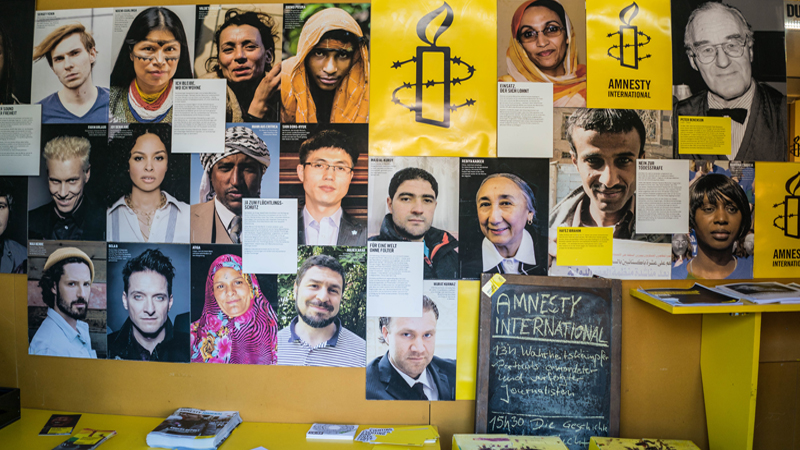
The German NGO Wahrheitskämper (TruthFighters) and Amnesty International set up a bus stall at the International Frankfurt book fair every year to educate people about threats to freedom of expression. Different sketch artists pay tribute to courageous human rights defenders.
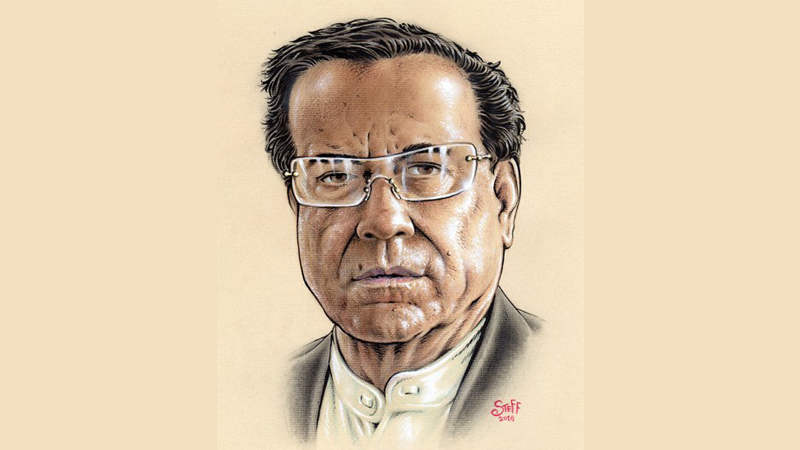
In 2018 the stall included portraits of Shaheed Salmaan Taseer, the late publisher of Daily Times of Pakistan, made by the German artist Steff Murschetz. Illustrator from Oberursel Christine Krahe painted the portrait of the Turkish author Ahmet Altan, who is imprisoned since 2016. Susanne Köhler, a Frankfurt based illustrator and initiator of the memorial project Wahrheitskämpfer – Fighters for Truth – drew the portrait of the Journalist Kyaw Soe Oo who is imprisoned in Myanmar. Christian Scharfenberg also made a portrait of slain US journalist John McNamara, who was killed in a mass shooting at The Capital Gazette newspaper in June 2018. Deniz Yucel was imprisoned by Turkish government in February 2017 for almost a year while serving as a correspondent for Germany’s Die WeltN24 media group in Turkey.
Artist Steff Murschetz from U-Comix-Magazin drew a sketch of Salmaan Taseer Shaheed
Speaking to Daily Times, Steff Murschetz said that Salmaan Taseer’s sketch was his way of conveying his love and respect for the visionary man who gave up his life while protecting Pakistani society from intolerance and injustice. Known German lawyer of Pakistani origin Advocate Muzaffar Chaudhry also joined the Amnesty International event and told Daily Times that the Supreme Court’s decision in Aasia Bibi’s case was a recognition of Salmaan Taseer’s clarity of vision.
Megha Rajagopala a BuzzFeed News Reporter, posted on 4 January 2019 the very interesting story of how LinkedIn censored, and then quickly restored, the profile of a New York–based Chinese human rights defender on its Chinese platform after a wave of negative publicity. Zhou Fengsuo is best known as one of the student leaders of the pro-democracy protests at Beijing’s Tiananmen Square in 1989. He was forced into exile in the United States over his role in the student movement, which landed him on a most-wanted list in China.
On 3 January, LinkedIn sent Zhou a message saying his profile and activities would not be viewable to users in China because of “specific content on your profile” (without saying which content!). Hours later, Microsoft-owned LinkedIn reversed its decision, apparently after South China Morning Post reporter Owen Churchill brought attention to the case. See the exchange below:
“My LinkedIn account was blocked by LinkedIn in China, a day after my other social account was blocked in China.This is how censorship spread from Communist China to Silicon Valley in the age of globalization and digitalization. How does LinkedIn get the order from Beijing?
Update, @LinkedIn just apologized and reversed the decision which was deemed an error. I applaud the prompt and correct response by LinkedIn. I hope other companies would do the right job and avoid such error in the future. Thanks to @owenschurchill for the quick follow up”
Human rights activism is a risky business in the Middle East in general but it is more so in Iraq where female activists have been targeted, wrote Oumayma Omar on 6 January 2019, based in Baghdad for the Arab Weekly. A series of killings in 2018 sparked fears of a coordinated campaign to silence successful and outspoken women in Iraq. In August and September 2018, four prominent women were assassinated, including activist Soad al-Ali in Basra and Tara Fares in Baghdad. They had campaigned for women’s freedoms and rights in a conservative, tribal society.
“The new political situation in Iraq has been detrimental on all Iraqis, especially women,” said Yanar Mohammed, president of the Organisation of Women’s Freedom in Iraq (OWFI) from self-exile in Canada.. “After the US-led invasion (2003), a new political system was created leading to a most sectarian, tribal and religious society where women’s lives don’t have much weight.” [see also: https://humanrightsdefenders.blog/2016/10/01/iraqi-human-rights-defender-yanar-mohammed-laureate-of-2016-rafto-prize/]
Discriminatory practices against women have become a fait accompli and the norm in Iraqi families in rural areas as well as big cities, including Baghdad, after the rise to power of Islamist parties. “They introduced extremist religious ideas based on hatred for women and viewing them as sexual and reproductive tools,” added the human rights defender…Despite intimidations and accusations of promoting secularism and encouraging women to go against their families, OWFI, which provides shelters for women who survive domestic violence, has been expanding since it was established in 2003.
Activist Hana Addour, president of Al-Amal organisation, said entrenched tribal values are still largely applied although Iraq has endorsed the Universal Declaration of Human Rights, which stipulates freedoms of expression, movement, opinion and the right to choose a partner without force or intimidation……She refuted as “baseless” accusations that activists were provoking women against social traditions. “We did not import our ideas and we do not contest customs or religious texts,” Addour said. “We only seek to implement the constitution by rejecting forced and early marriages and many other matters that we cannot accept under any pretext.”
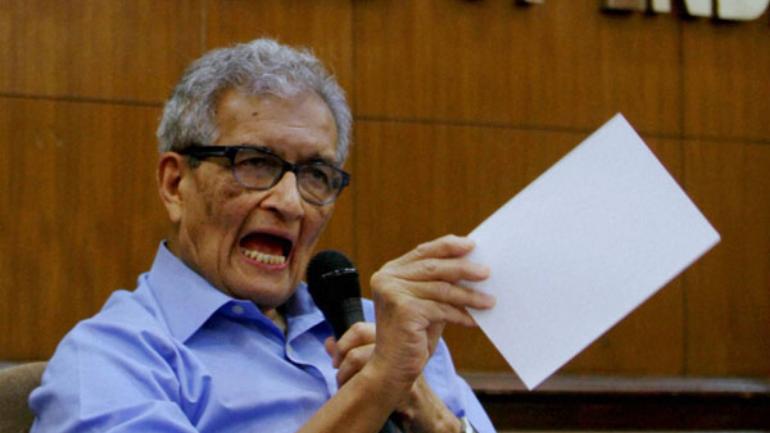
Amartya Sen said that many institutions in the country are under attack. (Photo: PTI)
Nobel laureate Amartya Sen on Sunday 6 January 2019 came out in support of actor Naseeruddin Shah, who recently stoked a controversy with his remark on mob violence and appeared in a video for Amnesty India against alleged government crackdown on NGOs, and said attempts were being made to “disturb” the actor. In a 2.13-minute solidarity video for Amnesty, Shah had said on 4 January that those who demand rights are being locked up. [for example: https://humanrightsdefenders.blog/2018/10/07/india-attacks-on-human-rights-defenders-abound-under-unlawful-activities-prevention-act/ ]
On being asked about the actor’s comments, Sen said, “We must protest against such attempts to disturb the actor. What has been happening (in the country) is objectionable. It should stop.” The 85-year-old economist Amartya Sen said that many institutions in the country are under attack, and their freedom is being encroached. “Even journalists are facing harassment,” he said.
Further talking about the troll attacks against personalities like Shah, Sen said, “Losing the ability to tolerate others is a serious cause for concern, it points to losing of the ability to think and analyse.”
Under the hashtag #AbkiBaarManavAdhikaar, Amnesty India had claimed that India has witnessed a massive crackdown on freedom of expression and human rights defenders. In a solidarity message in Urdu, Shah had said, “Artistes, actors, scholars, poets are all being stifled. Journalists too are being silenced.” “In the name of religion, walls of hatred are being erected. Innocents are being killed. The country is awash with horrific hatred and cruelty“. Last month, the 68-year-old also said that the death of a cow had acquired more significance than that of a police officer in the country. He was speaking in the wake of a mob violence that broke out in Uttar Pradesh’s Bulandshahr on December 3 over alleged cow slaughter in the Mahaw village. The violence led to the death of two men, including a police inspector.
The National Award-winning actor’s visit to a literary fest in December was cancelled following protests by Hindu outfits over his comments on mob violence.
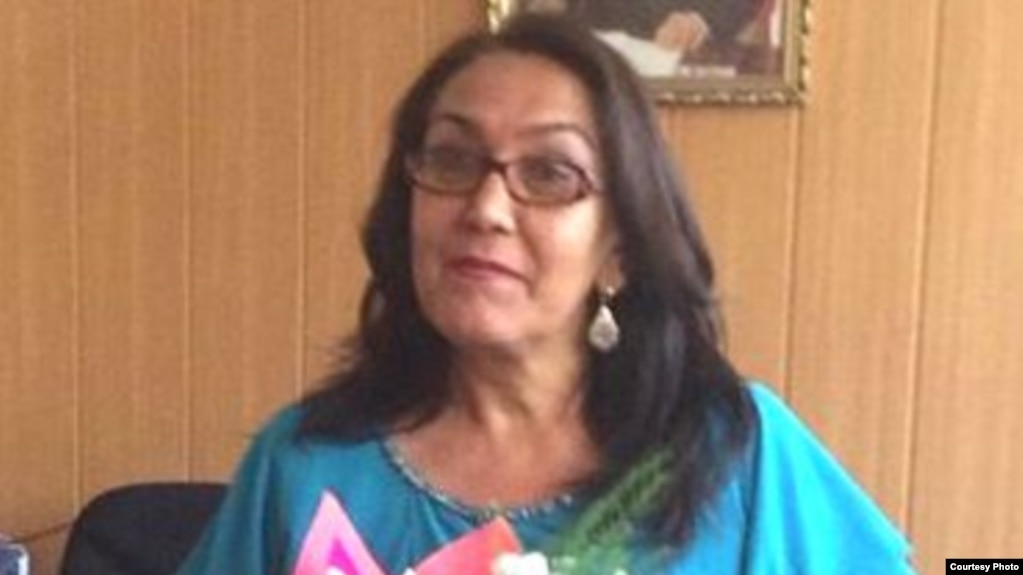
Radio Free Europe (RFE) announced on 4 January 2019 that Faiziniso Vohidova, a Tajik lawyer who defended dissidents for decades, died at the age of 55.
Faiziniso Vohidova in 2016
Faiziniso Vohidovawas a graduate of Moscow State University and started her career as a lawyer in 1995. She was one of the last lawyers in Tajikistan who provided legal assistance to opposition figures, journalists, and victims of torture. Steve Swerdlow, researcher with Human Rights Watch, called Vohidova’s death “a huge loss for Tajikistan” and described her as a brave “lawyers’ lawyer.”
“[Vohidova] was an amazing combination of fierce intellect, sharp wit [and] principle. [For] duration of Tajikistan’s independence she has been part of that small group of activists and lawyers who have sought to make it live up to the democratic pronouncements written in its Constitution,” Swerdlow wrote on Twitter, adding that she was “unafraid to take on the toughest battles, fight for justice till the end, no matter what the odds.”
Rajabi Mirz, an independent journalist and rights defender in Tajikistan, told RFE/RL that Vohidova was “the last pillar” of those challenging the authorities in Tajikistan. “She was one of the few who cared about Tajikistan’s future,” Mirzo said.






 Hans Thoolen on Human Rights Defenders and their awards