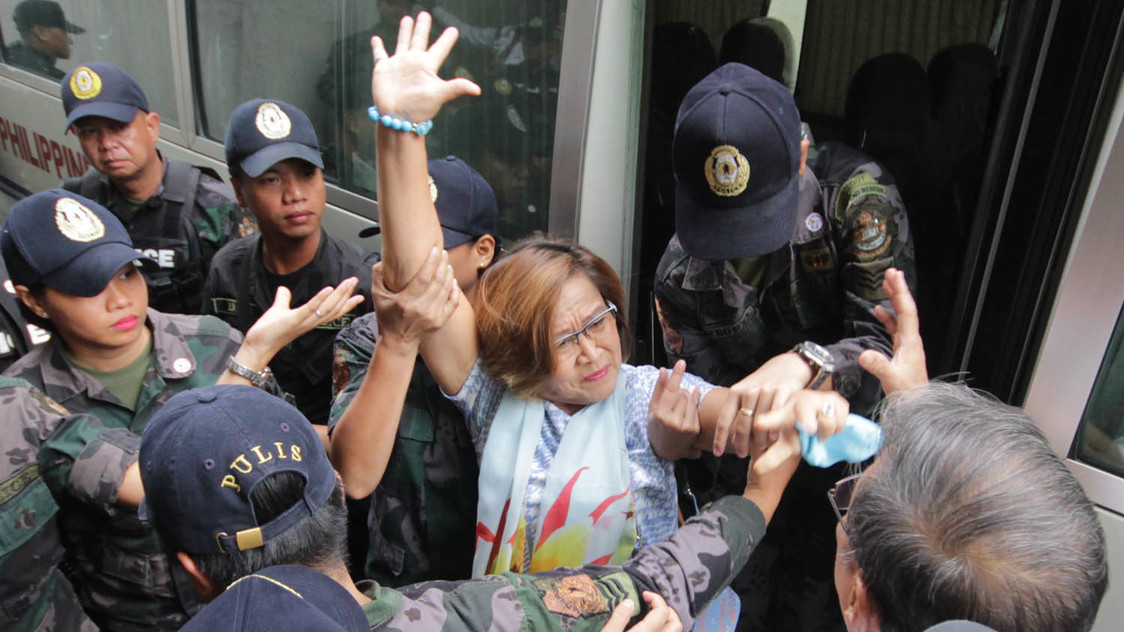
On 9 December 2020 Rappler announced that supporters of embattled Senator Leila de Lima will mark Human Rights Day on Thursday, December 10, with an online film screening titled “CinemaLeila 2020.”
The screenings will include films and documentaries about human rights issues in the Philippines Spearheaded by the Free Leila de Lima Movement, the screening will feature select short films and documentaries about human rights issues in the Philippines.
The line up includes the following titles:
Bad Elements
Miss You ‘Nay
Hayop
I Believe
Marapat Lang
Counter Terror
Paranoia of the Guilty
Dakilang Pagbabago 2020
Sober
Titser Gennie
Selda
Sino si Reina Mae Nasino?
PKNP (Pambili ng Karapatang Pantao)
Pawns
Ili Ili, Tulog Anay
These and other films and documentaries will be streamed on the Facebook page of the Free Leila de Lima Movement and, on De Lima’s official Facebook page.
There will be screenings on Wednesday, December 9 – Human Rights Defenders Day – from 7:30 pm to 9 pm, and on Thursday, December 10, also from 7:30 pm to 9 pm:
Interesting example of enhancing international awards at the local level: Several Dutch embassies have started to issue a local version of the Ministry’s international human rights award, the Tulip [see: https://www.trueheroesfilms.org/thedigest/award/D749DB0F-1B84-4BE1-938B-0230D4E22144]. Here the case of Georgia where the Ambassador, Maaike van Koldam, has awarded 3 Georgian media activists with a Human Rights Tulip prize
Established in 2008 by the Dutch government, the Human Rights Tulip is an annual award intending to support human rights defenders and help them learn from each other. Photo: The Embassy of Netherlands to Georgia.
The winner is Kamilla Mamedova, the founder of Radio Marneuli. The second prize went to Tsabunia Vartagava, an LGBTI and women’s rights activist from Georgia’s western region of Samegrelo, and Manana Qveliashvili, a journalist working on various human rights issues in the Adjara region.
Due to the Covid-19 pandemic, the award ceremony took place virtually. The Tulip prize will remain with the ambassador for now, until she will be able to hand it over to the winner in person.
A unique global broadcasting event, to coincide with UN Human Rights Day on 10 December, will promote a message of unity through music with the first-ever radio broadcast of Max Richter’s VOICES, incorporating text from the historic 1948 Declaration of Human Rights.
This special performance, produced by BBC Radio 3 and co-conceived by Richter and his creative partner Yulia Mahr, will be broadcast by 37 EBU radio channels from 34 countries, the EBU announced on 7 December 2020.
VOICES is inspired by the opening statement from the Declaration: “All human beings are born free and equal in dignity and rights.” A decade in the making, the piece premiered in London in February 2020, weeks before the pandemic brought unprecedented changes to the lives of citizens worldwide. With months of uncertainty still on the horizon, the recording’s uplifting messages of community and hope have particular resonance.
Max Richter and Yulia Mahr said, “Thinking back now to the premiere of VOICES in February feels like visiting another world. In these strange and anxious times, it is a great privilege to be able to mark Human Rights Day by presenting the work again, despite the pandemic. We are thrilled about the partnership with the UN Human Rights office and the collaboration with BBC Radio 3 and the EBU, which have made it possible to perform our work once more. In this challenging time in human history, the text of the Declaration is more important than ever.”
Víctor Fernández, Chief, Communications Section, Office of the United Nations High Commissioner for Human Rights, said, “Collaborating with Max Richter, BBC Radio 3 and the EBU on Human Rights Day was a natural way for the United Nations Human Rights Office to promote the global human rights message through high quality music.
“VOICES is a musical interpretation of the Universal Declaration of Human Rights, and music, like human rights, is universal. Both have the power to unite, to inspire and to promote peace and understanding. This concert on BBC Radio 3, broadcast via the EBU, helps ensure that the principles enshrined in the Declaration reach a wide audience.”
This is the second time that the EBU has collaborated with Richter. During Easter 2020, as the world was closing down, EBU radio channels across Europe presented the composer’s eight-hour work – Sleep – to audiences in 20 countries as a moment of hope in unprecedented times. VOICES will continue that tradition.
The BBC Radio 3 broadcast of VOICES will be presented by Elizabeth Alker and features soprano Grace Davidson; violinist Viktoria Mullova as soloist; British actor Sheila Atim as the narrator; the Tenebrae choir; the Max Richter ensemble – with Richter himself on keyboards and electronics; and conductor Robert Ziegler.
Neil Gaiman launches a crowdsourced animated film to help raise funds for Syrian refugees battling freezing temperatures and icy winds amid threat of Covid-19.
Neil Gaiman – celebrated author and Goodwill Ambassador for UNHCR – has joined forces with hundreds of fans and artists to release a new animated version of his poem What You Need To Be Warm.
The animated film aims to raise much needed funds for UNHCR’s Winter Appeal providing vital support for refugees in the Middle East including Syrian and Iraqi refugees, many of whom are battling their ninth winter away from home. This year is the hardest yet as refugees face snow, rain and freezing temperatures, as well as the impact of Covid-19 which has dramatically affected vulnerable families, put health at risk, devastated livelihoods, and pushed more refugees out into the cold.
Neil Gaiman said: “This animated film was a chance for people to come together to help raise awareness and life-saving funds to protect these families. I was blown away by the response and quality of drawings submitted online. People really care and want to help and they still can by making a donation“
Efi Koutsokosta in Euronews of 8 December 2020 writes that the European Union has agreed to establish a regime similar to the Magnitsky Act in America that will allow the 27 member bloc to sanction those responsible for human rights abuses. The decision came at a meeting of European foreign ministers in Brussels on Monday and will allow the EU to freeze assets and impose travel bans on individuals involved in serious human rights abuses. [see also: https://humanrightsdefenders.blog/2015/05/08/the-case-for-smart-sanctions-against-individual-perpetrators/]
The new measures will allow for travel bans on involved individuals and the freezing of their funds too. It could also be forbidden from making funds available to those being sanctioned.
“This unanimity rule is a real problem. Another problem with the EU Magnitsky Act is that it doesn’t include kleptocracy, it only includes human rights abuse. And what we found is that kleptocracy and human rights abuse go hand in hand, they are intertwined. Of course, we are celebrating today because this is a huge milestone but tomorrow the work begins to put pressure on sanctioning bad actors in countries like Russia and China and to make sure that the law that the EU has, is upgraded to include corruption,” Browder said.
The criteria for sanctions will apply to acts such as genocide, crimes against humanity, as well as. torture, slavery, extrajudicial killings, arbitrary arrests, or detentions.
It will then be up to the European Council, which consists of all 27 national governments, to act upon a proposal from a member state or from the High Representative of the EU for Foreign Affairs and Security Policy, to establish, review and amend the sanctions list.
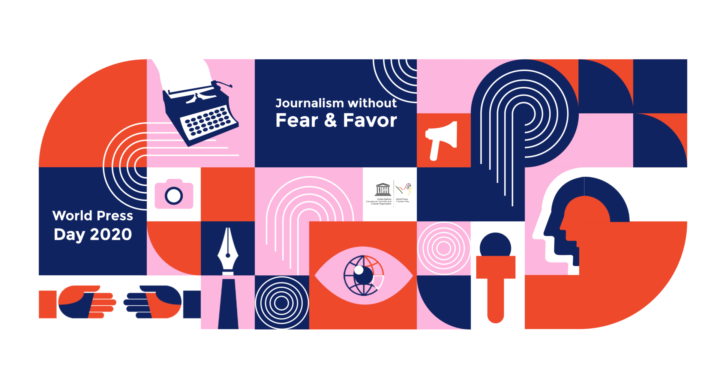
.unesco.org/news/visualizing-journalism-without-fear-favour (Image by UNESCO)
The ongoing COVID-19 pandemic has made even clearer the importance of being able to access reliable, unbiased information in a time of crisis – and of independent media as the source of such information. But freedom of the media is under attack in many countries all around the world and journalists are subject to harassment, repression and violence. The World Press Freedom Conference 2020 (WPFC) aims to stand up for a free, safe and independent media and protect journalism from new and existing forms of unwanted control, pressure and influence.
The WPFC is co-hosted by UNESCO and the Kingdom of the Netherlands and will take place on 9 – 10 December 2020 in a new, innovative format, merging digital and in-person elements. It will bring together journalists, media companies, human rights defenders, members of the judiciary, policymakers, academics, youth and NGOs from around the world and is open to anyone, anywhere, who is interested in press freedom. [see also https://humanrightsdefenders.blog/tag/world-press-freedom-index/]
RNW Media will be hosting a session called PRESSure is ON: creating an inclusive and enabling online space for digital media communities. This session puts the spotlight on the marginalised voices of young media makers. Bloggers, vloggers and media makers from teams in Libya, the Democratic Republic of Congo and India will discuss their on-the-ground experiences in their local contexts, the challenges they face when it comes to digital rights (both access and content takedowns) and the possible solutions.
The session on 10 December 12:15 – 13:15, will be led by Melody Patry, Advocacy Director at the digital rights NGO Access Now. The audience will be able to use a chat function to share their thoughts on the topics discussed and will be asked to respond to questions that will pop up on their screens throughout the session. These questions are designed to gather the audience’s opinions on such issues as what poses the biggest threat to freedom of speech and whether or not governments should have the right to censor media content they consider harmful to society.
The RNTC media training centre has joined forces with UNESCO and the Netherlands Ministry of Foreign Affairs to hold an online competition in the run-up to the conference offering the chance to win a two-day online Masterclass in Investigative Journalism. People are invited to submit a short story, picture or 10-second video message explaining what press freedom means to them or how they’ve contributed to it, via direct messaging @UnescoNow. A total of 20 winners will be selected to take part in RNTC’s masterclass which will take place in January.
The on-line training will introduce key concepts and tools for investigative journalism and strengthen participants’ capacity to identify and research issues of governance, accountability, corruption, and misuse of power. In order to publicise the competition, RNW Media has been sharing videos on its social media channels of journalists from around the world explaining what press freedom means to them
Many media (here Sudarsan Raghavan for the Washington Post on 3 December 2020) have reported the good news that three Egyptian human rights defenders were released from detention Thursday after a wave of international condemnation against the Arab nation’s authoritarian government that included UN and Hollywood celebrities.
The trio — Gasser Abdel-Razek, Karim Ennarah and Mohamed Basheer — work for the Egyptian Initiative for Personal Rights, one of the few remaining rights groups in Egypt, where President Abdel Fatah al-Sissi has waged a massive crackdown on opponents and activists alike.
“They are fine, they are in good spirits,” said Ragya Omran, their lawyer, Thursday night.
“It was a very quick and clean release, which is unprecedented,” Omran said. “There was a lot of international pressure. … It worked.”
Few arrests have sparked the global outrage that followed the detention of the EIPR employees. The United Nations, France and other governments publicly denounced the arrests. Antony Blinken, President-elect Joe Biden’s nominee for secretary of state, declared in a tweet that “meeting with foreign diplomats is not a crime. Nor is peacefully advocating for human rights.”
On social media, a petition campaign with the hashtags #FreeEIPRstaff and #FreeKarimEnnarah went viral, spearheaded by Ennarah’s British wife, Jess Kelly. It prompted Hollywood celebrities such as Scarlett Johansson and Emma Thompson to post videos of themselves on YouTube urging the release of the EIPR staffers. In Egypt, EIPR remained vocal and defiant.
On Thursday night, after the three men took cabs from the prison to their homes, one of the group’s leaders publicly noted that the global outcry played a significant role in convincing the regime to release his colleagues.
“I can confirm my friends and EIPR colleague, Gasser, Basheer and Karim have been released and are home which I guess means we (and you) managed to #FreeEIPRstaff,” tweeted Hossam Bahgat, the organization’s founder.
Bahgat, despite being under a travel ban and asset freeze imposed by the Sissi government, returned to take the helm last month after Abdel-Razek, its executive director, was taken into custody. Placed in a cold cell, he was initially denied warm clothing and a mattress, among other ill treatment, said Amnesty International.
On Thursday, 3 December 2020 Scoop carries the recent report by the Euro- Med Monitor which shows actions in a number of countries covered by the NGO
Hungary
The European Commission issued a new notice/ procedure against Hungary in which it considers Hungary’s new laws against refugees and asylum seekers illegal and violates the European Union laws for asylum seekers. The Hungarian government closed its transit areas and approved a new law prohibiting asylum seekers from entering the country. Under the new law, asylum seekers must first submit “a declaration of intent” at the embassies of Hungary in Serbia or Ukraine, and if they were approved by the National Directorate-General for Aliens Policing (formerly the Office of Immigration), asylum seekers can then enter the territory of Hungary to formally submit an asylum application.
During a lobbying and advocacy campaign extending for more than three years, Euro-Med Monitor has worked with partner international organizations to pressure the EU governments to accommodate more asylum seekers and distribute the burden among them. Euro-Med Monitor called on the EU to search for the best mechanisms to redistribute refugees and asylum seekers in Hungary in a fair manner between the EU member states, pressure the Hungarian government to take full responsibility for migrants and asylum seekers in its custody, and put an end to violations of their basic rights.
The EU Ombudsman announced on 10 November that an investigation has been opened into the possible complicity of the EU’s Executive in mismanaging funds allocated for overseeing the conduct of the Croatian border officers accused of participating in violence against asylum seekers, including shootings of refugees.
On May 19, Euro-Med Monitor addressed the Croatian government and concerned parties in the EU to immediately put an end to all illegal and discriminatory practices against asylum seekers and to conduct an independent investigation into violations committed by the Croatian police against refugees.
Spain
On 30 November, the Spanish authorities have cleared and dismantled dock camp in Gran Canaria, which was used to accommodate thousands of migrants and asylum seekers in very adverse conditions since last August.
On November 26, Euro-Med Monitor issued an urgent appeal to the Spanish authorities to end the overcrowding conditions in refugee camps in the Canary Islands, to deal with unsanitary conditions, to increase alternative reception centers, to transfer asylum seekers to the Spanish mainland in a quicker manner, and to establish fair asylum procedures for migrants and asylum seekers.
The Palestinian Territories
The EU called on the Israeli government to halt its policy of home demolitions in the occupied Palestinian territories (oPt), including demolishing housing units funded by the EU. This comes amid the high rate of demolitions this year.
In lobbying and advocacy campaigns that spanned over years, Euro-Med Monitor representatives met with members of the European Parliament and launched an intensive correspondence campaign revealing the high number of demolitions against projects funded by the EU in the Palestinian territories. Euro-Med Monitor brought the case to the United Nations Human Rights Council (UNHRC), providing a number of reports and statements, and contacted the Special Rapporteur on housing to exert pressure on Israel to put an end to its violations and demolitions last September.
The Jericho Magistrate’s Court issued a decision to release Palestinian activist Nizar Banat after he was arrested for publishing a video on Facebook criticizing the resumption of relations between the Palestinian Authority (PA) and Israel.
On November 22, Euro-Med Monitor called on concerned bodies in the PA and its Public Prosecutor to immediately release Banat, and urged the PA to to review its security policies in dealing with opponents and to put an end to all violations committed against the rights guaranteed by relevant international laws and treaties.
Saudi Arabia/United Arab Emirates
Negotiators in the European Council and the European Parliament approved new rules on November 8 that would control the export of dual-use goods such as electronic surveillance equipment to third countries that might use these technologies to harm their own citizens and are involved in human rights violations.
During the past months, Euro-Med Monitor, in cooperation with partner organizations, addressed several European Parliament members and representatives. The Euro-Med released several reports revealing the grave human rights violations committed by both Saudi Arabia and the UAE against civilians, including the war in Yemen, enforced disappearances, and arrest campaigns against journalists and activists for opposing the regime. Euro-Med Monitor, in cooperation with its partners in the region, called on the European Union (EU) countries to stop the export of weapons and modern surveillance technologies to countries that violate human rights in the Middle East.
Europe
On November 10, members of the European Parliament called for ensuring accountability for the European Border and Coast Guard Agency (Frontex) over returning migrants and asylum seekers from Greece to Turkish territorial waters. On May 6, 2020, Euro-Med Monitor addressed members of the European Parliament and the EU to impose transparency and accountability measures against Frontex practices and to establish an independent oversight committee to investigate and prevent any violations.
On 2 December 2020 the International Olympic Committee reported that “Building on the work undertaken over the last few years to address human rights issues within the scope of its responsibility across its three spheres of influence, as well as recent recommendations made by experts, the International Olympic Committee (IOC) has made further progress on the development and implementation of its human rights approach. In its recent consultative meeting, the IOC Executive Board (EB) received an update on the ongoing work in this field.
The IOC’s work has been informed by a series of “Recommendations for an IOC Human Rights Strategy”, produced by the independent experts HRH Prince Zeid Ra’ad Al Hussein, a former UN High Commissioner for Human Rights, and Rachel Davis, Vice President of Shift – a non-profit centre of expertise on business and human rights – commissioned by the IOC in 2019. They were developed following a consultative process with key internal staff and expert civil society stakeholders. Shift has been supporting the IOC since 2018 to develop the organisation’s existing human rights due diligence measures. [ see also: https://humanrightsdefenders.blog/2020/03/04/ioc-continues-its-cautious-work-on-human-rights-and-takes-first-steps-on-a-strategy/]
“We would like to thank Prince Zeid and Rachel Davis for their work and the report. The IOC remains committed not only to continuing, but also to strengthening its work concerning human rights within the scope of our responsibility,” said IOC President Thomas Bach.
The IOC has already taken a number of steps to deliver on its human rights responsibilities in its own operations. It has increased the alignment of its existing strategies on sustainability and gender equality and inclusion with human rights standards; and it is working on its own procurement processes and the creation of a human rights unit in the organisation. Engagement with human rights expert groups has also increased.
Work has further progressed in relation to the Olympic and Youth Olympic Games, supporting organising committees in developing and implementing their human rights approaches. As part of the Olympic Agenda 2020 reforms, human rights standards had already been reinforced in the “Operational Requirements” of the Host City Contract for the Olympic Games 2024 and beyond.
Setting out its role to advance respect for human rights as the leader of the Olympic Movement, the IOC is also aiming to work closely with the National Olympic Committees (NOCs) and International Federations (IFs). In its commitment to inclusion across the Olympic Movement, the IOC is working on a framework to ensure fairness, safety and non-discrimination of athletes on the basis of gender identity and sex characteristics; and it is planning to further advance its work around safe sport and implement the “Athletes’ Rights and Responsibilities Declaration”.
The IOC will continue the work already under way.
Additional action will be taken in the short term to complete the development of an IOC human rights strategy and policy commitment, and an amendment to the Olympic Charter will be considered.
Further work will look, among other things, at further embedding human rights in the good governance principles, and the establishment of the previously announced Human Rights Advisory Committee.

.jpg?t=thumbnail_352)

 Hans Thoolen on Human Rights Defenders and their awards