Author Archive

To Counter Domestic Extremism, Human Rights First Launches Pyrra

December 26, 2021

New enterprise uses machine learning to detect extremism across online platforms

On 7 December 2021, Human Rights First announced a new enterprise, originally conceived in its Innovation Lab as Extremist Explorer, that will help to track online extremism as the threats of domestic terrorism continue to grow.

Human Rights First originally developed Extremist Explorer to monitor and challenge violent domestic actors who threaten all our human rights. To generate the level of investment needed to quickly scale up this tool, the organization launched it as a venture-backed enterprise called Pyrra Technologies.

“There is an extremist epidemic online that leads to radical violence,” said Human Rights First CEO Michael Breen. “In the 21st century, the misuse of technology by extremists is one of the greatest threats to human rights. We set up our Innovation Lab to discover, develop, and deploy new technology to both protect and promote human rights.  Pyrra is the first tool the lab has launched.”

Pyrra’s custom AI sweeps sites to detect potentially dangerous content, extremist language, violent threats, and harmful disinformation across social media sites, chatrooms, and forums.

 “We’re in the early innings of threats and disinformation emerging from a proliferating number of smaller social media platforms with neither the resources nor the will to remove violative content,Welton Chang, founding CEO of Pyrra and former CTO at Human Rights First, said at the launch announcement.  “Pyrra takes the machine learning suite we started building at Human Rights First, greatly expands on its capabilities and combines it with a sophisticated user interface and workflow to make the work of detecting violent threats and hate speech more efficient and effective.”

The Anti-Defamation League’s Center on Extremism has been an early user of the technology. 
“To have a real impact, it’s not enough to react after an event happens, it’s not enough to know how extremists operate in online spaces, we must be able to see what’s next, to get ahead of extremism,” said Oren Segal, Vice President, Center on Extremism at the ADL. “That’s why it’s been so exciting for me and my team to see how this tool has evolved over time.  We’ve seen the insights, and how they can lead to real-world impact in the fight against hate.”   

 “It really is about protecting communities and our inclusive democracy,” said Heidi Beirich, PhD, Chief Strategy Officer and Co-Founder, Global Project Against Hate and Extremism.  “The amount of information has exploded, now we’re talking about massive networks and whole ecosystems – and the threats that are embedded in those places. The Holy Grail for people who work against extremism is to have an AI system that’s intuitive, easy to work with, that can help researchers track movements that are hiding out in the dark reaches of the internet. And that’s what Pyrra does.”

Moving forward, Human Rights First will continue to partner with Pyrra to monitor extremism while building more tools to confront human rights abuses. 

Kristofer Goldsmith, Advisor on Veterans Affairs and Extremism, Human Rights First and the CEO of Sparverius, researches extremism. “We have to spend days and days and days of our lives in the worst places on the internet to get extremists’ context.  But we’re at a point now where we cannot monitor all of these platforms at once. The AI powering Pyrra can,” he said.

Pyrra’s users, including human rights defenders, journalists, and pro-democracy organizations can benefit from using the tool as well as additional tools to monitor extremism that are coming from Human Rights First’s Innovation Lab.

“This is a great step for the Innovation Lab,” said Goldsmith. “We’ve got many other projects like Pyrra that we hope to be launching that we expect to have real-world impact in stopping real-world violent extremism.”   

https://www.humanrightsfirst.org/press-release/counter-domestic-extremism-human-rights-first-launches-pyrra

Vilma Nuñez, human rights defender, who stays in Nicaragua

December 24, 2021

The long-time president of the Nicaraguan Center for Human Rights, doesn’t rule out the possibility of being jailed by the Ortega-Murillo regime. Re-published on 11 December in Havana Times:

Vilma Nuñez learned about Nicaraguan jails when she was just a child. She was eight years old when they took her to visit a political prisoner – her father. He had been imprisoned by Somoza’s National Guard, the same repressive body that years later would also jail and torture her.

In the course of over six decades of work, she’s become the veteran defender of Nicaraguans’ human rights. Founder and current president of the Nicaraguan Center for Human Rights (Cenidh), she confesses that she decided to study Law to fight against the outrages she’d experienced since childhood. Her law career has spanned 63 years, although she was very seldom the prosecutor, but almost always worked on the side of defense. See also: https://humanrightsdefenders.blog/2018/12/02/nicaragua-moves-against-women-human-rights-defenders/

Through Cenidh, Nuñez continues her struggle for the liberation of the Ortega regime’s political prisoners, just as she did in 1958, when she formed part of the Leon student movement. Through that organization, she became involved in the Committee for the Liberation of the Political Prisoners during the the Somoza regime. On one occasion, she recalls, they requested and received an audience with Luis Somoza Debayle, effectively Nicaragua’s dictator from 1956–1967. Together with university chancellor Mariano Fiallos Gil, she met with the man who had inherited the Somoza dynasty. The dictator became enraged when they demanded the release of the prisoners.

Twenty-one years after that meeting, Nuñez was jailed and tortured with electric shocks by order of the dynasty’s final successor, Anastasio Somoza Debayle. It’s not surprising, then, that the current situation of the political prisoners brings her back to the days of that other terrible dictatorship that – like the current regime – wouldn’t tolerate criticism.

In addition, Nuñez is a survivor of the student massacre of July 23, 1959. She has felt in her own flesh what it means to be jailed for false crimes because of having protested. At 83, it’s been her destiny to once more live under attack from a new dictatorship.

At the end of 2018, the Ortega regime ordered the Sandinista-dominated National Assembly to strip Cenidh of the non-profit status it had held since its founding in 1990. It also confiscated its offices.

“They’ve struck us a blow, but it doesn’t hurt us,” the Cenidh president declared defiantly. “A serious human rights organization can’t be dissolved by a resolution from a political organ with no autonomy or independence; nor can they dissolve our commitment and accompaniment of the Nicaraguan people,” she affirmed, in reference to the legislature’s decision…

According to Nuñez, all the attacks are because they won’t forgive her for having accompanied the case of Zoilamerica Narvaez, Daniel Ortega’s stepdaughter. In 1998, Narvaez filed formal accusations of 19-years of rape and sexual abuse and harassment against Ortega.

The issue most disturbs Dr. Nuñez at present is not being able to accompany the victims at the site where the human rights violations are occurring. She can’t even file an appeal, because the entire state apparatus is controlled by the Ortega regime.

“No one listens or does anything, which generates a situation of powerlessness. You can’t protest, or do anything, and for that reason I’ve said that I feel I’m a prisoner in Nicaragua,” she explains.

Vilma Núñez Cenidh

Nevertheless, she insists that she won’t cease in her struggle for the defense of human rights and the search for justice. “Fear has been one of the most powerful weapons wielded by the dictatorship, and I won’t let it dominate me,” she declares.

The human rights defender doesn’t rule out the fact that they may want to jail her. Every day, she says, she once again conquers that fear. “The authentic defense of human rights isn’t restricted to the use of the Law. Although the national and international statutes are always useful, they go hand in hand with less formal mechanisms, and one of the most effective of these is the public denunciation,” Nuñez notes.

“I’m going to continue on in Nicaragua. My commitment is to keep standing beside the people, denouncing and defending human rights as long as I can. It’s always been my lot to be standing on the sidewalk, right in the nose of the tyrants and human rights violators,” Vilma Nuñez says.

Antonia Urrejola, president of the Inter-American Commission on Human Rights: “Ever since I first met her, [Dr. Nuñez’] strength has impressed me (…) if there’s a person who’s always been present in the denunciations of human rights violations in Nicaragua, it’s her. She’s an example of strength and courage.”

Gonzalo Carrion, Nicaragua Nunca + Human Rights Collective: “The history of the human rights movement in the last sixty years in Nicaragua chronicles a people suffering and resisting two different dictatorial dynasties. Whoever writes [that story] will inevitably have to tell of Vilma Nuñez’ activism and commitment.”

Gioconda Belli, Nicaraguan writer: “Who hasn’t seen Doña Vilma traveling to the most remote places to accompany victims whose rights have been violated? No one, more than you knows how to be at the side of the Nicaraguan people.”

This article was originally published in Spanish in Confidencial and translated by Havana Times

Egypt: Activist Patrick Zaki released following international pressure

December 22, 2021

While the recent harsh sentencing of 3 human rights defenders in Egypt made headlines [see: https://humanrightsdefenders.blog/2021/12/21/alaa-abdel-fattah-and-two-others-receive-heavy-prison-sentences-in-egypt/], and the Government decried foreign intervention, it may be interesting to note that not long ago the release of another human rights defender was attributed to international pressure and campaigning.

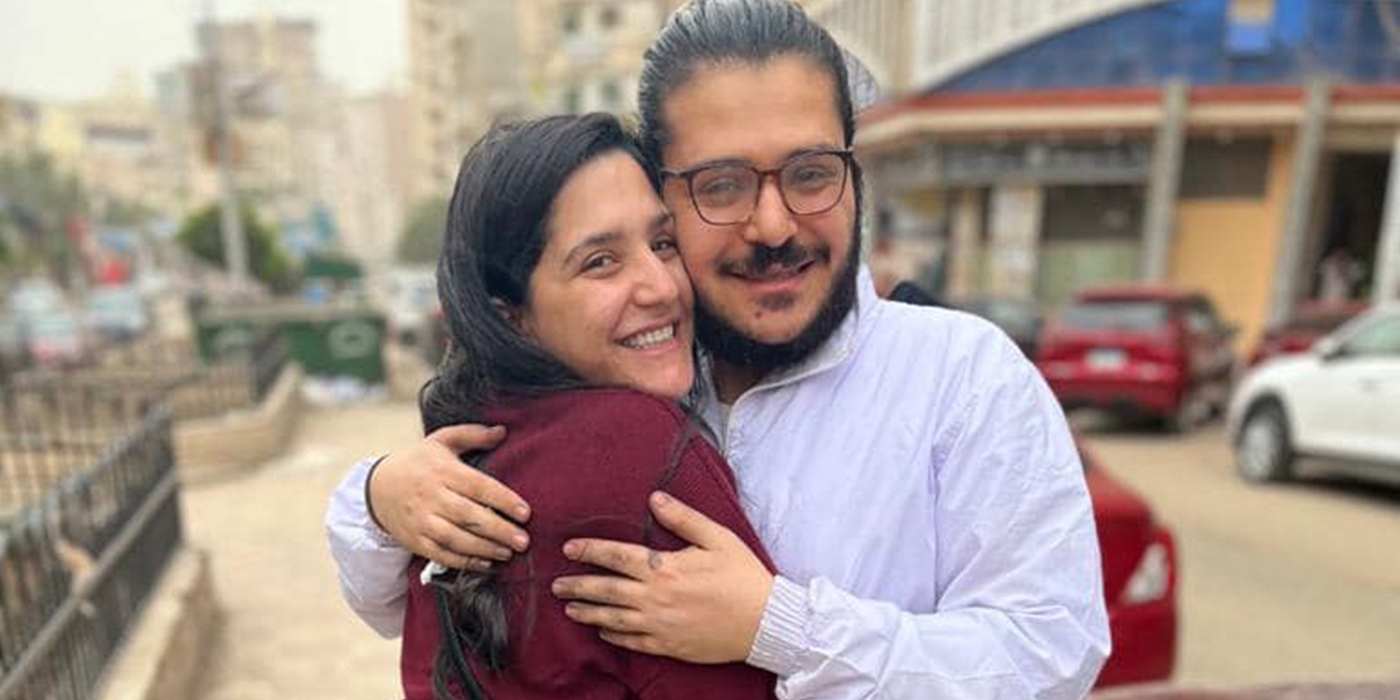
Patrick Zaki after his release on Wednesday 8 December 2021 (Screengrab/EIPR) By Areeb Ullah

Human rights activist Patrick Zaki was freed on Wednesday 8 December 2021, a day after Egypt’s Emergency State Security Misdemeanour Court ordered his provisional release. 

Zaki, a 28-year-old researcher at the Egyptian Initiative for Personal Rights (EIPR), had been studying at Italy’s Bologna University when he was taken into custody upon his return to Cairo in February 2020. Despite his release, he still faces a range of charges, including “calling for protests without permission”, “spreading false news” and “inciting violence and terrorism”. His trial will resume on 1 February 2022.

Tuesday’s hearing was the second time Zaki’s trial has been adjourned since the first session, on 14 September 2020. Human Rights Watch (HRW) told Middle East Eye that Zaki was subjected to physical torture in the days after his arrest.

Commenting on the court’s ruling for his release, Amr Magdi, Egypt researcher for HRW, described it as “rare happy news” for Patrick and his family. “Its a win with a bitter taste,” Magdi told MEE on Tuesday, pointing out that Zaki is technically still on trial as he has not been acquitted.

Zaki had been an outspoken campaigner for the truth about the 2016 murder of Italian student Giulio Regeni in Egypt. Zaki’s arrest sparked a solidarity campaign in Italy, with politicians and activists urging Egyptian authorities to release him.  Italian human rights campaigners have expressed concerns that Zaki could be at risk of torture and ill-treatment in Egypt’s notorious prisons, drawing parallels with the torture of Regeni.  Regeni’s family has also expressed solidarity with the detained activist.

In April, the Italian senate voted to approve a proposal by two lawmakers urging the government to grant Zaki Italian citizenship. Meanwhile, more than 50 Italian cities have announced the granting of “honorary citizenship” to Zaki. This was done, EIPR said, in order to show their appreciation for him as a human rights defender and to demand his immediate release in a campaign called 100 Cities with Patrick, launched by a group of human rights activists in Italy.

https://www.middleeasteye.net/news/egypt-patrick-zaki-released-italy-solidarity-regeni

https://www.middleeastmonitor.com/20220105-egypt-releases-3-prominent-political-prisoners-what-about-the-65000-others/

Human Rights Watch advises new German Government

December 22, 2021
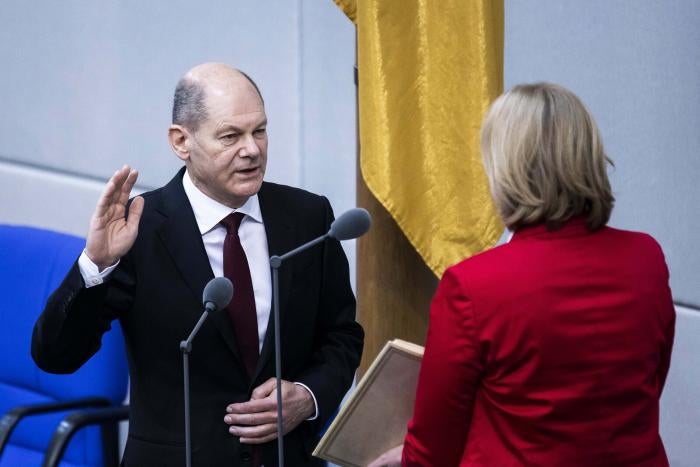
A man wearing a suit raises his right hand
Germany’s new Chancellor Olaf Scholz (left) and Baerbel Bas, President of the Bundestag, during the swearing-in of the new Federal Government in Berlin, December 8, 2021.  © 2021 Florian Gaertner/picture-alliance/dpa/AP Images

On 10 December 2021, David Fischer, HRW’s Media Coordinator, Germany published “A Human Rights Roadmap for Germany’s New Government

…The climate crisis threatens catastrophic impacts on human rights, and ambitious climate action by the government to reduce greenhouse gas emissions is critical if Germany – the European Union’s biggest greenhouse gas emitter – is to help prevent the worst of those impacts.  The new government’s coalition agreement, a non-binding roadmap for legislative action, calls for elimination of coal energy “ideally” by 2030, promises a roll-back of subsidies for fossil fuels and legislation to deal with climate change adaptation planning. These are positive steps but insufficient to reach Germany’s contribution toward the global goal in the Paris Agreement of limiting global warming to 1.5°C above pre-industrial levels.

In addition to the climate crisis, the new coalition between the Social Democrat Party (SPD), the Free Democrats (FDP) and the Greens (Die Grünen) will have to tackle challenges to the rule of law within the EU, stand up for human rights against autocrats in China and Russia, and address the many challenges arising from the pandemic.

The coalition agreement makes promising commitments to advance the rights of lesbian, gay, bisexual, and transgender (LGBT) people, including to change the law on legal gender recognition for transgender people so that it is based on self-determination. The coalition also commits to protecting human rights in supply chains in line with the UN Guiding Principles on Business and Human Rights that include the right to a remedy for victims. It proposes to increase the capacity of German courts to prosecute universal jurisdiction cases such as the trial on state-sponsored torture in Syria.

Within Europe, the new government intends to push for judgements of the European Court of Human Rights to have greater impact and “be implemented in all member states”. It supports the use of mechanisms and sanctions to enforce the rule of law in European Union member states. It also calls for shared responsibility for migrants and refugees among member states, an end to pushbacks at EU borders and for the border agency Frontex to respect human rights.

Scholz’s new government will now need to live up to expectations on human rights and prove that what the coalition dubbed “Germany’s responsibility for Europe and the World” is expressed in actions and not just words.

See also: https://www.justsecurity.org/79618/how-germanys-new-government-might-pursue-its-values-based-foreign-policy-in-europe/

https://www.hrw.org/news/2021/12/08/human-rights-roadmap-germanys-new-government

CALL FOR NOMINATIONS – Front Line Defenders 2022 Award for human rights defenders

December 22, 2021

Front Line Defenders is currently accepting nominations for the 2022 Front Line Defenders Award for Human Rights Defenders at Risk

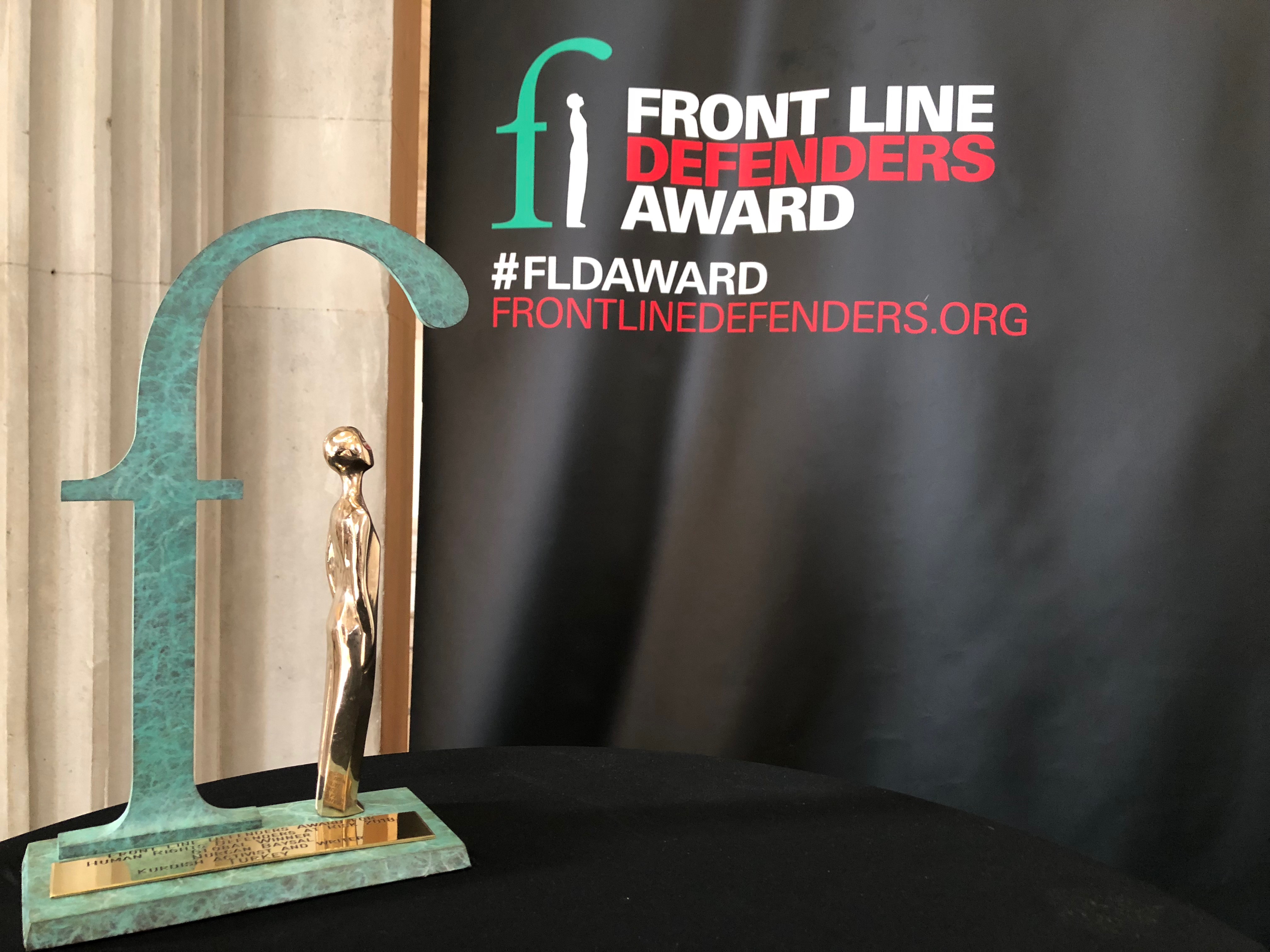
award banner

The annual Front Line Defenders Award was established in 2005. For more on this award and its laureates, see: https://www.trueheroesfilms.org/thedigest/awards/2E90A0F4-6DFE-497B-8C08-56F4E831B47D

In 2021, Front Line Defenders took the decision to name all 5 regional winners as Global Laureates. For each region of the world (Africa; Americas; Asia-Pacific; Europe & Central Asia; and Middle East & North Africa) there will be one winner selected and Front Line Defenders will recognize all five as the 2022 Front Line Defenders Award Laureates.

The nomination process is open for anyone to submit a nomination of a human rights defender, collective, organisation or community working on any human rights issue and facing significant risk due to their work or operating in an environment that itself is characterised as insecure. Winners will receive:

  • a modest financial prize;
  • a security grant to improve their security measures;
  • collaboration with Front Line Defenders for media work in recognition of the Award;
  • advocacy by Front Line Defenders related to the Award and the work of the winners;
  • an event co-organized by the HRD, local partners and Front Line Defenders to give visibility to the Award in the winners’ countries (as determined and guided by the winners);
  • the Global Laureates will attend a ceremony in Dublin at a date to be determined;
  • ongoing security consultation with Front Line Defenders

If you would like to nominate a HRD for the 2022 Front Line Defenders Award for Human Rights Defenders at Risk, please follow this link to the secure online nomination form 2022 Front Line Defenders Award – Nomination Form

Please submit nominations via the online form. If there are any problems using the form, or if you have any questions, please contact: campaigns@frontlinedefenders.org

Last year’s winners of the Front Line Defenders Award, see: https://humanrightsdefenders.blog/2021/12/14/front-line-defenders-award-for-human-rights-defenders-2021%EF%BF%BC/

https://www.frontlinedefenders.org/en/call-nominations-2022-front-line-defenders-award-human-rights-defenders-risk

Harassment of Adilur Rahman Khan and other Human Rights Defenders in Bangladesh

December 21, 2021

On 14 December 2021 a Statement Bangladesh: Stop Harassment of Human Rights Defenders” was published by Forum Asia, FIDH and other NGOs: “Bangladesh authorities must end the harassment of Adilur Rahman Khan and ASM Nasiruddin Elan, respectively Secretary and Director of the human rights group Odhikar, who have been targeted through the misuse of the criminal justice system”, eleven rights groups said.

On December 15, 2021, the Cyber Tribunal of Dhaka will continue the examination of prosecution witnesses in the case brought against Adilur Rahman Khan, also a member of OMCT General Assembly and FIDH Secretary-General, and ASM Nasiruddin Elan, for charges brought against them in Case No. 1 of 2013 under the notorious Section 57 of the Information and Communication Technology (ICT) Act, 2006 (amended in 2009), in relation to a fact-finding report issued by Odhikar on the killing of at least 61 people by security forces and law-enforcement agencies in May 2013. Khan and Elan face up to ten years in prison. See also; https://www.trueheroesfilms.org/thedigest/laureates/88F17E2F-F919-580F-2FDA-59B8E24ACBF6

The government should stop using vague laws to silence human rights defenders and start holding perpetrators of abuses to account, ” said Kerry Kennedy, President of Robert F. Kennedy Human Rights. “Odhikar’s findings not only should have led to investigations and reforms, but also should have been welcomed by the government as an opportunity to strengthen their commitment to upholding human rights.

Following Odhikar’s 2013 report, Khan and Elan were arbitrarily detained for respectively 62 and 25 days until they were both released on bail. On February 14, 2021, the Appellate Division of the Supreme Court of Bangladesh rejected Odhikar’s appeal to quash the case on its legal merits. On September 12, 2021, the Cyber Tribunal of Dhaka resumed the trial in the case against the two while their review petition is still pending hearing before the Appellate Division of the Supreme Court, contravening the right to a fair trial. On October 5, November 9, and November 24, 2021, the Cyber Tribunal of Dhaka started to examine prosecution witnesses in the case.

We express our deepest concern over the ongoing harassment of Adilur Rahman Khan and ASM Nasiruddin Elan, which is manifestly a form of reprisals against Odhikar for their legitimate human rights work, including for cooperating with UN human rights mechanisms in documenting enforced disappearances, extra-judicial executions and torture in Bangladesh.

It is further a matter of great concern that since 2013, attacks, unlawful surveillance, smear campaigns and harassment against Odhikar and its staff and management have been incessant. Odhikar is also facing serious difficulties to conduct its work due to violations of the right to freedom of association, since its registration has not been renewed by the NGO Affairs Bureau of the Government of Bangladesh and is still pending since 2015. Moreover, all of its bank accounts have been frozen and the organization has been forbidden from receiving funding from foreign or international sources, impacting its operations considerably.

The trial against Khan and Elan resumes in a context where human rights in Bangladesh are under attack from all sides. Human rights violations committed by security forces, including enforced disappearances, extrajudicial executions, and torture remain pervasive throughout the country, with absolute impunity. Authorities regularly crackdown on human rights defenders and journalists who speak out against these violations, including through the use of the Digital Security Act – 2018, the Special Powers Act – 1974, and other draconian laws. See also: https://humanrightsdefenders.blog/2014/12/02/adilur-rahman-khan-speaks-out-against-torture/

Cases such as these question the Bangladeshi government’s commitment to protecting human rights. The international community, including the United Nations and the diplomatic corps in Bangladesh, should monitor the case against Adilur Rahman Khan and ASM Nasiruddin Elan and take a clear stand to ensure that the government of Bangladesh respects the rights of the two defenders to a fair and public trial and, more generally, guarantees the right to defend human rights and puts an end to all acts of harassment against all human rights defenders in Bangladesh.

Our organisations call on the authorities of Bangladesh to immediately and unconditionally drop all charges against Adilur Rahman Khan and ASM Nasiruddin Elan, and to ensure in all circumstances that human rights defenders in Bangladesh are able to carry out their legitimate activities without any hindrance and fear of reprisals.

This trial is in reality an indictment of the authorities and a crucial test case for the country’s judiciary to be closely watched by the international community,” said Gerald Staberock, OMCT Secretary General, speaking on behalf of the Observatory. “The true culprits are those responsible for extra-judicial killings not those who report on it. Prosecuting human rights activists will not stifle dissent but will isolate Bangladesh from the international community.

The NGOs:

Amnesty International

Anti-Death Penalty Asia Network (ADPAN),

Asian Human Rights Commission (AHRC),

Asian Network for Free Elections

Capital Punishment Justice Project (CPJP)

CIVICUS: World Alliance for Citizen Participation,

Eleos Justice, Monash University, Associate Professor

FIDH, within the framework of the Observatory for the Protection of Human Rights Defenders, i

FORUM-ASIA

Robert F. Kennedy Human Rights

World Organisation Against Torture (OMCT), within the framework of the Observatory for the Protection of Human Rights Defenders

https://www.fidh.org/en/region/asia/bangladesh/bangladesh-government-must-act-to-address-rule-of-law-crisis

Alaa Abdel Fattah, and two others receive heavy prison sentences in Egypt

December 21, 2021

Egypt on Monday 20 December 2021 sentenced Alaa Abdel Fattah, a leading figure in the 2011 revolution, to five years in jail, with two others receiving four years, his sister Mona Seif and a judicial source said. [see also: https://humanrightsdefenders.blog/2020/08/06/re-issued-passionate-plea-for-help-in-open-letter-by-mona-seif-from-egypt-about-targeting-of-her-family/]

A computer programmer, blogger and high-profile activist who mobilized youths in the uprising that unseated autocrat Hosni Mubarak, Abdel Fattah had been in pre-trial detention since September 2019.

Abdel Fattah, his lawyer Mohamed al-Baqer and blogger Mohamed “Oxygen” Ibrahim were convicted of “broadcasting false news” in their trial in Cairo.

A judicial source, speaking on condition of anonymity, confirmed the verdict and sentencing to AFP.

Rulings in the court cannot be appealed. They require final approval by President Abdel Fattah al-Sisi.

Washington, which has already frozen 10 percent of its aid to Egypt over repeated rights violations, said it was “disappointed” by the sentence. “Journalists, human rights defenders, and others seeking to peacefully exercise their freedom of expression should be able to do so without facing criminal penalties, intimidation, harassment, or any other form of reprisal,” said State Department spokesman Ned Price.

The Committee to Protect Journalists decried Monday’s ruling as “unacceptable”.

The verdict “demonstrates the lengths to which authorities are willing to go to punish these journalists for their work”, said Sherif Mansour, CPJ’s Middle East and North Africa Coordinator. “Both journalists have already spent several years in prison on bogus charges, and authorities must release them immediately and unconditionally,” Mansour added.

Human Rights Watch on Sunday slammed “the government’s rush to use emergency courts… after holding people illegally for years in pretrial detention”. The New York-based rights watchdog then said that if Abdel Fattah and the other activists were to be sentenced, this would confirm “that fierce repression of peaceful critics remains the order of the day in Egypt”.

Abdel Fattah has spent most of the past decade in jail at Tora, one of the country’s most notorious prisons, after previous convictions. His mother, mathematics professor Laila Soueif, wrote in a New York Times opinion piece published on Saturday that “the outside world, once so inspired by the Egyptian revolutionaries, is looking away. His crime is that, like millions of young people in Egypt and far beyond, he believed another world was possible. And he dared to try to make it happen.

Prolific writer Abdel Fattah’s critically acclaimed essay collection “You Have Not Yet Been Defeated” was published in October.“At its fundamental core, his writing is attached to justice,” Soueif told AFP in October when the book was released.

Ahead of the trial session, Egypt’s foreign ministry lambasted the German government on Saturday for a statement calling for a “fair trial” and the release of the three dissidents. Cairo described the German foreign ministry’s call as “a blatant and unjustified meddling in Egyptian internal affairs”.

Rights groups say Egypt is holding some 60,000 political prisoners, many facing brutal conditions and overcrowded cells. See also: https://humanrightsdefenders.blog/2021/01/27/egypt-decade-after-arab-spring-amnesty-and-un-express-concern-over-detention/

In a 2019 interview with the show 60 Minutes on US broadcaster CBS, Sisi said there were no political prisoners in Egypt. And – of course – the official reaction to interventions was: Egypt’s foreign ministry stressed on Monday that it was absolutely not appropriate to comment on or in any way refer to an independent judicial process.

https://www.upi.com/Top_News/World-News/2021/12/20/Egypt-prison-sentences-three-activists-2011-uprising/9611640051667/

Franco-German Prize for Human Rights 2021

December 17, 2021

Germany and France honoured this year 15 people who have made outstanding contributions to the protection of human rights, campaigning for causes including women’s rights in Afghanistan, the freedom of the press in South Africa and children who are born as a result of rape in wartime.

On 10 December, international Human Rights Day, Foreign Minister Annalena Baerbock and French Foreign Minister Jean‑Yves Le Drian presented fifteen people with the Franco-German Prize for Human Rights. This award recognises the efforts of all those who work tirelessly every day to advance the causes of human rights and the rule of law. It is presented decentralised by the French and German missions in various locations around the world.

Chang Weiping a Chinese human rights lawyer.

Jake Epelle who works to combat the ongoing stigmatisation and discrimination faced by people with albinism in Nigeria.

Noelah Godfrey Msuya who promotes the rights of children and women in Tanzania.

Monika Borgmann who is a German-Lebanese documentary-maker.

Jacques Letang who is a judge and lawyer in Haiti.

Cristina Palabay from the Philippines who leads the national association Karapatan.

Alexandrine Victoire Saizonou who is an advocate for women’s and children’s rights in Benin.

Ajna Jusic from Bosnia discovered at the age of 15 that she was born as a result of rape during wartime, and since then she has advocated for others in the same situation.

Erika Lorena Aifán Dávila is a judge who has been the target of constant attacks from the authorities of Guatemala.

Nebahat Akkoc is the Managing Director of the NGO Kamer in Turkey.

The Venezuelan Education-Action Program on Human Rights or PROVEA.

Narges Mohammadi who is spokesperson and vice chairman of the Iranian organisation Defenders of Human Rights Center.

May Sabai Phyu is a Kachin activist from Myanmar/Burma.

Shaharzad Akbar is an Afghan human rights defender who campaigns in particular for the rights of women in Afghanistan.

Tabelo Timse is an investigative journalist and a member of an independent non‑profit media centre in South Africa.

https://www.auswaertiges-amt.de/en/aussenpolitik/themen/menschenrechte/franco-german-prize/2501086

Morocco’s extradition of Uyghur activist to China would violate international law

December 17, 2021

UN human rights experts called on Morocco’s government Thursday to halt a decision to extradite a Uyghur activist to China, where they said he risks facing severe human rights violations.

The experts said human rights defender Yidiresi Aishan, a Chinese Muslim and member of China’s Uyghur minority, faces risks such as arbitrary detention, enforced disappearance, torture, and other cruel, inhuman or degrading treatment or punishment.

This extradition process is happening without any form of individual examination and assessment of risks, which blatantly violates the absolute prohibition of refoulement under international human rights and refugee law,” they said in a statement.

Chinese authorities accused Aishan of joining a terrorist group, the East Turkestan Islamic Movement (ETIM), and carrying out or actively participating in activities within terrorist organizations under Article 120 of the Chinese Criminal Code.

The experts include Nils Melzer, the special rapporteur on torture and other inhuman treatment, Fionnuala Ni Aolain, the special rapporteur on protecting human rights while countering terrorism, and Mary Lawler, the special rapporteur on human rights defenders.

Aishan was arrested in Casablanca, based on a Red Notice issued by the International Criminal Police Organization (Interpol) on March 13, 2017. The warrant was suspended in August 2021. On Interpol see also: https://humanrightsdefenders.blog/2021/11/16/interpol-uae-major-general-and-chinese-public-security-official-are-not-good-candidates-for-interpol/

As an asylum seeker in Morocco, Aishan should be protected from any form of extradition or forced return to China until his refugee status is decided, they said. The experts emphasized that the existence of a bilateral agreement on extradition, or diplomatic assurances, do not release states from their obligations under international human rights and refugee law, in particular the principle of non-refoulment.

On 19 June 2022: https://www.hrw.org/news/2022/07/19/morocco-uyghur-activist-risk-extradition

https://www.rfa.org/english/news/uyghur/idris-hasan-12162021175312.html

EU launches a €1.5 billion 6-year plan to promote human rights and its defenders

December 17, 2021

w

On the eve of Human Rights Day (10 December 2021) and coinciding with the Summit for Democracy, the European Union launched the Global Europe Human Rights and Democracy programme. This programme, worth €1.5 billion, steps up EU support in promoting and protecting human rights and fundamental freedoms, democracy, and the rule of law and the work of civil society organisations and human rights defenders around the world during the period 2021–2027. The programme will promote and protect the universality of human rights, strengthen the rule of law and accountability for human rights violations and abuses, and defend the full and effective exercise of fundamental freedoms, including the freedom of expression, supporting independent journalism and media, while seizing opportunities and countering risks associated with digital and new technologies.

High Representative/Vice President Josep Borrell said: “Courageous people from all backgrounds are fighting on a daily basis for their civil liberties, for independent media and to safeguard democratic institutions, often at great personal risk. The European Union stands with them. The Global Europe Human Rights and Democracy programme will allow us to strengthen our support to and protection of universal human rights and democratic principles worldwide: for everyone, at any time and everywhere. Together with civil society organisations, human rights defenders, the UN Human Rights Office and the International Criminal Court, we will leave no one behind.”

International Partnerships Commissioner Jutta Urpilainen, said: “Human rights and democracy are a cornerstone of sustainable and inclusive development, and essential to addressing global challenges and ensure citizens reach their full potential and realise their aspirations. In whichever way you measure it – in stability, equality, economic growth, health or longevity – democracies always outperform other forms of government in the long run. I am proud to think of the countless human rights defenders, young people, women, girls and civil society organisations that the €1.5 billion Global Europe Human Rights and Democracy programme will empower to build a better tomorrow for all of us.

It has five overarching priorities:

  • Protecting and empowering individuals€704 million

Uphold all human rights, including by working towards the universal abolition of the death penalty, the eradication of torture and cruel and inhumane treatment, the fulfilment of basic needs, decent working conditions, the eradication of child labour, and a safe, clean, healthy and sustainable environment. The programme will promote equality, inclusion and respect for diversity, support human rights defenders and counter shrinking space for civil society, and strengthen the rule of law, ensure a fair and effective administration of justice, and close the accountability gap.

  • Building resilient, inclusive and democratic societies – €463 million

The programme will support functioning pluralist, participatory and representative democracies, and protect the integrity of electoral processes. It will, for instance, engage civil society observers in election observation and support pro-democracy organisations, networks and alliances.

  • Promoting a global system for human rights and democracy – €144 million

Enhance strategic partnerships with key actors, such as the Office of the UN High Commissioner for Human Rights (OHCHR), the International Criminal Court (ICC), regional human rights systems, national human rights institutions, the private sector, and the Global Campus of Human Rights.

  • Safeguarding fundamental freedoms, including harnessing the opportunities and addressing the challenges of digital and new technologies €195 million

Create and maintain an environment conducive to the full exercise of all fundamental freedoms both offline and online. For example, it will help strengthen the capacity of independent, pluralistic and quality media, including investigative journalists, bloggers and fact-checkers, to provide the public with reliable information through responsible and professional reporting. It will support civil society in fostering online media literacy and digital skills and in promoting an open, global, free and secure internet equally accessible to all.

  • Delivering by working together – €6.6 million

The earmarked funds can support the civil society in engaging with national authorities within the framework of the human rights dialogues that the EU conducts with partner countries, or finance training, studies, or exchanges of best practice. It underpins all of the activities.

In the first year of implementation, the EU will focus on promoting a global system for human rights and democracy. For example, in 2022–2024, the EU will support the Office of the United Nations High Commissioner for Human Rights with €16 million, the Global Campus of Human Rights with €10 million, and the International Criminal Court with €3 million. The EU will also support in 2022 the launch of a Team Europe Democracy initiative to reinforce the impact of EU and Member States’ global support to democracy. The 2021 action plan complements a number of urgent individual measures under the programme adopted earlier.

Background

The Global Europe Human Rights and Democracy programme is flexible as regards procedures, and supports civil society actions independently of the consent of partner countries’ governments and other public authorities. A substantial part of the programme will be implemented at country level. Subsequent calls for proposals covering the different activities, open to civil society organisations across the world, will be published in the coming months. See also: https://humanrightsdefenders.blog/2018/02/27/10611/

Funded under the thematic pillar of the new Neighbourhood, Development and International Cooperation Instrument (NDICI) – Global Europe, the Global Europe Human Rights and Democracy programme is the successor of the European Instrument for Democracy and Human Rights (EIDHR), which was established in 2006 to support civil society-led actions in the area of human rights and democracy in countries outside the EU. Under the previous financial period 2014–2020, the European Instrument for Democracy and Human Rights was allocated €1.33 billion.