Posts Tagged ‘women human rights defenders’
February 4, 2013
Ever since the monk Luon Sovath became the Laureate of the Martin Ennals Award 2012, I have following events in Cambodia with more than usual interest. And it is clear that the struggle for land rights there is continuing.
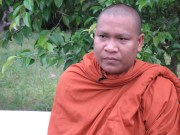
Luon Sovath by Dovona
Two Cambodian women human rights defenders were convicted on baseless charges in separate trials on 26/27 December 2012. Yorm Bopha was sentenced to three years in prison. Tim Sakmony from Borei Keila received a six-month sentence, partially suspended, and has been released.
Both women have been prominent in protesting against the forced eviction of their communities. Yorm Bopha was outspoken during the detention of 13 other women activists from Phnom Penh’s Boeung Kak Lake community, who were sentenced for up to two-and-a-half years’ imprisonment in May 2012. Tim Sakmony is one of the representatives of 106 families now living in tents next to the demolished site of the Borei Keila community, also in Phnom Penh. The two women are believed to have been targeted because of their leading roles in peacefully advocating for the right to adequate housing for their communities.
Further information: http://amnesty.org/en/library/info/ASA23/020/2012/en
In this context I want to draw attention to the film maker Chris Kelly and his colleagues. They have been filming in Cambodia for more than three and a half years, following the lives of three extraordinary individuals(including the Venerable Luon Sovath) caught up in the chaos and turmoil of Cambodia’s economic development. Now they are finished filming and starting the editing phase. They have launched a crowdfunding campaign to help raise funds towards the completion of the documentary.Please visit this link to see what they need to raise. If you cannot afford to donate, please help spread the word using your social media platforms, blogs, word of mouth or any other means that you can think of. http://www.blog.thecauseofprogress.com
Posted in human rights | Leave a Comment »
Tags: AI, Borei Keila, Cambodia, Chris Kelly, documentary, Human rights defender, Khmer Rouge, Land Law, Loun Sovath, Luon Sovath, Martin Ennals Award for Human Rights Defenders, MEA 2012, Phnom Penh, The Cause of Progress, Tim Sakmony, women human rights defenders, Yorm Bopha
January 26, 2013
The Association for Women’s Rights in Development (AWID) is seeking to hire a man-ager for its Women Human Rights Defenders Program (WHRD). Preferred location is Mexico (but flexible).
The application closing date is Sunday, February 24, 2012.
via Manager, Women Human Rights Defenders WHRD Program / Jobs at AWID / Get Involved / Home – AWID.
Posted in Human Rights Defenders | Leave a Comment »
Tags: AWID, job, job opportunity, manager, Mexico, vacancy, WHRD, women human rights defenders
January 24, 2013
The Observatory for the Protection of Human Rights Defenders, a joint programme of the FIDH and OMCT, received information from the local group “Voix des sans-voix pour les droits de l’Homme ” about serious threats against the HRD Philomène Muamba, President of ADDEF ( l’Association pour la défense des droits des enfants et femmes opprimés), based in Kasaï-Occidental. It seems that on 17 January at 03h00 in the morning 3 policemen and 2 military came to the house of Ms Philomène Muamba, in Tshikapa, without any written order. As she was not home, they expressed threats against her little sister. Philomène Muamba then lodged a complaint against X with both the military and civilian prosecutors in Tshikapa.
Since 2011 Philomène Muamba has received several death threats on the telephone along the lines that “you had us arrested and thought we were going to die in jail but …we will bury you”. In 2011 et 2012, she was indeed at the basis of a trial that had led to the conviction of persons who had been accused of several cases of rape. And one should note that on 17 January 2013 around 20h00 several detainees – including men mentioned above – had escaped from the central prison in Tshikapa.
The original report is only in French: http://www.omct.org/fr/human-rights-defenders/urgent-interventions/congo-dem-republic/2013/01/d22133/
Posted in FIDH, human rights, Human Rights Defenders, OMCT | Leave a Comment »
Tags: death threats, FIDH, Human rights defender, impunity, International Federation for Human Rights, Observatory, OMCT, Philomène Muamba, Protection of Human Rights Defenders, rape, Tshikapa, women human rights defenders, World Organisation Against Torture
December 22, 2012
The wicked never sleep but we are still going to have a short break around Christmas and will not bother you unless it is extremely urgent and pertinent. For those who want some more serious reading over the holidays I refer to the
interesting study on the state of affairs with regard to the protection of women human rights defenders made public by :

on http://urgent-responses.awid.org/index.php/Home
A concrete overview of its work is on behalf of women human rights defenders is included in: study on women HRDs and urgent responses
With this I wish you a pleasant holiday
Posted in human rights, Human Rights Defenders | Leave a Comment »
Tags: Advocacy Organizations, AWID, Christmas, human rights, Human Rights and Liberties, Human Rights Defenders, United Nations Special Rapporteur, urgent, women human rights defenders
November 26, 2012
In her report, the Special Rapporteur reviews the types of legislation affecting the work of HRDs, including laws relating to: anti-terrorism and national security; public morals; the registration, functioning and funding of associations; access to information and official-secrets; defamation and blasphemy; and Internet access. While all of these categories are relevant, the AWID document looks at how four of these practices affect Women Human Rights Defenders (WHRDs).
Anti-terrorism and national security WHRDs in Zimbabwe have continually denounced arbitrary arrests and violations of the right to peaceful assembly. The increase in Governments that use anti-terrorism and/or national security laws to detain, prosecute, convict, and harass WHRDs is a worldwide concern. According to the Special Rapporteur, this type of legislation is “so broad that any peaceful act expressing views of dissent would fall under the definition of a terrorist act, or an act facilitating, supporting or promoting terrorism”.
Public morals In Meso-America, WHRDs working to promote women’s sexual and reproductive rights and the decriminalization of abortion[3] are the ones who most often experience criminalization and defamation by the State, private groups and the media. The Special Rapporteur’s report strongly emphasises how vital sexual health and reproductive rights (SHRR) defenders are for the promotion, protection and respect of women’s human rights, highlighting that “ these activities should not be subject to criminal sanction”. Zero tolerance for judicial harassment against SHRR defenders is called for, and States with legal frameworks guaranteeing SHRR should “ensure that such legislation is enforced without discrimination”.
Legal restrictions on operations Increasingly, States are issuing special regulations that affect the legal operation of women’s organizations in ways that are intended to inhibit their work. The 2005 report Written Out: How Sexuality is Used to Attack Women’s Organizing states that “after the attacks of 9/11, the US government put into place a set of supposedly terrorism-related legal and financial restrictions for any organization that funds groups outside the US. Under these policies, such funding organizations now have to prove that the groups receiving funds are not in any way engaging in terrorist activities”.
Defamation Although defamation legislation is intended to protect a person’s reputation from false and malicious attacks, legal frameworks under the umbrella of defamation tend to hide political or economic interests in order to retaliate against criticism and public denouncement of corruption. While defamation laws rarely protect WHRDs from defamation, they are often used to limit the freedom of expression of WHRDs. The Meso-American Assessment of Violence against WHRDs states that defamation is “one of the most repeated forms of violence against WHRDs in the region, either by the state, private groups and the media”. The Special Rapporteur’s report highlights that penalties are imposed on WHRDs who criticize Government representatives or religious laws. Under penal codes for defamation or blasphemy penalties vary from fines to months of imprisonment. These provisions prevent WHRDs from holding public officials or religious leaders accountable.
The Special Rapporteur raises concern about the development of legislation that allows authorities to supervise the activities of civil society organizations (CSOs). The report refers to confidential information received by the Special Rapporteur that points to how reporting requirements have been imposed on CSOs to retain their licence to operate, placing surveillance on CSOs, demanding documentation without prior notice, and restricting access to foreign funding and limiting this to up to 10% of their total annual income. Similarly, restrictions on certain areas of work have been imposed on women’s rights organizations, in particular those related to defending political rights and those that use human rights language in their organizations’ objectives. Excessive requirements for operating legally make it difficult for WHRDs to comply, and in some instances the required documentation puts WHRDs at risk. This trend of legal control and restriction undermines and delegitimizes the work of WHRDs and their organizations, as the resources and time required to respond to such demands deter women’s rights advocates from forming organizations.
Recommendations The 26 recommendations presented in the Special Rapporteur’s report aim at ensuring that national legislations comply with basic human rights enshrined in their constitutions – and consistent with the Declaration on HRDs – to create favourable working environments for HRDs. Special attention is needed regarding legislation that responds to the needs and situations of WHRDs, in particular those working on SHRR. The report makes an important call for States to “repeal all legislation that, with the declared objective of preserving public morals, criminalizes the activities of HRDs working on sexual orientation and gender identity issues”. Importantly, the Special Rapporteur’s recommendation to “ensure that civil society, national human rights institutions and other stakeholders are involved in a broad consultative process to ensure that the drafting of new legislation is in compliance with the Declaration on Human Rights Defenders and other applicable international human rights instruments”, is critical to guarantee the inclusion and full participation of WHRDs in civil society.
for details see: http://www.awid.org/News-Analysis/Friday-Files/When-States-Use-Legislation-Against-Women-Human-Rights-Defenders
Posted in human rights | Leave a Comment »
Tags: AWID, Civil society, human rights, Human Rights and Liberties, Human Rights Council, Human rights defender, Special Rapporteur on the situation of human rights defenders, UN, UN Special Rapporteur, United Nations Special Rapporteur, women human rights defenders
November 23, 2012
PBI UK put on VIMEO an interesting panel discussion on Women Human Rights Defenders. It is over an hour long and you need good broadband access to see it properly.
Panellists:
Chair: Dr Sarah Wollaston MP (5 mins)
1. Jivka Petkova, Gender Advisor on Human Rights and Democracy, European External Action Service. “Protecting and supporting WHRDs through the EU.”
2. Dolores Infante, Assistant to the UN Special Rapporteur on HRDs. “An overview of the work of the Special Rapporteur’s office on addressing risks faced by WHRDs.”
3. Kathryn Lockett, Advisor, Violence Against Women and Girls, Conflict, Humanitarian and Security Department, DFID. “DFID’s work on tackling Violence Against Women and Girls: the role of WHRDs”.
4. Amy Clemitshaw, Deputy Head of Human Rights and Democracy Department, FCO. “The UK’s use of the EU human rights guidelines overseas to support human rights defenders.”
Panel 1 – Women human rights defenders: Empowering and protecting the change-makers on Vimeo on Vimeo
Posted in films, Human Rights Defenders | Leave a Comment »
Tags: Human Rights Defenders, PBI, policy, protection, video, Vimeo, women human rights defenders
November 8, 2012
Women human rights defenders in Dhanusha, a district in Nepal’s southern Terai region, are often subjected to threats and attacks due to their work. In the summer of 2010, Peace Brigades International, a non-governental organization working for the protection of Nepalese human rights defenders since 2006, visited Dhanusha to profile their struggles, as well as to bring to light the special needs of women human rights defenders across Nepal.
“Carrying the Ideal: Women Human Rights Defenders” documents the courageous and often dangerous work of women defenders carried out in a climate of impunity and injustice and in a social strata supportive of caste and gender discrimination.
via “Carrying the Ideal” English on Vimeo.
Posted in films, human rights, Human Rights Defenders | Leave a Comment »
Tags: Dhanusha, Human Rights Defenders, impunity, Nepal, PBI, Peace Brigades International, video, Vimeo, women human rights defenders
October 26, 2012
On 14 October 2012, TV channel LTR broadcast a program in which human rights defender Ms Tolekan Ismailova was depicted as spreading propaganda for homosexuality in Kyrgyzstan and being destructive to Kyrgyz values. Similar accusations were published in several Kyrgyz-language newspapers. Ms Tolekan Ismailova is the director of Human Rights Centre ‘Citizens Against Corruption’. These accusations refer to the documentary ‘I Am Gay and Muslim’, which was part of the human rights film festival Bir Duyno – Kyrgyzstan (One World Kyrgyzstan), organised annually in Bishkek. The documentary was scheduled to be shown on 28 September 2012 in Bishkek. The film explores the problematic issue of gay rights in the Islamic world, taking the example of Moroccan young men who speak about their sexual and religious identity.
On 26 September 2012, the organisers of the festival had received phone calls and text messages threatening them with physical harm while the director of the cinema was threatened that the building would be set on fire unless the film’s screening was cancelled. Dublin-based Front Line Defenders condemns the smear campaign and threats against Ms Tolekan Ismailova and the other organisers of the human rights festival, and is concerned for their physical and psychological integrity and security.
For actions see: https://www.frontlinedefenders.org/node/20249/action
This information was received through the International Secretariat of Women Human Rights Defenders International Coalition.
Posted in human rights | Leave a Comment »
Tags: Bishkek, Citizens Against Corruption, film festival, Front Line (NGO), human rights, Human Rights Defenders, Kyrgyzstan, LGBT rights, Tolekan Ismailova, women human rights defenders
October 26, 2012
CIVICUS (a worldwide civil society alliance) wrote on 17 October 2012 a letter to the UN Special Rapporteur on Human Rights Defenders, Mrs. Margaret Sekaggya. Triggered by the recent shooting of the girl Malala Yousafzai, the letter details other such attacks on women HRDs in Pakistan.
for the full text go to:
CIVICUS Letter to the Special Rapporteur on Human Rights Defenders.
Posted in human rights, Human Rights Defenders | Leave a Comment »
Tags: CIVICUS, Civil society, Human Rights Defenders, Malala Yousafzai, Margaret Sekaggya, Pakistan, United Nations Special Rapporteur, women human rights defenders
July 2, 2012
The UN High commissioner of Human Rights has hardly left the country and the regime shows its true nature by arresting a groups of peaceful demonstrators.
The Observatory for the Protection of Human Rights Defenders has been informed by reliable sources about the repression of a peaceful demonstration organised by Women and Men of Zimbabwe Arise (WOZA), a civic movement that defends women’s rights and freedoms in Zimbabwe.
According to the information received, on June 27, 2012 in the morning, 101 members of WOZA were arrested in the centre of Bulawayo, where protests were due to start at 11.00 a.m in ten different locations. All were taken to Bulawayo Central Police Station, many of whom handcuffed. Their lawyers were denied access to their clients on three occasions. The 101 were released without charges between 4.30 p.m. and 5.30 p.m. on the same day, in batches of 5 people so as to prevent any mass protests.
Previously, on June 26, 2012, eight members of the Zimbabwe Human Rights Association (ZimRights) were also arrested in Bulawayo as they were on their way back from a workshop to commemorate the 2012 United Nations International Day in Respect of Victims of Torture. They were also detained at Bulawayo Central Police Station for an hour, before being released without charges.
On the same day in Karoi, four other members of ZimRights were briefly detained before being released without charges.
The Observatory, a joint programme of the International Federation for Human Rights (FIDH) and the World Organisation Against Torture (OMCT), expresses its deepest concern about the increasing obstacles to freedom of assembly, refers these cases to the United Nations Special Rapporteurs and requests urgent intervention by all. For action modalities go to:
Zimbabwe: Arbitrary arrests of WOZA peaceful demonstrators / June 29, 2012 / Urgent Interventions / Human rights defenders / OMCT.
Posted in FIDH, human rights, Human Rights Defenders, OMCT, UN | Leave a Comment »
Tags: arbitrary arrest, Human Rights Defenders, Office of the United Nations High Commissioner for Human Rights, women human rights defenders, WOZA, Zimbabwe, ZimRights
 Hans Thoolen on Human Rights Defenders and their awards