On Tuesday 12 March 2020 Asharq al-Awsat reported – somewhat garbled – that Tahani Abbas, a Sudanese human rights activist, was awarded “the Martin Institute Prize in Switzerland.” The newspaper surely meant: the Martine Anstett Prize for Human Rights (see: http://www.trueheroesfilms.org/thedigest/awards/martine-anstett-human-rights-prize).
Ms. Abbas told Asharq Al-Awsat that she was proud to receive the prize and because it embodies the distant world’s perception of the Sudanese people’s struggle and shows that the world is watching out for human rights. She went on to say that “personally, the award credits me with a strong role with regards to defending human rights and makes me feel that our efforts and positions in the defense of human rights are appreciated and did not go in vain.” In her acceptance speech, Abbas stressed that all Sudanese women qualify to stand in her place and receive the prize, adding that “I am only a miniature and symbolic example that personifies that struggle of all the women of Sudan. I am an extension of Sudan’s feminist struggle, which is deeply ingrained in its history since before the era of the Kandakes or Nubian Queens, passing through Mendi, daughter of the Sultan Ajabna, and reaching the icon of the Sudanese revolution, Alaa Salah.”
Despite the admiration of observers and the organizers of the prize for the role of Sudanese women in the revolution, Abbas demonstrated her anger at what she calls “women’s weak political participation of after the revolution”. However, she says “Despite being denied political participation after the success of the revolution, our struggle will not stop.” Abbas has been an active human rights defender since 2009 and is a member of many Sudanese feminist and human rights groups. She is a member of the executive committee of the Regional Alliance of Women Human Rights Defenders of North Africa and the Middle East, a member of the executive committee of the No to the Oppression of Sudanese Women Initiative, the My Fair Home campaign which is concerned with domestic workers, the I am Sudanese, which is concerned with nationality and a member of the Sudanese Alliance to End Child Marriage.
In her assessment of the human rights situation in Sudan after the revolution, she says that it has improved a lot as per international standards. She said: ”The reports of international human rights organizations demonstrate this, and, locally, we feel that, as human rights defenders, we have achieved some victories.”
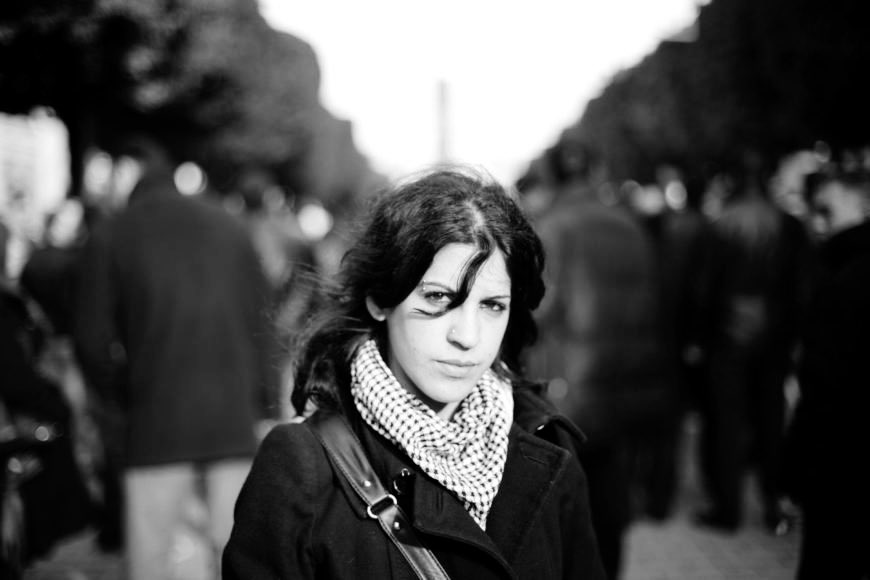
On 28 January 2020 The Human Rights Foundation in New York expressed its sadness at the passing of Tunisian activist, journalist, and educator Lina Ben Mhenni, after a long battle with a chronic illness (1983-2020).
“Lina was a force who fought tenaciously until her last breath. She fought censorship, corruption, and human rights abuses, all while grappling with serious illness. But nothing stood in her way. Her voice and cause will resonate with generations to come,” said Thor Halvorssen, president of HRF. “She will forever be an inspiration to all of us at HRF and in the Oslo Freedom Forum community to never give up even in the darkest moments. We will truly miss our beloved friend Lina.”
Lina was one of the only Tunisians to criticize the repressive government openly on international broadcasts before the Jasmine Revolution began in 2011. She is often described as one of the bravest bloggers in the world, whose work was instrumental in documenting, informing, and mobilizing citizens during the Revolution. Lina’s impactful achievements led her to be nominated for the 2011 Nobel Peace Prize. She authored and published a book the same year entitled, “Tunisian Girl: A Blogger for an Arab Spring.” Much of her writing was focused on freedom of expression and rights of women and students in Tunisia.
“Lina’s life experiences went beyond her 36 years. Many people know about Lina – whether through the media or different social platforms – but no amount of reporting on her could do justice to the values and principles for which she fought during Tunisia’s era of tyranny and after the Revolution,” said Aymen Zaghdoudi, MENA Legal Advisor at Article 19 in Tunisia. “Lina stood with the weak, the deprived, and the oppressed – even at the expense of her own health – and turned her pain into inspiration and hope for those around her.”
Lina spoke at the 2011 Oslo Freedom Forum, urging the outside world to continue to pay attention to events in Tunisia and other Arab countries where recent revolutions appeared to have ended. Upon joining the HRF community that year, she was actively involved in the discussions unfolding about the Arab Spring.
In recent years, Lina continued to press for human rights and continued democratic reform. In 2016, she started a campaign called “Books to Prison,” to counter extremism within Tunisia’s prisons. She was inspired by her father, who was a political prisoner, and had once told her that prisoners had so little to read to change their minds or be inspired. By November 2019, her campaign had collected more than 45,000 books, helping to free the minds of tens of thousands of people. Apart from her calls for democratic reform, Lina taught linguistics at a university in Tunisia and was a professional translator. She also brought awareness to the issue of organ donation and after a kidney transplant, amazingly received silver medals in the World Transplant Games.
You can read Lina Ben Mhenni’s blog “A Tunisian Girl” here.
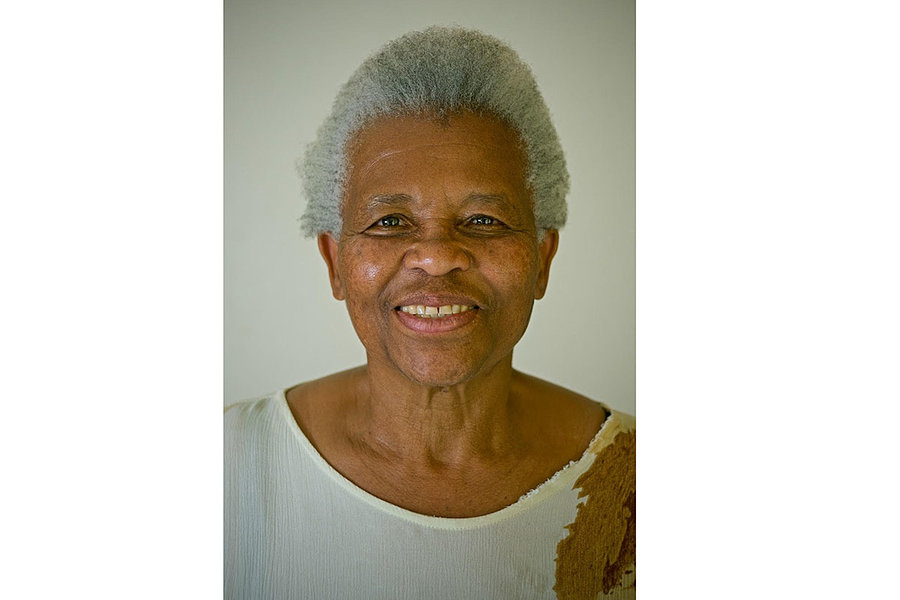
The first inkling Sizani Ngubane had that she might grow up to be an activist came when she was just 6 years old. It was the early 1950s, and while her father, a migrant worker, was away from the family home near the eastern city of Pietermaritzburg, his brother evicted her mother from their land. “You’re a woman,” she remembers her uncle telling her mother, “so you have no right to this property if your husband isn’t around. Those were the early years of apartheid, South Africa’s infamous system of white minority rule, and a woman like Ms. Ngubane’s mother had few places to turn. The white government wasn’t likely to be on her side, and neither were the men in charge in her own community. At 6, of course, Ms. Ngubane didn’t know exactly what was happening, but her mother’s humiliation told her all she needed to know. “From that experience I just said to myself, when I grow up I want to be part of the people who are going to correct these wrongs,” she says.
In the 70 years since, indeed, she has become the voice for tens of thousands of women like her mother. In the late 1990s, Ms. Ngubane was a founding member of the Rural Women’s Movement, which today counts some 50,000 members. Among other work, the organization fights to make sure women have access to, and ownership over, the land on which they live and work. This has been a major challenge in many rural areas under the authority of semi-autonomous traditional chieftaincies that were originally set up by the apartheid and colonial governments. These leaders have often been reticent to give more rights to women. As South Africa’s government mulls over whether to expropriate some land from white owners and return it to the country’s black majority, her work has become all the more urgent – and complicated.
Ms. Ngubane spoke by phone with the Monitor’s Johannesburg bureau chief Ryan Lenora Brown about why land is so important in South Africa, and what keeps her going as an activist.
Since the start of democracy in South Africa, there’s been a program to provide land or money to people who were stripped of their land during the colonial or apartheid periods. But it’s moved slowly, and over the last few years, there’s been a lot of talk about expropriating land – that is to say, redistributing the land, whether current landowners want that or not. What do you think of that idea? And do you think it will really happen?
I support it. A large percentage of South African arable land is still in the hands of white people, even though they are a small minority in this country. How equal is that? How constitutional is that? But the problem now is that our government is not really doing anything about it. They promised us in the 1990s that by 2014 they would have redistributed 30% of land into hands of original users. I say users and not owners because in our culture land is not owned. Mother Nature was not a commodity that could be bought and sold. But only about 10% of that land has been returned to date. So I think those promises were politically motivated to get people to come out and vote in elections. I don’t see real transformation of the land situation happening anytime soon.
Why is access to land so important for South African women in particular?
When you begin to give land to women, a lot of abuses in society are eliminated. They can feed their own families without fear of being evicted. They can inherit land when their male relatives die. And most importantly, they are not so controlled by the men in their lives. Because when land is the main value of a society and women cannot own land, we are nothing. We are not 100% human beings. It is easy to abuse and abandon us. So the land is the only way out for us.
What is the accomplishment you’re most proud of?
The thing I’m most proud of isn’t necessarily any legal battle we’ve won. It’s the fact that before we started this movement women in many rural communities were not empowered to speak. Now we see our women speaking up for their rights, even at national and international levels. And no one tells them to shut up, because we have taught them that this is our constitutional right. [The men] know they must listen.
You’ve been an activist for nearly six decades. And there are still more battles to be fought. Right now, for instance, you’re preparing to go to court as part of a challenge against the Ingonyama Trust, an organization run by the Zulu king Goodwill Zwelithini that controls an area in eastern South Africa the size of Belgium. I’m wondering what keeps you going through battles like this one.
It comes from my heart. From when I was 6 years old I knew exactly what I was going to do with my life. Don’t ask me how exactly I knew there was a world outside that rural community where I grew up. The only other place I had ever seen was the city of Pietermaritzburg [10 miles away], where I went once a year with my mother to buy school shoes. But somehow I knew even then I was going to grow up to see the world, and learn from it. And that’s exactly what I’ve done.
——
On 28 November 2019 Kim Harrisberg reports for the Thomson Reuters Foundation about the “Death-Defying South African Nominated for International Human Rights Award“. A South African women’s land rights activist who has been stabbed with a knife, slapped with a gun and hit by a speeding car and those are just a few of the murder attempts on Sizani Ngubane who is currently in hiding to prevent further attempts on her long life of activism.
“We cannot separate women’s land rights from gender based violence in South Africa,” said the 74-year-old activist who frequently champions women’s access to land in rural KwaZulu-Natal (KZN) province. “We are celebrating 25 years of democracy, but rural women are still treated like children. It is not in line with our constitution,” Ngubane, founder of the Rural Women’s Movement (RWM) land rights group, said in a phone interview.
Land is a hot topic in South Africa, where President Cyril Ramaphosa last year launched a process to change the constitution with a proposed redistribution of land aimed at addressing high levels of inequality. But in KZN, Zulu King Goodwill Zwelithini controls 2.8 million hectares of land, a fragmented sub-tropical area the size of Belgium, under an entity called the Ingonyama Trust established in 1994. The Zulu monarch wants President Cyril Ramaphosa to sign an agreement promising to exclude territories that the king controls from land reform.
Land rights activists are challenging the control wielded by such traditional authorities over rural communities, particularly on women who are often evicted once widowed. “The trust has turned communities into tenants by leasing ancestral land to them,” said Ngubane, adding that a compulsory rent, rising 10% every year, had to be paid by community members who otherwise face eviction.
Ngubane, along with rights groups, is challenging the Ingonyama Trust in Pietermaritzburg High Court in March 2020. The work of the Rural Women’s Movement includes finding housing for evicted women and children, helping grow food on communal land for the hungry and sick, campaigning for better legal protection of women’s land rights and more. “We are like one big family,” Ngubane said. “We have now begun to spread our wings into different parts of the country.” Launched in 1998, the Rural Women’s Movement has grown to 50,000 women, said Ngubane.
Ngubane said there was retaliation and danger involved in challenging the traditional authorities, citing burnings, kidnappings and beatings of outspoken women and men. “My dream is that one day KwaZulu-Natal will be like other provinces, where women’s rights are seen as human rights and women are given the same power over land that men are keeping for themselves,” Ngubane said.
Miroslava Breachlived under constant threat starting in March 2016, when she began to feel pressure over her publications regarding links between drug cartels and politics. She brought this to the attention of her old friend, the recently elected governor of Chihuahua state Javier Corral, as well as those in charge of the mechanisms at the federal level to protect journalists. The Colectivo 23 de Marzo is made up of Mexican journalists in collaboration with Forbidden Stories, Bellingcat and Centro Latinoamericano de Investigaciones Periodísticas (CLIP). We reconstructed the thread of threats linked to Miroslava’s work, the warnings that she raised about the danger she was in, and the clues that she let in her publications prior to her murder on March 23 2017 that the authorities did not fully investigate.
Miroslava Breach in the Tarahumara sierra. She investigated illegal logging, the effects of megaprojects, and narcopolitics. Source: Colectivo 23 de Marzo
Before her murder, a grey Malibu prowled down José María Mata street in the Granjas neighbourhood of Chihuahua. Security cameras captured the vehicle on the street six times between March 21 and 22 2017 as it passed in front of the two-story house now infamous for the murder: number 1609, with its brown gates and a small garden out front. On the morning of March 23, 2017, journalist Miroslava Breach Velducea was shot to death while waiting inside her car to take her son to school.…….
Ezega.com reported on 6 November 2019 the deatch of the highly-awarded woman human rights defender Bogaletch Gebre, founder of KMG Ethiopia (Kembatti Menotti Gezzima-Tope).
Bogaletch Gebre was a victim of female genital mutilation at the age of 12 and was forbidden from joining formal education, which forced her to sneak out of her home to attend a missionary school that paved the way for her to be what she became. Following her elementary years at the Missionary school, Bogalech Gebre attended various local schools as well as some prestigious Higher Education Institutions abroad.
In an interview with ETV, she said the trauma of FGM took her years to recuperate and she suffered complications from it years later. It wasn’t during her youth years Bogaletch Gebre learned more about what had happened to her and her family because of FGM. At the time Bogalech was a graduate student in the United States. When Bogaletch Gebre found out that FGM was needless and harmful practice, she became incensed. She eventually left her PhD program in epidemiology at the University of California, Los Angeles, and in 1995 she returned to Kembata Tembaro, her hometown in Ethiopia.
In 1997 she and her younger sister started KMG, an indigenous Resident Charity Organization with the goal of helping to create an environment where the values and rights of women are recognized and where their talents and wisdom are nurtured. The organization was founded with the two sister’s belief that if women are empowered and their talents nurtured, the lives of both men and women would improve.
Bogalech Gebre along with her sister began implementing their plans in the region of Kembatta – Tembaro. The organization they founded is now diversified its scope and operates in additional 24 of Southern Nations Nationalities and People’s Regional State (SNNPRS) and Oromia district, reaching out to more than 481,289 direct and 2,859,500 indirect beneficiaries, 70% of whom are women.
The realization of their effort has protected many girls from going through lasting complications. Bogalech Gebere believed and spoke about the need for a change and bringing together all communities, women, and men to make informed decisions.
In 2010, the Independent newspaper characterized her as “the woman who began the rebellion of Ethiopian women.” In particular, the Independent report praised her for KMG’s strong commitment to reduce the rate of bridal abductions in Kembatta and FGM. Bogalech Gebre was awarded the 2005 North-South Prize, in 2007 the Jonathan Mann Award for Global Health and Human Rights and in 2013 both the Bruno Kreisky Award and he King Baudouin International Development Prize.
Dr. Widad Akreyi at the award ceremony for the 2018 International Woman Harmony Award, Cortona, Italy, Nov. 23, 2018.
On 12 June 2019 Marta Bellingreri (an Italian writer, Arabist and cultural mediator. is the author of two books about Lampedusa and minor migrants in Tunisia, France and Italy) wrote a profile of Dr. Widad Akreyi, who lived through the 1980s Anfal genocide and the 2014 Yazidi genocide, and has become one of the major defenders of human rights in Iraq and beyond.
Asma Jahangir is rightly considered one of the foremost human rights defenders of our time [see: https://humanrightsdefenders.blog/2018/02/11/asma-jahangir-one-of-the-worlds-most-outstanding-human-rights-defenders-dies-at-age-66/]. So, the two-day ‘Asma Jahangir Conference 2019 – Roadmap for Human Rights’ which concluded in Lahore, Pakistan on 20 October 2019 is fully justified. The News carries a long report on the meeting in which some 120 jurists, politicians, human rights defenders and media people acted as panellists from Pakistan, England, America, Sri Lanka, Bangladesh, Ireland, Sweden and Afghanistan. Thousands of students, attended the sessions. They all resolved to carry forward the legacy of Asma Jahangir, who fought relentlessly against dictatorial forces and always sought due process of law, equality for women and protection of minorities in the country.
(Former) Politicians dominated the panels but other speakers at the sessions paid tribute to Asma Jahangir and appreciated her commitment to human rights with a resolve to uphold the rule of law and struggle for women’s rights. Munaza Hassan spoke of women’s right to inheritance. Daughter of Asma Jahangir and journalist Munizae Jahangir, who conducted the session, said: “It is a rare moment when all political parties are seen on the same platform.” She said that politicians conveniently forget to protect fundamental rights and right to expression when in they assume power. She said: “We are convinced that without freedom of the media, the rule of law and guarantees of security to human rights defenders, neither democracy nor justice, is possible. The main challenge to development of Pakistan and the rights of its citizens is a national security state. Until the national security is subservient, no other initiative in economy, health, education and rule of law can find success.
The day began with a short film on Asma Jahangir receiving the Right Livelihood Award, produced by True Heroes Films, where she spoke of growing expectations of citizens as far as what the governments should deliver. And governments falling ever further behind, internationally this gap of creative impulses of society on one side and governments dragging their feet on the other, has been the key engine of human rights challenges. Despite threats to her life, she spoke of never leaving Pakistan as it is a place where she has received most love and affection.
As a continuation of the discussion on ‘Art inspires politics’, Munizae Jahangir conducted a panel discussion on ‘How women can build bridges for peace in South Asia’. Former foreign minister Hina Rabbani Khar, Afghan politician Fawzia Koofi, human rights lawyer from Sri Lanka Bhavani Fonseka, Swedish Ambassador Ingrid Johansson and former Afghan ambassador to Pakistan Omar Zakhilwal opined that peace in South Asia was a prerequisite to securing women’s fundamental rights and the resources should be directed towards socio-economic areas rather than the military. Human Rights Ambassador of the Kingdom of the Netherlands, H. E. Dr Bahia Tahzib-Lie, Award-winning novelist Mohammad Hanif, Christian Caryl of the Washington Post, Wusat Ullah Khan, Ms Aisha Sarwari and Iqbal Khattak participated in the discussion on the role of social media.
Dr Bahia talked about the centrality of human rights in a thriving democratic society, and also the role of her government in supporting human rights initiatives all-over the world, including Pakistan. Aisha Sarwari talked about how women are systematically excluded from law-making process and, therefore, law-making concerning social media. She said it is essential for the social and economic development of all countries for women to be able to use the media as disruptive technology and end permission culture. Wusat Ullah Khan mentioned that the social media gives space to freedom, but also makes people extremely vulnerable. He said freedom of speech is part of a bouquet – you cannot talk about freedom of speech without talking about right to life and education and freedom of religion.
Iqbal Khattak, country representative of Reporters without Borders (RSF), spoke about the need for digital safety training and how one should protect oneself by disengaging with trolls. He particularly highlighted threats, accusations of blasphemy as threats that should be taken very seriously. He strongly encouraged use of PICA laws for individuals to seek online protection. He also highlighted Pakistan’s considerable investment in controlling social media spaces and vigilance on part of civil society. The Government of Pakistan should take social media as fundamental right.
On fighting the culture of shame and silence, woman rights activist Uzma Noorani, British professor of human rights Ms Siobhan Mullally, provincial Ombudsperson Khyber-Pakhtunkhwa Rukshanda Naz, Pakistan People’s Party leader Nafisa Shah, former chairperson of the Punjab Commission on the Status of Women Fouzia Viqar said that there should be universality of rights, for all excluded communities including women and marginalised remote communities.
..
On ‘Silencing civil society’, Ms Fareeda Shahid moderated the session of Knut Ostby, United Nations Resident and Humanitarian Coordinator for Pakistan. Ms Zohra Yusuf, human rights activist and council member of HRCP, Mohammad Tehsin, convener of Pakistan Civil Society National Forum, law expert Asad Jamal said registered civil society organisations should be allowed to function, 2013 policy of banning CSOs should be challenged. Mass communication needed to change narratives.
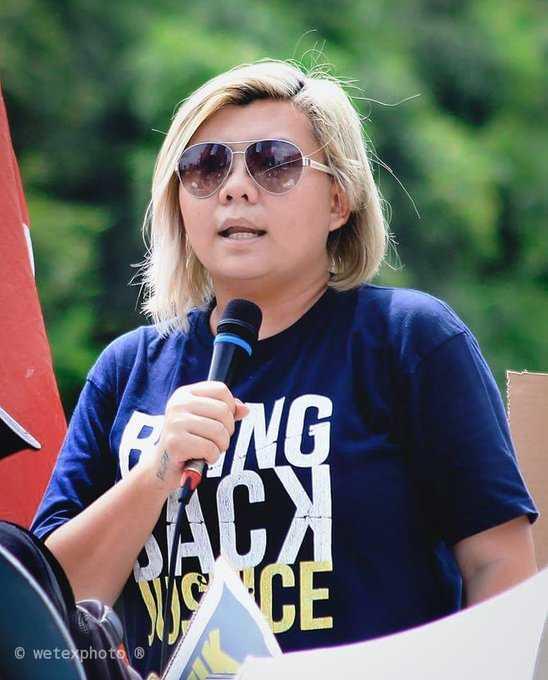
Human rights lawyer Veronica Koman Photo: Whens Tebay
Five UN experts(Mr. Clement Nyaletsossi Voule, Special Rapporteur on the right to peaceful assembly and association; Mr. David Kaye, Special Rapporteur on the promotion and protection of the right to freedom of opinion and expression; Ms Dubravka Šimonović, Special Rapporteur on violence against women; Ms Meskerem Geset Techane, Chair of the Working Group on discrimination against women and girls; Mr. Michel Forst, Special Rapporteur on human rights defenders) have urged Indonesia to protect the rights of lawyer Veronica Koman who advocates for West Papuan rights. They also urged Indonesia to protect people’s rights to peaceful protest and those reporting on protests in West Papua, and to ensure access to the internet
Earlier this month a police warrant was issued for Ms Koman, who is believed to be in Australia, after police claimed she spread fake news online. Indonesian authorities have blamed disinformation and Papuan independence activists for a recent wave of protests in the region
The UN rights experts said Indonesian authorities should address acts of harassment, intimidation and threats against people reporting on the protests. Ms Koman was named as a “suspect” by authorities who accused her of provoking unrest after she published reports on the protests and on a racist attack against Papuan students in Java that triggered the demonstrations. “We welcome actions taken by the Government against the racist incident, but we urge it to take immediate steps to protect Veronica Koman from any forms of retaliation and intimidation and drop all charges against her so that she can continue to report independently on the human rights situation in the country,” the experts said.
They also expressed concerns over reports indicating that the authorities were considering revoking Ms Koman’s passport, blocking her bank accounts and requesting Interpol to issue a Red Notice to locate her. The experts stressed that restrictions on freedom of expression not only undermined discussion of government policies, but also jeopardised the safety of human rights defenders reporting on alleged violations.
Protests have been increasingly taking place in the provinces of Papua and West Papua since mid-August over alleged racism and discrimination and amid calls for independence. “These protests will not be stopped by an excessive use of force or by cracking down on freedom of expression and access to information,” the experts said… The experts welcomed the engagement of the authorities on these matters and said they looked forward to continued dialogue.
On 7 August 2019 DefendDefenders’ blog annouinced that Gladys Mmari, Tanzania, was chosen as Human Rights Defender of the Month July 2019:
Gladys Mmariis a driven Tanzanian human rights defender (HRD), and the founder of MAFGE (Male Advocacy For Gender Equality) – a non-governmental organisation (NGO) focused on women empowerment through educating both women and men. “So much of the work that I do is cultural conversation. We have grown up talking about these issues among women, but now, I have to work with men as well – making it more challenging,” Mmari stresses. She fosters the idea that male voices should be heard, and educated, in women’s rights, and that it is important to establish an equitable understanding between the genders, while breaking down gender stereotypes. “We need to stop romanticising the idea of women empowerment, and co-empower one another to achieve the goals of an equal world,” Mmari affirms.
After obtaining a law degree, she worked as a human rights researcher in Tanzania, with a focus on the African Court on Human and Peoples’ Rights and indigenous rights. Then, she worked for AfricAid, an NGO specialised in cultivating leadership in young women and girls. She recalls a young boy who, following one of her sessions, asked her why he could not participate in the dialogues. He also wanted to boost women and girls’ rights. “It was a turning point for me,” Mmari says. “The time has come to work together and empower each other to revisit the many socio-cultural constraints that have stopped us from equality.” Her organisation MAFGE was hereby born.
She pinpoints numerous challenges faced in her work. “It is challenging to mobilise men to join, to ensure impact to women empowerment.” Furthermore, “most organisations that deal with women empowerment want to fund women organisations. And they do not want to see men in women organisations.”
She also points out the political situation in Tanzania as a great hurdle. Political rallies in the state deviate and misconceive the importance of HRDs, putting them at risk. As she expresses a sincere concern for Tanzanian HRDs, she mentions that the government is currently registering all NGOs under a single entity. “Here there is potential importance of this initiative, as this could be used for something productive such as acting as a more centralised human rights platform allowing more structured approaches, information passage, and funding opportunities. It is a step forward, unless it is a political interest”.
Gladys will continue to fight for women’s rights. “Women are born into unequal societies, and their achievements are unacknowledged and their potential left untapped [..] I can imagine my children and grandchildren living in a world with equal rights, and that they’ll get the opportunities and securities that I missed as a woman. That’s what keeps me going.”
Through MAFGE, she is also running a crowdfunding campaign, to strengthen gender equality in Tanzania.



 Hans Thoolen on Human Rights Defenders and their awards