This post is not directly related to Human Rights Defenders, but the numbers in this press statement of 24 September 2014 are so striking that I could not resist:
A spokesperson for the High Commissioner for Refugees at the UN, Melissa Fleming, revealed that “Turkey received 138,000 [Syrian] refugees in three days, which is equivalent to what was received by Europe throughout the past three years,” Anadolu news agency reported.
On 7 March 2014 UNHCR published a series of 6 videos on female genital mutilation (FGM), Too Much Pain, with stories of refugee women who have undergone FGM and have become human rights defenders engaged to end this practice. These women explain their experiences of flight, asylum and integration in the EU. These video clips deserve much wider recognition.
In Part 1, refugee women talk about why they had to flee because of their commitment to end the practice. The other videos explain that FGM is recognized internationally as a violation of the human rights of girls and women. The practice also violates a person’s rights to health and physical integrity; the right to be free from torture and other rights. FGM is harmful not cultural; it has life-long consequences and can be a ground for asylum. (See all videos: https://www.youtube.com/playlist?list=PLtPw-Y91GlmWvO9wxMUW-Ey3eMY2vwWYZ )
This video complements the UNHCR publication Too Much Pain: Female Genital Mutilation & Asylum in the European Union – A Statistical Overview, and updated in March 2014 (see here: http://goo.gl/lDnCRJ).
This post is not about human rights defenders and not really about the treatment of refugees in Greece. It is simply such a story – published by Behzad Yaghmaian in the Globalist of 11 February 2014 – that I could not resist sharing it. The original title is: “Syria’s Civil War and the World’s Oldest Refugee; A reflection on our collective failures as human societies“. Once you have read this, you will agree that Greece, Germany and the UNHCR should quickly find a solution on humanitarian grounds:
(Sabria Khalaf, 107-year old refugee of the Syrian civil war (c) Behzad Yaghmaian)
Human Rights Defenders are involved in asylum claims in many ways. The asylum seeker may be a victim of persecution or the people who help them are human rights defenders. Anyway the new UNHCR report “Beyond Proof – Improving Credibility Assessment in EU Asylum Systems” should be a relevant tool for all of them:
A really strange case has popped up in Athens, not immediately related to the demonstrations in Turkey but it could add to the tension: A Turkish activist, Bulut Yayla, was reportedly abducted from Solonos Street in Exarchia on Thursday 30 May 2013 and two days later he was traced in Istanbul’s antiterrorism department, where he was being held for questioning. Read the rest of this entry »
With regard to the defectors sent back from Laos via China to North Korea – on which I reported a few days ago – it is interesting to note the reaction by China which has expressed anger at the criticism by two UN High Commissioners (for human rights and refugee): “We hope that the Office of the High Commissioner for Human Rights of the UN does not make irresponsible remarks based on unspecified news,” foreign ministry spokesman Hong Lei, but also appeared to distance itself from the repatriation by saying the refugees had passed through the country with “valid documents and visas”. “In the whole process, China has not received a request by any party to assist in the repatriation of these persons“.
Nine North-Korean defectors, aged 15 to 23, entered Laos through China on 9 May 2013 and were caught by Laotian authorities on 16 May. They were sent back home on Tuesday 28 May via China. [Under North Korean law, defectors face a minimum of five years of hard labour and as much as life in prison or the death penalty in cases deemed particularly serious] UN Human Rights Commissioner, Navi Pillay, urged Chinese and Laotian authorities to publicly clarify the fate of the nine defectors and the conditions of their return, which apparently violated international law, UN deputy spokesperson
said. “The High Commissioner’s office is dismayed that the governments of Laos and China appear to have abrogated their non-refoulement obligations, especially given the vulnerability of that group, all of whom are reported to be orphans” The UN High Commissioner for Refugees said on Thursday in a statement that it is trying to locate the defectors and expressed concern that they did not receive a chance to have their asylum claims assessed.
UNHCR’s Refworld 2013 goes live this week at http://www.refworld.org. The website has undergone significant changes based on a feedback received from internal and external users over the years.
Refworld started almost 20 years ago as an ever-expanding series of DVD’s containing the different databases of documentation centre of the United Nations High Commissioner for Refugees. With the wider availability of broadband it switched in 2007 to internet only. It was already then considered an advanced protection information resource which aims to facilitate evidence-based and effective decision-making in refugee status determination procedures. Now it functions more broadly as a key tool for evidence-based advocacy relating to resettlement, statelessness, internal displacement, as well as specific protection concerns. The database, updated on a daily basis, now contains more than 167,000 documents relating to countries of origin or asylum, case law, legislation and policy. Especially the ‘country of origin’ information is relevant to human rights defenders as it is in fact a selection of human rights violations documentation. Also the legal information section is a unique collection of worldwide documentation concerning refugee law and statelessness.
Do you know of anybody who has gone beyond the call of duty and shown outstanding dedication and service to the refugee cause? Or maybe a group of people or an organization? Any person can nominate candidates (individuals, groups of people or organizations) but self-nominations and nominations of current or former UNHCR staff are not encouraged.
Each laureate for the Nansen Refugee Award is selected in line with the following:
The deed for which the person/entity is nominated should either take place outside the framework of normal professional duties and/or go beyond the call of duty;
It should demonstrate courage;
It should raise awareness for refugees; and
It should, in a significant way, benefit the beneficiaries the Awardee serves and possibly also the country/area where the Awardee operates.
The independent Nansen Refugee Award Committee, chaired by the United Nations High Commissioner for Refugees, selects the annual laureate by a unanimous or majority decision.
Ms. Ingrid Prestetun, Coordinator, Nansen Refugee Award Programme, UNHCR Geneva.
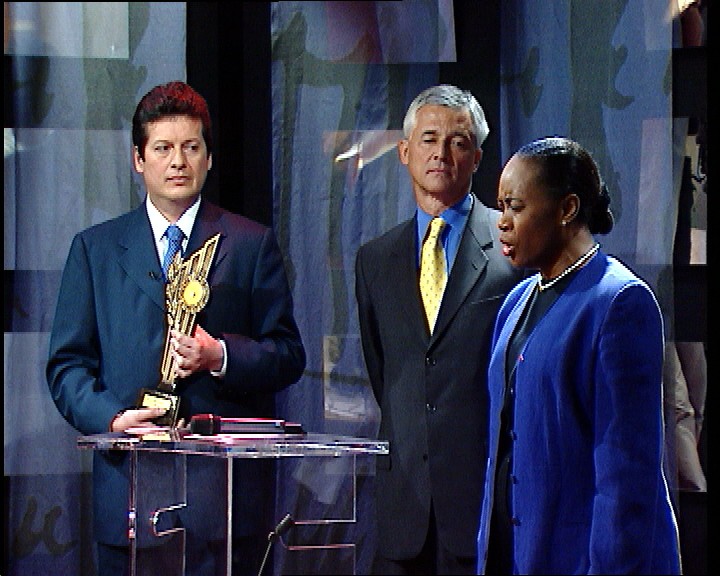
Barbara Hendricks at MEA ceremony 2003 with late Sergio Vieira de Mello and Alirio Uribe Munoz
The trigger to write about this very special person is that she has just been celebrated as UNHCR’s Goodwill ambassador for 25 years.
“You are really the princess of the humanitarian and human rights world,” High Commissioner for Refugees António Guterres said at a special UNHCR staff ceremony in Geneva. “The authority of your voice is a precious instrument for our fight,” he added. “Twenty-five years – it’s a long time and the cause of refugees has been a part of my life since my first mission,” said Hendricks, adding that it had been an honour to work for UNHCR. She praised the refugees who inspire her and the UNHCR staff who help them. “Thank you so much. It has been a fantastic journey and I look forward to continuing for as long as I can.”
What many people do not know is that Barbara Hendricks has not only been a dedicated and outspoken advocate for refugees for the past 25 years, but also been a strong supporter of other causes including human rights, e.g. as a Patron of the Martin Ennals Award for Human Rights Defenders or in giving her support to creating the True Heroes Foundation, Films for Human Rights Defenders in 2007.
The American-born Swedish citizen was inspired by the struggle for civil rights in the USA as a child and never let off. The human rights world needs celebrities but even more it needs celebrities with real and long-term commitment. This is what makes Barbara Hendricks a Human Rights Defender in her own name! Thanks.


 Ms. Ingrid Prestetun, Coordinator, Nansen Refugee Award Programme, UNHCR Geneva.