A recent case study by Freedom House focuses on programming that offers holistic protection, support, and services, tailored to the needs of human rights defenders in their host country. This case study focused on the most current wave of migration of HRDs and CSOs who were forced to flee after anti-government protests in April 2018.
The Nicaraguan government continues to violate freedoms of expression, assembly and information and thwart the work of HRDs, including journalists and CSOs. Ortega-Murillo’s recent actions against potential presidential candidates and opposition figures demonstrate that the country will continue to see an outpouring of critics, activists, and HRDs to Costa Rica, among other countries. Nicaraguans continue to flee based on the attacks and harassment they face as HRDs and members of CSOs that champion democracy and human rights. See also: https://humanrightsdefenders.blog/2022/02/21/nicaragua-death-in-detention-and-sham-trial/
Of those 20 Nicaraguan HRDs who were surveyed, almost 90% stated that harassment and surveillance was a primary reason for leaving Nicaragua, followed by violence (65%) and threats (50%). Costa Rica provides comparatively ample protection for migrants, and recently launched a new asylum category for those fleeing from authoritarian regimes in Venezuela, Cuba, and Nicaragua. The flow of migration since 2018 has persisted until March 2020 when the border shut due to the COVID-19 pandemic. Yet, migrant flows have begun to increase in recent months. However, Costa Rica is struggling to recover economically from the pandemic, particularly within the tourist, service, and commercial industries where most migrants and refugees find work. Most Nicaraguan refugees find themselves in a precarious economic situation, unable to find steady work, forcing many to resort to informal work with low salaries. HRDs are often not recognized as having different needs or characteristics from the larger refugee population, either by organizations or the Costa Rican population in general. Even for those who continue to work in human rights describe their ability to continue work is difficult, and many express experiencing severe trauma as an exile, with remorse for not being able to stay and remain fighting for human rights at home. [see also: https://humanrightsdefenders.blog/2021/12/24/vilma-nunez-human-rights-defender-who-stays-in-nicaragua/] However, many Nicaraguan HRDs try to carry out their work by investigating the laws and procedures in Costa Rica, accompanying their compatriots in their efforts, sharing knowledge, and giving advice. There are support and protection options for HRDs and CSOs in exile in Costa Rica, including a network of organizations and institutions facilitated by the United Nations High Commissioner for Refugees (UNHCR) that provide access to vital services.
All available support and protection options for Nicaraguan HRDs are operating at full capacity and cannot keep pace with the growing demand. We believe that it is necessary to seek support and accompaniment mechanisms for HRDs that facilitate their subsistence and enhance the implementation of their work to defend the human rights of exiles and other Nicaraguan migrants who lack mechanisms for complaint and demand for their rights in Costa Rica.
With massive new flows starting in the wake of the Russian attack on Ukraine, the new book announced on 28 February 2022 by UNHCR –People Forced to Flee: History, Change and Challenge – is most timely.
People Forced to Flee draws on the lessons of history to probe how we can improve responses to forced displacement. Tracing the roots of asylum from early history to contemporary times, the book shows how the 1951 Convention relating to the Status of Refugees turned the centuries-old ideals of safety and solutions for refugees into global practice. It highlights the major achievements in protecting people forced to flee since then, while exploring serious setbacks along the way.
Published at a time when over 84 million people in the world are forcibly displaced, it examines international responses to forced displacement within borders as well as beyond them, and the principles of protection that apply to both: reviewing where they have been used with consistency and success, and where they have not. At times, the strength and resolve of the international community seems strong, yet solutions and meaningful solidarity are often elusive.
Most forced displacement is experienced in low- and middle-income countries and persists for generations. People forced to flee face barriers to improving their lives, contributing to the communities in which they live, and realising solutions. Responding better is not only a humanitarian necessity but a development imperative.
The book shows how this work gained momentum with the international affirmation in December 2018 of the Global Compact on Refugees; and it illustrates how it is being supported by a growing group of partners encompassing forcibly displaced people, local communities and authorities, national governments, international agencies, non-governmental organisations and the private sector.
People Forced to Flee also examines how increased development investments in education, health and economic inclusion are helping to improve socio-economic opportunities both for forcibly displaced people and their hosts. Alongside this are greater investments in data, evidence and analysis pointing to what works best. And it discusses the wide array of financing mechanisms that can support sustainable responses.
As noted by Filippo Grandi, the UN High Commissioner for Refugees, in his foreword, the book highlights with great clarity the enormous challenges to preventing, mitigating, and finding solutions to forced displacement. “The drivers of displacement are unrelenting; the demands placed on humanitarian funding are growing,” Grandi notes. Yet he adds that while “the challenges are enormous, history has repeatedly demonstrated the potential for, and power of, positive change”.
People Forced to Flee: History, Change and Challenge, takes up the mantle of a series of UNHCR publications, stretching back to 1993, that were previously entitled The State of the World’s Refugees. This book was written by Ninette Kelley.
To mark the UN Refugee Agency’s 70th anniversary, award-winning cartoonist Hani Abbas has created seven images that will be sold as digital assets to raise funds for Afghanistan.
Syrian-Palestinian cartoonist Hani Abbas, 44, was born and grew up in Yarmouk, a Palestinian refugee camp in the southern suburbs of the Syrian capital Damascus. From the late 1990s his cartoons appeared in publications and exhibitions in Syria and across the Middle East, before he and his family fled the conflict in 2012 and eventually settled in Switzerland as refugees.
Since then, Abbas’s work – which tackles themes of injustice, loss, and the human cost of conflict – has featured in publications including Le Temps and La Liberté in Switzerland and France’s Le Monde. He is also a member of the Cartooning for Peace organization, a network of press cartoonists committed to promoting freedom and democracy. In 2014, Abbas received the International Editorial Cartoon Prize in Geneva. [see: https://www.trueheroesfilms.org/thedigest/laureates/01DCF77A-3DEA-97F4-CE95-6BD185538207]
To mark the 70th anniversary of UNHCR, the UN Refugee Agency, Abbas has teamed up with national partner association Switzerland for UNHCR to launch the agency’s first-ever NFT (non-fungible token) fundraising sale. Abbas has created seven cartoons, from which ten copies of each will be converted into unique digital assets and sold as NFTs on the OpenSea online marketplace to raise funds for UNHCR’s Afghanistan crisis response.
Ahead of the start of the sale on 4 November, UNHCR spoke with Abbas and asked him about his life in Syria, his experiences as a refugee, and the meaning behind the images he has created.
What was your early life like growing up in Yarmouk camp?
Yarmouk is called a camp, but it’s really a part of the city with buildings, streets, and all the normal services. Growing up there was something nice and something hard. A lot of people in a small area; many pupils in the school. We had a beautiful, funny life – hard, but beautiful. Sometimes hard memories become nice when you look back. When I remember it now, I have nostalgia about that time. I remember my friends, my neighbourhood, my street, my family home.
When did you first show a talent for drawing?
When I was a child, I loved to draw. I drew everything, and I drew on everything – I was drawing on the walls, in school textbooks, on my body – everywhere. This is a child’s job! I loved drawing and when I was in school, my art teacher supported me and entered my work in a UN children’s drawing prize which I won twice, when I was 13 and 14. Those prizes gave me the power and the belief to continue drawing – I felt like I had something to say through my drawing. You can explain your story, your feelings, your ideas.
Did you always want to be a cartoonist?
No. At first it was anything, but when I was around 18, I started thinking about cartoons because I saw a lot in the newspapers, and on the walls of the camp. The walls were like our newspaper in the camp. Yarmouk was one big newspaper. In 1998 I published my first cartoon in a Palestinian magazine, then had exhibitions in the camp, in Damascus, Aleppo and Lebanon. I started connecting with newspapers – that’s how it goes. At the same time, I was also a teacher in an elementary school in Damascus.
What themes do you address in your cartoons?
My early cartoons were about Palestine, Palestinian refugees in the Middle East. More political than funny because it was difficult for me to draw something funny. I always go towards tragedy and darkness because I draw what I’m feeling. I’m trying to explain about myself and my people. At that time, I was just drawing and there was no problem for me, but when the conflict started, you had to take your life in your hands when you drew.
I’m still drawing now. Drawing in a safe place like Switzerland is good, you have total freedom. But you lose the sense of danger, the challenge. For me I did my best drawings under the bombs. I lost a big part of my power when I left Syria, but I still have the power of memory.
“The memories occupy my mind all the time.”
How did the conflict affect you personally?
I moved many times in Syria starting from March 2011 until December 2012 when I left. The last six months were very difficult to live under the bombs all the time. At that time, we would hear three sounds. The first was the sound of the shell when it was launched. The second was the sound of the shell above us in the sky. The third sound was the sound the of the explosion on the ground, or in a building. I was drawing all the time, but when I heard that first sound, I would lift my pencil and wait, thinking: ‘maybe this is my last drawing’. If I heard the third sound, that meant I was still alive. I’m lucky because I always heard all three sounds, but many thousands of Syrian people around me never heard the third sound.
You managed to escape Syria, first to Lebanon and then Switzerland. How did your life change?
Before, my family was all in the same place, now everyone is spread around the world. I’m here in Switzerland, in Geneva, my brother is in Cologne in Germany, my parents and two other brothers are in Sweden, and another brother is in Madrid, in Spain. It’s not easy to connect with them. It’s good we have social media and video calls, but it’s not the same. My kids are speaking French now, my brother’s kids are speaking German, Swedish, another Spanish. When they meet now it’s not easy to connect with so many languages, different cultures, different educations. We will lose our family tree. The branches have been cut off and are drifting down the river in different directions. But Switzerland is very good for my kids, without any problems and without any bad memories, without any dangers in the future. For me, it’s okay. I’m working here, I’m still drawing, I’m feeling good – life is good – but the memories occupy my mind all the time.
The images you’ve created for the NFT sale are part of a series you call “Windows”. What significance do windows have in your work?
What is the meaning of windows in my heart? They are our windows to see the country, to see people – to connect with them and hear them. In 2011, after four months of the conflict I drew the first window – a destroyed building with just a window still standing, and a young man waiting outside with a flower to see his love, who was gone. It represents what we’ve lost. I’ve drawn other figures who have left everything else behind but take a window with them, because the window is their memory. I have my own ideas and feelings about the images, but I hope everyone who looks at them can see the effect of war on people.
“I hope all the people who have problems in their countries can get out.”
The money raised in the sale will be used to support the people of Afghanistan. How did you feel watching recent events there?
It felt familiar for me because we were – we’re still – like them. The same problems, the same feelings, the same stories. In the news we always heard about the politics, but we didn’t know what was happening to normal people. For me, I hope all the people who have problems in their countries can get out. I support people who want to get out if they have dreams, if they want to protect their kids.
You’re used to publishing your cartoons in newspapers. How do you feel about them being turned into unique digital assets and sold as NFTs instead?
I don’t have any experience of this – I just do the drawings! But every cartoonist wants their work to be seen, and I support these new ideas. Anything that will help people and explain the hard conditions and problems they face, and allow other people to support them. It’s a new idea, and when I heard about it, I loved it. We hope now it succeeds in focusing attention on the problems of [Afghans], and makes money for them of course, because they need it. Sometimes, to make a little bit of change in people’s lives they just need a tent or a little bit of food, a bit of support or a little education.
On 16 July 2021 Reuters reported that Canada is establishing a dedicated refugee stream for “human rights defenders,” including journalists, who may need to seek asylum to escape persecution in their country,
The stream – the first of its kind in the world, according to the UN refugee agency – will accommodate 250 people a year, plus their families, and focus on people at heightened risk, such as women, journalists and LGBTQ2 rights advocates.
“We must not overlook those who bear witness to these human tragedies, who are active through demonstration and reporting so the rest of us can be informed. But in doing so they risk persecution, arrest, torture and even death,” Immigration, Refugees and Citizenship Minister Marco Mendicino said on Friday in a virtual news conference from Toronto.
One example a spokesperson gave of a person eligible under this program is an activist against the regime in Belarus who had fled to Poland but needed permanent refuge.
Canada aims to resettle 36,000 refugees this year, almost four times its total of 9,200 resettled in 2020. But by the end of April, only 1,630 resettled refugees had arrived in Canada, according to government figures.
On 3 June 2021 the Danish Parliament approved amendments to the Danish Aliens Act.
The amendments will enter into effect if Denmark secures a formal agreement with a third country. This could see the forcible transfer of asylum-seekers and the abdication of Denmark’s responsibility for the asylum process and for protecting vulnerable refugees.
UNHCR strongly opposes efforts that seek to externalize or outsource asylum and international protection obligations to other countries. Such efforts to evade responsibility run counter to the letter and spirit of the 1951 Refugee Convention, as well as the Global Compact on Refugees where countries agreed to share more equitably the responsibility for refugee protection.
Already today nearly 90% percent of the world’s refugees live in developing or the least developed countries that – despite their limited resources – step up and meet their international legal obligations and responsibilities.
UNHCR has raised repeatedly its concerns and objections to the Danish government’s proposal and has offered advice and pragmatic alternatives.
UNHCR will continue to engage in discussions with Denmark, which remains a valuable and long-standing partner to UNHCR, in order to find practical ways forward that ensure the confidence of the Danish people and uphold Denmark’s international commitments.
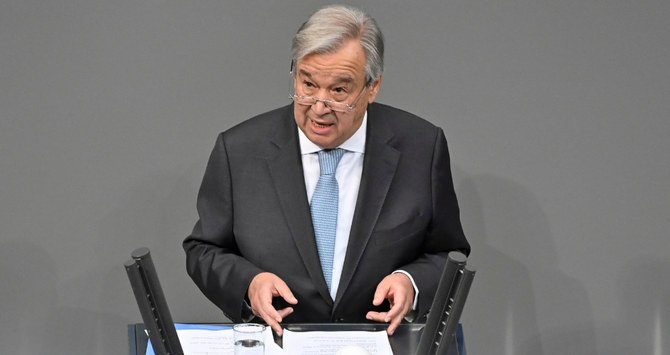
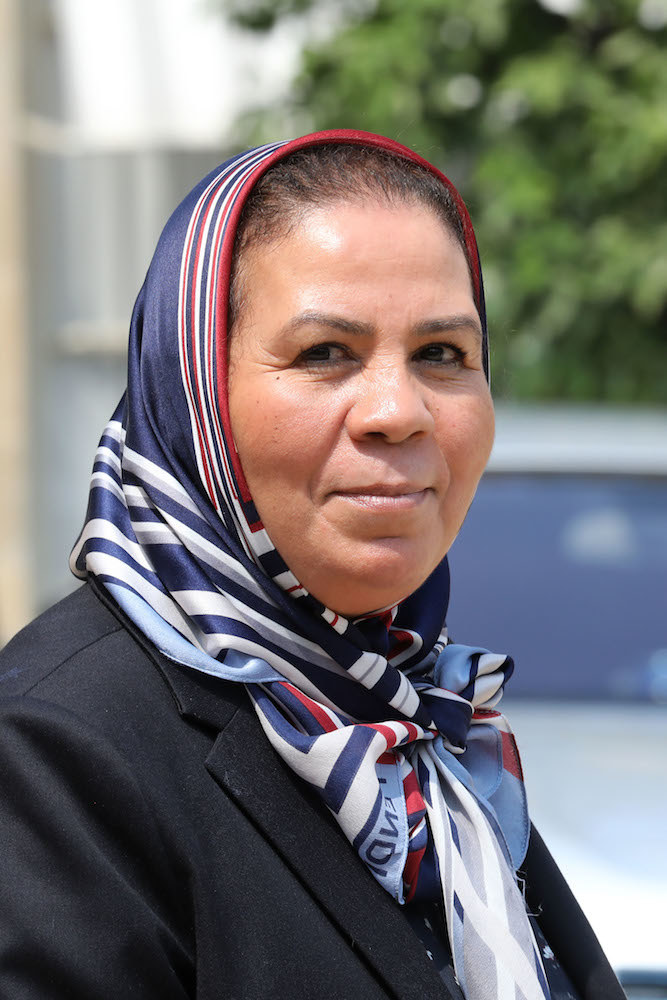
Arab News of 4 February 2021 writes about the Zayed Award for Human Fraternity 2021 which recognises French-Moroccan activist Latifa ibn Ziaten and Antonio Guterres.
The Zayed Award recognizes the institutions and community of people who are spreading the work of human fraternity and coexistence around the world. It was inspired by the Document on Human Fraternity which was signed by His Eminence the Grand Imam Dr. Ahmed El-Tayeb and His Holiness Pope Francis on February 4, 2019 in Abu Dhabi, the capital of the United Arab Emirates.
HCHF’s mission is to act on the aspirations outlined in the Document on Human Fraternity by meeting with religious leaders, heads of international organizations, and others across the world, to support and spread the values of mutual respect and peaceful coexistence. In addition, the committee provides counsel on a variety of initiatives, including the Abrahamic Family House, which is being built in Abu Dhabi. See also: https://humanrightsdefenders.blog/2018/01/23/emirates-at-the-upr-in-geneva-two-sides-of-the-same-medal/y.
Guterres praised fellow recipient Ibn Ziaten for “her dedicated efforts to support young people and promote mutual understanding, arising out of immense personal tragedy, (that has) won admirers at home and beyond.”[see: https://humanrightsdefenders.blog/2016/04/08/us-state-department-international-women-of-courage-awards-2016-yulan/ Ibn Ziaten’s son, Imad, was the first person to die at the hands of terrorist Mohamed Merah during a series of shootings in the cities of Toulouse and Montauban in southwestern France between March 11 and 22, 2012. When Ibn Ziaten visited Les Izards in Toulouse, where the Merah had lived, to find out more about the man who took her son’s life she was shocked to find young people there hailing the killer as a hero of Islam. “I had the impression they were killing my son all over again,” she said at the time. This motivated her to found the Imad ibn Ziaten Youth Association for Peace to help young people in deprived areas and promote interreligious dialogue. Guterres reiterated that discrimination, racism and extremist violence continue to surge around the globe, fueled by the COVID-19 pandemic, an economic recession, a climate emergency and continuing threats to peace and security. Unity is more important now than ever, he added. Guterres said he will donate the $500,000 prize that accompanies the award to the Office of the High Commissioner for Refugees to support its work with “the most vulnerable members of the human family: the forcibly displaced.”
Neil Gaiman launches a crowdsourced animated film to help raise funds for Syrian refugees battling freezing temperatures and icy winds amid threat of Covid-19.
Neil Gaiman – celebrated author and Goodwill Ambassador for UNHCR – has joined forces with hundreds of fans and artists to release a new animated version of his poem What You Need To Be Warm.
The animated film aims to raise much needed funds for UNHCR’s Winter Appeal providing vital support for refugees in the Middle East including Syrian and Iraqi refugees, many of whom are battling their ninth winter away from home. This year is the hardest yet as refugees face snow, rain and freezing temperatures, as well as the impact of Covid-19 which has dramatically affected vulnerable families, put health at risk, devastated livelihoods, and pushed more refugees out into the cold.
Neil Gaiman said: “This animated film was a chance for people to come together to help raise awareness and life-saving funds to protect these families. I was blown away by the response and quality of drawings submitted online. People really care and want to help and they still can by making a donation“
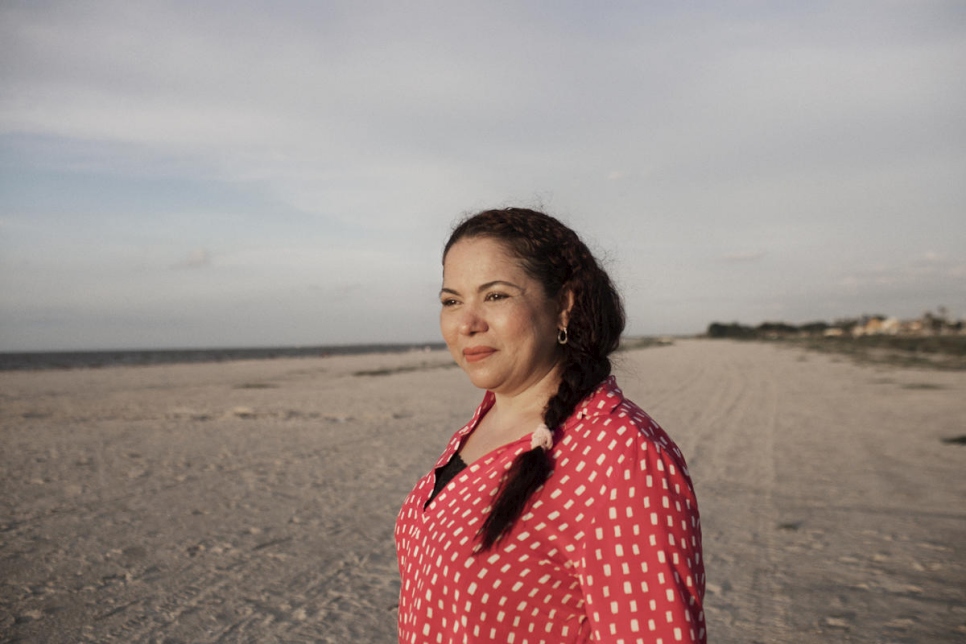
The 2020 laureate of the Nansen Refugee Award is a Colombian educator who has spent more than 20 years rescuing sexually exploited and trafficked children, many of them refugees. Mayerlín Vergara Pérez, Maye, has dedicated her life to defending children. As the Caribbean Regional Coordinator for the Renacer Foundation she has devoted more than two decades to helping the Colombian non-profit reach its goal of eradicating sexual exploitation and abuse of children and adolescents. Founded 32 years ago, the organisation has assisted over 22,000 child and adolescent survivors of commercial sexual exploitation, and survivors of other types of sexual and gender-based violence.
“People like Maye represent the best of us. Her bravery and selfless pursuit to rescue and protect some of the world’s most vulnerable children is nothing short of heroic,” said Filippo Grandi, UN High Commissioner for Refugees. “She embodies the essence of this award. Her unwavering dedication has saved the lives of hundreds of refugee children and restored their hopes for a better future,” he added.
For over 20 years, Maye has gone to extraordinary lengths, often risking her own safety to rescue girls and boys who are victims of sexual exploitation and trafficking. On foot, she combs the streets of remote communities in north-east Colombia where human traffickers and smugglers operate. Maye leads a team of dedicated staff at the Renacer Foundation in close coordination with the Colombian Family Welfare Institute, a government body tasked with protecting children in the South American nation. By speaking out against the abuses she has witnessed, she has called on civil society, Colombian authorities, and the tourism sector – which is fertile ground for sexual exploitation and trafficking in the country – to ensure that children and adolescents are protected.
“Sexual exploitation has a huge impact on children, emotionally, psychologically, physically and socially,” said Maye. “We see girls who don’t feel that their bodies belong to them. Their bodies have been so maltreated, so abused, so exploited that they feel alienated from those bodies, as if they don’t belong to them.”
In 2009, Maye’s relentless activism and advocacy helped usher in two landmark pieces of legislation. Law 1329 established a mandatory minimum sentence of at least 14 years in prison for those convicted of aiding and abetting the sexual exploitation of children and adolescents. While Law 1336 targeted the owners of establishments that allow the sexual exploitation of children on their premises.
Since 2015, the deteriorating situation in Venezuela has forced millions to flee. An estimated 1.7 million have sought shelter in neighbouring Colombia. Desperate to find safety and a better life, Venezuelans have resorted to any means possible to flee the country, with many falling prey to human trafficking networks, criminal gangs, and illegal armed groups that are often active along borders. Women and girls are often forced into sexual exploitation by smugglers to pay for their passage.
According to data provided by Colombian authorities, between 2015 to 2019, the number of victims of human trafficking there increased by 23 per cent. The rise is partly linked to the influx of Venezuelan refugees and migrants into the country.
Data from the Colombian government shows that in just the first four months of 2020, authorities had already identified a 20-per cent rise in trafficking involving foreign nationals over the previous year. In over half of cases, sexual exploitation was the ultimate goal of the trafficking.
This new film directed by Greg Barker [see also: https://humanrightsdefenders.blog/2014/01/23/we-are-the-giant-film-about-the-arab-spring-here-is-the-trailer/] and based on his own award-winning documentary, confusingly also called Sergio, is a biographical drama about Sérgio Vieira de Mello, a diplomat from Brazil who worked for the United Nations High Commissioner for Refugees (UNHCR) for most of his life and was briefly High Commissioner for Human Rights. He was celebrated as a pre-eminent humanitarian before tragically dying in the Canal Hotel bombing in Iraq alongside many of his staff in 2003. The fiction film Sergio made its premiere at the Sundance Film Festival on 28 January 2020 before heading to Netflix.
Kayleigh Donaldson in Screenrant of 2 january 2020 wrotes perhaps a bit too breathlessly that the film Sergio is “one of the most anticipated Netflix original movies in 2020“.
Now the first two reviews are out and they indicate that it is foremost a romantic story that is well acted but diverts a lot from reality.
Jessica Kiang in Variety of 29 January 2020 is the more critical and – in my view – serious voice:
… handsome, heroic, charismatic de Mello (played with persuasive charm by Wagner Moura) certainly does seem like a man whose present was shaped by …the better, brighter, freer global future he believed the U.N. could be instrumental in achieving and that he personally could help midwife into being. Such noble intentions and such impact on world affairs does render understandable Barker’s rather starry-eyed approach, but [puts] unnecessary length and sentimental emphasis on the man’s romantic life…
..First, we spin forward to the 2003 bombing of the U.N. headquarters in Baghdad, which was ordered by terrorist leader Abu Musab al-Zarqawi and which claimed at least 22 lives and wounded over 100 people, and here provides a loose framing device. De Mello and close associate Gil Loescher (Brian F. O’Byrne), both critically wounded, were trapped under tons of rubble in the blast, and … screenwriter Craig Borten imagines a borderline delirious de Mello reliving moments of significance from his storied life. Chief among these reminiscences is the tale of his romance with Carolina Larriera.. .an Argentinian U.N. economic adviser whom the married father-of-two met while brokering a peace deal between the rebels and the Indonesian government in East Timor.
In Adrian Teijido’s calm, throughful photography (it’s a refreshing choice to not go the shaky handheld docudrama route), de Armas and Moura make an attractive couple, and de Armas is able to imbue Carolina — whose role seems just a little wispy on the page — with an intelligence and will that makes her more than just de Mello’s romantic foil. But Barker’s emphasis on this love story at the expense of a deeper exploration of the exceptional talents that earned de Mello his reputation for feats of diplmatic wizardry in highly fraught situations where others had tried and failed, also has a curiously flattening effect.
Although the relationship with Larriera was doubtless crucially important to de Mello, it was not the thing that made him extraordinary in the eyes of the world. And so the hesitant courtship, the smouldering looks, and the romancing, including a tasteful but unnecessarily lengthy sex scene over which Fernando Velázquez’ otherwise rather generic political-thriller score crescendos like it’s high drama, all feel like a distraction from the more thorny and politically provocative side of de Mello’s story. That’s especially irksome given that the scenes of geopolitical debate, diplomatic argument and even ego clash between de Mello and the world-wearily witty Loescher … are actually where the film crackles to life.
…But this sentimental approach glosses over much of the potential drama that is set up only to dissipate: de Mello’s prickly relationship with U.S. Envoy Paul Bremer (Bradley Whitford); his association, criticized by Loescher, with war criminals and terrorists if he believed it could achieve his ends; and his fateful decision to send the U.S. Army guards away from the U.N. office in Baghdad in 2003. Sergio Vieira de Mello was, by all accounts, not a man who let fear of making the wrong decision stop him from acting decisively, and it’s a shame that the soft-edged romantic prevarications of “Sergio” prevent the film from embodying that same dynamism.
Courtesy of Sundance
John DeForein Hollywood Reporter of 30 January 2020 sees a more than successful transition from documentary to a feature film:
… Rather, it’s one of those rare films .. in which a genuine concern for geopolitics coexists perfectly well with romance and old-fashioned moviegoing pleasures. This portrait of influential U.N. diplomat Sergio Vieira de Mello benefits immensely from two magnetic leads, Wagner Moura and Ana de Armas, whose onscreen chemistry is undeniable; but its deft sense of structure is of equal importance, making it an engrossing picture even for those who know next to nothing about its subject or settings.
..Sergio and refugee expert Gil Loescher were trapped alive in the rubble; as a framing device, Sergio sets flashbacks to various points in his career during the hours when two American soldiers (Garret Dillahunt and Will Dalton) worked to extract the pinned men. These episodes help cement the diplomat’s reputation as an idealistic fix-it man for some of the world’s trickiest conflicts. …Sergio is out for a jog during his East Timor assignment when he passes another jogging foreigner, Carolina Larriera (de Armas). The attraction is immediate, but the film savors its development: …While the film plays up Sergio’s attractiveness to the younger woman (shirtless, the 50 year-old man probably bore little resemblance to Moura), it’s not blind to emotional flaws: He’s ignorant of key facts about his two sons’ lives, and he admits he’s most attentive to relationships and projects whose timeframe is finite.
Also on hand in East Timor is Loescher (Brian F. O’Byrne), who will be trapped by his side in Baghdad. The real Loescher, who had two legs amputated in his rescue from the site, was an independent expert who was only in Sergio’s Baghdad office (along with Arthur Helton – see: https://en.wikipedia.org/wiki/Arthur_Helton) to interview him for a column on openDemocracy.net. In Sergio, Loescher is a composite, depicted as Vieira de Mello’s right-hand man for multiple U.N. missions — the conscience who argues against his boldest moves. As a storytelling device, this works quite well; but using Loescher’s real name is an unexpected choice for a documentarian, and confuses the truth for no reason. [my view: INDEED – see also: https://humanrightsdefenders.blog/2017/06/07/gil-loescher-life-long-defender-of-rights-of-refugees-honored/ and https://www.imdb.com/title/tt0479980/]
Those who know the history intimately may take issue with other condensations that play perfectly well to a layperson: Sergio’s interactions with U.S. diplomat Paul Bremer (Bradley Whitford) are dramatically satisfying, and seem to capture the general nature of U.S./U.N. friction at the time; a question regarding the U.S. Army’s protection of Sergio’s office is probably also finessed for maximum thematic effect. The picture is most vulnerable to Hollywoodisms in scenes set after the bombing, as Carolina looks frantically for Sergio; the latter dreams of a sunny beach in his native Rio de Janeiro; and those soldiers heroically try to extract him despite having none of the necessary rescue equipment. But, coming late in the film as they do, these indulgences feel appropriate to the film’s lionization of its subject and investment in the couple’s relationship. Sergio believes in heroes and big ideals, and hopes we’re capable of the same belief…
Monica Castillo in NBC of 31 January 2020 adds an interview with the star Wagner Moura who “was so intrigued by Vieira de Mello’s story that he signed on as a producer for the movie. In the interview with NBC News, Moura said that this is the first of many stories he’d like to share to address the lack of Latinos on the screen. In the interview he also says “this guy is kind of a personal hero for me, and I’ve been working with the U.N. for a while; I’m a goodwill ambassador for the ILO [International Labour Organization] and the fight against slave labor..[Sergio] was a man who dedicated his life to human rights. When he was killed, he was the high commissioner for human rights; when he started in the U.N., he was the high commissioner for refugees“. Well he was NOT, he worked for the UNHCR.
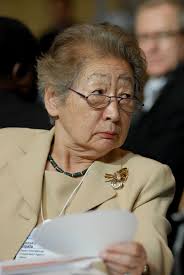
Sadako Ogatathe first woman to head the UN High Commissioner for Refugees has died at the age of 92 on 22 October 2019. I served under her for many years and have the greatest admiration for her. Sadako Ogata worked on some of the largest crises of the decade during her time in service from 1991 to 2000, including the Kurdish refugees fleeing from Iraq after the 1991 Gulf War, the Balkans War and the Great Lakes region of Africa. Before joining the UN, she was an academic – serving as dean of the faculty of foreign studies at Sophia University in Tokyo in 1989, where she had been a professor since 1980. She was well respected by UN staff and world leaders alike, and was described by her colleagues as a “five-foot giant” for her formidable negotiating skills and ability to confront hostile factions. From 2003 to 2012, Ogata was the head of the Japan International Cooperation Agency, overseeing efforts to provide assistance to those in developing countries.
Back in Japan, she also criticised her country’s low acceptance of refugees. “Japan has to set up a situation to welcome people… those who are in need, in serious need… I think we should be open to bringing them in,” she said in a Reuters interview in 2015. “[To say] Japan does not have resources, that’s nonsense.”
She rightly received a lot of recognition while alive, including:
1994 Franklin Roosevelt Four Freedoms Award
1994 Prize for Freedom (Liberal Int’l)
1994 International Human Rights Law Group Award
1995 Liberty Medal
1995 Freedom Award (refugees)
1997 Ramon Magsaysay Award for Community Leadership


 Hans Thoolen on Human Rights Defenders and their awards