Posts Tagged ‘UN Special Rapporteur’
September 19, 2013

(Sudanese IDPs – (c) AI private)
In a long letter to the UN Human Rights Council now in session a group of 13 NGOs urges the Council to continue monitoring Sudan. The letter has two main chapters on:
Conflicts in Darfur, Southern Kordofan, and Blue Nile, ………and
Repression of Civil and Political Rights……….
The letter ends with urging the Human Rights Council to:
- condemn the human rights violations in Darfur, Southern Kordofan and Blue Nile, as well as the government’s continued use of indiscriminate bombing in all three states, attacks on civilians, and other abuses by government forces and allied militia;
- establish an independent investigation into ongoing human rights violations in Southern Kordofan, Blue Nile, and Darfur, and report back to the Human Rights Council promptly;
- urge Sudan to grant humanitarian agencies access to Southern Kordofan and Blue Nile states, in compliance with international human rights and humanitarian law obligations;
- express concern over the continued restrictions of basic civil and political rights, and the continued harassment of critics of the government, including the practice of arbitrary detention, torture and ill-treatment, preventing meaningful public dialogue on critical issues at a time when Sudan is preparing to adopt a new constitution and for national elections in 2015;
- urge Sudan to reform its repressive National Security Act of 2010 and other laws granting immunity to officials, seriously investigate allegations of human rights violations and hold perpetrators to account;
- renew the special procedure country mandate on Sudan for at least three years under Item 4 with a clear mandate to monitor and report twice a year to the Human Rights Council and the General Assembly on violations of human rights in all parts of Sudan.
——-
Earlier on AI’s Global Blog, Khairunissa Dhala, Researcher on Sudan/South Sudan team at Amnesty International has answered her own question: “Does the human rights situation in Sudan still require a UN-mandated Independent Expert to monitor and report back on developments?” as follows: “Given Sudan’s dire human rights situation – ongoing armed conflicts in three different states, restrictions on freedoms of expression, association and assembly, including arbitrary arrest and torture of human rights defenders and activists – it is hard to imagine that there is even a question on whether this is needed. But we’ve been here before.
Two years ago, I attended the HRC’s 18th session where members of the Council reached a “compromise” on human rights monitoring in Sudan. It was a “compromise” because, while the Independent Expert’s mandate was renewed, it solely focused on providing technical assistance and capacity-building support to the national authorities. In other words, the Independent Expert would no longer be asked to monitor the human rights situation in Sudan. [….]Compromising on the Independent Expert’s mandate was seen as a concession to Sudan by the international community. A concession given to a country where widespread and systematic violations and abuses of international human rights and humanitarian law are taking place.
But there should be no compromise on human rights. Since then, the Independent Expert’s mandate has successively been renewed to provide technical assistance, while the awful human rights situation in Sudan calls for a clear need for monitoring.. Conflict remains ongoing in Southern Kordofan and Blue Nile, to the detriment of the civilian population. Over the past two years I have interviewed numerous men, women and children from these two states. They have shared harrowing accounts of how their loved ones were killed when bombs dropped by Antonov aircrafts, from high altitudes, by the Sudanese Armed Forces, landed on their homes. Coupled with ground attacks by Sudanese forces and the armed opposition group the SPLA-N, this conflict has led to more than 200,000 people fleeing to refugee camps in South Sudan and Ethiopia, in addition to the tens of thousands of internally displaced people in the two areas. The Sudanese authorities are still denying unhindered humanitarian access to all affected areas. Meanwhile, in Sudan’s Darfur state, a decade after the start of the armed conflict, the crisis is ongoing and violence has again intensified. This year alone, more than 300,000 people were forced to leave their homes behind, fleeing violent clashes between predominantly ethnic Arab groups.
Across Sudan, freedom of expression, association and assembly also remain restricted. Journalists and activists face constant harassment, arbitrary arrests, as well as torture and other forms of ill-treatment by Sudan’s National Intelligence and Security Service. Given the critical human rights situation, any compromise on the Independent Expert’s mandate is an abdication of the Human Right Council’s duty to promote and protect human rights in Sudan…..The Independent Expert should have their mandate strengthened to monitor Sudan’s human rights situation under item 4 (Human rights situations that require the Council’s attention) and report twice a year to the Council and the UN General Assembly on violations of international human rights and humanitarian law taking place anywhere in the country.”
Read more:
Sudan: Letter to the UNHRC regarding the renewal and strengthening of the special procedure mandate on the situation of human rights in Sudan
Why monitoring human rights in Sudan still matters | Amnestys global human rights blog.
Posted in AI, FIDH, HRW, human rights, Human Rights Defenders | Leave a Comment »
Tags: Amnesty International, Blue Nile, Cairo Institute for Human Rights Studies, Darfur, East and Horn of Africa Human Rights Defenders Project, experts, human rights, Human Rights Defenders, Human rights in Sudan, human rights violations, Human Rights Watch, International Federation for Human Rights, international human rights and humanitarian law, Khairunissa Dhala, killings, South Kordofan, Special Procedures, Sudan, UN Special Rapporteur, United Nations Human Rights Council
August 2, 2013

Special Rapporteur on Belarus Miklós Haraszti. – Photo: OSCE/Susanna Lööf
2 August 2013 the Special Rapporteur on the situation of human rights in the Republic of Belarus, Miklós Haraszti, said that the detention of Bialiatski is “a symbol of the repression against human rights defenders.” Read the rest of this entry »
Posted in human rights, Human Rights Defenders, UN | 1 Comment »
Tags: Belarus, belarusian authorities, Bialiatski, confiscation, FIDH, freedom of association, Human right, Human rights defender, Human Rights Defenders, Miklos Haraszti, Minsk, Non-governmental organization, OSCE, Special Rapporteur, UN, UN Human Rights Council, UN Special Rapporteur
May 31, 2013
(Egyptian President Mohammed Morsi)
In the context of restrictive legislation to hinder the work of human rights defenders, the Egyptian case deserves urgent attention now. The law on NGOs is being rewritten in this important country and others in the region may follow the example. Despite recent amendments Read the rest of this entry »
Posted in AI, CIHRS, HRW, human rights, Human Rights Defenders, UN | 1 Comment »
Tags: AI, Arab Network for Human Rights Information, Cairo Institute for Human Rights Studies, Civil society, controversial restrictions, Egypt, empowering civil society, foreign funding, Forum of Independent Human Rights Organisations, freedom of association, funding, HRW, human rights, Human Rights Defenders, Human Rights Watch, Middle East, Morsi, Navanethem Pillay, NGO, NGOs, Non-governmental organization, Shura Council, UN High Commissioner for Human Rights, UN Special Rapporteur
May 24, 2013
The Bangkok Post of 24 May 2013 contains a nice little item that should give heart to those who work on UN special procedures and of wonder about the impact of all this advocacy work: It seems that Thailand has conceded a bit on issues raised by a UN special rapporteurs regarding freedom of expression and migrant labour, and to the fatal harassment of human rights defenders.The ‘admission’ is in a document included in 108 pages of communications involving special rapporteurs of the United Nations recently made available ahead of the 23rd session of the UN Human Rights Council.
via Thai government concedes abuses raised by a UN special rapporteur as abuses of human rights | Bangkok Post: news.
Posted in human rights, Human Rights Defenders, UN | 1 Comment »
Tags: advocacy work, Bangkok Post, enforcement, freedom of expression, Government of Thailand, Human right, Human Rights Defenders, lese majeste, migrant labour, migrants, rapporteurs, Special Rapporteur, thai government, Thailand, UN Special Rapporteur, United Nations, United Nations Human Rights Council, United Nations Special Rapporteur
April 29, 2013
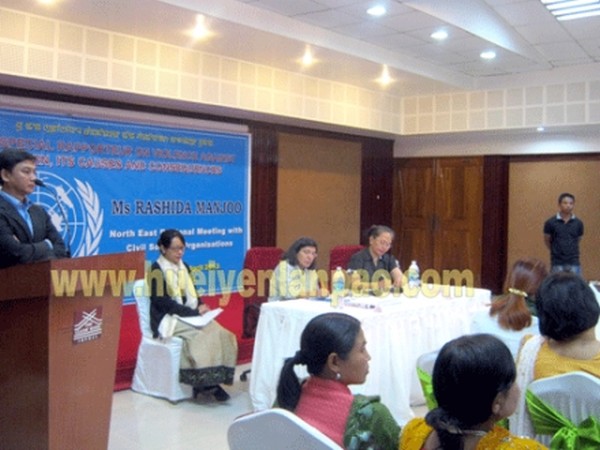
(Executive Director of HRA Babloo Loitongbam delivering the vote of thanks of the meeting)
The Indian agency E-Paonet reports in some detail on the visit by a UN Special Rapporteur to India. Let’s start by acknowledging India’s willingness to accept the Rapporteur (unlike other countries such as Eritrea I just reported on today)!
The Rapporteur in question is Rashida Manjoo the United Nations Special Rapporteur on Violence Against Women, its Causes and Consequences who held a consultative meeting with representatives of civil society organizations, women human rights defenders, victims and other advocates working on violence against women at Classic Hotel, on 28 April. As many as forty separate depositions were made during the meeting, the largest one during her current 10-day long official mission to India from April 22 to May 1. After hearing all the depositions, Rashida observed that it was not her mandate to comment on the depositions made before her, but assured that her report and recommendations would be based on facts and they would be placed on the table of the forthcoming session of the United Nations Commission on Human Rights, which is scheduled to take place June this year at Geneva for necessary actions. Read the rest of this entry »
Posted in human rights, Human Rights Defenders | Leave a Comment »
Tags: Assam Rifles, civil society organizations, consultation, Convention on the Rights of the Child, E-Paonet, fact finding, Human Rights Defenders, India, national ngos, New Delhi, Rashida Manjoo, UN Special Rapporteur, United Nations Special Rapporteur, Violence against women, West Bengal, women human rights defenders
January 9, 2013
Phyllis Bennis, a Fellow of the Institute for Policy Studies and of the Transnational Institute in Amsterdam, wrote in her blog through Al-Jazeera, on 9 January 2013, a very informative piece under the title: “Human Rights Watch: Time to stand with human rights defenders” with the provocative byline: It is disappointing to see HRW’s unwillingness to stand with those who are working to promote and defend human rights.
The full article one should certainly read at: http://www.aljazeera.com/indepth/opinion/2013/01/20131781532514238.html but what matters here is the policy question to what extent a (decent) NGO (i.c. HRW) should take to task another (very biased) NGO (i.c. UN Watch).
In short, the pro-Israeli, UN-bashing UN Watch discovered that the UN Special Rapporteur for Human Rights in the Occupied Palestinian Territory, US lawyer Richard Falk, was still ‘on the Board’ of HRW. HRW quickly replied that he was only a member of HRW’s local support committee in Santa Barbara, California, where he lives and that it was an oversight that he still held this honorary position and that it was rectified (“longstanding policy, applied many times, that no official from any government or UN agency can serve on any Human Rights Watch committee or its Board. It was an oversight on our part that we did not apply that policy in Richard Falk’s case several years ago when he assumed his UN position”). UN Watch of course cried victory implying that Falk was expelled an enemy of human rights or because he is anti-Semitic.
The author of the blog finds fault with HRW’s meek response that did indeed not amount to a strong defense of Richard Falk’s credentials, impartiality and expertise. Should HRW not have made clear that substantively it stands with Richard Falk, that he was removed for technical reasons only and would be welcomed back as soon as he ceases to be UN Rapporteur? These are policy question that each NGO should answer for itself but in the context of UN Watch’s obsession to undermine the work of the UN in general and Richard Falk in particular a more robust stance would have been useful. I think that the similarity – even confusion – in name should also have led HRW to take a tougher public stand.
Phyllis Bennis concludes with: “Given his Middle East staff’s consistent work, there is no question that Ken Roth and the HRW board understand that human rights criticism of Israeli occupation is well-grounded in fact, and that such criticism remains a crucial element in changing the public, media and policymaking discourse in the United States. If we are ever to have any hope of changing US government policy in Palestine-Israel towards one grounded in human rights and international law, consistent human rights criticism and a willingness to stand with human rights defenders like Richard Falk when they face attack, remain crucial tools – for all human rights activists, including the leadership of Human Rights Watch.”
Posted in HRW, human rights, Human Rights Defenders | 1 Comment »
Tags: HRW, human rights, Human Rights Watch, Institute for Policy Studies, Israeli-occupied territories, Kenneth Roth, NGOs, Palestine, Phyllis Bennis, Richard Falk, UN, UN Special Rapporteur, UN Watch
November 26, 2012
On 12-13 November Belarusian HRH hosted the first meeting of the Belarusian human rights defenders with Miklós Haraszti, the UN Special Rapporteur on the situation of human rights in Belarus.
 Among those who represented Belarus there were Valiantsin Stefanovich, the deputy head of the Human Rights Centre “Viasna”; Tatsiana Reviaka, President of the Belarusian Human Rights House; Anna Gerasimova, director of Belarusian Human Rights House; Aleh Hulak, chairperson of theBelarusian Helsinki Committee; Dzmitry Charnykh, the lawyer of BHC; Zhanna Litvina, chairperson of the Belarusian Association of Journalists; Ina Kuley, chairperson ofSalidarnasts (Solidarity), an organisation that provides support to victims of political persecution in Belarus; Liudmila Hraznova, chairperson of the Human Rights Alliance; Alena Krasouskaya-Kaspiarovich, deputy chairperson of a prisoners’ rights organisation Platforma (Platform); Aleh Vouchak, chairperson of Legal Assistance to the Population; Yury Chavusau, the lawyer of the Assembly of NGOs, and Siarhei Ustsinau, Belarusian human rights defender.
Valiantsin Stefanovich as the representative of “Viasna” made a presentation on political prisoners in Belarus, as well as analyzed the situation on the freedom of peaceful assembly in the country.
The decision to renew the mandate of the UN Special Rapporteur on Belarus was adopted on 28 September in Geneva during the 21th session of the UN Human Rights Council. Miklós Haraszti, Hungarian diplomat, was appointed for this position and on 1 November he officially started to work.
Human rights defenders held initial consultations with the UN Special Rapporteur on Belarus – Human Rights House Network.
Posted in human rights, Human Rights Defenders | 1 Comment »
Tags: Belarus, human rights, Human rights defender, UN Special Rapporteur, United Nations Special Rapporteur
November 26, 2012
In her report, the Special Rapporteur reviews the types of legislation affecting the work of HRDs, including laws relating to: anti-terrorism and national security; public morals; the registration, functioning and funding of associations; access to information and official-secrets; defamation and blasphemy; and Internet access. While all of these categories are relevant, the AWID document looks at how four of these practices affect Women Human Rights Defenders (WHRDs).
Anti-terrorism and national security WHRDs in Zimbabwe have continually denounced arbitrary arrests and violations of the right to peaceful assembly. The increase in Governments that use anti-terrorism and/or national security laws to detain, prosecute, convict, and harass WHRDs is a worldwide concern. According to the Special Rapporteur, this type of legislation is “so broad that any peaceful act expressing views of dissent would fall under the definition of a terrorist act, or an act facilitating, supporting or promoting terrorism”.
Public morals In Meso-America, WHRDs working to promote women’s sexual and reproductive rights and the decriminalization of abortion[3] are the ones who most often experience criminalization and defamation by the State, private groups and the media. The Special Rapporteur’s report strongly emphasises how vital sexual health and reproductive rights (SHRR) defenders are for the promotion, protection and respect of women’s human rights, highlighting that “ these activities should not be subject to criminal sanction”. Zero tolerance for judicial harassment against SHRR defenders is called for, and States with legal frameworks guaranteeing SHRR should “ensure that such legislation is enforced without discrimination”.
Legal restrictions on operations Increasingly, States are issuing special regulations that affect the legal operation of women’s organizations in ways that are intended to inhibit their work. The 2005 report Written Out: How Sexuality is Used to Attack Women’s Organizing states that “after the attacks of 9/11, the US government put into place a set of supposedly terrorism-related legal and financial restrictions for any organization that funds groups outside the US. Under these policies, such funding organizations now have to prove that the groups receiving funds are not in any way engaging in terrorist activities”.
Defamation Although defamation legislation is intended to protect a person’s reputation from false and malicious attacks, legal frameworks under the umbrella of defamation tend to hide political or economic interests in order to retaliate against criticism and public denouncement of corruption. While defamation laws rarely protect WHRDs from defamation, they are often used to limit the freedom of expression of WHRDs. The Meso-American Assessment of Violence against WHRDs states that defamation is “one of the most repeated forms of violence against WHRDs in the region, either by the state, private groups and the media”. The Special Rapporteur’s report highlights that penalties are imposed on WHRDs who criticize Government representatives or religious laws. Under penal codes for defamation or blasphemy penalties vary from fines to months of imprisonment. These provisions prevent WHRDs from holding public officials or religious leaders accountable.
The Special Rapporteur raises concern about the development of legislation that allows authorities to supervise the activities of civil society organizations (CSOs). The report refers to confidential information received by the Special Rapporteur that points to how reporting requirements have been imposed on CSOs to retain their licence to operate, placing surveillance on CSOs, demanding documentation without prior notice, and restricting access to foreign funding and limiting this to up to 10% of their total annual income. Similarly, restrictions on certain areas of work have been imposed on women’s rights organizations, in particular those related to defending political rights and those that use human rights language in their organizations’ objectives. Excessive requirements for operating legally make it difficult for WHRDs to comply, and in some instances the required documentation puts WHRDs at risk. This trend of legal control and restriction undermines and delegitimizes the work of WHRDs and their organizations, as the resources and time required to respond to such demands deter women’s rights advocates from forming organizations.
Recommendations The 26 recommendations presented in the Special Rapporteur’s report aim at ensuring that national legislations comply with basic human rights enshrined in their constitutions – and consistent with the Declaration on HRDs – to create favourable working environments for HRDs. Special attention is needed regarding legislation that responds to the needs and situations of WHRDs, in particular those working on SHRR. The report makes an important call for States to “repeal all legislation that, with the declared objective of preserving public morals, criminalizes the activities of HRDs working on sexual orientation and gender identity issues”. Importantly, the Special Rapporteur’s recommendation to “ensure that civil society, national human rights institutions and other stakeholders are involved in a broad consultative process to ensure that the drafting of new legislation is in compliance with the Declaration on Human Rights Defenders and other applicable international human rights instruments”, is critical to guarantee the inclusion and full participation of WHRDs in civil society.
for details see: http://www.awid.org/News-Analysis/Friday-Files/When-States-Use-Legislation-Against-Women-Human-Rights-Defenders
Posted in human rights | Leave a Comment »
Tags: AWID, Civil society, human rights, Human Rights and Liberties, Human Rights Council, Human rights defender, Special Rapporteur on the situation of human rights defenders, UN, UN Special Rapporteur, United Nations Special Rapporteur, women human rights defenders
September 27, 2012
On 26 September UPI reports from Geneva that a U.N. rights delegation announced plans to assess the role human rights defenders have played in Tunisia since the country’s Jasmine Revolution in 2010.
Margaret Sekaggya, U.N. special envoy on human rights organizations, leads a delegation to Tunisia for a trip that concludes Oct. 5, a first since the country’s revolution.
“Human rights defenders have played an essential part in the call for democracy, justice and human rights across the region,” she said in a statement. “We are intrigued and excited to observe the working conditions of defenders of all generations in the country that in many ways triggered the Arab Spring.”
Read more: http://www.upi.com/Top_News/Special/2012/09/26/UN-rights-delegation-heads-to-Tunisia/UPI-29741348668711/#ixzz27fzkoNw1
U.N. rights delegation heads to Tunisia – UPI.com.
Posted in Human Rights Defenders | Leave a Comment »
Tags: Arab spring, Human Rights Defenders, Margaret Sekaggya, Tunisia, UN, UN Special Rapporteur


