Posts Tagged ‘travel ban’

Egyptian human rights defender Alaa Abdel Fattah finally free!

September 23, 2025

Egyptian media reported on 22 September, 2025, that President Abdel Fattah al-Sisi had issued a presidential pardon for the imprisoned Egyptian-British activist Alaa Abdel Fattah. On 23 September the Guardian, HRW and others reported that the British-Egyptian human rights activist Alaa Abd el-Fattah has indeed been released from jail after serving six years for sharing a Facebook post.

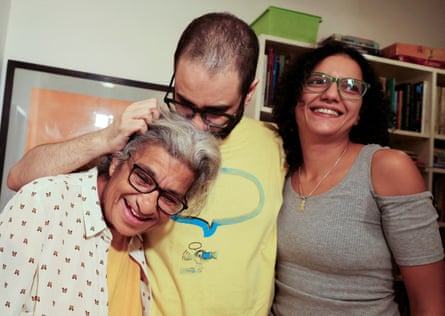
Early on Tuesday morning his campaign said in a statement that Abd el-Fattah was released from Wadi Natron prison and was now in his home in Cairo. “I can’t even describe what I feel,” his mother, Laila Soueif, said from her house in Giza as she stood next to her son surrounded by family and friends. “We’re happy, of course. But our greatest joy will come when there are no [political] prisoners in Egypt,” she added.

Peter Greste, an Australian journalist who was imprisoned alongside Abd el-Fattah, told Australian Associated Press: “It’s absolutely wonderful news, I’m absolutely overjoyed, I think it vindicates all the work and the efforts of the people who lined up behind him. See also: https://humanrightsdefenders.blog/2025/01/19/i-owe-alaa-abd-el-fattah-my-life-which-is-why-i-am-going-on-a-hunger-strike-to-help-free-him/

Alaa Abd el-Fattah stands next to his mother, Laila Soueif, and sister, Sanaa, at their home in Giza.
Alaa Abd el-Fattah stands next to his mother, Laila Soueif, and sister, Sanaa, at their home in Giza. Photograph: Mohamed Abd El Ghany/Reuters

Amnesty International’s Erika Guevara Rosas said the release was welcome but long overdue. “His pardon ends a grave injustice and is a testament to the tireless efforts of his family and lawyers, including his courageous mother Laila Soueif and activists all over the world who have been relentlessly demanding his release,” she said. The following quote can be attributed to Amr Magdi, senior Middle East and North Africa researcher at Human Rights Watch: “President Sisi’s pardon of the imprisoned Egyptian activist Alaa Abdel Fattah is long overdue good news. Though we celebrate his pardon.

The campaign for Abd el-Fattah’s release was led by his family, including his mother, who was admitted to hospital in London twice after going on hunger strikes trying to secure his release. The UK prime minister, Keir Starmer, is also known to have telephoned Sisi three times to lobby for Abd el-Fattah’s release. see: https://humanrightsdefenders.blog/2022/07/07/mona-seifs-letter-a-cry-for-help-for-alaa/

https://www.theguardian.com/world/video/2025/sep/23/egyptian-british-activist-alaa-abd-el-fattah-reunited-with-family-after-release-from-prison-video

https://www.hrw.org/news/2025/09/22/egypt-presidential-pardon-for-activist-alaa-abdel-fattah

https://www.theguardian.com/world/2025/nov/14/british-egyptian-activist-alaa-abd-el-fattah-stopped-from-flying-to-uk-says-family

Tomorrow (16/9/25) in Geneva: Packed with Courage – stories of human rights defenders banned from travelling

September 15, 2025

Listen to the stories of four human rights defenders who have been banned from travelling by their own governments simply for trying to cooperate with the United Nations. Can you guess which suitcase belongs to whom?

Location: Geneva, Switzerland Date: 16 September 2025, 10:00AM – 5:00PM CEST

Some States use travel bans as reprisals against human rights defenders who cooperate with the United Nations. These acts of retaliation are designed to isolate, intimidate, and silence them.  

A travel ban may be less visible than a prison cell, but its impact is deeply damaging. It restricts defenders from attending UN meetings, carrying out their work, reuniting with family or seeking international protection.   

Travel bans take many forms, including cancelling or confiscating passports, detaining defenders attempting to exit a country, denying defenders the right to leave or enter back into their own countries, and placing defenders on terrorist lists.   

Through this exhibition, we unpack the stories of four human rights defenders who have been barred from entering or leaving in their own countries under arbitrary travel bans. These are not just about State reprisals against activists, they are stories of people whose lives have been disrupted, whose voices have been silenced, and whose basic freedoms have been trampled. They are also stories of resilience and perseverance in seeking positive social change.

Their voices defend human rights. Travel bans silence them: #EndReprisals!

Their voices defend human rights. Travel bans silence them: #EndReprisals!

https://ishr.ch/events/packed-with-courage-stories-of-human-rights-defenders-banned-from-travelling

Travel bans are Reprisals!

May 28, 2025

The Issue

Some States are using travel bans to punish and silence human rights defenders who dare to speak out at the United Nations. These acts of reprisal — from confiscating passports to unjustly labeling activists as terrorists — are designed to isolate, intimidate, and silence voices demanding accountability and justice.  A travel ban may be less visible than a prison cell, but its impact is no less damaging. It prevents defenders from attending UN meetings, carrying out their work, reuniting with loved ones, or seeking safety.

This is the lived reality for: 

These are not isolated cases — they are part of a pattern of reprisals meant to silence dissent and deter others from engaging with the UN.  

What the International Service for Human Rights demand is: 

  • The lifting of travel bans and restrictions against Loujain, Mohamed, Anexa, and Kadar. 
  • The inclusion of their cases in the UN Secretary-General’s annual report on reprisals. This is the first step to recognise they are cases of reprisals which need to be addressed and resolved. 
  • Concrete action from States to publicly condemn and raise these cases at the Human Rights Council and General Assembly.  
    According to our research, we found that more publicity and peer-pressure bring more probability for the reprisal case to be resolved (i.e. here, for the bans to be lifted). 
  • The establishment of clear UN protocols to prevent and respond to acts of reprisal. 

You can help us achieve our goals:  

The first step, is for the Secretary-General to include these cases in his reprisals report. You can contribute by:

👉 Signing our petition to the UN Secretary-General to ensure Loujain, Mohamed, Anexa, and Kadar are included.

Together, we can #EndReprisals.

Find out more about the campaign.https://www.change.org/p/their-voices-defend-human-rights-travel-bans-silence-them-endreprisals

https://www.change.org/p/their-voices-defend-human-rights-travel-bans-silence-them-endreprisals

Hong Kong: Targeting of Exiled Activists’ Families Escalates

May 16, 2025

Father of Anna Kwok Charged with National Security Crime

The Hong Kong police arrested the father of a prominent US-based activist, Anna Kwok, on April 30, 2025, and charged him with a national security crime, Human Rights Watch said today. The arrest of Kwok Yin-sang was the first such prosecution of a family member of an exiled activist. Hong Kong authorities should immediately drop all charges and release him.

The Hong Kong authorities have recently intensified their harassment of the families of 19 wanted Hong Kong activists living in exile. Punishments and harassment against individuals for the alleged actions of another person is a form of collective punishment, prohibited by international human rights law.

The Chinese government has increased its appalling use of collective punishment against family members of peaceful activists from Hong Kong,” said Yalkun Uluyol, China researcher at Human Rights Watch. “The Hong Kong authorities should immediately and unconditionally release Anna Kwok’s father and cease harassing families of Hong Kong activists.”

On May 2, national security police formally charged Kwok Yin-sang, 68, with “directly or indirectly” dealing with the finances of an “absconder” under section 90 of the Safeguarding National Security Ordinance, which carries a punishment of up to seven years in prison. Kwok Yin-sang remains in custody with a bail hearing scheduled for May 8. Anna Kwok’s brother was also arrested on April 30 but has been released on bail pending further investigation.

Anna Kwok, 28, is the executive director of Hong Kong Democracy Council, a nongovernmental organization based in Washington, DC. In July 2023, she was among a first group of eight people against whom the Hong Kong police issued arrests warrants and HK$1 million (US$129,000) bounties for violating Hong Kong’s National Security Law.

Since then, Hong Kong police have issued similar baseless arrest warrants and bounties against 11 other exiled Hong Kong activists.

Hong Kong authorities have sought to intimidate dozens of family members of the 19 “wanted” individuals, primarily by interrogating them. In the case of Ted Hui, a resident of Australia, they also confiscated HK$800,000 (US$103,000) from him and his family for having allegedly violated the National Security Law.

There has been a new wave of harassment against these families in recent months, Human Rights Watch said. After the Hong Kong police issued the third group of arrests and bounties against six exiled activists in December 2024, they began to harass their families. In January, police interrogated eight family members and former colleagues of the UK-based scholar Chung Kim-wah, and raided the office of the Hong Kong Public Opinion Research Institute, with which Chung was formerly associated.

In February the police questioned the aunts and an uncle of Carmen Lau, a UK-based activist and former district councilor. On March 18, police interrogated the stepfather of the activist Tony Chung, who is in the UK.

On April 10, national security police took the parents of the US-based activist Frances Hui into custody for questioning.

The 19 wanted activists have also faced various other forms of harassment. In June and December 2024, the Hong Kong government cancelled the passports of 13 wanted activists, including Anna Kwok. In March, Lau and Chung reported that anonymous individuals sent letters to residents in various London neighborhoods urging them to hand in the activists to the Chinese Embassy in London, citing the warrants and bounties against them. Similar letters were sent to Melbourne-based Kevin Yam, a democracy activist and an Australian citizen.

Many of the 19 activists, including Kwok and Frances Hui, have reported online harassment campaigns, including rape and death threats, since the government issued the warrants and bounties against them. The media reported that an online campaign, which exhibited signs of a previous Chinese government influence operation, sought to mobilize far-right people in the UK to attack activists on the bounty list.

The 19 wanted activists live in the UK, US, Canada, and Australia. The US government in March sanctioned six officials in Hong Kong for using the National Security Law “extraterritorially to intimidate, silence, and harass” the activists. The other three governments have issued statements condemning the arrest warrants, but have not taken action to hold Hong Kong officials accountable. The US government is also the only one that has arrested someone for allegedly harassing a Hong Kong activist on its soil, though the person was later acquitted.

The Chinese government has used two draconian national security laws, the National Security Law of 2020 and the Safeguarding National Security Ordinance of 2024, to dismantle the city’s pro-democracy movement and take away its fundamental freedoms, which are enshrined in Hong Kong’s de facto constitution, the Basic Law. Over 200,000 Hong Kongers have left Hong Kong, among them protesters and activists who have continued their activism abroad.

The AustralianUK, and US governments, the European Union, and the United Nations High Commissioner for Human Rights have all publicly expressed concerns about the two security laws.

“Beijing isn’t likely to stop abuses against the families of exiled activists unless affected governments send a strong message that such repression carries a cost,” Uluyol said. “They should fully investigate and sanction Chinese and Hong Kong officials involved, and pass strong laws to protect their residents and citizens from transnational abuses.”

https://www.hrw.org/news/2025/05/04/hong-kong-targeting-exiled-activists-families-escalates

Venezuela: Where is Eduardo Torres? 

May 13, 2025

ISHR, T

ISHR, the Observatory for the Protection of Human Rights Defenders, a partnership of the World Organisation Against Torture (OMCT) and the International Federation for Human Rights (FIDH), request your urgent intervention in the following situation in Venezuela.

The Observatory has been informed of the disappearance of Mr. Eduardo Torres, a labour lawyer who has been a member for over five years of the Venezuelan Education-Action Program on Human Rights (PROVEA), an FIDH member organisation.

According to witnesses, Eduardo Torres was last seen on Friday, 9 May 2025 at 4:00 p.m. in Parque Central in Caracas, after attending a meeting. At that moment, Mr. Torres contacted his family and informed them he was heading home, near Av. Fuerzas Armadas in Caracas, but he never arrived.

Seeking information about Eduardo Torres’ whereabouts, his wife, Ms. Emiselys Nuñez, accompanied by PROVEA members, have visited various detention centres in Caracas, including the Bolivarian National Intelligence Service (SEBIN) at El Helicoide, several National Bolivarian Police (PNB) stations in Maripérez, Boleíta and Petare, as well as the General Directorate of Military Counterintelligence (DGCIM) in Boleíta. As of the publication of this urgent appeal, his whereabouts remain unknown.

On 11 May 2025, Ms. Emiselys Nuñez and PROVEA’s legal team went to the Palace of Justice to submit a “Habeas Corpus” petition before the Judge of First Instance in Control Functions of the Criminal Judicial Circuit of the Metropolitan Area of Caracas, Specialised in protection matters, to request information on whether Eduardo Torres had been detained by the Venezuelan State. However, after more than seven hours of waiting, they were not “authorised” to receive the document, without providing details, and in clear violation of Article 27 of the National Constitution and Articles 2, 3, and 4 of the Organic Law of Personal Liberty and Security.

On 12 May 2025, the PROVEA team, along with Mr. Torres’ wife and mother, went to the Constitutional Chamber of the Supreme Court of Justice and handed the “Habeas Corpus” petition at 12:10 pm.

The Observatory highlights that Mr. Torres has been repeatedly been subjected to threats and acts of harassment by Venezuelan police officers. Like the rest of the PROVEA team, he is a beneficiary of precautionary protection measures granted by the Inter-American Commission on Human Rights (IACHR) due to repeated threats, criminalisation, and harassment in connection with his human rights work in Venezuela.

The Observatory recalls that on 7 January 2025, Mr. Carlos Correa, former PROVEA coordinator, was intercepted in the centre of the capital Caracas by hooded officials. His whereabouts remained unknown for several days before he was released on 16 January 2025.

The Observatory also recalls that on 15 October 2024, the passport of Mr. Torres, among other human rights defenders and/or persons identified as opponents, was cancelled in a selective and discretionary manner as a mechanism of repression and intimidation to prevent him from leaving the country and/or cooperating with international protection mechanisms, thus violating his rights to identity, free transit and mobility.

The Observatory expresses its deepest concern due to the high probability that Mr. Eduardo Torres is in a condition of arbitrary detention and enforced disappearance, due to his work as a human rights defender and given the constant threats against him. If confirmed, these acts would increase the risk of torture and ill-treatment against him.

The Observatory underlines that this disappearance occurs two weeks before the national and regional elections scheduled for 25 May 2025, again highlighting the risks against human rights defenders in Venezuela and exemplifying a systematic attempt to silence all critical voices committed to human rights and democracy in the country.

The Observatory urges the Venezuelan authorities to guarantee the physical and psychological security of Mr. Eduardo Torres, to disclose his whereabouts and to proceed to his immediate and unconditional release, in case he is indeed detained by State actors.

https://www.fidh.org/en/issues/human-rights-defenders/venezuela-disappearance-of-eduardo-torres-member-of-provea

Council of the European Union decides to impose measures on more individuals and entities in Iran

April 29, 2025

The Council decided 14 April to impose restrictive measures on an additional seven individuals and two entities responsible for serious human rights violations in Iran, including for the use of the judiciary as a tool for arbitrary detention.

The European Union continues to be deeply concerned by Iran’s distressing practice to arbitrarily detain EU mono and dual nationals ..

In this context, the EU is imposing sanctions on the Shiraz Central Prison, located in Fars Province, and the First Branch of the Revolutionary Court of Shiraz. Furthermore, the EU is imposing restrictive measures on members of the judiciary, including Hedayatollah Farzadi, head of Evin prison, and Mehdi Nemati, head of the Fars Prisons Protection and Intelligence Department.

Restrictive measures now apply to a total of 232 individuals and 44 entities. They consist of an asset freeze, a travel ban to the EU, and a prohibition to make funds or economic resources available to those listed. A ban on exports to Iran of equipment, that might be used for internal repression, and of equipment for monitoring telecommunications is also in place.

The European Union expresses its support for the fundamental aspiration of the people of Iran for a future where their universal human rights and fundamental freedoms are respected, protected and fulfilled. The relevant legal acts have been published in the Official Journal of the EU.

The EU introduced in 2011 a regime consisting of restrictive measures that have been renewed annually since, and last extended until 13 of April 2026. Since 2022, the EU has drastically increased restrictive measures, adopting 11 packages of sanctions in the context of growing concerns about serious human rights abuses and violations in Iran.

Human rights defender Rufat Safarov detained in Azerbaijan on way to award ceremony

December 5, 2024
Rufat Safarov. Via Voice of America.

On 4 December 2024, Aytan Farhadova in OC media reported that human rights defender Rufat Safarov was detained in Azerbaijan a week before he was set to be awarded the Human Rights Defender of the Year award by US State Secretary Antony Blinken. That day, Safarov’s lawyer, Elchin Sadigov, posted on Facebook that Safarov was accused of hooliganism and fraud resulting in major damage.

Sadigov later posted a message written by Safarov, in which he explained that he was planning to visit the US two days after receiving his visa in order to accept the Global Human Rights Defender Award from Blinken. [not totally clear which award is referred to – ed]

So I was awarded as a strong human rights defender of the year. Because the United States initially nominated me, I express my deep gratitude to [Mark] Libby, the US Ambassador in Azerbaijan, and Mr Blinken, US Secretary of State, who supported my candidacy.’

https://www.trueheroesfilms.org/thedigest/laureates/327debe6-fca9-40c4-b972-db855616566b

State Department’s Deputy Spokesperson, Vedant Patel, during a press briefing on Tuesday, said: We’re deeply concerned by reports that human rights defender Rufat Safarov has been detained in Azerbaijan’, Patel said, adding that they were ‘closely monitoring the case.’

Frank Schwabe, the head of the German delegation of the Parliamentary Assembly of the Council of Europe (PACE), criticised Safaravo’s arrest, saying that PACE will ‘respond to this in January’.

Safarov, a former prosecutor’s office official who spoke out against human rights abuses by the government, was sentenced to nine years in prison on charges of bribery, fraud, and human rights violations in 2016. He was released from prison alongside almost 400 others  after Azerbaijani President Ilham Aliyev issued an amnesty to mark Novruz in 2019.

https://www.streetinsider.com/Reuters/Azerbaijan+denounces+diplomatic+criticism+of+human+rights/24067963.html

Soltan Achilova again banned from traveling to receive her award

November 21, 2024

The undersigned human rights organisations, which together represent the Jury for the Martin Ennals Award for Human Rights Defenders, condemn the continued harassment against 2021 Martin Ennals Award Finalist and woman human rights defender from Turkmenistan, Soltan Achilova. This morning, Soltan Achilova and her daughter were once again prevented from travelling to Geneva. As in 2023, Soltan Achilova was set to be recognized for her valuable contributions to the documentation of human rights violations in Turkmenistan by the Martin Ennals Foundation.

Soltan Achilova is a woman human rights defender and journalist, who continues to work in Turkmenistan, one of the most repressive and isolated countries in the world, ranking 176th out of 180 countries in terms of press freedom and working conditions for journalists. She has been reporting about her country for over a decade. Her pictures of daily life are one of the few sources of documentation of human rights violations occurring in Turkmenistan. As a result of this work, she remains under constant surveillance by Turkmen authorities and has suffered numerous incidents of harassment, intimidation, and threats. Despite the challenges, Soltan Achilova persists in her human rights work, regularly sending information and pictures outside the country so that government authorities can be held accountable. [see: https://humanrightsdefenders.blog/tag/soltan-achilova/]

On the morning of 20 November 2024, Soltan Achilova and her daughter Maya Achilova were scheduled to travel from Ashgabat to Geneva, to participate in the Martin Ennals Award ceremony. At 6:30 a.m. local time, according to the information received by the Martin Ennals Foundation, a group of law enforcement officers pushed Soltan Achilova, her daughter and her daughter’s husband into an ambulance and brought them to the specialised hospital “Infectious Disease Control Centre” in the Choganly neighbourhood of Ashgabat, located near the Ashgabat International Airport. Maya Achilova reported to the Foundation that her husband, her mother and herself are being retained at the medical facility, guarded by the security forces, and that one of the security service agents is in possession of the keys to Soltan Achilova’s apartment. Thereby, Turkmen authorities have once again prevented Soltan Achilova from travelling to Geneva, Switzerland, where she would finally be recognized as a Finalist of the 2021 Martin Ennals Award for her documentation of land grabs and forced evictions of ordinary citizens in Ashgabat.

Turkmen authorities have prevented woman human rights defender Soltan Achilova from traveling freely outside of her country on several occasions; the latest occurring as recently as November 2023. In the early hours of 18 November 2023, Soltan Achilova and her daughter were stopped by Turkmen government officials from boarding their flight to Switzerland. A customs official took their passports, wet them with a damp rag and declared the passports to be ruined, preventing Soltan and Maya Achilova from boarding the plane. Despite receiving assurances at high-level from Turkmen authorities that Soltan Achilova would not be prevented from traveling once again, the authorities continue to harass the woman human rights defender with travel restrictions and arbitrary detention.

The human rights organisations that make up the Jury of the Martin Ennals Award, as well as the Martin Ennals Foundation, once again condemn Turkmen authorities for their continued harassment of woman human rights defender and photojournalist Soltan Achilova and her family members and call for their immediate release. The organisations jointly call upon the Turkmen authorities to provide all the necessary assistance to enable her travel outside of Turkmenistan. Finally, the organisations renew their calls for Turkmenistan to fully implement their human rights obligations, including, inter alia, allowing human rights defenders and journalists to conduct their work without fear of reprisals.

Following the writing of this statement, an article containing further details was published by the Chronicles of Turkmenistan, an online publication of the Turkmen Initiative for Human Rights, which, according to its author, has also been in contact with Soltan Achilova’s family.

Signatories:

Amnesty International

Human Rights Watch

World Organisation Against Torture (OMCT)

International Service for Human Rights (ISHR)

International Federation for Human Rights (FIDH)

HURIDOCS

Human Rights First

Front Line Defenders

Brot für die Welt

International Commission of Jurists

The Martin Ennals Foundation

https://www.frontlinedefenders.org/en/statement-report/turkmen-authorities-yet-again-prevent-woman-human-rights-defender-and-2021-martin

https://www.reuters.com/world/journalist-seized-turkmenistan-ahead-swiss-award-ceremony-say-rights-groups-2024-11-21/

Prominent Baluch human rights defender stopped from attending TIME event in US and then assaulted

October 22, 2024

Front Line Defenders call for the Pakistani authorities to be held accountable for their mistreatment and abuse of prominent Baloch woman human rights defender Dr. Mahrang Baloch and other human rights defenders accompanying her in Karachi, on 8 October 2024. The woman human rights defender was attacked by Sindh police while she was returning from the Karachi’s Jinnah international airport after immigration authorities denied her permission to leave the country.

Dr. Mahrang Baloch is a woman human rights defender and a staunch advocate for the rights of the ethnic Baloch community in Pakistan. She has campaigned peacefully against systemic violations including extra judicial killings, enforced disappearances, arbitrary detentions and custodial torture in Balochistan. Human rights defenders speaking out against state violence, especially seeking to hold the military and intelligence agencies accountable, undertake significant risks – against themselves and their families.

On 7 October 2024, Pakistani authorities prevented Dr. Mahrang Baloch from leaving the country. The woman human rights defender was to attend an event in New York organized by TIME which had named her in the TIME100 Next 2024 List recognizing her human rights work. Unfortunately immigration officers at the Karachi airport withheld her passport for several hours and denied her permission to board her flight without any legal basis or reasoning. Dr. Mahrang Baloch finally left the airport at around midnight after she recovered her passport. Shortly after, her vehicle was intercepted by a group of officers from the Sindh police on the old airport road in close proximity to the airport. Police brutally beat and abused Dr. Mahrang Baloch and several other human rights defenders including Sammi Deen Baloch. Police illegally seized Dr. Mahrang’s passport and mobile phone. They also took the vehicle keys, leaving the human rights defenders stranded on a deserted road at late hours in the night.

Reprisals including restrictions on travel are common in Pakistan, especially for those who speak out against state repression. In August 2024, Sammi Deen Baloch, the Front Line Defenders award winner for 2024 was prevented from traveling to Geneva for an advocacy mission to highlight human rights issues in Balochistan. The attack on Dr. Mahrang Baloch is not an isolated incident. It spotlights what many human rights defenders in Pakistan face as punishment for their work. Human rights defenders from oppressed communities such as the Baloch are especially targeted. State response to peaceful campaigns by the Baloch Yakjehti Committee (Baloch Solidarity Committee) has been to suppress protests and campaigns with brute force and repressive measures including criminalization.

https://www.frontlinedefenders.org/en/statement-report/pakistan-woman-human-rights-defender-dr-mahrang-baloch-prevented-leaving-pakistan

https://www.rferl.org/a/pakistan-baloch-baluch-rights-travel-ban/33151431.html

Egyptian NGOs demand apology after closure of 13-year case over lack of evidence

April 1, 2024

Hossam Bahgat is demanding an apology and remedy after a travel ban and freeze on his assets was reversed on 20 March 2024 (AFP/Mada Masr/file photo)

On 22 March 2024 MEE reported on a very interesting development in Egypt, where dozens of rights defenders have been affected by travel bans and asset freezes for over decade in a ‘politically motivated’ case [see also: https://humanrightsdefenders.blog/tag/hossam-bahgat/].

Egypt has announced the closure of a 13-year landmark case in which human rights defenders were accused of receiving illicit foreign funding – but those affected by the allegations are demanding justice. An investigative judge on Wednesday declared the closure of case 173/2011, known in the media as the “foreign funding case”, due to what he described as “insufficient evidence”.

The case has been widely denounced as a politically-motivated attack on Egypt’s civil society.  Judge Ahmed Abdel Aziz Qatlan’s decision marks the end of a probe against 85 organisations. It also means an end to asset freezes and travel bans imposed on members of these organisations, he added.

Before the decision on Wednesday, accusations against most of the organisations implicated had already been dropped and this week’s decision only affects five organisations. 

These were the Egyptian Initiative for Personal Rights (EIPR); the Arabic Network for Human Rights Information (ANHRI); the Arab Penal Reform Organisation; the Cairo Institute For Human Rights Studies; and Al-Nadeem Center for  Rehabilitation of Victims of Violence.

Rights groups and human rights defenders have called for an apology and compensation for the defendants. Hussein Baoumi, foreign policy advocacy officer at Amnesty International, who had previously monitored the case as Amnesty’s Egypt researcher, said the closure of the case is a welcome step but is “long overdue”.

“The government must issue a public apology and compensate the human rights defenders for years of smearing and punitive measures, merely because they defended the rights of millions of people,” he told Middle East Eye.

Baoumi expressed cautious optimism about the government’s respect for the court decision. “It is too early to say if this marks a serious shift in the government’s crackdown on civil society,” he said. “Closing case 173 must be followed by lifting all travel bans and asset freezes against human rights defenders, all those arbitrarily detained must be released and the NGO law must be amended to bring it in line with Egypt’s obligations.”

Hossam Bahgat, director of the EIPR, has been under a travel ban and barred from accessing his bank account for eight years. Following the closure of the case, he said he felt “vindicated but not relieved”.

He demanded “an official and public apology and restitution for the psychological and material damage resulting from this bogus case”. Gamal Eid, the founder of the ANHRI, welcomed the decision to lift his travel ban but said he still hopes for “the return of all the innocent and oppressed people to their families and loved ones”, referring to the estimated 65,000 political prisoners still languishing in Egyptian jails.

The Cairo Institute for Human Rights (CIHRs) said on Friday: “The decision does not remedy the injustices suffered by the dozens of human rights defenders targeted by the case over the course of the previous decade. Egyptian authorities must issue a formal apology to the victims of this persecution and compensate them for the losses and hardship they have been forced to endure.

Bahey eldin Hassan, CIHRs director, has been sentenced to 18 years in jail in absentia and his sentence remains in effect, the group said.  Hassan and dozens of other human rights defenders are currently living in exile because they fear arrest if they return to Egypt.

CIHR also called on Egypt to put an end to its ongoing crackdown on civil society and human rights defenders, including Ibrahim Metwally, Ezzat Ghoneim, and Hoda Abdelmoniem, who are still behind bars in connection with their work.

CIHR is calling for a review of Egypt’s counter-terrorism legislation and penal code to safeguard the freedom of human rights defenders to carry out their jobs without fear of reprisals. 

“Only through a comprehensive review of repressive Egyptian legislation, the releasing of the tens of thousands of peaceful political prisoners, and a genuine opening of public space, can Egyptian authorities demonstrate genuine political will to reform,” it said.

https://eipr.org/en/press/2024/11/eipr-executive-director%E2%80%99s-asset-freeze-lifted-after-eight-years-without-trial

https://www.middleeasteye.net/news/egypt-ngos-demand-apology-after-closure-13-year-case-over-lack-evidence