Posts Tagged ‘the Office of the UN High Commissioner for Human Rights’
September 8, 2014
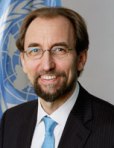 On 8 September 2014 the new UN High Commissioner for Human Rights, Zeid Ra’ad Al Hussein, addressed for the first time the Human Rights Council, and many will have been listening for clues about where he stands on key issues, how ‘activist’ he is likely to be etc. As the speech was rather long and covered a huge variety of issues, it is not easy to draw any conclusions yet. The fist half addressed issues of war and violence and in particular the humanitarian crises of today.
The role of the individual is beautifully worded: “courage is the first human virtue, revered the world over, the very virtue we value the most as human beings. The courageous individual is not he or she who wields great political power or points a gun at those who do not – that is not courage. The courageous individual is he or she who has nothing to wield but common sense, reason and the law, and is prepared to forfeit future, family, friends and even life in defence of others, or to end injustice. In its most magnificent form, the courageous individual undertakes this exertion, without ever threatening or taking the life of someone else, and certainly not someone defenceless.”..”the Takfiris [IS] who recently murdered James Foley and hundreds of other defenceless victims in Iraq and Syria – do they believe they are acting courageously? “…
“Navi Pillay was one of the greatest senior officials the UN has ever had, and one of the most able, formidable High Commissioners for Human Rights. That she could annoy many Governments – and she did – was clear; but she believed deeply and movingly in the centrality of victims, and of those who are discriminated against. They needed her vocal chords, her lungs and her pen, and she made everyone listen. I pledge to continue along the same path: to be as firm, yet always fair; critical of states when necessary, and full of praise when they deserve it.”
“A ministerial-level meeting will be held in New York on 25 September, on the need for a code of conduct to be adopted by the permanent members of the UN Security Council regarding use of veto, in situations where atrocities are ongoing and where those facts are well founded. This is not a call to have the UN Charter rewritten, but a call for the permanent members to exercise a moratorium in very specific circumstances involving atrocity crimes. I applaud the Government of France for taking the lead over this, and thank it for inviting me to participate on the 25th. When the veto is exercised for the sole purpose of blocking action by the Security Council, with no alternative course of action offered, and when people are suffering so grievously – that is also a form of cruelty.”
After briefly describing his priorities:
- halt the increasingly conjoined conflicts in Iraq and Syria. In particular, dedicated efforts are urgently needed to protect religious and ethnic groups, children – who are at risk of forcible recruitment and sexual violence – and women, who have been the targets of severe restrictions.
- ensure accountability and stop impunity
- to take a step back and look at how and why these crises erupted,
the UN High Commissioner touched on a number of current situations and mentioned the importance of the different mechanisms and bodies. Finally he came to the civil society with the following words:
“But the work done by OHCHR, by the Special Procedures, by Treaty Bodies, this Council itself, and indeed, by Member States, could never be achieved without the greater efforts of civil society actors. We need their continuing support and contributions to realise progress. I encourage the Council to strengthen its constructive engagement with civil society actors, and to ensure that their voices can be raised safely and without reprisals. Freedoms of expression, association and peaceful assembly are rights that enable people to share ideas, form new thinking, and join together with others to claim their rights. It is through the exercise of these public freedoms that we make informed, considered and intelligent decisions about our development. To restrict them undermines progress. We must acknowledge the value of civic contribution, build the capacity of marginalised voices, ensure a place at the table for civil society actors, and safeguard their activities – including the activities of those who cooperate with this Council, its Special Procedures and Commissions of Inquiry. I take this opportunity to echo the Secretary-General’s condemnation of acts of reprisal against individuals by reason of their engagement with the United Nations.”
At the end of this speech, he paid significant attention to the issue of migration: “The treatment of non-nationals must observe the minimum standards set by international law. Human rights are not reserved for citizens only, or for people with visas. They are the inalienable rights of every individual, regardless of his or her location and migration status. A tendency to promote law enforcement and security paradigms at the expense of human rights frameworks dehumanises irregular migrants, enabling a climate of violence against them and further depriving them of the full protection of the law.”
See full text at: Media Centre.
Posted in human rights, Human Rights Council, Human Rights Defenders, OHCHR, UN | Leave a Comment »
Tags: Al Hussein, Al'Hussein, Civil society, Human Rights Council, Human Rights Defenders, humanitarian, Navi Pillay, reprisals, Takfiris, the Office of the UN High Commissioner for Human Rights, UN High Commissioner, UN High Commissioner for Human Rights, war, Zeid Ra'ad Al Hussein
May 6, 2014
The disappearance of Karen activist “Billy” has prompted the United Nations High Commissioner for Human Rights UNHCHR to condemn the “pattern of killings and forced disappearances of environmental activists in Southeast Asia” and to urge authorities to conduct thorough and independent investigations. “We are concerned about the lack of progress with an investigation into the disappearance of a prominent human rights defender in Thailand,” UNHCHR spokesman Rupert Colville said in a statement released on Friday 2 May. Read the rest of this entry »
Posted in human rights, Human Rights Defenders, OHCHR, UN | 1 Comment »
Tags: Billy, Cambodia, Chut Wutty, disappearances, environmental activists, environmental issues, Human Rights Defenders, indigenous groups, Karen, killings, Land issues, Laos, Philippines, Pholachi Rakchongcharoen, Rupert Colville, Sombath Somphone, South-east asia, Thailand, the Office of the UN High Commissioner for Human Rights
May 6, 2014
While not directly about Human Rights Defenders, this workshop organised by the Permanent Mission of Switzerland to the UN and others (see below) is of great importance to HRDs as they are the ones who provide most of the information to the Treaty Bodies, and are often the victims of the violations reported, including reprisals against them for having cooperated. Thus, this meeting on “The outcome of the treaty body strengthening process: Lessons learnt, implications and implementation” should be of interest to all. It takes place on 9 May 2014, 9.30am to 1pm in Room XXII, Palais des Nations, Geneva. Read the rest of this entry »
Posted in human rights, Human Rights Defenders, UN | 1 Comment »
Tags: Andrew Clapham, Geneva, Geneva Academy of International Humanitarian Law and Human Rights, human rights, Human Rights Defenders, international human rights law, international human rights treaties, meeting, Permanent Mission of Switzerland to the UN, reprisals, the Office of the UN High Commissioner for Human Rights, treaty bodies, UN
February 6, 2014
The BBC has produced a map which shows the broad legal status of gay people living in UN member states, according to data provided by the UN’s human right’s office, who built on information from the International Lesbian Gay Bisexual Trans and Intersex Association.
The legal status of people in same-sex relationships depends very much on where they live. At one end of the spectrum there are those countries that punish homosexuality with the death penalty – Iran, Mauritania, Saudi Arabia, Sudan and Yemen – as well as in parts of Nigeria and Somalia. At the other end, there are those countries where gay couples have the same marriage rights as heterosexual couples. However, the categorisation of countries according to their approach to gay rights is not without problems. Some states have conflicting laws on same-sex relationships, simultaneously having laws that punish and protect, while other countries have different laws in different regions. This is reflected in the key. Countries have been categorised by their most progressive or regressive laws, apart from where laws are contradictory. Countries where gay rights vary between states have been coloured by their most progressive or regressive law. [The map does not reflect day-to-day experiences of lesbian, gay, bisexual and trans and intersex people. In many places where anti-discrimination laws exist, gay people continue to be persecuted by state authorities and wider society.]
There is also an interesting timeline, pulled together by the UN, which uses 1789 – the date of the French Revolution – as its starting point. It was chosen by the UN as a baseline, as it was a time when homosexuality was criminalised in many countries.
BBC News – Where is it illegal to be gay?.
Posted in books, human rights, OHCHR, UN | 1 Comment »
Tags: anti-discrimination, BBC, Discrimination, gay people, gay rights, homophobia, Homosexuality, interactive world map, International Lesbian Gay Bisexual Trans and Intersex Association, legal status, LGBT, lgbt human rights, LGBTI, OHCHR, overview, the Office of the UN High Commissioner for Human Rights
January 11, 2014

(Special Rapporteur on the situation of human rights in Myanmar Tomás Ojea Quintana. UN Photo/JC McIlwaine)
On 11 December 2013 Tomás Ojea Quintana, the Special Rapporteur on the human rights situation in Myanmar, welcomed the release of 44 prisoners of conscience in Myanmar, hailing it as an important step towards fulfilling President Thein Sein’s pledge of freedom for all political prisoners by the end of this year. “When I look back to the start of my mandate in 2008, I was referring to figures of over 1,900 persons detained on political grounds. It is important to acknowledge the significance of the progress that has been made: today we are referring to figures of less than 50”. The expert said the practice of arresting those who express views that are different to those of the Government became embedded during 50 years of military rule. “Moving to a culture of democracy, where people are free to express their views, will take time,” he stated. “The releases today are a step towards this, but need to be accompanied by legislative reforms.” However on 17 December the Observatory for the Protection of Human Rights Defenders, a joint programme of FIDH and OMCT, welcoming the latest release of prisoners of opinion in Burma/Myanmar, deplored the re-arrests of human rights defenders Ko Htin Kyaw and Aye Thein within hours of their “release”. Front Line reported that on 3 December 2013, Tin Htut Pai was arrested for his involvement in commemorating the one-year anniversary of the protests against the Letpadaung mining project. Tin Htut Pai is currently detained but has not been permitted to see his lawyer. Tin Htut Pai is the founder of Generation Youth, an organisation that advocates for youth empowerment and campaigns against land confiscation.
On 10 January 2014 this was followed by praise from the spokesperson for the UN High Commissioner for Human Rights, Rupert Colville, for President Thein Sein’s announcement on 2 January that he would commute death sentences to life imprisonment and reduce some sentences on humanitarian grounds and to mark the 66th anniversary of independence of the country. The move is “very significant” for Myanmar, which has not carried out the death penalty since 1989, the spokesperson noted, as the country assumed the chair of the Association of Southeast Asian Nations (ASEAN).
https://www.un.org/apps/news//story.asp?NewsID=46718&Cr=myanmar&Cr1=#.UtEULijKzZQ
http://www.un.org/apps/news/story.asp?NewsID=46904&Cr=myanmar&Cr1=#.UtEThCjKzZQ
http://www.fidh.org/en/asia/burma/14406-burma-it-is-time-to-free-all-human-rights-defenders-and-stop-ongoing
http://www.frontlinedefenders.org/node/24414#sthash.HRV7IJe0.dpuf
Posted in FIDH, Front Line, human rights, Human Rights Defenders, OHCHR, OMCT, UN | Leave a Comment »
Tags: abolition, arrest, ASEAN, Burma, death penalty, detention, FIDH, Front Line (NGO), Human Rights Defenders, human rights situation, Letpadaung, Mining, Myanmar, Observatory for the Protection of HRDs, OMCT, President Thein Sein, release, Rupert Colville, Special Rapporteur, the Office of the UN High Commissioner for Human Rights, Tin Htut Pai, Tomas Ojea Quintana, UN Special Rapporteur
December 21, 2013
On 19 December 2013 it was announced that the AJCs Jacob Blaustein Institute for the Advancement of Human Rights on the occasion of the 20th anniversary of the Office of the UN High Commissioner for Human Rights released a unique volume entitled: “The United Nations High Commissioner for Human Rights: Conscience for the World”. Read the rest of this entry »
Posted in books, human rights, OHCHR, UN | 1 Comment »
Tags: Advancement of Human Rights, American Jewish Committee, Felice Gaer, High Commissioner, High Commissioner for Human Rights, human rights violations, Israel, Jacob Blaustein Institute, Jacob Blaustein Institute for Human Rights, Martinus Nijhoff, Navi Pillay, New York, Office of the High Commissioner for Human Rights, the Office of the UN High Commissioner for Human Rights, UN, UN High Commissioner for Human Rights, United Nations
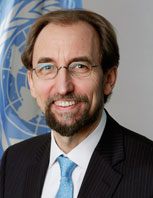 On 8 September 2014 the new UN High Commissioner for Human Rights, Zeid Ra’ad Al Hussein, addressed for the first time the Human Rights Council, and many will have been listening for clues about where he stands on key issues, how ‘activist’ he is likely to be etc. As the speech was rather long and covered a huge variety of issues, it is not easy to draw any conclusions yet. The fist half addressed issues of war and violence and in particular the humanitarian crises of today.
 Hans Thoolen on Human Rights Defenders and their awards