On Monday 17 March, I reported on a clampdown on human rights defenders in Sri Lanka which looked very much like reprisals (https://thoolen.wordpress.com/2014/03/17/sri-lanka-champion-retaliator-against-human-rights-defenders/). Fortunately, Front Line Defenders reports today that the human rights defenders Ruki Fernando and Reverend Praveen Mahesan were released from detention. They had been detained on 16 March 2014 when visiting the Killinochchi district after the arrest of human rights defender Ms Balendran Jayakumari. She remains in detention under the Prevention of Terrorism Act (http://www.frontlinedefenders.org/node/25400).
Posts Tagged ‘Sri Lanka’
Sri Lanka: champion retaliator against human rights defenders
March 17, 2014Today, 17 March 2014, the Asian Human Rights Commission, comes out with a statement that makes Sri Lanka look like one the worst offenders when it comes to retaliation and reprisals against human rights defenders. My feelings about reprisals are well-known and were recently expressed in: https://thoolen.wordpress.com/2014/03/13/zero-tolerance-for-states-that-take-reprisals-against-hrds-lets-up-the-ante/
A draft resolution promoting reconciliation, accountability, and human rights in Sri Lanka is being discussed at the United Nations Human Rights Council. The proposed resolution calls for, among other things, the Office of the High Commissioner, “To lead a comprehensive investigation into alleged serious violations and abuses of human rights and related crimes by both parties in Sri Lanka and establish the facts and circumstances of such violations and of the crimes committed with the view to avoiding impunity and ensuring accountability with assistance from relevant experts”.
The statement of the AHRC reads: Read the rest of this entry »
Asian human rights TV: 19th consecutive episode
February 26, 2014In the weekly round up of human rights news the Asian Human Rights Commission [AHRC] covers this week (25 February 2014) the following topics:
- Pakistan’s long march meets further challenges
- Disguised police officers in Sri Lanka try to disrupt protest
- 10th anniversary of torture victim Maina Sunuwar’s death
- Extrajudicial killing in broad daylight in Bangladesh
- The ALRC makes 17 written submissions on human rights issues in Asia to the UN
- Pakistani social activist is murdered
- Voices of survivors: this week from the Philippines.
It is remarkable and promising that a small regional NGO is able to keep this up, paving the way for further such developments in the future. See also my end-of-year post:
https://thoolen.wordpress.com/2013/12/28/2014-heralds-the-age-of-images-in-human-rights-work/
Filippines HRD wins Emilio Mignone award for work against enforced disappearances
December 23, 2013
(Mary Aileen Bacalso receiving the Award in Argentina from foreign Minister Hector Timerman)
Human rights defender Mary Aileen Bacalso from the Philippines received the Emilio F. Mignone International Human Rights Award in Argentina Tuesday last week for her advocacy work in her capacity as the secretary-general of the Asian Federation Against Involuntary Disappearances (AFAD). Argentine Foreign Minister Hector Timerman presided over the ceremony, which was conducted at the Argentine Foreign Ministry. It was attended also by representatives from Argentine human rights organizations, and the family of human rights defender Emilio Mignone, after whom the award was named. [Mignone’s daughter Monica disappeared during the Argentine dictatorship]
Bacalso’s own husband was abducted by seven armed men in 1988. He was released after being tortured and made to admit to the accusations, said Bacalso in a phone interview with InterAksyon.com. In 1998, she co-founded AFAD with two other organizations in India and Sri Lanka as a response to the problem of enforced disappearances in many parts of Asia. In Sri Lanka alone, there were 60,000 cases at the time, according to the AFAD website. From the beginning, they took pointers from and coordinated with human rights groups in Latin America which were formed in the 1980s to take action on enforced disappearances. AFAD now has 11 member-organizations from eight countries, with the main office based in the Philippines. They disseminate information, campaign for the ratification of the International Convention for the Protection of All Persons from Enforced Disappearance, research and document cases, and accompany families of victims of enforced disappearances.
Aside from bringing them recognition, Bacalso said she hoped the award would also give them credibility as they try to convince governments in Asia and in the rest of the world to stop enforced disappearances.
In her acceptance speech, she recalled the adversity faced by those who fought for the rights of the victims of enforced disappearances. “AFAD’s own former Chairperson from Indonesia, Munir, who worked tirelessly for the cause of the disappeared, was poisoned by a lethal dose of arsenic in a flight from Jakarta to Amsterdam via Singapore.” “Our colleagues in Kashmir are persecuted in more ways than one, including non-issuance of passports to restrict their movement and block them from forging solidarity with sister organizations in other countries. “Our leaders in Bangladesh were recently arrested, their office raided and files and pieces of equipment stolen in a desperate attempt to silence them. “In Laos, almost a year ago, development worker Sombath Somphone was taken by the police in broad daylight as evidenced from the CCTV camera footage, yet despite the obvious proof, the Laos government denies knowledge of the victim’s whereabouts. His wife has gone from pillar to post and has knocked on doors of national and international bodies yet her husband is nowhere to be found.” “In the Asian region with a huge number of cases and where defenders face the danger of being disappeared themselves, this award, representing the support of the Argentinian government, is a strong protection to our work in our region,” Bacalso said.
for more information on the Mignone award go to the Digest of awards on: www.trueheroesfilms.org
Smear campaign by Sri Lankan State radio station against HRD Nimalka Fernando
November 17, 2013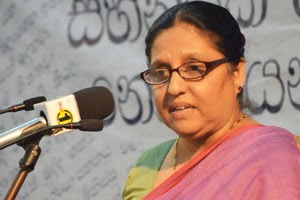
The Observatory for the Protection of Human Rights Defenders, a joint programme of the World Organisation Against Torture (OMCT) and the International Federation for Human Rights (FIDH), expresses its great concern about the smear campaign and threats suffered by Ms. Nimalka Fernando, attorney-at-law, women’s rights activist and President of the International Movement Against All Forms of Discrimination and Racism (IMADR) in Sri Lanka. [Ms. Fernando was also a convener of the alternative summit to the Commonwealth Heads of Government Meeting (CHOGM), which is taking place in Sri Lanka from November 10 to 17, 2013 amid strong criticism of the country’s human rights abuses.] Read the rest of this entry »
UN High Commissioner hits back in Sri Lankan disinformation campaign – and rightly so
September 22, 2013
The UN High Commissioner for Human Rights, Navi Pillay, in a statement which some claim unusual for a top UN official to direct at a UN-member country, took aim at Defence Secretary Gotabhaya Rajapaksa, and other government officials, just after her visit last month to Sri Lanka. During the visit at least three government ministers “joined in an extraordinary array of distortion and abuse” which is continuing now, Pillay’s spokesman, Rupert Colville, told reporters in Geneva: “We consider it deeply regrettable that government officials and other commentators continue what appears to be a coordinated campaign of disinformation in an attempt to discredit the high commissioner or to distract from the core messages of her visit.” Pillay’s office sent a formal complaint to the government demanding that it immediately retract and publicly correct “misinformation”.
In the statement Pillay complained that the defence secretary made widely reported but false claims that she had asked President Rajapaksa during their private meeting to remove a statue of Sri Lanka’s first prime minister from Colombo’s Independence Square. “Firstly, we categorically deny that the high commissioner ever uttered a single word about the statue of Prime Minister D.S. Senanayake at any point during her visit to Sri Lanka, let alone asked the president to remove it. This claim is without a shred of truth,” Colville said. “Secondly, there has been a further distortion concerning comments the high commissioner made to the president concerning a flag in Independence Square.” Pillay asked the president why the flag of one religious community was flying next to the national flag in such a symbolic location, Colville said.
UN rights Chief hits out at senior officials and Gota for waging misinformation campaign.
The full statement is made available on the OCHR website
Related articles
- U.N. High Commissioner says Sri Lanka increasingly authoritarian (thoolen.wordpress.com)
Human rights worker in Malaysia to appear in court tomorrow for screening the film “No Fire Zone”
September 18, 2013On July 3, 2013, Komas program officer Ms Lena Hendry, Executive Director Mr Arul Prakkash and one of the Board of Directors, Ms Anna Har, were arrested during the screening of the film “No Fire Zone, the Killing Fields of Sri Lanka”. MSN Malaysia reports: that today the KDN issued a notice informing Komas that Ms Lena Hedry would be charged and for her to appear in the Magistrate court tomorrow, 19 September Read the rest of this entry »
NGOs make statement on integration of gender in human rights work
September 16, 2013 On 12 September 2013 Cynthia Rothschild delivered a statement the Human Rights Council on behalf of World Organization Against Torture, with Amnesty International, Asia Pacific Forum on Women, Law and Development, Association for Progressive Communications, Association for Women’s Rights in Development, Center for Women’s Global Leadership, Coalition of African Lesbians, Front Line Defenders, International Service for Human Rights, ISIS- WICCE, Latin American and the Caribbean Committee for the Defense of Women’s Rights, MADRE, Nazra for Feminist Studies, Urgent Action Fund, WOREC Nepal, and Women’s Initiatives for Gender Justice.
“The Council has done strong work in support of the 6/30 gender integration resolution. Read the rest of this entry »
More controversy surrounding the issue of retaliation against HRDs in Sri Lanka
September 10, 2013
On 9 September 2013, UN High Commissioner for Human Rights, Navi Pillay, told the Human Rights Council in Geneva that she had an immediate concern for the protection of human rights defenders, journalists and communities that she met during her recent visit to Sri Lanka. Read the rest of this entry »
Sri Lankan HRD, Sunila Abeysekera, dies: tribute by A paper bird
September 9, 2013
The last time I saw Sunila Abeysekera was almost three years ago, over breakfast on one of her very occasional visits to New York. Some people, myself included, were trying to talk her into applying for my old job at Human Rights Watch, a post I thought far too small for her. She politely demurred, in different terms: “My life is enough of a problem,” she said, “and the last thing I need in it is a large organization.” She talked about the dangers of having your work commodified and separated from the people it’s about – either by a bureaucracy, or by the kinds of personality cults that thrive around those who get called (as she was: often, unwillingly, and accurately) “heroes.” Both distract from the simple realities of the stories you try to tell, and the stories, she said, were what counted.At the same time, she was at one of those points (they came quite frequently) where her life was in serious danger in Sri Lanka. People were threatened enough by the stories for which she was witness and messenger that they wanted to kill her. Her friends wanted her to get out, and she herself said she wanted a quiet place somewhere, to rest and think. She said that kind of thing much more often than she meant it. The resting part was something of which she was utterly incapable. She never did it, not till the very last.
Sunila died on 9 September, back in Colombo, at 61, after a long battle with cancer. I didn’t know her very well, but I thought of her as a role model as well as friend. She was scholar, activist, intellectual, feminist, and listener. Others will have more and better things to say about her. I’ll just remember this: while always subordinating herself to the stories she had to tell – – horrible stories, many of them, about rape, torture, murder in the long Sri Lankan civil war – her passion for truth and her personal compassion were always part of them. Without being that kind of person, a kind you instantly recognize but can’t possibly describe, she would never have heard them, would never have won trust or become a witness. A lot of august philosophers these days write and theorize about the role of the witness in contemporary politics and ethics, but the writing was unnecessary as long as she was alive. You could point at Sunila, and understand.
I would say “rest in peace,” but wherever she is, she isn’t resting.
via Sunila Abeysekera, witness: 1952-2013 | a paper bird.
 Hans Thoolen on Human Rights Defenders and their awards