Posts Tagged ‘Somalia’
February 24, 2014
Abdiaziz Abdinur Ibrahim, a participant in the Protective Fellowship Scheme for Human Rights Defenders At Risk at the Centre for Applied Human Rights at York University, was jailed in his native Somalia in 2013 after he interviewed a woman who claimed she was raped by government security forces. On 21 February 2014 he was honored as the recipient of the Oxfam Novib/PEN Award For Freedom Of Expression which recognises writers who have been persecuted for their work and continue to write
via Persecuted journalist in spotlight at University of York From York Press.
http://www.pen-international.org/oxfam-novibpen-award-for-freedom-of-expression/
Posted in awards, human rights, Human Rights Defenders | Leave a Comment »
Tags: Abdiaziz Abdinur Ibrahim, awards, Centre for Applied Human Rights, Centre for Applied Human Rights at York University, freedom of expression, human rights awards, Human Rights Defenders, Journalist, Oxfam Novib/PEN Award For Freedom Of Expression, Protective Fellowship Scheme for Human Rights Defenders, rape, Somalia, writer, York university
February 8, 2014
The Committee to Protect Journalists [CPJ] has published its Risk List, indicating where press freedom is in decline. In determining the list, CPJ staff examined six press freedom indicators: fatalities, imprisonments, restrictive legislation, state censorship, impunity in anti-press attacks, and journalists driven into exile. Countries named to the Risk List are not necessarily the world’s worst places for journalists; such a list would include nations like North Korea and Eritrea, where free expression has long been suffocated. Instead, the Risk List identifies the 10 places where CPJ documented the most significant downward trends during 2012. Those trends included:
- High murder rates and entrenched impunity in Pakistan, Somalia, and Brazil.
- The use of restrictive laws to silence dissent in Ecuador, Turkey, and Russia.
- The imprisonment of large numbers of journalists, typically on anti-state charges, to thwart critical reporting in Ethiopia, Turkey, Vietnam, Iran, and Syria.
- An exceedingly high fatality rate in Syria, where journalists faced multiple risks from all sides in the conflict.
CPJ, which is publishing its Risk List for the first time, identified Syria and Somalia, which are racked by conflict, along with Iran, Vietnam, and Ethiopia, nations that are ruled with an authoritarian grip. But half of the nations on the Risk List– Brazil, Turkey, Pakistan, and Russia, along with Ecuador–practice some form of democracy and exert significant influence on a regional or international stage.
Threats to press freedom were not confined within the borders of these nations. Four Risk List countries sought to undermine international or regional press freedom initiatives during the year. Russia pushed for centralized control of the Internet ahead of the World Conference on International Telecommunications. Ecuador led an effort, supported by Brazil, to weaken the ability of the Inter-American Commission on Human Rights to intervene in cases of systemic or grave press freedom abuses. Brazil and Pakistan were among a handful of countries that tried to derail a U.N. plan to improve journalist security and combat impunity worldwide.
Setbacks in Brazil are particularly alarming given its status as a regional leader and home to a diverse array of news media. But a spike in journalist murders, a failure to address impunity, and a pattern of judicial censorship have put Brazil’s press freedom at risk, CPJ found. Turkey, too, has projected an image as a regional model for freedom and democracy. But while Prime Minister Recep Tayyip Erdoğan has expressed a commitment to press freedom, his administration has wielded an anti-terror law as a club to jail and intimidate journalists.
Less surprising, but no less worrisome are setbacks in Vietnam, Ethiopia, and Iran. Though Ethiopia and Vietnam have been applauded for economic strides, both countries have lagged in terms of openness and freedom of the press. Conditions worsened in 2012, as Ethiopian and Vietnamese authorities ramped up efforts to stifle dissent by imprisoning journalists on anti-state charges. Iran, ignoring international criticism of its press record, has intensified an assault on critical voices that began after the disputed 2009 presidential election.
In Syria and Somalia, where journalists faced risks from multiple sides, the death tolls have mounted. Crossfire was the leading cause of death for journalists in Syria, although at least three journalists were assassinated, CPJ research shows. Both rebels and forces loyal to President Bashar al-Assad have been implicated in acts of violence against the press. All 12 journalists killed in Somalia in 2012, the country’s bloodiest year for the press, were targeted in direct reprisal for their reporting. Both insurgents and government officials were suspected of involvement. In both countries, the ranks of young journalists, many with little training and experience, have been particularly hard hit.
In the full report below you can find capsule reports on the 10 nations named to the CPJ Risk List:
Posted in Human Rights Defenders | Leave a Comment »
Tags: Brazil, censorship, Committee to Protect Journalists, CPJ, death threats, Ecuador, Ethiopia, freedom of expression, freedom of information, Human Rights Defenders, internet, Iran, journalists, killings, media, Pakistan, Press Freedom, press freedom index, Risk List 2012, Russia, Somalia, Syria, Turkey, Viet Nam
October 27, 2013
 reported that on 22 October 2013, unidentified gunmen shot Mohamed Mohamud Tima’adde six times on his way to work. Three people were subsequently arrested trying to access the Medina hospital ward where Mohamed Mohamud was being treated. Initially it was reported that he was responding well, but on 27 October AP reports that according to the Somali journalist Ahmed Nor Mohamed his colleague has died of his wounds on Saturday night.
Read the rest of this entry »
Posted in Front Line, Human Rights Defenders | Leave a Comment »
Tags: AP, attack, Frontline Defenders, Horn of Africa, human rights, Human rights defender, Journalist, killings, Medina, Mogadishu, Mohamed Mohamud, Mohamed Mohamud Tima, Mohamed Mohamud Tima'adde, murder, shooting, Somali diaspora, Somalia, television, Universal Television, Universal TV
April 16, 2013
On 14 April 2013, two prominent human rights lawyers, Mohamed Mahmoud Afrah and Abdikarin Hussein Gorod, were killed when they were in the wrong place at the wrong time: Al-Shabaab adherents in army uniform stormed Somalia’s main court complex in Mogadishu. They were among the approximately thirty people killed in the suicide attack.
Both Mohamed Mahmoud Afrah and Abdikarin Hussein Gorod have worked for a Legal Aid programme funded by the UN Development Programme in Mogadishu and had previously assisted internally displaced persons and other vulnerable individuals. They had recently defended Abdiasis Abdinur Ibrahim, also known as Koronto, a journalist who was jailed for interviewing an internally displaced woman who said she had been raped by state security forces in Mogadishu. A case referred to in this blog and by Front Line Defenders http://www.frontlinedefenders.org/node/21570
Posted in human rights | Leave a Comment »
Tags: Abdikarin Hussein Gorod, Al-Shabaab, Front Line Defenders, Human Rights Defenders, human rights lawyers, killings, Koronto, legal aid, Mogadishu, Mohamed Mahmoud Afrah, Somalia, suicide bombers, terrorism, UNDP
April 15, 2013
The Special Rapporteur on Human Rights Defenders in Africa has announced with satisfaction the release of Mr Ibrahim Abdias Abdinur, a journalist and human rights defender in Somalia who was arrested and detained by the Somali police on 10 January 2013.
via Communique on the release of Mr Ibrahim Abdias Abdinur, journalist and human rights defender in Somalia / Press Releases / ACHPR.
Posted in human rights | Leave a Comment »
Tags: Africa, African Commission on Human and Peoples' Rights, Human right, human rights, Human Rights and Liberties, Human rights defender, Human Rights Defenders, Ibrahim Abdias Abdinur, Journalist, Somalia, Special Rapporteur
March 8, 2013
On 7 February I reported via Front Line Defenders that journalist and human rights defender Abdiasis Abdinur Ibrahim – nicknamed Koronto – in Somalia was arrested convicted to one year jail for ‘fabricating’ – i.e. reporting on – a rape case and allegedly entering the house of the reported rape victim without consent. The charges (!) against the rape victim were dropped by the appeals court on 3 March 2013, but Koronto’s sentence was upheld, albeit with a reduction to 6 months.
Posted in human rights | Leave a Comment »
Tags: Abdiasis Abdinur Ibrahim, freedom of information, Front Line, human rights, Human rights defender, journalists, Koronto, Mogadishu, radio journalist, rape, sexual abuse, Somalia
February 22, 2013
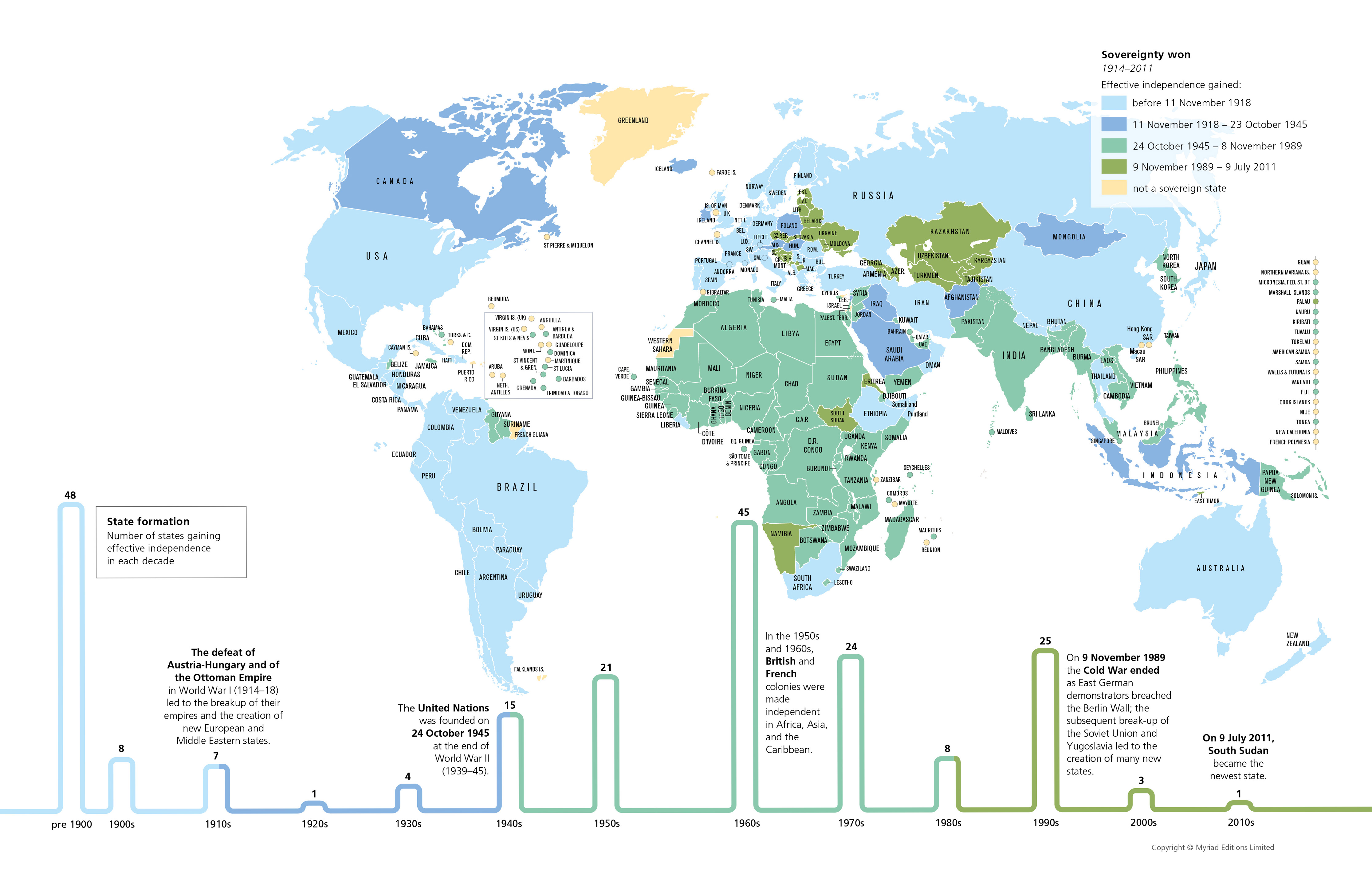
On 22 February 2013 Dan Smith published a post on his blog on the ‘state of States’. While not directly touching on human rights defenders, it gives in few words an excellent overview of the formation and deformation of States which provide much of the power and abuse that human rights defenders struggle against. I summarize some of the main issues here, but urge you to read the full text:
First he points out that most states are relatively new. By 1900 there were just 48 states in our modern sense of the term. In the years either side of World War I, with the break-up of the Ottoman and Habsburg Empires, there was considerable state-making. Even so, the UN was founded by just 51 states. Today, 193 states make up the UN, the newest being South Sudan in July 2011.

- From 48 to 193 (recognised states, that is) – from The State of the World atlas Read the rest of this entry »
Posted in human rights | Leave a Comment »
Tags: Afghanistan, conflict and peace, Dan Smith, Failed state, Fragile state, fragile states, historical perspective, Human Rights Defenders, Nigeria, non-state actors, Pakistan, politics, Somalia, South Sudan, sovereignty, state power, States, UN, ungoverned spaces, United Nations
February 7, 2013
With in mind that 13 February will be World Radio Day I report via Front Line that on 5 February 2013, human rights defender, Abdiasis Abdinur Ibrahim, also known as Koronto, was sentenced to one year in prison following an attempt to investigate the case of a woman who claimed to have been raped by state security forces. Abdiasis Abdinur Ibrahim is a radio journalist working for two private radio stations, Radio Dalsan and Radio Ergo, both broadcasting from Mogadishu.
 The trial of Abdiasis Abdinur Ibrahim opened on 2 February 2013, approximately three weeks following his arrest and detention by police officers of the local Central Investigation Department (CID). During the hearing, the prosecution alleged that Abdiasis Abdinur Ibrahim fabricated the reported rape in a news story and intended, by so doing, to insult a state institution. The human rights defender was tried under Islamic Sharia law. Abdiasis Abdinur Ibrahim was also accused of entering a house without consent from the owner. The human rights defender had reportedly gone to the house of the reported rape victim to conduct an interview with her. In closing the case on the morning of 5 February, the prosecution accused Abdiasis Abdinur Ibrahim of distributing false information to various media outlets causing prejudice to the public trust of Somali security forces. On the same day, the court handed down its decision, convicting the journalist to one year in prison. Journalists and human rights defenders who observed the trial report gross due process irregularities as the trial was dominated by the prosecution and the accused journalist was not afforded sufficient opportunity to defend himself. Abdiasis Abdinur Ibrahim’s lawyer has announced his intention to appeal the conviction.
On 15 January, the National Union of Somali Journalists (NUSOJ) had released a public statement requesting that Abdiasis Abdinur Ibrahim be immediately and unconditionally released and expressing concern over reports that some members of the police were putting pressure on the reported rape victim to retract her story.
Posted in Front Line, human rights, Human Rights Defenders | 1 Comment »
Tags: Abdiasis Abdinur Ibrahim, Criminal Investigation Department, freedom of expression, freedom of information, Front Line (NGO), journalists, Koronto, Mogadishu, rape, Sharia, Somali, Somalia, Trial, Unesco, World Radio Day 2012
May 22, 2012

(Photo credit: Wikipedia)
The International Federation for Human Rights (FIDH) welcomes the strong stand taken by the African Commission on Human and Peoples’ Rights (ACHPR) on the political, security and humanitarian confllicts and crises raging on the continent, at its 51st Session. FIDH now urges African Union (AU) Member States to give immediate effect to the recently adopted resolutions. The document published by allAfrica.com refers to the recent conflict between Sudan and South Sudan the unconstitutional changes of government that lately occured in Mali and Guinea-Bissau, the territorial integrity of Mali and a West African region where several armed groups, like in Nigeria, still perpetrate violations. On HRDs the document of FIDH states the following:
“The African Commission considered with a particular attention the civil and political rights’ violations happening in several countries. The Commission condemned the recurring impediment to Human rights defenders’ action in countries like Ethiopia – where the Charities and Civil Societies Proclamation adopted in 2009 continues to place excessive restrictions on Human rights organisations’ work – Swaziland – where authorities keep opposing the fundamental rights to freedom of expression, freedom of assembly and freedom of association – and Somalia, where journalists are taken in the grip of the ongoing armed conflict and are openly murdered. The FIDH welcomes the African Commission’s clear call for the amendment of the Ethiopian Charities and Civil Societies Proclamation, for the respect of the rights to fundamental freedoms in Swaziland and for justice to be rendered to the murdered journalists in Somalia. All these recommandations were supported by our organisation.”
Posted in books, FIDH, human rights, Human Rights Defenders | Leave a Comment »
Tags: Africa, African Court on Human and Peoples Rights, African Union, Ethiopia, FIDH, human rights, Human Rights Defenders, International Federation for Human Rights, Somalia, Swaziland
February 23, 2012
Human Rights Watch (HRW) uploaded on 18 February 2012 a short, crisp video about the recruitment of child soldiers in Somalia by Al-Shabaab.
Somalia, Child Soldiers – YouTube.
Posted in films, HRW, human rights | Leave a Comment »
Tags: Al-Shabaab, child soldiers, HRW, human rights, Human Rights Watch, Somalia


 Hans Thoolen on Human Rights Defenders and their awards