Posts Tagged ‘reprisals’
March 28, 2017
On 24 March 2017 a group of important NGOs that are active at the UN Human Rights Council made a joint statement at the end of the 34th session. These are: International Service for Human Rights, Asian Forum for Human Rights and Development (FORUM ASIA), Global Centre for the Responsibility to Protect, Human Rights House Foundation, CIVICUS, International Lesbian, Gay, Bisexual, Trans and Intersex Association (ILGA), Amnesty International, and Human Rights Watch. They:
….. welcome the renewal of key Special Procedures mandates, and in particular that of the Special Rapporteur on human rights defenders. At a time when defenders are under an unprecedented attack and killings of defenders are on the rise, the united stance of the Human Rights Council is key. While we welcome the restoring of consensus to this key resolution, we deeply regret the fracturing of the same on the right to food resolution, particularly given the increasing interrelationship of food insecurity, conflict and human rights violations.
At the outset of this session, High Commissioner Zeid has described 2017 as a pivotal year for the Council, and has diagnosed an attack on the entire rights-based system. To be a credible part of this system, and rise to the world’s challenges, the Council must – while appropriately engaging the concerned States – respond firmly to human rights violations and victims’ demands for accountability Some actions at this session have struck this balance in part; others – such as the decision hastily ending the mandate on Haiti – have not. The Council still fails to bring needed attention to a range of violations in countries such as Azerbaijan, Bahrain, China, Egypt, Philippines, Turkey and others.
The urgent dispatch of a Fact-Finding Mission [FFM] on Myanmar is a welcome step. We now look to you, President, to consult, including with civil society, on the appointment of the FFM’s members. But we regret the dissociation of Myanmar from the resolution, and call on Myanmar to fully cooperate with the FFM. We look to all States, including in particular those with investment, trade and business relationships with Myanmar, to fully facilitate the work of the FFM. We commend the Council for recognising the fundamental relationship between violations of human rights and the commission of mass atrocities, including by advancing accountability for such crimes in the DPRK, South Sudan, Sri Lanka and Syria.
Finally, Mr President, we are again concerned about allegations of intimidation and reprisals against defenders from Myanmar, Bahrain and Sri Lanka, including during the current session. In line with your legal obligation, we urge you to take these cases seriously, follow-up thoroughly on the allegations, and ensure that all those who engage with the body you preside over can do so safely.
Posted in AI, HRW, Human Rights Council, Human Rights Defenders, ISHR | Leave a Comment »
Tags: Civil society, Human Rights Defenders, joint statement, Myanmar, NGOs, reprisals, UN Human Rights Council
March 7, 2017
On 6 March the ISHR reported on that first week during which several dignitaries emphasised the key role that a vibrant civil society plays in promoting and protecting human rights.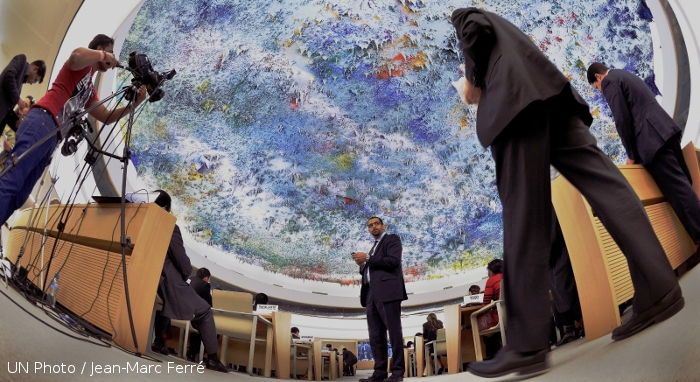
The President of the General Assembly, Peter Thomson, highlighted the importance of civil society by calling States, the UN and civil society to work shoulder to shoulder and advance with common purpose. Other high-level speakers expressed concern regarding increasing restrictions to civil society space, particularly against HRDs and journalists.
- Delegates from Botswana, the Czech Republic, Costa Rica, the European Union, France, Malta, Liechtenstein and Luxembourg, among others, reiterated their support to the work of HRDs and journalists and stressed the importance of guaranteeing their protection.
- Delegates from Germany, Norway, Poland, Slovenia, Sweden and the United Kingdom, among others, condemned acts of reprisals against HRDs and emphasised that HRDs must be able to participate and engage with the Council without fear of intimidation or reprisals.
The pivotal role defenders play in promoting sustainable development was also recognised. Georgia underscored the importance of strengthening the role of NGOs and safeguarding civil society’s space to ensure they are heard. ‘Without close cooperation with all stakeholders, it is impossible to secure the sustainable development of the country.’
So, there is no shortage of good statements in Geneva, but the what matters most is the upcoming renewal of the mandate of the Special Rapporteur on Human Rights Defenders and any real action on reprisals!
Source: #HRC34 | High-level officials kick off Council session, emphasise critical role of defenders | ISHR
Posted in human rights, Human Rights Council, Human Rights Defenders, ISHR, UN | Leave a Comment »
Tags: high level segment, ISHR, reprisals, Special Rapporteur on Human Rights Defenders, UN Human Rights Council
February 28, 2017
On 27 February 2017 the new Secretary General, António Guterres, addressed for the first time the UN Human Rights Council. For 10 years, he was the “other” High Commissioner (for Refugees), just down the road from the Palais des Nations where he was speaking. Some of his remarks are quoted here (from SG/SM/18456-HRC/25), especially the last paragraph dedicated to human rights defenders and journalists: Read the rest of this entry »
Posted in human rights, Human Rights Council, Human Rights Defenders, UN | 2 Comments »
Tags: António Guterres, Human Rights Defenders, journalists, populism, Portugal, reprisals, UN Human Rights Council, United Nations Secretary General
February 24, 2017
A preview of what to look out for at the upcoming session of the UN Human Rights Council from 27 February – 24 March 2017. This selection of what is most relevant to human rights defenders is based on the excellent overview provided by the International Service for Human Rights (ISHR): Read the rest of this entry »
Posted in human rights, Human Rights Council, Human Rights Defenders, ISHR | 2 Comments »
Tags: Bahrain, Burundi, China, ISHR, Norway, reprisals, Special Rapporteur on Human Rights Defenders, special rapporteurs, Sri Lanka, UN Human Rights Council, UPR
February 15, 2017
The document “The Situation of Human Rights Defenders – Item 3: Amnesty International’s Written Statement to the 34th Session of the UN Human Rights Council (27 February- 24 March 2017)” could of course be obtained directly from AI. However, I do it via: http://www.refworld.org/docid/58a195034.html, in order to highlight this very useful service provided by the documentation service of the UN High Commissioner for Refugees (UNHCR) which regularly gives links to documentation concerning countries of origin of refugees. The entry will look like this:
In their submission AI states in part:
In 1998 the international community adopted, by consensus, the Declaration on the Right and Responsibility of Individuals, Groups and Organs of Society to Promote and Protect Universally Recognized Human Rights and Fundamental Freedoms thereby recognising the importance that civil society actors play in the defence of the values that underpin human rights. The Declaration stresses that we all have a role to fulfil as human rights defenders and urges States particularly to protect human rights defenders from harm as a consequence of their work.
However, almost two decades after that historical moment human rights defenders continue to be harassed, tortured, jailed and killed for speaking out against injustice. During the protests against the Dakota Access Pipeline in the USA last year, the security forces used excessive and unnecessary force when arresting members of the Standing Rock Sioux Tribe and other Indigenous communities who oppose its construction.
Over 3,500 human rights defenders have been killed since the Declaration was adopted in 1998 and according to recent figures released by Frontline Defenders, the number of killings in 2016 marked an increase in the number reported in the previous year.
These killings usually occur after threats and warnings. Berta Cáceres, the leading indigenous, environmental and women’s rights defender from Honduras was killed in March 2016 despite enjoying a high national and international profile. In the aftermath of her killing, Honduras was under increased pressure to protect its human rights defenders, nonetheless, in October 2016, José Ángel Flores and Silmer Dionisio George of the Unified Movement of the Aguán were murdered, and currently international organization Global Witness, along with Honduran organizations MILPAH, COPINH and CEHPRODEC are facing a smear campaign against them for their work defending land, territory and environmental rights.
Amnesty International also continues to receive reports of human rights defenders being subjected to unfounded criminal proceedings, arbitrary detention and judicial harassment, which prevents them from speaking up against injustice, delegitimizes their causes and creates a chilling effect on activities that promote human rights. Human rights defender Narges Mohammadi is serving 22 years’ imprisonment after being convicted of national security related charges in Iran. Her conviction stems from her peaceful human rights activities, including her work to end the death penalty and her 2014 meeting with the former European Union (EU) High Representative for Foreign Affairs and Security Policy.
In Egypt civil society has been subjected to an unprecedented crackdown. In 2016, the authorities intensified a criminal inquiry into NGOs’ registration and foreign funding that could lead to criminal prosecution and sentences reaching up to life imprisonment. The authorities have also subjected NGO personnel to interrogation, freezing of personal and organizational assets, preventing leading human rights defenders from foreign travel, arbitrary arrest and detention.
Amnesty International notes with concern that the organisations, networks and methods people rely on to stand up for their communities are also attacked. Unions are threatened. Lawyers and activists in China have been ill- treated and sometimes tortured in detention. In Pakistan, human rights defenders are labeled as ‘foreign-agents’. In Viet Nam, attacks against human rights defenders are common, and include beatings and daily harassment and surveillance.
In other parts of the world, newspapers are closed down. Social media are banned and digital conversations monitored. Taking to the streets to protest is impossible.
In Turkey, against the backdrop of the failed military coup in 2016, unfair criminal prosecutions under criminal defamation and counter-terrorism laws targeted political activists, journalists and other critics of public officials or government policy. Over 180 media outlets have been arbitrarily shut down and 80 journalists remain in pre-trial detention.
States also repeatedly interfere with human rights defenders’ ability to communicate safely and expose human rights violations to regional and international human rights mechanisms, including this Council and its mechanisms. Recently the Special Rapporteur on the situation on the situation of human rights defenders noted, with great concern, the number of human rights defenders that received social media threats simply for meeting with him on his visit to Mexico at the beginning of this year.
In Burundi in January 2017, the Bujumbura Court of Appeal ruled to disbar three lawyers and suspend another. Each had contributed to a civil society report to the UN Committee against Torture prior to its review of the country in July 2016. The permanent closure of five human rights organizations and the suspension of five others was ordered in October 2016 on the allegation that they tarnished the image of the country. One of the suspended organizations was later banned following publication of a controversial report.
……..Amnesty International urges the Human Rights Council to:
- Renew the mandate of the Special Rapporteur on the situation of human rights defenders and cooperate fully with it, including by encouraging swift and comprehensive responses to communications from the Special Rapporteur and acceptance of requests for country visits.
- Reaffirm that protecting human rights is necessary for individuals to live in dignity, and that deepening respect for these fundamental freedoms lays the foundation for stable, safe and just societies;
- Recognize the legitimacy of human rights defenders and applaud the role they play in the advancement of human rights, and urge States to facilitate and publicly support their work;
- Urge States to adopt and implement legislation which recognises and protects human rights defenders;
- Stress the urgent need for all States to establish national protection mechanisms for human rights defenders at risk;
- Urge States effectively to address threats, attacks, harassment and intimidation against human rights defenders, including, where applicable, by thoroughly, promptly and independently investigating human rights violations and abuses against them and bringing alleged perpetrators to justice in fair trials without recourse to the death penalty, and providing effective remedies and adequate reparations to the victims;
- Urge States to ensure that the criminal justice system or civil litigation is not misused to target nor harass human rights defenders;
- Refrain from bringing criminal charges or, other judicial proceedings or taking administrative measures against human rights defenders because of the peaceful exercise of their rights;
- Ensure that those who challenge injustice peacefully are not portrayed as threats to security, development or traditional values;
- Emphasize the fact that human rights defenders who work on gender equality, women’s rights or LGBTIQ rights face particular risk of being subjected to certain forms of violence and other violations that need to be particularly addressed;
- Pay particular attention to other groups who may be at risk, such as those who work for economic, social and cultural rights, defenders who work in the area of business and human rights; in an area exposed to internal conflict or a natural disaster; defenders living in isolated regions or conflict zones; and defenders working on past abuses, such as the families of victims of enforced disappearance;
- Condemn any acts of intimidation or reprisals against human rights defenders who cooperate or seek to cooperate with international human rights mechanism;
- Urge States to cooperate fully with the recently mandated Assistant Secretary-General for Human Rights to prevent, end and redress acts of reprisal and intimidation.
Source: Refworld | The Situation of Human Rights Defenders – Item 3: Amnesty International’s Written Statement to the 34th Session of the UN Human Rights Council (27 February- 24 March 2017)
Posted in AI, Amnesty international, human rights, Human Rights Council, Human Rights Defenders, UN | Leave a Comment »
Tags: AI, Amnesty International, Andrew Gilmour, Human Rights Defenders, human rights documentation, killings, Refworld, reprisals, UN Human Rights Council, UNHCR
February 10, 2017
There has been a slew of accusations coming from the Government Accountability Project (GAP) – a US based whistleblower NGO – against the UN and in particular the Office of the UN High Commissioner for Human Rights. The latest piece by Bea Edwards is entitled “Trouble at UN OHCHR: Investigate the High Commissioner” (9 February 2017). While I am most supportive of the OHCHR and its successive high commissioners including the current incumbent who has been vocal and courageous in taking on powerful adversaries [see: https://humanrightsdefenders.blog/tag/zeid-raad-al-hussein/ and especially https://humanrightsdefenders.blog/2016/09/14/un-high-commissioner-for-human-rights-states-may-shut-my-office-out-but-they-will-not-shut-us-up/], I have to admit that there are some worrying aspects, especially the latest accusation that a senior official “made a habit of providing the Chinese Government with the names of Chinese human rights activists who applied for accreditation to the sessions of the Human Rights Council before they traveled to Geneva“. UN Watch – known for its anti UN bias – took this issue and even linked it to the death of Cao Shunli [https://humanrightsdefenders.blog/tag/cao-shunli/]. The High Commissioner issued on 2 February 2017 a forceful statement entitled “UN rights office categorically rejects claims it endangered NGOs” (see http://www.ohchr.org/EN/NewsEvents/Pages/DisplayNews.aspx?NewsID=21139&LangID=E). In this statement it says that “Chinese authorities, and others, regularly ask the UN Human Rights Office, several days or weeks prior to Human Rights Council meetings, whether particular NGO delegates are attending the forthcoming session. The Office never confirms this information until the accreditation process is formally under way, and until it is sure that there is no obvious security risk.” I give both document below but must say that the UN statement leaves open the possibility that Governments are given the names of those who intend to attend before they have left their country. Read the rest of this entry »
Posted in human rights, Human Rights Defenders, OHCHR, UN | 3 Comments »
Tags: accreditation, Cao Shunli, China, Government Accountability Project (GAP), Human Rights Defenders, reprisals, the Office of the UN High Commissioner for Human Rights, UN Watch, whistleblowers, Zeid Bin Raad al-Husseini
December 2, 2016
On 29 November 2016 ‘ProtectDefenders.eu’ – the EU Human Rights Defenders mechanism implemented by International Civil Society – concluded its first annual meeting of beneficiaries: human rights defenders at risk from all regions of the world who have benefited from the project gathered today in Brussels. The meeting aimed at reflecting on this first year of coordinated work to support defenders worldwide and at highlighting the worrying global phenomenon of criminalisation of human rights defenders.[see: https://thoolen.wordpress.com/2015/12/04/international-cooperative-consortium-protect-the-defenders-launched-on-2-december/]
To conclude the meeting, the twelve partner organisations of ProtectDefenders.eu have issued a public statement urging all national authorities to “publicly recognise the crucial role played by human rights defenders and protect them in all circumstances from any form of judicial harassment“. As stressed by Antoine Madelin, FIDH Director for International Advocacy and Chair of the Board of ProtectDefenders.eu, “Human Rights Defenders are the pillars of democracy and of the rule of law but are too often subjected to unfair criminal prosecution, in an effort to undermine their work in the defence of human rights.”
Since the launch of the project in October 2015, ProtectDefenders.eu has witnessed an increased criminalisation of defenders worldwide in reprisal to the conduct of legitimate human rights activities.
ProtectDefenders.eu held its meeting in Brussels under the motto “Defenders are not criminals” and brought together dozens of human rights defenders at risk supported by the EU mechanism during its first year of implementation, together with prominent representatives of NGOs, European institutions and Representatives of International and Regional Protection Mechanisms, including the United Nations Special Rapporteur on the situation of human rights defenders, Michel Forst. Participating defenders, coming from more than 20 countries such as Burundi, Honduras, Egypt, Bangladesh or the Russian Federation, shared their experiences of resilience in often dangerous and challenging situations and debated on the most effective strategies to counter criminalisation and pursue their work.
This meeting has also emphasised the main achievements and highlights of the first year of ProtectDefenders.eu. In the first twelve months, the EU Mechanism has provided more than 330 emergency grants to defenders at high risk, facilitating a rapid response to their legal, medical, security or emergency relocation needs in pressing circumstances. At the same time, ProtectDefenders.eu has successfully started and run a temporary relocation programme, disbursing more than 700,000 € in support of 74 temporary relocations in favour of 150 individuals, with the collaboration of host institutions worldwide and in the framework of the EU Temporary Relocation Platform.
The Project has also provided institutional and operational support to grassroots organisations, allocating more than 300,000 € through 32 grants. 1,300 defenders worldwide were trained to improve their security and protection in difficult contexts.
Finally, ProtectDefenders.eu has expanded its advocacy and outreach dimension, by conducting fact-finding missions and monitoring trials against defenders particularly in difficult countries, as well as carrying out initiatives to assist and connect isolated and vulnerable defenders throughout the world. ProtectDefenders.eu has coordinated more than 430 urgent alerts aimed at mobilizing the attention of concerned authorities, public and media on behalf of defenders at risk.
Human Rights defenders who attended the meeting positively assessed the first year of implementation of ProtectDefenders.eu. The twelve partners praised the EU strong support through the EIDHR of a project as ambitious and comprehensive as ProtectDefenders.eu. As pointed out by Andrew Anderson, Executive Director of Front Line Defenders and member of the Board of ProtectDefenders.eu, in the closing speech, “human rights defenders in danger around the world do benefit from this strong coordination between international civil society organizations and the institutions of the European Union.”
[ProtectDefenders.eu, the European Union Human Rights Defenders mechanism, delivers emergency help and temporary relocation grants for activists at risk, who face threats due to their work and are in need of urgent support. It also provides training and capacity-building for human rights organisations. ProtectDefenders carries out monitoring, advocacy and lobbying to raise awareness about the situation of human rights defenders and their need for protection]
Source: Newsfeed – ProtectDefenders.eu
Posted in EU, human rights, Human Rights Defenders | Leave a Comment »
Tags: Brussels, Civil society, criminalisation, EU, EU Mechanism for Human Right Defenders, ProtectDefenders.eu, reprisals, stigmatization
October 26, 2016
In an open letter to the UN members states, dated 26 October 2016, twelve NGOs, coming from all regions, call for the suspension of Burundi from the Human Rights Council given the combination of its flagrant refusal to coöperate with the Council and the gross and systematic violations of human rights occurring in the country. [see also: https://thoolen.wordpress.com/2016/02/08/what-is-burundi-doing-in-the-un-human-rights-council/]. Here the main points: Read the rest of this entry »
Posted in human rights, Human Rights Council, UN | 2 Comments »
Tags: Burundi, DefendDefenders, gross and systematic violations, membership UN human rights council, NGOs, reprisals, suspension membership Council, UN Human Rights Council
October 5, 2016
The problem of reprisals against human rights defenders has been the subject of quite a few posts in this blog [see my earlier posts: https://thoolen.wordpress.com/tag/reprisals/]. On 3 October 2016 the SG of the United Nations, Ban Ki-moon, finally unveiled details about the long-awaited focal point against reprisals. This is a much-needed element to help combat the growing problem of governments preventing human rights defenders from engaging with the UN or punishing and even imprisoning them when they do so.

Assistant Secretary General, Andrew Gilmour, will be given a special mandate to receive, consider and respond to allegations of intimidation and reprisals against human rights defenders and other civil society actors engaging with the UN. In announcing the appointment Mr Ban said ‘These courageous individuals are often our only eyes and ears in extremely tough environments – and we owe them our best possible support’. ‘I have decided, in consultation with the High Commissioner for Human Rights, to designate my new Assistant Secretary-General for Human Rights, Mr. Andrew Gilmour, to lead our efforts within the UN system to put a stop to all intimidation and reprisals against those cooperating with the United Nations on human rights,’.
A recent report by the SG shows that reprisals take many forms, including travel bans, the issuance of arrest warrants on terrorism charges, detention and torture, surveillance, death threats, attempts to frame activists for criminal acts, defamation, and intimidation. In several cases defenders are tarnished as ‘terrorists’ or ‘traitors’, contributing to perceptions that engagement with the UN is an act of betrayal. In some cases reprisals have led to individuals fleeing their country, in others, to death.
This is an extremely welcome development. The ability of people or organisations to provide evidence or submit information or complaints to the UN is not a privilege – it is a fundamental right enshrined in the UN Declaration on Human Rights Defenders and it must be protected,’ said Ms Sinclair, ISHR’s legal counsel.
Source: Ban Ki-moon appoints high-ranking official to combat reprisals against human rights defenders | ISHR
Posted in human rights, Human Rights Council, Human Rights Defenders, ISHR, OHCHR, UN | 1 Comment »
Tags: Andrew Gilmour, anti-reprisals focal point, Ban Ki-moon, harassment, Human Rights Defenders, intimidation, ISHR, reprisals, Sinclair, UN
September 28, 2016
The Diplomat wrote under the title “OSCE Manages to Irritate Tajikistan, Kyrgyzstan and Human Rights Advocates, Too” a good piece summarizing the situation at the latest annual human rights conference (officially the Human Dimension Implementation Meeting), taking place from 19-30 September 2016, in Warsaw.
Most attention should go to the recurring reprisals against HRDs and in particular (when they are out of reach through exile) against their family: Read the rest of this entry »
Posted in awards, FIDH, HRW, human rights, Human Rights Defenders, Observatory for the Protection of Human Rights Defenders, OMCT | Leave a Comment »
Tags: Askarov, Aziza Abdirasulova, Eastern Europe, Human Rights Defenders, Kadyrzhan Batyrov, Kyrgyzstan, Moscow Mechanism (OSCE), Muhiddin Kabiri, Observatory for the Protection of Human Rights Defenders, OSCE, reprisals, Tajikistan, threats, Tolekan Ismailova, Uzbek, Warsaw
 Hans Thoolen on Human Rights Defenders and their awards