Nathalia Bonilla is an environmental human rights defender from Ecuador who works in the protection of the rights of Nature. She told ISHR about her country’s sharp policy turn in favour of extractive activities and spoke about the ‘utopia’ she and her peers would like to see in its place. ‘A revolution where you can’t dance is not my revolution,’ Nathalia said, in arguing for an ‘environmentalism for the people’.
On 2 February2026 Exile Hub, one of Global Voices’ partners in Southeast,Asia, published this story on How Kant Kaw turned a dream into a 15-year fight for equality in Myanmar.
Kant Kaw’s journey into journalism officially began in 2009, but her story started long before that. As a child, she devoured books of every kind, captivated by the power of language. She dreamed of becoming a writer, yet understood early that writing alone could not sustain her. So she pursued practical jobs while holding on to her passion. Everything changed the day she discovered journalism. For her, it was the perfect convergence of purpose and livelihood. It allowed her to write, to witness, and to serve the public. Fifteen years later, she remains in the field, saying that she never stopped loving the work.
Kant Kaw soon realized that her calling extended beyond reporting events as they unfolded. She felt compelled to disclose the struggles that women in Myanmar face every day. “I met women who had to carry their fear in silence, yet still found the strength to protect their children and families. They wake up every morning choosing survival. In our conversations, I saw not weakness, but extraordinary strength — especially during moments of political upheaval.”
Through Kant Kaw’s work, stories that might otherwise have remained untold reached wider audiences. For example, she shone a light on the realities of a young mother in a conflict-affected township who begins each day calculating risk, choosing safer routes to buy food, wondering whether her child’s school will be open, and navigating military checkpoints.
Years of reporting, especially in post-coup Myanmar, have taken a toll. These days, she practices intentional self-care to sustain her work: music, hiking, friendships, and proactive emotional problem-solving. She gives care as much as she receives it, offering support and presence to friends who struggle. She knows the stakes:
Her dream of becoming a writer did come true — just not in the way she first imagined. She writes for the public, for women whose voices have been muted by injustice, and continues to write as an act of resistance, a record of truth, and a source of hope.
Through her writing, she pushes back against silence, against injustice, and against anyone who dares to underestimate what a woman can do.
Nathalia Bonilla is an environmental human rights defender from Ecuador who works in the protection of the rights of Nature. She told ISHR about her country’s sharp policy turn in favour of extractive activities and spoke about the ‘utopia’ she and her peers would like to see in its place. ‘A revolution where you can’t dance is not my revolution,’ Nathalia said, in arguing for an ‘environmentalism for the people’.
Salvino Oliveira was honored as a 2025 Young Activist Summit Laureate. | Courtesy of Jefferson Teófilo
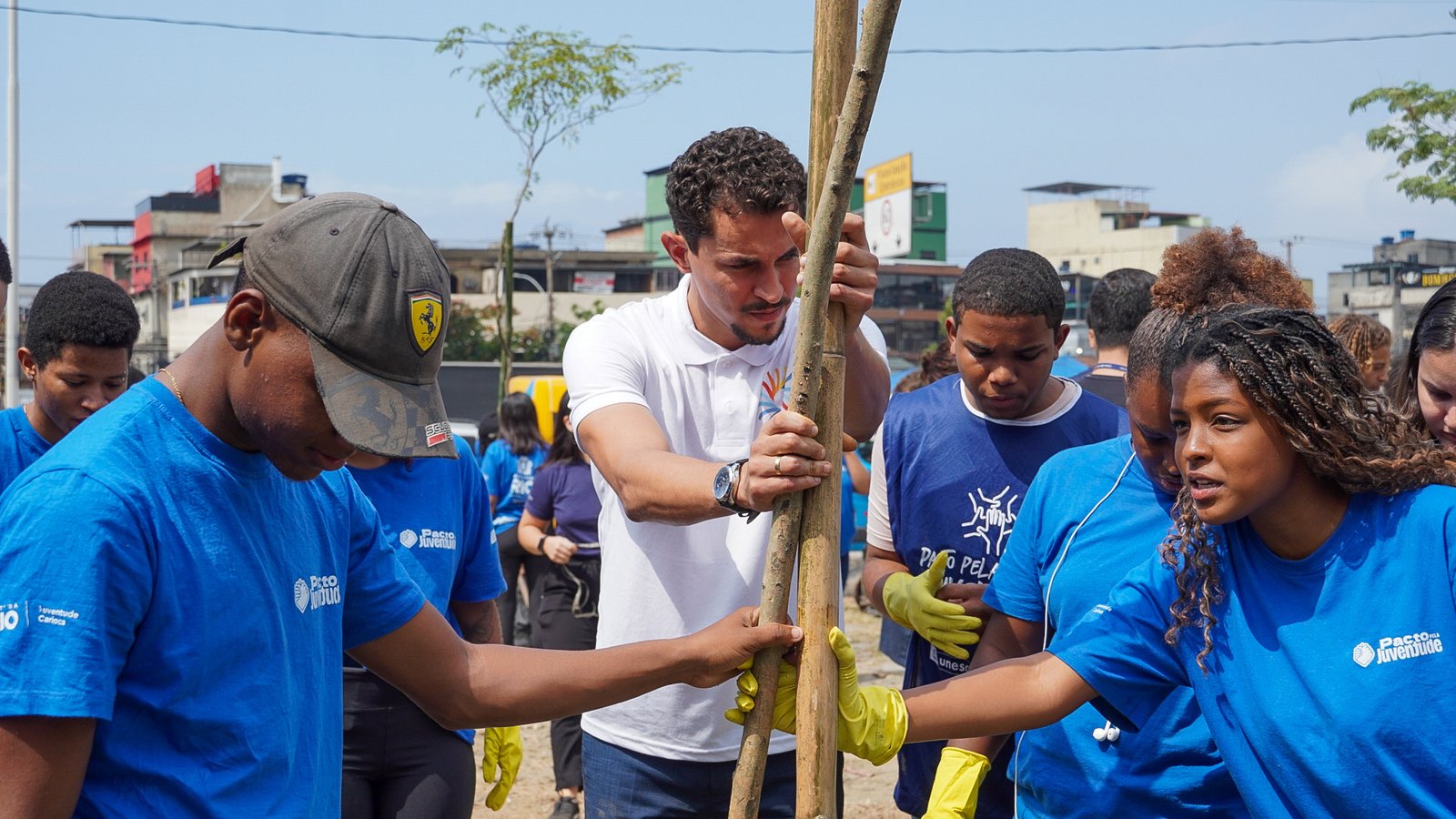
On 22 December 2025, Global Citizen published the story of how at 27, Salvino Oliveira went from being a street vendor in Rio’s Cidade de Deus to a city councilor leading education reform. This was followed by him starting his first social project: making tuition free for poor children at 15 years old. In recognition of his efforts towards making education more accessible, Oliveira has been honored as a 2025 Young Activist Summit Laureate. Here, Oliveira shares how education transformed his life, and why he’s committed to making that transformation accessible to every young person in Brazil’s favelas.
My name is Salvino Oliveira, and I am everything I’ve been.
I say this because my story begins in a tiny house in Cidade de Deus, meaning City of God, a favela in Rio de Janeiro. At 13, I started working to help my family survive: selling water bottles at traffic lights, candy on buses, working as a street vendor, upholsterer, construction helper — anything honest that could put food on the table.
But Cidade de Deus is more than poverty. It’s the Rio neighborhood with the most public squares, making it a natural place for culture, leisure, and community gathering. It’s the birthplace of funk carioca — the soundtrack of favela resistance and joy. It’s also home to Olympic athletes and artists. These public spaces and that cultural richness shaped who I became, the friends I made, my first loves, the things I believe in.
Then I got lucky. I was selected by lottery to study at Colégio Pedro II, one of Brazil’s most prestigious tuition-free public schools. In Brazil, elite families typically send their children to private schools, while public schools serve the poor; a few exceptional public institutions, like Pedro II, offer quality education through competitive lottery systems. That education changed everything. It opened a door that seemed permanently locked for someone from my background. At 15, even while working and living with gun violence all around me, I understood that if this access had reached me, I had a responsibility to give it back.
At 15, I created my first social project: free tutoring for children in Cidade de Deus.
When I entered Brazil’s federal university system to study Public Administration at Universidade Federal do Rio de Janeiro (UFRJ), a tuition-free institution, like all public universities in Brazil, that social project grew into AfroEducando (later renamed Mais Nós), a community prep course for university entrance exams. Within one year, we had 22 units across Rio’s metropolitan region, all volunteer-run, helping first-generation Black students from favelas access higher education.
When the “social bug” bites you, there’s no going back — and so the projects continued. I co-founded Projeto Manivela to train community leaders to engage with the government and turn demands into policies. Then came PerifaConnection, a media platform where young people from favelas across Brazil write columns in major national newspapers about politics, economics, culture, climate, and human rights. The idea was simple and radical: we refuse to let other people tell our story for us. Mainstream Brazilian media have historically portrayed favelas primarily through the lens of crime and poverty. Today, favela youth occupy editorial space in national media, changing how Brazil sees its peripheries.
I became an activist in 2018 during the federal military intervention in Rio’s security forces. Working at the Public Security Observatory, I saw firsthand how policies treated favelas like war zones, with heavily armed police operations causing civilian casualties. As I became more visible in my community, friends warned me: “Be careful, you’re an activist now. This can put you at risk.” That’s when I understood that fighting for education and rights in Rio means challenging power structures involving politics, money, and organized crime that often operate in contested urban territories.
Cressida Kuala lives in a small gold mining town in the Highlands Region of Porgera District in the Enga Province of Papua New Guinea. In 2011, Cressida founded the Porgera Red Wara (River) Women’s Association, and she started speaking out about issues such as environmental degradation, chemical waste, pollution, expropriation of land, and the impact on the local community.
Marie Louise Baricako, a women’s rights activist from Burundi, in Geneva for the Human Rights Council (Geneva Solutions/Michelle Langrand)
Michelle Langrand in Geneva Solutions of 8 October 2025, talks with Burundian women’s rights defender Marie Louise Baricako – who was In Geneva to attend the Human Rights Council. She warns that her country is sinking deeper into crisis as the region teeters on the brink, urging the international community to push for a national dialogue.
Marie Louise Baricako recalls the Arusha negotiations with a mixture of pride and sorrow. In the late 1990s, she pushed for women to have a seat at the table in the talks aimed at ending Burundi’s inter-ethic civil war – and yet, 25 years on, much of the agreement’s promises remain unfulfilled.
“If women are left out, Burundi will keep losing,” she says. “How can you hope to develop when 52 per cent of your population are left aside?”
Baricako has spent a lifetime trying to empower that 52 per cent. In 1988, she became the first Burundian woman to earn a PhD, studying in Cameroon, and later led the English department at the University of Burundi. Born in Muramvya province, she spent much of her adult life abroad, including in The Gambia, where she joined Femme Africa Solidarité, a feminist network founded in Geneva in 1996 to promote female leadership in peace, security and development……
Fortuné Gaetan Zongo, UN special rapporteur on Burundi since 2021, warns of a “real risk” of regional destabilisation. “If Kinshasa were to fall, Burundi would be deeply affected,” he tells Geneva Solutions. Some 78,000 Congolese refugees fleeing the violence have crossed into Burundi since the beginning of the year, raising questions about how Burundi, already struggling, can cope with their humanitarian needs while the UN aid system is strapped for cash.
Baricako sees how ethnic narratives continue to be exploited by those in power. “This is what our leaders today are nourishing, because in their mind, Tutsi had kept power for so long alone, excluding Hutus. Now, they say ‘we have taken it, we shall not release it, until Jesus comes back’,” she says.
Yet repression is not limited to a group. “When women or human rights defenders dare to speak out on any violation, the next day, either they are in prison or they are killed,” she says…
Despite the bleak prospects, Baricako places hope in ordinary Burundians. “They have had time to believe in these stories of Hutus or Tutsi being the enemy. Now I believe people have realised that it is not about the ethnic group,” she says. “Burundians want a peaceful country, and they are ready to work as hard as they can to rebuild Burundi.”
Baricako stresses that talks would lead to more unfulfilled promises without the participation of those in power. She calls on the African Union and the East African Community to step out of their indifference and pressure Burundi to the table.
Zongo, who has been met with the government’s outright refusal to cooperate with him and other human rights experts, also notes that certain states with good relations with Burundi, like Tanzania, DRC and Cameroon, “can convince Burundi to sit at the table and engage in cooperation.”
For all the setbacks, Baricako remains steadfast. “The support of civil society has been essential in staying strong and not abandoning the fight,” she says. “Peace is our business, whether they want it or not. I will not go to the battlefield with a weapon, but what I have in my heart, I will use it to stand for peace and security of Burundians.”
‘Water is to protected. Water is not for sale. Water is to be defended.’
Doris Ramírez is a fisherwoman and a fisherfolk’s union representative from Guatemala’s southern coast. She told ISHR how her late husband’s passing drove her to embrace activism and described her aspirations for the future for her coastal community.
In March 2025, Doris attended the 58th session of the UN Human Rights Council, delivering a statement calling on Guatemala to abide by its obligations to secure the protection of marine biodiversity, the traditional rights of fisherfolk and the protection of those who are protecting the environment.
Judi Aldalati is a Syrian journalist, a researcher and human rights defender. She told ISHR how seeing the early days of the Arab Spring led her to pursue the defence of human rights and shared her aspirations for the future of Syria amidst the uncertainty that has followed the collapse of the Assad regime.
Gladys Mbuya is a lawyer by profession, a human rights defender, and a peace crusader. She is the founder of the Liberal Law Office in Cameroon and serves as the president of the International Federation of Women Lawyers for Cameroon. She also holds a role as a traditional leader.
Her work centres on promoting the recognition and respect of human rights, particularly the rights of women and girls. She represents women and girls in court who cannot afford legal fees and actively advocates for the revision of laws that discriminate against them.
Gladys faced intimidation, threats, and even attempts at arrest for her activism, yet remains steadfast in her mission. She has defended numerous individuals – including prominent activists – in cases involving arbitrary detention and violations of free expression and assembly. She was part of the legal team that defended Mimi Mefo, Ndoki Michèle, and Agbor Balla, which led to their cases being dropped at the court.
‘Human rights defence work is a noble cause. The international community should continue standing by human rights defenders. They should increase the volume of political pressure on our governments for them to fulfil their obligations under all the international conventions they have ratified.’
Angélique is a Malagasy environmental and community rights defender who founded the Razany Vohibola Association in 2016. She represents over 3,000 villagers from four communities near the Vohibola Forest and leads efforts to preserve one of Madagascar’s last remaining primary forests.
Under her leadership, and in collaboration with the Ministry of the Environment, villagers have formed patrols to monitor and protect the forest against illegal logging, poaching, and the growing impacts of climate change. Angélique and her community face ongoing threats, including direct intimidation and violence from the authorities. One of her colleagues, patrol officer Mick, was killed for speaking out against illegal land grabbing, yet his death remains unpunished by local authorities.
Despite these grave risks, Angélique continues to advocate for justice and environmental protection. She also calls for structural change, urging the Malagasy government to pass a law that protects human rights defenders and holds public officials accountable.
There is currently no law to protect human rights defenders in Madagascar. We need this law to pass. The army and the gendarmes must be trained to understand who we are so they can become our allies.


 Hans Thoolen on Human Rights Defenders and their awards