Posts Tagged ‘Palestine’

Bloggers and technologists who were forced “offline” in 2018

January 8, 2019

Read the rest of this entry »

Surangya’s take on human right in 2018

January 2, 2019
There are many people looking back on 2018 in terms of human rights. I would like to share the following by Surangya published on 1 January 2019 in Newsclick, entitled: “From terror plots to national security threats, political dissenters faced several charges and labels for raising their voice and questioning excessive power“, with its own angle and priorities:
Political Freedom

As 2018 draws to an end, we take a look at how the year fared for dissent and democracy in different parts of the world:

…Palestinian children detained in Israeli prisons for protesting the occupation

The occupying state of Israel is perhaps one of the best examples of a country normalising violence of all sorts. For decades, Israel has occupied Palestinian lands and subjected the people to all kinds of humiliation. This has only intensified the resistance against the occupation, with Palestinians ferociously protesting, even at the cost of their lives…..Israel recognises this threat, which is why as of November 2018, there were almost 6,000 Palestinians in Israeli prisons, most of whom challenged the occupation in one way or another. Even more astonishing is the fact that among these prisoners are nearly 250 children, over 40 of whom are under 16 years of age..This imprisonment of children and subjecting them to torture, inhumane living conditions, often even solitary confinement, is a clear violation of the UN Convention on the Rights of Child, to which Israel is a signatory. Just recently, a 17-year-old Palestinian boy, Ahyam Sabbah, was sentenced to 35 years in prison for a charge of attempted stabbing…

Plot to assassinate the prime minister in India

… With the general elections approaching in 2019, the far-right government led by the Bharatiya Janata Party (BJP) with Narendra Modi at the helm, has been looking for any excuse to silence those highlighting this government’s many flaws and suppression of minorities. The most prominent case this year was of the arrest of 10 renowned human rights activists, who were labelled members of the banned Communist Party of India (Maoist) and made part of a plan to assassinate Prime Minister Modi, despite there being no concrete evidence supporting these allegations. The wording of the UAPA is such that any speech a person makes questioning the state can be seen as a threat to the country’s security and sovereignty. [see also: https://humanrightsdefenders.blog/2018/09/22/attack-on-human-rights-defenders-in-india-are-an-attack-on-the-very-idea-of-india/]
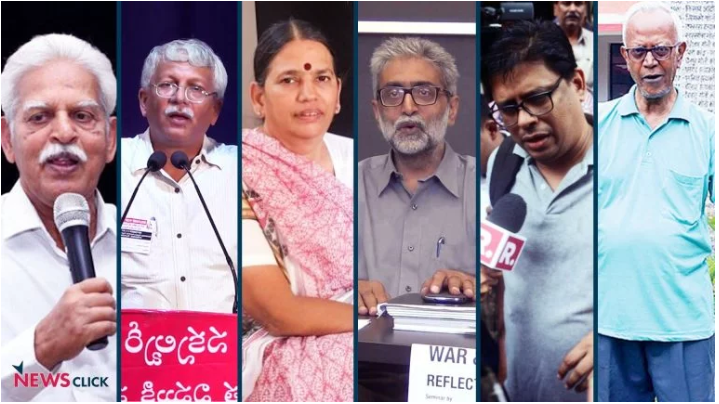
PD%203.PNGVaravara Rao, Vernon Gonsalvez, Sudha Bharadwaj, Gautam Navlakha, Arun Ferreira and Stan Swamy were amongst the activists who faced charges.

Failed peace process in Colombia

Two years after the signing of a peace treaty between the Colombian government and the Revolutionary Armed Forces of Colombia (FARC) in Havana, Cuba, the government has failed to make good on its promises. While the guerrilla organisation surrendered arms for the most part after the treaty was signed, the government now shows no political will to implement the accords and demobilised combatants have been subject of unabated persecution. 92 people who participated in the reincorporation process have been killed……For the more than 400 social leaders and human rights defenders assassinated by right-wing paramilitary and state forces since the Havana agreements were signed, the legal system has been much slower to find those responsible and the government has shown it has no desire to dismantle the criminal structures that carry out these crimes. Just in 2018, human rights organisations reported that over 226 leaders were assassinated and the National Indigenous Organisation of Colombia (ONIC) declared in August that under Duque’s presidency, there has been an increase in the attacks against indigenous people.

Impending elections always create an upsurge in state clampdowns on people’s rights to free speech and protest.

Crackdown in Congo

As the Democratic Republic of Congo finally hit the polls on December 30 after a delay of two years, there was widespread apprehension over the fairness of these elections. President Joseph Kabila held on to power for two years after his constitutionally mandated term ended in December of 2016. Despite being president for the permitted two terms, he remained reluctant to give up control over the country, and only agreed to not contest this time after naming Emmanuel Ramazani Shadary as his successor. Shadary is a former minister of interior, and remains under sanctions by the European Union for committing human rights violations in Congo…..At least 2,000 activists, opposition members, and journalists have been put behind bars since the protests against Kabila began in 2015. Many were released after weeks or months of detention and reported mistreatment. In November alone, at least 18 pro-democracy activists were arrested from the capital city Kinshasa. It remains to be seen if the much anticipated elections will bring a change and some relief to the people of Congo.

Philippines

A scenario similar to this, but of a different magnitude, is being witnessed in the island nation of Philippines under the authoritarian regime of Rodrigo Duterte, with widespread attacks on activists and pubic dissenters…Earlier this month, the government approved extension of martial law for the third time, making it effective for another year. While the stated purpose of this is to combat “extremists”, often labelled as members or leaders of the banned Communist Party of Philippines (CPP) or New People’s Army (NPA), those facing chargers are mostly activists challenging Duterte’s authority. In late February, the Duterte regime released a list of almost 600 activists and political dissenters, which was called the Terror List. Labelled terrorists and members of banned groups, many in the list are renowned activists and public figures, including Victora Tauli-Corpus, the current UN Special Rapporteur on the Rights of Indigenous People.

Brasil

Any concrete evidence to show Lula’s involvement in the corruption scandal is yet to be presented. His indictment, however, gave the extreme right candidate Jair Bolsonaro’s campaign a push, ultimately leading to his victory. The judge responsible for the legal crusade against Lula, Sergio Moro, has been rewarded with a place in Bolsonaro’s cabinet as the Minister of Justice. The attacks against Brazil’s social movements have already intensified. Two leaders of the Landless Rural Workers Movement (MST) were assassinated days before the Human Rights Day on December 10. Members of social movements fear that such incidents will become more commonplace under Bolsonaro, known for encouraging Brazilians to resort to violence when faced with social conflicts.

The year ahead…

While 2018 saw several right-wing regimes and authoritarian leaders accede to power, the coming year offers hope of being different as discontent against neo-liberal systems is rising. The Yellow Vests movement in France, which is still going strong after almost a month and a half, is an inspiring instance of that. Several countries will hit the polls in 2019. The need for mobilising against anti-people parties and disseminating the truth about such parties which often seem appealing to the masses with their populist messages is now stronger than ever, especially if we are to make 2019 any different.

Runners up for Front Line Defenders Award for Human Rights Defenders 2016 announced

May 11, 2016

Frontline NEWlogos-1 condensed version - cropped has announced that the finalists for its 2016 award are human rights defenders from Azerbaijan, Burma/Myanmar, Colombia, Honduras, Palestine, and Tanzania. For more information on the annual Front Line Defenders Award for Human Rights Defenders at Risk: http://www.brandsaviors.com/thedigest/award/front-line-defenders-award.


The 6 finalists for 2016 are Read the rest of this entry »

Israeli journalist and Palestinian pastor win Olof Palme award 2015

January 8, 2016

On 7 January 2016 it was announced that Israeli journalist Gideon Levy and Palestinian pastor Mitri Raheb have won the 2015 Olof Palme human rights prize. Levy, a journalist at the left-leaning Israeli daily Haaretz, and Raheb, a preacher and pastor in the Lutheran church in Bethlehem, were honoured for their “courageous and indefatigable fight against occupation and violence, and for a future Middle East characterised by peaceful coexistence and equality for all,” the Olof Palme Memorial Fund said in a statement. Read the rest of this entry »

Israel refuses entry to UN special rapporteur Wibisono

June 15, 2015

Unfortunately, Israel joined the countries that think non-cooperation with the UN pays: last week it refused entry to Makarim Wibisono, the UN special rapporteur on human rights in the Palestinian territories, who is working on a report on rights violations in east Jerusalem, the West Bank and Gaza. “Since taking up his mandate in June 2014… Wibisono has sought Israel’s cooperation with his mandate, including access to the occupied Palestinian territory and meetings with Israeli officials. His requests to access Israel and the occupied Palestinian territory in order to carry out his mandate have not received a formal response from the government of Israel,” said Xabier Celaya, from the media unit of the Office of the High Commissioner for Human Right.

The Israeli Foreign Ministry justified its decision by saying that “Israel cooperates with most human rights mechanisms of the UN. Israel does not cooperate with unfair and unbalanced mandates such as the… rapporteur’s mandate, and consequently his entry to Israel is not allowed.”

[Israel remains the only country for which a special investigator is permanently assigned. The position of special investigator to the Palestinian territories was first created in 1993 and that Wibisono of Indonesia is the sixth person since then to hold that post.]

Earlier in the month, Wibisono spoke out against Israeli plans to relocate Palestinian Beduin communities in the West Bank “I am alarmed at indications that the rollout of plans, which in their full effect are believed to entail the forced eviction and forcible transfer of thousands of people, contrary to international human rights law and international humanitarian law, now appears imminent,” Wibisono said

https://thoolen.wordpress.com/2014/06/23/non-cooperation-from-some-states-with-the-un-human-rights-council-is-persistent/

via Israel refuses entry to UN special investigator Wibisono – Arab-Israeli Conflict – Jerusalem Post.

Binding UN treaty needed for protection of environmental human rights defenders

June 11, 2014
Defenders of the environment often face terrible consequences for their actions, suffering rights violations and violence, according to a new report by Friends of the Earth International to be released on June 26, during the 26th Session of the U.N. Human Rights Council . “A new case of violence against environmental rights defenders and violations of their rights is reported to us on average once a week, and this is just the tip of the iceberg,” said Lucia Ortiz, of Friends of the Earth International. “Environmental defenders who uphold the right of communities to determine their own development path in opposition to corporate-driven mega projects are subject to many types of human rights abuses, often committed by corporations or on their behalf”.

Friends of the Earth International recorded more than 100 incidents of violence against environmental rights defenders and violations of their rights in 27 countries around the world in the period November 2011 – October 2013. More than half of the killings recorded were targeted assassinations of peasant leaders and deaths of peasants during violent confrontations regarding land disputes, often involving the protection of peasant territories from polluting development projects such as hydroelectric dams, monoculture plantations or the extraction of oil, gas and minerals.

The new report calls on the UN Human Rights Council to create an international treaty to address corporate human rights violations. [On may 7, 2014, a global alliance of civil society organizations known as the Treaty Alliance representing more than 500 groups called on UN Human Rights Council members to support an initiative in June that would begin a process towards creating an international legally binding treaty to address corporate human rights violations. For more information read: www.foei.org/news/groups-call-for-un-treaty-to-tackle-corporate-human-rights-violations/ –  A regulatory and enforcement framework that is legally binding for corporations has been proposed at the Council by a group of 84 nations since September 2013]

The following environmental defenders will be in Geneva on June 23-27:

1) Micaela Antonio Gonzalez from Guatemala and Victor Barro from Friends of the Earth Spain will expose the human rights violations by the Spanish company Hidralia in Guatemala.

2) Abeer Al Butmah from Friends of the Earth Palestine will expose the human rights violations by Israeli water company Mekorot in Palestine.

3) Godwin Ojo from Friends of the Earth Nigeria and Paul de Clerck from Friends of the Earth Europe will expose the human rights violations by Royal Dutch Shell in the Niger Delta.

4) Alberto Villarreal will expose the violations of the human right to health posed by the Philip Morris International challenge to the tobacco control legislation in Uruguay.

Friends of the Earth International is critical of ‘voluntary mechanisms’ such as the Global Compact and Ruggie’s UN Guiding Principles on Business and Human Rights and believes they have not reduced attacks on human rights defenders and are thus insufficient to protect human rights.

The report ‘We defend the environment, we defend human rights‘ is available at www.foei.org/resources/publications/publications-by-subject/human-rights-defenders-publications/we-defend-the-environment-we-defend-human-rights/

For some of my earlier posts on environmental issues and human rights defenders see: https://thoolen.wordpress.com/tag/environmental-issues/

Human rights defender Shireen Essawi goes on hunger strike against trial postponement

May 18, 2014

Shireen Essawi holding a photograph of her brother Samer

On 8 May 2014 human rights defender and lawyer Ms Shireen Essawi began a hunger strike after learning of the postponement of her trial for nine months and a day. She is charged with cooperating with actors who are working against the state of Israel. Shireen Essawi is a human rights lawyer who has participated in monitoring and documenting human rights violations committed against Palestinian prisoners in Israeli prisons, especially children, women, and prisoners from the Gaza Strip. The human rights defender also reported on practices adopted by Israeli authorities for Palestinian and Arab prisoners in Israeli jails that she believes violate human rights, such as preventing visits by lawyers.

The postponement of her trial on 7 May 2014 follows several court appearances by the human rights defender since her arrest on 6 March 2014. It is reported that under Israeli law, a trial may be suspended and detention can continue upon the condition that a final judgment and sentence is issued within nine months and a day of the adjournment. Shireen Essawi began her hunger strike out of solidarity with Palestinian prisoners, and has declared she will continue it in protest at the adjournment of her trial. The human rights defender was arrested at her home in Jerusalem as part of a wave of arrests targeting lawyers. Her colleagues have since been released on bail, pending trials.

Front Line Defenders expresses its concern at the postponement of the trial and continued detention of Shireen Essawi, which is solely related to her peaceful and legitimate human rights work, in particular concerning the rights of Palestinians and Arab Israelis.

via: http://palsolidarity.org/2014/05/hunger-strike-by-human-rights-defender-ms-shireen-essawi-as-trial-postponed-by-one-year/

Solidarity Foundation for Human Rights reports two human rights defenders kidnapped in Nablus

February 26, 2014

On 25 February 2014 the International Middle East Media Centre [IMEMC] carries a report from the Palestinian Solidarity Foundation for Human Rights (SFHR) that Israeli soldiers kidnapped on Tuesday its lawyer and its researcher, after the army violently invaded their homes in the northern West Bank city of Nablus.

The lawyer is Fares Riyad Abu al-Hasan and the researcher Ahmad Hamed al-Beetawy. The NGO said dozens of soldiers invaded the home of Abu al-Hasan, in the Rojeeb Housing Projects area, east of Nablus, and kidnapped him after violently searching his home causing property damage. The soldiers detonated the door of Abu al-Hasan’s home, invading the place and terrifying the family. They also interrogated Abu al-Hasan’s father for more than an hour, and confiscated documents and files. Abu al-Hasan was moved to the Petah Tikva interrogation facility. The  soldiers also detonated the front door of the home of Ahmad al-Beetawy, and invaded the property in the Dahia area, south of Nablus, searched it for more than an hour and kidnapped him.

The foundation said that the soldiers also invaded its office in al-Isra’ building, in the center of Nablus city, and confiscated computers and files after violently searching the property.

via Two Palestinian Human Rights Defenders Kidnapped In Nablus – International Middle East Media Center.

Palestinian human rights defenders attacked during forcible eviction of Ein-Hijleh village

February 19, 2014

Frontline NEWlogos-1 condensed version - croppedreports that on 6 February 2014, the Israeli Defence Forces (IDF) and Border Police forcibly evicted the entire Palestinian village of Ein-Hijleh and declared the village a closed military zone. During the eviction 19 people, including human rights defenders and journalists were temporarily detained whilst at least 32 villagers were injured. Several of the detained were subject to physical aggression. Amongst the 19 detained were human rights defenders Issa Amro, Mahmoud Zawhara, Abdullah Abu Rahmeh, Bassem Tamimi and Mohammad Al Khatib.

The forced displacement follows a series of raids and attacks which have targeted the local community as well as human rights defenders who peacefully opposed the eviction. The campaign began on 31 January 2014, when the IDF blocked access to the village and prevented the delivery of water and food supplies. On 3 February 2014, the IDF attempted to gain entry to the village. On 4 February 2014 a renewed attempt to enter the village included the use of tear gas against peaceful protesters, but was hindered by locals forming a human chain.

Front Line Defenders has previously issued urgent appeals on Issa Amro: http://www.frontlinedefenders.org/IssaAmro.

see also: https://thoolen.wordpress.com/2013/08/14/five-un-experts-urge-israel-to-stop-harassment-of-human-rights-activist-issa-amro/

Eyad El-Sarraj, Palestinian Laureate of MEA 1998, dies at 69

December 18, 2013

Today, 18 December 2013,  Scoop News brings the sad news that Palestinian Human Rights Defender Dr. Eyad El-Sarraj, Palestinian psychiatrist and Commissioner-General of the Palestinian Independent Commission for Citizens’ Rights, passed away in Gaza a few hours ago. Born in Beersheva, Palestine on 27 April 1944, Dr El-Sarraj arrived with his family in Gaza in 1948 as a refugee. He grew up to become the first psychiatrist to practice in Gaza, beginning in 1977. Dr El-Sarraj went on to found and direct the Gaza Community Mental Health Programme [GCMHP], which he established in 1990 to promote the mental well-being of three major target groups in the Palestinian community: children, women, and victims of organized violence and torture. “We strongly believe that there is a correlation between human rights and mental health, because sound mental health cannot be gained under violent circumstances, and human rights will not be respected in a society exposed to ongoing trauma,” states the organisation’s strategy document. His human rights work was not without cost – in 1996 he was arrested and tortured for condemning torture and violation of human rights by the Palestinian Authorities.  In 1998 he received the Martin Ennals Award for Human Rights Defenders [MEA], in 1997 the Physicians for Human Rights Award, and in 2010 the Swedish labour movement’s  Olof Palme Prize. In the same year, Dr El-Sarraj was jointly awarded the Juan José López-Ibor prize in psychiatry, along with Professor Jules Angst, in recognition of his contribution to advancement of the rights and dignity of people with a mental illness, and his scientific research. Other notable activities include being a consultant to the Palestinian delegation at the Camp David 2000 Summit, and his appearance as an expert witness before the United Nations-mandated Goldstone Commission on the war crimes committed during Israel’s 2008-9 military offensive “Operation Cast Lead.” His evidence on the long-term psycho-social impacts of the conflict on civil society in Gaza was quoted in the final report. The light that Iyad El-Sarraj shone into some of the darkest corners of Palestine can not be dimmed by his death. “You are the window through which I can breathe,” one of his patients once told him. His legacy of hope, and a legion of Palestinians both taught and inspired by him, will continue his important work.  During his acceptance speech at the MEA ceremony he said, “Receiving this award reminded me of one of the persons I left behind in prison. He said to me: ‘Don’t forget me… please… don’t forget me’.” The best we can do now, is the same for El Sarraj: Don’t forget him… please… don’t forget him!

For more information and a video on El Sarraj and his work see: http://www.martinennalsaward.org/index.php?option=com_content&view=article&id=83&Itemid=107&lang=en

via Palestinian Human Rights Defender Dies at 69 | Scoop News.