Posts Tagged ‘Netherlands’

Call for nominations for the 2022 Human Rights Tulip award

July 21, 2022

The Dutch Ministry of Foreign Affairs has opened their call for nominations for the 2022 Human Rights Tulip award.

The Human Rights Tulip comes with €100,000 in prize money, which the winner can use to further develop or expand the scale of their work for human rights. The nomination period will close on 2 August 2022

The Human Rights Tulip is an award presented by the Dutch government for human rights defenders who promote and support human rights in innovative ways. Please see https://www.trueheroesfilms.org/thedigest/awards/D749DB0F-1B84-4BE1-938B-0230D4E22144 for further information on the award and its laureates. With the nomination form (available in 5 languages) you can nominate organisations and individuals who you consider worthy of this award.

https://www.government.nl/topics/human-rights/documents/forms/2022/07/20/human-rights-tulip-nomination-form

Two lawyers from Belarus share Lawyers for Lawyers Award 2021

September 10, 2021

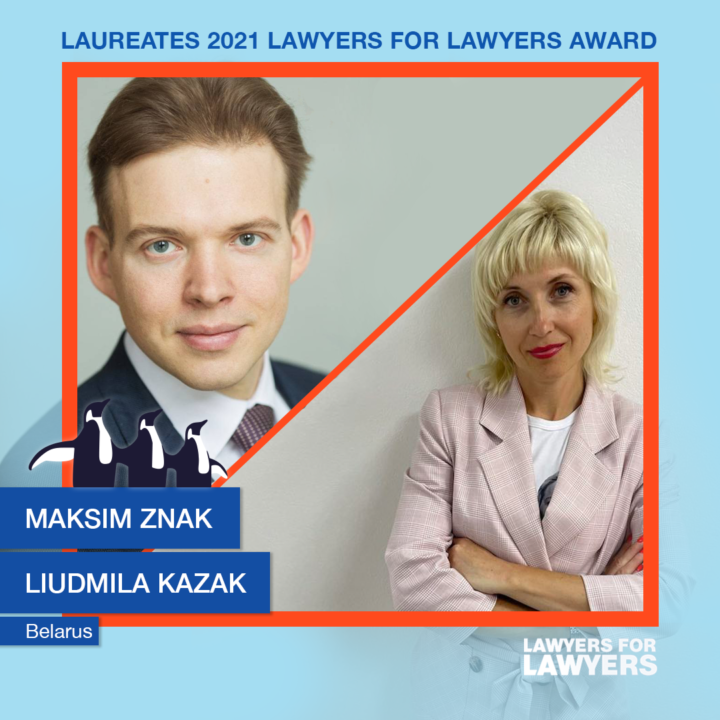
Belarusian lawyers Maksim Znak and Liudmila Kazak will receive the Lawyers for Lawyers Award 2021. The Award will be presented at a ceremony co-hosted by Lawyers for Lawyers and the Amsterdam Bar Association in the Rode Hoed in Amsterdam on 18 November 2021. For more on this award and its laureates, see: https://www.trueheroesfilms.org/thedigest/awards/B40861B3-0BE3-4CAF-A417-BC4F976E9CB0

By awarding Maksim Znak and Liudmila Kazak the Lawyers for Lawyers Award, the jury wants to highlight the important work of both lawyers who bravely represented Belarusian human rights defenders and opposition leaders and are paying a high price for their work. With this Award, the jury also wants to raise awareness of other Belarusian lawyers who have been subjected to pressure, harassment and intimidation in connection to their professional activities especially in the aftermath of the 2020 presidential elections”.

Maksim Znak and Liudmila Kazak laureates Lawyers for Lawyers Award 2021

Maksim Znak                                                                                     

Maksim Znak represented Viktor Babaryko, a potential candidate in the presidential elections who was not allowed to formally register. He also provided legal assistance to Svetlana Tikhanovskaya, a former candidate for the presidency who is now in exile, and Maria Kolesnikova, Coordination Council co-leader. On 9 September 2020, Mr. Znak was arrested for allegedly having committed the offence of “calls to actions seeking to undermine national security” in violation of Article 361(3) of the Criminal Code of Belarus. In February 2021, additional charges were added, including “conspiracy to seize state power” and “organising extremism”. On 6 September 2021, Mr. Znak was sentenced to 10 years in prison during a closed-door-trial. His sentencing is another indication of the challenging working environment in which Belarusian lawyers must operate.

Liudmila Kazak

Liudmila Kazak is a human rights lawyer who has defended political prisoners, human rights defenders, and journalists, including the opposition leader Maria Kolesnikova. On 24 September 2020, she was detained. The next day, the court held Kazak administratively liable for disobeying police officers based on testimony given by anonymous masked witnesses who appeared via Skype and claimed to be the arresting officers. She was sentenced to a fine under article 23.4 of the Belarusian Administrative Code and released on 26 September 2020. On 11 February 2021, she was notified of a pending disciplinary proceeding against her before the Qualification Commission for legal practice in the Republic of Belarus. On 19 February 2021, the Qualification Commission disbarred Ms. Kazak. Ms. Kazak appealed the decision, but, on 15 April 2021, a district court upheld Ms. Kazak’s disbarment. On 17 June 2021, an appellate court upheld the district court decision.

For 2019 award, see: https://humanrightsdefenders.blog/2019/05/21/lawyers-for-lawyers-award-to-turkish-human-rights-defender-selcuk-kozagacli-on-23-may/

Call for nominations 2021 Tulip award

July 19, 2021

The nomination period for the Human Rights Tulip 2021 is open and will end on 27 July at 11:59 PM.

For more on this award and its laureates, see: https://www.trueheroesfilms.org/thedigest/awards/D749DB0F-1B84-4BE1-938B-0230D4E22144

Nominations can be made by filling out Nomination form for the Human Rights Tulip 2021. Please note that human rights defenders and organisations cannot nominate themselves. The nomination form is available in English, French, Spanish, Russian and Arabic.

For any questions, please send an email to dmm-tulip@minbuza.nl.

Selection procedure: To decide who should win, all the submitted nominations are reviewed using agreed selection criteria. A certain weight is given to each criterion. 

The selection criteria are as follows:

  1. Working to peacefully promote and/or protect human rights, especially in one of the following fields:
    • freedom of expression (including online);
    • freedom of religion or belief;
    • equal rights for LGBTI persons;
    • equal rights for women and girls;
    • fight against impunity and accountability for international crimes.
  2. Level of repression and risks faced as a result of the human rights work.
  3. Level of innovation and creativity in the approach to promote and protect human rights.
  4. Ability to achieve impact and to reach and improve the life of (marginalised) beneficiaries through the human rights work.
  5. Working with and involving relevant partner organizations and/or communities.
  6. Sustainability of the project and the possibility to scale up the approach or project.

A panel of 5 human rights experts pre-selects the top ten candidates with the highest scores as well as three ‘wild cards’, so that strong candidates who don’t score well on every single point still have a chance of winning. This list of 13 candidates is then submitted to an independent jury with 6 members. The jury discusses the profiles of these candidates and selects three candidates most eligible for the Human Rights Tulip award. The names of these three candidates are given to the Minister of Foreign Affairs, who picks the winner of Human Rights Tulip.

https://www.government.nl/topics/human-rights/human-rights-tulip/nomination-and-selection-procedure

The intriguing case of Artur Ligęska who was in prison with Ahmed Mansoor in the UAE

June 9, 2021

Mirage news of 8 June 8, 2021 tells the sad story of Artur Ligęska, a 40-year-old Polish citizen who has spoken out widely about torture and ill-treatment in Emirati prisons. He was found dead in his apartment in Amsterdam, the Netherlands on May 26, 2021. The Gulf Centre for Human Rights and Human Rights Watch are deeply saddened by the news of his death and extend their sincere condolences to his friends and family.

Following his release from al-Sadr prison in May 2019, Artur dedicated himself to seeking justice for the abuse he and other prisoners suffered in prison, especially Ahmed Mansoor, an award-winning human rights defender who is on the advisory boards of GCHR and Human Rights Watch. [see: https://www.trueheroesfilms.org/thedigest/laureates/074ACCD4-A327-4A21-B056-440C4C378A1A]Artur was a uniquely valuable source of information on prison conditions in the United Arab Emirates (UAE).

He was an activist, author, and fitness expert and had recently celebrated the second anniversary of his acquittal on May 9. He had been sentenced to life in prison in the UAE following a deeply flawed trial on drug charges despite the absence of any evidence of drugs in his possession.

In a voice message to a friend at GCHR on May 9, Artur said, “My main wish for this new-life birthday is freedom for Ahmed Mansoor. I really do hope that this year will be special for him. I was thinking all day about him. I remember our last talk, and I was thinking about his wife and kids. …In the last days, Ahmed told me ‘Don’t forget about me.’

Artur said he was planning to organize a protest in The Hague soon to call for Ahmed’s release. Artur’s many actions to help Ahmed included advocacy with Polish and EU officials, providing human rights groups with information, taking part in human rights events, documentary films and TV appearances, and writing about Ahmed in his two books.

Artur first phoned GCHR staff in April 2019 to tell them that Ahmed was on a hunger strike and told them that he was worried that Ahmed might die because his health had deteriorated greatly. He told GCHR that Ahmed was being held in “terrible conditions” in a cell with no bed, no water, and no access to a shower. Ahmed today remains in a 2-by-2 meter isolation cell with no bed or mattress, serving a 10-year prison sentence for his human rights activities.

Despite suffering serious trauma after suffering abuse as a prisoner in the UAE, Artur again phoned GCHR to share the good news that human rights groups’ advocacy had been successful. Ahmed had ended his hunger strike after being allowed to phone his ill mother and to go outside to see the sun for the first time in two years. Artur sacrificed phone calls to his own family to make calls on behalf of Ahmed, referring to him as a brother.

Following his release, Artur was able to provide GCHR with more details about what he called the “medieval prison conditions” in al-Sadr prison, including periods when there was no running water despite extreme heat.

In a wide-ranging interview released by Human Rights Watch in January 2020, Artur described how he and Ahmed had become “prison mates in UAE hell.” Artur spent eight months in al-Sadr prison, in solitary confinement in a cell beside Ahmed’s. His friend suffered psychological torture from a near-total lack of human contact and access to the library, Artur said. See also: https://humanrightsdefenders.blog/2021/02/22/lawlor-urges-uae-to-free-ahmed-mansoor-mohamed-al-roken-and-other-hrds/

Artur told GCHR that after he left the UAE, he had undergone surgery and therapy to treat the damage done by the rape and psychological torture that he said he was subjected to but he was recovering well and taking classes to become a journalist and human rights professional.

On April 13, 17 European Parliament members wrote to the EU’s High Representative Josep Borrell to express their “deepest concern over the ongoing human rights violations in the United Arab Emirates, particularly with regards to the systematic crackdown on freedom of speech and expression and the subsequent retaliation received during detention.” The letter mentions Ahmed, and also refers to Artur, noting, “The use of torture has not been limited to Emirati nationals, as there have also been instances of EU citizens that have reported facing brutal torture at the hands of prison authorities.”

On October 22, 2020, Amnesty Westminster Bayswater and GCHR held an online event, The Prisoner and the Pen, featuring the writing, songs and poetry of prisoners who are human rights defenders and the work of writers and artists from the Middle East and North Africa region. The event, held on Ahmed ‘s birthday, included his poems. Artur read from his memoir, “The Sheikh’s Different Love,” published in 2019 in Polish. He has also written a second bestselling book in Poland, “Prison Diary.” His story is documented in a film by Hossam Meneai, Isolation Cell 32, which debuted at the Polish Film Festival in America in November. Artur also appears in an upcoming documentary about Ahmed Mansoor made by Manu Luksch.

Artur’s untimely and unexpected death comes as a great shock to those who knew him. The Dutch police are investigating the circumstances of his death.

https://www.miragenews.com/tribute-to-artur-ligeska-former-prisoner-in-uae-573024/
Shelter City Netherlands: Call for Applications for September 2021

April 29, 2021

Justice and Peace Netherlands is launching a new call for applications for at risk human rights defenders to participate in Shelter City. The deadline for applications is 14 May 2021 at 23:59 CEST (Central European Time). Please be aware that special conditions apply because of the COVID-19 situation (see conditions below).

Shelter City provides temporary safe and inspiring spaces for human rights defenders at risk where they re-energise, receive tailor-made support and engage with allies. The term human rights defender is intended to refer to the broad range of activists, journalists and independent media professionals, scholars, writers, artists, lawyers, civil and political rights defenders, civil society members, and others working to advance human rights and democracy around the world in a peaceful manner.

From September 2021 onwards, several cities in the Netherlands will receive human rights defenders for a period of three months. At the end of their stay in the Netherlands, participants are expected to return with new tools and energy to carry out their work at home.

Journalists’ Safe Haven Initiative

Justice and Peace aims to promote the safety of journalists, and in particular women journalists, worldwide so that they can build new strategies and continue their important work for freedom of expression in their country of origin. With the support of the Dutch Ministry of Foreign Affairs, Justice and Peace will be able to provide two additional temporary safe spaces per year in The Hague for journalists at risk and provide them with tailor-made support.

Shelter City and COVID-19

Please note that the current situation of the coronavirus (COVID-19) may pose certain challenges to the stay of human rights defenders in the Netherlands in 2021. These challenges can include:

  • Limitations and/or changes in the programme that we can offer human rights defenders during their stay in the Netherlands;
  • New measures and restrictions (including a lockdown) taken by the Dutch government;
  • Cancellation of flights to/from the Netherlands;
  • Postponement of return to the home country after 3 months because of travel restrictions;
  • Participants might be requested to self-quarantine for 5-10 days upon arrival in the Netherlands (the Shelter City programme will be adapted accordingly) and to take other preventive measures due to COVID-19 (including a COVID-19 test before travelling to the Netherlands).

Please consider these potential challenges carefully before applying to the programme.

Applicants must fulfil the following conditions:

In order to be eligible to the Shelter City programme, applicants must meet the following conditions:

  1. They implement a non-violent approach in their work;
  2. They are threatened or otherwise under pressure due to their work;
  3. They can be relocated for a maximum period of 3 months. Limited spots are available for people who are not able to stay for the full 3 months;
  4. They are willing and able to return to their country of origin after 3 months;
  5. They are willing to speak publicly about their experience or about human rights in their country to the extent that their security situation allows;
  6. They have a conversational level* of English (limited spots are available for French or Spanish speaking HRDs);
  7. They are willing and able to come to The Netherlands without the accompaniment of family members;
  8. They have a valid passport (with no less than six months of validity) or be willing to carry out the procedures for its issuance. Justice and Peace covers the costs of issuing a passport and/or visa (if applicable);
  9. They are not subjected to any measure or judicial prohibition to leaving the country;
  10. They are willing to begin their stay in The Netherlands around September 2021.

Note that additional factors will be taken into consideration in the final round of selection, such as the added value of a stay in the Netherlands as well as gender, geographic, and thematic balance. Please note that we can only accept human rights defenders currently residing in a third country under exceptional circumstances.

To apply or submit the application of a human rights defender, please fill in the form by clicking ‘Apply Now’ below. Application forms must be completed by 14 May 2021, at 23:59 CEST (Central European Summer Time). An independent commission will select the participants.

Note that the selected human rights defenders will not automatically participate in Shelter City as Justice and Peace is not in control of issuing the required visas to enter the Netherlands.

For last year’s call see: https://humanrightsdefenders.blog/2020/11/24/new-call-for-applications-for-human-rights-defenders-at-risk-to-participate-in-shelter-city-netherlands/

Apply now for Shelter City 2021

For more information, please contact us at sheltercity[at]justiceandpeace.nl.

10 December: World Press Freedom Conference 2020

December 6, 2020

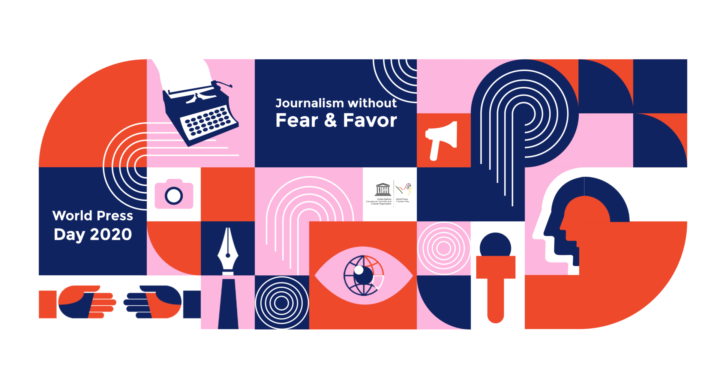
Journalism without fear or favour

Journalism without fear or favour
.unesco.org/news/visualizing-journalism-without-fear-favour (Image by UNESCO)

The ongoing COVID-19 pandemic has made even clearer the importance of being able to access reliable, unbiased information in a time of crisis – and of independent media as the source of such information. But freedom of the media is under attack in many countries all around the world and journalists are subject to harassment, repression and violence. The World Press Freedom Conference 2020 (WPFC) aims to stand up for a free, safe and independent media and protect journalism from new and existing forms of unwanted control, pressure and influence.

The WPFC is co-hosted by UNESCO and the Kingdom of the Netherlands and will take place on 9 – 10 December 2020 in a new, innovative format, merging digital and in-person elements. It will bring together journalists, media companies, human rights defenders, members of the judiciary, policymakers, academics, youth and NGOs from around the world and is open to anyone, anywhere, who is interested in press freedom. [see also https://humanrightsdefenders.blog/tag/world-press-freedom-index/]


RNW Media will be hosting a session called PRESSure is ON: creating an inclusive and enabling online space for digital media communities. This session puts the spotlight on the marginalised voices of young media makers. Bloggers, vloggers and media makers from teams in Libya, the Democratic Republic of Congo and India will discuss their on-the-ground experiences in their local contexts, the challenges they face when it comes to digital rights (both access and content takedowns) and the possible solutions.

The session on 10 December 12:15 – 13:15, will be led by Melody Patry, Advocacy Director at the digital rights NGO Access Now. The audience will be able to use a chat function to share their thoughts on the topics discussed and will be asked to respond to questions that will pop up on their screens throughout the session. These questions are designed to gather the audience’s opinions on such issues as what poses the biggest threat to freedom of speech and whether or not governments should have the right to censor media content they consider harmful to society.

The RNTC media training centre has joined forces with UNESCO and the Netherlands Ministry of Foreign Affairs to hold an online competition in the run-up to the conference offering the chance to win a two-day online Masterclass in Investigative Journalism. People are invited to submit a short story, picture or 10-second video message explaining what press freedom means to them or how they’ve contributed to it, via direct messaging @UnescoNow. A total of 20 winners will be selected to take part in RNTC’s masterclass which will take place in January.

The on-line training will introduce key concepts and tools for investigative journalism and strengthen participants’ capacity to identify and research issues of governance, accountability, corruption, and misuse of power. In order to publicise the competition, RNW Media has been sharing videos on its social media channels of journalists from around the world explaining what press freedom means to them

Design is a powerful tool but designers need to partner with human rights defenders

June 16, 2020

“Designers should not be portrayed as the heroes of our time” says Bernhard Lenger

Alice Morby in Dezeen Magazine of 26 January 2018 (this is not a typo – I came accross it only recently and thought it contained interesting thoughts as we often feel that there should be more design expertise available to human rights defenders)

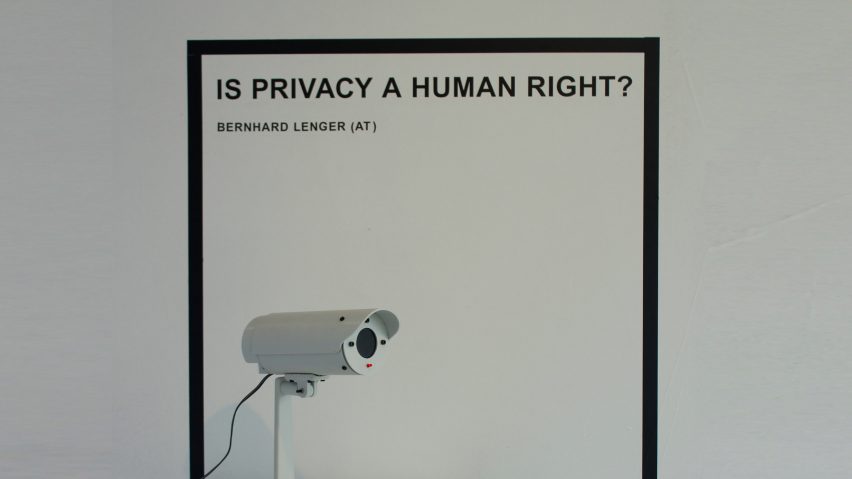
Lenger, pictured at Dezeen’s Good Design For A Bad World talk, believes designers can only make a difference if paired with other “changemakers”

Born in Austria but now based in Eindhoven, Lenger often takes a political stance through his work. We Are Human Rights is the first instalment in his We Are initiative, which he describes as a platform for tackling issues through “design thinking”. Designers can’t solve real-world problems on their own, according to designer Bernhard Lenger, whose latest project sees creatives team up with human-rights defenders to develop tools for change. See: https://humanrightsdefenders.blog/2018/11/09/designers-try-their-hands-at-human-rights-issues-in-seven-countries-sudan-nicaragua-colombia-russia-kenya-mexico-and-burundi/

Think of it as a kind of consultant agency, an organisation that people, governments or NGOs can turn to and get support,” Lenger explained. “By combining the experts in two fields, design and human rights, unique and relevant projects will be the outcome – as the context of the projects is set by the culture and human rights issue of the human rights defender.

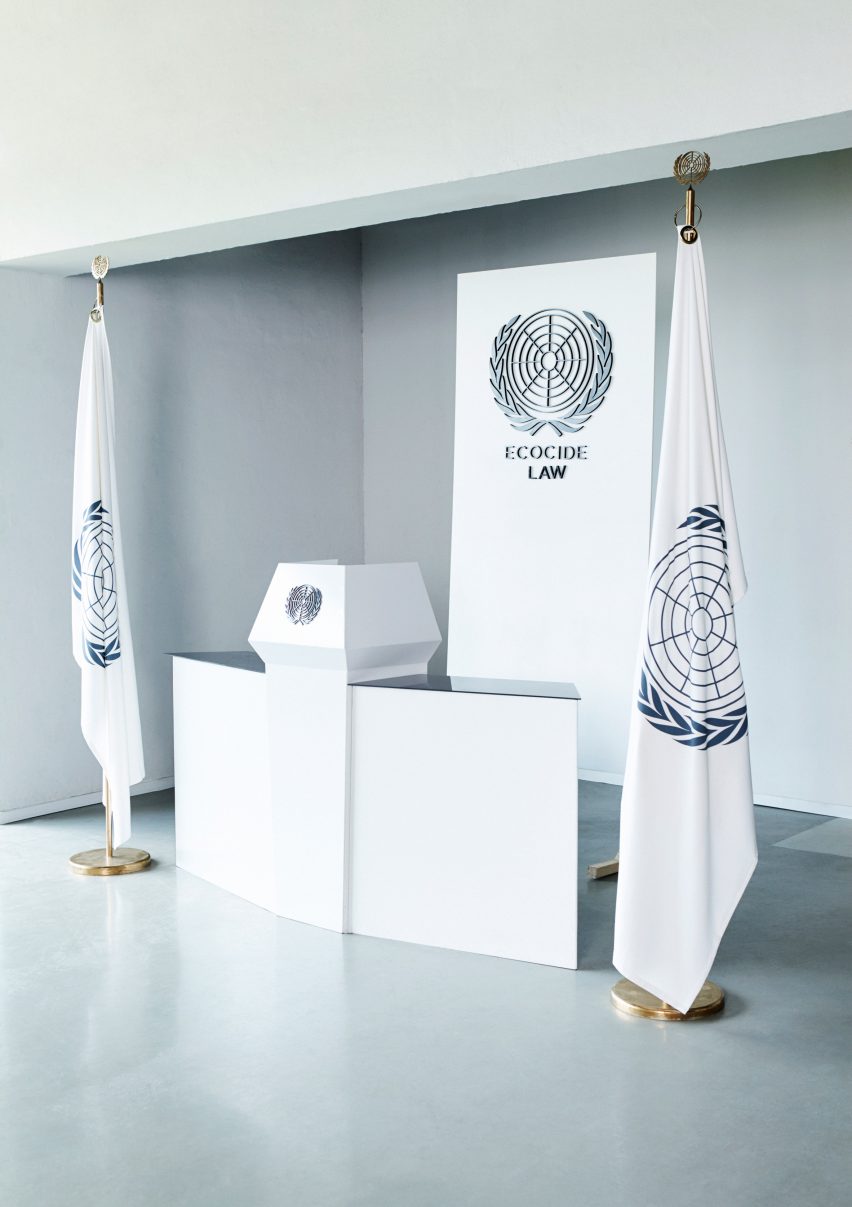
…Lenger was one of the speakers for Dezeen’s Good Design for A Bad World talks programme at Dutch Design Week 2017, where panellists – mainly designers – were invited to discuss how design could help tackle real-world issues. Speaking during a talk focused on pollution, Lenger presented another project he has been involved in, called This is Ecocide. Developed while he was studying at Design Academy Eindhoven, This is Ecocide saw Lenger partner with environmental lawyer Polly Higgins to develop a campaign to make ecocide – the destruction of the environment – illegal.

Lenger often takes a political stance with his work. His previous project, This is Ecocide, saw him try to criminalise the destruction of the environment

This project started with the discovery that ecocide was once recognised by the International Criminal Court as a crime, but was removed. With help from Higgins, he found that this was a result of lobbying from four countries: the USA, the UK, France and the Netherlands. “I was like, what should I do? I was 25 years old graduating from Design Academy, how could I work on a field of international law?” he told the audience.

Young designers are taking on more responsibility

According to Lenger, he isn’t unique in wanting to use to design to solve bigger problems. He said he had noticed a shift in the degree of responsibility felt by young designers. “Some people just want to make pretty things, some feel like there’s something missing if they just make pretty things,” he said.

https://www.dezeen.com/2018/01/26/bernhard-lenger-dutch-design-week-designers-not-heroes-interview/

Zimbabwean Human rights defender sets up torture fund

May 28, 2020

On 28 May 2020 Bulawayo News reported that Kwekwe-based human rights defender Nkosilathi Moyo said he was putting together a war chest to assist victims of State-sponsored violence.

Moyo launched his fight for democracy in 2015 when he travelled to the Netherlands and met European Union’s human rights ambassadors lobbying them to support human rights defenders in Zimbabwe. During the visit he also met Queen Maxima of the Netherlands and lobbied her to support efforts to improve democracy back home.

Speaking to Southern Eye on Monday, Moyo said the recent events that saw MDC Alliance’s Harare West MP Joanah Mamombe, youth leaders Cecilia Chimbiri and Netsai Marova, and Amalgamated Rural Teachers’ Union of Zimbabwe gender secretary Moreblessing Nyambara tortured at the hands of suspected State security agents, had motivated him to set up the fund.

Prior to the COVID-19 crisis, I established the community human rights defenders academy which trained more than 80 defenders in Midlands province, empowering them with skills to enhance human rights and democracy in Zimbabwe.”

Now in light of the upsurge in violations against activists with the height of that madness being abduction of an MP Joanah Mamombe and others, I have been jolted to act. So far I have written to foreign embassies in Harare, international donors and other development partners to solicit for a financial facility that would support victims of human rights violations. We have also started putting together resources with local partners for the same cause,” Moyo said.

In the past, Moyo through his organisation Zimbabwe Youths in Politics, raised awareness on good governance and tenets of democracy mostly among rural dwellers.

[see also: https://humanrightsdefenders.blog/2013/02/04/zimbabwe-death-threats-against-human-rights-defenders-nkosilathi-moyo-and-jasper-maposa/]

What we are realising is that autocratic regimes take advantage of poverty among political activists to suppress them and violate their rights at will. But with the kind of funding we are putting together, that will not be the case. Activists need to be supported to meet medical bills, legal representation costs, programming of their activities and compensation to their families in extreme cases. So that is the motivation of our current efforts. We should not wait for the worst to happen, then we start running around to look for resources. A ready fund must be there,” Moyo said.

https://bulawayo24.com/index-id-news-sc-national-byo-186130.html

IM: Adri Kemps: former director AI Netherlands and volunteer at Netherlands Helsinki Committee.

May 18, 2020
On 13 May 2020, Adri Kemps passed away at the age of 65. He was – from 1993 – 2001 – Director of Amnesty International Netherlands. Even after an infarct in 2015 he continued to be active in human rights work e.g. as an active volunteer at the Netherlands Helsinki Committee.  Adri was known for his cheerful character, optimistic outlook, but above all his passion, especially about human rights. He could be stubborn and persistent as well, but always engaging and a true gentleman. That combination brought him many successes, as the obituary written by his friend and long-time colleague Harry Hummel underlines.

Remembering the life of Adri Kemps (1955 – 2020)

…. Adri was part of a brilliant team, at the national office of Amnesty International. Human rights until that time were a concept only known to a group of foreign policy experts and to a minute fraction of the legal community. Amnesty in the Netherlands was hugely successful in popularizing the concept as a notion that stood above political struggle. Adri and his friends developed campaigns to mobilise public support to raise human rights issues in countries around the world. A new action method for Amnesty, that was viewed by many in the organization’s London headquarters as a suspect deviation. This group of volunteers was dominant in the Netherlands’ representation in Amnesty’s international decision-making bodies. By 1980, they formed the majority of the executive board of Amnesty Netherlands. A group of people aged 25 or younger leading an organization with a budget of millions and several dozen staff members, unthinkable in today’s professionalized civil society sector in the Netherlands.

At that time, Adri was part of the board for a couple of years. He was also engaged in setting up a number of other organizations working on international solidarity (as this was called). He soon left for Nicaragua, joining his partner Marijke (who he had met at Amnesty), and gradually carving out a role for himself in development work in that new location.

In the beginning of the 1990s, a much more mature man, he joined Amnesty Netherlands again as Executive Director. An exceedingly difficult job, he had to lead an organization that was professionalizing rapidly but still maintained some characteristics of the volunteer spirit. The period was a challenging time for human rights, and yet it was a high period for their national as well as international recognition. Adri skilfully utilized this for the benefit of the organization.

After yet another, shorter period living in Nicaragua, he returned to the Netherlands to head the Netherlands Fundraising Regulator (CBF). An entity that runs a certification scheme for fund-raising NGOs, independent from both government and civil society, yet a civil society body itself, and subject to diverse pressures and not easy to lead.

He started running into health problems, including a stroke now six years ago. During his recovery, he joined the Netherlands Helsinki Committee’s office, and stayed on to work on an increasingly broad range of assignments. His expertise and strategic and tactical insight helped the organization tremendously in its fund-raising efforts. He took on substantive activities as well – things important for the promotion and defence of a healthy society but that did not necessarily fall in the defined areas of work of the organization – a training on strategy development for fund-raising organizations in Ukraine, involvement in a study on political advertising on the internet.

He continued to be active in local social democracy in Haarlem, where he lived, and increasingly also in initiatives to recreate a sound environment and in addressing the climate crisis. The extreme political repression that has developed over the past years in Nicaragua, the country where he had lived for such a long time, affected him a lot. He spent time advising on initiatives to help local people and increase pressure on the government.

The maxim that to be a human rights activist, you must by definition be an optimist, definitely applied to Adri. His co-workers at the NHC remember him as a friendly, interested and cheerful colleague, bringing a lot of positivity and creativity to the workplace.

Adri (in the middle) at a meeting with Ukrainian civil society and government representatives, discuss effective government-civil society partnerships

https://www.nhc.nl/in-memoriam-nhc-expert-advisor-and-volunteer-adri-kemps/

Social assistance fraud detection system violates human rights says Dutch court

February 12, 2020

An algorithmic risk rating system implemented by the Dutch state to try to predict the likelihood that social security claimants commit benefits or tax fraud violates human rights laws, a court in the Netherlands ruled. The Dutch Risk Indication System (SyRI) legislation uses an undisclosed algorithmic risk model to profile citizens and has been directed exclusively to neighborhoods with mostly low-income and minority residents. Human rights defenders have called it a “welfare surveillance state.”

Several civil society organizations in the Netherlands and two citizens instigated legal action against SyRI, seeking to block its use. The court today ordered an immediate stop to use the system. The ruling is being hailed as historical by human rights defenders, and the court bases its reasoning on European human rights law, specifically the right to privacy established by article 8 of the European Convention on Human Rights ( ECHR) instead of a specific provision in the EU data protection framework (GDPR) that relates to automated processing.

Article 22 of the GDPR includes the right of individuals not to be subject to automated individual decision-making only where they can produce significant legal effects. But there may be some uncertainty about whether this applies if there is a human somewhere in the circle, such as reviewing an objection decision. In this case, the court has avoided such questions by finding that SyRI directly interferes with the rights established in the ECHR. Specifically, the court determined that the SyRI legislation does not pass an equilibrium test in Article 8 of the ECHR that requires that any social interest be considered against the violation of people’s private life, and a fair and reasonable balance is required.

In its current form, the automated risk assessment system did not pass this test, in the opinion of the court. Legal experts suggest that the decision sets some clear limits on how the public sector in the United Kingdom can make use of AI tools, and the court is particularly opposed to the lack of transparency on how the algorithmic rating system worked….

The UN special rapporteur on extreme poverty and human rights, Philip Alston, who intervened in the case by providing the court with a human rights analysis, welcomed the ruling, describing it as “a clear victory for all those who are justifiably concerned about the serious threats that digital welfare systems represent for human rights. ” “This decision sets a strong legal precedent for other courts to follow. This is one of the first times that a court stops the use of digital technologies and abundant digital information by welfare authorities for human rights reasons, ”he added in a press release.

In 2018, Alston warned that the UK government’s rush to apply digital technologies and data tools to socially redesign the provision of large-scale public services risked having a huge impact on the human rights of the most vulnerable. Therefore, the decision of the Dutch court could have some short-term implications for UK policy in this area.

The ruling does not close the door to the use by states of automated profiling systems, but it does make it clear that in Europe human rights laws must be fundamental for the design and implementation of risk tools.

..It remains to be seen whether the Commission will push pan-European limits to specific uses of AI in the public sector, such as for social security assessments. A recent leaked draft of a white paper on AI regulation suggests that it is leaning towards risk assessments and a mosaic of risk-based rules.

https://newsdio.com/blackboxs-social-assistance-fraud-detection-system-violates-dutch-human-rights-and-judicial-rules-newsdio/44625/