Posts Tagged ‘Martin Ennals Award for Human Rights Defenders’

MI5 spying on Martin Ennals: what’s new?

August 21, 2015

On Friday, 21 August, the Guardian reported on MI5 spying on Dorris Lessing but also on Martin Ennals. [“The files released on Friday reveal that MI5 also kept a close watch on prominent figures of the left who were never members of the Communist party. They include the brothers David and Martin Ennals..the latter became general secretary of the National Council of Civil Liberties, a founder member of the Anti-Apartheid Movement and secretary general of Amnesty International…. [Shortly after the end of the second world war] MI5 replied that its files on the Ennals brothers had been “in great demand recently”. MI5 was concerned that UN groups, in which it said both brothers were involved, might be infiltrated by the Communist party. MI5 noted that Martin was “well known to Special Branch for his activities in the Anti-Apartheid Movement”.

However, nine months ago (25/26 October, 2014) the Daily Mail had already referred to this issue under the title: “Revealed: How Special Branch spied on leading anti-apartheid activist“.

The Government is facing calls to reveal the truth about a spying operation on one of Britain’s most respected human rights activists. Previously secret documents show the late Martin Ennals was put under years of surveillance by Special Branch. He was a key figure at Amnesty International and the National Council for Civil Liberties – now known as Liberty – and a leading campaigner against apartheid. Details of his marriage, family and holiday destinations were recorded. His luggage was also regularly searched as he made trips to and from Britain. But the files, released by the Metropolitan Police under the Freedom of Information Act, have been heavily redacted.

His son Marc, who is mentioned in the files, added: ‘If they were doing this to him, they must have been doing this to millions of others who were essentially much more of a threat. He was just fighting for human rights.’” Marc Ennals said it was ‘frustrating’ that so much material from the files had been redacted and the freedom of expression group Article 19, which Martin Ennals helped found in the 1980s, called on the Government to ‘come clean’.

Whether that is now the case I cannot judge, but as founder of the Martin Ennals Award for Human Rights and a close personal friend of Martin Ennals, I can hardly be surprised by the ‘revelations’. Martin told me from the first day we met that I would alway have to assume that conversations and documents would be overheard or read. That he was accused of communist sympathies was also not a secret as he had taken a very public anti-McArthy stand in UNESCO as explained in the biography I wrote for the Encyclopedia of Human Rights, OUP, 2009, Vol 2, pp 135-138 (ed. David P. Forsythe). Perhaps the most ‘shocking’ is the normalcy of the assumption that anti-apartheid activities are (were) a valid source of concern!

http://www.martinennalsaward.org/index.php?option=com_content&view=article&id=98&Itemid=74&lang=en

http://www.dailymail.co.uk/news/article-2807885/How-Special-Branch-spied-leading-anti-apartheid-activist.html

MI5 spied on Doris Lessing for 20 years, declassified documents reveal | Books | The Guardian.

London discussion on business and human rights defenders on 14 July

June 28, 2015

The International Service for Human Rights [ISHR] and the Business & Human Rights Resource Centre [BHRRC] organize a well-stocked panel on “Business and the protection of human rights defenders” on 14 July 2015 (12h30-14h30) in London: DLA Piper, 3 Noble Street, London. RSVP by Friday 10 July. The discussion.. Read the rest of this entry »

Martin Ennals 2015 ceremony will be held on 6 October in Geneva

June 22, 2015
MEA 2015 nominees: Robert Aung, Ahmed Mansoor, Asmaou Diallo

MEA 2015 nominees: Robert Aung, Ahmed Mansoor, Asmaou Diallo

A very early “save the date’ announcement: those who need to travel from far away may want to note that the 2015 Martin Ennals Award Ceremony will take place on 6 October, at 18h30 at Uni-Dufour, Geneva. It is the event that opens Human Rights Week hosted by the University of Geneva from 6 – 9 October.


The laureate will be selected from among the three 2015 finalists, shown in the picture above: Read the rest of this entry »

BREAKING NEWS: FINAL NOMINEES MARTIN ENNALS AWARD 2015 JUST ANNOUNCED

April 22, 2015


new MEA_logo with text

Being the award of the global human rights community (for Jury see below) today’s announcement (22 April 2015) deserves special attention:

The Final Nominees of Martin Ennals Award for Human Rights Defenders 2015 are:

Robert Sann Aung (Myanmar)

Since his first year of University in 1974, Robert Sann Aung has courageously fought against human rights abuses. He has been repeatedly imprisoned in harsh conditions, physically attacked as well as regularly threatened. His education was interrupted numerous times and he was disbarred from 1993 – 2012. In 2012 he managed to regain his license to practice law. Since then he has represented jailed child soldiers, those protesting at a contested copper mine, peaceful political protesters, those whose land has been confiscated by the military, as well as student activists. Throughout his career he has provided legal services, or just advice, often pro bono, to those whose rights have been affected.

Upon receiving the news of his selection, he stated, “I feel humble and extremely honored to be nominated for this prestigious award. This nomination conveys the message to activists, human rights defenders and promoters who fight for equality, justice and democracy in Myanmar that their efforts are not forgotten by the world. And this is also the nomination for the people in Myanmar who stand together with me, who struggle with me, for the betterment of citizens so that they can live in dignity, under the just law, in conformity with the principles of UN human rights declaration.”

Asmaou Diallo (Guinea)

Her human rights work started following the events of 28 September 2009 when the Guinean military attacked peaceful demonstrators. Over 150 were killed, including her son, and over 100 women raped. Hundreds more were injured. She and l’Association des Parents et Amis des Victimes du 28 septembre 2009 (APIVA), which she founded, work to obtain justice for these crimes and to provide medical and vocational support to victims of sexual assault, many of whom cannot return to their homes. She has worked to encourage witnesses to come forward and supported them as they provided information and testimony to court proceedings. As a result, eleven people have been charged, including senior army officers.

Upon receiving the news of her selection, she stated, “As a human rights defender in Guinea, I am very comforted to be among the nominees for the Martin Ennals Foundation, this prize encourages me to continue my fight for the protection and promotion of human rights in Guinea. I trust that this award will have a positive effect on the legal cases concerning the events of the September 28, 2009, and will be a lever for all defenders of human rights in Guinea

 Ahmed Mansoor (United Arab Emirates)

Since 2006, he has focussed on initiatives concerning freedom of expression, civil and political rights. He successfully campaigned in 2006-2007 to support two people jailed for critical social comments. They were released and the charges dropped. Shortly after, the Prime Minister of UAE issued an order not to jail journalists in relation to their work. He is one of the few voices within the United Arab Emirates who provides a credible independent assessment of human rights developments. He regularly raises concerns on arbitrary detention, torture, international standards for fair trials, non-independence of the judiciary, and domestic laws that violate international law. He was jailed in 2011 and since then has been denied a passport and banned from travelling.

Upon receiving the news of his selection, he stated, “I’m very pleased to be nominated for the Martin Ennals award. This recognition indicates that we are not left alone in this part of the world and that our voices resonate and our efforts are appreciated by a well-informed people. I hope this nomination sheds further light on the human rights issues in the UAE. It is not just full of skyscrapers, big malls and an area attractive to businesses, but there are other struggles of different sorts beneath all of that.”

The Martin Ennals Award for Human Rights Defenders (MEA) is a unique collaboration among ten of the world’s leading human rights organizations to give protection to human rights defenders worldwide. The Jury is composed of:

  • Amnesty International,
  • Human Rights Watch,
  • Human Rights First,
  • Int’l Federation for Human Rights,
  • World Organisation Against Torture,
  • Front Line Defenders
  • International Commission of Jurists,
  • EWDE Germany,
  • International Service for Human Rights
  • HURIDOCS

An electronic version with Bios, Photos, and Video can be found at: http://bit.ly/1DYqlFn

For last year’s nominees see: https://thoolen.wordpress.com/2014/06/22/announcement-ceremony-of-the-martin-ennals-award-2014-on-7-october/

For further information: Michael Khambatta +41 79 474 8208, khambatta@martinennalsaward.org or visit http://www.martinennalsaward.org

Cambodian MEA Laureate 2012 Luon Sovath charged with incitement

November 5, 2014
 
cambodia-luon-sovath-award-oct-2012.jpg

(Luon Sovath after receiving the Martin Ennals Award for Human Rights Defenders in Geneva on 2 October 2012; left myself.  AFP)
 On 4 November Radio Free Asia (RFA) reports that two outspoken critics of Cambodia’s Prime Minister Hun Sen are called to court this month on vague charges of “incitement to commit a crime,” but the defendants say they have done nothing illegal. It concerns the human rights defender and monk Luon Sovath (MEA Laureate 2012) and dissident Sourn Serey Ratha (based in the USA). They received summons dated 22 October (!) signed by Phnom Penh Municipal Court deputy prosecutor Meas Chanpeseth accusing then of “incitement to commit crimes in Phnom Penh, Cambodia and abroad” in 2011, under Penal Code article 495, but the summonses, which ordered the two men to appear in court together in the capital on 25 November, do not specify what crimes they had incited or how their cases were linked.

[Under the Penal Code, incitement is vaguely defined in article 495 as directly provoking the commission of a crime or an act that creates “serious turmoil in society” through public speech, writings or drawings, or audio-visual telecommunication. Luon Sovath faces up to five years in prison if convicted, while Sourn Serey Ratha faces a total maximum punishment of 15 years.]

Read the rest of this entry »

Martin Ennals Award for Human Rights Defenders 2015: nominations until 9 December

October 16, 2014
Martin Ennals Award for Human Rights Defenders

Martin Ennals Award for Human Rights Defenders

The Martin Ennals Foundation is accepting nominations for the 2015 Martin Ennals Award for Human Rights Defenders.The goal of the program is to extend recognition and protective publicity to those who are currently involved in frontline work involving the promotion and protection of human rights. Recent recipients include individuals and organizations from Bangladesh, China, Chechnya, Cambodia, Uganda, Syria, Iran, Uzbekistan, Burundi, Sri Lanka, and Zimbabwe. The award is granted annually to an individual or, in exceptional cases, an organization in recognition of their commitment and ongoing efforts in the defense and promotion of human rights. Nominees must currently be involved in work for the promotion and protection of human rights. Priority is given to those who are at risk and have demonstrated an active record of combating human rights violations by courageous and innovative means. The program aims to encourage and promote the work of individuals or organizations, particularly if they are working in conditions hostile to fundamental human rights and are in need of protection.No posthumous awards are given except when a candidate has already passed the first round [as happened this year with Cao Shunli]. The candidate should not use or advocate violence. Anybody can nominate an individual or organization. Neither individuals nor organizations may nominate themselves. The present value of the annual award is 20,000 Swiss francs, which should be used for further work in the field of human rights. All 3 Final Nominees will be invited to the award ceremony which is hosted by the City of Geneva in late 2015.

The deadline is 9 December 2014

Program guidelines in English, French, and Spanish, FAQ, online nomination form, and information about previous recipients are available at the website: www.martinennalsaward.org

via Martin Ennals Foundation Invites Nominations for Human Rights Defenders Award | RFPs | PND.

Don’t miss the High Commissioner’s words at MEA 2014 ceremony

October 10, 2014

The ceremony of the Martin Ennals Award 2014 is over (7 October 2014). It was again very impressive to hear and see 3 courageous Human Rights Defenders being honored. Some 450 people (my estimate) gave standing ovations to the 3 nominees whose work was shown in impressive films produced for the occasion. The film portraits are already available on the website: http://www.martinennalsaward.org where there is also a short summary of the whole evening.

Martin Ennals Award for Human Rights Defenders

Martin Ennals Award for Human Rights Defenders

Especially the film on Chinese HRD Cao Shunli is a masterpiece given that the film makers had almost no images to work with due to the modesty of the human rights defender as well as her untimely death in detention only 2 days after her nomination in March 2014.

The internet has buzzed with congratulations and encouragements to the other two nominees, Adilur from Bangladesh and Alejandra Ancheita from Mexico. The latter became ultimately the Laureate [see https://thoolen.wordpress.com/2014/10/07/breaking-news-alejandra-ancheita-is-the-2014-mea-laureate/#more-5648 ].

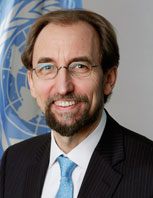
One of the nicest surprises was the address by Zeid Ra’ad Al Hussein, the United Nations High Commissioner for Human Rights at one of his first public appearances outside the UN. UN HCHR Al Hussein The High Commissioner gave a moving and almost poetic description of the sorry state of affairs left to human rights defenders to correct: He said inter alia: Read the rest of this entry »

ALERT: MEA Laureate 2007 Pierre Claver Mbonimpa arrested in Burundi

May 16, 2014


MEA Laureate 2007 Pierre-Claver Mbonimpa

MEA Laureate 2007 Pierre-Claver Mbonimpa

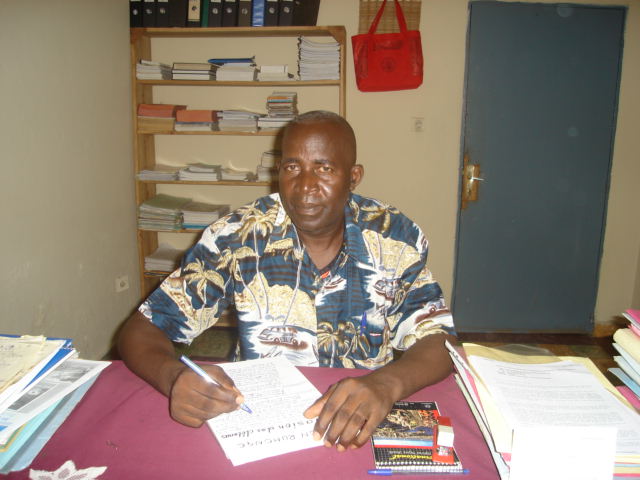
MEA Laureate 2007, Pierre-Clavier Mbonimpa, was arrested this morning early. The latest information is that he is still detained  at the Police-Judiciare. The background is rising tension in Burundi, where it is feared that President Pierre Nkurunziza is expected to campaign for a third term in office in 2015 despite a two-term constitutional limit. The Economist of 29 March 2014 already carried an article under the prescient title “Trouble Ahead” and on 17 April Paul Debbie, security chief at the UN office in Burundi, was ordered to leave the country in connection with a UN report disliked by the Government containing “allegations of weapons distribution to members of the youth league of the ruling party”. [http://www.aljazeera.com/news/africa/2014/04/burundi-expels-un-official-over-arms-report-2014417144546195161.html] It is feared that this youth wing, named the Imbonerakure, are being armed and trained in weapons use, raising fears of a return to civil war, even of genocide. No charges have been brought against Mbonimpa, but it is believed that the arrest is related to comments made on the radio regarding the above. Read the rest of this entry »

Breaking news: the 2014 MEA Final Nominees are…

April 23, 2014

It was just announced that the following three Human Right Defenders have been selected as the Final Nominees for the Martin Ennals Award 2014: Read the rest of this entry »

Ganji: Human rights in Iran improved, but still short of expectations

March 26, 2014


Remise du Prix Martin Ennals 2006

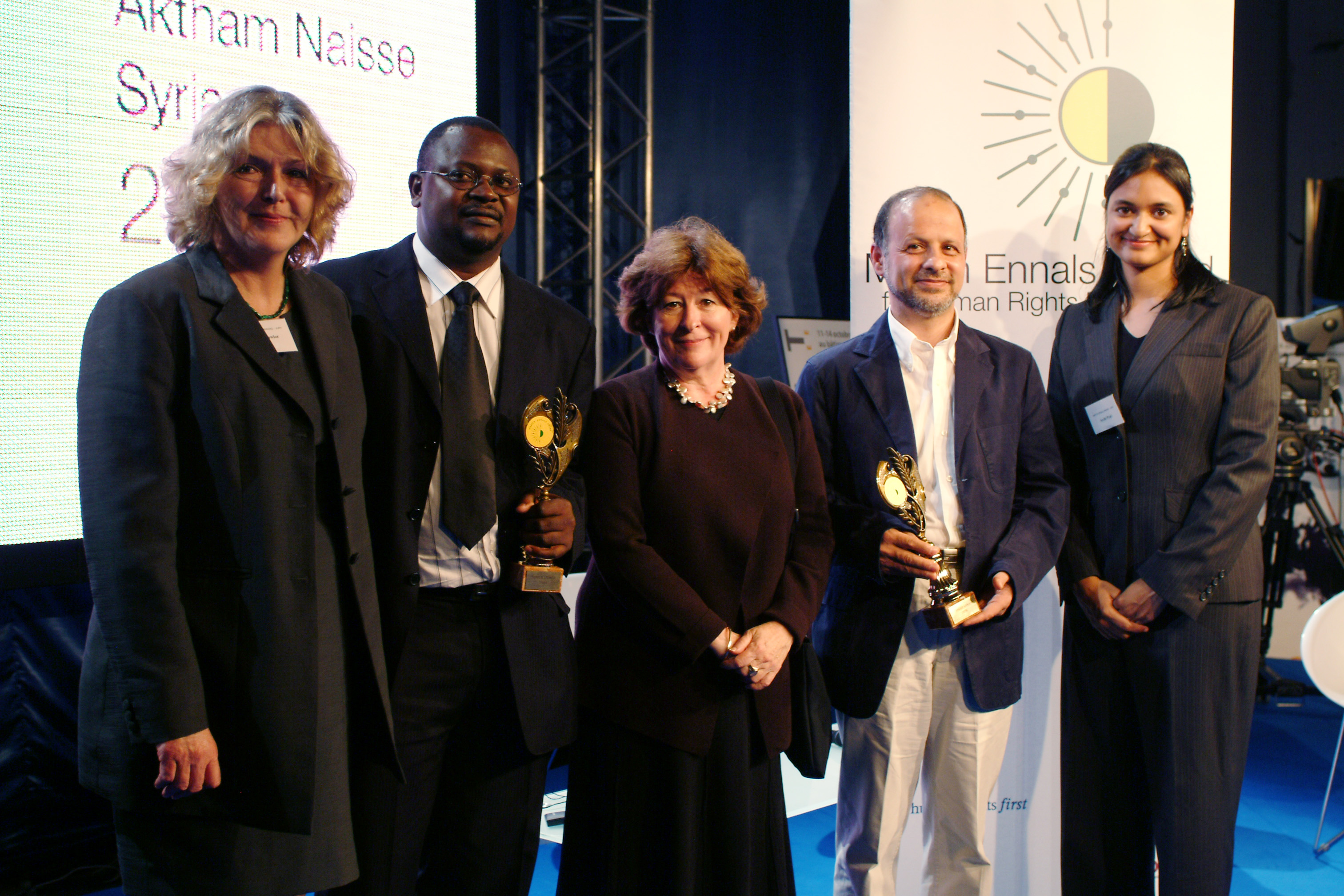
(Ganji – second from the right – at the MEA ceremony of 2006, where he received the award from UN High Commissioner Louise Arbour)

Al-Monitor of 25 March carries a lengthy interview with MEA Laureate Akbar Ganji in which Jahandad Memarian records many interesting insights, especially on the issue of sanctions and support to human rights defenders. The whole interview is certainly worth reading; here follow some long excerpts:

It is not an exaggeration to say that Akbar Ganji is the most celebrated dissident within the ranks of Iranian journalists since the inception of the Islamic Republic of Iran in 1979. A former supporter of the revolution, Ganji became disenchanted and turned into one of its most vocal critics. He is best known for his work as a journalist covering the 1998 murders of Iranian dissidents in Reformist newspapers, a series which came to be known as “the chain murders” that implicated top governmental officials. For his work revealing the murders of dissidents and attending a conference in Berlin that was condemned by hard-liners who were reeling after a Reformist victory in parliament, Ganji was arrested and served time in Tehran’s Evin Prison from 2001 to 2006. During his final year in prison, he went on a hunger strike that doctors urged him to end for concerns he would suffer permanent brain damage.

Ganji has won several international awards, including the World Association of Newspapers’ Golden Pen of Freedom Award, the Canadian Journalists for Free Expression’s International Press Freedom Award, the Martin Ennals Award for Human Rights Defenders and the Cato Institute Milton Friedman Prize for Advancing Liberty. In an exclusive interview via email with Al-Monitor, Ganji, based in New York, shared his thoughts about human rights and democracy in the context of President Hassan Rouhani’s administration.

Al-Monitor:  The UN secretary-general, Ban Ki-moon, has sharply criticized the Iranian president, Hassan Rouhani, saying, “He has not made any significant improvement” in ending human rights abuses since taking office. Nevertheless, Mahmoud Sadri — Iranian professor of sociology at the Federation of North Texas Area Universities — is optimistic about the new administration and has asked Iranian dissidents and intellectuals to take advantage of this historic opportunity. How do you evaluate the Rouhani administration?

Ganji:  The situation has improved from various aspects compared with the [Mahmoud] Ahmadinejad administration. However, it falls short of the expectations of democracy advocates and human rights activists. The Rouhani administration truly seeks to improve the state of human rights, but it has faced obstacles in Iran’s power hierarchy, including organizations that [Supreme Leader] Ayatollah [Ali] Khamenei oversees, such as the judiciary, law enforcement, etc., in addition to the Majles [parliament] that is controlled by the conservatives and some radical reactionaries.

…….Since his administration came to power, Rouhani has spoken with the supreme leader about freeing the Green Movement’s leaders (former Prime Minister Mir-Hossein Mousavi and former Majles speaker Mehdi Karoubi) and political prisoners, guaranteeing that nothing would happen, if they were freed.

Al-Monitor:  In January, you wrote a Huffington Post article titled “The Iran Nuclear Accord Is Good for Human Rights.” It seems to me whenever international pressure on the Iranian government increased, Iran improved its record. For example, Tehran released political prisoners ahead of Hassan Rouhani’s UN speech, including prominent human rights lawyer Nasrin Sotoudeh. Don’t you think such actions stem from international pressure? In the absence of this leverage — i.e., international pressure — Iran would continue human rights violations.

Ganji:  With regard to “external pressure on an undemocratic regime and improvement of human rights or increased oppression,” there is no law/rule that would address the cause-reaction relationships. At most, one can speak of “correlation.”[…] we need to know the following:

First, economic sanctions represent the collective punishment of a country’s people and do not necessarily lead to dictatorships’ downfall.

Second, long-term sanctions destroy the internal infrastructure of societies. ..Consequently, trust that is the basis of social capital is destroyed. Because of the sanctions, the oppressive regime’s increasing level of oppression, the internal destruction of society, is not visible. It is only in the aftermath of the dictatorship’s downfall that we will witness the visible spread of a wave of hatred, revenge and violence.

Third, in a life and death situation, the state of human rights, democracy and freedom completely falls by the wayside.

Fourth, consider Iraq’s example again. Before, the invasion al-Qaeda forces did not exist in Iraq, but they were born and bred as a result of the US sanctions and the US attack on Iraq. This story has been repeated in Libya and Syria. …..Iranian, US and European officials have professed that economic sanctions against Iran have affected Iran’s economy negatively. Last year, the economic growth rate fell to -5.8%. The inflation rate rose to 40%. The corruption rate climbed, and other negative outcomes followed. We should ask ourselves, what is the impact of recession on ordinary people’s lives?

The middle class, as a vehicle of democracy, has been transformed to the impoverished class, and its democratic movement may lose its agents. Democracy is the product of the balance of power between the government and civil society.

The transformation of the nuclear agreement from temporary to permanent, improvement of Iran’s relationship with Western governments, rekindling of ties between Iran and the United States, lifting of all the economic sanctions and alleviation of foreign threats can help empower the people through their mobilization and expansion of civil society. In that sense, the regime’s focus and its supporters will not be on discovering conspiracies of foreign governments and military attacks to destroy the regime. Let’s not forget that democracy and human rights have a direct relationship with economic development.

Al-Monitor:  You have opposed US aid to Iranian dissidents and human rights activists. What are your key criticisms against such aid? What actions should foreign countries.. take or avoid ?

Ganji:  The opposition that I have spoken about consists of groups and people that advocate regime change in Iran, so they can come to power. It is not possible for the leaders of a country to be indebted to other foreign governments, including the United States, Israel, Saudi Arabia, Russia and China. In that case, they will become the greater powers’ pawns. Look at the groups that have received financial aid from foreign governments in the past 35 years. What have they done? Do their terrorist and espionage activities constitute human rights activism, or are such activities considered criminal in all countries, including the United States and Israel, and are they strongly punished?

However, I support educational financial aid, including student scholarships and research fellowships for scholars. Just think about what would have happened if the $1.5 trillion that was spent on the wars in Afghanistan and Iraq would have been used toward education and development of the Middle East, and how that would have changed the region. Why do Western governments, the United States included, not grant scholarships to tens of thousands of talented and smart Iranian youth as students in social sciences?

Western governments should protest all human rights violations; they should give ethical and spiritual support to pro-democracy and human rights activists; they should file complaints at the UN Human Rights Council and ease the process of bringing perpetrators to justice. Moreover, Western powers should stop selling weapons of torture and oppression to dictatorial regimes. Ultimately, they should allocate financial resources to form independent labor unions and improve the state of human rights.

Ganji: Human rights improved, still short of expectations in Iran – Al-Monitor: the Pulse of the Middle East.

Read more:

https://thoolen.wordpress.com/tag/iran/

http://www.al-monitor.com/pulse/originals/2014/03/rouhani-reform-nuclear-iran-politics-student-human-rights.html#ixzz2x3K4G8RK