A report on how Ugandan LGBT rights defenders celebrated Kuchu Memorial Day was posted by Kikonyogo Kivumbi on 28 in ‘Erasing 76 Crimes’. Human rights defenders in Uganda have earmarked January 26 as Kuchu Memorial Day to remember and celebrate the life of David Kato and other LGBT human rights defenders killed because of their activism and sexuality.
Pastor Simon Anthony addresses the Kuchu Memorial Day service in Kampala. Kasha Nabagesera stands beside him. (UhspaUganda photo)
At a memorial church service on Sunday, 26 January in Kampala, human rights defenders paid tribute to David Kato (murdered that day in 2011, at his home).
The remembrance service was led by Pastor Simon Anthony, a senior pastor from The Fellowship of Affirming Ministries (TFAM) Uganda. The fellowship embraces all people with love, irrespective of their sexuality or any other considerations.
Rolando Jiménez Perez,Chilean human rights defender, is given the floor in the newsletter of the International Service for Human Rights [ISHR] of February 2014. Here are some of the most quotable statements but the whole interview with Camille Marquis is worth reading:
‘I wanted to fight for human rights in order to help lesbians, gays, bisexuals and transsexuals and to put an end to any brutality for reasons of sexual orientation and gender identity. During the dictatorship of Augusto Pinochet, Rolando Jiménez Pérez was a member of the Communist Party driven, along with his fellow party workers, by the goal of restoring democracy. His sexuality was used by the party as a means to belittle him. This brought home to Rolando just how strong a role a person’s sexual orientation could play and he made up his mind that once the dictatorship was over he would turn his attention entirely to human rights and in particular towards lesbian, gay, bisexual and transgender (LGBT) people.
On 16 February 2014 Faith Karimi and Neda Farshbaf wrote for CNN how pop star Rihanna is adding major star power to the campaign for gay rights in Russia. The singer behind hits such as “Disturbia” and “SOS” tweeted a photo of herself wearing a hat emblazoned with P6, short for Principle 6. This campaign speaks out against Russia’s anti-gay propaganda law as the nation hosts the Winter Olympics. And Rihanna has 34 million followers on Twitter! The photo links to her Instagram account, which has about 12 million followers. In subsequent tweets, she posted links to other articles highlighting the issue.
The BBC has produced a map which shows the broad legal status of gay people living in UN member states, according to data provided by the UN’s human right’s office, who built on information from the International Lesbian Gay Bisexual Trans and Intersex Association.
The legal status of people in same-sex relationships depends very much on where they live. At one end of the spectrum there are those countries that punish homosexuality with the death penalty – Iran, Mauritania, Saudi Arabia, Sudan and Yemen – as well as in parts of Nigeria and Somalia. At the other end, there are those countries where gay couples have the same marriage rights as heterosexual couples. However, the categorisation of countries according to their approach to gay rights is not without problems. Some states have conflicting laws on same-sex relationships, simultaneously having laws that punish and protect, while other countries have different laws in different regions. This is reflected in the key. Countries have been categorised by their most progressive or regressive laws, apart from where laws are contradictory. Countries where gay rights vary between states have been coloured by their most progressive or regressive law. [The map does not reflect day-to-day experiences of lesbian, gay, bisexual and trans and intersex people. In many places where anti-discrimination laws exist, gay people continue to be persecuted by state authorities and wider society.]
There is also an interesting timeline, pulled together by the UN, which uses 1789 – the date of the French Revolution – as its starting point. It was chosen by the UN as a baseline, as it was a time when homosexuality was criminalised in many countries.
launched two innovative legal databases: the Sexual Orientation & Gender Identity (SOGI) UN Database and the SOGI Legislative Database. Read the rest of this entry »
The Council of the European Union [the EU’s 27 foreign affairs ministers], which previously adopted a non-binding toolkit to promote LGBT human rights, has upgraded its guidelines in order “to promote and protect the enjoyment of all human rights by lesbian, gay, bisexual, transgender and intersex (LGBTI) persons.” The new document is binding and represents a step forward in international human rights law. The LGBTI Guidelines instruct EU diplomats around the globe to defend the human rights of LGBTI people. .
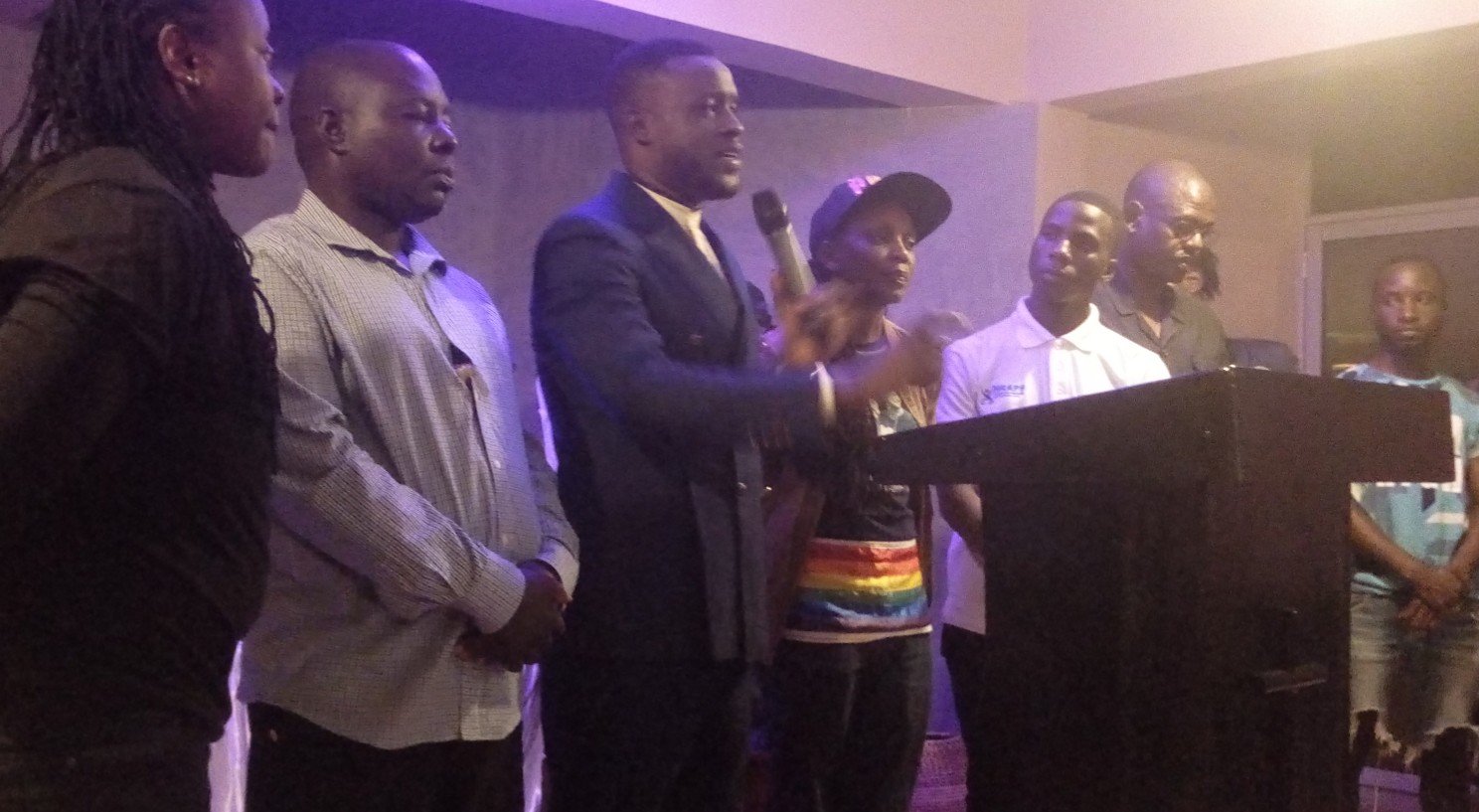 Pastor Simon Anthony addresses the Kuchu Memorial Day service in Kampala. Kasha Nabagesera stands beside him. (UhspaUganda photo)
 Hans Thoolen on Human Rights Defenders and their awards