Posts Tagged ‘Latin America’
January 9, 2019
 In 2018, 321 defenders in 27 countries were targeted and killed for their work – the highest number ever on record – according to data collected by Front Line Defenders. More than three-quarters of these, 77% of the total number of activists killed, were defending land, environmental or indigenous peoples’ rights, often in the context of extractive industries and state-aligned mega-projects. [see also: https://humanrightsdefenders.blog/2018/04/28/annual-reports-2017-by-front-line-defenders/]
Front Line Defenders reports that the murders of HRDs were not isolated events, but were preceded by judicial harassment, threats and physical attacks. At least 49% of those killed had previously received a specific death threat, and in an additional 43% of killings there had been general threats made to HRDs in the area. In the vast majority of cases, HRDs did not receive the necessary protection and support from state authorities from the time they reported threats to the time they were murdered.
According to the Front Line Defenders Global Analysis 2018, in addition to the threats experienced by male colleagues, WHRDs face gendered and sexualized attacks from both state and non-state actors, as well as from within their own human rights movements. Such violations include removal from public or high-ranking positions in NGOs, trade unions, and political societies; smear campaigns questioning their commitment to their families; sexual assault and rape; militarized violence; and the harassment and targeting of their children. In Saudi Arabia, authorities arrested, sexually assaulted, and tortured WHRDs who led the successful campaign for the abolition of the driving ban in 2018. Despite these attacks and the ongoing threats to stay silent, WHRDs in Saudi Arabia, as well as their family members, have publicly reported and condemned the abuses and are receiving unprecedented national, regional, and international visibility for their activism.
In addition to physical attacks and torture, the Front Line Defenders Global Analysis 2018 highlights the continuing trend towards restrictive legislation aimed at stifling the powerful work of HRDs and WHRDs, including:
- A Digital Security Act in Bangladesh carrying a 14-year sentence for using digital media to “cause damage to the state”;
- Retrospective legislation in Xinjiang province, China, legalising the use of “re-education” camps for the minority Uyghur population, including HRDs;
- Anti-terror legislation in Nicaragua widening the definition of terrorism to include those accused of damaging property, leading to dozens of arrests of protesters now facing terrorism charges and 20 years in prison.
Front Line Defenders Digital Protection Team responded to a high number of reports from Brazil, Egypt, Guatemala, Honduras, Iraq, Mexico, Nicaragua and Venezuela in 2018. According to the Global Analysis, authorities around the world frequently used phone and email surveillance to target LGBTI+ defenders, WHRDs and environmental activists in particular. The report notes that in Tanzania, Pakistan, Russia, Malaysia, Nicaragua, Turkey, and many countries in MENA, governments claimed that HRDs were threatening “national security” as an excuse for censoring and blocking NGO websites.
Despite the severe and sometimes life-threatening risks faced by HRDs and WHRDs, Global Analysis 2018 highlights a number of major success achieved by HRDs and WHRDs in 2018, including:
- The critical and leading role played by HRDs in securing The Escazu Agreement, now signed by 24 states in Latin America and the Caribbean, which stipulates a participatory approach to environmental projects and the mitigation of conflicts;
- The monumental vote for reproductive rights in Ireland, secured through the extensive, decades-long campaigning of Irish WHRDs in the face of defamation, smear campaigns, and threats;
- The Coalition of Women Leaders for the Environment and Sustainable Development in the Democratic Republic of Congo (DRC), who successfully campaigned for a province-wide decree in Equateur protecting women’s land and forest rights.
In response to attacks against HRDs in 2018, Front Line Defenders is working with HRDs to promote their security with a range of protection programming. In addition to risk management and digital protection trainings, advocacy at the national, international, and EU level, emergency relocation, Front Line Defenders provided nearly 550 protection grants to activists at risk in 2018. Front Line Defenders also works with HRDs to devise visibility campaigns to counteract the defamation and smear campaigns that put them at risk.
https://www.frontlinedefenders.org/en/resource-publication/global-analysis-2018
Posted in books, Human Rights Defenders | 6 Comments »
Tags: annual report 2018, environmental activists, Front Line (NGO), Global Analysis 2018, Human Rights Defenders, killings, Latin America, threats
June 21, 2018
On Wednesday 20 June 2018, Dublin based international human rights organisation, Front Line Defenders along with the HRD Memorial Network, launched a major new report on the killing of human rights defenders (HRDs) at the UN Human Rights Council in Geneva. The report, Stop the Killings, analyses the root causes of killings of HRDs in 6 countries: Brazil, Colombia, Guatemala, Honduras, Mexico and the Philippines, which between them have accounted for 80% HRDs killed in the last three years. 
In its Annual Reports for the last 4 years, Front Line Defenders has reported the killing of 879 HRDs. These were not random killings but the targeted elimination of those working to improve their own communities. The use of lethal violence to silence those who defend the rights of the most vulnerable has become widespread, and is endemic in a number of countries. In its 2017 Annual Report, Front Line Defenders reported the killing of 312 HRDs in 27 countries; the true figure is certainly higher. Two-thirds of those killed were working on the environment, land rights and indigenous peoples’ rights, often in remote, rural areas.
Among the key drivers of killings and violence against HRDs detailed in the report are::
- state failure to recognise the legitimacy and importance of the work of HRDs;
- smear campaigns against HRDs by the state and/or its agents;
- economic policies which prioritise the ruthless exploitation of natural resources over the protection of the environment and the land;
- rights of peasant communities and indigenous peoples;
- lack of effective systems to document and investigate attacks on HRDs and provide protection;
- collusion by the state and/or its agents in the killing of HRDs.
The report was launched by United Nations Special Rapporteur on Extrajudicial, Summary or Arbitrary Executions, Agnes Callamard, at a special side event during Human Rights Council proceedings on Wednesday 20 June 2018.
The full text of the report can be downloaded from: https://share.riseup.net/#VWzkKTN4f-156VE4dc-r_Q
See also my: https://humanrightsdefenders.blog/2018/01/05/front-lines-2017-report-confirms-worst-expectation-over-300-hrds-killed/
https://humanrightsdefenders.blog/2017/07/15/documenting-the-killings-of-environmental-defenders-guardian-and-global-witness/
Posted in books, Human Rights Defenders | Leave a Comment »
Tags: Agnes Callamard, environmental activists, Front Line (NGO), HRD Memorial Network, Human Rights Defenders, Indigenous rights, killings, Latin America, Philippines, report, side event, STOP THE KILLINGS
April 28, 2018
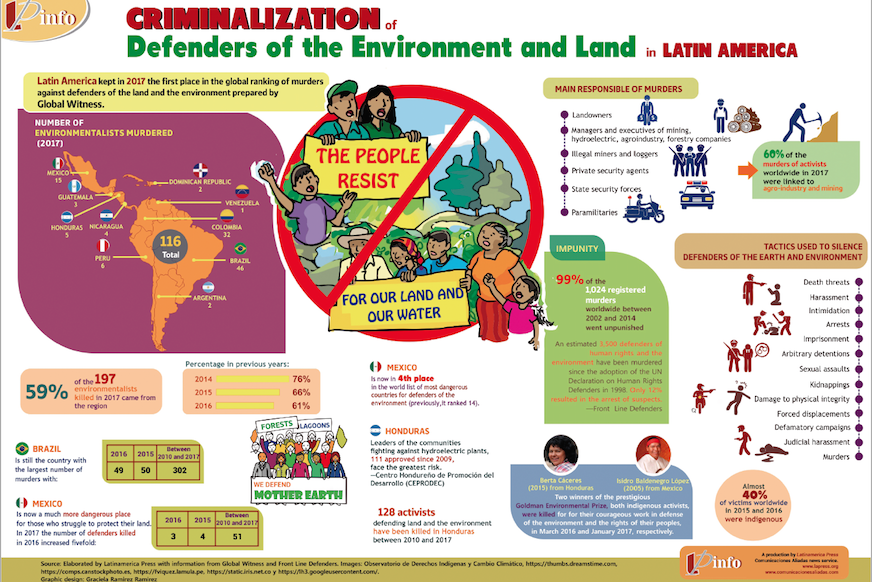
The report, A Recipe for Criminalization: Defenders of the Environment, Territory and Land in Peru and Paraguay, outlined the three “ingredients” both countries use to undermine the efforts of human rights defenders. First, they delegitimize activists through smear campaigns. Second, they apply laws and regulations that allow for forced evictions. And, third, they misuse the criminal justice system to prosecute activists for unfounded reasons.
“Those who bravely stand up to defend their land and the environment are frequently targeted because of their work. These attacks have a devastating impact on their physical, mental and emotional wellbeing, as well as that of their families and communities,” Amnesty International Americas director Erika Guevara-Rosas said in a press release.
The report included examples of how these ingredients combine on the ground. For example, Amnesty International highlighted the case of community activists working to protect their home in Peru’s Cajamarca region from the gold and copper Conga mining project. On 26 April 2013, police arrested 16 protesters on trumped up charges of abduction and coercion. The state prosecutor sought 30-year prison sentences. But the evidence presented was secondhand and so spotty and contradictory that a court dismissed the case in 2017.
In Paraguay, the Tekoha Sauce community of the Avá Guaraní People was evicted from their ancestral lands by a court order following a dispute with local businessman German Hultz. The community was forced onto a nature reserve where they struggle to survive because hunting and fishing is not allowed. During the court proceedings leading up to the eviction, their opponents stigmatized the indigenous community by referring to them as a “gang of criminals.”
On 24 April 2018, Front Line reported that on 19 April 2018, Olivia Arévalo Lomas, a woman human rights defender and spiritual leader of the Shipibo-Konibo indigenous peoples, was killed by unknown assailants just a few feet from her home in the community of ‘Victoria Gracia’, in Peru. The defender was shot in the chest and died instantly. Her body was left on the street in full view of her local community (https://www.frontlinedefenders.org/en/profile/olivia-arevalo). The killing of Olivia Arévalo Lomas comes after a spike in violence, threats and intimidation against members of FECONAU communities in Ucayalí, such as Santa Clara de Uchunya. In the past six months, several members of FECONAU have been subjects of attacks. A representative of FECONAU, Edinson Mahua, was shot at close range and narrowly escaped serious injury, while community leaders in Ucayalí have received anonymous death threats.
In the meantime Colombia has seen a spike in assassinations of human rights defenders in 2018, according to study by Colombian NGO Somos Defensores. A total of 46 human rights leaders have been killed so far this year, up from 26 in the same period last year; paramilitary groups were responsible for three of the killings, four were murdered by guerrilla groups and another four were killed at the hands of security forces. The investigative body also recognized a total of 132 acts of aggression against public defenders so far this year. Of the registered acts, there were 12 attacks, 66 death threats and one case of forced disappearance. The provinces in which the aggression occurred were predominately in areas at the heart of the country’s conflict, with Cauca, Antioquia and Norte de Santander figuring heavily in the statistics.
The UN has said it is “extremely concerned” about the increase in violence surrounding social leaders while Inspector General Fernando Carrillo has “urged” authorities to “assume their commitments to defend the lives of social leaders.” While the government has attempted to reel in the varying armed criminal groups responsible for a lot of these acts — as seen with the 2016 peace deal with the FARC guerrilla organisation, and ongoing peace negotiations with the ELN rebel group — it has clearly failed to provide basic security, and protect human rights defenders, rural community leaders and other social activists.
—-
https://www.ecowatch.com/environmental-activists-amnesty-international-2563882266.html
https://reliefweb.int/report/peru/recipe-criminalization-defenders-environment-territory-and-land-peru-and-paraguay
https://colombiareports.com/killing-of-human-rights-leaders-in-colombia-more-than-doubles-study/
https://www.business-humanrights.org/en/latin-america-infographic-summarises-criminalization-of-land-environmental-rights-defenders-in-the-region
Posted in AI, Front Line, human rights, Human Rights Defenders | 5 Comments »
Tags: AI, Colombia, criminalisation, environmental activists, forced evictions, Front Line (NGO), Human Rights Defenders, infographic, land rights defender, Latin America, Latin America Press, Olivia Arévalo Lomas, Paraguay, Peru, Somos Defensores
March 2, 2018
While all eyes are on the ongoing session of the UN Human Rights Council in Geneva, the Inter-American Commission on Human Rights (IACHR) – on 28 February – presented its report “Toward a Comprehensive Policy to Protect Human Rights Defenders,” in the context of the 167th session of the IACHR taking place in Colombia. The purpose of this report is to provide the States in the region with guidance in developing their domestic policies, programs, and protection mechanisms for human rights defenders, in keeping with inter-American human rights standards.
“The work of defending human rights in the countries of the Americas has become extremely dangerous,” said the President of the IACHR, Commissioner Margarette Macaulay. “The levels of violence against people who defend human rights in our region are alarming, and the rates of impunity for these types of crimes are very high. The focus of the IACHR’s concern is on the violent deaths of rights defenders, the impunity that tends to surround these types of crimes, and the remaining vulnerability of all persons and groups on whose behalf the defender had worked. This makes it essential and urgent for the States to adopt effective measures to put an end to this situation,” she added.
https://humanrightsdefenders.blog/2018/02/22/amnestys-annual-report-2017-is-out-depressing-but-rays-of-hope/
https://humanrightsdefenders.blog/2017/07/15/documenting-the-killings-of-environmental-defenders-guardian-and-global-witness/
…….
“We are aware of and welcome the efforts made by some States to implement different mechanisms, laws, and policies to protect rights defenders, but unfortunately these have not been effective enough,” said the IACHR Rapporteur on Human Rights Defenders, Commissioner Francisco Eguiguren. “That is why the IACHR in this report has laid out the main components of a comprehensive protection policy, so that such a policy can be effective and so that we can manage to stop the killings and other attacks that are putting an end to the lives of rights defenders or preventing them from doing their work. The aim of the IACHR is to provide the States with a guide on developing domestic policies, programs, mechanisms, and practices for the effective protection of human rights defenders, in accordance with Inter-American human rights standards,” he indicated.
A comprehensive protection policy is based on a recognition of the State’s interrelated and interdependent obligations to enable rights defenders to freely and safely carry out their work of defending human rights. In this sense, a comprehensive protection policy refers to a broad, all-encompassing approach that requires extending protection beyond physical protection mechanisms or systems when defenders experience situations of risk. It requires implementing public policies and measures designed to respect the rights of defenders; prevent violations of their rights; diligently investigate acts of violence against them; and punish the perpetrators and masterminds of any attack on human rights defenders.
The report also analyzes the main steps forward and challenges in terms of the efforts underway in some States, such as the national protection mechanisms, legislation, and policies and programs that exist in some countries. It also makes recommendations to the States on how to ensure better implementation of prevention, protection, and investigation measures to achieve a comprehensive protection policy.
..Human rights defenders are an essential pillar for the strengthening and consolidation of democracies in the hemisphere. Acts of violence against human rights defenders not only infringe on the defenders’ own rights as human beings but also undermine the critical role they play in society and in upholding democratic standards.
Contact info María Isabel Rivero
, IACHR Press and Communication Office
mrivero@oas.org
http://www.oas.org/en/iachr/media_center/PReleases/2018/039.asp
Posted in books, Human Rights Defenders | Leave a Comment »
Tags: Americas, enabling environment, environmental activists, Francisco Eguiguren, Human Rights Defenders, IACHR, Inter-American Commission on Human Rights, Latin America, Margarette Macaulay, national level, protection of HRDs, report
March 8, 2017
International Women’s Day focuses on many different aspects of the struggle for the human rights of women. I have selected three special actions this year:
(1) a short piece honoring woman who are land rights defenders;
(2) a digital protection tool for women human rights defenders (Cyberwomen);
(3) a documentary film on how rape was made into a international war crime.
[Of course this blog has had many earlier posts on women human rights defenders: https://humanrightsdefenders.blog/tag/women-human-rights-defenders/ ] Read the rest of this entry »
Posted in human rights, Human Rights Defenders | Leave a Comment »
Tags: Ana Mirian Romero, Common Dreams, digital security, FFIDH, Honduras, ICC, Institute for War and Peace Reporting (IWPR), international women's day, Josephine Pagalan, Latin America, Melania Chiponda, Philippines, rape, Rwanda, Standing Rock, The Uncondemned (film), USA, women human rights defenders, Zimbabwe
September 1, 2016
The chilling trend of attacking human rights defenders working on environment and land rights continues. The help keep an overview here a summary of a number of relevant items:
On 26 August 2016
Patricia Schaefer of the
Center for International Environmental Law posted a blog in the NonProfitQuarterly website under the Title “
International Collaboration Reports on Violence against Environmental Activists”, summarizing two recent reports (
On Dangerous Ground by
Global Witness and a more recent “
Deadly Shade of Green” by Center for International Environmental Law (CIEL), British NGO Article 19, and Vermont Law School).
Global Witness stated that worldwide, in 2015, there were 185 individuals killed in 16 countries while defending their land, forests, and rivers against industrial encroachment. At the top of the list were Brazil (50 killings), the Philippines (33), and Colombia (26). Global Witness recounts, “Conflicts over mining were the number one cause of killings in 2015, with agribusiness, hydroelectric dams and logging also key drivers of violence. In 2015, almost 40 percent of victims were from indigenous groups.” [Global Witness’ earlier report: https://thoolen.wordpress.com/2014/04/16/environment-deadly-for-human-rights-defenders-says-global-witness/].
Read the rest of this entry »
Posted in Front Line, HRW, human rights, Human Rights Defenders, UN | 4 Comments »
Tags: Berta Cáceres, Brazil, Center for International Environmental Law, Deadly Shade of Green, Ecuador, environmental activists, Front Line (NGO), Global Witness, Gloria Capitan, HRW, Human Rights Defenders, killings, land rights defender, Latin America, Nilce de Souza Magalhães, Patricia Schaefer, Philippines, resource extraction, World Bank
February 27, 2016
The criminalization of human rights defenders in the context of the extraction of natural resources and megaprojects is becoming a very worrisome phenomenon in Latin America, denounces the Observatory in a report published today in Mexico. Entitled “The criminalization of human rights defenders in the context of industrial projects: a regional phenomenon in Latin America”, this document points to the role of businesses, civil servants, public prosecutors, judges, and the State. The report issued by OMCT and FIDH (in the context of their Observatory for Human Rights Defenders) on 25 February 2016 describes the specific cases of human rights defenders criminalized in eight Latin American countries (Brazil, Colombia, Ecuador, Guatemala, Honduras, Mexico, Nicaragua and Peru).
The report especially stresses two core issues common to all the countries studied: Read the rest of this entry »
Posted in books, FIDH, human rights, Human Rights Defenders, Observatory for the Protection of Human Rights Defenders, OMCT | 4 Comments »
Tags: Brazil, Colombia, criminalisation, criminalization, Ecuador, environmental issues, FIDH, Honduras, Human Rights Defenders, independence of the judiciary, Latin America, Mexico, Nicaragua, Observatory for the Protection of Human Rights Defenders, OMCT, Peru, regional NGOs, resource extraction
January 16, 2016
Santiago Canton will be leaving his post as Executive Director of RFK Partners for Human Rights at the end of this week as he has accepted the position of Secretary for Human Rights for Buenos Aires in Argentina. He started in 2012.
[Santiago Canton is also an Adjunct Professor at American University’s Washington College of Law, the Georgetown University Law Center, and the Universidad de Buenos Aires. In 2013, Mr. Canton served as a member of the World Bank Panel of Experts on Human Rights, part of a process that reviewed the bank’s environmental and social safeguard policies. From 2001 to 2012, Mr. Canton was the Executive Secretary of the Inter-American Commission on Human Rights. In 1998, he was elected as the first Special Rapporteur for Freedom of Expression in the Inter-American System. From 1994 to 1998, Mr. Canton was Director for Latin America and the Caribbean for the National Democratic Institute for International Affairs. Mr. Canton was a political assistant to President Carter in democratic development programs in countries in Latin America. In 2005, Mr. Canton was awarded the Chapultepec Grand Prize for freedom of expression throughout the Americas.]
Posted in Human Rights Defenders | Leave a Comment »
Tags: argentina, Buenos Aires, career, freedom of expression, Human rights defender, Latin America, RFK, RFK Human Rights, Robert F. Kennedy Center for Justice and Human Rights, Santiago Canton
January 6, 2016
The latest statistical report released by Front Line Defenders revealed the appalling reality that human rights defenders all over the world are at great risk to be victims of extreme forms of violence. And based on the organization’s annual report, 157 human rights activists were killed or died in detention in 25 countries in 2015. Latin America, Philippines are named as most dangerous places for Human Rights Defenders. Read the rest of this entry »
Posted in Front Line, human rights, Human Rights Defenders | 6 Comments »
Tags: annual report 2015, asian region, enabling environment, environmental issues, EU, Human Rights Defenders, Ireland, killings, Latin America, Latin Post, LGBTI, Mary Lawlor, Philippines, resource extraction, restrictions, statistics
December 3, 2014
 Brussels-based Protection International‘s Focus Report provides detailed monitoring of developments in the field of national public policy on the protection of Human Rights Defenders. This year’s edition of Focus highlights the renewed interest in adopting legal instruments for the protection if HRDs in Latin America (in Honduras and Guatemala) and in Sub-Saharan Africa (in Côte d’Ivoire, Burundi and Mali).
The report (second year running) draws attention to the recent publication of guidelines on the protection of HRDs by OSCE’s Office for Democratic Institutions and Human Rights (ODIHR). The work of several Latin American civil society organisations (CSOs) that have presented cases concerning murdered HRDs before the regional mechanisms has been of great value. These efforts have led to the development of jurisprudence by the Inter-American Court of Human Rights.
Finally, this edition includes contributions by external collaborators:
- the Preface, prepared by Michel Forst, the UN Special Rapporteur on the Situation of Human Rights Defenders;
- an analysis of advances in the field of protection in the Americas, by Jesús Orozco H., President of the Inter-American Commission of Human Rights (IACHR) and Rapporteur on Human Rights Defenders;
- an overview of the topic in Africa by Reine Alapini Gansou, the Commissioner and Special Rapporteur on Human Rights Defenders of the African Commission for Human and Peoples’ Rights (ACHPR); and
- contributions by representatives of local CSOs in Mexico, Colombia and Brazil, countries that have pioneered the effective implementation of public policies for the protection of HRDs.
- PI hopes to enrich the discussions on the adoption of appropriate policies in countries where they do not exist and to help authorities and civil society organisations implement them where they do.
For last year’s report: https://thoolen.wordpress.com/2013/02/25/protection-international-publishes-focus-report-2013-on-policies-concerning-human-rights-defenders/
Focus 2014 Report: http://files.flipsnack.com/ /embed.html?hash=fd152nkz0&wmode=window&bgcolor=EEEEEE&t=14174580301417458119
Posted in books, human rights, Human Rights Defenders, Protection International | 2 Comments »
Tags: annual report 2014, civil society organisations, Focus 2014, Jesús Orozco, Latin America, Michel Forst, national mechanisms, ODHIR, Protection International, protection mechanisms, Rapporteur on Human Rights Defenders (ACHPR), Reine Alapini-Gansou, Special Rapporteur on Human Rights Defenders (ACHPR), UN Rapporteur on Human Rights Defenders
 In 2018, 321 defenders in 27 countries were targeted and killed for their work – the highest number ever on record – according to data collected by Front Line Defenders. More than three-quarters of these, 77% of the total number of activists killed, were defending land, environmental or indigenous peoples’ rights, often in the context of extractive industries and state-aligned mega-projects. [see also: https://humanrightsdefenders.blog/2018/04/28/annual-reports-2017-by-front-line-defenders/]


 Hans Thoolen on Human Rights Defenders and their awards