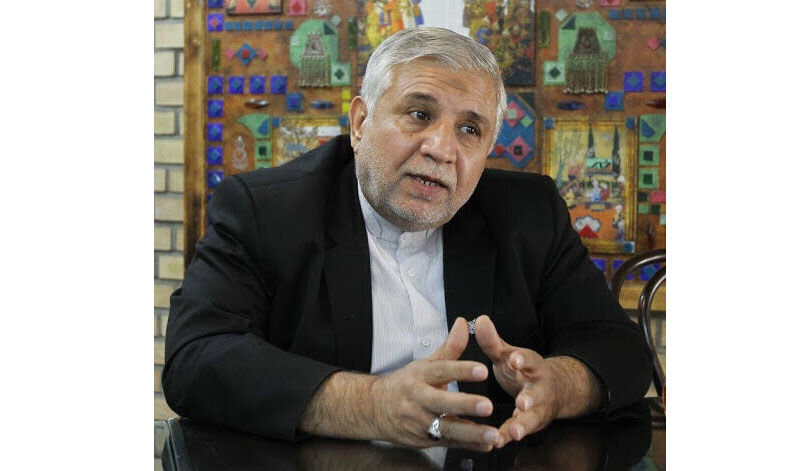
My eye was drawn to a post in the Tehran Times of 4 August 2020 entitled: “Ex-diplomat urges intl. community not to keep silent over U.S. violation of human rights“
Mohsen Pakaeen, the former Iranian ambassador to Azerbaijan, has urged the international community not to keep silent over the United States’ violation of the human rights when the world is battling the coronavirus pandemic. The aricle then continues to list some international statements in support of lifting sanctions:
“The international community must respond to the United States’ behavior and make this country fulfil its duties regarding respect for human rights,” Pakaeen told IRNA in an interview published on Tuesday. He also said, “In a situation in which all countries in the world and international institutions, even [the United Nations] High Commissioner for Human Rights, stress the necessity of removing sanctions on countries battling the coronavirus, we are witnessing the United States’ healthcare terrorism against our country.”
On March 31, a UN human rights expert called for lifting international sanctions against countries ranging from Iran to North Korea and Venezuela in coronavirus crisis, according to Reuters.
“The continued imposition of crippling economic sanctions on Syria, Venezuela, Iran, Cuba, and, to a lesser degree, Zimbabwe, to name the most prominent instances, severely undermines the ordinary citizens’fundamental right to sufficient and adequate food,” Hilal Elver, UN special rapporteur on the right to food, said in a statement.
In a letter to the G-20 economic powers on March 24, UN Secretary-General Antonio Guterres called for rolling back international sanctions regimes around the world. Guterres said sanctions are heightening the health risks for millions of people and weakening the global effort to contain the spread of the new coronavirus, Foreign Policy reported.
Michelle Bachelet, the UN high commissioner for human rights, also said on March 24 that “At this crucial time, both for global public health reasons, and to support the rights and lives of millions of people in these countries, sectoral sanctions should be eased or suspended,” .
On 23 June 2020 the Center for Human Rights in Iran (CHRI) published under the title “No Lawyers, No Justice” a list of lawyers imprisoned in Iran for defending Human Rights Defenders. The adagium “utopia is a world without lawyers” clealry does not apply to Iran:
At least nine known cases of attorneys that have been arrested, charged with national security-related crimes, and/or banned from practicing law in the last two years. In addition to the list below, CHRI maintains this regularly updated list of lawyers known to have been imprisoned in Iran for their work defending the law.
Payam Derafshan: Held incommunicado at an unknown location since his arrest in June 2020 on unannounced charges. In May 2020, he was sentenced to a one-year suspended prison sentence for“insulting the supreme leader,” and suspended from practicing law for two years.
Soheila Hejab: Held at Gharchak Prison since May 2020, serving an 18-year prison sentence, five of which she must serve before becoming eligible for parole for “forming a group for women’s rights.”
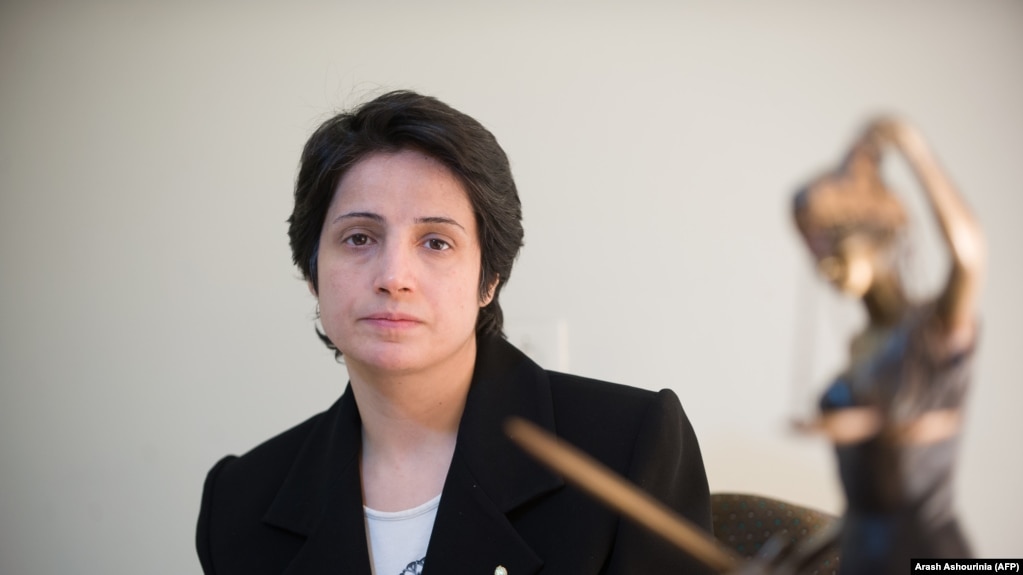
Nasrin Sotoudeh: Detained in June 2018 and sentenced to 38 years in prison, 12 years of which she must serve before becoming eligible for parole. Among her charges were “encouraging prostitution” for advocating against compulsory hijab. Previously she served three years in prison for “acting against national security” and “membership in the Defenders of Human Rights Center.”
Mohammad Najafi: Imprisoned for demanding accountability for deaths in detention and facing new unspecified charges, he was sentenced in 2019 to 13 years in prison for “propaganda against the state,” “insulting the supreme leader,” and “collaborating with enemy states,” in addition to a four-year prison sentence in 2018. He must serve 10 years before becoming eligible for parole.
Amirsalar Davoudi: Behind bars since November 2018, he was sentenced to 30 years in prison and 11 lashes. He will be eligible for release after serving 15 years under the charge of forming “an illegal group,” which was a news channel for lawyers on the Telegram messaging app.
Arash Keykhosravi, who, along with fellow lawyer Ghasem Sholeh Sa’di, was sentenced to six years in prison but later acquitted, is facing new charges of “publishing falsehoods” for writing an article criticizing the imprisonment of attorney Mohammad Najafi.
Abdolfattah Soltani, who spent more than seven years behind bars for defending political prisoners, and Mohammad Ali Dadkhah, who was sentenced in 2012 to nine years in prison but released on furlough in 2013, are both banned from practicing law.
The assault on rights lawyers in Iran has been occurring amid a backdrop of two major changes to the legal process that have facilitated the authorities’ ability to convict defendants in politically motivated prosecutions on unsubstantiated charges.
In January 2018, Iranian courts began citing the Note to Article 48 of Iran’s Criminal Procedures Regulationsas justification for forcing defendants to choose their legal counsel from a court-approved list. The note also allows a delay in an individual’s access to counsel in cases involving “national security” charges, which are used against perceived critics of the state.
In a second blow to due process, in November 2019, Judiciary Chief Ebrahim Raisi ruled that Appeal Courts could issue verdicts without the presence of defendants and their attorneys, rendering the appeal process effectively meaningless.
“If the head of the judiciary can stop lawyers from practicing, it’s time to say goodbye to this profession,” Sotoudeh said in 2018. She was arrested two months after making the comments and has been behind bars ever since. [See also: https://humanrightsdefenders.blog/tag/nasrin-sotoudeh/]
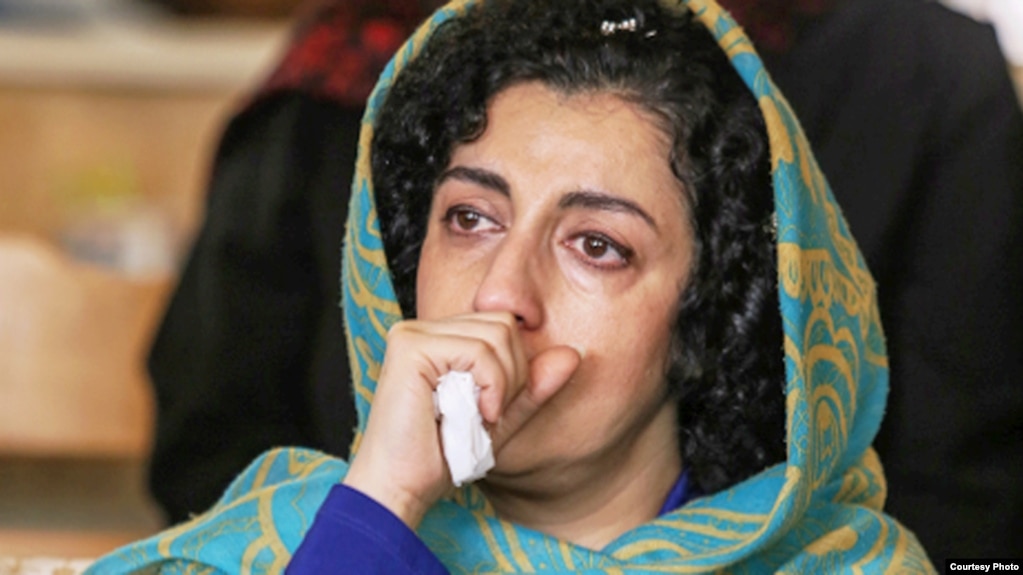
Narges Mohammadi has “serious health problems,” her brother says, but is not allowed out of prison to see a doctor.
Reporters Without Borders (RSF) has condemned the latest “absurd charge” brought against jailed Iranian journalist and human rights advocate Narges Mohammadi, who has been imprisoned since 2015. On 12 June 2020 RSF urged the UN special rapporteur on the human rights situation in Iran, Javaid Rehman, to “intervene quickly and do everything possible to obtain the release of Iran’s longest-held woman journalist.“
In a recent open letter to the Iranian judicial authorities, her brother revealed that she was now accused of “dancing in prison during the days of mourning” commemorating the seventh-century killing of Imam Hussein, a revered figure in Shi’ite Islam. Mehdi Mohammadi, now a refugee in Norway, also wrote that his sister had serious health problems but “was not allowed out of prison to see a doctor, who went to her cell.” “This persecution of Narges Mohammadi is evidence of judicial discrimination at the behest of the Intelligence Ministry and senior justice system officials,” said Reza Moini, the head of RSF’s Iran-Afghanistan desk.
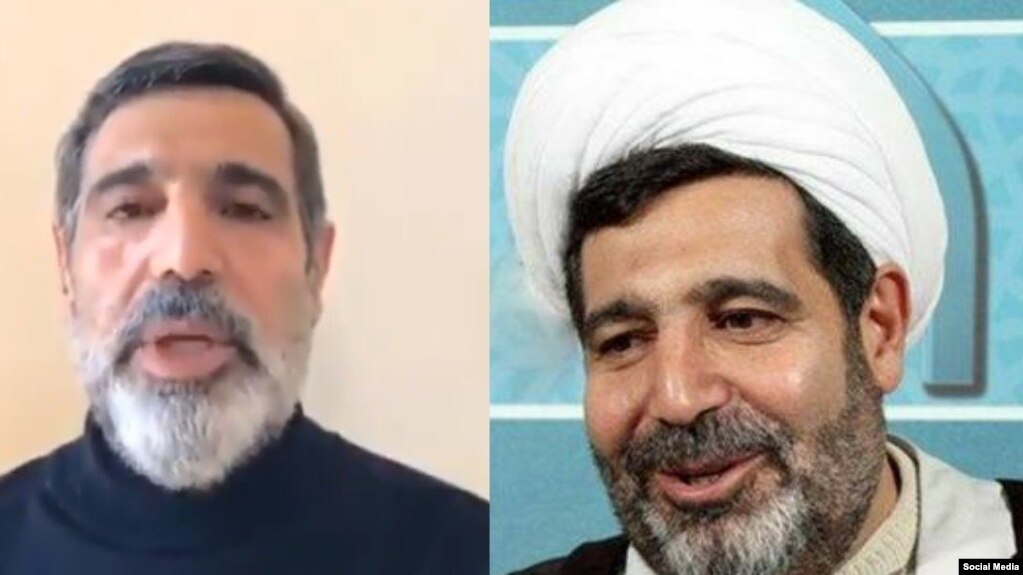
In the meantime there is also an interesting case of an Iranian judge and former prosecutor who was arrested in Romania by Interpol for rights violations (13 June 2020 Radio Farda)
Gholamreza Mansouri, Iranian judge and former prosecutor.
Iran’s Judiciary Spokesman confirmed that Interpol has detained Gholamreza Mansouri in Romania. He is accused of human rights violations by rights defenders, but he is also one of the defendants in a recent sensational corruption case in Iran who fled to Europe. Judiciary spokesman Gholam-Hossein Esmaili said Mansouri’s extradition is not possible now due to coronavirus restrictions but he will be returned to Iran and put on trial for corruption. He also told a local news network that Iran requested the arrest through the Interpol.
In a tweet on June 11, the Secretary-General of Reporters without Borders urged German authorities not to let him escape justice. Reporters without Borders (RSF) has supported the call of Iranian activists and filed a complaint with Germany’s Federal Public Prosecutor against Mansouri for the arrest and torture of at least 20 journalists in 2013….Mansouri is a highly influential prosecutor and judge notoriously famous for prosecuting journalists and putting them behind bars. In one instance in 2013 he ordered the simultaneous arrest of 20 journalists in one day.
Mansouri’s name came up as one of the recipients of bribes in the first trial session of Akbar Tabari, a former Judiciary deputy. The former judge allegedly received 500,000 euro in bribes from Tabari.
In a video published on social media on June 9, Mansouri claimed that he was abroad for treatment of a serious medical condition and could not return due to the restrictions introduced after the breakout of coronavirus. He did not reveal where he was but said he would go to an Iranian embassy to arrange for his return to defend himself against the corruption charges.
On 21 April 2020, – for the first time – a group of 14 former winners of the Martin Ennals Award for Human Rights Defenders rallied around their follow laureates lingering in jail. They signed a joint letter to the Permanent Representatives to the UN of Bahrain, China, Iran and the United Arab Emirates:
Your Excellencies:
As the COVID-19 pandemic spreads, we the undersigned, winners of the Martin Ennals Award for Human Rights Defenders, are calling for the release of all imprisoned human rights defenders around the world, who are at tremendous risk due to the virus. We add our voices to the calls of international leaders, of hundreds of civil society organizations and thousands of mobilized citizens, to grant clemency towards vulnerable prisoners during this health crisis, including our fellow award-winners who are imprisoned for their defense of human rights in four countries:
Despite the tragedy of lives lost and significant economic damage, we believe this crisis will also present opportunities for a better world. Now is the time to remedy the unjust detention of these individuals. By releasing our brothers and sisters – Ilham, Ahmed, Nabeel, Abdullah, and Nasrin – the leaders of your nations would demonstrate their capacity for mercy and responsibility. We therefore call on your government to free our fellow Martin Ennals Award winners immediately, as well as all human rights defenders in detainment, so that their physical integrity is ensured, and they can receive appropriate medical and psychological support.
There is a list – updated monthly – by the One Free Press Coalition of nearly 40 news organizations, which identifies the 10 most urgent cases threatening press freedom around the world. Understanding the COVID-19 requires unbiased journalists, whose work requires protection. Not only does the act of informing the public carry risk to one’s own health but, in many countries, risk of retaliation. In China, freelance video journalist Chen Quishi disappeared on February 6 after informing family of plans to report on a temporary hospital in Wuhan, where the virus originated. Beijing has since expelled journalists from outlets including The Wall Street Journal, The New York Times and The Washington Post and demanded personnel information from Voice of America and TIME. Mohammad Mosaed, a reporter in Iran who criticized the government’s response to the pandemic, has been barred from practicing journalism and suspended from social media. Family members of imprisoned Egyptian journalist Alaa Abdelfattah were detained for protesting on behalf of prisoners who are vulnerable to the spread of the virus. An Azerbaijani journalist freed in mid-March described detention conditions allowing one shower per week, without soap, he told CPJ
Journalist, who warned about pandemic, banned from work and social media.
Freelance economic reporter Mohammad Mosaed awaits a court date, after intelligence agents of the Islamic Revolutionary Guard Corps (IRGC) arrested and interrogated him in February regarding social media accounts critical of government. The criticism included lack of preparedness to tackle the coronavirus outbreak. Until trial, authorities bar him from practicing journalism and suspended his social media accounts. Last year he endured 16 days in Evin prison for his tweets and was released on bail.
Editor facing potential detention, arrested again March 28.
Rappler editor Maria Ressa is scheduled for trial April 24, expecting a verdict on a cyber-libel charge brought by local businessman Wilfredo Keng regarding a May 2012 story. The relevant law took effect four months after the story in question was published. Depending how judges interpret the 2012 Cybercrime Prevention Act, Ressa could face six years in prison.
Family of jailed journalist protests prisons’ inaction to prevent COVID-19 threat.
While blogger Alaa Abdelfattah is held in Cairo’s Tora Prison, three of his family members face charges of unlawful protest, illegal assembly and obstructing traffic in their call to protect prisoners from the spread of coronavirus. They were released on bail exceeding $300 apiece. After reporting about politics and human rights violations, Abdelfattah has endured threats and been told he will never go free if he speaks of guards’ abuse.
Journalist covering coronavirus disappeared more than six weeks ago.
Freelance video journalist Chen Quishi has not been seen since February 6, when he informed family of plans to report on a temporary hospital. In late January, he had traveled from Beijing to the city of Wuhan in Hubei province and began filming and reporting on the coronavirus health crisis, according to his posts on YouTube. Friends running his Twitter account believe he is likely held in residential surveillance.
Journalist fears for her life, amid government-orchestrated threats.
After 19 years of persecution and legal censorship, award-winning journalist Claudia Julieta Duque told IWMF that she learned on February 29 about an ongoing criminal threat against her life. According to Duque, agents of the state institution in charge of protecting human rights defenders and at-risk journalists, called the National Protection Unit (UNP), were reportedly ordered to carry out intelligence activities to infiltrate Duque’s security scheme and threaten her welfare.
Imprisoned publisher undertook hunger strike while awaiting appeal.
No date has been set, following postponement of a March 12 appeal in the case of Martin Inoua Doulguet, publisher of Salam Info. He was found guilty on criminal charges of defamation and conspiracy in September, and sentenced to three years in prison. The privately owned quarterly newspaper reports on crime and politics in Chad, and Doulguet’s penalty includes a $1,675 fine and paying part of $33,514 in plaintiff damages.
Journalist serving life sentence prepares for final appeal.
On April 6, a Kyrgyz court is scheduled to hear the final appeal in the case of award-winning journalist Azimjon Askarov. The ethnic Uzbek, who reported on human rights, has spent more than nine years imprisoned on trumped-up charges that included incitement to ethnic hatred and complicity in the murder of a police officer. The decade-long case has drawn persistent international condemnation, and Kyrgyzstan’s only imprisoned journalist’s health deteriorates.
Cuban journalist Roberto Jesús Quiñones has spent more than six months behind bars, experiencing worsening treatment. Staff listen to all of his phone calls, have served him food containing worms, and upon learning of his secretly publishing from prison, suspended family visits and put him in solitary confinement. A municipal court in Guantánamo sentenced him to serve one year as a result of “resistance” and “disobedience” when police beat and detained him for covering a trial as a CubaNet contributor last April and his refusal to pay a fine imposed on him following this incident.
Reporter experiences repeated retaliation for his work.
On two different occasions last year, Benin courts delivered prison sentences to Ignace Sossou, a reporter for privately owned site Web TV. First was a one-month imprisonment and fine of $850 for publishing “false information” about local business dealings. Then an 18-month sentence and fine of $337 for defamation and disinformation in his reporting public statements made by Public Prosecutor Mario Mètonou.
Turkish and U.S. leaders continue pressuring for murdered journalist’s justice.
On March 25 Turkish officials indicted 20 Saudi nationals in the ongoing pursuit for answers surrounding Jamal Khashoggi’s brazen killing in Istanbul in 2018 and the Saudi crown prince’s role. That follows a March 3 news conference with U.S. Senator Ron Wyden, Representative Tom Malinowsk, and The Washington Post columnist’s fiancé, Hatice Cengiz, announcing that they are invoking procedures within the Senate Intelligence Committee to provide a congressional release of information from intelligence agencies.
The London-based human rights group Amnesty International says more than 300 people were killed in protests in Iran last month. In a report released on 16 December 2019 Amnesty says that according to reports it compiled, at least 304 people were killed and thousands injured between November 15 and 18 as authorities crushed protests with lethal force. The organization interviewed dozens of people inside Iran. It also analyzed video footage obtained by the group, which shows Iranian security forces opening fire on unarmed protesters who did not pose any imminent risk. The report said thousands of journalists and human rights defenders have also been arrested in an attempt to stop them from speaking out about Iran’s repression. Iran has yet to disclose details of the casualties.
On 18 December the European Union extended sanctions against Iran by another year over what the bloc says are serious human rights violations. The EU said in a statement it extended a travel ban and asset freeze against 82 people and also a ban on EU exports that might help in the repression of internal dissent. In 2011, the EU imposed the restrictions over the repression of peaceful demonstrators, journalists, human rights defenders and others. The sanctions also target those involved in torture, inhumane treatment and stonings or hangings. The extension prolongs the sanctions until April 13, 2018.
On 19 December 2019 Reporters Without Borders (RSF) said it is “appalled” by a Tehran court’s decision to uphold prison sentences for four journalists from the Gam (Step) online magazine. However, the appeals court in Tehran reduced the length of the jail terms from 18 to five years for each journalist — Amirhossein Mohammadifard, Sanaz Allahyari, Amir Amirgholi, and Assal Mohammadi — for a combined total of 20 years, the Paris-based media freedom watchdog said on December 18. The journalists were arrested a year ago on what Amnesty International called “spurious” national security charges related to their reporting on workers’ rights protests in Khuzestan Province over grievances concerning unpaid wages and poor conditions.
RSF said on December 18 that the same appeals court in Tehran also upheld a prison sentence for Marzieh Amiri, a journalist for the reformist Shargh newspaper, but reduced her sentence from 10 years in prison and 148 lashes to five years in prison. Amiri was arrested in May after covering a demonstration outside parliament in the capital.
On 20 December 2019 UN human rights experts called on the Iranian authorities to release all individuals arbitrarily detained and mistreated during recent protests, and expressed concerns over the hundreds of people who have been killed. “We are shocked at reports of the ill-treatment of those detained during the protests that took place in November 2019, and deeply disturbed that the reported use of excessive force by the Iranian security forces led to an untold number of casualties, including deaths,” the experts said.
In a quiet suburban Christchurch garden, Kurdish-Iranian journalist, writer, poet and film-maker Behrouz Boochani, cigarette in hand, paces out three large steps. “We lived in a very small room, from here to here, four of us. On Manus you didn’t have privacy or space. Finding the time and quiet to write was the hardest thing.”
But find time he did, to write poems and articles, film a documentary on a smartphone and tap out an entire book, furtively sent paragraph by paragraph via What’sApp text messages, chronicling the squalid conditions, medical neglect, mental anguish, suicide, even murder, experienced by asylum seekers held on Manus Island under Australia’s “stop the boats” policy.
It is six years since Boochani was pulled from a sinking boat just days out of Indonesia and taken to Australia’s “offshore processing centre” on Manus Island, Papua New Guinea. It is just over a week since he left Port Moresby to fly to Auckland, taking a route that avoided Australia, to speak at Christchurch’s WORD book festival as a free man. “I got my freedom through literature,” he says.
Boochani knows the power of words. As a journalist in Iran in 2013, he reported on the arrest and detention of his colleagues on Kurdish-language magazine Werya in Ilam, north-west Iran. His fellow journalists were eventually released – they attributed their survival to Boochani’s article – but by then he was in danger. He fled, travelling through South-east Asia to Indonesia where, in July that year, he was among a group of 75 men, women and children who boarded an unseaworthy boat heading for Australia. The vessel’s bilge pump failed in rough seas. When rescued by the Royal Australian Navy, Boochani requested asylum under the 1951 Convention Relating to the Status of Refugees, to which Australia is a party. Instead, he and his fellow asylum seekers were incarcerated on Christmas Island before being transferred to the Manus Island detention centre as part of Australia’s “Pacific Solution II”.
………To write his book, he adopted a new routine, sleeping from 6pm until 11pm when everyone was too busy to note his absence. From 11pm, he would write under the blankets until 8am, then sleep until noon. In 2016, after the PNG Supreme Court declared the indefinite detention of asylum seekers to be unlawful, phones were no longer prohibited. Each night, he would sit outside, smoking, writing, absorbing as much of the natural environment as he could from his side of the prison fence. “For the prisoner who is alone, nature is so important,” he says. “Always, it is a place you can escape to – even the sky, they cannot take the sky away. But it is very harsh to look up at the many birds flying and knowing you cannot follow them.”
….
“If someone asked me to write this book again, of course I am able to write it, but I could not write it this way. When I describe starving, I was starving. When I describe the characters, those people were around me in prison. It is the same with the feelings. In that camp people rely on each other; there’s a culture of brotherhood because there is no space, but there’s also a kind of hatred because you are so tired of having so many other people around you. I have lost those feelings now, but in prison they were true feelings.”
Through articles sent to the Guardian, the Sydney Morning Herald, the Refugees Action Collective and the United Nations, and the support of a global network of writers, translators, academics and activists, including Australia’s Janet Galbraith, founder of online project Writing Through Fences, Boochani refused to let the thousands of asylum seekers sent to Manus Island and Nauru fade from public gaze. In 2017, the UN High Commissioner for Human Rights described Australia’s offshore processing centres as “unsustainable, inhumane and contrary to human rights” (New Zealand’s offers under National first, then Labour, to settle at least 150 detainees were rejected by successive Australian prime ministers).
……
Plea for release
But within the camp the book also drew attention to Boochani himself. This year, the Media, Entertainment and Arts Alliance, the union for Australia’s creative professionals, sent an open letter to the Government of Scott Morrison urging Boochani’s release. Signed by prominent journalists and writers, including Tom Keneally Helen Garner, Christos Tsiolkas, Kate Grenville and Nobel laureate JM Coetzee, it said, “We are deeply concerned for Behrouz Boochani’s welfare and safety. The success of his book and his status as a journalist have made him a target of the Manus authorities; a danger that has only increased with his rising profile.”
In June, WORD Christchurch programme director Rachael King invited Boochani to speak at a special festival event. Especially after the city’s March 15 mosque shootings, she explained, “it felt important to share the stories of refugees”.
With help from author Lloyd Jones, whose recent book The Cage is itself a dark parable about the human capacity for inhumanity, she was able to email her invitation directly to Boochani. Boochani was receptive to the idea. By then he was one of more than 300 people moved from Manus Island to Port Moresby. He was hoping to be part of Australia’s “refugee swap” deal with the US (he was later accepted for this programme), but he wanted to wait until the Manus Island camp was finally closed.
“It would have been immoral for me to leave those people in Manus, to create a platform and have this privilege and this recognition, because it is about all our resistance – it was not only for me.”
In October, Australia’s Home Affairs Minister, Peter Dutton, told Parliament “we’ve completely closed” the Manus Island facility. By then, only three asylum seekers were left on the island. The remaining detainees still in Papua New Guinea were in Port Moresby, including a reported 46 held in Bomana Prison.
Iranian lawyer Nasrin Sotoudeh is seen in Tehran on 1 November 2008.
The Council of Bars and Law Societies of Europe (CCBE) has bestowed its annual Human Rights Award to four lawyers from Iran: Nasrin Sotoudeh, Addolfattah Soltani, Mohammad Najafi and Amir Salar Davodi. Shirin Ebadi will receive the award on behalf of the jailed lawyers from CCBE President José De Freitas.
The CCBE is a professional organization that represents Law Societies from 45 different countries and over one million lawyers. Previous recipients of the award include Avocats Sans Frontières (ASF) and Azerbaijani human rights lawyer Intigam Aliyev. For more on this and other awards for lawyers see: http://www.trueheroesfilms.org/thedigest/awards/ccbe-human-rights-award
Mohammad Najafi performed various human rights related work and defended protestors who were arrested during a mass uprising in early 2018.
Amirsalar Davoudi was sentenced to 30 years in prison, 111 lashses and substantial monetary fine for his work. One of the charges included “collaborating with the enemy sate” which was brought against Davoudi for doing an interview with the Voice of America’s Persian section.
A statement from the CCBE urges Iran “to take all the necessary measures to release these four human rights lawyers and to guarantee that all lawyers in the Islamic Republic of Iran are able to perform their professional duties without fear of reprisal, hindrance, intimidation or harassment.”
Tomorrow, 29 November, 2019, young people will gather at locations around the world for a Fridays for Future Global Climate Strike. On 2 December, United Nations delegates, world leaders, business executives, and activists will meet at the 25th Conference of the United Nations Framework Convention on Climate Change (COP25) in Madrid to discuss ways to protect the environment. Participants in these events should also discuss ways to protect the protectors: the individuals and groups targeted around the world for their efforts on behalf of the planet.
Protecting the endangered Asiatic cheetah. Tweeting a satirical poem. Attending a climate conference. Campaigning against a power plant. These actions hardly conjure images of suicide bombers or coup plotters. Yet they have been labeled “eco-terrorism,” “extremism,” or “threats to national security” by governments and businesses that seek to block the work of environmental activists. The dangers facing environmental defenders do not stop at accusations that they are national security risks.From the Amazon rainforest to South African mining communities, activists seeking to preserve ecosystems and ancestral lands are being threatened, attacked, and even killed with near total impunity, Human Rights Watch has found. But in contrast to many of these illegal acts, the unjust labeling of environmentalists as security threats is often more insidious, as it is generally carried out under the color of law.
In a long interesting piece on 28 November Human Rights Watch writes that only in exceptional cases would the actions of environmental activists meet a generally recognized definition of terrorism … When they engage in civil disobedience, their aim is usually to strengthen – and improve the enforcement of – existing environmental protection measures. It lists examples where environmental activists have been smeared as terrorists or other national security threats (for more detail see the original article):
In Kenya, the police and military have frequently labeled environmental activists opposing a mega-infrastructure project in the Lamu coastal region, including a coal-fired power plant, as “terrorists” while subjecting them to threats, beatings, and arbitrary arrests and detentions. In 15 cases documented by Human Rights Watch between 2013 and 2016, the authorities accused environmental defenders of membership in, or links to, the extremist armed group al-Shabab but provided no compelling evidence.
In the Philippines, President Rodrigo Duterte in 2018 placed 600 civil society members, including environmentalists and indigenous rights defenders, on a list of alleged members of the country’s communist party and its armed wing, which he declared to be a terrorist organization. Duterte’s “terrorist list” included Victoria Tauli-Corpuz, an indigenous Filipina who is the UN special rapporteur on the rights of indigenous peoples and a climate change activist.
In Ecuador, eight years passed before the prominent environmental activist José “Pepe” Acacho, a Shuar indigenous leader, was able to clear himself of “terrorism” charges for his activities opposing mining and oil exploration in the Amazon. Acacho was charged with terrorism in 2010 for allegedly inciting violence during Shuar protests against a mining law.
In the US in August 2018, then-US Interior Secretary Ryan Zinke blamed “environmental terrorist groups” that opposed logging for wildfires on the West Coast – a proposition immediately attacked by leading environmental organizations including the Sierra Club. In 2017, 84 members of the US Congress, most of them Republicans, asked the Justice Department if activists mobilizing against the construction of oil pipelines could be prosecuted as terrorists. (The department’s response was that in some cases, yes.)
.
In Russia, at least 14 environmental groups have stopped work in recent years, and the head of the prominent group Ekozaschita! (Ecodefense!), Alexandra Koroleva, fled the country in June to avoid prosecution under the draconian Law on Foreign Agents. The 2012 law requires any Russian group accepting foreign funding and carrying out activities deemed to be “political” to register as a “foreign agent,” a term that in Russia implies “spy” or “traitor.” Authorities have used the law to silence groups that opposed state-sanctioned development projects and petitioned authorities for the release of imprisoned environmental activists, a Human Rights Watch investigation found.
Civil society participation will be crucial to ambitious outcomes at COP25. Parties to the summit, which include all UN member countries and the European Union, should allow activists ample opportunity to air their concerns about the climate crisis and use their combined expertise to help identify solutions. They should also provide activists with a safe space to speak out about the threats they face for carrying out their work.
In addition, parties should publicly commit to robustly carrying out international and regional treaties that protect environmental defenders. One of these treaties is the Escazu Agreement (the Regional Agreement on Access to Information, Public Participation and Justice in Environmental Matters in Latin America and the Caribbean), the world’s first covenant to include specific provisions promoting and protecting environmental defenders. Twenty-one countries have signed the 2018 agreement. But only six countries have ratified it – five shy of the ratifications needed to enter it into force. Chile, which stepped down as COP25 host because of protests stemming from economic grievances, but will still preside over the negotiations in Madrid, should lead by example and ratify the agreement.
COP25 participants should also commit to upholding the Aarhus Convention (the United Nations Economic Commission for Europe Convention on Access to Information, Public Participation in Decision-making and Access to Justice in Environmental Matters), to which Spain is a signatory. The convention – an environmental pact for Europe, the European Union, and Central Asia – grants the public, including environmental groups, an array of rights including public participation and access to information and justice in governmental decisions on the environment, without harassment or persecution. Parties to the treaty, including the EU, and Poland for its crackdown at COP24, have been criticized – including in some cases by the Aarhus Convention’s own oversight body – for flouting these provisions.
COP25 delegates should recognize that to genuinely protect the environment, they also need to protect its defenders – including those unjustly targeted in the name of security.
The World Economic Forum announced that from 30 August to 1 September 2019 more than 400 members of the World Economic Forum’s Global Shapers Community of innovators, activists and entrepreneurs under the age of 30 meet in Geneva to Spark Global Change. The theme of the summit is Leading for Impact. The Shapers, representing about 150 countries, will share their experiences, their impact and the lessons learned in managing grassroots projects in their local Global Shaper Hubs and through regional and global collaborations. They will also participate in skills-building and leadership-development workshops.
The summit will focus on enhancing leadership in the community’s three main impact areas: standing up for equity and inclusion, protecting the planet, and shaping the future of education and employment.
In the past year, Shapers in 125 cities have developed grassroots projects to promote equity and inclusion, including awareness campaigns, education initiatives and skill-building efforts to reduce barriers to women in the workplace, increase civic engagement among minority groups and advocate for the rights of refugees.
Perhaps a good case would be that of Saba Kord Afshari who for the simple act of removing her hijab and taking a video was made a “criminal” in Iran. #SabaKordafshari was sentenced to 24 years prison for #WalkingUnveiled and being voice of the voiceless. Activists call on the world, all politicians, all celebrities, MeToo movement – and why not the Shapers of the WEF ? – to take action.