The glimmer of hope for Nasrin Sotoudeh and Iran which I saw in my post of 6 September [https://thoolen.wordpress.com/2014/09/06/glimmer-of-hope-in-iran-nasrin-sotoudehs-ban-to-practice-overruled/] seems to have been crushed already. Yesterday, 20 october, the Observatory for the Protection of Human Rights Defenders, the joint programme of FIDH and OMCT, has received new information that on 18 October 2014, a three-member disciplinary investigation panel of Tehran’s Bar Association has now suspended Nasrin Sotoudeh’s law license for three years, based on a complaint filed by the Islamic Revolution Court’s Prosecution Office (unlike the first disciplinary panel of the Tehran Bar Association which rejected a similar request). Read the rest of this entry »
Posts Tagged ‘Iran’
Canadian web defenders high up among Tulip nominations
October 12, 2014
(ASL19, founded by Iranian-Canadian Ali Karimzadeh Bangi, develops ways for Iranians to counter the country’s “Great Firewall” of censorship – COLIN MCCONNELL / TORONTO STAR)
The prize aims to reward groups that use innovation to promote human rights. Of the 30 shortlisted candidates, ASL19, founded by Iranian-Canadian Ali Karimzadeh Bangi, is running fourth.
The remainder of the article sets out how the group helps Iranians to evade censorship.
Canadian web defenders up for top human rights award | Toronto Star.
Kirk-Rubio Bill in US Senate risks to undermine Human Rights Defenders in Iran
September 14, 2014A marvelous example of how (bellicose) sanctions can harm human rights defenders is to be found in this piece of 10 September by
 Tyler Cullis
“Under the title Kirk-Rubio Bill Would Undermine Human Rights in Iran, Torpedo Nuclear Talks”, they argue that a new Senate bill (fortunately still pending) that purports to support human rights in Iran would actually ratchet up broad sanctions on the Iranian population, bolster Iranian hardliners, and even directly target some Iranian human rights defenders. The bill would impose new sanctions under the guise of human rights and threaten to derail the nuclear talks while undermining human rights defenders inside Iran. Considering that Senator Kirk has previously called on the US to collectively punish and “take the food out of the mouths” of Iranians, this charade of human rights concern is especially callous.
As Iranian human rights defenders [including MEA Laureate Emad Baghi] continue to speak out against sanctions and in support of current diplomatic efforts, the Kirk-Rubio bill would escalate Iran’s isolation through broad sanctions and risk torpedoeing nuclear talks. If passed, the legislation would be a gift to hardline political factions in Iran, who themselves are widely suspected of ratcheting up abuses to gain the upper-hand against moderates seeking to implement internal reforms and secure a diplomatic deal with world powers.
Glimmer of hope in Iran: Nasrin Sotoudeh’s ban to practice overruled
September 6, 2014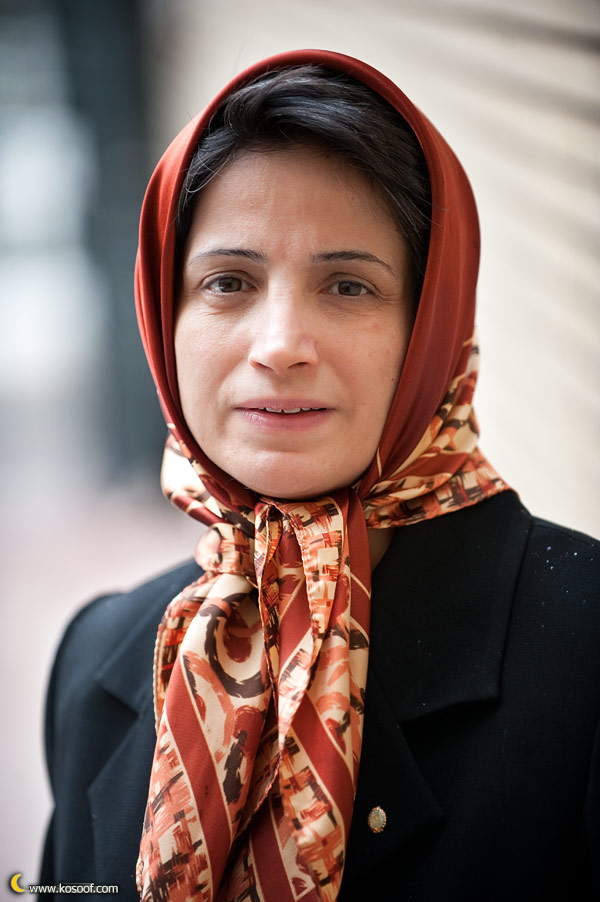 The International Campaign for Human Rights in Iran reports on 5 September that the Lawyers’ Court denied the Tehran Prosecutor’s Office request for the suspension of Sotoudeh’s license to practice, and stated in a ruling that, “In the opinion of the Lawyer’s Court, Ms. Sotoudeh’s temporary suspension was unwarranted and will be overruled”. According to this ruling Ms. Sotoudeh can continue her profession as a lawyer says her husband Reza Khandan on Facebook.
[Prominent lawyer and human rights defender Nasrin Sotoudeh – final nominee of the MEA in 2012 and winner of the Sakharov prize- was arrested on September 4, 2010. A lower court sentenced her to 11 years in prison, a 20-year ban on her legal practice, and a 20-year ban on foreign travel, on charges of “acting against national security,” “propaganda against the state,” and “membership in the Human Rights Defenders Center.” An appeals court reduced her sentence to six years in prison and a 10-year ban on her legal practice. After almost three years in prison, Nasrin Sotoudeh was released on September 18, 2013. Upon release, Nasrin Sotoudeh objected to the ruling by the Tehran Revolutionary Court to suspend her license to practice law, asserting the Court’s lack of jurisdiction over this matter. She subsequently renewed her license and announced that she would continue her legal practice. However, judges have refused to allow her to appear in court to represent her clients.]
for more posts on Sotoudeh: https://thoolen.wordpress.com/tag/nasrin-sotoudeh/
Retaliation against Iranian Human Rights Defender for meeting with Ashton
June 12, 2014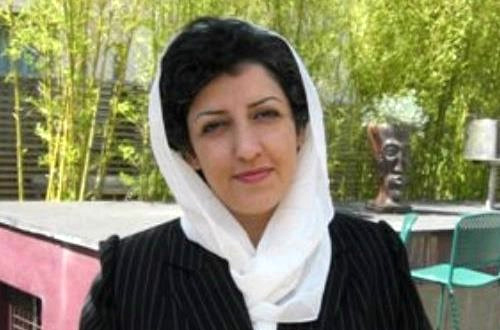
Reprisals are not limited to human rights defenders cooperating with the UN. Narges Mohammadi, a prominent human rights defender in Iran, told the NGO ‘International Campaign for Human Rights in Iran’ that new charges have been brought against her stemming from her March 8, 2014 meeting with the EU foreign policy chief Catherine Ashton. Mohammadi was charged with “propaganda against the state” and “collusion against national security” for her meeting with Ashton at the Austrian Embassy in Tehran. She was released on $10,000 bail. [Mohammadi was one of several women activists who accepted an invitation to meet the EU foreign policy head during her March visit to Tehran. The meeting took Iranian officials by surprise and unleashed a flurry of criticism by conservatives who described the meeting as “foreign interference in Iranian domestic affairs” and labeled the Iranian participants as foreign collaborators.]
Mohammadi stated: “I have been ‘charged’ with every single civil activity I have engaged in since my release from Zanjan Prison in August 2012, such as participating in gatherings on women’s rights, air pollution, and [Rouhani’s] Citizenship Rights Charter. I was also accused of honoring families of political prisoners at meetings, or attending a gathering with Gonabadi Dervishes in front of the Prosecutor’s Office, or giving interviews to media outside Iran. I told them there that when you fit all my civil activities into these two charges, it means that I must remain silent and still.”
Mohammadi was arrested in 2009 and charged with “assembly and collusion against national security,” “membership in the Defenders of Human Rights Center,” and “propaganda against the state.” She was first sentenced to 11 years in prison, but Branch 54 of the Tehran Appeals Court reduced her sentence to six years in prison. She was released in 2013 for medical reasons after a severe illness in Zanjan prison.
Iranian human rights defender Nasrin Sotoudeh speaks to the Guardian
June 2, 2014
“Nasrin Sotoudeh’s seven-year-old son, Nima, wants to go out to play. His mother, the leading Iranian human rights lawyer whose arbitrary imprisonment in 2010 sparked an international campaign to free her, has been talking for ages. Nima is bored. At the door to their apartment in north-west Tehran, Nasrin takes Nima in her arms. The boy stands on tip-toe to embrace his mother. They hold each other for a minute or more. It is as though the two cannot bear to be separated..…….”. For more: Freed Iranian rights lawyer: Ive a bad feeling about the women I left behind | World news | theguardian.com.
other posts on Nasrin: https://thoolen.wordpress.com/tag/nasrin-sotoudeh/
Facebook bad for your health in Iran
May 29, 2014
The Guardian reports that eight people have been jailed in Iran on charges including blasphemy and insulting the country’s supreme leader on Facebook. The opposition website Kaleme reported that two of the eight, identified as Roya Saberinejad Nobakht, 47, from Stockport (Iranian/UK national), and Amir Golestani, each received 20 years in prison and the remaining six – Masoud Ghasemkhani, Fariborz Kardarfar, Seyed Masoud Seyed Talebi, Amin Akramipour, Mehdi Reyshahri and Naghmeh Shahisavandi Shirazi – between seven and 19 years. They were variously found guilty of blasphemy, propaganda against the ruling system, spreading lies and insulting Ayatollah Ali Khamenei.
[The relevant backdrop is that there is a growing row between President Hassan Rouhani’s administration, which favours internet freedom, and hardliners wary of relaxing online censorship. Last week, Iran’s national TV paraded six young Iranians arrested for performing a version of Pharrell William’s hit song Happy and posting a video of it on the internet. The arrests caused global outrage and prompted Rouhani to react in their support. The performers were soon released, but the video’s director, Sassan Soleimani, remains in jail. The arrests highlighted the challenges Rouhani faces in delivering his promise of allowing people greater access to social networks such as Facebook and Twitter, which remain blocked in Iran….In recent weeks Rouhani has stepped up his rhetoric in support of internet freedom. “The era of the one-sided pulpit is over,” he said recently at a conference in Tehran, endorsing social networks and asking his communications minister to improve bandwidth in the country. He intervened when the authorities blocked access to the mobile messaging service WhatsApp, ordering the ban to be lifted. Iran’s judiciary, which is a political institution independent of the government, has since moved to challenge Rouhani’s intervention and orderered WhatsApp to be banned. Until two years ago, Iran’s ministry of information and communications technology was in charge of policing the country’s online community, but in 2012 Khamenei ordered officials to set up the supreme council of virtual space, a body that is closer to the supreme leader than to the government. This means Rouhani is not the sole decision-maker in the future of Iranian web. With help from Iran’s cyberpolice, the judiciary and the Revolutionary Guards have identified and arrested Iranians because of web-related issues, including several employees of the Iranian gadget news website Narenji, who have been in jail since December.]
via Briton among eight jailed in Iran for web insults | World news | The Guardian.
International Service for Human Rights rings alarm bell over composition of UN Committee on Civil society
May 1, 2014“Civil society loses as repressive States win election to regulate NGO access to UN” is the headline of a rightly alarming report on 23 April 2014 by the New York desk of the International Service for Human Rights [ISHR]. It calls on States that value and respect a vibrant civil society should do more to support non-governmental organisations to have their voices heard at the United Nations. The call comes after very few such States stood for election to an important UN committee that regulates civil society access to the UN, leaving the field to repressive States whose intolerance for civil society at home looks set to further restrict NGO access to the UN. Read the rest of this entry »
Ganji: Human rights in Iran improved, but still short of expectations
March 26, 2014
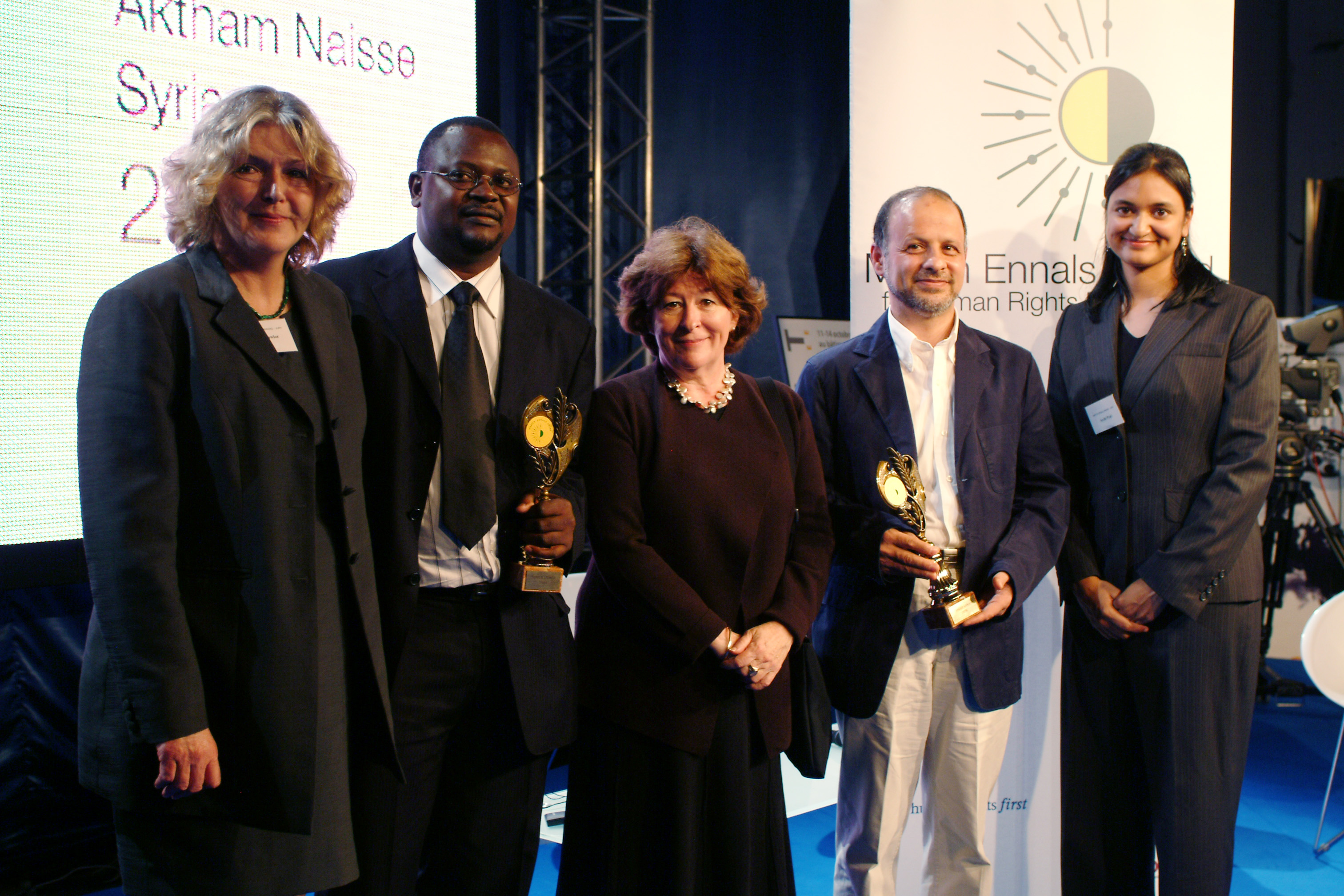
(Ganji – second from the right – at the MEA ceremony of 2006, where he received the award from UN High Commissioner Louise Arbour)
Al-Monitor of 25 March carries a lengthy interview with MEA Laureate Akbar Ganji in which Jahandad Memarian records many interesting insights, especially on the issue of sanctions and support to human rights defenders. The whole interview is certainly worth reading; here follow some long excerpts:
“It is not an exaggeration to say that Akbar Ganji is the most celebrated dissident within the ranks of Iranian journalists since the inception of the Islamic Republic of Iran in 1979. A former supporter of the revolution, Ganji became disenchanted and turned into one of its most vocal critics. He is best known for his work as a journalist covering the 1998 murders of Iranian dissidents in Reformist newspapers, a series which came to be known as “the chain murders” that implicated top governmental officials. For his work revealing the murders of dissidents and attending a conference in Berlin that was condemned by hard-liners who were reeling after a Reformist victory in parliament, Ganji was arrested and served time in Tehran’s Evin Prison from 2001 to 2006. During his final year in prison, he went on a hunger strike that doctors urged him to end for concerns he would suffer permanent brain damage.
Ganji has won several international awards, including the World Association of Newspapers’ Golden Pen of Freedom Award, the Canadian Journalists for Free Expression’s International Press Freedom Award, the Martin Ennals Award for Human Rights Defenders and the Cato Institute Milton Friedman Prize for Advancing Liberty. In an exclusive interview via email with Al-Monitor, Ganji, based in New York, shared his thoughts about human rights and democracy in the context of President Hassan Rouhani’s administration.
Al-Monitor: The UN secretary-general, Ban Ki-moon, has sharply criticized the Iranian president, Hassan Rouhani, saying, “He has not made any significant improvement” in ending human rights abuses since taking office. Nevertheless, Mahmoud Sadri — Iranian professor of sociology at the Federation of North Texas Area Universities — is optimistic about the new administration and has asked Iranian dissidents and intellectuals to take advantage of this historic opportunity. How do you evaluate the Rouhani administration?
Ganji: The situation has improved from various aspects compared with the [Mahmoud] Ahmadinejad administration. However, it falls short of the expectations of democracy advocates and human rights activists. The Rouhani administration truly seeks to improve the state of human rights, but it has faced obstacles in Iran’s power hierarchy, including organizations that [Supreme Leader] Ayatollah [Ali] Khamenei oversees, such as the judiciary, law enforcement, etc., in addition to the Majles [parliament] that is controlled by the conservatives and some radical reactionaries.
…….Since his administration came to power, Rouhani has spoken with the supreme leader about freeing the Green Movement’s leaders (former Prime Minister Mir-Hossein Mousavi and former Majles speaker Mehdi Karoubi) and political prisoners, guaranteeing that nothing would happen, if they were freed.
Al-Monitor: In January, you wrote a Huffington Post article titled “The Iran Nuclear Accord Is Good for Human Rights.” It seems to me whenever international pressure on the Iranian government increased, Iran improved its record. For example, Tehran released political prisoners ahead of Hassan Rouhani’s UN speech, including prominent human rights lawyer Nasrin Sotoudeh. Don’t you think such actions stem from international pressure? In the absence of this leverage — i.e., international pressure — Iran would continue human rights violations.
Ganji: With regard to “external pressure on an undemocratic regime and improvement of human rights or increased oppression,” there is no law/rule that would address the cause-reaction relationships. At most, one can speak of “correlation.”[…] we need to know the following:
First, economic sanctions represent the collective punishment of a country’s people and do not necessarily lead to dictatorships’ downfall.
Second, long-term sanctions destroy the internal infrastructure of societies. ..Consequently, trust that is the basis of social capital is destroyed. Because of the sanctions, the oppressive regime’s increasing level of oppression, the internal destruction of society, is not visible. It is only in the aftermath of the dictatorship’s downfall that we will witness the visible spread of a wave of hatred, revenge and violence.
Third, in a life and death situation, the state of human rights, democracy and freedom completely falls by the wayside.
Fourth, consider Iraq’s example again. Before, the invasion al-Qaeda forces did not exist in Iraq, but they were born and bred as a result of the US sanctions and the US attack on Iraq. This story has been repeated in Libya and Syria. …..Iranian, US and European officials have professed that economic sanctions against Iran have affected Iran’s economy negatively. Last year, the economic growth rate fell to -5.8%. The inflation rate rose to 40%. The corruption rate climbed, and other negative outcomes followed. We should ask ourselves, what is the impact of recession on ordinary people’s lives?
The middle class, as a vehicle of democracy, has been transformed to the impoverished class, and its democratic movement may lose its agents. Democracy is the product of the balance of power between the government and civil society.
The transformation of the nuclear agreement from temporary to permanent, improvement of Iran’s relationship with Western governments, rekindling of ties between Iran and the United States, lifting of all the economic sanctions and alleviation of foreign threats can help empower the people through their mobilization and expansion of civil society. In that sense, the regime’s focus and its supporters will not be on discovering conspiracies of foreign governments and military attacks to destroy the regime. Let’s not forget that democracy and human rights have a direct relationship with economic development.
Al-Monitor: You have opposed US aid to Iranian dissidents and human rights activists. What are your key criticisms against such aid? What actions should foreign countries.. take or avoid ?
Ganji: The opposition that I have spoken about consists of groups and people that advocate regime change in Iran, so they can come to power. It is not possible for the leaders of a country to be indebted to other foreign governments, including the United States, Israel, Saudi Arabia, Russia and China. In that case, they will become the greater powers’ pawns. Look at the groups that have received financial aid from foreign governments in the past 35 years. What have they done? Do their terrorist and espionage activities constitute human rights activism, or are such activities considered criminal in all countries, including the United States and Israel, and are they strongly punished?
However, I support educational financial aid, including student scholarships and research fellowships for scholars. Just think about what would have happened if the $1.5 trillion that was spent on the wars in Afghanistan and Iraq would have been used toward education and development of the Middle East, and how that would have changed the region. Why do Western governments, the United States included, not grant scholarships to tens of thousands of talented and smart Iranian youth as students in social sciences?
Western governments should protest all human rights violations; they should give ethical and spiritual support to pro-democracy and human rights activists; they should file complaints at the UN Human Rights Council and ease the process of bringing perpetrators to justice. Moreover, Western powers should stop selling weapons of torture and oppression to dictatorial regimes. Ultimately, they should allocate financial resources to form independent labor unions and improve the state of human rights.
Read more:
Iran’s Larijani attacks human rights report by UN and Sotoudeh expresses faith in the future
March 20, 2014When it comes to the human rights situation in Iran one could refer to numerous recent reports that lament the continued repression and ill-treatment of human rights defenders in spite of the change of President at the top (as I did e.g. in: https://thoolen.wordpress.com/2014/03/10/iran-human-rights-defenders-arbitrarily-detained-are-made-to-suffer-again-through-lack-of-medical-care/), but perhaps another way to demonstrate the enormous gap between the fanatics in power and those who struggle for a better Iran is two contrasting quotes:
The first comes from the Head of Iran’s Human Rights Council, Mohammad Javad Larijani, who in a 2-hour press conference rejected again any criticism and attacked the UN Rapporteur on Iran, Ahmed Shaheed, saying that his report was biased and filled with inaccurate reports and double standards.Larijani said that “he was turned into a media actor for propaganda against the Islamic Republic of Iran”. [from Iran rejects latest human rights report by the UN | Iran Pulse: Must-Reads from Iran Today.]
The other comes from http://www.arsehsevom.net/2014/03/nasrin-sotoudeh-equality-will-prevail/, quoting human rights lawyer Nasrin Sotoudeh, one of the Final Nominees of the MEA in 2012 and recently released:

Not much more to say!
 Hans Thoolen on Human Rights Defenders and their awards