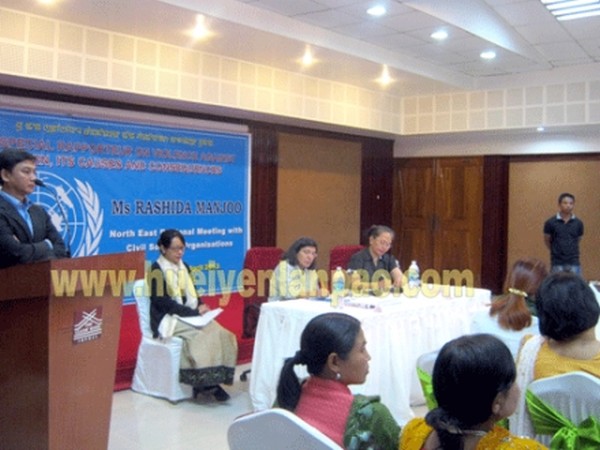
(Executive Director of HRA Babloo Loitongbam delivering the vote of thanks of the meeting)
The Indian agency E-Paonet reports in some detail on the visit by a UN Special Rapporteur to India. Let’s start by acknowledging India’s willingness to accept the Rapporteur (unlike other countries such as Eritrea I just reported on today)!
The Rapporteur in question is Rashida Manjoo the United Nations Special Rapporteur on Violence Against Women, its Causes and Consequences who held a consultative meeting with representatives of civil society organizations, women human rights defenders, victims and other advocates working on violence against women at Classic Hotel, on 28 April. As many as forty separate depositions were made during the meeting, the largest one during her current 10-day long official mission to India from April 22 to May 1. After hearing all the depositions, Rashida observed that it was not her mandate to comment on the depositions made before her, but assured that her report and recommendations would be based on facts and they would be placed on the table of the forthcoming session of the United Nations Commission on Human Rights, which is scheduled to take place June this year at Geneva for necessary actions. Read the rest of this entry »
For many years Dublin-based Front Line Defenders has continued a practice of issuing official-looking cards to whom they judge to be genuine human rights defenders. It is interesting to note that the news service Authint has picked up on this and issued a statement on 2 April 2013 saying: Defenders has issued an identity card to local human rights activist Abdul Qadeer Dar [in Kashmir]. Dar is an Executive Director of Voice of Victims and Chairman Peoples Rights Movement.” “The card is for those human rights defenders who have worked very closely with or have attended one of the Dublin Platforms or trainings”, Front Line told KNS. The “Card doesn’t empower the holder to represent Front Line defenders as it is not a membership organization. The card is intended to demonstrate that its holder is human rights defender with whom front Line Defenders has worked”.
I reported earlier that on 28 February the International Federation for Human Rights (FIDH) and the World Organisation Against Torture (OMCT), in the framework of their joint programme the Observatory for the Protection of Human Rights Defenders, organised a meeting on (legal) restrictions increasingly imposed on human rights defenders. This was followed up on 11 March with an oral intervention at the UN Human Rights Council.
The statement referred to the recently published Annual Report 2013 of the Observatory, which states that NGOs’ access to funding, in particular foreign funding, is increasingly being hindered by governments around the world. Restrictive laws combined with unfounded criticism, smear campaigns and judicial harassment directed against human rights defenders because of the source of their funding create a hostile environment towards their activities as a way to silence them. Belarusian law now prohibits any possibility for an NGO to hold a bank account in an institution based abroad, and criminalises the use of so-called unauthorised funds. These new provisions were adopted as FIDH Vice-President and “Viasna” President Ales Bialiatski was sentenced to 4.5 years’ imprisonment after he made use of foreign funds to finance human rights activities in his country. Read the rest of this entry »
The local NGO Samaj Chetna Adhikar Manch has been working in 20 villages in Madhya Pradesh, India, and has been in the forefront of the struggles to end malnutrition from the area as well as widespread corruption in welfare schemes that defeats all attempts of snatching the children away from the death trap of absolute poverty induced malnutrition. The organisation has earned the ire of the local goons because of its complaint to the National Commission for Protection of Child Rights (NCPCR) that led to an enquiry and consequent dismissal of those responsible for irregularities. The relatives of those dismissed are now harassing and threatening the activists with dire consequences.
The continuing harassment and brazen attacks on the activists of the organisation despite the local administration being aware of the threats is akin to criminal negligence and points to complicity with the accused. T
Under the title “Urgent Appeals, theory and practice“, the NGO ‘Asian Human Rights Commission‘ reflects on the need and increasing practicality (especially thanks to IT) of conducting urgent appeals. The AHRC Urgent Appeals system was created to give a voice to those affected by human rights violations and it now concludes that “Patterns start to emerge as violations are documented across the continent, allowing us to take a more authoritative, systemic response, and to pinpoint the systems within each country that are breaking down. This way we are able to discover and explain why and how violations take place, and how they can most effectively be addressed. On this path, larger audiences have opened up to us and become involved: international NGOs and think tanks, national human rights commissions and United Nations bodies. The program and its coordinators have become a well-used tool for the international media and for human rights education programs. All this helps pave the way for radical reforms to improve, protect and to promote human rights in the region”.
To illustrate the point the AHRC comes at the same time with a call for action against what it calls a “witch hunt” by the Indian authorities against human rights defender Madhuri Krishnaswami of the Jagrat Dalit Adivasi Sangthan. In the most recent attack, the District Magistrate has written a letter to the Divisional Commissioner that found its way to Chief Secretary accusing the organisation to have links with Maoists and have demanded an inquiry into the issue. The attack is not a stray one but comes high on heels of an externment notice served on her by the same district administration in May, 2012 and subsequent attack on a JADS rally by the local goon with the administration looking away. Interestingly, the charge has been refuted by the police with the Inspector General of Police, categorically denying the presence of any Maoists activities in the reason.[The administration, evidently, is working on the behest of deeply entrenched vested interests whose corruption Madhuri and the organisation have continuously been exposing. The current attack, too, is an attempt to divert attention from the massive scam in the implementation of the Mahatma Gandhi National Rural Employment Guarantee Act in the area tipped to be worth more than 150 crore INR.]
At the same time the AHCR expresses great concern over the abduction of 4 human rights defenders in Pakistan by (probably) members of an outlawed religious organization. The unknown armed persons abducted six workers of a NGO including, two lady workers. However, after some time they threw the two women out of the vehicle. It is feared that the abducted workers would be assassinated as has happened in the past. Many health workers and human rights defenders have been killed after their abduction by such ‘religious groups’. The NGO, ‘HAND’, works under the UN programme. The abducted persons and female workers who were working in the Noor Mohammad Village Goth, Mauripur, Karachi, where they have been distributing medicines and rations to the residents for some time. The male abductees were Engineer Amjad Ali Siyal, Mohammad Ashfaq, dispenser, Khurram Ahmad Abbas, dispenser and driver Humayun Ahmad, driver. The released women, Miss. Shakila and Miss. Rashida told police that the kidnappers had taken the four abducted workers in a car towards Balochistan. The police claim that they were abducted by one of the banned Muslim extremist groups who are opposed to the polio vaccination programme and this incident due to the campaign against NGO volunteers. It is believed that the abductors are convinced that they are working for the interests of America or the West.
A short documentary about the five winners of the Human Rights Tulip Award, the award of the Dutch government for human rights defenders. The winners are from Honduras, Congo, Iran, China and India. The films were done by the True Heroes Foundation (THF).
Dutch newspapers and human rights groups concerned with the Dalits (untouchables) report that the winner of the Dutch Human Rights Tulip of 2012 has been barred from traveling to the Netherlands to receive his award in person on Wednesday 9 January. Marimuthu Bharathan, a Dalit human rights defender from Tamil Nadu, was refused a passport by the Indian authorities, according to a press release by International Dalit Solidarity Network (IDSN).This is the second year in a row that the recipient of the Dutch Human Rights award will not be present at the ceremony in The Hague [Last year, Chinese activist Ni Yulan was in custody awaiting trial during the award ceremony.]The jury of the Tulip has recognised Marimuthu Bharathan as a “tireless champion of better living and working conditions for his country’s Dalits”. Himself a Dalit, he works against caste discrimination by supporting Dalits who as manual scavengers are condemned to clean dry latrines with their bare hands. He also sets up Dalit organisations, campaigns for reforms of the corrupt police system, and fights for compensation and rehabilitation of Dalits who suffer human rights violations. Mr Bharathan’s work as director of the Human Rights Education and Protection Council in Tamil Nadu has put him on a collision course with the state’s authorities who consistently prohibit demonstrations for Dalit rights organised by him and disrupt his work.
According to Indian human rights organisations, this refusal appears to be connected with a false murder charge. “The passport refusal is yet another example of the disenfranchised position of the 200 million Dalits and the defenders of their rights in India. The Indian authorities clearly fail in combating discrimination and exclusion of Dalits and are themselves often the perpetrator of crimes against them. The systemic abuse and torture in police stations is an example of that,” said Gerard Oonk, director of the India Committee of the Netherlands and co-ordinator of the Dalit Network Netherlands.
The Jury for the Dutch Human Rights Defenders Tulip has awarded the 2012 Tulip to Marimuthu Barathan (note that the spelling is sometimes Bharatan) from India. It will be presented in The Hague on 9 January 2013. True Heroes is making a filmed portrait on his work.
The jury praised Mr Barathan as a ‘tireless campaigner for better living and working conditions for the Dalits in India’.The Human Rights Defenders Tulip, which is being awarded for the fifth time, comprises a statuette and €100,000 for a project to be decided on in consultation with the recipient.
Front Line Defenders reports on 13 November that since 14 October 2012, the Indian human rights defender Mr. Azimuddin Sarkar and his family have been targeted with threats and intimidation on several occasions, which has been exacerbated by unwillingness on the part of the police to investigate the matter. Azimuddin Sarkar is the District Human Rights Monitor of MASUM, a non-governmental human rights organisation based in Howrah, Kolkata, West Bengal.
On 14 October 2012, a group of 20-25 people, of whom four were identified as locally known thugs, raided the house of Azimuddin Sarkar’s older brother, who was home with his family at the time, in Bardhanpur village, West Bengal state. The thugs reportedly issued threats to Azimuddin Sarkar, saying they would “teach him a lesson” as they threatened the family with weapons and looted the house. An hour after the incident, police appeared on the scene and advised the victims to make a complaint. When the human rights defender’s brother went to the local police station at Raninagar the next day, it is reported that the officer on duty refused to file the complaint, insisting instead to register it only as ‘information received’. A written complaint was sent to the Superintendent of Police at Murshidabad.
On 16 October, Azimuddin Sarkar asked a friend from a non-governmental organisation to make a request to the police to arrest the culprits. The Officer in Charge (OC) at Raninagar station responded that they should leave the matter be, as it was related to MASUM. The OC added that MASUM was not the State Human Rights Commission, and as such “had no right to pressurise the police”. The next day, around 11pm on 17 October, four of the same thugs assembled outside Azimuddin Sarkar’s family home armed with lethal weapons and went on to publicly threaten to kill the human rights defender and his family.
On 19 October, the human rights defender filed a written complaint on the incident with the OC and the Superintendent of police at Murshidabad, supported by multiple eye witnesses. On 5 November, after repeated attempts to call the OC at Raninagar police station, a call from a fellow District Human Rights Monitor at MASUM was returned. All the OC offered regarding police actions on the issue was that he could give no detail of whether any case had been initiated or not. The police have reportedly sent a number of messages to the complainants urging them to withdraw their complaints against the assailants.
Azimuddin Sarkar has been involved in campaigns against the use of torture by the police and Border Security Forces in the area. Currently he is unable to move freely and carry out his work due to the threats. It is believed he is being targeted solely for his legitimate and peaceful human rights activities.
And even in a basically democratic country such as India the ‘sophisticated’ attack on HRDs is possible. In what is perhaps the first international reaction to the Indian government’s heightened scrutiny of NGOs receiving foreign funds, the United Nations Special Rapporteur Margaret Sekaggya has in a report presented at the UN Human Rights Council in Geneva expressed concern about the new regime (introduced by Foreign Contribution Regulation Act). In her report presented on 5 March she observed that some of the provisions of the new Act “may lead to abuse by the authorities when reviewing applications of organisations which were critical of authorities”. Indian law on foreign funds to NGOs worries UN body | Firstpost.


 Hans Thoolen on Human Rights Defenders and their awards