The fourth anniversary of the military coup in Myanmar is a time to mourn the loss of thousands of innocent lives at the hands of a brutal 2025military regime while celebrating the heroism of those who continue to stand up for human rights in a country under siege, a UN expert said on30januaary
“It is also a time for the international community to provide the people of Myanmar a genuine partnership to help end this nightmare,” said Tom Andrews, Special Rapporteur on the human rights situation in Myanmar.
Andrews said four years of military oppression, violence and incompetence have cast Myanmar into an abyss.
“Junta forces have slaughtered thousands of civilians, bombed and burned villages, and displaced millions of people. More than 20,000 political prisoners remain behind bars. The economy and public services have collapsed. Famine and starvation loom over large parts of the population,” the Special Rapporteur said.
“The junta’s plans, including holding sham elections this year in a backdrop of escalating armed conflict and human rights violations, are a path to ruin,” Andrews said.
He said it was not possible to hold a legitimate election while arresting, detaining, torturing and executing leaders of the opposition and when it is illegal for journalists or citizens to criticise the junta.
“Governments should dismiss these plans for what they are – a fraud,” Andrews said.
He lauded pro-democracy activists, journalists, doctors, human rights defenders and citizens from all walks of life who have risked their lives to fight for Myanmar’s future.
“The resilience and courage of Myanmar’s people continue to amaze and inspire others around the world. I am heartened by the courageous efforts of those documenting the junta’s crimes, caring for those injured by the attacks, providing food and shelter to those displaced, and teaching children whose education was upended by the coup. These heroic efforts are compelling indicators that Myanmar’s best days lie ahead,” the expert said.
Andrews said action by member states including targeted sanctions and a crackdown on the arms trade by Singapore have contributed to a one-third drop in the volume of weapons and military supplies the junta has been able to purchase through the formal banking system since the year ending March 2023.
“When governments muster the political will, they help save lives and support freedom in Myanmar,” the Special Rapporteur said, calling for stronger action from the international community. “The failure of the Security Council to take action requires that UN Member States who support human rights coordinate strong, sustained actions that can deny the junta the means to continue its brutality against the people of Myanmar.”
He urged governments to back efforts to hold perpetrators of grave human rights violations accountable, including in the International Criminal Court (ICC), and by supporting the democratic movement and civil society as they build the foundation for a strong justice system and transitional justice processes.
“Impunity has enabled a decades-long cycle of violence and oppression in Myanmar. Ultimately, this sad chapter of Myanmar’s history must end with junta leaders being prosecuted for their crimes,” Andrews said.
On 17 June 2024, Maria Elena Vignoli, Senior Counsel, International Justice Program of HRW, reported on several statements by States to rejects recent intimidation efforts.
Ninety-three member countries of the International Criminal Court (ICC) have declared their “unwavering support” for the court in the face of recent threats. The June 14 statement by an unprecedented number of ICC members across the globe follows a slew of threats, particularly after ICC Prosecutor Karim Khan announced on May 20 that he was seeking arrest warrants against two senior Israeli officials, including Prime Minister Benjamin Netanyahu, along with three Hamas leaders.
On June 4, after the warrant applications were announced, the US House of Representatives passed a bill aimed at imposing sanctions against the ICC, its officials, and those supporting investigations at the court involving US citizens or allies. The bill is now under consideration in the US Senate. The proposed law is reminiscent of the sanctions imposed by President Donald Trump on the previous ICC prosecutor to intimidate the court from pursuing cases against US and Israeli personnel for crimes committed in Afghanistan and Palestine. President Joe Biden revoked those sanctions in 2021 and has so far opposed the current bill.
The ICC is also in Russia’s crosshairs. In 2023, Russian authorities issued arrest warrants against Khan and six ICC judges after the ICC issued an arrest warrant against Russian President Vladimir Putin and another Russian official for war crimes committed in Ukraine. Russian lawmakers also enacted a law criminalizing cooperation with the ICC.
In both the Palestine and Ukraine investigations, ICC officials are simply doing their job. The joint statement sends a strong message that ICC members have the court’s back and will not bow to efforts to undermine its independence.
Kai Ambos in a post on IPS of 23 January 2024 asks: “South Africa is taking Israel to the International Court of Justice. But what are the real chances of a guilty verdict?”
HURIDOCS has been working with urgency to meet the needs of our Ukrainian partners to enable effective, comprehensive and safe documentation of human rights violations. The HURIDOCS Team on 19 April 2022 tells how:
A maternity ward and children’s hospital are hit by an airstrike. Schools and apartment blocks are shelled. A psychiatric facility is attacked. Residential areas are targeted by cluster bombs. Critical infrastructure is struck by missiles. Mass civilian graves are discovered.
These horrendous attacks on civilians in Ukraine, some of them on healthcare facilities, are labelled by the United Nations as ‘acts of unconscionable cruelty’. Russia’s invasion of Ukraine, which started on 24 February 2022, is unfolding as a series of atrocities committed against civilians.
Indiscriminate attacks using missiles, heavy artillery shells, rockets and airstrikes on civilians and non-combatants are in contravention of international humanitarian law and may amount to war crimes. Apart from attacks on civilians, Russia is reported to be shelling agreed-upon humanitarian corridors from conflict zones and therefore halting mass evacuations.
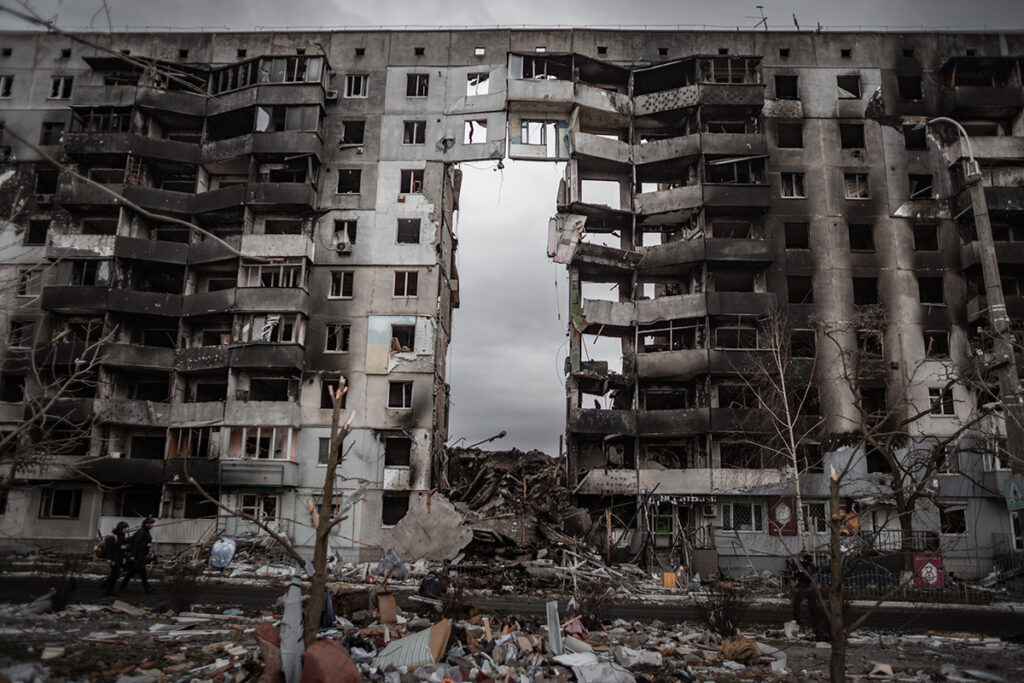
Borodyanka, a Ukrainian commuter town near Kyiv, was among the first places to be hit by Russian airstrikes.
Kyiv Declaration calls for support to groups actively documenting violations
Leaders of more than 100 Ukrainian civil society organisations have published the Kyiv Declaration, which defines the invasion as “a war against the fundamental principles of democracy”. The #KyivDeclaration asks for solidarity and immediate action, and outlines six urgent appeals to the international community. The organisations are collectively calling for the creation of safe zones in Ukraine, military aid, sanctions against Russia, humanitarian aid, freezing assets and revoking visas of prominent Russian families, and providing equipment to track war crimes. This includes technology and support to groups who are actively documenting the events in Ukraine, as well as human rights groups and lawyers who will be supporting accountability efforts in the long run.
An appeal from 100 Ukrainian civil society leaders
HURIDOCS has been working with urgency to meet the needs of our Ukrainian partners to enable effective, comprehensive and safe documentation of human rights violations.
“When Russia started its full-scale invasion in February this year, we revived the work of EuromaidanSOS. We are faced with a large number of war crimes that need to be documented. Among these are indiscriminate attacks on civilians and civilian objects, deliberate killings, torture, cruel and inhumane treatment, enforced disappearances and other crimes listed in the Rome Statute. Such acts are not justified by any circumstances of the war. Russia is simply using war crimes as a way of waging war.
Our volunteers from EuromaidanSOS are based in different parts of the country, and some of them work directly in hot spots, where they face constant connectivity issues. This is why usable technical solutions are indispensable. As this work is undertaken in the context of war, it is important to have qualified technology support. We are very grateful to the organisations, such as HURIDOCS, providing it in this difficult time for us.”– Oleksandra Matviychuk, Head of the Center for Civil Liberties and Board Member of HURIDOCS
Documenting violations is vital for accountability
Four days into the Russian invasion, the International Criminal Court (ICC) Prosecutor opened an investigation into war crimes being committed in Ukraine. In conjunction with the investigation, the ICC launched a contact portal and anyone with relevant information is urged to come forward and share the details with the ICC. The United Nations Human Rights Council expressed that it is gravely concerned about the escalating human rights and humanitarian crisis and passed a resolution to establish a Commission of Inquiry. The Commission will first and foremost collect evidence of violations and those responsible, and subsequently submit reports to the Human Rights Council and General Assembly. The Federal Prosecutor’s Office in Germany has launched an investigation by collecting evidence of suspected crimes on civilians and critical infrastructure. Germany’s probe is based on the principle of universal jurisdiction, which allows countries to prosecute crimes against international law outside of its borders.
The United Nations High Commissioner for Human Rights released a statement where she expressed horror by the images of civilian bodies on the streets and in improvised graves in the town of Bucha. She stated that reports of egregious crimes raise serious questions about possible war crimes and grave breaches of international and humanitarian law. She urged that “it is vital that all efforts are made to ensure there are independent and effective investigations into what happened in Bucha to ensure truth, justice and accountability, as well as reparations and remedy for victims and their families”.
In addition to these and other measures already underway to investigate possible war crimes and breaches of international and humanitarian law, some of the most authoritative civil society organisations in Ukraine have established a global initiative to seek justice and hold perpetrators accountable. The ‘Breaking the Vicious Circle of Russia’s Impunity for Its War Crimes’ initiative was jointly established by the Ukrainian Helsinki Human Rights Union, the Kharkiv Human Rights Protection Group and the Center for Civil Liberties, and is also known as the ‘Tribunal for Putin’.
The Tribunal for Putin aims to document events which can be classified as genocide, crimes against humanity and war crimes under the Rome Statute of the International Criminal Court. The Tribunal for Putin will also collect evidence and facts on the crimes committed and will work with existing international mechanisms of the United Nations, Council of Europe, OSCE, EU and the International Criminal Court. The initiative has called for support from various actors such as international organisations, networks, government agencies, public associations, volunteer initiatives and groups who all share the common goal of restoring peace in Ukraine and ensuring that justice will prevail.
Civil society plays a crucial role in seeking justice
In this context, it is clear that the systematic documentation of human rights violations, irrespective of who is committing the transgression, is critical to achieving justice and accountability. Documentation should not only be undertaken to assist future justice and accountability mechanisms but also to support the process of reckoning and healing.
Civil society plays a key role in efforts to document and monitor violations, and to build and strengthen cases for accountability. Civil society actors are usually the first to respond to crises, have the deepest community reach and can mobilise the people who are living through these experiences. Documenting human rights violations as they happen is imperative in the process of restoring justice. To effectively and safely assist the community there is a need for strong digital tools to gather, process, preserve, manage, protect and analyse the rapidly growing bodies of potential evidence, including large amounts of storage-intensive video. In addition, deterrence against the worst violations can also be established through credible documentation strategies.
HURIDOCS is a longtime supporter of civil society organisations and human rights defenders who use human rights documentation strategies and tools as a means to strengthen accountability and advocate for justice. We are already supporting a number of groups working on documenting human rights violations in Ukraine and HURIDOCS invites other initiatives who need support with their documentation efforts to contact us. We value diverse approaches to documenting violations, as it may strengthen accountability measures and aid in articulating narratives during the process of memorialisation.
Support for documenting violations in Ukraine
With the increased need for support to document violations in Ukraine to strengthen accountability, the Alfred Landecker Foundation has partnered with HURIDOCS to increase our capacity to support civil society-led initiatives where our expertise can be helpful. HURIDOCS is grateful to the Foundation for the support, as it comes at a time when documenting threats to peace, justice and democracy is critical. The support from the Alfred Landecker Foundation will be used to assist groups who are already participating in documentation efforts, and to aid other initiatives related to documenting violations in Ukraine.
HURIDOCS is currently supporting our partners in the following ways:
Training and consultation on information collection, protection and management techniques and associated tools, such as Uwazi;
Setting up digital information repositories to securely store sensitive data;
Refinement and integration of existing technology solutions to document, protect and analyse evidence of human rights violations; and
Hardening and scaling infrastructure to preserve and protect large amounts of information.
There is a significant and growing need to support organisations with their efforts to gather, process, preserve, manage, protect and analyse information on abuses. Reliable documentation of violations is essential for the restoration of justice in the pursuit of upholding democracy and human rights.
US President Joe Biden’s cancellation of punitive sanctions targeting the International Criminal Court (ICC) removes a serious obstacle to the court’s providing justice to the victims of the world’s worst crimes, Human Rights Watch said on 2 April 2, 2021. Biden revoked a June 2020 order by then-President Donald Trump authorizing asset freezes and entry bans to thwart the ICC’s work. This was expected after an appeal by many NGOs, see: https://humanrightsdefenders.blog/2021/02/19/large-group-of-ngos-call-on-biden-administration-to-repeal-icc-sanctions/
In announcing the repeal of the executive order, Secretary of State Antony Blinken said that “[t]hese decisions reflect our assessment that the measures adopted were inappropriate and ineffective.” The State Department also lifted existing visa restrictions.
“The Trump administration’s perversely punitive sanctions against the ICC showed stark contempt for the victims of grave international crimes and the prosecutors who seek to hold those responsible to account,” said Richard Dicker, international justice director at Human Rights Watch. “In removing this unprecedented threat to the global rule of law, President Biden has begun the long process of restoring US credibility on international justice through the ICC.”
On 17 February 2021, more than 70 Non-Governmental Organizations, Faith-Based Groups and Academic Institutions called for the Biden Administration to Repeal ICC Sanctions:
The undersigned organizations urge the Biden Administration to engage constructively with the International Criminal Court (ICC). The U.S. government’s support for the ICC could help secure justice for victims in situations from Myanmar to Darfur, just as it helped facilitate the February 4 historic conviction of a former leader of an armed rebel group for war crimes and crimes against humanity in northern Uganda.There is an immediate need to act to reset U.S. policy regarding the ICC. Most urgently, we are alarmed by recent calls for the U.S. government to maintain or even expand the sanctions put into place by the Trump administration in June 2020 currently targeting the court’s work.These actions were an unprecedented attack on the court’s mandate to deliver justice and the rule of law globally, an abuse of the U.S. government’s financial powers, and a betrayal of the U.S. legacy in establishing institutions of international justice. They were also an attack on those who engage with the court, including human rights defenders and victims. These extraordinary measures have put the U.S. at odds with many of its closest allies. They also have been challenged on constitutional grounds domestically. Keeping in place the executive order authorizing sanctions would be inconsistent with the new administration’s laudable commitments to respecting the rule of law and pursuing multilateral cooperation in support of U.S. interests. It would also transform a shameful but temporary action into a standing license for other governments to attack multilateral institutions when they disagreewith those bodies’ actions. We call upon the U.S. government to rescind Executive Order 13928 and all sanctions measures against ICC officials at the earliest possible opportunity. We appeal for constructive engagement with the ICC and we urge the Biden administration and members of Congress to support that approach.
This statement was coordinated by the Washington Working Group for the International Criminal Court (WICC), an informal and nonpartisan coalition of diverse NGOs, including human rights organizations, faith based groups, professional associations, and others.
The Advocates for Human Rights, Allard K. Lowenstein International Human Rights Clinic, Yale Law School, American Civil Liberties Union (ACLU), American Jewish World Service (AJWS), Amnesty International USA, Anti-Torture Initiative, American University Washington College of Law, Associazione Luca Coscioni, Center for Civilians in Conflict (CIVIC), Center for Constitutional Rights (CCR)Center for Justice and Accountability Center for the Study of Law & Genocide, Loyola Law School, Center for Victims of Torture (CVT) Congregation of Our Lady of Charity of the Good Shepherd, US, Provinces Darfur Women, Action Group Democracy for the Arab World Now (DAWN), Eumans European Center for Constitutional and Human Rights, Fortify Rights, Global Centre for the Responsibility to Protect, Global Justice Center, Global Justice Clinic, New York University School of Law, Guernica 37, Chambers and Centre for International Justice, Human Rights and Gender Justice Clinic, City University of New York School of Law, Human Rights FirstHuman Rights Institute, Georgetown University Law Center, Human Rights Watch, Institute for Policy Studies, Drug Policy Project, Institute for Policy Studies, New Internationalism Project, International Association of Democratic Lawyers, International Center for Transitional Justice (ICTJ). International Commission of Jurists (ICJ), International Criminal Court Alliance (ICCA), International Federation for Human Rights (FIDH), International Human Rights Clinic, Boston University School of Law, International Human Rights Clinic, Harvard Law School, InterReligious Task Force on Central AmericaJ . StreetJustice for Muslims Collective. Leitner Center for International Law and Justice, National Advocacy Center of the Sisters of the Good Shepherd. Never Again Coalition, No Peace Without Justice, Open Society Foundations, Operation Broken Silence, Parliamentarians for Global Action (PGA), Partners in Justice International, Pax Christi USA, Physicians for Human Rights, Presbyterian Church (USA), Office of Public Witness, Project Blueprint,The Promise Institute for Human Rights, UCLA School of Law REDRESS, The Rendition Project
On 11 June 2020 Visiting Fellow William Burke-White posted on the website of Brookings an informative piece “Order from Chaos” in which he reviews the danger of Trump’s new sanctions on the International Criminal Court and human rights defenders. It is worth reading and studying in full….:
In March, the Appeal’s Chamber of the International Criminal Court (ICC) authorized an investigation of potential war crimes alleged to have occurred more than a decade ago in Afghanistan, including those by the United States. While the U.S. military under President Obama did conduct investigations of its activities in Afghanistan, there remain concerns that those investigations did not go far enough up the chain of command and did not adequately include conduct by the U.S. intelligence community. In a post on this blog just after the decision, I argued that the Trump administration’s threats to prevent such a case may have actually pushed the court toward such an investigation.
Today, the Trump administration issued unprecedented sanctions against the ICC, as well as the international lawyers and human rights investigators involved in the case. This sanctions regime is fundamentally misguided. It will do little to stop the ICC’s investigation, erodes the U.S. longstanding commitment to human rights and the rule of law, and may undermine one of the most powerful tools in the U.S. foreign policy arsenal — economic sanctions.
What emergency? In a moment of real national emergencies — ranging from the COVID-19 pandemic, to police misconduct, to the highest unemployment rate in a generation — the fact that President Trump, in an executive order on June 11, “declare[d] a national emergency to deal with” the threat posed by the ICC investigation in Afghanistan seems almost farcical. An underfunded court with relatively little to show for two decades of work trying to end impunity would likely be surprised to learn that, in Trump’s view, it has the power to “impede the critical national security and foreign policy work of United States Government and allied officials, and thereby threaten the national security and foreign policy of the United States.” Admitting that a duly authorized investigation of U.S. conduct in Afghanistan constitutes such a threat is both a recognition of the power of international law and a suggestion that the U.S. has something to hide.
Of course, declaring a national emergency is a necessary precondition for the sanctions imposed on the ICC and its officials. While the U.S. has had a complicated history with the ICC — from President Bill Clinton’s signing of its founding treaty to President George Bush’s early efforts to undermine the court — the new sanctions go further than any past U.S. actions in their direct attack on the ICC and its staff. Bush’s “unsigning” of the Rome Statute was largely symbolic. So, too, was the American Service members Protection Act that threatened to invade the Netherlands to rescue any U.S. citizens that might be prosecuted in The Hague.
In contrast, today’s sanctions directly target individual international lawyers and investigators working for a legitimate international organization undertaking lawful actions under its statute. More specifically, today’s sanctions seize the property of to-be-designated ICC officials who undertake investigation or prosecution of U.S. personnel and any other foreign nationals who are deemed to have assisted such efforts. So too, the new sanctions prohibit the entry into the United States of such individuals and their immediate family members.
The sanctions language is sufficiently broad that it could, in theory, apply to a victim or witness who provided information incidental to the court’s investigation or an academic whose scholarship the court relied upon in framing a legal argument. This new sanctions regime draws strong parallels to those imposed by the U.S. in the past against terrorist groups, dictators, and human rights abusers. Those same sanctions are now turned on international lawyers and human rights defenders.
The sanctions imposed today on ICC officials are unlikely to achieve Trump’s objective of blocking the investigation of U.S. conduct in Afghanistan. If anything, the sanctions will redouble those efforts. Unlike most corrupt dictators or terrorist organizations, individuals who choose to work for the ICC or in international human rights more generally are motivated by conscience, not wealth. They rarely have significant assets in U.S. bank accounts or meaningful real property for the U.S. to seize. Similarly, the foreign victims of crimes in Afghanistan who might testify before the ICC are not likely to have assets subject to seizure.
Hence, the threat of such a seizure under this new sanctions regime will do little to deter investigation or cooperation. Even blocking ICC employees from entering the U.S. will have minimal impact. Effective investigation of crimes in Afghanistan more than a decade ago does not require on-the-ground presence in the U.S. today. In fact, given the moral compass of most human rights advocates and international criminal prosecutors, treating them like terrorists under this new sanctions regime will more likely be a call to action under the law than an effective threat.
This new sanctions regime is a direct affront to international human rights and, particularly, individuals who have dedicated their lives to enforcing international law and ending impunity. President Trump has a long history of attacking international institutions that he doesn’t like. His recent criticisms of the World Health Organization are case in point. This new attack on the ICC is, however, different because it targets not just another international institution, but also the individuals who work for that institution. As such, it is an effort to directly sanction human rights defenders and officials of international justice for doing their jobs. The new sanctions regime seeks to punish those individuals, working for an international organization created by a treaty the United States signed in 2000, and undertaking a legal investigation authorized by a panel of international judges. It flies in the face of every U.S. and international effort to protect human rights defenders and offers a powerful example for despots around the world to follow suit.
Other, better tools
Finally, the use of U.S. sanctions against ICC personnel is a dangerous step toward undermining one of the most powerful and important tools of U.S. foreign policy — international sanctions. In a world where the use of force is difficult and often ineffective, carefully crafted and strategically applied sanctions are a key tool of U.S. power. For sanctions to work, however, they must be used judicially and viewed as broadly legitimate. Overuse of sanctions creates incentives for actors to find work-arounds to avoid the pain. Sanctions that are seen as illegitimate fail to garner international cooperation for enforcement and compliance. Applying tough sanctions against the personnel of an international organization undermines their efficacy and legitimacy for times when they could actually advance U.S. national security.
So, what should Trump have done instead? Simply investigate and prosecute any crimes that the U.S. may or may not have committed in Afghanistan years ago. The Rome Statute of the ICC makes clear that the court is a backstop to national prosecutions and that it will not investigate or prosecute when national governments have held themselves and their soldiers accountable. If the U.S. did nothing wrong in Afghanistan, it could simply submit to the ICC evidence of a genuine investigation with respect to both military and intelligence agency activities that reached that conclusion. And if there are violations of the laws of war in Afghanistan that have yet to be adequately investigated and prosecuted, then the U.S. has a legal and moral duty to ensure that those perpetrators are held accountable. To do so would uphold the rule of law and provide a concrete step toward renewing America’s human rights leadership.
UN Human Rights Office). The study documents incidents from nearly 50 countries, such as the detention and imprisonment of activists, and the filming of participants at meetings, including on UN premises, without their consent. Andrew Gilmour, UN Assistant Secretary-General for Human Rights, said there are also cases of authorities threatening and harassing relatives of activists. “Some governments seem prepared to go to almost any lengths to punish people who cooperate with us. This may actually underscore the justice of the victims’ causes,” he said. The report covers the period from 1 June 2018 to 31 May of this year. It also notes misuse of online spaces to promote hate speech, cyberbullying and smear campaigns, particularly against women and lesbian, gay, bisexual, transgender and intersex persons. Mr. Gilmour expressed concern over the continued trend in the use of national security arguments and counter-terrorism strategies as justification for blocking access to the United Nations. “Reported cases include individuals or organizations being charged with terrorism, blamed for cooperation with foreign entities or accused of damaging the reputation or security of the State. These have also been used to justify restrictions on foreign funding,” he wrote in the report’s conclusions and recommendations. “A disproportionate number of cases of enforced disappearance or detention, many which have been deemed arbitrary by United Nations experts, relate to these national security arguments. This is a worrisome trend that I have addressed publicly, including in my previous report, and, regrettably, it continues.” He said the UN will continue to strengthen its response to these developments, including through improved reporting on allegations. However, he added, the onus remains on countries as “Member States must be accountable for their own actions and practices, and provide remedy when reprisals occur. [see also: https://humanrightsdefenders.blog/2019/09/17/intimidation-and-reprisals-on-un-premises-ngos-ask-for-more-action/%5D
However, the ISHR – which has followed the phenomenon much more systematically, made a more detailed and sombre assessment on 19 September: “Beyond rhetoric – States should step up efforts to prevent reprisals”
It notes that during the second interactive dialogue on reprisals with the Assistant Secretary-General, only Germany and Costa Rica raised specific cases of reprisals in Egypt and Nicaragua, respectively. The Bahamas and the Maldives shared good practices. Other States condemned reprisals rhetorically, expressing particular concern about reprisals and intimidation against women human rights defenders and LGBTIQ defenders, as well as by Council members.
During the dialogue Germany followed up again on the case of Egyptian lawyer Ebrahim Metwally who was arrested on his way to Geneva to attend a meeting with the Working Group on Enforced and Involuntary Disappearances. He was tortured and has been detained since September 2017. During the first interactive dialogue in September 2018, Germany was the only country to raise concern over an individual victim of reprisals. Costa Rica was the only other country to raise a specific situation of reprisals this year: it expressed particular concern about acts of intimidation and reprisals in Nicaragua.
The Bahamas responded to the allegations of intimidation and reprisals against woman human rights defender Alicia Wallaceafter she engaged with the Committee on Elimination of all forms of Discrimination against Women (CEDAW). She and her colleagues were subjected to hate speech by a well-known radio personality, the effect of which was to create an unsafe environment for Ms. Wallace and other women human rights defenders. The Bahamas affirmed its commitment to protect human rights defenders and ensure that they can engage freely with the UN. The delegation told the Council that authorities proactively provided assistance to Ms. Wallace to guarantee her safety.
The Maldives also told the Council that it is investigating the deaths of human rights defender Yameen Rashidand journalist Ahmed Rilwan to bring the perpetrators to justice; that the defamation law providing imprisonment sentences for journalists was repealed in November 2018; and that an amendment to the Human Rights Commission Act is currently considered in parliament, which would guarantee that the Commission can communicate with international organizations. The Maldives agreed with the Assistant Secretary-General that the powerful impact of prevention is through a zero tolerance policy for reprisals and committed to condemn all reprisals as a matter of urgency. The Maldives admitted that that they ‘have seen it first hand and do not want to bear witness to it again!’.
In its statement during the interactive dialogue, ISHR asked the Assistant Secretary-General what steps should be taken to ensure a more comprehensive report to the Council. This came in response to notably missing cases that ISHR submitted implicating Brazil, Russia and the United States. The Assistant Secretary-General acknowledged ISHR’s leading role in efforts to end reprisals, expressed his concern regarding the situations mentioned, but disagreed with ISHR’s statement that Secretary-General Guterres is pandering to certain States, ignoring victims’ legitimate claims and undermining efforts to protect victims from reprisals. He explained that the particular case raised by ISHR concerning remarks made by the then U.S. National Security Adviser, Mr. John R. Bolton, and the U.S. Secretary of State, Mike Pompeo did not fall under the reporting mandate of the Secretary-General as the intimidation related to the International Criminal Court. However, ISHR recalls that the Secretary General’s 2018 reprisals report stated that ‘while recognising the independent judicial character of the International Criminal Court, the Court is regarded as a related organisation in the United Nations’ and cases related to the ICC have been included several times previously, for example:
The 2018 reprisals report documented that two defenders in Iraq faced reprisals after attending a preparation meeting for a conference aimed at calling on Iraq to join the Court (para 29).
The 2017 reprisals report included Israel in the reprisals report regarding incidents of reprisals and intimidation of defenders engaging with or promoting engagement with the International Criminal Court (para 39).
Read ISHR’s full statement at the interactive dialogue here.
Jessica Corbett, staff writer for Common Dreams writes on 25 March “‘Blatant Effort to Intimidate and Retaliate’: Pompeo Imposes Visa Ban on ICC Staff Probing US War Crimes“
Secretary of State Mike Pompeo announced new visa restrictions in a press briefing on Friday. (Photo: U.S. State Department)
Human rights defenders expressed outrage on Friday after Secretary of State Mike Pompeo revealed that the Trump administration is revoking or denying visas for any International Criminal Court (ICC) personnel who try to investigate or prosecute U.S. officials or key allies for potential war crimes. The move, Pompeo confirmed is a direct response to ongoing efforts by the ICC to probe allegations of war crimes and crimes against humanity tied to the war in Afghanistan. There was an immediate and almost unanimous outcry by the key human rights NGOs in the USA:
Jamil Dakwar, director of the ACLU‘s Human Rights Program (the ACLU currently represents Khaled El Masri, Suleiman Salim, and Mohamed Ben Soud, who were all detained and tortured in Afghanistan between 2003 and 2008): “This is an unprecedented attempt to skirt international accountability for well-documented war crimes that haunt our clients to this day,” Dakwar said. “It reeks of the very totalitarian practices that are characteristic of the worst human rights abusers, and is a blatant effort to intimidate and retaliate against judges, prosecutors, and advocates seeking justice for victims of serious human rights abuses.”
Richard Dicker, international justice director at Human Rights Watch,called it “an outrageous effort to bully the court and deter scrutiny of U.S. conduct.” He encouraged ICC member countries to “publicly make clear that they will remain undaunted in their support for the ICC and will not tolerate U.S. obstruction.”
Daniel Balson, advocacy director at Amnesty International USA, noted that this is just “the latest attack on international justice and international institutions by an administration hellbent on rolling back human rights protections.” Visa bans, as Balson pointed out, are “powerful tools typically reserved for the most serious of human rights abusers.” But rather than targeting global criminals, the Trump administration has set its sights on the ICC—an impartial judicial body that aims to promote accountability under international law by probing and prosecuting crimes of aggression, crimes against humanity, war crimes, and genocide.
The move is “is highly indicative of [the administration’s] culture of disregard for rights abuses,” said Balson. “Throwing roadblocks in front of the ICC’s investigation undermines justice not only for abuses committed in Afghanistan, but also for the millions of victims and survivors throughout the world who have experienced the most serious crimes under international law.”
Pompeo’s announcement came after John Bolton, President Donald Trump’s national security adviser and a longtime critic of the ICC, threatened to impose sanctions on court officials in September if they continued to pursue an investigation of potential crimes by U.S. civilians or military personnel in Afghanistan….”These visa restrictions may also be used to deter ICC efforts to pursue allied personnel, including Israelis, without allies’ consent,” Pompeo added. “Implementation of this policy has already begun.”
Africa on Line of 23 January 2018 report that human rights defenders NGOs have urged Liberian President Weah to prosecute war crimes.
Twenty international, African and Liberia-based human rights organizations have sent an open letter to Liberian President George Weah, calling on his administration to investigate and prosecute war atrocities. According to a release by the Center for Justice and Accountability based in the United States, the groups also called upon President Weah “to make accountability a priority” for his administration and “ensure the protection of Liberian human rights defenders, particularly those working on accountability initiatives.“
The Center for Justice and Accountability describes the two phases of Liberia civil war, which caused the killings of an estimated 250,000 people and request that the atrocities are investigated and prosecuted. “A report by Liberia’s Truth and Reconciliation Commission (TRC) released in June 2009 found all sides responsible for serious violations of domestic and international law, including war crimes, crimes against humanity, widespread and systematic rape and sexual slavery, torture, use and recruitment of child soldiers, and mass executions of civilians,” the release said.
“Although the TRC recommended the establishment of an Extraordinary Criminal Tribunal in Liberia to investigate and prosecute perpetrators of serious violations of international criminal and humanitarian law, the only prosecutions to date have been outside of Liberia,” it added. Hassan Bility, Executive Director of Monrovia based Global Justice and Research Project and one of the authors of the open letter said: “Justice must be one of the cardinal points of the President’s new agenda. There must be justice for war crimes, otherwise there will be no lasting peace in Liberia.” Mr. Bility, a former journalist and torture survivor of the civil war, helped initiate the arrests of several Liberian perpetrators in Europe and the U.S. in partnership with the Swiss based NGO, Civitas Maxima.
President Weah, during his inaugural address, assured that his administration would protect human rights and justice for all Liberians: “Today, we Liberians have reached an important milestone in the never-ending journey for freedom, justice, and democracy; a search that has remained central to our history as a nation,” .
Reacting to the speech on Monday, Mr. Bility told FrontPageAfrica the President’s commitment to social justice and human rights would make some difference…“This is an opportunity for him to right many of the things that probably slipped through the safety net of the Ellen administration,” he added.
Recent cases such as the conviction of Jungle Jabbah in Philadelphia and the indictments of other alleged war criminals in Europe and the U.S. have shown that prosecuting war criminals will not reignite the civil war in Liberia, as has often been feared, added Nushin Sarkarati, Senior Staff Attorney at the Center for Justice and Accountability. “It is time to bring these examples of justice home, and make ending impunity in Liberia a priority.”
However, as the the Economist on 4 January 2018 says: Yet there are doubts about the kind of leader Mr Weah will be. Since his election as a senator in 2014, he has rarely attended parliament. Nor has he introduced or co-sponsored any legislation. Mr Weah’s relative lack of education, though, only seems to make him more popular. His supporters see the former slum-dweller as one of them—a champion from their streets. Much will depend on the ministers and advisers with whom he surrounds himself. Liberia needs better roads and schools, more jobs and electricity, and a thousand other things. Presidents, unlike footballers, must aim at multiple goals.


 Hans Thoolen on Human Rights Defenders and their awards