Posts Tagged ‘human rights’
September 8, 2013

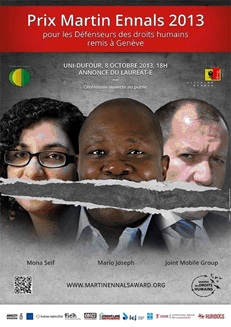
2013 Martin Ennals Award ceremony
October 8th, 2013, 6 pm
Please subscribe online: http://www.martinennalsaward.org
The Martin Ennals Foundation and the City of Geneva announce the 20th ceremony of Martin Ennals Award for human rights defenders. This event is integrated within Human Rights Week, a four-day event organized at the University of Geneva. This ceremony is open to the public. All who are interested in human rights are welcome to come and pay tribute to these men and women who are engaged in the defense of human rights, often risking their lives. It is crucial that the public knows the work of these individuals, not only in Geneva but also at the international level, in order to ensure that they can benefit from a certain degree of protection.
The following 3 nominees were carefully selected by the Jury of the Martin Ennals Award, made up of ten of the world’s leading human rights organisations:
- Ms Mona Seif (Egypt) who is one of the core founders of the ”No To Military Trials for Civilians”, a grassroots initiative that aims to stop military trials for civilians in Egypt.
- The Joint Mobile Group (Russia) seeks accountability for human rights abuses in Chechnya, notably enforced disappearances, torture in custody, and extra-judicial executions.
- Mr Mario Joseph (Haïti) has been referred to as Haiti’s most prominent human rights lawyer, and has worked on some of the most important cases including the one against former dictator Jean-Claude “Baby Doc” Duvalier.
Ms Navanethem Pillay, United Nations High Commissioner for Human Rights, will present the award to one of these nominees. The ceremony will be held in French and in English at Uni-Dufour, Jean-Piaget auditorium, U-600 at 6 pm. A live broadcast will be given in the Charles-Rouiller auditorium, U-300, located in the same building and it should also be streamed on the internet.
Posted in films, human rights, Human Rights Defenders, MEA | 2 Comments »
Tags: 2013 ceremony, City of Geneva, Egypt, Final Nominees for the Martin Ennals Award 2013, Geneva, Haiti, human rights, human rights awards, Joint Mobile Group, Mario Joseph, Martin Ennals Award, MEA, Mona Seif, Office of the United Nations High Commissioner for Human Rights, Russia, United Nations, University of Geneva
September 6, 2013

( Photo: EPA)
The piece below, taken from the Voice of Russia of 6 September 2013, is interesting for a number of reasons:
1. it addresses the almost comical issue of basing the Arab Court of Human Rights in Bahrain
2. it quotes at length the (understandably) sarcastic comments by Brian Dooley of Human Rights First in the Huffington Post
3. it is lovely example of a different but biased geopolitical perspective: Read the rest of this entry »
Posted in HRF, human rights, Human Rights Defenders | Leave a Comment »
Tags: Al-Jazeera, Arab Court of Human Rights, Arab League, Bahrain, Bahrain Centre for Human Rights, Bashar al-Assad, Boris Volkhonsky, Brian Dooley, Huffington Post, human rights, Manama, Maryam Alkhawaja, massive violations, politics, Voice of Russia
September 6, 2013
Truth commission archives are an important part of dealing with the past, which is a long-term process addressing a legacy of human rights violations. Read the rest of this entry »
Posted in human rights, Human Rights Defenders, UN | Leave a Comment »
Tags: archives, documenting, human rights, Human Rights and Liberties, human rights violations, impunity, meeting, Office of the United Nations High Commissioner for Human Rights, science, side event, Special Rapporteur, Swisspeace, Switzerland, Truth and Reconciliation Commission, Truth commissions, United Nations Human Rights Council
September 5, 2013
On 7 April 2013 I posted on this blog the announcement of the Anti-kidnap alarm for human rights defenders in form of the Natalia bracelet launched in Stockholm by Civil Rights Defenders.
This was followed 10 days later, 17 April, by a post referring to the Panic Button developed by Amnesty International (“How to turn a mobile phone into an alert system for human rights defenders: AI’s Panic Button”).
Now the New York based Human Rights foundation announces its Partnership with global encrypted communications firm Silent Circle to protect the private communications of political dissidents, human rights groups, and civil society organizations in at-risk scenarios. (http://humanrightsfoundation.org/HRF-Announces-Silent-Circle-Partnership-to-Support-Dissidents-04-09-2013.php)
There exist already the older and more wide-ranging tools of: “Security in a Box” (a collaboration between Front Line and Tactical Tech Collective – see http://security.ngoinabox.org/welcome) and Protection International‘s on-line Manual: http://protectioninternational.org/publication/new-protection-manual-for-human-rights-defenders-3rd-edition/.
While these (and perhaps other tools that I have missed!) may have all different features, the question could be asked who among the hard-pressed human rights defenders on the ground have the time and energy to sort through all this and pick what is most meaningful for them? Competition may well bring out the best but can also be confusing.
Posted in Front Line, human rights | 4 Comments »
Tags: Amnesty International, Civil Rights Defenders, Human right, human rights, Human rights defender, Human Rights Foundation, information technology, internet, Natalia project, Panic Button, protection, Protection International, Security-in-a-box, Silent Circle, Tactical Tech Collective, technology
September 4, 2013


On 28 May 2012 I congratulated Loreen – the Swedish winner of the Eurovision song festival – as she was the only of the contesting artists who stood up for human rights. During her visit to Baku she visited human rights defenders at risk during a meeting the NGO Civil Rights Defenders arranged. The Government of Azerbaijan tried to downplay the issue by saying that music and human rights have to be separate, but it is shocking that a number of musicians seem to agree with this position.
The New-York based Human Rights Foundation, on 3 September 2013, reports that the American musician Kanye West performed at the wedding of President Nursultan Nazarbayev’s grandson last Saturday night in Kazakhstan. He reportedly received $3 million for the private engagement in the oil-rich former Soviet state, which has been autocratically since 1991. West’s lucrative private performance comes on the heels of a similar concert given by Jennifer Lopez for the dictator of neighboring Turkmenistan earlier this summer, which sparked a worldwide media interest. At the time, Lopez claimed ignorance of Turkmenistan’s notorious human rights abuses. West is not the first global celebrity to be approached to play in Kazakhstan: in 2011, Sting refused to play a private concert there, citing concern over the repression of workers in the country.
Posted in human rights, Human Rights Defenders | 2 Comments »
Tags: Azerbaijan, dictatorship, Eurovision Song Contest, eurovision song festival, human rights, Human Rights Foundation, Jennifer Lopez, Kanye West, Kazakhstan, Loreen, music, Nursultan Nazarbayev, Sting, Turkmenistan
September 4, 2013
The Business Standard reports on 4 September that Human Rights Watch urged the Fiji government to amend articles that undermine human rights in a draft constitution scheduled to be promulgated Friday. Under the current draft, significant restrictions in articles 17, 18 and 19 would allow the government to interfere with key rights of freedom of expression, assembly and association. The draft constitution sets out broad limitations to these rights “in the interests of national security, public safety, public order, public morality, public health, or the orderly conduct of elections”. In January, the government scrapped a draft of the constitution developed by a committee headed by a noted constitutional and human rights lawyer, Yash Ghai, and handed duties to draw up the constitution to government legal officers in the attorney generals chambers.”This draft constitution represents a major step backwards for human rights from the constitution thrown out by Fiji’s military in April 2009,” said Phil Robertson of Human Rights Watch.”Unless the government revises this draft constitution to guarantee freedom of association, assembly and expression, its hard to see how Fiji could become a rights-respecting democracy.” Since Commodore Frank Bainimarama took power in a military coup 5 December 2006, his government has consistently attacked critics, including arbitrarily detaining them, and instituted heavy censorship. The military and police have indiscriminately arrested and detained human rights defenders, journalists and labour leaders.
via Fiji urged to revise draft constitution | Business Standard.
Posted in HRW, human rights, Human Rights Defenders | Leave a Comment »
Tags: Constitution, controversial restrictions, Fiji, Frank Bainimarama, freedom of association, freedom of expression, human rights, Human rights defender, Human Rights Watch, National security, Politics of Fiji, Yash Ghai
September 3, 2013
A recent 100-page report by Human Rights Watch, “Tightening the Screws: Azerbaijan’s Crackdown on Civil Society and Dissent,” documents the dramatic deterioration of the government’s record on freedom of expression, assembly, and association in the past 18 months. The authorities have arrested dozens of political activists on bogus charges, imprisoned critical journalists, broken up peaceful public demonstrations, and adopted legislation imposing new restrictions on fundamental freedoms. Read the rest of this entry »
Posted in HRW, human rights, Human Rights Defenders | Leave a Comment »
Tags: activism, Azerbaijan, Civil society, critical journalists, Election, facebook, freedom of expression, Giorgi Gogia, HRW, human rights, Human Rights Defenders, Human Rights Watch, illegal detention, imprisonment, judicial harasment, protest, twitter
September 3, 2013
 (Special Rapporteur on the right to freedom of peacful assembly and of association Maina Kiai. UN Photo/Jean-Marc Ferré)
On 9 August 2013 three independent
United Nations Rapporteurs jointly called on the Government of
Uganda to repeal a new bill that places restrictions on the freedom of peaceful assembly and of association, and to prepare a new version that complies with the country’s international human rights obligations.
Read the rest of this entry »
Posted in human rights, Human Rights Defenders, UN | Leave a Comment »
Tags: Frank William La Rue, freedom of assembly, freedom of association, human rights, Human Rights Defenders, human rights obligations, kiai, legal restrictions, Maina Kiai, Margaret Sekaggya, peaceful assembly, police intimidation, Politics of Uganda, Special Rapporteur, Uganda, United Nations, United Nations Special Rapporteur
September 2, 2013
On 28 August 2013, 50 years after Dr. Martin Luther King delivered his historic “I Have a Dream” speech, Corinne Duffy of Human Rights First (HRF) gives an interesting palette of stories how his words and action continue to inspire HRDs everywhere: 
Posted in HRF, human rights, Human Rights Defenders | Leave a Comment »
Tags: Africa, dr martin luther, freedom of religion, HRF, human rights, Human Rights Defenders, Human Rights First, Immigration, King, LGBT, LGBT rights, Martin Luther King, racial discrimination, South Africa, United States, Zainab Al-Khawaja
September 2, 2013
On Saturday 31 August 2013 United Nations High Commissioner for Human Rights, Navi Pillay, said at the end of her long awaited one-week-long fact-finding mission that the Sri Lankan state is becoming more authoritarian. “The war between government troops and Tamil rebels may have ended, but in the meantime democracy has been undermined and the rule of law eroded,” the U.N. commissioner for human rights told a news conference in Colombo, Sri Lanka. She visited the former Tamil rebel-held areas in northern Sri Lanka, and met civil society groups, politicians and aid workers before meeting President Mahinda Rajapaksa and his brothers, Defense Secretary Gotabhaya Rajapaksa and Economic Affairs Minister Basil Rajapaksa.” I am deeply concerned that Sri Lanka, despite the opportunity provided by the end of the war to construct a new vibrant, all-embracing state, is showing signs of heading in an increasingly authoritarian direction,” Pillay said. The U.N. envoy said that some people she visited in the northeastern part of the country previously held by the rebels had been later visited by military and police officers and questioned again. “This type of surveillance and harassment appears to be getting worse in Sri Lanka, which is a country where critical voices are quite often attacked or even permanently silenced,” she said. Pillay visited Sri Lanka on the invitation of the Sri Lankan government, but some of the members of the government have criticized her and openly ridiculed her, with one of the Cabinet ministers saying he was willing to marry her.Pillay also expressed concern about media freedom, incomplete investigations into disappearances and abductions, attacks on civil protests, issues of sexual harassment of women and harassment of human rights defenders. She is due to submit a report to the UN Human Rights Council in Geneva next month. Cabinet Minister Keheliya Rambukwella said that the government had invited her to the country genuinely and would await the report to be submitted next month.
via U.N. human rights chief says Sri Lanka increasingly authoritarian – Wire Lifestyle – The Sacramento Bee.
the full version of her very substantive speech can be found at:
https://www.colombotelegraph.com/index.php/full-speech-un-high-commissioner-for-human-rights-navi-pillay-at-the-press-conference-on-her-mission-to-sri-lanka/
- Sri Lanka ready to probe Pillay’s claims (oneislandtwonationsblogspotcom.typepad.com)
Posted in human rights, Human Rights Defenders, UN | 2 Comments »
Tags: Colombo, colombo sri lanka, fact-finding mission, harassment, human rights, Keheliya Rambukwella, Liberation Tigers of Tamil Eelam, Mahinda Rajapaksa, Navi Pillay, president mahinda rajapaksa, Sri Lanka, Sri Lankan government, UN High Commissioner for Human Rights, United Nation, united nations high commissioner



 Hans Thoolen on Human Rights Defenders and their awards