Posts Tagged ‘Human Rights Defenders’

Call for nominations for the 2020 Rafto Prize

January 15, 2020

Rafto

The Bergen-based Rafto Foundation encourages everyone with an interest in or knowledge of human rights to make a nomination for the 2020 Rafto Prize. Read more about the formal criteria and how to nominate online at Rafto.no. (see link below).  Deadline for nominations is 1st February.  For more on this and similar awards go to: http://www.trueheroesfilms.org/thedigest/awards/rafto-prize .

The dates for the 2020 Rafto Prize events are:

  • Announcement of the Rafto Prize: 24 September
  • The Rafto Conference: 7 November
  • The Award Ceremony: 8 November.

For last year, see: https://humanrightsdefenders.blog/2019/09/26/the-rafto-prize-2019-to-refugee-rights-defender-rouba-mhaissen-from-syria/

https://www.rafto.no/the-rafto-prize-1/nominasjoner

Front Line Defenders Global Analysis 2019 is out: 304 HRDs killed

January 14, 2020
The most dangerous and deadly sector of human rights defenders remains land, environmental and indigenous rights, according to the Global Analysis report 2019 by Front Line Defenders. 304 people across 31 countries were targeted and killed last year and the document starts by listing their names.

Front Line Defenders said this was due to “the profit driven exploitation of natural resources, combined with corruption, weak governments and poverty“. Speaking to RTÉ News, Executive Director of Front Line Defenders, Andrew Anderson, described the scale of the killings as “horrific” ..almost one person a day is being killed around the world because they are working “peacefully to defend land rights, environmental rights” and to “hold the powerful to account”.  “The true scale of the problem is probably much higher” he said.

In the cases for which the data is available, the report found:

  • 85% of those killed last year had previously been threatened either individually or as part of the community or group in which they worked
  • 13% of those reported killed were women
  • 40% of those killed worked on land, indigenous’ peoples and environmental issues

Last year saw mounting pressure on activists defending LGBTI rights, as well as women’s rights and migrants’ rights. Female activists faced online smear campaigns, trolling and defamation to intimidate, shame or harass in order to push women activists out of online spaces. The statistics show that 13% of human rights defenders killed in 2019 were women. The report also notes some positive developments, including the male guardianship system being revoked in Saudi Arabia, women from the Sulaliyat tribe in Morocco being able to inherit and own land, and Sudan removing a law where women could be arrested if found dancing, wearing trousers or mixing with men who were not their relatives.

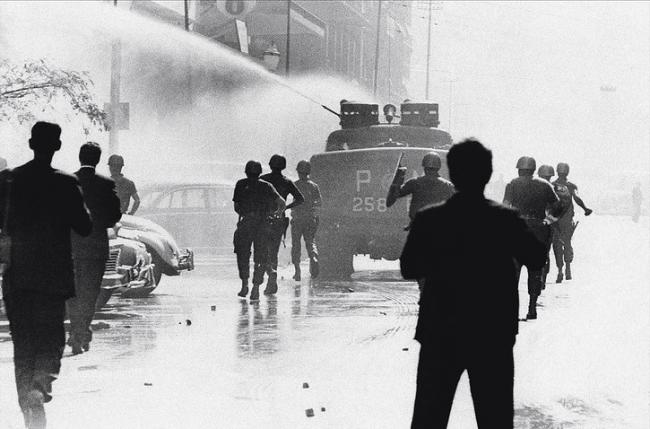
With massive protests in Iran, Hong Kong and Chile, Front Line Defenders said that 2019 was characterised by waves of public uprisings of “remarkable magnitude”, which demanded change of how people are governed. However, it said there were restrictions on freedom of expression and authorities often invoked “security” as a justification to ban all peaceful demonstrations Physical assaults, defamation campaigns and digital attacks were major issues.

Internet shutdowns, restricting access or blocking communication tools, such as social media, were common. Messaging app WhatsApp, which is popular for organising and communications, became a “serious threat” when it was used against human rights defenders in a number of cases.

As the role of human rights defenders ranged from organising and mobilising to monitoring and documenting human rights violations, the human rights organisation said it provided more than 620 protection grants to activists at risk in 2019.

For last year’s report see: https://humanrightsdefenders.blog/2019/01/09/front-line-defenders-says-record-number-of-activists-killed-in-2018/

https://www.rte.ie/news/ireland/2020/0114/1107280-front-line-defenders/

https://www.theguardian.com/law/2020/jan/14/300-human-rights-activists-killed-2019-report

South Sudan’s President Salva Kiir has released two human rights activists

January 8, 2020

Garang Malak reports in the Kenyan newspaper the Nation that South Sudan’s President Salva Kiir has released two human rights activists who were jailed for criticising the government. The order, dated January 1, 2020, included a list of 30 inmates most of who had been imprisoned on minor offences and had shown good conduct while in detention. But it also included Peter Ajak Biar [see: https://humanrightsdefenders.blog/2019/03/30/seven-persons-charged-in-south-sudan-including-peter-biar-ajak/ ]and Keribino Agok Wol, critics of President Kiir’s regime. The two were detained in July 2018 before they were jailed in June 2019. Mr Biar, 35, a PhD student at Cambridge University, had called on top leaders in Juba to resign and give the younger generation a chance to lead the country.

https://www.nation.co.ke/news/africa/Salva-Kiir-pardons-key-critics-Peter-Biar–Keribino-Wol/1066-5405914-h4dloxz/index.html

Annual reports 2019: Amnesty International

December 29, 2019

The 3rd annual report comes from Amnesty International which this year looks at some of the positive highlights, many won by human rights defenders:

[The first two annual reports in this blog are: https://humanrightsdefenders.blog/2019/12/27/annual-reports-2019-civicus-global-report/ and https://humanrightsdefenders.blog/2019/12/28/annual-reports-2019-huridocs-harnessing-the-power-of-human-rights-information/]

With inequality, injustice and hate speech seemingly ever more prevalent across the globe, you’d be forgiven for thinking 2019 has been a bad year for human rights. Yet, AI says that we have also seen some significant wins. Activists the world over have been galvanised to stand up and fight for our human rights – and thanks to their relentless campaigning we achieved some striking leaps forward. Here are some highlights…

January 

Legal abortion services were finally available to women in Ireland, following an historic referendum in May 2018 that marked a huge victory for women’s rights. It was the result of years of dedicated work by activists, including Amnesty International, to encourage a powerful conversation that helped catalyse the abortion debate in Ireland. This ultimately led to greater protection for those people who need an abortion there, and paved the way for the same inspiring progress in Northern Ireland later in the year.

As a tribute to Julián Carrillo, an environmental rights defender killed in October 2018, we launched Caught between bullets and neglect, a digest on Mexico’s failure to protect environmental human rights defenders. Just a few hours after the launch, two suspects in Julián’s murder were arrested, showing the immediate impact Amnesty’s work can have on justice.

The Angolan Parliament approved a revision of the Criminal Code to remove a provision widely interpreted as criminalizing same-sex relationships. They even took a step further, by criminalizing discrimination against people based on sexual orientation – the first country in 2019 to make this move, and a hearteningly radical move for an African nation.

February

After spending 76 days in detention in Thailand, refugee footballer Hakeem al-Araibi was able to return to his home in Melbourne on 12 February. The Bahrain-born footballer had been detained upon arrival in Bangkok on 27 November 2018, due to an erroneous Interpol red notice, and faced the threat of extradition to Bahrain. A campaign launched by Amnesty and other groups to free the footballer, who is a peaceful and outspoken critic of the Bahraini authorities, grew into the #SaveHakeem movement. The campaign spanned three continents, engaging footballers, Olympians and celebrities, and drawing the support of more than 165,000 people.

Following international attention and campaigning by Amnesty, Saudi authorities overturned a call by the Public Prosecution to execute Saudi woman activist Israa al-Ghomgham for charges related to her peaceful participation in protests. Israa al-Ghomgham still faces a prison term, and Amnesty continues to campaign for her immediate and unconditional release.

March

In Ukraine, an International Women’s Day rally organized by human rights defender Vitalina Koval in Uzhgorod, western Ukraine, went ahead peacefully, with participants protected by police. The event marked a major change for the region, after similar rallies organised by Koval in previous years had been targeted by far-right groups, with police singularly failing to protect participants from violence.

AFRICOM admitted for the first time that its air strikes have killed or injured civilians in Somalia, after the release of Amnesty’s investigation The Hidden US War in Somalia: Civilian Casualties from Air Strikes in Lower Shabelle. Following this report, US military documents came to light confirming that the US authorities knew of further allegations of civilian casualties resulting from many of their air strikes in Somalia.

Gulzar Duishenova had been championing disability rights in her country Kyrgyzstan for years. In March 2019, her persistence paid off when Kyrgyzstan finally signed up to the Disability Rights Convention. Amnesty supporters wrote nearly a quarter of a million messages backing her.

And in Iraq, just days after Amnesty and other NGOs raised the alarm about a draft cybercrime law that would seriously undermine freedom of expression there, the Iraqi parliament chose to withdraw the bill, confirming to Amnesty that its “concerns have been heard”.

April

In April, love triumphed when a ban on all LGBTI events in Ankara, Turkey, was lifted by the administrative appeals court. “This is a momentous day for LGBTI people in Turkey, and a huge victory for the LGBTI rights activists – love has won once again,” said Fotis Filippou, Campaigns Director for Europe at Amnesty International.

The District Court of The Hague issued an interim ruling in favour of Esther Kiobel and three other women who took on one of the world’s biggest oil companies, Shell, in a fight for justice. Esther has pursued the company for more than 20 years over the role she says it played in the arbitrary execution of her husband in Nigeria. Amnesty has shared over 30,000 solidarity messages with Esther Kiobel, and is supporting her Kiobel vs Shell case in The Hague. As a result of this hearing, the court in October 2019 heard for the first time the accounts of individuals who accuse Shell of offering them bribes to give fake testimonies that led to the ‘Ogoni Nine’ – who included Esther Kiobel’s husband – being sentenced to death and executed.

President of Equatorial Guinea, Teodoro Obiang Nguema, announced that his government would introduce legislation to abolish the death penalty.

May

Taiwan became the first in Asia to legalize same-sex marriage after passing an historic law on 17 May, with the first same-sex weddings taking place on 24 May. Together with LGBTI rights groups from Taiwan, Amnesty had campaigned for this outcome for many years. We are now working to end all discrimination against LGBTI people in Taiwan.

Qatar promised more reforms to its labour laws ahead of the 2022 World Cup. Human rights pressure also played a role in FIFA’s decision to abandon plans to expand the 2022 Qatar World Cup to 48 teams, which would have involved adding new host countries in the region. Amnesty worked together with a coalition of NGOs, trade unions, fans and player groups, calling attention to the human rights risks of the expansion, including the plight of migrant workers building new infrastructure.

June

Climate change activist Greta Thunberg and the Fridays for Future movement of schoolchildren were honoured with Amnesty International’s Ambassador of Conscience Award 2019. The Fridays for Future movement was started by Greta, a teenager from Sweden who in August 2018 decided to miss school every Friday and instead protest outside the Swedish parliament, until it took more serious action to tackle climate change.

In a long overdue move, Greece passed legislation to recognize that sex without consent is rape, and Denmark’s government committed to doing the same. This development is testament to the persistence and bravery of survivors and campaigners for many years, and creates real momentum across Europe following 2018 Amnesty’s review of outdated legislation in 31 European countries and other barriers to accessing justice for rape survivors.

From 1 June 2019, contraceptives and family planning clinic consultations became free of charge in Burkina Faso. The change was seen as a response to our 2015 My Body My Rights petition and human rights manifesto calling for these measures to be put in place. With financial barriers removed, women in Burkina Faso now have better access to birth control, and more choice over what happens to their bodies.

July

In a momentous and inspiring day for human rights campaigners, the UK parliament voted through a landmark bill on 22 July to legalize same sex marriage in Northern Ireland. The bill also forced the UK government to legislate for abortion reform in Northern Ireland, including decriminalization on the basis that a Northern Ireland Executive (government of NI) did not return in three months.

Also in July, in a US Congressional hearing, a senior Google executive gave the clearest confirmation yet that the company has “terminated” Project Dragonfly, its secretive programme to develop a search engine that would facilitate the Chinese government’s repressive surveillance and censorship of the internet. This followed Amnesty’s #DropDragonfly campaign, and hundreds of Google staff speaking out.

On 22 July, 70-year-old human rights defender and prominent Palestinian Bedouin leader Sheikh Sayyah Abu Mdeighim al-Turi was released from prison in Israel, after spending seven months in detention for his role in advocating for the protection of Bedouins’ rights and land. Sheikh Sayyah thanked Amnesty International and all those who took action on his behalf: “I thank you all very much for standing up for the right of my people and the protection of our land. While I was in prison, I felt and heard your support loud and clear, and it meant the world to me.”

August

Mauritanian blogger Mohamed Mkhaïtir, who was sentenced to death and held in arbitrary detention for more than five years after publishing a blog on caste discrimination, finally walked free.

In August, Saudi Arabia announced major reforms easing some of the major restrictions imposed on women under its repressive male guardianship system, including allowing them the right to obtain a passport which should make it possible for them to travel without permission from a male guardian. The changes also grant women in Saudi Arabia the right to register marriages, divorces, births and deaths and to obtain family records. While we welcome these changes, people campaigning for women’s rights remain in prison, and we must do all we can to fight for their freedom.

September

Syrian national Ahmed H. was finally allowed to return home, after being imprisoned and then held in immigration detention in Hungary for more than four years. He had been arrested on terrorism charges after being caught up in clashes on the Hungarian border. At the time he was helping his elderly parents, who were escaping Syria and were crossing into Hungary as refugees. An amazing 24,000 people joined the #BringAhmedHome campaign, calling on Cyprus to allow Ahmed to return to his family.

A court in Tunis acquitted 18-year-old activist Maissa al-Oueslati, after she faced trumped-up charges that could have resulted in her imprisonment for up to four years. Maissa and her 16-year-old brother had been arbitrarily detained by police earlier in the month for filming a protester threatening to set himself on fire in front of a police station.

October

At midnight on Tuesday 22 October 2019, after a last-minute effort by the DUP to overturn the bill, same sex marriage became legal in Northern Ireland, while abortion was decriminalised. All criminal proceedings were dropped, including those against a mother who faced prosecution for buying her 15 year-old daughter abortion pills online.

Grainne Teggart, Amnesty International’s Northern Ireland Campaign Manager, said it was the beginning of a new era for Northern Ireland, in which the nation was freed from oppressive laws that police people’s bodies and healthcare. “Finally, our human rights are being brought into the 21st century. This will end the suffering of so many people. We can now look forward to a more equal and compassionate future with our choices respected.”

November

Kurdish-Iranian award-winning journalist and refugee Behrouz Boochani arrived in New Zealand to attend a special WORD Christchurch event on a visitor’s visa sponsored by Amnesty International. It was the first time Boochani, known for his work reporting on human rights abuses from within the Australian government’s refugee detention centres, had set foot outside Papua New Guinea since he was detained on the country’s Manus Island in 2014.

Humanitarian volunteer Dr Scott Warren was found not guilty by a court in Arizona of charges linked to helping migrants on the US-Mexico border. In a similar case, Pierre Mumber, a French mountain guide who gave hot tea and warm clothes to four West African asylum seekers in the Alps, and was acquitted of “facilitating irregular entry”.

December

Alberto Fernández is inaugurated as President of Argentina on 10 December. As president-elect, Fernández announced he would push for the legalization of abortion as soon as he took office, saying: “It is a public health issue that we must solve.”

The Philippines’ Commission on Human Rights said that 47 major fossil fuel and carbon-polluting companies could be held accountable for violating the rights of its citizens for the damage caused by climate change. The landmark decision paves the way for further litigation, and even criminal investigations, that could see fossil fuel companies and other major polluters either forced to pay damages, or their officials sent to jail for harms linked to climate change.

The regional Economic Community of West African States’ (ECOWAS) Court of Justice rejected a 2015 ban imposed by the government of Sierra Leone preventing pregnant girls from sitting exams and attending mainstream school – and ordered the policy to be revoked with immediate effect.

PBI’s ‘Right to Defend’ – a new multi-media awareness campaign

December 26, 2019
Putting Human Rights Defenders at the Centre

Throughout 2018, PBI ran a global campaign championing defenders for the Nobel Prize. The nomination was supported by over 4000 people and 200 organisations worldwide [https://humanrightsdefenders.blog/2018/10/05/further-plea-to-nobel-foundation-to-recognize-the-hrds-of-the-world/]. Then, it launched the campaign ‘Shoulder to Shoulder with Human Rights Defenders’, to mark the 20th anniversary of the UN Declaration on Human Rights Defenders.

Now, it wants to go further to raise the profile of human rights defenders working in some of the most dangerous environments in the world. PBI UK are working closely with the filmmaker and photographer Manu Valcarce on ‘Right to Defend’, a multi-media, multi-platform communications and awareness campaign, celebrating those making universal human rights a reality. Their stories set an example of solidarity and humanity that needs to be heard: stories of extraordinary human rights defenders taking a stand against injustice: community leaders fighting to protect collective land rights against mining companies; women struggling for gender equality; human rights lawyers risking their own safety to defend the rights of activists.

PBI UK are working on a unique 60-minute documentary film, online platform, photographic exhibition, and social media campaign presenting the work of around 100 at-risk grassroots human rights defenders in Latin America, Africa and Asia on the frontline of the global fight for universal human rights. The first piece of the project was released on the 10th of December: Human Rights Day:

So far, approximately 100 stories of human rights defenders have been recorded across four countries (Colombia, Honduras, Mexico and Nepal) alongside photographic material. You will be able to see the film at festivals in 2020, and the portraits will be debuted at an exhibition held at The Law Society in London, before touring worldwide. The online platform will enable PBI to further its impact as a global entity across 21 countries for campaigning, advocacy and awareness-raising to enhance the protection of human rights defenders.

https://peacebrigades.org.uk/news/2019-12-02/putting-hrds-centre

Targeting of Digital Rights Defenders in Ecuador, Argentina, and Beyond

December 25, 2019
Danny O’Brien wrote in Electronic Frontier Foundation of 19 December 2019 that “More Than Thirty Human Rights Groups Protest the Targeting of Digital Rights Defenders”.

…And some human rights defenders are technologists: building tools to defend or enhance the practice of human rights, and calling out the errors or lies of those who might misuse technology against its users. At this year’s Internet Governance Forum in Berlin, civil society groups mourned a growing trend around the world: the targeted harassment and detention of digital rights defenders by the powerful. Digital rights defenders includes technologists who work to create or investigate digital tools, and who work to improve the security and privacy of vital infrastructure like the Internet, and e-voting devices. As the declaration, signed by a coalition NGOs notes:

The work digital rights defenders do in defense of privacy is fundamental for the protection of human rights. When they raise awareness about the existence of vulnerabilities in systems, they allow the public and private sector to find solutions that improve infrastructure and software security for the benefit of the public. Furthermore, their work as security advisers for journalists and human rights activists is of vital importance for the safety of journalists, activists and other human rights defenders.

The problem is not confined to, but is particular pressing in Latin America. As 2019 draws to a close, Swedish security researcher Ola Bini remains in a state of legal limbo in Ecuador after a politically-led prosecution sought to connect his work building secure communication tools to a vague and unsubstantiated conspiracy of Wikileaks-related hacking. Meanwhile in Argentina, e-voting activist Javier Smaldone remains the target of a tenuous hacking investigation.

See also: https://humanrightsdefenders.blog/2019/01/08/bloggers-and-technologists-who-were-forced-offline-in-2018/

https://www.eff.org/deeplinks/2019/12/over-thirty-human-rights-groups-protest-targeting-digital-rights-defenders-ecuador

Colombia and Mexico: problems with national panic button devices for human rights defenders

December 24, 2019

A GPS-enabled “panic button” that Colombia‘s government has issued ito abut 400 persons is supposed to summon help for human-rights defenders or journalists if they are threatened. But it the article claims that it has technical flaws that could let hostile parties disable it, eavesdrop on conversations and track users‘ movements, according to an independent security audit conducted for The Associated Press. There is no evidence the vulnerabilities have been exploited, but are alarmed. “This is negligent in the extreme,” said Eva Galperin, director of cybersecurity at the nonprofit Electronic Frontier Foundation, calling the finding “a tremendous security failure.”

Over the past four years, other “distress alarms” and smartphone apps have been deployed or tested around the world, with mixed results. When effective, they can be crucial lifelines against criminal gangs, paramilitary groups or the hostile security forces of repressive regimes. [see: https://humanrightsdefenders.blog/2014/06/23/today-official-launch-of-ais-panic-button-a-new-app-to-fight-attack-kidnap-and-torture/ and https://humanrightsdefenders.blog/2014/04/24/the-natalia-gps-alarm-bracelet-wins-golden-egg-awards-in-stockholm/]

The “boton de apoyo,” distributed by Colombia‘s Office of National Protection is a keychain-style fob. Its Chinese manufacturer markets it under the name EV-07 for tracking children, pets and the elderly. The operates on a wireless network, has a built-in microphone and receiver and can be mapped remotely with geo-location software. A button marked “SOS” calls for help when pressed.

A company official, John Chung, acknowledged that Rapid7 notified him of the flaws in December. In keeping with standard industry practice, Rapid7 waited at least two months before publicly disclosing the vulnerabilities to give the manufacturer time to address them. Chung told the AP that Eview was working to update the EV-07‘s webserver software, where Rapid7 found flaws that could allow user and geolocation data to be altered.

Activists have good reason to be wary of public officials in Colombia, where murder rates for land and labor activists are among the world‘s highest, and there is a legacy of state-sponsored crime. The DAS domestic intelligence agency, which provided bodyguards and armored vehicles to high-risk individuals prior to 2011, was disbanded after being caught spying on judges, journalists and activists. Five former DAS officials have been prosecuted for allegedly subjecting Duque and her daughter to psychological torture after she published articles implicating agency officials in the 1999 assassination of Jaime Garzon, a much-loved satirist.

Tanya O‘Carroll of Amnesty International, which has been developing a different kind of “panic button” since 2014 , said the Colombian model is fundamentally flawed. “In many cases, the government is the adversary,” she said. “How can those people who are the exact adversary be the ones that are best placed to respond?”…

In Mexico, the attorney general‘s office has issued more than 200 emergency alert devices to journalists and rights activists since 2013. But there have been multiple complaints . One is unreliability where cell service is poor. Others are more serious: Cases have been documented of police failing to respond or answering but saying they are unable to help.

O‘Carroll of Amnesty International said trials in 17 nations on three continents—including the Philippines, El Salvador and Uganda—show it‘s best to alert trusted parties—friends, family or colleagues. Those people then reach out to trusted authorities. Amnesty‘s app for Android phones is still in beta testing. It is activated with a hardware trigger—multiple taps of the power button. But there have been too many false alarms.

Sweden-based Civil Rights Defenders offers a 300-euro stand-alone panic button first deployed in Russia‘s North Caucasus region in 2013 and now used by more than 70 people in East Africa, Central Asia, the Balkans, Southeast Asia and Venezuela, said Peter Ohlm, a protection officer at the nonprofit. The organization‘s Stockholm headquarters always gets notified, and social media is typically leveraged to spread word fast when an activist is in trouble.

https://stockdailydish.com/colombia-panic-buttons-expose-activists/

General Assembly adopted draft resolution seeking protection of human rights in Russian-occupied Crimea,

December 22, 2019

https://www.bignewsnetwork.com/news/263442213/un-adopts-updated-resolution-to-safeguard-rights-in-crimea

Iran: nothing good to report in December 2019

December 20, 2019

The London-based human rights group Amnesty International says more than 300 people were killed in protests in Iran last month. In a report released on 16 December 2019 Amnesty says that according to reports it compiled, at least 304 people were killed and thousands injured between November 15 and 18 as authorities crushed protests with lethal force. The organization interviewed dozens of people inside Iran. It also analyzed video footage obtained by the group, which shows Iranian security forces opening fire on unarmed protesters who did not pose any imminent risk. The report said thousands of journalists and human rights defenders have also been arrested in an attempt to stop them from speaking out about Iran’s repression. Iran has yet to disclose details of the casualties.

On 18 December the European Union extended sanctions against Iran by another year over what the bloc says are serious human rights violations. The EU said in a statement it extended a travel ban and asset freeze against 82 people and also a ban on EU exports that might help in the repression of internal dissent. In 2011, the EU imposed the restrictions over the repression of peaceful demonstrators, journalists, human rights defenders and others. The sanctions also target those involved in torture, inhumane treatment and stonings or hangings. The extension prolongs the sanctions until April 13, 2018.

On 19 December 2019 Reporters Without Borders (RSF) said it is “appalled” by a Tehran court’s decision to uphold prison sentences for four journalists from the Gam (Step) online magazine. However, the appeals court in Tehran reduced the length of the jail terms from 18 to five years for each journalist — Amirhossein Mohammadifard, Sanaz Allahyari, Amir Amirgholi, and Assal Mohammadi — for a combined total of 20 years, the Paris-based media freedom watchdog said on December 18. The journalists were arrested a year ago on what Amnesty International called “spurious” national security charges related to their reporting on workers’ rights protests in Khuzestan Province over grievances concerning unpaid wages and poor conditions.

RSF said on December 18 that the same appeals court in Tehran also upheld a prison sentence for Marzieh Amiri, a journalist for the reformist Shargh newspaper, but reduced her sentence from 10 years in prison and 148 lashes to five years in prison. Amiri was arrested in May after covering a demonstration outside parliament in the capital.

On 20 December 2019 UN human rights experts called on the Iranian authorities to release all individuals arbitrarily detained and mistreated during recent protests, and expressed concerns over the hundreds of people who have been killed. “We are shocked at reports of the ill-treatment of those detained during the protests that took place in November 2019, and deeply disturbed that the reported use of excessive force by the Iranian security forces led to an untold number of casualties, including deaths,” the experts said.

——

https://www3.nhk.or.jp/nhkworld/en/news/20191216_26/

https://stockdailydish.com/eu-extends-sanctions-on-iran-over-human-rights-violations/

https://www.voanews.com/press-freedom/rsf-appalled-five-iranian-journalists-get-total-25-years-prison

UN Experts Alarmed at Alleged Mistreatment of Detained Protesters

2019 Franco-German Human Rights Prize to 14 human rights defenders

December 13, 2019

The Franco-German Human Rights and the Rule of Law Prize [for more indo see: http://www.trueheroesfilms.org/thedigest/awards/franco-german-prize-for-human-rights-and-the-rule-of-law] is awarded to human rights defenders around the world, but also to lawyers who represent the human rights defenders and journalists who work to make the truth known. Through this prize, France and Germany wish to show their support for the work of these individuals. [ for info on the previous round, see: https://humanrightsdefenders.blog/2017/12/07/franco-german-prize-for-human-rights-and-the-rule-of-law-awarded-for-second-time/%5D

The winners of the 2019 Franco-German Human Rights and the Rule of Law Prize are fighting battles in key fields such as the fight against torture and inhuman or degrading treatment, against forced disappearances, against violence on women, against discrimination of LGBT people and the promotion of gender equality.

The prize winners include:

  • Ales BIALIATSKI (Belarus)
  • Li WENZU (China)
  • El Nadim Center (Egypt)
  • Mr Ameha Mekonnen Asfaw (Ethiopia)
  • Ms Robin Chaurasiya (India)
  • Nasrin SOTOUDEH (Iran)
  • Amina HANGA (Nigeria)
  • Ms Miluska Del Carmen Luzquinos Tafur (Peru)
  • Ms Mary Aileen Bacalso (Philippines)
  • Ms Irina Biryukova (Russia)
  • Ms Delphine Kemneloum Djiraibe (Chad)
  • Ms Asena Gunal (Turkey)
  • Luz Mely REYES (Venezuela)
  • Mr Vu Quoc Ngu (Vietnam)
—

Li Wenzu (center) receives the 2019 Franco-German Human Rights and Rule of Law Award, presented by the French and German ambassadors to China at the French embassy in Beijing, December 11, 2019.

Li Wenzu (center) receives the 2019 Franco-German Human Rights and Rule of Law Award, presented by the French and German ambassadors to China at the French embassy in Beijing, December 11, 2019.

In her acceptance speech, Li said the award was a boost not just to her personally, but to all the hundreds of lawyers, rights activists and their families caught up in a nationwide crackdown that began in July 2015.

——

(From left) Robin Chaurasia receiving the award from Sonia Barney and Juergen Morhard on Thursday.

(From left) Robin Chaurasia receiving the award from Sonia Barney and Juergen Morhard

Mumbai-based women’s rights activist Robin Chaurasiya has won the Franco-German Award for Human Rights. Ms. Chaurasiya, who co-founded the non-profit Kranti in 2010, has worked for the betterment of girls born in the red-light areas of the city. Consul General of the Federal Republic of Germany, Dr. Juergen Morhard, and the Consul General of France in Mumbai, Sonia Barbry, presented the award to Ms. Chaurasiya. “When I came to India from the U.S. to work with another NGO, I saw that many children were left on their own once they entered their teenage years. They would be locked in rooms for the slightest mischief,” she said. She believed these children had many talents but did not have the environment to flourish. “I recall they were only being taught how to make pickles and do basic work. I feel we need to get rid of these notions and let them pursue their passion, which could be the ambition to become a doctor or an engineer,” she said. Ms. Das said she met Ms. Chaurasiya at the NGO. “It motivated us to start this initiative. We nurture and help these women fulfil what they want for themselves, not the other way round. If someone wants to study something like music, we look for the best places where they can be enrolled. One of our members is now a music therapist.”

—-

Günal received the prize at a ceremony held at the Embassy of Germany in Ankara on 16 December. Receiving the prize, Asena Günal made a speech in brief:

“As someone working in the field of culture, it would not have occurred to me that I would receive a prize in the field of human rights. As the honorable Ambassador has said ‘cultural rights are more than just an ingredient to the international human rights framework. Participation in cultural life of the society on the one hand, freedom of expression on the other are indispensable rights of every human being’. However, for many years in Turkey, participation in cultural life and freedom of artistic expression remained as a side issue, because there were more pressing concerns such as torture, enforced disappearance and imprisonment. The struggle for human rights was the one carried out by those keeping watch day and night at the Human Rights Association in case someone appealed for help, lawyers who ran to police stations when people were detained, Saturday Mothers who gathered every week despite all obstacles.

“Today, the field of human rights in Turkey has expanded to include culture. There are two reasons for this: One of them is that people have become aware of the importance of considering access to artistic expression and culture and arts in the framework of human rights. The other reason is that state oppression on culture, arts and civil society has increased. Here, I would like to particularly underline the ongoing unjust detention of Osman Kavala that began two years ago and the following oppression and unfounded allegations that made him a target. “In trying times like these, such awards give the motivation to persevere, and make you feel that your efforts are worthwhile. I have never been alone in this process:


https://www.diplomatie.gouv.fr/en/country-files/germany/events/article/2019-franco-german-human-rights-and-the-rule-of-law-prize-10-dec-2019

https://www.rfa.org/english/women/li-wenzu-franco-german-prize-12132019114110.html