Posts Tagged ‘Human Rights Defenders’

Arctivism Projects: human rights and artists collaborating

May 18, 2020

Special Rapporteur on Human Rights Defenders in Africa issues press statement

May 13, 2020
African Commission on Human and Peoples’ Rights

On 1 May 2020 the Special Rapporteur on Human Rights Defenders and Focal Point on Reprisals in Africa, Rémy Ngoy Lumbu, expresses concern following reports of reprisals against human rights defenders and civil society in Africa and the adverse effects that national responses of States Parties to combat the COVID-19 pandemic have on their work. [please note that Africa has a regional rapporteur, not to be confused with the UN Secial Rapporteur on HRDs, Mary Lawlor (https://humanrightsdefenders.blog/2020/05/07/mary-lawlor-takes-up-post-as-un-special-rapporteur-for-human-rights-defenders/)]:

In the context of this COVID-19 global pandemic, the role of human rights defenders has become ever more important to safeguard the fundamental human rights enshrined in the African Charter on Human and Peoples’ Rights (African Charter). The Rapporteur notes, in particular, serious violations of the freedom of assembly and association, as enshrined in the African Charter and the UN Declaration on Human Rights Defenders.

The Rapporteur deplores the fact that, notwithstanding the press releases of the African Commission on Human and Peoples’ Rights of 17 and 24 March 2020 encouraging States to ensure compliance with the provisions of the African Charter and advocating for effective and human rights-based responses to curb the spread of the COVID-19  pandemic in Africa, several human rights defenders continue to be detained in overcrowded or unsanitary prisons and other detention centres without being charged, and this makes them especially vulnerable to COVID-19 infection.

The Special Rapporteur stresses the obligation of States Parties to ensure that measures adopted within the framework of COVID-19 national responses are not used as an opportunity to discriminate against, stigmatize or target particular individuals or groups, including civil society organizations and human rights defenders.

The Special Rapporteur would like to remind that efforts deployed by States Parties to curb the spread of COVID-19 in their respective territories should not result in the silencing of human rights defenders and should comply with the provisions of the African Charter. The Special Rapporteur would also like to call on human rights defenders to continue, with determination, their activities to promote and protect human rights in compliance with the laws and regulations adopted in the context of this global threat.

The Special Rapporteur urges States Parties to:

  1. Ensure that national responses to the COVID-19 pandemic do not lead to the targeting or undue interference with the work of human rights defenders;
  2. Refrain from using COVID-19 related emergency declarations to justify the adoption of repressive measures against specific groups such as human rights defenders;
  3. Also refrain from adopting measures that restrict civic space and contribute to creating a hostile environment for human rights defenders;
  4. Ensure that human rights defenders can communicate freely without fear of reprisal;
  5. Take all necessary measures enabling human rights defenders to conduct their core activities, in particular, those providing support to the most vulnerable populations, while complying with the health measures necessary to combat COVID-19; and
  6. Promptly release human rights defenders detained without charge.

https://www.achpr.org/pressrelease/detail?id=496

TRANET-Africa reports attacks increasing on youth human rights defenders

May 12, 2020

Corona pandemic leads to “tsunami of hate and xenophobia” says Guterres

May 8, 2020
Coronavirus Has Sparked 'Tsunami Of Hate And Xenophobia': UN Chief
UN chief Antonio Guterres appealed for “an all-out effort to end hate speech globally. (File photo)

Additionally, “journalists, whistleblowers, health professionals, aid workers and human rights defenders are being targeted simply for doing their jobs,” Guterres said. The UN chief … singled out educational institutions to help teach “digital literacy” to young people — whom he called “captive and potentially despairing audiences.” Guterres also called on “the media, especially social media companies, to do much more to flag and… remove racist, misogynist and other harmful content.”

See also: https://humanrightsdefenders.blog/2019/06/19/un-strategy-and-plan-of-action-on-hate-speech-launched/

https://www.ndtv.com/world-news/un-chief-antonio-guterres-says-coronavirus-covid-19-has-sparked-tsunami-of-hate-and-xenophobia-2225238

Ali Gharavi of the “#Istanbul10” speaks about his experience and his hope

May 6, 2020

Ali Gharavi is a consultant working with human rights defenders, their organisations and communities. He is one of ten people who were arrested in Turkey in July 2017 at an information management and well-being workshop on Buyukada island. The hashtag #Istanbul10 was used in the sustained advocacy efforts that called for the dropping of all charges against them and their immediate release. [see: https://humanrightsdefenders.blog/2020/02/16/turkey-who-will-defend-the-human-rights-defenders/]

In March 2020, ahead of an anticipated – but since postponed – verdict hearing, Ali spoke with IFEX Regional Editor Cathal Sheerin about how his experience being arrested in Turkey and jailed for four months has affected his life and informed his work. “While I breathe, I hope: In conversation with Ali Gharavi of the #Istanbul10″ (interview published through a partnership between Global Voices and IFEX).

Ali Gharavi. Credit Annie Game
CS: How do you feel about the upcoming hearing? I feel a combination of anticipation and anxiety. It’s been a roller coaster of emotions over the last almost three years and the verdict was supposed to have been reached at the last hearing. In terms of realistic outcomes, we’ve talked about two or three possibilities with our families, lawyers and the authorities in Sweden. I’ve been trying to keep my wits about me and not putting all my eggs in one basket, but we’re pretty optimistic that the outcome could be acquittal.

What makes you optimistic for acquittal? I’m only nominally optimistic really because these things can turn on a dime. At the hearing before the last one, the prosecutor said that – of the ten of us plus Taner Kılıç – he would accept acquittal for five because of lack of evidence, but the rest he wanted to convict. I was in the acquittal group. All of us are quite adamant, however, about not having this ‘split’ decision.

Why do you think you were divided into two groups? It’s really hard to say. Two of us in the acquittal group – Peter Steudtner and I – are not Turkish, so it’s possible that they want to remove the international angle from all of this. However, that’s just my speculation. It’s actually quite arbitrary, and I think this is partly because they have no evidence. It might even be a way to ramp this down: Let’s acquit half of them now and then acquit the rest in a trickle.

…..
How aware were you when you were detained of the advocacy that was taking place on your behalf? What impact did it have on your morale? Maintaining my morale was one of the biggest challenges for me. I was held at four different sites. At one point, they transferred us to the anti-terrorism headquarters for interrogation, which sounds like – and was – quite a harrowing experience. ……

I’ve done letter-writing campaigns in the past, and I never knew for sure if they had any effect on the people who were in jail, but having been on the inside, I can say that those moments were life-saving. Sometimes my lawyer would search for my name on Twitter and print out all the tweets that had been posted that week about me; there was also this Twitter campaign, #haikusforAli, and demonstrations in Brussels, sit-ins in front of embassies. All of those moments reminded me that people on the outside were thinking of me and mobilising. I’m not exaggerating when I say that those were the things that saved me when I was in the depths of an abyss.

How has the experience affected how you work?  The kind of work I’d been doing was intended exactly for this kind of situation, where you need to pay attention to the whole person, not just their devices or the organisation’s activities. Because of my incarceration, I now understand that at a molecular level. For me, the whole experience has placed a higher premium on understanding people – who they are, where they are – as a big part of how we can actually help them regardless of whichever aspect of their work we’re trying to assist them with. One thing the experience revealed was how inadequately resourced and researched care and crisis response is: how do you care for not just the person incarcerated, but also his family, the community around him, his colleagues?

Once the crisis is ‘over’ the assumption is that life goes on as usual, whereas there’s actually recovery that needs to be done. Often there’s also a massive financial burden due to legal costs and the inability to work for a while. After my release I went to Berlin and arrived into a very supportive debriefing environment. It’s a very privileged situation to be in – those ten days were very helpful in making me understand that I’d be going through this trauma and recovery and that it’s not just business as usual. There was a crowd-funder created for me so that I didn’t just have to drop back into work, and there was physical and psychological therapy too. I knew it intellectually, but now I know it viscerally, that just because you get released the trauma doesn’t just go away. It takes years to be functional again. People assume that when you recover you’re going to go back to being who you were, but that’s not true.

Would you ever return to Turkey? It would be very difficult for me to feel safe there, but I would go, if only in order to ‘get back on the horse’. If the verdict doesn’t go the way we expect, then I’d be incarcerated if I turned up there, so I obviously wouldn’t return. I love Turkey – the people and the environment – and I feel like a big part of my life and friends is now off-limits to me. But I dream of when I’ll be able to go back, hug the people who were inside with me and eat baklava with them. As Cicero said: ‘While I breathe, I hope.’

The humanity of what I experienced in detention was humbling. Regardless of why those people were incarcerated with me, they – that young 19-year-old who spoke to me in German, and others – were an amazing source of inspiration and support. During the toughest times I’d be angry with them, but they were amazingly unwavering. I’ve heard via word of mouth that those two supposed ISIS members are now back with their families and all is well. I owe them a big debt of gratitude.

Most of the time I was incarcerated alongside political prisoners who faced trial on specious charges, or who had been (and continue to be) detained for years on end as they wait for an indictment. And now we hear that despite the mortal threat of COVID-19 sweeping through the prison system, those prisoners will stay behind bars.

[see also: https://humanrightsdefenders.blog/2020/03/20/corona-virus-threatens-human-rights-defenders-in-detention-egypt-and-turkey/]

‘While I breathe, I hope’: In conversation with Ali Gharavi of the #Istanbul10

While I breathe, I hope: In conversation with Ali Gharavi of the #Istanbul10

NSO versus Whatsapp continues in court

May 5, 2020

WhatsApp logo is seen displayed on a smart phone screen on 11 December 2019 [Ali Balıkçı/Anadolu Agency]

WhatsApp logo is seen displayed on a smart phone screen on 11 December 2019 [Ali Balıkçı/Anadolu Agency]

The NSO Group has always maintained its innocence insisting that its spyware is purchased by government clients for the purpose of tracking terrorists and criminals and that it had no independent knowledge of how those clients use its spyware. This claim is contradicted by court documents in WhatsApp’s lawsuit filed last year against the Israeli firm. While bringing the lawsuit, WhatsApp said in a statement that 100 civil society members had been targeted and called it “an unmistakable pattern of abuse”. New documents seen last week indicate that servers controlled by NSO Group and not its government clients, as alleged by the Israeli firm, were an integral part of how the hacks were executed. “NSO used a network of computers to monitor and update Pegasus after it was implanted on users’ devices,” said WhatsApp, “these NSO-controlled computers served as the nerve centre through which NSO controlled its customers’ operation and use of Pegasus [software used to hack computers and phones].”NSO Group is also accused by WhatsApp of gaining “unauthorised access” to its servers by evading the company’s security features.

n the ongoing legal battle between Facebook and software surveillance company NSO Group, the social media giant is trying to get NSO Group’s legal counsel dismissed because of an alleged conflict of interest. In a court filing made public this week, Facebook asked a federal judge to disqualify law firm King & Spalding from representing NSO Group because the firm previously represented Facebook-owned WhatsApp in a different, sealed case that is “substantially related” to the NSO Group one. King & Spalding, an Atlanta-based firm with a range of big corporate clients, has denied there is a conflict of interest, according to the filing.“Any attorney defending this suit would love to have insight into how WhatsApp’s platform and systems work,” the court filing states. “And King & Spalding has that insight—because it was once WhatsApp’s counsel.”The dispute with Facebook is one of multiple legal battles currently facing NSO Group. Amnesty International is trying to get an Israeli court to revoke NSO Group’s export license in Israel, citing Pegasus’s alleged role in humans rights abuses. [see: https://humanrightsdefenders.blog/2019/09/17/has-nso-really-changed-its-attitude-with-regard-to-spyware/]https://www.amnesty.org/en/latest/news/2020/06/nso-spyware-used-against-moroccan-journalist/

https://www.cyberscoop.com/nso-group-lawsuit-whatsapp-conflict-of-interest-king-spalding/

Israel’s NSO Group accused of ‘unmistakable pattern of abuse’ in hacking case

Land rights defenders are the main target of those destroying the environment

April 24, 2020

The world has come together in the fight against a common enemy in COVID-19; a force so strong that it has knocked economies to the ground, turned our daily lives upside down and made us reflect on what really matters. Yet amidst the world’s lockdown, there are land grabbers and investors looking to take advantage of the situation. For them, there is no better time to strike than now.

This Earth Day, more than any other, it’s time to shine a spotlight on the everyday guardians of our planet, land and environment defenders, who stand at the front line to defend their land and territories from corporate or state abuse and unsustainable exploitation.  They protect lands, forests and water sources, which provide their communities with good and healthy food, shelter and medicine.

By protecting such resources for the common good, they find themselves directly in the way of others who want to profit from these natural resources. If their lives were at risk before, this global pandemic has only exasperated an already difficult situation. When a community goes into lockdown, defenders not only become easier to target, they lose their right to protection and the world’s attention and that of the media, is elsewhere.
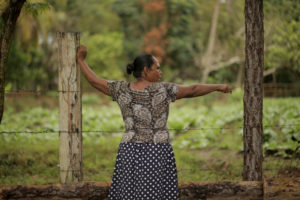
A Miskito woman in Nicaragua. Photo: Jason Taylor/ILC.

Defending land, ecosystems, and Indigenous rights has always come with immense risks.

More than three people were murdered each week in 2019 for defending their land and environment. Countless more were attacked or threatened. Only a year ago, the United Nations Human Rights Council adopted a landmark resolution, recognizing the importance of environmental human rights defenders and urging States to ensure their protection. Yet, as governments call states of emergencies and enforce new containment measures, even where national protection mechanisms for defenders exist, they are rendered futile.

Even worse, lockdowns are being used by irresponsible companies to further suppress defenders and by governments to give industries a free pass.

We saw evidence of this as the first cities in Colombia went into lockdown and three social activists were killed. Marco Rivadeneira, a high-profile activist, was murdered in the southern Putumayo province, Ángel Ovidio Quintero was shot dead in the western Antioquia region, and Ivo Humberto Bracamonte was killed on the eastern border with Venezuela. These follow more than six hundred murders of social activists in Colombia since the Peace Accords were signed.

While in Indonesia, two local land defenders have been killed and four arrested in connection with land disputes in Sumatra and Borneo, as mining and palm oil operations in rural areas continue on with business as usual and activists are told to stay home.

In Brazil, the country’s environment agency is withdrawing its enforcement staff because of the risk of contracting the virus. This move coincides with a 70 percent increase in deforestation compared to 2019. Many fear that loggers and land grabbers will take advantage of the lax policing, hoping for impunity. We are observing the same trend in other countries, all over the world.

The increased vulnerability of these defenders is palpable, and what’s happening, alarming. We must ask ourselves how we can ensure and promote their safetyUN Human Rights Experts have expressed grave concern on “the rise of reports of killings and other instances of excessive use of force targeting in particular people living in vulnerable situations”.  Amnesty International has issued a series of recommendations to states in the Americas to ensure that their responses to COVID-19 are in line with their international human rights obligations.

In addition to appealing to States to maintain and reinforce their promises and protection schemes, there are some urgent steps that we need to take.

Develop an urgent real-time alert system for crisis situations to help people in danger. Where data is available, 80 percent of killings are preceded by a non-lethal attack or a threat on the affiliated group or community.  So while environmental human rights defenders receive daily death threats, usually a sign for what’s to come, who will hear their cries for help?

A group of organizations belonging to the Defending Land and Environmental Defenders Coalition – among them, the Business and Human Rights Resource Centre, Frontline Defenders, Global Witness, the World Resources Institute and the International Land Coalition – are systematically monitoring COVID-related incidents in order to identify trends. Cases can be securely collected beginning Friday via LANDex, a global monitoring system dedicated to democratizing land data.

Particularly vulnerable are many of the world’s 320 million Indigenous peoples, whose territories are often rich in natural resources. Despite protecting more than 50% of the world’s land surface, they have formally recognized ownership over just 10%, which leaves them especially exposed. Governments and corporations should heedcalls for a moratorium on external activities in Indigenous territories without their express consent.

Beyond urgent measures, building longer-term resilience for these communities is essential so that they are not as vulnerable to increased harassment, threats, criminalization and eventually, killings. Secure land rights for local communities gives greater control over their own territories, and provides them with legal recourse when faced with harassment and attacks.

On this Earth Day, as we look forward to re-building a more sustainable world, we cannot forget those who have dedicated their entire lives – putting themselves and their families at risk – to do just that.

See also: https://humanrightsdefenders.blog/2020/01/14/front-line-defenders-global-analysis-2019-is-out-304-hrds-killed/
Land and environmental defenders are sitting ducks, while world goes into lockdown

Front Line Defenders publishes its Annual Report for 2019

April 22, 2020

Front Line Defenders just published ‘Dispatches 2019′  its annual magazine showcasing the work the organisation is doing to support human rights defenders. Together with Global Analysis 2019 (on which I reported already: https://humanrightsdefenders.blog/2020/01/14/front-line-defenders-global-analysis-2019-is-out-304-hrds-killed/), it offers a valuable reminder of the courage of human rights defenders in driving positive social change around the world and maintaining hope in the face of enormous adversity:

Over the last year, Front Line Defenders has continued to expand its support to human rights defenders most at risk. In 2019, FLD provided rapid and practical support to 2,307 human rights defenders and 366 organisations in 117 countries. Through the Protection Grants programme alone, FLD provided direct support through 626 grants totalling over euro 1.5 million to HRDs facing urgent threats, an increase of 17% compared to 2018.

As highlighted in its 2019-2022 Strategic Plan <https://www.frontlinedefenders.org/en/strategic-plan>, it is an organisational priority to support most-marginalised HRDs, including women human rights defenders, LGBTI rights defenders and defenders working on land, environment and indigenous peoples’ rights. Some examples of that commitment in 2019 include the provision of an unprecedented number of protection grants to environmental rights defenders (+51%), the presentation of the Front Line Defenders Annual Award to five LGBTI+ Rights Defenders, the beginning of a new learning and consultation process focused on defamation facing women human rights defenders at risk, and the publication (with Irish writing centre Fighting Words) of the anthology Yes, We Still Drink Coffee, Stories of Women Human Rights Defenders.

A highlight of 2019 was the biennial Dublin Platform <https://www.frontlinedefenders.org/en/2019-dublin-platform> , bringing together 114 HRDs at risk and over 100 other international stakeholders. We hope that the encouragement and support shared by so many brave HRDs from around the world during the Platform can help sustain and energize them for the challenging months ahead.….As the COVID-19 crisis further develops and impacts on human rights defenders (https://www.frontlinedefenders.org/en/statement-report/defending-rights-during-pandemic-impact-covid-19-safety-and-work-human-rights)  and those they work for, Front Line Defenders has been taking necessary measures to ensure that our support to HRDs at risk can be maintained. See also: https://humanrightsdefenders.blog/2020/04/10/policy-response-from-human-rights-ngos-to-covid-19-front-line-tips-for-human-rights-defenders-working-from-home/….And to continue providing a platform for HRD voices, even when convening is not possible, FLD has re-launched its podcast series “Rights on the Line” <https://open.spotify.com/show/2v4KDqlWf0I2uFNninRl6A>  – new episodes will be launched each week.

——-

https://www.frontlinedefenders.org/en/resource-publication/dispatches-2019

Amnesty accuses Facebook of complicity in Vietnamese censorship

April 22, 2020

On 21 April, Reuters reported that Facebook has begun to significantly step up its censorship of “anti-state” posts in the country. This follows pressure from the authorities, including what the company suspects were deliberate restrictions placed on its local servers by state-owned telecommunications companies that caused Facebook to become unusable for periods of time. The next day Amnesty International demanded that Facebook reverses immediately its decision.  “The revelation that Facebook is caving to Viet Nam’s far-reaching demands for censorship is a devastating turning point for freedom of expression in Viet Nam and beyond,” said William Nee, Business and Human Rights Advisor at Amnesty International. “The Vietnamese authorities’ ruthless suppression of freedom of expression is nothing new, but Facebook’s shift in policy makes them complicit.

Facebook must base its content regulation on international human rights standards for freedom of expression, not on the arbitrary whims of a rights-abusing government. Facebook has a responsibility to respect freedom of expression by refusing to cooperate with these indefensible takedown requests.” The Vietnamese authorities have a long track record of characterizing legitimate criticism as “anti-state” and prosecuting human rights defenders for “conducting propaganda against the state.” The authorities have been actively suppressing online speech amid the COVID-19 pandemic and escalating repressive tactics in recent weeks.  “It is shocking that the Vietnamese authorities are further restricting its peoples’ access to information in the midst of a pandemic. The Vietnamese authorities are notorious for harassing peaceful critics and whistleblowers. This move will keep the world even more in the dark about what is really happening in Viet Nam,” said William Nee.

Facebook’s decision follows years of efforts by Vietnamese authorities to profoundly undermine freedom of expression online, during which they prosecuted an increasing number of peaceful government critics for their online activity and introduced a repressive cybersecurity law that requires technology companies to hand over potentially vast amounts of data, including personal information, and to censor users’ posts. “Facebook’s compliance with these demands sets a dangerous precedent. Governments around the world will see this as an open invitation to enlist Facebook in the service of state censorship. It does all tech firms a terrible disservice by making them vulnerable to the same type of pressure and harassment from repressive governments,” said William Nee…

In a report published last year, Amnesty International found that around 10% of Viet Nam’s prisoners of conscience – individuals jailed solely for peacefully exercising their human rights – were jailed in relation to their Facebook activity. In January 2020, the Vietnamese authorities launched an unprecedented crackdown on social media, including Facebook and YouTube, in an attempt to silence public discussion of a high-profile land dispute in the village of Dong Tam, which has attracted persistent allegations of corruption and led to deadly clashes between security forces and villagers.  The crackdown has only intensified since the onset of COVID-19. Between January and mid-March, a total of 654 people were summoned to police stations across Viet Nam to attend “working sessions” with police related to their Facebook posts connected to the virus, among whom 146 were subjected to financial fines and the rest were forced to delete their posts. On 15 April, authorities introduced a sweeping new decree, 15/2020, which imposes new penalties on alleged social media content which falls foul of vague and arbitrary restrictions. The decree further empowers the government to force tech companies to comply with arbitrary censorship and surveillance measures.

See also: https://humanrightsdefenders.blog/2020/02/10/28-ngos-ask-eu-parliament-to-reject-cooperation-deal-with-vietnam-on-11-february/

Re Facebook and content moderation see also the Economist piece of 1 February 2020: https://www.economist.com/business/2020/01/30/facebook-unveils-details-of-its-content-oversight-board

https://www.amnesty.org/en/latest/news/2020/04/viet-nam-facebook-cease-complicity-government-censorship/

Norwegian Human Rights Fund Annual report 2019

April 21, 2020

From the Preface written John Peder Egenæs and Sandra Petersen of the Norwegian Human Rights Fund (NHRF):

…..2019 will stand out as an important year for the Norwegian Human Rights Fund (NHRF) in terms of growth and development. … We believe that the seeds of change planted by grantees every day will result in a robust and forceful defense for future generations. As this annual report demonstrates, our grantees and local human rights defenders are continuing to stand up and fight for a future of equality and dignity for all. For some, their work centers on ensuring that vulnerable workers have safe and dignified work environments, for others it’s providing psychosocial support for families of the disappeared and seeking justice for victims of torture and others are leading movements for gender equality. Establishing links, coordinating and collaborating on the local and national levels to create better working conditions for civil society and human rights defenders are crucial to strengthening the work and moving it forward. For this work, we support grantees who build networks and equip and empower defenders with the tools and skills needed for their work; who advocate for positive laws or the prevention of restrictive laws to protect or enable a thriving civil society; and others who provide relief, support and legal representation for human rights activists in cases of arbitrary arrests, detention or when they’re facing threats. Our grantees’ work is interlinked and reinforcing; success in one struggle impacts and can lead to success in another. Their work is driven by the needs on the ground and thus it comes in many forms, but the efforts to contribute to make positive and structural changes and the realization of human rights are shared by all. In 2019, the Norwegian government led an adoption of a new resolution on environmental human rights defenders – a critically important response during one of the most dangerous and even deadly points in recent history for human rights defenders, especially those who fight for natural resources, the rights of indigenous peoples and against environmentally detrimental megaprojects. …… Working together with our partners, we are able to see the reality of the dire situation for people on the front lines working for change, which leads us to seek to increase our support to and solidarity with their work. During 2019, the NHRF created strategic partnerships that increased the financial base for the years to come. We know this will be indispensable for local and front-line human rights defenders and for investing in the realization of human rights for the most vulnerable and marginalized. With these increased resources and with support from our partners, we will continue to invest and sow seeds that we believe will lead to long-term positive change…


Click to access NHRF-AR-2019-OL-20April-compressed-file.pdf