The CIVICUS Monitor, which tracks freedom of association, peaceful assembly and expression in 198 countries and territories, announced in a new report – “People Power Under Attack 2023” – that almost one third of humanity now lives in countries with ‘closed’ civic space.
This is the highest percentage –30.6% of the world’s population– living in the most restrictive possible environment since CIVICUS Monitor’s first report in 2018. Meanwhile, just 2.1% of people live in ‘open’ countries, where civic space is both free and protected, the lowest percentage yet and almost half the rate of six years ago.
“We are witnessing an unprecedented global crackdown on civic space,” said CIVICUS Monitor lead researcher Marianna Belalba Barreto. “The world is nearing a tipping point where repression, already widespread, becomes dominant. Governments and world leaders must work urgently to reverse this downward path before it is too late.”
The CIVICUS Monitor rates each country’s civic space conditions based on data collected throughout the year from country-focused civil society activists, regionally-based research teams, international human rights indices and the Monitor’s own in-house experts. The data from these four separate sources are then combined to assign each country a rating as either ‘open,’ ‘narrowed,’ ‘obstructed,’ ‘repressed’ or ‘closed.’
Seven countries saw their ratings drop this year. These include Venezuela and Bangladesh, each now rated ‘closed’ due to intensifications of existing crackdowns on activists, journalists and civil society.
Democratic countries slipped too. Europe’s largest democracy, Germany, fell from ‘open’ to ‘narrowed’ amid protest bans and targeting of environmental activists. Bosnia & Herzegovina also declined to ‘obstructed,’ the twelfth European country downgraded since 2018.
One of 2023’s most dramatic slides occurred in Senegal, once considered among West Africa’s most stable democracies. Senegal entered the ‘repressed’ category amid sustained government persecution of protesters, journalists and opposition ahead of February elections.
“The range of countries where authorities restricted citizen participation in 2023 shows clampdowns are not isolated incidents but are part of a global pattern,” said Belalba. “A global backslide requires a global response. If citizens are not able to freely gather, organise and speak out, the world will not be able to solve inequality, confront the climate crisis and bring an end to war and conflict.”
CIVICUS Monitor data shows that worldwide, authorities target people’s freedom of expression above all else. Half of all documented violations in 2023 targeted free speech, with incidents ranging from a bombing outside a journalist’s house in Indonesia, the arrest of the head of a radio station in Tunisia and police pepper-spraying a reporter covering a protest in the United States.
Our research also reveals that intimidation is the number one tactic to restrict citizen freedoms. Human rights defenders, activists and media experienced intimidation in at least 107 countries. Media in particular bear the brunt, with 64% of incidents targeting journalists.
Despite these alarming trends, People Power Under Attack 2023 highlights areas of progress too. Timor-Leste’s civic space moved up to the second best rating ‘narrowed’ from ‘obstructed,’ reflecting the country’s commitment to fundamental freedoms. Four other countries saw ratings improve, though they remain in ‘repressed’ or ‘obstructed’ zones.
The report also details bright spots where countries made steps toward opening societies. Among these, Fiji repealed a restrictive media law. The Kenyan courts recognised the right of LGBTQI+ people to associate. Even Tajikistan, rated ‘closed,’ created a national human rights strategy with civil society input. Still, these and other improvements remain halting and often disconnected compared to widespread repression.
“These small steps show that even amid unprecedented restrictions, civil society is pushing back,” said Belalba. “These courageous acts of resistance by active citizens and civil society organisations give us hope that the downward trend is not permanent and can be reversed.”
On 5 December 2023, Mary Lawlor, the UN Special Rapporteur on the situation of human rights defenders concluded her visit to Algeria with the observation: “While I welcome the evident reforms which have taken place over the past four years and the new emphasis on public consultation, I regret that some human rights defenders who work on sensitive issues face continued restrictions”.
The UN expert observed four main patterns of violations used to suppress human rights defenders: ongoing judicial harassment, dissolution of key human rights organisations, limitations on freedom of movement and intimidation and surveillance leading to severely negative impacts on their mental health and that of their families.
“I was saddened that a handful of human rights defenders who attempted to travel to Tizi Ouzou, where I was holding meetings, were prevented from doing so and detained for 10 hours,” Lawlor said.
“Given Algeria’s recent history, robust laws relating to terrorism are clearly necessary,” the expert said. “However, it is disappointing that laws designed to prevent terrorism are instilling terror in human rights defenders through overly broad and vague definitions of what constitutes terrorism in the Penal Code.”
The Special Rapporteur noted that Article 87 bis of the Penal Code was one of the most frequently cited laws used to prosecute human rights defenders.
Despite this, the expert said there were many people working to protect and promote human rights with the full support of the government and the newly created consultative bodies in areas including women’s rights, children’s rights, healthcare, poverty relief and political participation. Based on this collaboration and experience, the Special Rapporteur believes the government is now better equipped to reach out to human rights defenders working on sensitive issues.
Lawlor welcomed the acquittal of three human rights defenders, Jamila Loukil, Kaddour Chouicha and Said Boudour, of terrorism charges in Dar El Baida court on Sunday.
“I hope this acquittal will kickstart a review process of Article 87 bis, and I stand ready to assist the Algerian government in any way I can in this regard,” she said.
11 human rights NGOs had publicly expressed their wish that this visit be an opportunity to free imprisoned activists and for reforms to see the light of day.
On 6 December, following the public report of this visit, NGOs support the main measures recommended by the Special Rapporteur, namely that: • The Algerian government must view Human Rights Defenders as allies and opportunities within society, not as threats. The signatories call for the repeal of all repressive laws and legislative provisions relating to the rights to freedom of association and peaceful assembly, and the adoption, on the basis of broad consultation with Algerian society, a regulatory framework complies with international standards notably respect for human rights in Algeria. • Many civil society organizations are in danger of disappearing. This is already the case of the Algerian League for the Defense of Human Rights (LADDH) and the Rassemblement Actions Jeunesse (RAJ). Civil society organizations must have the freedom to adequately play their role. • Several articles of law must also be reformed in accordance with international standards. This is the case of articles 79 and 87 bis of the Penal Code, relating to the attack on the integrity of the national territory and the fight against terrorism which are abusively used to imprison activists. The same goes for the Ban on Exiting the National Territory (ISTN) which is today used in a punitive manner to restrict the movement of human rights defenders in Algeria.
The signatories finally call on the Algerian government to release all prisoners of conscience and human rights defenders currently in prison
From right, jailed Hong Kong barrister Chow Hang-tung and Chinese rights attorneys Xu Zhiyong and Ding Jiaxi were honored with human rights awards by the Council of Bars and Law Societies of Europe. Credit: Reuters, AP, Reuters
Three jailed attorneys from Hong Kong and China have been honoured with Council of Bars and Law Societies of Europe human rights awards, as a Chinese court rejected appeals from two of them, upholding their original sentences for “subversion.”
The ceremony in Athens took place on Friday 24 November, the same day that a court in the eastern province of Shandong rejected appeals from Ding and Xu, who are currently serving 12- and 14-year jail terms handed down by the Linshu County People’s Court for “subversion of state power,” respectively.
“The dignity of our profession … it is bound up with the dignity of the law, with whether the law reflects our autonomy or denies it,” wrote Chow, who organized now-banned annual vigils commemorating the 1989 Tiananmen massacre.
“In that sense the building of democratic institutions that alone can safeguard the law’s dignity is also a lawyer’s duty, which is why all three of us receiving this prize today are jailed for working for democracy in China, a fight that may seem unrelated to our profession but is in fact, central to it,” said Chow.
She is currently awaiting trial under a security law on charges of “subversion” amid an ongoing crackdown on dissent in Hong Kong.
“It is a fight we cannot waver from, even when knowing that the laws we served would likely condemn us,” she said, describing the fight as “the highest service a lawyer can offer her fellow men.”
Rights activist Patrick Poon said the fact that Chow was honored alongside Xu and Ding shows how little difference there is now between the judicial systems in Hong Kong and mainland China, following a years-long crackdown on political opposition and public dissent in the wake of the 2019 protest movement.
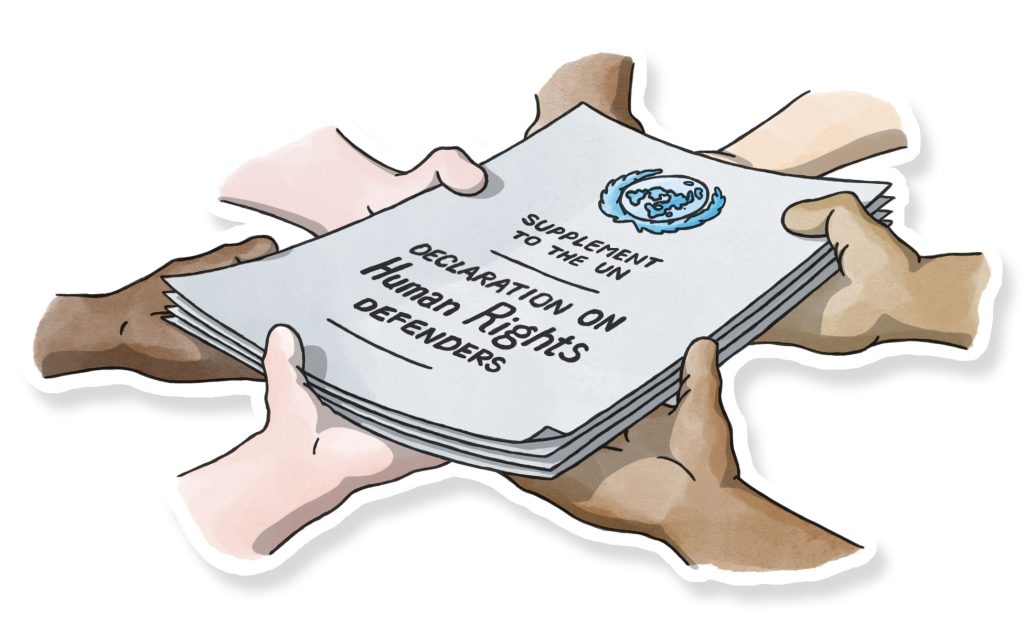
25 years ago, the United Nations adopted the Declaration on Human Rights Defenders. The declaration has been essential to protect those who defend human rights. It’s time to celebrate the Declaration, human rights defenders and all the contributions they have brought to our societies.
The Declaration is a landmark document that sets out the rights and responsibilities of States, human rights defenders, and all actors in society in ensuring a safe environment where defenders are recognised, valued, and encouraged to work for the promotion and protection of human rights.
As part of this celebration, Amnesty International, CIVICUS, Defend Defenders, FIDH, Forum Asia, Front line Defenders, Gulf Centre for Human Rights, ICNL, ILGA World, IM Defensoras, ISHR, MENA WHRD Coalition, OMCT, Peace Brigades International , Protect Defenders, Protection International and RFK Human Rights launched a collaborative project to analyse the contributions of the Declaration to defenders’ lives and work, as well as progress in international human rights law on the protection of defenders.
What do we want to achieve?
This project seeks to enhance the awareness of the Declaration and encourage greater dialogue on the protection needs of defenders
One of the outcomes of the project will be the creation of a supplement to the Declaration that will be a civil society-led document taking into account developments in international and regional jurisprudence relating to defenders over the past 25 years and evolutions of human rights movements, addressing key gaps and limitations in the Declaration, and reflecting defenders’ lived experiences and needs.
This supplement will guide change on the ground in the next 25 years, and beyond!
We need the input and voices from human rights defenders everywhere!
What can you do?
We are consulting online and offline with human rights defenders across the globe on changes in national, regional and global contexts in which they work, evolutions of human rights movements and activism, and defenders’ lived experiences and protection needs. We are also reviewing how international and regional jurisprudence in relation to human rights defenders has developed over the last 25 years.
1. Add your voice
By sharing your experiences, insights, and recommendations, you can help shape the future of human rights and contribute to the protection and promotion of defenders’ rights.
Are you a human rights defender and want to contribute to the project?
Help us raise awareness about the UN Declaration on human rights defenders. Join the #Right2DefendRights social media campaign.
Join the social media campaign!
Discover our #Right2DefendRights social media kit and post the content on your networks. Download the kit
3. Learn more about the Declaration
Learn more about the Declaration on Human Rights Defenders, its importance, content and application. Visit our online e-learning platform and take our 30 minutes course.
Take the e-course
Visit our online e-learning platform and learn more about the Declaration.Learn more
4. Get in touch!
Let us know if there are convening of HRDs happening anywhere that we could do consultations around. Drop an email to Tess Mcevoy: t.mcevoy@ishr.ch
—————
And on Monday 11 December (10:00 – 12:00 EST) there will be an event “UDHR75 + HRDS25 = 100% HUMAN RIGHTS” at Ford Foundation Center for Social Justice, New York with HRDs speaking about their lived experiences, with: Sukhgerel Dugersuren, OT Watch, Mongolia Karina Sánchez, IM Defensoras, Mesoamerican Intiative of Women Human Rights Defenders, LAC Sirley Muñoz, Somos Defensores, Colombia Brenda Kugonza, Women Human Rights Defenders Network Uganda Edita Burgos, Karapatan, Philippines Moderation: Tess McEvoy, International Service for Human Rights
On 5 December 2023 Amnesty International launched its global website as an .onion site on the Tor network, giving users greater access to its work exposing and documenting human rights violations in areas where government censorship and digital surveillance are rife.
In recent years, a number of countries including Algeria, China, Iran, Russia and Viet Nam have blocked Amnesty International websites.
“By making Amnesty International’s website available as a secure .onion site on Tor, more people will be able to read our human rights research and engage with the vital work of speaking truth to power, and defending human rights.”Donncha Ó Cearbhaill, Head of Security Lab at Amnesty Tech.
However, audiences accessing the Amnesty.org website through Tor will be able to bypass attempts at censorship.
An .onion site is a website that is only accessible through Tor, a volunteer-run network of servers which encrypt and route internet traffic through multiple servers around the world, providing users with an added layer of privacy and anonymity.
“The onion site provides a means for individuals around the world to exercise their rights to privacy, freedom of expression, freedom of peaceful assembly, and freedom of association in a safe and secure online environment,” said Donncha Ó Cearbhaill, Head of Security Lab at Amnesty Tech.
The Tor Project has a version of the Tor Browser for many common platforms, including Windows, Mac, Linux, and Android. Onion sites can also be accessed on iPhone through the Onion Browser app. In countries where the Tor network is blocked, visitors will also need to configure Tor bridges which help bypass attempts to block connections to the network.
Amnesty International is also making language-specific content published in Chinese, Farsi and Russian available on the Amnesty International Tor onion website.
“We are thrilled that one of the most recognized human rights organizations has adopted an onion service to provide greater online protections for those seeking information, support and advocacy. Amnesty International’s choice to offer an onion version of their website underlines the critical role of this open-source privacy technology as an important tool in our shared work of advancing human rights,” said Isabela Fernandes, Executive Director, the Tor Project.
What are .onion sites?
Onion services never leave the Tor network. Their location and IP addresses are hidden, making it difficult to censor them or identify their operators. In addition, all traffic between users and onion services is end-to-end encrypted. As a result, users leave no metadata trail making it impossible for their identity or internet activity to be tracked.
Both Tor and virtual private networks (VPNs) can help internet users bypass website blocking and censorship.
Tor routes connection through a number of volunteer run and randomly assigned servers preventing anyone individual or organization from being able to track both the identity and internet activity of users while a VPN connects through a single privately owned server.
The Tor software was first released more than 20 years ago and is now developed and maintained by the Tor Project, a US-registered not-for-profit organization which is focused on advancing human rights and freedoms by creating and deploying free and open-source anonymity software and privacy technologies.
14 NGOs that closely follow and engage with the General Assembly Third Committee have published a joint statement on outcomes of this 78th sessionp
The undersigned civil society organisations mark the conclusion of the UN General Assembly’s (GA) 78th Third Committee session with the following observations on both thematic and country-specific outcomes. We urge all States to implement the commitments they have made during this session to their full extent.
We welcome the joint statement on reprisals, led by Ireland and Uruguay and joined by a cross-regional group of countries. The statement called on all States and the UN to prevent, respond to, and ensure accountability for cases of intimidation and reprisals against those who engage or seek to engage with the UN. Once again, 80 States signed on to the statement, and affirmed their commitment to freedom of expression and association; solidarity with defenders, civil society and victims of violations; and contributed to ensuring that UN bodies and processes are informed by, and respond effectively to, the needs of communities on the ground. We urge more States to sign on to future such statements.
We welcome the adoption of the biennial resolution on human rights defenders focusing on the 75th anniversary of the Universal Declaration on Human Rights and the 25th anniversary of the UN Declaration on Human Rights Defenders. The resolution included strengthened language on women human rights defenders, defenders in conflict and post conflict situations and children defending human rights; as well as multiple and intersecting forms of discrimination and defenders’ work to develop new human rights ideas. We welcome calls on States to refrain from internet shutdowns and restrictions including digital technologies, as well as on OHCHR to collect information on threats, attacks and cases of arbitrary detention. We now look to all States to implement these commitments and meaningfully progress the protection of human rights defenders.
We welcome the adoption of a strong resolution on the safety of journalists. This resolution adds new commitments for States on a wide range of issues, including on strategic lawsuits against public participation (SLAPPs), journalists covering protests, and gender-based harassment and abuse. The resolution also recognised the growing threat of generative artificial intelligence to the safety of journalists. We urge all States to translate these renewed international commitments into allocation of resources and political will at the national level to prevent, protect and remedy all human rights violations against journalists.
A new resolution on the promotion and protection of human rights in the context of digital technologies was adopted, advancing discussion on artificial intelligence at a critical time as the Global Digital Compact attempts a similarly comprehensive exercise. The text brings the omnibus coverage of the various Human Rights Council resolutions to the Third Committee, highlighting intersections of digital technologies, human rights, security and sustainable development, and crucially recognising that certain applications of digital technologies are incompatible with international human rights law. The text included language on racial and gender-based discrimination, business and human rights, privacy, targeted surveillance, data protection, freedom of expression, censorship and internet shutdowns. We hope to build on this broad foundation and strengthen elements on targeted surveillance, commercial spyware, biometric data in digital public infrastructure, and applications of artificial intelligence in future resolutions.
The resolution on terrorism and human rights adopted by consensus underscores the importance of the promotion of human rights and meaningful participation of all of society in counter-terrorism efforts nationally and globally. This resolution offered an opportunity to reflect on changes in State violations in the name of counter-terrorism or national security, and to build on language on gender inclusivity, civil society engagement and the importance of international humanitarian law and humanitarian access included in the recent UN Global Counter-Terrorism Strategy and report by the Special Rapporteur on human rights and counter terrorism. However, as the resolution was a technical rollover from GA76, we regret that this opportunity was not seized this session and hope that future resolutions will build upon these advancements.
We welcome the adoption of the resolution on strengthening the role of the UN in the promotion of democratization and enhancing periodic and genuine elections, focusing on media freedom and freedom of expression, presented by the US. The role of human rights defenders, as well as States’ obligation to ensure the right of all to participate in elections and to take steps to eliminate policies and practices discriminating on various grounds was maintained in the text. Critically, for the second time, the text recognised women and girls in all their diversity, and listed sexual orientation and gender identity as prohibited grounds of discrimination; despite votes being called to amend those references. Consensus was broken on the resolution for the first time, but was ultimately adopted by an overwhelming majority.
We welcome the adoption by consensus of the resolution on the rights of Indigenous Peoples. We specifically welcome calls on States to ensure the protection and safety of indigenous human rights defenders, and to prevent and investigate human rights violations, killings, reprisals and abuses against them.
The rights of the Child resolution, focusing on the digital environment, was adopted by consensus. Despite the timeline precluding a full consideration of the lengthy text and risking an imbalanced update, we welcome the co-facilitators’ decision to open the full text for negotiation, to include updates related to the theme and references to General Comments 25 and 26 of the Committee on the Rights of the Child. We welcome retention of agreed language, and updates, including: bridging digital divides; protection from violence, harassment and abuse in the digital environment; access to information and impacts of digital acceleration on education access; sexual and reproductive health; multiple and intersecting forms of discrimination; and private sector responsibilities. We are disappointed however by decisions to delete agreed language on the full, equal and meaningful participation of girls, delete paragraphs on COVID-19 that resulted in lost language on children’s rights, to remove language on specific challenges facing girls, and to include new non-agreed language on the common responsibilities of parents.
Gender related resolutions
The resolution on policies and Programmes Involving Youth presented by Cabo Verde, Kazakhstan and Portugal, was adopted by consensus. The zero-draft was slimmed down in a streamlining exercise, leading to the exclusion of human rights frameworks and a focus on reinserting previously agreed language. We are pleased that references to multiple and intersecting forms of discrimination, sexual and gender based violence, sexual and reproductive health services, menstrual health, comprehensive education and human rights frameworks were retained. However we regret that despite significant support from Member States, agreed language from the previous resolution on sexual and reproductive health and rights, menstrual hygiene management, marginalised persons and situations, comprehensive sexuality education, as well as references to adolescents were not included in the final text.
We welcome the adoption by consensus of the resolution on the human rights to safe drinking water and sanitation (WASH), presented by Germany and Spain, that included new references to menstrual health and hygiene management, sexual and reproductive health-care services, and sexual and gender-based violence. Language was maintained on the stigmatising effect of lack of menstrual health and hygiene management on young women and girls; as well as inequalities caused by COVID-19 in accessing adequate WASH services especially for women, girls and persons in vulnerable situations, adversely impacting gender equality and women’s empowerment. We regret that, despite significant support, references to multiple and intersecting forms of discrimination and sexual and gender-based violence were either omitted or diluted in the final text, neglecting the need to comprehensively address various forms of violence and discrimination women and girls face when accessing water and sanitation.
We welcome the adoption by consensus of theviolence against women migrant workers resolution presented by Indonesia and the Philippines. The resolution includes new references to gender-based violence through digital technologies, particularly impacting women migrant workers in transit and in destination countries; as well as root causes of migration, including climate change, the availability of equitable work and inequitable ownership of local resources, which undermine women’s empowerment. Strengthened recognition of domestic and care migrant workers as a particularly vulnerable group who can face exploitation, violence, and abuse due to the informal nature of their employment was included. We regret that despite significant support, additional references to sexual and reproductive health, intimate partner violence, and multiple and intersection forms of discrimination were omitted in the final text. We echo the resolution’s call to all Member States to protect all migrant women from harassment and violence, regardless of migration status.
The resolution on the Girl Child, presented by the Southern African Development Community (SADC), was adopted by consensus. We welcome the retention of agreed language, as well as the theme proposed for the Secretary General’s Report to the eightieth GA session on the impact of digital technologies on girls, and related language updates. However, we deeply regret that the circulation of the text did not allow sufficient time for a comprehensive and substantive update. We are disappointed that the only other update to the text was the unprecedented inclusion of language on family-oriented and family-policies. In the absence of references to other policies that aim to realise the rights of girls in all their diversity, this new inclusion results in an imbalanced text that fails to fully recognize and address the challenges they face. Given the rapidly changing global landscape for girls and that last substantive revision of this text was in 2017, a comprehensive update to this resolution remains crucial.
The resolution on rural women was adopted by consensus and co-sponsored by more than 60 Member States. We welcome the retention of agreed language that recognizes the impact of historical and structural power relations, gender stereotypes and negative social norms on the achievement of gender equality and the empowerment of women and girls, particularly those living in rural areas. We also welcome that the resolution urges Member States to implement policies and programs that promote and protect the human rights of women and girls, address sexual and gender-based violence and multiple intersecting forms of discrimination, and strengthen measures to ensure universal access to sexual and reproductive health and reproductive rights. We, however, deeply regret that several proposals to further strengthen the resolution that were supported by many Member States were not retained in the final draft including on the particular challenges women and girls living in rural areas face in accessing sexual and reproductive health services, and references to women and girls in all their diversity.
The resolution on follow up to the Beijing Declaration and Platform for Action presented by Bangladesh was adopted by consensus. We welcome the text, which includes new references to the high-level meeting on universal health coverage, the universality of the 2030 agenda and their role in achieving gender equality, and to the UN system-wide Knowledge Hub on addressing sexual harassment. It also calls for a high-level meeting at the 80th General Assembly to celebrate the 30th anniversary of the Fourth World Conference on Women, and to accelerate the realisation of gender equality and the empowerment of all women and girls. We regret that proposed text on multiple and intersecting forms of discrimination and on the importance of the realisation of sexual and reproductive health and reproductive rights was not included in the final document.
COUNTRY SITUATIONS
Thejoint statement on the human rights situation in Xinjiang, China delivered by the UK on behalf of a cross-regional group of 51 countries is a strong message to Chinese authorities regarding growing concerns about abuses against Turkic Muslim communities. This year, there are new signatories from several regional groups. The statement emphasises the serious human rights violations Uyghurs and other Turkic Muslim communities continue to suffer in Xinjiang, and echoes the UN Office of the High Commissioner for Human Rights’ August 2022 report, which concluded that the abuses ‘may constitute international crimes, in particular crimes against humanity.’ The statement notes that a year has passed since the release of the OHCHR report, and China has yet to engage constructively with its findings. It urges China to end its human rights violations, engage constructively with the OHCHR, and fully implement the reports’ recommendations. With only one more State signature than the 2022 joint statement, work remains to be done to ensure broader support from Member States to hold China accountable for its human rights violations including from Muslim-majority countries.
Resolutions
While we support the below resolutions that highlight violations of human rights in specific countries, we acknowledge the existence of human rights violations in many other countries that also merit the attention of the UN General Assembly and look forward to a time when they are also considered in the Third Committee.
The resolution on the human rights situation in the Islamic Republic of Iran was adopted following a vote (80 in favour; 65 against; 29 abstentions). Initiated by Canada and a core group and cosponsored by 50 countries, this comprehensive resolution calls on Iran to uphold the rights of all citizens. It specifically calls on Iran to prohibit child, early and forced marriage, female genital mutilation, children being subject to the death penalty, torture and other inhuman treatment. It condemns fundamental rights violations, the frequent imposition of the death penalty, intensified and targeted repression of women and girls, the use of surveillance and force against non violent protesters, and poor prison conditions. It also calls for an end to all discrimination and violations against ethnic, linguistic and other minorities as well as recognized and unrecognised religious minorities, including Baha’is who continue to suffer various violations including persecution, mass arrests, lengthy prison sentences.
We welcome the adoption of the resolution on the situation of human rights in the Syrian Arab Republic. We particularly welcome new references to the victim- and survivor-centric Independent Institution on Missing Persons, a mechanism established by the UN General Assembly this June, to help clarify the fate and whereabouts of all missing persons in Syria. However, we are disappointed that the resolutions’ co-sponsors orally amended the text to remove a critical paragraph that would have mandated a regular report on humanitarian access in the country. Not only would this report have specifically highlighted instances where humanitarian access was not full, timely, unrestricted or sustained; it would have filled a gap left by the failure to renew the Security Council-mandated cross-border humanitarian mechanism earlier this year.
The consensus adoption of the resolution on the human rights situation in the Democratic People’s Republic of Korea (DPRK) demonstrates that Member States remain deeply concerned about the appalling abuses committed by the DPRK authorities. We welcome in particular the inclusion of language on accountability. We also welcome language stressing the linkages between the human rights situation in the country, including with respect to the rights of women and girls, and the continuing diversion of DPRK’s resources to pursuing nuclear weapons and ballistic missile programmes over the welfare of its people.
The resolution on the situation of human rights of Rohingya Muslims and other minorities in Myanmar, which was adopted by consensus, once again does not reiterate key elements of the 2021 UNGA resolution which followed the military coup in February 2021. The resolution fails to comprehensively address ongoing and escalating human rights violations by the military, despite the Special Rapporteur on Myanmar’s warning that a ‘raging fire of brutality’ is engulfing the country. The resolution however recognizes the impacts of militarization aggravated by the continued access to arms from abroad, reiterates protection needs of the Rohingya and calls for all necessary measures to be taken to provide justice to victims and ensure accountability.
The resolution on the situation of human rights in the temporarily occupied territories of Ukraine, including the Autonomous Republic of Crimea and the city of Sevastopol was adopted by vote. The resolution strongly condemns intensifying crackdowns against journalists and other media workers, human rights defenders and civil rights activists, as well as forcible transfers of Ukrainian children and other civilians to the temporarily controlled or occupied territories of Ukraine and their deportation to the Russian Federation. The resolution further calls on Russia to cease all violations and abuses, including discriminatory measures and practices, arbitrary detentions and arrests within the framework of the so-called filtration procedures, enforced disappearances, torture, sexual and gender-based violence, including compeling apprehended persons to self-incriminate or ‘cooperate” with law enforcement, ensure fair trial, and revoke all discriminatory legislation.
CIVIL SOCIETY ACCESS While we welcome the action by some States to invite civil society organisations to join informals as observers this session, it was disappointing that only a few States extended this invitation. This year, once again, civil society encountered challenges in staying informed about informal negotiations. The schedule of these informal sessions, previously available in the UN journal until 2019, was once again absent from the said journal. Instead, it was exclusively published on the e-deleGATE platform, to which civil society does not have access.These critical barriers to civil society access to Third Committee negotiations deprive the Committee of civil society’s technical expertise and mean that its outcomes fail to leverage the contributions of a crucial stakeholder in promoting the implementation of human rights.
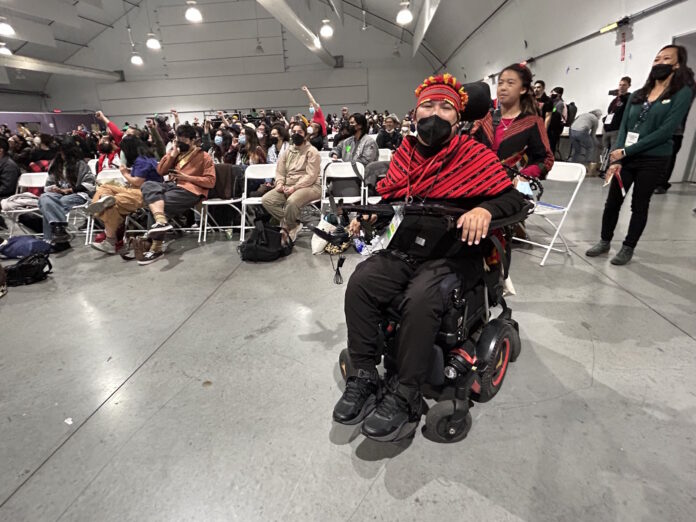
Brandon Lee and his daughter Jesse Jane at the People’s Counter Summit of the No To APEC Coalition, Nov. 11, 2023. Photo by Jia H. Jung
Jia Jung wrote on 20 November, 2023 about Chinese American Bay Area native Brandon Lee who gave the keynote speech at the No to APEC People’s Counter Summit, “People Over Profit and Plunder,” at San Francisco State University on Saturday, Nov. 11, 2023.
Lee was living with his wife and daughter in the Philippines and working as a human rights advocate, land defender, and journalist for the Northern Dispatch when he was shot by Philippine armed forces on Aug. 6, 2019. He survived – as a quadriplegic who remains steadfast in his international activism. Lee said, inter alia:
In high school, I was voted most shyest. I always preferred to work behind the scenes behind the camera, never in front. I was working security during rallies or painting posters the day before.
…In 2003, I transferred to this campus and joined the League of Filipino students at San Francisco State University. That’s where I learned that our country, the United States, continues to dominate and stagnate the Philippine economy, politics, and culture.
Around this time, I also started volunteering for the Chinese Progressive Association. That’s where I learned about the conditions and struggles of immigrant Chinese workers, and tenants. It was at that time I met Pam Tau Lee, the founder of the Chinese Progressive Association.
She was one of my mentors. And that’s where I learned that in the late nineties, San Francisco had 20,000 garment workers. But in less than 10 years, many of the immigrant monolinguistic women workers lost their jobs, with 88% of the workers being offshored to countries with weaker labor protection. It was during these years that I learned how interconnected our struggles are, and I became an internationalist and an anti-imperialist.
In 2007, I went on a life changing exposure trip to the Philippines. I met Youth and Students who are now movement leaders. I joined with workers boycotting Nestlé on their picket line. Ka Fort [Diasdado Fortuna], the chair of their union, was killed in cold blood by state agents. Ka Fort was dearly, dearly loved by the Nestlé workers for his leadership in building the union and his ultimate sacrifice.
So workers also launched a public campaign – “there’s blood in your coffee” – to draw international attention against Nestlé. Nestlé believes that water is a corporate right and not a human right. In this same trip, we visited many sectors, including the most oppressed majority and largest class – the peasants – as well as the Igorot Indigenous people in the northern part of the Philippines.
The Igorots, who live on resource-rich lands, are considered squatters on their own land because the Philippine government considers any land with a slope of 18 degrees Philippine land. The Igorots have been fighting against foreign occupation and colonization for hundreds of years.
And until now, they have continued their fight against government neglect and development aggression, militarization, and for the recognition for the right to ancestral land and self-determination.
On that exposure trip, our group also attended the one-year death anniversary of Alyce Claver, the wife of Chandu [Constancio]Claver, who was the provincial chair of the progressive party, Bayan Muna, and the president of the Red Cross. Chandu and Alyce were driving their kids to school when a motorcycle pulled up and shot at their car. Alyce shielded her husband and was riddled with two dozen bullets. Chandu made it out alive and is now in Canada with his kids after filing for political asylum, but the family today continues to be traumatized.
During this trip, we joined a medical and fact-finding mission to a remotevillage, and thankfully, the military had pulled out. The Indigenous peasants taught us about how the soldiers had blindfoldedthem and pointed a gun to their nape. The soldiers accused the farmers of supporting the land defenders and the resistance fighters known as the New People’s Army. The Philippine militarypretended to have a fake medical mission, giving out expired medicine to the local Indigenous people.
This trip, 16 years ago, changed the direction of my life.
I believe that we are shaped by our experiences, and this exposure program gave me new direction. It fortified my commitment to serving the fight for the Philippine liberation from U.S. imperialism. And to this day, the stories and sacrifices of Alyce Claver, Ka Fort, and so many others continue to fuel my commitment.
Two years later in 2009, I decided to deepen my commitment and decided to do a three-month integration in a remote area deep in the mountains. When I returned, I learned about Melissa Roxas, who was also from the U.S. and was abducted by the Armed Forces of the Philippines. She was conducting a medical mission. After a week, her captors released her as long as she promised to shut up.
She didn’t, though – she didn’t shut up. As she was she was released, she told the world what happened. As a health worker, Melissa diagnosed the Philippines’ societal problems and saw the illness of neoliberal policies from living among the poor. Melissa was brave. Her journey back from the trauma perpetuated by the Philippine military would soon follow for me.
The year following, 2010, I went all in and decided to live and serve the Igorot Indigenous people. I married my girlfriend, who is an Indigenous Ifugao, and we had a daughter, Jesse Jane, who is here with us today. I lived nine years with Indigenous people in the northern part of the Philippines, and I learned how they defended their land rights and lives in the resource-rich area known as the Cordillera region.
I saw firsthand how neoliberal policies promoted by APEC, such as the Philippine Mining Act of 1995, liberalize the mining industry, allowing foreign mining companies to reap 100% profit from the plundering of Indigenous people’s lands, unbridled large-scale destructive mining, dams, energy and other foreign projects, masquerading as development projects, and destroy the environment and forcibly displace Indigenous people who have been living there for generations.
Now, 13 years later, I’m speaking in front of you, a survivor of state violence and war that is spread by APEC and neoliberalism. They say APEC will promote sustainability. The Indigenous community say no. They are robbed of their life, land, culture, and worse, their future. Despite decades of people’s resistance, the plunder the natural resources, of indigenous – of ancestral – domains, continues. The region is blanketed with 176 large-scale mining and more than 100 energy projects, such as hydropower and geothermal projects awarded to private corporations.
One such energy project is the Chevron geothermal power project, which covers a large area in Kalinga. If left unchallenged and unopposed, all these could mean the ethnocide of the Igorots and the massive destruction of the ecosystem in the Cordillera region…
Indigenous communities were militarized, bombed, and strafed with artillery shelling, but they did not cower and they did not back down. They remained steadfast. They took care of each other. And they continued to hold the line.
They say APEC is innovative and will solve our problems. Hell, no.
Because I protested alongside the Indigenous communities, and, as a journalist, wrote about the daily attacks they face, I was also threatened and harassed. I was placed under surveillance. Tailed. Followed. They watched our office. They took pictures of us at our office and homes, as well as the tricycle, jeep, and bus terminal. I was red-tagged and politically vilified as a terrorist. I experienced death threats in the form of the burial blanket for the dead. I was detained and had my bag illegally searched at a military checkpoint the week before members of the 54th Infantry Battalion of the Philippine Army shot me in front of my daughter in front of my home on August 6th, 2018.
They had visited me at my house and office looking for me. They said they wanted to partner with my organization, the Ifugao Peasant Movement, but we refused. I told them two names – William Bugatti and Ricardo Mayumi – on why we do not want to partner with them.
While their assassination attempt against me was unsuccessful, I am permanently scarred and paralyzed. I am now quadriplegic, unable to use my hands and legs. I am considered one of the lucky ones. But I live with trauma every day. [see also: SF human rights activist fights for his life after being shot in the Philippines]
I know firsthand that the backdoor trade deals handled by APEC will not benefit the people; they only benefit the corporations and imperialist countries like the United States. That is why the United States sends its military around the world, finance schools, support fascist governments – to open up industries.
In fact, I have no doubt that the bullets lodged in my body today are paid by our taxpayer dollars.
Although I am paralyzed physically, they have failed to shut me up.
Today, I am proud to be standing with you, metaphorically speaking, in fighting back against APEC. Against state and political repression. Against corporate greed and power. Against the wealthy elite. Against the plunder of our planet. Against foreign domination of our peoples.
The Indigenous communities are resilient also. Like millions of people in the Global South, they are fighting back. They continue to protest despite being attacked. They have successfully barricaded several mines, rejecting countless mining and dam projects.
They have been on the frontlines of fighting the WTO [World Trade Organization], dismantling the Chico Dam equipment during the late dictator Marcos, which launched a coordinated people’s response that brought the Indigenous people to the national liberation struggle.
They are also on the frontlines of fighting APEC; a fight has led thousands to take up armed struggle as an appropriate response to defending their land, which is their life.
One of their martyr freedom fighter, Arnold “Ka Mando” Jaramillo, favorite expression ispayt latta! It means fight to the end, or continue to fight, and it’s today emulated by the Cordillera mass movement. Payt latta.
I will continue to fight as long as I breathe. Take a look around – my story is just one of many. There are a thousand people here today, diverse and multigenerational, coming from across the world, each with their own journey, own experiences, and reason for being here. But what unites us all is our opposition to APEC and neoliberal policies. We have so much in common – so much we can unite and rage against. A common enemy – APEC – and the neoliberal policies that prioritize profit and plunder over people and planet.
We will not go gently into that night. Rage. Rage! We will fight!
We will fight for a better future for all. Let us continue to talk, to build and work together, now and after APEC. For now, are you ready? Are you ready to shut down APEC?
The award ceremony took place on at the Palace Cultural Center in St. Gallen.
Paula Weremiuk from Narewka on the Polish-Belarusian border works as a teacher during the day and as a refugee aid worker in the Bialowieza forest at night. According to the Paul Grüninger Foundation, a refugee drama of enormous proportions has been taking place there since 2021.
Paula Weremiuk searches for people in need in the inaccessible areas of Bialowieza, providing them with clothing, food, sleeping bags and the most basic necessities, writes the Paul Grüninger Foundation. The Belarusian dictator Alexander Lukashenka is forcing thousands of refugees from the Middle East and Africa across the border to Poland, where they are met with strong political rejection.
At the border, in the primeval forest of Bialowieza, there is often brutal violence, abuse, rape and repeated deaths. The refugees, including women and small children, are helplessly abandoned to their fate in the inaccessible terrain and are chased back and forth across the border by the authorities. Refugee helpers are being harassed and criminalized, the press release continues.
Ayşe Gökkan’s award was accepted by her lawyer, Berfin Gökkan. The lawyer read out a letter from Ayşe Gökkan written in Kurdish: “I greet you with the warmth of the sun and the enthusiasm of Jin-Jiyan-Azadî. As a member of the Movement of Free Women, I accept this award on behalf of thousands of struggling Kurdish women. There are many fighting women in prison in Turkey.”
The foundation justified the awarding of the recognition prize of 10,000 francs to the Kurdish feminist and human rights defender Ayşe Gökkan for her civil society commitment and her criminalization:
“Ayşe Gökkan has particularly distinguished herself as a journalist and as an activist for women’s rights. For almost forty years, she has been writing newspaper columns against racial and gender discrimination, speaking at national and international podiums and seminars, leading workshops on the topic of gender inequality and taking part in peaceful demonstrations in this context.
From 2009 to 2014, Ayşe Gökkan was mayor of the Kurdish city of Nusaybin, which lies on the border between Turkey and Syria. When Turkey began to build a wall against refugees between Nusaybin and the neighbouring Syrian town of Qamishlo, the mayor protested against this “wall of shame” with, among other things, a sit-in strike.
Because of her civil society commitment, Ayşe Gökkan has been arrested in Turkey more than eighty times, subjected to more than two hundred investigations and, in 2021, sentenced to more than 26 in a grotesque court case based on the statements of a single “secret witness” for membership in a “terrorist organization”.
She is a victim of the criminalization of the political opposition in Turkey. Ayşe Gökkan is in prison, her sentence has not yet been confirmed by the Turkish Court of Cassation, and proceedings are also pending before the European Court of Human Rights.”
On 21 November, 2023 the Martin Ennals Foundation, joined by HRW and the ISHR, issued the following statement:
The Martin Ennals Foundation condemns the harassment of Soltan Achilova and her daughter by government authorities at Ashgabat airport and calls for Turkmen authorities to stop their reprisals against journalists for their human rights work.
In the early hours of November 18th, 2023, Mrs. Soltan Achilova and her daughter were stopped by Turkmen government officials from boarding their flight for Switzerland. A customs official took their passports, wet them with a damp rag and declared the passports to be ruined, effectively obstructing Soltan from traveling to Geneva where she would feature as a keynote speaker at the University of Geneva’s Human Rights Week 2023.
This act of harassment and denial of freedom of movement is particularly reprehensible in that it comes only a few days after Turkmenistan’s 4th Universal Periodic Review, during which high-level government representatives expressed their “support for …the promotion and protection of fundamental freedoms and human rights“, giving multiple examples of their progress in terms of respect for freedom of expression.
Soltan Achilova believes she was not allowed to leave the country because of the authorities’ fear that negative information might be heard during the Human Rights week in Geneva. Yet, the obstruction from travel of an internationally recognized human rights defender is more striking evidence of the lack of freedoms in the country and the bad faith with which the Turkmenistan government engages with the Human Rights Council.
Turkmenistan is one of the most repressive and isolated countries in the world, ranking 176th out of 180 countries in terms of press freedom and working conditions for journalists. Soltan has been reporting about her country for more than a decade. Her pictures of daily life are one of the few sources of documentation of human rights violations occurring in this most secretive nation. In 2021, Soltan was recognized by the Martin Ennals Award for her documentation of land grabs and forced evictions of ordinary citizens in Ashgabat.
Soltan has not been allowed to travel freely outside of her country on several occasions. She is under constant surveillance by Turkmen authorities and has suffered numerous incidents of harassment, intimidation, and threats. Despite the challenges, Soltan persists in her human rights work, regularly sending information and pictures outside of the country so that government authorities are held to account.
We renew calls for Turkmenistan to fully implement their human rights obligations, including, inter alia, allowing human rights defenders and journalists to conduct their work peacefully. We invite Member States accompanying the 4th Universal Periodic Review of Turkmenistan to strongly sanction the silencing of Soltan Achilova and other Turkmen journalists.
Law professor Diane Desierto advocates for dignity and justice, and for her students to do the same
When Nobel laureate Maria Ressa was arrested for cyberlibel, she wasn’t shaken. In a two-year period, the Filipino American journalist, Time magazine Person of the Year, Fulbright scholar, and author of How to Stand Up to a Dictator had racked up 10 arrest warrants, plus a barrage of online hate, for her role as founder of Rappler, an independent news site known for its criticisms of authoritarian president Rodrigo Duterte. The claims ranged from fraud to tax evasion to ties with the Central Intelligence Agency, all of which were eventually dismissed.
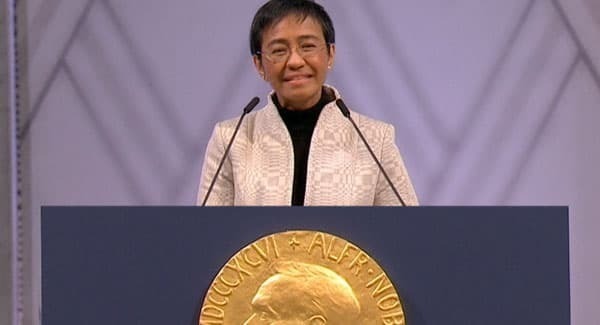
Ressa offers the 2021 Nobel Peace Prize lecture in Oslo, Norway.
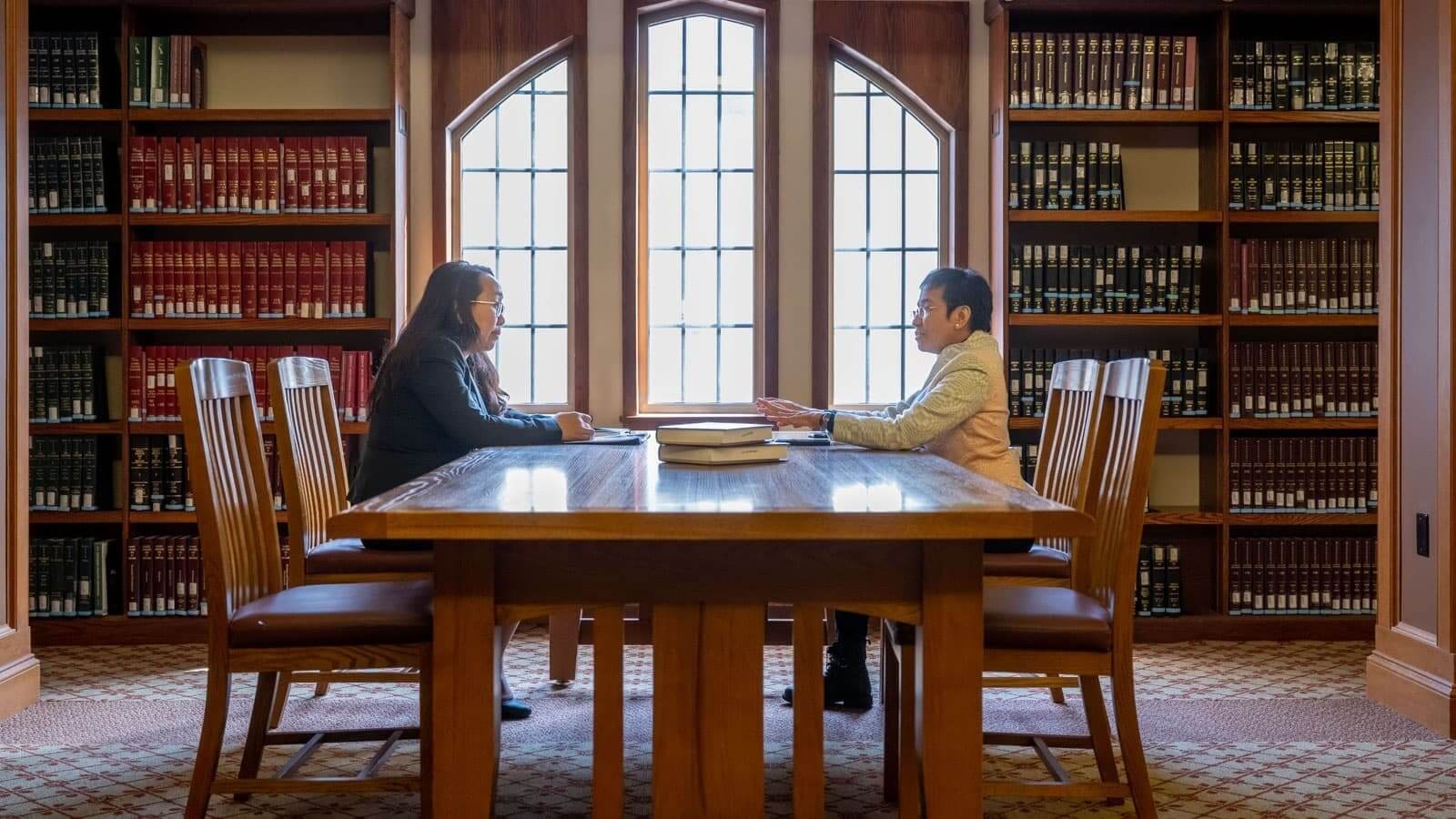
But when her cyber libel conviction, the first of its kind in the Philippines and which carries a seven-year jail sentence, reached the country’s Supreme Court, she needed help. That help came in the form of Notre Dame law professor Diane Desierto.
Desierto is the faculty director of the LL.M. in International Human Rights Law and founding director of the Law School’s new Global Human Rights Clinic. While teaching and publishing, she also serves as a member of a United Nations working group, faculty at the Hague Academy of International Law, and international counsel at the Permanent Court of Arbitration, the UN Human Rights Committee, the International Criminal Court, the International Court of Justice, and the Philippine Supreme Court. She’s tangled with threats, attacks, and authoritarian governments, primarily in the Philippines and other Southeast Asian countries, as well as China, where she was detained twice.
Though Ressa already had a powerhouse legal team, she asked Desierto to represent her at the Philippine Supreme Court.
“I chose Diane to represent me because she had the courage to stand up. She understood the risks,” Ressa says, noting that these days lawyers are even more likely to be harassed or killed than journalists. “Yet she also understood both, from a Filipino perspective, the ties that bind and the way the law can be used to protect us.”
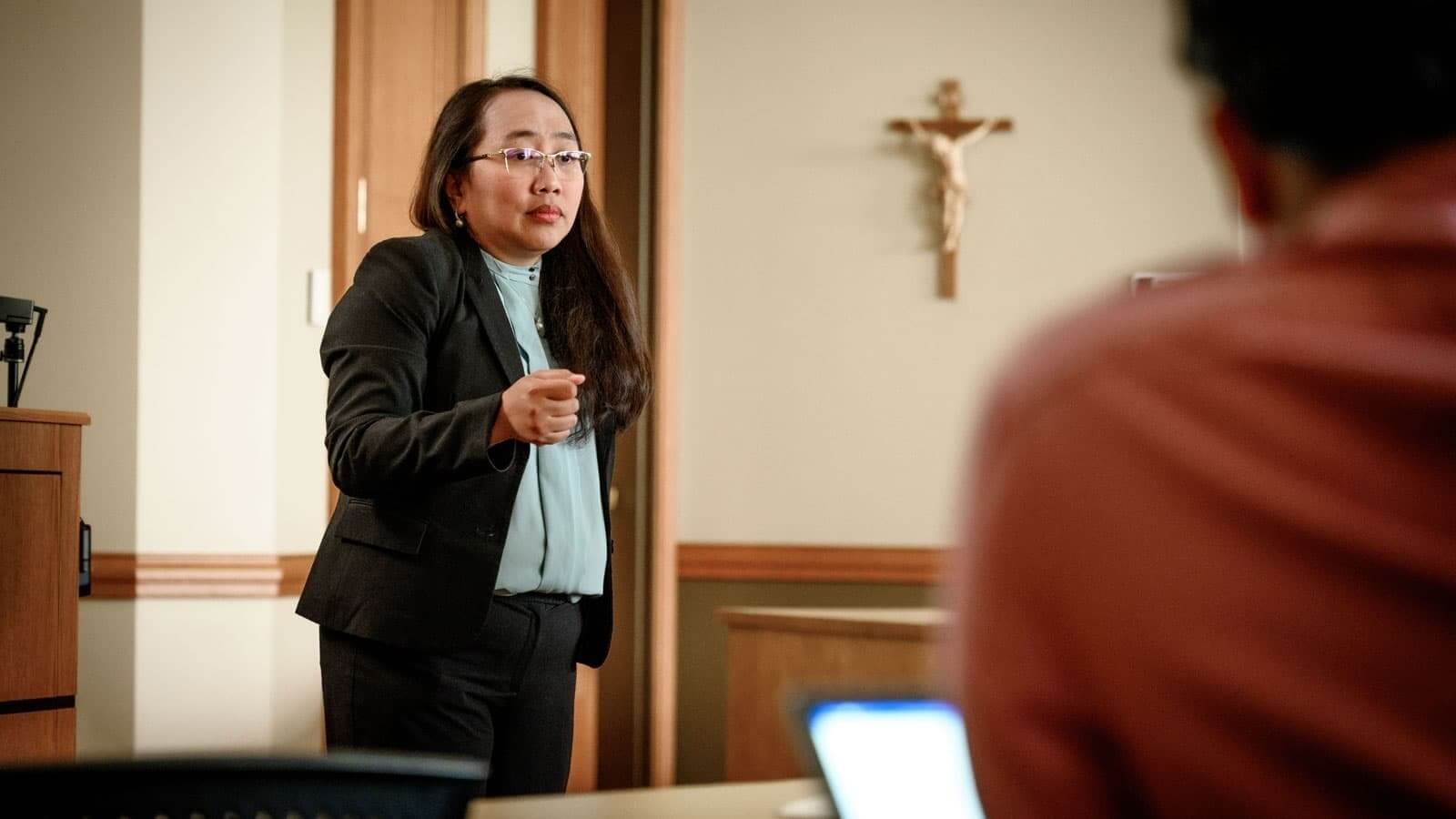
Professor Diane Desierto says human rights lawyers from around the world are welcome at Notre Dame.
She smiles and says, “And she’s never lost a case.”
In a matter of days, Desierto had filed an appeal, on top of her international commitments and teaching load. But her motivation was simple: “This is the right thing to do.” She adds, “We’re the place that wants to do the right thing.”
“Human rights lawyers generally experience a range of threats. It’s not just physical threats and death threats and actual killings, but also the delegitimization of the work that they do. And that includes being discredited publicly. That includes having all forms of coercion being placed on your family. So some of the threats that I’ve dealt with have not just been physical threats to my person or detention, but have also included threats to my family’s law firm, have also included arrests and detentions and all manner of harassment and intimidation. But that’s just the tip of the iceberg that most human rights lawyers face today.” Desierto says
Desierto notes that according to recent studies, 72 percent of the world’s population live under authoritarian rule. Additionally, during the COVID pandemic, emergency regimes were set up, during which time 3,000 human rights lawyers were killed globally. That’s already a high number, but Desierto underscores the ripples of what 3,000 people could have done.
“We are trusted by a lot of places around the world where human rights defenders are under siege,” Desierto says. “They have sanctuary here, and they can grow with a community here, and they can be supported with this community.” Roqia Samim has experienced that support firsthand. Samim is a human rights lawyer from Afghanistan and a 2022 graduate from the LL.M. program.
“Notre Dame Law School and the LL.M. Program for International Human Rights Law became my home and became my shelter.”—Roqia Samim ’22 LL.M.
“Unfortunately, when I came to Notre Dame, at the same time that I arrived here, I lost my home and my country,” Samim says, citing the 2021 Taliban takeover. She adds that given her background in human rights and her advocacy for women’s rights, she fears detention, disappearance, or murder if she were to return home. “It was really hard for me to accept that there is no home for me to go back to from Notre Dame; there is no place for me to go back and work for human rights. But Notre Dame Law School and the LL.M. Program for International Human Rights Law became my home and became my shelter. They supported me here to continue my work for human rights in my country from here.”
Samim remains committed to research human rights issues and violations in Afghanistan as a senior research associate in the Law School. In that role she co-authored a piece titled “Afghan Women’s Rights as the Taliban’s Bargaining Tool for International Recognition,” which was featured by the United Nations Special Rapporteur on Human Rights Defenders. In the piece, she and co-author Tahmina Sobat ’20 LL.M. detail violations and oppression such as banning women from working or attending secondary school or university, and imposing dress codes and gender segregation rules.
“With this opportunity I can document all those human rights abuses and violations by the Taliban in Afghanistan, and provide evidence and reports to the international organizations, including United Nations, to have serious attention for these ongoing violations in my country.”
Research aside, being part of a robust, diverse, and historic community has given her confidence and a sense of belonging, she says.
“Since I came to Notre Dame, and since I attended this program, I don’t feel that I’m alone anymore. I see my work as a strong commitment to serve humanity and human beings to access their basic rights and dignity,” she says. “There are many people like me, fighting for human rights around the world. I saw that, and I learned that, here in this program. Working with a diverse group of people, a diverse group of human rights lawyers from different countries, I realized that gave me more motivation to work harder for human rights and realized that I’m not alone in this fight.”
Desierto wants that message sent to lawyers around the globe. You are not alone. You are welcome here. We at Notre Dame can and will support you.
“We have something really great here,” Desierto says. “I want to let human rights defenders know anywhere in the world that this is legitimately the one place where no topic is censored. Where no issue is ever immune from discussion. This is one place that has genuine freedom to do all of it and be all of it. Where we strive to realize the human rights outcome.”
Desierto is living that mission. While teaching and zig-zagging across the globe, she is handling Maria Ressa’s final petition and preparing for oral arguments at the Supreme Court of the Philippines.
She and Ressa await a decision, as do thousands of journalists, and hundreds of Notre Dame LL.M. alumni who also fight for human rights, all across the globe.
Desierto and Ressa await a decision for their appeal to the Philippines’ Supreme Court.




 Hans Thoolen on Human Rights Defenders and their awards