Posts Tagged ‘Human Rights Defenders’
February 25, 2013

Protection International (PI) is published on 23 February 2013 its first FOCUS report. To commemorate the 15th Anniversary of the UN Declaration on Human Rights Defenders (HRDs), the report presents the results from PI’s research on public government policies to protect human rights defenders internationally. It analyzes the development of public policy meant to protect human rights defenders. While acknowledging advances that have clearly enhanced existing regional and international mechanisms, the report adopts a critical approach since States are ultimately responsible for protecting Human Rights Defenders, starting with governments.PI hopes this report will contribute to the discussion on how to improve existing public policies and spur discussion between civil society organizations and governments of countries where protection of human rights defenders is far from being ensured.
The full report can be downloaded in several languages via: FOCUS Report 2013 : “Public Policies for the Protection of Human Rights Defenders: The State of the Art” | | ProtectionlineProtectionline.
Posted in books, human rights, Human Rights Defenders | 1 Comment »
Tags: 2013, Advocacy Organizations, annual report, Civil society, Focus 2013, Human right, human rights, Human Rights and Liberties, Human rights defender, Human Rights Defenders, PI, policies, politics, protection, Protection International, UN Declaration, United Nations
February 24, 2013
Bukeni Waruzi – just back from a field trip to Kenya – posted an excellent piece on “Witness‘ blog on 23 February under the title “Can Cell Phones Save Kenya’s Elections?. Here some excerpts:
The December 2007 elections were marred by unprecedented violence: killings, rapes, lootings, attacks on civilians, and massive displacement. Historically peaceful, Kenya devolved into violence that caught many unprepared—including human rights activists who were unable to use video to document the magnitude of what was happening.
Posted in films, Human Rights Defenders | Leave a Comment »
Tags: Africa, Bukeni Waruzi, civil society organizations, documenting, election violence, Elections in Kenya, filming, human rights activists, Human Rights Defenders, Kenya, Nairobi, video, violence, Witness
February 23, 2013
 The InQuirer from Monrovia reports on 21 February 2013 that Search For Common Ground (SFCG) has launched a new project in Liberia. According to Oscar Bloh, Country Director of SFCG, the project is being launched in Lofa and Bong Counties, two of Liberia’s most populated counties, with the aim of encouraging the authorities to protect and promote human rights in the country. According to Bloh, now that the 14-year war has ended with a democratically elected government, the protection of human rights and access to justice should be key factors in promoting good governance in the country. The organization is working in partnership with the Independent National Human Rights Commission of Liberia, the United Nations Mission In Liberia UNMIL, the Government of Liberia (through the Ministry of Justice) and the European Union in implementing the project which targets about 80,000 citizens. He said the SFCG will work with county authorities, including the police, to engage society and stakeholders by explaining the rule of law. Giving an overview of the project, Mr. James Yarsiah, Executive Director of the partner NGO ‘Rights and Rice’ said the protection of human rights is cardinal to the national transformation in Liberia explained that the activities under the project include the training of local rights activists, providing skills for selected civil society organizations and empowerment of the citizens. The Executive Secretary of the Coalition of Human Rights Defenders, Daniel H. Allison, said over the past fifteen years Liberia has become a violator of human rights despite the election of a democratically elected government. He called on the Ellen Johnson-Sirleaf led administration to exert every effort to stop human rights violation in the country. This may not be earth-shaking news but is a nice example of the myriad of local projects that are going on.
via allAfrica.com: Liberia: SFCG Launches Human Rights Project in Lofa, Bong.
Posted in human rights | Leave a Comment »
Tags: Africa, Civil society, Ellen Johnson-Sirleaf, European Union, Human right, human rights, Human Rights and Liberties, Human Rights Defenders, Liberia, Monrovia, NGOs, projects, Search For Common Ground
February 22, 2013
The Gulf Centre for Human Rights (GCHR) on 16 February 2013 reported that it had received information that authorities in the UAE are targeting family members of human rights defenders (pictured above) currently in detention. Read the rest of this entry »
Posted in human rights | Leave a Comment »
Tags: detention, Emirates, family, GCHR, Gulf Centre for Human Rights, harassment, Human right, human rights, Human rights defender, Human Rights Defenders, judicial harassment, Middle East, Moza Al-Mansoori, Saleh Al-Dhufairi, UAE, United Arab Emirates
February 22, 2013
An impressive list of 20 human rights organizations have signed a statement regarding Omani human rights defenders who are currently in detention, especially those undertaking hunger strikes. 24 defenders and activists including Basma Al-Kiyumi, Bassima Al-Rajhi, Saeed Al-Hashemi, Hamad Al-Kharusi, and Bassam Abu Qasida undertook a hunger strike on 9 February 2013 in Samail Central Prison, protesting the delayed ruling on the appeals that they brought to the Supreme Court against the judgments that were passed against them. Confirmed reports reveal that the conditions of some of the hunger strikers have deteriorated seriously to the point that some are currently at risk of death. Saeed

Al-Hashemi was transferred to the Royal Hospital in Muscat, where a neurologist examined him and confirmed that he is in urgent need of physiotherapy or surgery as a result of an injury on his right side sustained when he was beaten by unknown assailants during peaceful protests in Oman in 2011. The same reports reveal that Hamad Al-Kharusi and Bassam Abu Qasida were transferred to the jail’s clinic due to exhaustion caused by their hunger strike.These human rights defenders were incarcerated following the decisions of the Appeals Court on 5, 12, and 19 December 2012 which upheld sentences of between 6 months and 1 year in prison issued against them by the Muscat Court of First Instance in July and August 2012.
Read the rest of this entry »
Posted in FIDH, human rights | Leave a Comment »
Tags: activists, Al-Haq, Arab Organization for Human Rights, Bahrain, Cairo Institute for Human Rights, coalition, FIDH, Human right, Human rights defender, Human Rights Defenders, hunger strikers, hungerstrike, illegal detention, illtreatment, International Federation, judicial harassment, Middle East, Oman, politics
February 22, 2013
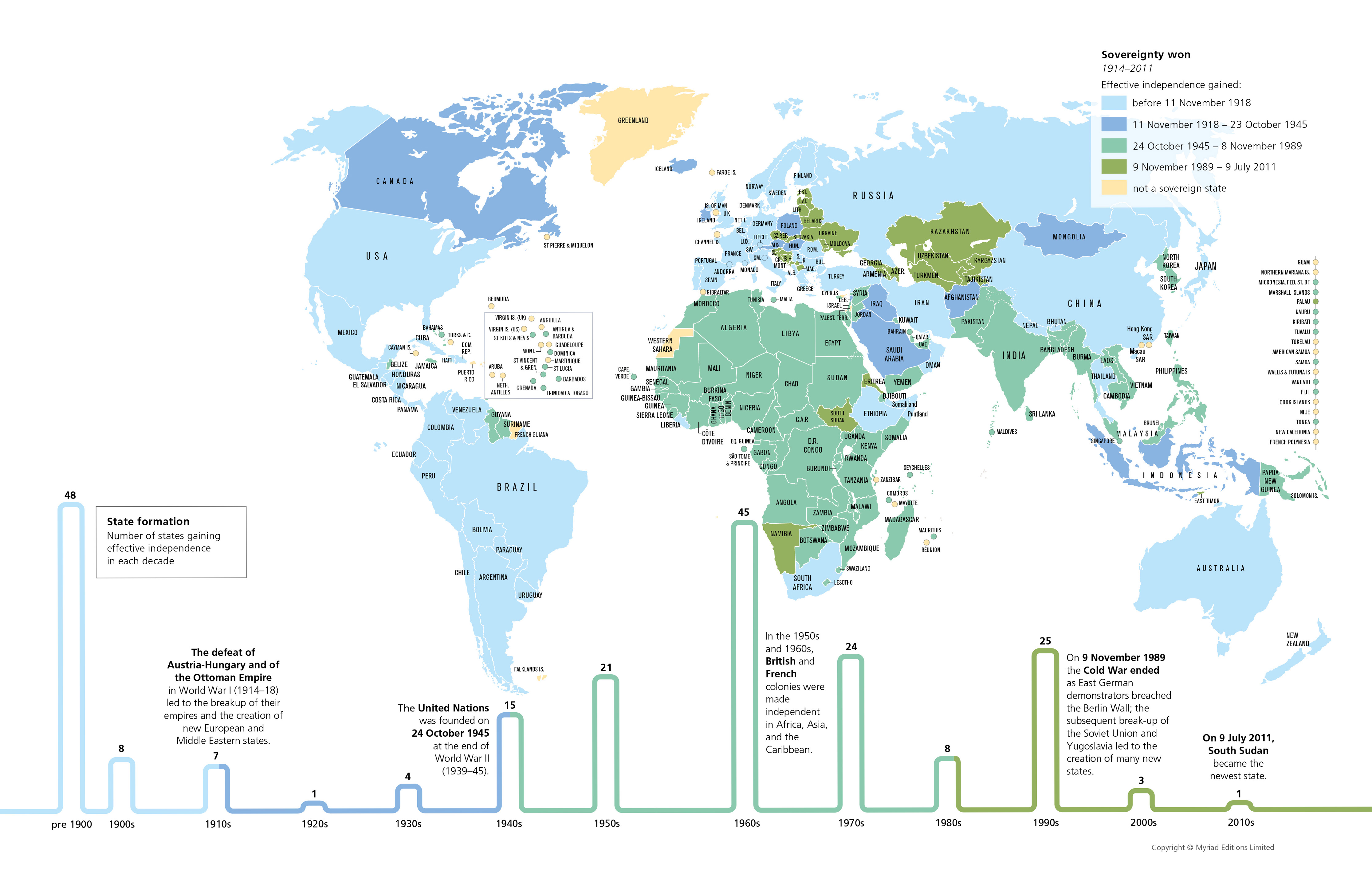
On 22 February 2013 Dan Smith published a post on his blog on the ‘state of States’. While not directly touching on human rights defenders, it gives in few words an excellent overview of the formation and deformation of States which provide much of the power and abuse that human rights defenders struggle against. I summarize some of the main issues here, but urge you to read the full text:
First he points out that most states are relatively new. By 1900 there were just 48 states in our modern sense of the term. In the years either side of World War I, with the break-up of the Ottoman and Habsburg Empires, there was considerable state-making. Even so, the UN was founded by just 51 states. Today, 193 states make up the UN, the newest being South Sudan in July 2011.

- From 48 to 193 (recognised states, that is) – from The State of the World atlas Read the rest of this entry »
Posted in human rights | Leave a Comment »
Tags: Afghanistan, conflict and peace, Dan Smith, Failed state, Fragile state, fragile states, historical perspective, Human Rights Defenders, Nigeria, non-state actors, Pakistan, politics, Somalia, South Sudan, sovereignty, state power, States, UN, ungoverned spaces, United Nations
February 22, 2013
On 18 February 2013, a number of human rights defenders and civil society organisations were publicly accused of carrying out a “well orchestrated campaign of disinformation” and of publishing defamatory and false material on a military task force in the Aguán region, “damaging the image of the nation”. The allegations were made during a press conference convened by the Commander of the Joint Task Force “Xatruch III” German Antonio Alfaro Escalante.
During the press conference, the Plataforma Agraria Regional del Aguán (Regional Agricultural Platform of Aguán) and human rights defenders Messrs Wilfredo Paz, Vitalino Alvarez, Yoni Rivas and Marvín Palacios were accused of publishing false accusations regarding Xatruch III through online networks and international human rights organisations. The websites Defensoresenlinea.com, Voselsoberano.com and Hondurastierralibre.com were each accused of publishing material accusing the Task Force of intimidating, threatening and killing people Colón. Commander Alfaro Escalante also referred to the human rights organisation Comité para la Defensa de los Derechos Humanos en Honduras Read the rest of this entry »
Posted in Front Line, Human Rights Defenders | Leave a Comment »
Tags: Advocacy Organizations, Civil society, Front Line, German Antonio Alfaro Escalante, Honduras, Human right, Human Rights and Liberties, Human rights defender, Human Rights Defenders, Latin America, military, threats
February 20, 2013
The Pastoral Land Commission (CPT), which has for years campaigned to advance social justice and the rights of small farmers and the landless in Brazil, suffered three attacks on its headquarters in the state of Acre in this year alone. It is suspected that these attacks are reprisal attacks on CPT, which recently denounced irregularities in forest management and land ownership in the states of Acre and Amazonas. The CPT was awarded the Right Livelihood Award Foundation (http://www.rightlivelihood.org/), in 1991. Read the rest of this entry »
Posted in human rights | Leave a Comment »
Tags: Amazonas, Boca do Acre, Brazil, CPT, Human Rights Defenders, land disputes, land ownership, Pastoral Land Commission, Right Livelihood Award, social justice
February 19, 2013

Human rights defenders Messrs
He Jun Ling, Gao Yue Qiang, Liu Xiangying, and
Wang Xian Jie will go on a joint trial from 4 to 8 March 2013, reports Front Line Defenders.He Jun Ling, Gao Yue Qiang Liu Xiangying, and Wang Xian Jie are human rights defenders who were employed by the state controlled public transport operator SMRT Ltd. More than 100 mainland Chinese bus drivers refused to report for duty on the 26
th of November 2012. It took some time for authorities to label the stoppage an ‘illegal strike’. Once that happened, things moved quickly. 29 drivers accused of participating in the action were swiftly rounded up and deported. Five men were also arrested. One has already been tried, jailed and sent back home. The others – He Jun Ling, Gao Yue Qiang, Liu Xiang Ying and Wang Xian Jie – are waiting for their cases to be heard. They are currently facing charges of inciting an illegal strike among bus drivers, and could be sentenced to a fine of 2,000 Singapore dollars (approx €1,250), a 12-month prison sentence or both.
He Jun Ling and
Liu Xiangying revealed last week that were assaulted by police officials while they were held in custody in December 2012. According to the information received, He Jun Ling was interrogated from 5am to 1pm, during which time he was locked in a small room, handcuffed, and beaten in the stomach. Liu Xiangying reported that an official threatened him, stating that “they can dig a hole and bury him. No one will be able to find him.” He was also handcuffed to a chair and beaten in his neck and the left side of his body.
Read the rest of this entry »
Posted in Front Line, human rights, Human Rights Defenders | Leave a Comment »
Tags: Chinese, detention, Front Line, Human Rights and Liberties, Human Rights Defenders, ill treatment, industrial action, police beatings, right to strike, Singapore, strike, torture, Trade union, transport, transportation, Vimeo
February 19, 2013
Mr. Khalil Maatouk is a human rights lawyer who has defended numerous prisoners of conscience before Syrian courts. He was arrested with a friend by armed men on October 2, 2012 (!!) at a checkpoint in Sahnaya (in the countryside outside of Damascus). Since then, 139 days later, no further information could be obtained regarding his situation and whereabouts. Neither of the men has been seen since, although even the already extensive period of legal custody of 60 days elapsed. Despite repeated requests by his relatives and lawyers, the Syrian authorities have failed to provide information on Mr. Khalil Maatouk’s fate and whereabouts and did not allow him to contact his family and lawyers. While two witnesses claimed having seen Mr. Maatouk in a detention centre, the judicial authorities have recently denied holding him in custody.
Read the rest of this entry »
Posted in FIDH, human rights, Human Rights Defenders, OMCT | Leave a Comment »
Tags: Damascus, FIDH, Forced disappearance, Human right, Human rights defender, Human Rights Defenders, International Federation for Human Rights, lawyer, legal profession, Observatory, OMCT, Syria, World Organisation Against Torture