Posts Tagged ‘Human rights defender’

Interview with Kenyan human rights defender Okiya Omtatah

September 3, 2019
The Kenyan newspaper the Daily Nation of 1 September 2019 carries a long profile of the human rights defender Okiya Omtatah. See also: https://humanrightsdefenders.blog/2018/12/03/human-rights-defenders-in-kenya-honored-with-national-awards/

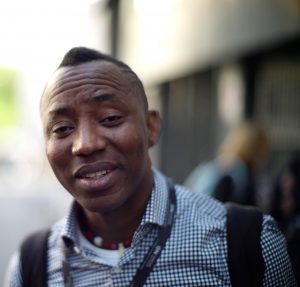
Okiya Omtatah

Activist Okiya Omtatah at Milimani Law Courts on September 14, 2018. PHOTO | FILE | NATION MEDIA GROUP

1. The many petitions you have presented in court on behalf of Kenyans and the fact that you have succeeded in many of them points to a void in our public life as ordinary citizens created by the government through its many agencies. Sir, who is sleeping on the job that has prompted you to step in? How can we hold these public servants or institutions responsible as taxpayers for sustainable quality service delivery? Komen Moris, Eldoret

My activism is anchored on the Constitution of Kenya, 2010. My overriding objective is to the immense power of the Constitution to have the Judiciary entrench constitutionalism and the rule of law in the conduct of public affairs.

Hence, all the petitions I have filed concern public law, and they fall in three broad categories: motions challenging decisions of law-making institutions where I contest the constitutionality of statutes by Parliament or by county assemblies, and both the constitutionality and legality of subsidiary legislation; motions contesting the constitutional and legal validity of policy decisions and other administrative actions of the executive at both national and county levels, and motions seeking to protect public property from thieving public officials and private individuals.

From my experience, the struggle is against contemptuous disregard of the constitutionally prescribed limits and powers of government, and affirmation that Kenyans are not subjects but sovereign citizens with their rights and fundamental freedoms enshrined in the Bill of Rights. From the above, it follows that the solution to our problems is to uphold the Constitution. However, it is clear our political leadership has failed in its duty to whip us as a nation into fully implementing the Constitution so as to realise its great promise.

2. Not long ago you called on Kenyans to contribute towards instituting a suit against all the MPs over house allowances they had awarded themselves. How did this initiative go and how much were you able to raise? Githuku Mungai

The initiative was not for instituting the case but to pay for the costs of serving the petition on the MPs through full page adverts published in the Daily Nation and Standard newspapers as ordered by the High Court. I required at least a million shillings but only raised some Sh130,000.

3. Over the course of your public life, you have largely been plastered with two labels: a defender of public interest by many and a rebel to a few. This can be attributed to the many cases you have argued out in the corridors of justice, among them bank capping rates, judges retirement age, most recently the CBA-NIC tax waiver. These cases largely touch on the crucial interests of the ordinary citizen. I can’t help but ask, what is the philosophy behind what you do? Do you feel intimidated or shaken by the weight of cases you take on considering the fact that in many cases you take them on your own? Kagwera Raphael, Kisii

The philosophy behind what I do is the Gospel of Christ, who preached about God’s love and divine mercy, and continues to reveal that the Kingdom of God is among us and therefore we must do right. At creation time, God gave Adam and Eve the power over all that he had created, but He did not give them the power over themselves; He gave them the law.

And when they broke that law they lost the Garden of Eden. Hence, the rule of men is doomed since it is anathema to the will of God. Only the rule of law works. Hence, humanity cannot rule itself and prosper except by the laws anchored on promoting the rights and fundamental freedoms of all people – and that includes obeying the Constitution of Kenya, which largely mirrors the Gospel of Christ. I don’t feel threatened or intimidated by the cases I take on since I take them up as part of my apostolate. And for as long as God wants to use me to call upon all Kenyans to obey the law, I will be available to do so.

4. Having had a peaceful, respectful, issue-based and effective campaign for the Busia senatorial race during the 2017 elections, one which didn’t turn out as most of us had expected, what is your objective opinion on Kenyan politics and campaigns? Kagwera Raphael, Kisii

My Busia senatorial race was a very rewarding experience for me. Though I vied on a Ford-Kenya ticket in an ODM stronghold and, literally, I had no money to match what the incumbent unleashed, I chose the route of civic and political education to agitate for resource-based leadership and it worked very well. It was a neck and neck race where I got more than 100,000 votes, and the difference between me and the Senator wasn’t much. But even though we can’t cap the amounts of money candidates spend on campaigns, the amounts and their sources must be disclosed to law enforcement. That way, it will at least reduce the distortion illicit money has on the democratic process, especially on poverty-stricken populations scavenging for basics. We must also eradicate mass poverty at the grassroots.

5. Your nature of work in the areas of human rights demands that you really need a good and reliable sponsorship so to speak, or stable source of income from where you can get resources to mount the kind of legal challenges you undertake. What is the source of your income? What is your reaction to allegations that you are often paid to institute the cases you do? Francis Njuguna, Kibichoi

First of all I don’t need a lot of money because I don’t hire lawyers to research, draft and prosecute my cases. I do so myself. Second, I lead a very simple lifestyle which is basically a source of income through the savings I make. I have seen people who earn much more than I do lead very miserable lives due to reckless lifestyles. As for allegations, they are just that. It is human nature to speculate where you have no facts. And it is written in the Holy Book that John the Baptist ate not and he was called a madman; Christ ate and drunk and He was called a glutton.

6. Our history is full of examples of good human rights activists including yourself, Kepta Ombati, Cyprian Nyamwamu, Boniface Mwangi, among others who tried to unsuccessfully run for political office. No doubt, political office is an expansion of activism and movement work. What should good activists do to win elections and continue their good work as politicians? Raphael Obonyo, Nairobi

They should not give up and I don’t think they have. The society is changing and, soon, we will have issue-based politics and one’s ethnicity or capacity to give handouts will not be trump cards at elections. While still at it, I point out that Prof Kivutha Kibwana, the Makueni Governor who has performed exceptionally well, was and is an activist who was elected into office and has delivered on his convictions.

7. There is a popular joke in Kenya about the Judiciary: ‘Why hire a lawyer when you can buy a judge?’ Former Chief Justice Dr Willy Mutunga began ambitious efforts to transform Kenya’s courts and earn back the people’s trust. What is your assessment of the transformation at the Judiciary given that you frequently interact with them? Raphael Obonyo, Nairobi

The joke is just a joke. Whereas one or two judges may not be up to scratch, most judges and other judicial officers are very hard working individuals who deliver for Kenyans in very difficult situations. The Kenyan Judiciary is the only arm of government that retains and espouses Kenya’s republican character. We cannot compare the Judiciary to the Executive and the Legislature, at both national and county levels, which are totally captive to ethnicity and corruption

8. Due to the nature of your work, sometimes you challenge decisions of the powerful and mighty. Don’t you ever fear for your life when making such challenges? Have you ever received threats to have you drop the matter you are pursuing? Emmanuel Lesikito

Though I take precaution, I know that there are no human beings who are mighty and powerful. Only God is mighty and powerful. So I have no fear of any man and their threats, since God is my shield. No man can destroy my soul.

9. Of all the advocacy and litigation cases that you have undertaken in the interest of the public good, explain the one case that posed the greatest challenge and possibly a danger to your life. Nyongesa Chris Makhanu, Nairobi

A 2012 petition where I challenged the flawed procurement of the BVR kits which failed to work on Election Day. I was offered a bribe of Sh9 million to drop the case but I refused. I then applied to court for police protection but Justice Majanja dismissed my application. Two days later I was attacked by two men who hit my head with metal bars and left me for dead. As they were clobbering me, I could hear them say something to the effect that “Ulikataa pesa sasa utakufa na kesi yako pia itakufa” (You refused our offer; we are going to kill you and your case is going to collapse). But God saved me.

10. Do you really always read Kenyan’s mood before you move to court? I am referring to the case on the new currency, which by and large has been welcomed by a majority of Kenyans. Bernard Nyang’ondi, Mombasa

No, I am driven by fidelity to the law and the public interest.

11. Thank you for fighting for the common person. My question is: Fresh job seekers are required to produce a Certificate of Good Conduct and clearance certificate from Ethics and Anti-corruption Commission, among others. These requirements make me wonder, do jobseekers have to pay for not committing crime? Do they have to pay for not being corrupt? Why have you never gone to court to challenge these primitive requirements? Evans Muteti, Mombasa

Justice Odunga declared those requirements to be unconstitutional in the case that was filed by Justice GBM Kariuki. I also filed another case on the same — but it is pending at the High Court — to allow the Supreme Court to determine whether it will allow the High Court to proceed or it will hear an advisory reference on the same issue that was filed by the Kenya National Commission on Human Rights (KNCHR).

12 Sir, you are known to be one of the most relentless and leading human rights defenders in Kenya. You are no guest in our courts and all these court cases require resources. What motivates you? Geoffrey Oyoo, Embakasi East

The Holy Scripture, especially the teachings on the salt and light of the world; the Good Samaritan, and the call to be witnesses of Christ.

13. Recently, a young woman died at KNH after she developed maternal complications due to negligence by staff on duty. Of course many other preventable deaths occur in public hospitals due to negligence. Don’t you think it is more worthwhile to fight for the rights of such helpless victims as opposed to, say, pursuing elitist court cases like the one on new currency notes? Stephen Kathurima, Nairobi

There are no elites under the law. All are equal. Secondly, I believe in draining the swamp not waiting to kill every snake and mosquito that escapes from the swamp. The mess in our hospitals and other institutions is a rule of law problem. Let’s drain the swamp by implementing the Constitution and upholding the rule of law.

https://www.nation.co.ke/news/One-on-one-with-activist-Okiya-Omtatah/1056-5256164-l8pfwyz/index.html


European Court rules on Sergei Magnitsky’s death

August 29, 2019

48 Human Rights groups intervene for detained Nigerian Omoyele Sowore

August 26, 2019

On 23 August 2019 48 NGOs issued an urgent appeal in relation to the arrest and detention of Omoyele Sowore, Nigerian journalist and human rights defender, to the UN and African human rights bodies. Joy Hyvarinen, head of advocacy at Index on Censorship said: “Index on Censorship urges the Nigerian authorities to release the prominent journalist and campaigner Omoyele Sowore immediately. The arrest and detention are a shocking violation of Mr Sowore’s human rights, which calls into question Nigeria’s willingness and ability to meet international human rights obligations.


Omoyele Sowore (Photo: Mohamed Nanabhay / Wikipedia)

To the members of the Working Group and the Special Rapporteurs:

We, 48 human rights and press freedom organisations, respectfully request that you consider this urgent appeal in relation to the arrest and arbitrary detention of Nigerian journalist and human rights defender Omoyele Sowore who was arrested by the authorities following a call for peaceful protest. We request that you urgently intervene to secure the immediate release of Mr Sowore and declare his arrest and detention a gross violation of his human rights, including the right not to be arbitrarily detained as protected by Article 9(1) of the International Covenant on Civil and Political Rights (ICCPR) and Article 6 of the African Charter on Human and Peoples’ Rights (the Banjul Charter); the right to a fair trial as protected by Article 14 ICCPR and Article 7 of the Banjul Charter; the right to freedom of expression as protected by Article 19 ICCPR and Article 9 of the Banjul Charter; the right of freedom of peaceful assembly and of association as protected by Articles 21 and 22 ICCPR and Articles 10 and 11 of the Banjul Charter; and his rights as a human rights defender as outlined in the 1999 UN Declaration on Human Rights Defenders and 2017 African Commission Cotonou Declaration on strengthening and expanding the protection of all Human Rights Defenders in Africa.

Background 

  1. Mr Sowore is a prominent journalist, human rights activist and pro-democracy campaigner. He is the founder of Sahara Reporters, an online news agency based in New York City that focuses on corruption, human rights abuses and other political misconduct in Nigeria. Challenging government corruption and speaking truth to power has been the constant thread throughout Mr Sowore’s career, from the leading of student protests in the 1990’s to his recent campaign running for Presidential office in Nigeria.

Omoyele Sowore’s arrest and detention 

  1. Mr Sowore was arrested on 3 August 2019 in his hotel room during a trip to Lagos. Security agents forcefully detained Mr Sowore without informing him of any charges against him and flew him to Abuja, where he is currently being detained at the facility of the headquarters of the Nigerian State Security Service. Mr Sowore has access to food and water, but no access to the outside world: no newspapers, television or phone, and he spends most days in isolation. He was held incommunicado until 6 August, during which time Mr Sowore refused to answer any questions without consulting with his lawyer. He was allowed access to his lawyers only on 7 August, 4 days after his arrest.
  2. Based on Section 35 of the Nigerian Constitution, Mr Sowore should have been arraigned before a court within 48 hours. As of today, Mr Sowore has not been arraigned in any court.
  3. However, on 6 August, 3 days after his arrest, the State Security Service did seek an ex- parte order from the Federal High Court in Abuja to detain Mr Sowore under Section 27(1) of the Terrorism Act 2013, which enables the detention of anyone planning to “commit an act of violence”. The Court’s order of 8 August, made within 48 hours after the State Security Service’s request, granted the authorities permission to detain Mr Sowore for 45 days. Within 24 hours, his legal team, led by Mr Femi Falana, filed a motion to set aside the order and requested Mr Sowore’s immediate release, arguing that his detention was contrary to the Nigerian Constitution. At the time of writing, this request has not been heard by the courts and no date for hearing has been fixed. Importantly: no formal charges have been filed against Mr Sowore.

Mr Sowore’s call for a peaceful #RevolutionNow protest 

  1. The arrest of Mr Sowore appears to be the direct consequence of his call for a peaceful protest scheduled to take place on 5 August 2019, using the hashtag #RevolutionNow.

The objective of the protest was to demand that the Nigerian government end corruption and economic inequality and guarantee education to all. That the protest Mr Sowore and the Coalition for Revolution (CORE) movement he founded called for was a peaceful one is made clear at the very outset of the call for protest, issued on 27 July, which starts by setting out the “rules of engagement”:

We eschew all forms of violence. No protester should throw any object as little as stones or attack any security officials. We are aware of their intent to provoke the mass unduly by using undue tactics and sponsored agents, so as to give the protest a bad name. We encourage all Nigerians to remain calm as we are ready to fight these injustices to a logical conclusion. 

  1. A week earlier, in an interview with the Arise News channel, Mr Sowore stated that “Nigeria needs revolution, not war,” clearly distinguishing his call for substantial change from a call to violence. Mr Sowore has used the word “revolution” contextually to mean “change for the better” since 2006, when he founded Sahara Reporters. Mr Sowore then stated that he would “revolutionise” the way news is being reported in Nigeria –– something he actually did with the investigative citizen journalism the website publishes.
  2. Despite Mr Sowore’s arrest and detention, the 5 August #RevolutionNow protests took place in Abuja, Lagos, Osun, Ondo and Cross River. Protesters met a police force that dispersed them with teargas and gunshots. Numerous protesters, including several of Sahara Reporters’ journalists, were arrested and charged with illegal assembly.

Request for urgent action 

  1. It is clear that Mr Sowore’s arrest on apparent grounds of suspicion of terrorism is unfounded. Mr Sowore did what he has done throughout his career as a journalist and human rights activist: exercise his right to freedom of expression and seek to bring about change through peaceful means, in this case a peaceful protest. The use of the emotive term “revolution” merely underlines his desire for transformative change in what he considers the shortcomings of the current government. There are strong suspicions that Mr Sowore’s arrest stems from ulterior motives than responding to any supposed criminal wrongdoing. This is further highlighted by the fact that the authorities failed to define a charge against him for the first few days after his arrest; the investigations that were subsequently instigated against him under the Terrorism Act were clearly only created to serve the purpose of silencing Mr Sowore.
  2. As such, the arrest and detention of Mr Sowore amount to a violation of his right not to be arbitrarily detained as guaranteed under Article 9 ICCPR and Article 6 of the Banjul Charter. The fact that the charges brought against him most likely stem from his call for a peaceful demonstration and his critical stance on the Nigerian government also violates Mr Sowore’s right to free expression under Article 19 of the ICCPR and Article 9 of the Banjul Charter and his right of freedom of peaceful assembly and of association under Articles 21 and 22 ICCPR and Articles 10 and 11 of the Banjul Charter. Not properly arraigning Mr Sowore before a competent court within the time limit mandated by the Nigerian Constitution and not allowing him access to a lawyer during the initial days of his detention violates his right to a fair trial as protected by Article 14 ICCPR and Article 7 of the Banjul Charter. The foregoing also constitutes a violation of his rights as a human rights defender as defined in the 1999 UN Declaration on Human Rights Defenders and 2017 African Commission Cotonou Declaration on strengthening and expanding the protection of all Human Rights Defenders in Africa.
  3. As a State Party to both treaties, Nigeria is under an obligation to guarantee these rights to all its citizens, as specified under Article 2(1) of the ICCPR and Article 2 of the Banjul Charter. Accordingly, we appeal to the Working Group and UN and AU Special Rapporteurs to:
  • intervene urgently to secure the immediate release of Mr Sowore; and
  • declare his arrest and continuing detention a gross violation of his human rights.

SIGNED BY:
All Workers’ Convergence (AWC) 

Afrika Movement for Freedom and Justice (AMFJ)

Agege Women Agenda (AWA)

ARTICLE 19 Senegal/West Africa

Centre for Constitutional Rights

Centre for Human Rights and Social Justice (CHRSJ)

Chidi Odinkalu Former Chairman, National Human Rights Commission (Nigeria) & Senior Fellow, Open Society Justice Initiative

Coalition for Revolution (CORE) 

Committee for the Defence of Human Rights (CDHR) 

Community Women Initiatives (CWI) 

The Concerned Forum 

Congress of Progressive Youths (COPY) 

Democratic Youth League

Edo State Civil Society Organisation (EDOSCO)

Enough is Enough (EiE) Nigeria 

Freedom of Expression Hub

Gani Fawehinmi Apostles 

Gani Fawehinmi Memorial Organization (gafam.org) 

Governance Advancement Initiative for Nigeria (GAIN)

Global Voices Sub-Saharan Africa

Grassroot Justice Centre

Human and Environment Development Agenda (HEDA) 

Human Rights Network for Journalists-Uganda (HRNJ-UGANDA)

IAmVocal

Index on Censorship 

Media Legal Defence Initiative

Media Rights Agenda

Moshood Abiola Vanguard for Democracy (MAVD)

Movement For People’s Rights

National Conscience Party (NCP), Lagos State Branch

Nigerians in Diaspora Europe, Belgium-Luxembourg (NIDOE-BeLux)

Open Society for West Africa (OSIWA), Nigeria Office

Paradigm Initiative

People’s Alternative Front (PAF)

Peoples’ Unite

Rivers State Civil Society Coalition (RIVSCO)

Rule of Law and Accountability Advocacy Centre (RULAAC) 

Save Lagos Group

Socialist Vanguard Tendency (SVT) 

Socio-Economic Rights and Accountability Project (SERAP)

Sovereign Vital Force 

Spaces for Change 

Take-It-Back (TiB) Movement 

Talakawa Parliament

Veteran Group for Operation Clean Crusade (VGOCC) 

Women for Leadership Change

Workbond International Network (WIN)

Youth In Good Governance Initiative (YIGGI) 

Saudi lawyer Waleed Abu al-Khair winner of ABA human rights award

August 14, 2019

Waleed Abu al-Khair

Waleed Abu al-Khair.

Saudi human rights lawyer Waleed Abu al-Khair, who was convicted on anti-terrorism charges and sentenced to 15 years in prison, is the winner of the 2019 ABA International Human Rights Award. For more on this and other awards for human rights lawyers see: http://www.trueheroesfilms.org/thedigest/awards/aba-international-human-rights-award

The ABA Journal states that Abu al-Khair founded Monitor for Human Rights, one of the only human rights organizations in Saudi Arabia, in 2008. He dedicated his legal career to defending human rights and the right to freedom of expression, and pushed for an elected parliament, independent judiciary, constitutional monarchy and other reforms in his country. Abu al-Khair’s 2014 arrest and conviction largely stemmed from comments he made to the media and on social media that criticized Saudi Arabia’s human rights record, discussions of human rights in his home and his defense of activists who were punished for criticizing the government, according to Human Rights Watch and Amnesty International. The human rights organizations say the specific charges against him included disobeying the ruler and seeking to remove his legitimacy; insulting the judiciary and questioning the integrity of judges; setting up an unlicensed organization; harming the reputation of the state by communicating with international organizations; and preparing, storing and sending information that harms public order.

His full 15-year sentence was upheld by a Saudi appeals court in 2015 after he refused to apologize for the alleged offenses. He is currently in the Dhahban Central Prison in Jeddah, Saudi Arabia. The United Nations Human Rights Council’s Working Group on Arbitrary Detention has twice reviewed the legitimacy of Abu al-Khair’s detention, and in 2018, declared that Saudi Arabia lacked legal basis and grounds for restricting his freedoms of expression and opinion, the ABA press release says.

Abu al-Khair earlier also received the Olof Palme Prize, Ludovic-Trarieux International Human Rights Prize, Law Society of Ontario’s Human Rights Award and Right Livelihood Award. [see: https://humanrightsdefenders.blog/2017/02/28/saudi-arabia-imprisoned-waleed-abu-al-khair-receives-another-human-rights-award/ and https://humanrightsdefenders.blog/2018/11/14/right-livelihood-award-urges-freedom-for-3-saudi-laureates/]

http://www.abajournal.com/web/article/imprisoned-saudi-lawyer-receives-this-years-international-human-rights-award

Gladys Mmari is African Human Rights Defender of the Month (July)

August 8, 2019
On 7 August 2019 DefendDefenders’ blog annouinced that Gladys Mmari, Tanzania, was chosen as Human Rights Defender of the Month July 2019:

Gladys Mmari is a driven Tanzanian human rights defender (HRD), and the founder of MAFGE (Male Advocacy For Gender Equality) – a non-governmental organisation (NGO) focused on women empowerment through educating both women and men. “So much of the work that I do is cultural conversation. We have grown up talking about these issues among women, but now, I have to work with men as well – making it more challenging,” Mmari stresses. She fosters the idea that male voices should be heard, and educated, in women’s rights, and that it is important to establish an equitable understanding between the genders, while breaking down gender stereotypes. “We need to stop romanticising the idea of women empowerment, and co-empower one another to achieve the goals of an equal world,” Mmari affirms.

After obtaining a law degree, she worked as a human rights researcher in Tanzania, with a focus on the African Court on Human and Peoples’ Rights and indigenous rights. Then, she worked for AfricAid, an NGO specialised in cultivating leadership in young women and girls. She recalls a young boy who, following one of her sessions, asked her why he could not participate in the dialogues. He also wanted to boost women and girls’ rights. “It was a turning point for me,” Mmari says. “The time has come to work together and empower each other to revisit the many socio-cultural constraints that have stopped us from equality.” Her organisation MAFGE was hereby born.

She pinpoints numerous challenges faced in her work. “It is challenging to mobilise men to join, to ensure impact to women empowerment.” Furthermore, “most organisations that deal with women empowerment want to fund women organisations. And they do not want to see men in women organisations.”

She also points out the political situation in Tanzania as a great hurdle. Political rallies in the state deviate and misconceive the importance of HRDs, putting them at risk. As she expresses a sincere concern for Tanzanian HRDs, she mentions that the government is currently registering all NGOs under a single entity. “Here there is potential importance of this initiative, as this could be used for something productive such as acting as a more centralised human rights platform allowing more structured approaches, information passage, and funding opportunities. It is a step forward, unless it is a political interest”.

Gladys will continue to fight for women’s rights. “Women are born into unequal societies, and their achievements are unacknowledged and their potential left untapped [..] I can imagine my children and grandchildren living in a world with equal rights, and that they’ll get the opportunities and securities that I missed as a woman. That’s what keeps me going.”

Through MAFGE, she is also running a crowdfunding campaign, to strengthen gender equality in Tanzania.

https://www.defenddefenders.org/blog/human-rights-defender-of-the-month-july-2019-gladys-mmari/

Third Anniversary of Kem Ley’s Murder in Cambodia: the real culprit?

July 12, 2019

Mourners observe Kem Ley's funeral procession in Phnom Penh, July 24, 2016.

Mourners observe Kem Ley’s funeral procession in Phnom Penh, July 24, 2016.- AP Photo

Two dozen nongovernmental organizations on Tuesday 9 jult 2019 demanded that Cambodia’s government establish an independent and impartial commission to investigate the murder of prominent political commentator and rights campaigner Kem Ley, a day ahead of the third anniversary of his death. Kem Ley was shot to death in broad daylight on July 10, 2016 while having a morning coffee at a Caltex gas station in the capital Phnom Penh, days after publicly criticizing Prime Minister Hun Sen and his family for abuse of power.

Authorities charged a former soldier named Oeuth Ang with the murder and sentenced him to life in prison in March 2017, but many in Cambodia do not believe the government’s story that Kem Ley was killed by the man over a debt. In May, Cambodia’s Supreme Court rejected Oeuth Ang’s appeal for reduction of sentence and upheld his life imprisonment term. The day of Oeuth Ang’s sentencing, Geneva-based International Commission of Jurists (ICJ), New York-based Human Rights Watch and London-based Amnesty International highlighted multiple issues they said had not been adequately investigated during his trial and called for a probe into Kem Ley’s killing that adheres to international standards.

On Tuesday, 21 other groups joined the three NGOs in reiterating that call and questioning why the government had failed to take meaningful action in the case. “It has been three years since significant gaps were highlighted in the investigation and trial of Kem Ley’s case, which need to be remedied through an independent, impartial and effective investigation,” said Frederick Rawski, ICJ’s director for Asia and the Pacific.

The 24 NGOs noted in Tuesday’s statement that 164 organizations had signed a joint letter to Cambodia’s Deputy Prime Minister Sar Kheng calling for the creation of an independent Commission of Inquiry into Kem Ley’s case, citing the “flawed investigation” into his killing and “lack of progress in subsequent investigations” of suspected accomplices.

Soon after Kem Ley’s funeral, and fearing for their safety, his wife Bou Rachana—then pregnant—fled with her children from Cambodia to neighboring Thailand to seek asylum in a third country. They spent over a year and a half in Thailand before being granted permission to settle in Australia in February last year.

Debbie Stothard, the secretary-general of Paris-based International Federation for Human Rights (FIDH), said: “The Cambodian authorities’ ongoing failure to identify and prosecute the masterminds behind Kem Ley’s murder shows that an independent investigation is urgently needed to deliver justice to his family and to make progress towards ending impunity for the killing of human rights defenders in Cambodia,” she said.

Tuesday’s statement called Kem Ley’s killing “an alarming reminder of Cambodia’s culture of impunity” in cases of killings and harassment of rights defenders, labor leaders, journalists, members of the political opposition and others critical of Hun Sen’s regime.

Sok Ey San, spokesman of Hun Sen’s ruling Cambodian People’s Party (CPP), dismissed Tuesday’s statement as “politically motivated” and said it was “filled with groundless allegations.”

The call by the 24 NGOs came as police in Phnom Penh charged youth activist Kong Raiya and three of his family members with “incitement of social unrest” after arresting them for selling T-shirts bearing Kem Ley’s portrait and urging people to wear them on Wednesday to mark the anniversary of his murder. Am Sam Ath, deputy director of the Cambodian rights group LICADHO, told RFA’s Khmer Service that police arrested Kong Raiya, his wife and his parents-in-law on Tuesday along with his six-month-old baby, who was later released to family members.

See also Global Voices of 17 July: : https://globalvoices.org/2019/07/17/cambodian-activists-arrested-for-commemorating-the-anniversary-of-political-analyst-kem-leys-death/

https://www.rfa.org/english/news/cambodia/probe-07092019170518.html

NGOs ask EU to intervene for human rights defender Azimjon Askarov in Kyrgyzstan

July 10, 2019

On 11 June 2019 NGOs wrote a joint Letter to High Representative Mogherini regarding detained Human Rights Defender Azimjon Askarov in Kyrgyzstan. His is a wellknown case, see e.g.: https://humanrightsdefenders.blog/2015/07/23/fury-about-us-award-for-askarov-in-kyrgyzstan-backlash-or-impact/

Eren Keskin in Turkey sentenced to prison and more to come..

May 28, 2019

On 28 May 2019 Euromedrights brought out a press release “Sentencing of Eren Keskin: another blow against freedom of expression in Turkey”.

This extremely courageous human rights defender has received attention in this blog recently [see: https://humanrightsdefenders.blog/2019/05/12/martin-ennals-award-finalist-eren-keskin-honoured-in-ankara/].

On 21 May, at the final hearing of the Özgür Gündem “Editors-in-Chief on Watch” campaign trial, woman human rights defender and co-chair of the Human Rights Association-Insan Hakları Dernerği (IHD), Eren Keskin, was sentenced to 3 years and 9 months prison term for “propaganda for a terrorist organisation” and “openly inciting to commit crime”

As deeply concerning as this sentencing is, it is far from an isolated case: across Turkey, civil society activists struggling to ensure basic human rights and fundamental freedoms are targeted by the judiciary, acting as an extension of the legislative power, for legitimately and peacefully exercising their constitutional rights. EuroMed Rights strongly condemns the judicial harassment against Ms Keskin and her fellow activists. 

EuroMed Rights calls on the Turkish authorities to respect their obligations under international human rights treaties, the European Convention on Human Rights and the Turkish constitution, end the crackdown on critics and halt the persecution of human rights defenders. and release all those detained for peacefully expressing their opinions.

Note The Editors-in-Chief on Watch campaign of Özgür Gündem daily began on May 3, 2016 and ended on August 7, 2016. Daily was closed through the Statutory Decree No. 675 issued under the State of Emergency. At the end of March, Ms. Keskin has been sentenced to 7 years and a half on charges of “insulting the President and State institutions” over three reports published in the newspaper in 2015. On 3 July, she will again stand trial in front of 23th High Criminal Court in Istanbul for the “ Özgür Gündem main trial”.

https://mailchi.mp/euromedrights/sentencing-of-eren-keskin-another-blow-against-freedom-of-expression-in-turkey?e=1209ebd6d8

The story of Pierre-Claver Mbonimpa: a survivor from Burundi

May 27, 2019

On 24 May 2019 Open Democracy published another long piece on an inspiring human rights defender – in cooperation with the Fund for Global Human Rights.  In “How international solidarity saved an activist’s life in BurundiAntoine Kaburahe describes the story of Pierre-Claver Mbonimpa, the laureate of the Martin Ennals Award 2007. [http://www.martinennalsaward.org/hrd/pierre-claver-mbonimpa-2/]. The author was personally involved in the case and the piece is a good example of how international solidairy can save lives.

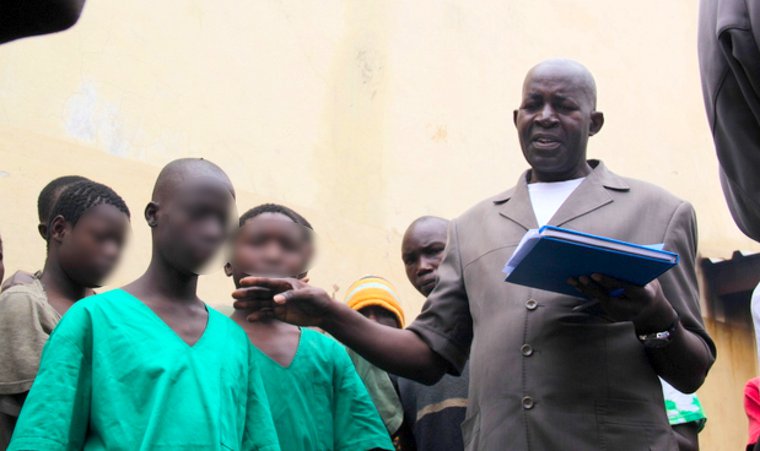
A man standing beside children in green clothing
Pierre-Claver Mbonimpa visiting minors detained in prison
..Pierre-Claver Mbonimpa was the founder of a human rights organisation, APRODH, in his home country of Burundi, and it had worrying information: the ruling party was secretly distributing weapons to its youth wing. APRODH had also investigated the military training of young Burundians across the border in the Democratic Republic of the Congo, where Burundians had been involved in a long-running conflict – without unofficial support from their government. In 2014 Mbonimpa had been imprisoned by the Burundian authorities, which accused him of “smearing the government and lying”. Thanks to an international mobilisation, including a call from Barack Obama, then US president, he had been released on parole, but the regime kept an eye on him…..Pierre-Claver Mbonimpa was used to threats. But that day, the killers meant them. It was in the evening that the news dropped. Pierre-Claver had been shot. Word spread rapidly: ‘Mutama’, the ‘old man’, as he is affectionately called, is well-known and respected for his commitment to human rights in Burundi…

Pierre-Claver Mbonimpa remembers well what had happened. He had been in his car with his driver. “I saw behind us a motorcycle that was riding at a breakneck speed. The bike got to us at a fast pace. The man shot four bullets. The shooting was almost close-range. A bullet hit me on the neck and blood spurted.” Bleeding heavily, he was rushed to hospital in a critical condition. I went there to see what was happening: at the time I was still a journalist in Burundi before being myself forced into exile. The crowd was already at Bujumbura Central Polyclinic.

Security guards sent by various embassies came to ensure my safety at the Polyclinic, because there was a rumour that I was going to be killed in my hospital bed,” says Pierre-Claver. “All the embassies worked in synergy for my evacuation. “Despite my weakness, my pain, I would like to say that I saw a great surge of solidarity at that moment,” says Pierre-Claver. “In my room I saw distinguished individuals such as diplomats of the African Union, those of the European Union and ambassadors.

It was clear to his supporters that Pierre-Claver needed to leave the country immediately. Currently in Belgium as a refugee, [his daughter] Zygène Mbonimpa remembers with overwhelming emotion the support of The Fund for Global Human Rights: “Doctors quickly noticed that Mutama had been seriously affected. He needed care he could not find in Burundi. And then, we were afraid he would be finished off on his hospital bed. I wrote to Tony Tate [programme officer at the Fund] and his reaction was quick. He agreed to pay for flight tickets, and the organisation also contributed to the payment of hospitalisation costs in Burundi.”

Tate confirms Zygène’s account... I immediately sought approval from my directors and board members to make an emergency grant,” he says. “We were able to wire the money to APRODH’s account within 24 hours. After the money arrived, it became clear that Pierre-Claver would receive other money and assistance from other funders as well. The money The Fund provided was combined with others to pay for the travel costs of one of his family members to accompany him to Brussels.

That financial support was critical. The Belgian embassy had agreed to give Pierre-Claver a visa, but the family had to find air fares in a very short time. “Without this support, we would have had a big problem to raise this money while Dad’s life was in a very critical condition,” says Zygène. Tate says he was pleased that the Fund was able to respond to the incident and ensure the safety of one of its long-time partners: “My hope was that the family would see that as an organisation, we stand by our grantees in good times and in bad,” he says. “As a human rights funder, we have an ethical responsibility to provide emergency funding when activists we support are in danger. Human rights work is inherently risky and those who support it must stand ready to respond quickly when defenders are in need.”

In Brussels, Pierre-Claver was quickly operated on. Doctors first fastened a metal frame on his head to hold his skull together. He spent 121 days in hospital, fed by serum and then a kind of porridge, as he could not open his mouth or chew food. He sat in an armchair, unable to lie down, and his weight went down from 82 kg to 54 kg. But his ordeal did not stop there. As they had missed him, those who wanted to kill him went after his family. First, his son-in-law, Pascal Nshirimana, was killed, and while he was still in the hospital, his son Weli, 24, was also killed. [see e.g.: https://humanrightsdefenders.blog/2015/11/12/mea-laureate-mbonimpa-has-message-of-hope-at-his-sons-funeral/]

Through all this, the now seventy-year-old activist has remained a man guided by peace and justice. We have never heard him speak of revenge…

Always on the phone, Pierre-Claver continues to encourage teams on the ground. He also travels very often in the sub-region. “It is important that the international community continues to support independent human rights organisations in Burundi,” he says, “because with the closure of UN organisations and the ban on international media including the BBC, there is a risk that human rights violations will be committed behind closed doors. Organisations such as APRODH still have focal points. But they need means to work.”

Pierre-Claver remains modest and accessible despite two honorary doctorates by major Belgian universities and several international awards. [see: https://humanrightsdefenders.blog/2017/10/17/mbonimpa-wins-also-the-2017-civil-courage-prize/]. Asked what he thinks of those who tried to kill him, he simply answers: “I forgave those who shot me and those who killed my son and my son-in-law. But I want justice. If the assassins were arrested, I would be happy to see justice doing its job. For my part, I will not ask for any compensation. What would they give me for the death of my child and my son-in-law?

https://www.opendemocracy.net/en/frontline-insights/how-international-solidarity-saved-an-activists-life-in-burundi/

Even a human rights lawyer working for the government in Colombia is not safe

May 24, 2019

That the problems in Colombia are huge you wil all know. A good, lenghty report by Ted Piccone at Brookings from March 2019 gives an overview of the myriad issues including the continuing killing of human rights defenders: “..While these legal and political skirmishes play out, one critical element of the peace accords is tragically failing—the protection of human rights defenders, leaders of social movements, and political opposition figures. The official protection system, which is central to the non-recurrence features of the accord, is operating but unable to defend these leaders effectively from attacks perpetrated by a collection of armed groups (including remnants of paramilitary units demobilized in an earlier peace agreement), drug traffickers, and other violent actors intent on disrupting the peace process. The numbers are chilling: As of the end of 2018, the United Nations has received reports of the murder of 454 human rights defenders and social leaders since the signing of the peace agreement, and of the 163 murders they have verified, 110 occurred in 2018. The United Nations has also verified the murder of 85 former FARC-EP members. These ongoing attacks, and the relatively high rates of impunity, underscore the fearsome challenge of building peace in the midst of so much conflict and violence.” [See also: https://humanrightsdefenders.blog/2019/04/26/somos-defensores-in-colombia-publishes-annual-report-2018-worst-ever/]

All this is underlined by the recent killing of a human rights lawyer reported on 24 May 2019. Paula Andrea Rosero Ordóñez, 47, was shot dead at close range by two hitmen, according to a police report. What makes it even more shocking is that this has happened to a lawyer working as a representative of the public ministry in Nariño, a department in south-west Colombia, Rosero asked for extra protection from the government in 2016 after receiving death threats.

https://www.brookings.edu/blog/order-from-chaos/2019/03/28/is-colombias-fragile-peace-breaking-apart/

https://www.lawgazette.co.uk/news/human-rights-lawyer-shot-dead-in-colombia-/5070380.article