Posts Tagged ‘Human Rights Council’
January 14, 2015
The Graduate Institute and the Geneva Academy of International Humanitarian Law and Human Rights organise jointly a training course specially designed for diplomates and NGO representatives in the UN Human Rights Council. The classes are on 2 – 6 February 2015 in the evenings from 15h30 to 19h15 in the Villa Barton, Geneva (final timings to be confirmed). The fee is CHF 950. – (excludes housing).
Excerpts from the brochure:
Multilateral diplomacy in the advancement of Human Rights (primarily through the Human Rights Council) is one of the main activities of International Geneva. Established in March 2006, the Council is now a well-established mechanism of the United Nations and is approaching its 10th year–yet the individuals who engage at the Council sessions often change, and they often juggle a larger portfolio of responsibilities.
Everyone benefits when the Council functions better, and the council functions better when individuals arrive fully prepared to contribute at their best.
This reflects the non-partisan spirit in which this training has been designed. Preparing for high-level professional engagements requires a deep understanding the rules of the council–as well as the personal acumen to advocate and negotiate with good judgment and strong communications skills–all of which comes from familiarity, practice and individual preparation for the Council sessions.
In order for delegates and representatives to better tackle the substantive and practical challenges ahead, we are offering this training program for individuals who aspire to perform more effectively in a multilateral context. The programme is designed to enhance personal skills in multilateral diplomacy, with a particular focus on the human rights context.
Learning Themes
While taking examples on the work of the HRC and its special procedures, the training will highlight some of the prevailing substantive issues as well as the behaviors of the Council, in order to teach participants to better navigate in their aspirant work. The training will be organised around the following themes:
Functioning of the Human Rights Council:
The phenomenon of working within and across “groupings”:
Leadership in the Human Rights Council:
Learning outcomes & skills-building
- Functioning and rules of the Human Rights Council
- Chairing formal and informal multilateral meetings
- Drafting skills (in the Human Rights context)
- Negotiation and mediation skills & techniques
- Oral communications skills for public speaking “on the record” in the human rights context
- Advocacy and lobbying techniques
Methodology
The training will combine some theory, background and insights (about negotiations, the HRC and its functional history) with applied skills and techniques–including best practices and opportunities to enhance personal effectiveness. Sessions will be designed to address cross-cutting issues and will build participant skills through simulation exercises, small group breakouts, and role-playing.
Instructors will include those from the Graduate Institute and Geneva Academy, as well as actors working with (or in the domain) of the Human Rights Council.
http://graduateinstitute.ch/fr/home/executive/training-workshops/multilateralism-winter/multilateralism_winter_programme.html.
Posted in human rights | Leave a Comment »
Tags: diplomacy, Geneva, Geneva Academy of International Humanitarian Law and Human Rights, Graduate Institute of International and Development Studies, Human Rights Council, lobbying, Multilateral diplomacy, NGOs, training course, UN Human Rights Council, United Nations
December 5, 2014
(Vladimir Putin (c) Mikhail Metsel)
Russia‘s TASS agency reports on 5 December that today President Vladimir Putin will meet in the Kremlin members of the Russian Presidential Council for Civil Society Development and Human Rights (HRC) and federal and regional ombudsmen. “The meeting participants are planned to tell the head of state about their work in the current year, as well as touch upon most important issues of human rights observance and development of the civil society institutions in regions,” the press service said.
Putin regularly meets with human rights defenders, the piece continues and refers to one held on 14 October with members of the Human Rights Council. The main issues on the agenda were assistance to Ukrainian refugees, support of non-profit organizations, transparency of elections, problems of the law enforcement system and others.
The article continues (without blushing): “Speaking of supporting the civil society institutions, including human rights defenders, Putin promised that the state spending on this in 2015 would be increased to 4.7 billion rubles ($86.47 million), while in 2013 this figure stood at 2.7 billion rubles ($49.67 million).” The president thanked the Russian human rights activists for the attention they pay to numerous facts of violation of human rights in the neighbouring country — Ukraine. “Many international human rights organizations hypocritically turn a blind eye to the developments,” he said.
Many of the proposals voiced by the human rights activists turn into presidential instructions. Thus, on the October meeting results the president has already given a number of instructions on organizing assistance to children affected by the armed conflict in the south-east of Ukraine, on perpetuation of the memory of the victims of political repression, on migration problems, on improving law enforcement activity and a number of others.
TASS: Russia – Putin to discuss with ombudsmen human rights observance issues.
some items that were apparently not discussed: https://thoolen.wordpress.com/tag/foreign-agent/
Posted in human rights, Human Rights Defenders | Leave a Comment »
Tags: Civil society, foreign agent law, human rights activists, Human Rights Council, Human Rights Defenders, human rights organizations, President Putin, Putin, Russia, TASS, Ukraine
November 12, 2014
On Thursday, 20 November 2014, the International Service for Human Rights (ISHR) celebrates its 30th anniversary with the launch and discussion of two important legal reports:
The first is a memorandum of advice on the legal obligations of the Human Rights Council, its President and Bureau to combat reprisals prepared by Sir Nicolas Bratza and Prof Egbert Myjer  (both formerly of the European Court of Human Rights – Egbert Myjer portrayed here on the left), together with the leading international law firm Freshfields. This is indeed a crucial area for the future of the whole human rights system as argued consistently in this blog : https://thoolen.wordpress.com/tag/reprisals/]
The second study is a comparative research report on the recognition and protection of human rights defenders under national law.
The panelists are:
- Sir Nicolas Bratza, report author and former President of the European Court of Human Rights

- Maryam Al-Khawaja, Bahraini human rights defender

- Reine Alapini-Gansou, Special Rapporteur on Human Rights Defenders of the African Commission on Human and Peoples’ Rights

The debate is moderated by Phil Lynch, Director, International Service for Human Rights
The event takes place in Room IX of the Palais des Nations, Geneva, from 15h00 to 16h15. The legal briefing is followed by ISHR’s 30th anniversary reception.
Invitation to a High-level Legal Briefing: 20 November 2014.
Posted in human rights, Human Rights Defenders, ISHR | Leave a Comment »
Tags: anniversary, debate, Egbert Myjer, Geneva, Human Rights Council, Human Rights Defenders, International Service for Human Rights, ISHR, Maryam Al-Khawaja, Nicolas Bratza, Phil Lynch, Reine Alapini-Gansou, Reprisal, retaliation, UN Human Rights Council
October 1, 2014
Under the title “India dissociates itself from UN Human Rights Council resolution favouring pluralistic civil society“, Counterview of 30 September 2014, expresses its disappointment with the position taken by India (and other States such as South Africa) who one would normally expect to come out in support of a vibrant civil society, including specifically human rights defenders. They did not call for a vote – so the resolution passed – but expressed strong opposition. This is in line with earlier behaviour in the Council [see: https://thoolen.wordpress.com/2014/04/12/india-and-south-africa-forsaking-their-human-rights-credentials/]. Here some extracts: Read the rest of this entry »
Posted in human rights, Human Rights Council, Human Rights Defenders, UN | Leave a Comment »
Tags: Article 19, Civil society, Human Rights Council, Human Rights Defenders, India, NGOs, South Africa, UN, UN Human Rights Council, UN Resolution, vibrant civil society
September 24, 2014
Phil Lynch, Director of the International Service for Human Rights, wrote an insightful post on URG Insights that is a must. It describes with concrete examples how the current Human Rights Council – and especially its Bureau – is failing to uphold the acquired right of NGOs to speak freely in the UN and – when necessary – mention names of offending countries. It seems like a complete throwback to the early 80’s when in the then Commission on Human Rights NGOs were restricted in mentioning countries by name. This let to untenable and even comical situations where NGOs would describe in detail atrocities and then say that they were talking about a big country in the south of Latin America, only to be asked by the Chair to say which country they had in mind. When the obvious answer came: “Argentina”, the NGO was ruled out of order! That States now feel that the time is right to try again to muzzle NGO criticism became already clear last year with China’s elaborate efforts to silence the ‘one minute silence’ for Cao Shunli [https://thoolen.wordpress.com/2014/03/20/china-in-the-un-human-rights-council-manages-to-silence-cao-shunli-as-well-as-ngos/] and the worryingly broad support it got for its procedural wrangling. Thus it would be crucial that the whole NGO movement and the States that support them take a clear stand. In meantime Lynch’s “Human Rights Council President, Bureau and Member States must respect the role and rights of NGOs” is giving the right background and follows here in toto:
“The right, and indeed the responsibility, of non-governmental organisations (NGOs) to critique governments, expose and pursue accountability for human rights violations, and advocate for changes in law, policy and practice should be uncontroversial and uncontested. This is particularly the case at the UN Human Rights Council, the world’s apex body for human rights debate and dialogue, the mandate of which includes promoting and protecting the right to freedom of expression.
Read the rest of this entry »
Posted in human rights, Human Rights Council, Human Rights Defenders, ISHR, UN | Leave a Comment »
Tags: Cao Shunli, China, Civil society, Commission on Human Rights NGOs, Human Rights Council, human rights violations, International Service for Human Rights, ISHR, moment of silence, NGOs, Phil Lynch, right to speak in UN, UN Human Rights Council, UN procedures, URG Insights
September 8, 2014
During the current session of the Human Rights Council there will again many side events in Geneva. I will refer to some of them not only in the hope that you may able to attend, but also to illustrate the concerns of the NGO movement:
On Tuesday 9 September from 12.00 to 13.30 (Palais des Nations, Room XXI) there will be a side-event organised jointly by Amnesty International, CIVICUS, Human Rights Watch, FIDH, ISHR and the International Bar Association. Speakers are:
- Kenneth Roth, Executive Director, Human Rights Watch
- Souhayr Belhassen, Honourary President, International Federation for Human Rights FIDH
- Philip Luther, Middle East and North Africa Program, Amnesty International
- Phillip Tahmindjis, Director, International Bar Association Human Rights Institute
- Moderator: Yves Magat, Journalist, Télévision Suisse Romande
Posted in Amnesty international, FIDH, HRW, human rights, ISHR | Leave a Comment »
Tags: Amnesty International, Civil society, Egypt, FIDH, Geneva, Human Rights Council, Human Rights Watch, impunity, International Bar Association, International Bar Association Human Rights Institute Moderator, ISHR, Kenneth Roth, NGOs, Philip Luther, Phillip Tahmindjis, repression, side event, Souhayr Belhassen
September 8, 2014
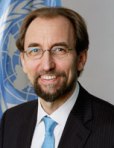 On 8 September 2014 the new UN High Commissioner for Human Rights, Zeid Ra’ad Al Hussein, addressed for the first time the Human Rights Council, and many will have been listening for clues about where he stands on key issues, how ‘activist’ he is likely to be etc. As the speech was rather long and covered a huge variety of issues, it is not easy to draw any conclusions yet. The fist half addressed issues of war and violence and in particular the humanitarian crises of today.
The role of the individual is beautifully worded: “courage is the first human virtue, revered the world over, the very virtue we value the most as human beings. The courageous individual is not he or she who wields great political power or points a gun at those who do not – that is not courage. The courageous individual is he or she who has nothing to wield but common sense, reason and the law, and is prepared to forfeit future, family, friends and even life in defence of others, or to end injustice. In its most magnificent form, the courageous individual undertakes this exertion, without ever threatening or taking the life of someone else, and certainly not someone defenceless.”..”the Takfiris [IS] who recently murdered James Foley and hundreds of other defenceless victims in Iraq and Syria – do they believe they are acting courageously? “…
“Navi Pillay was one of the greatest senior officials the UN has ever had, and one of the most able, formidable High Commissioners for Human Rights. That she could annoy many Governments – and she did – was clear; but she believed deeply and movingly in the centrality of victims, and of those who are discriminated against. They needed her vocal chords, her lungs and her pen, and she made everyone listen. I pledge to continue along the same path: to be as firm, yet always fair; critical of states when necessary, and full of praise when they deserve it.”
“A ministerial-level meeting will be held in New York on 25 September, on the need for a code of conduct to be adopted by the permanent members of the UN Security Council regarding use of veto, in situations where atrocities are ongoing and where those facts are well founded. This is not a call to have the UN Charter rewritten, but a call for the permanent members to exercise a moratorium in very specific circumstances involving atrocity crimes. I applaud the Government of France for taking the lead over this, and thank it for inviting me to participate on the 25th. When the veto is exercised for the sole purpose of blocking action by the Security Council, with no alternative course of action offered, and when people are suffering so grievously – that is also a form of cruelty.”
After briefly describing his priorities:
- halt the increasingly conjoined conflicts in Iraq and Syria. In particular, dedicated efforts are urgently needed to protect religious and ethnic groups, children – who are at risk of forcible recruitment and sexual violence – and women, who have been the targets of severe restrictions.
- ensure accountability and stop impunity
- to take a step back and look at how and why these crises erupted,
the UN High Commissioner touched on a number of current situations and mentioned the importance of the different mechanisms and bodies. Finally he came to the civil society with the following words:
“But the work done by OHCHR, by the Special Procedures, by Treaty Bodies, this Council itself, and indeed, by Member States, could never be achieved without the greater efforts of civil society actors. We need their continuing support and contributions to realise progress. I encourage the Council to strengthen its constructive engagement with civil society actors, and to ensure that their voices can be raised safely and without reprisals. Freedoms of expression, association and peaceful assembly are rights that enable people to share ideas, form new thinking, and join together with others to claim their rights. It is through the exercise of these public freedoms that we make informed, considered and intelligent decisions about our development. To restrict them undermines progress. We must acknowledge the value of civic contribution, build the capacity of marginalised voices, ensure a place at the table for civil society actors, and safeguard their activities – including the activities of those who cooperate with this Council, its Special Procedures and Commissions of Inquiry. I take this opportunity to echo the Secretary-General’s condemnation of acts of reprisal against individuals by reason of their engagement with the United Nations.”
At the end of this speech, he paid significant attention to the issue of migration: “The treatment of non-nationals must observe the minimum standards set by international law. Human rights are not reserved for citizens only, or for people with visas. They are the inalienable rights of every individual, regardless of his or her location and migration status. A tendency to promote law enforcement and security paradigms at the expense of human rights frameworks dehumanises irregular migrants, enabling a climate of violence against them and further depriving them of the full protection of the law.”
See full text at: Media Centre.
Posted in human rights, Human Rights Council, Human Rights Defenders, OHCHR, UN | Leave a Comment »
Tags: Al Hussein, Al'Hussein, Civil society, Human Rights Council, Human Rights Defenders, humanitarian, Navi Pillay, reprisals, Takfiris, the Office of the UN High Commissioner for Human Rights, UN High Commissioner, UN High Commissioner for Human Rights, war, Zeid Ra'ad Al Hussein
June 30, 2014
The always reliable Monitor of the ISHR wraps up the latest session of the UN Human Rights Council in Geneva with a comment on the Council’s missed opportunity to strengthen the protection of human rights defenders who work to corporate accountability for human rights violations: Read the rest of this entry »
Posted in human rights, Human Rights Defenders, ISHR | Leave a Comment »
Tags: corporate accountability, environmental activists, Human Rights Council, Human Rights Defenders, human rights violations, impunity, ISHR, Resolution, UN Human Rights Council, United Nations Guiding Principles on Business and Human Rights
June 23, 2014
In a recent piece published on LinkedIn on 3 June 2014, I argued that there is not enough attention given to enforcement [https://www.linkedin.com/today/post/article/20140603192912-22083774–crime-should-not-pay-in-the-area-of-international-human-rights]. This conviction was fortified by reading the ISHR Monitor of 20 June in which Heather Collister sums up recent cases of persistent non-cooperation by States with the Council’s special procedures and other mechanisms.
The Human Rights Council heard updates from the Special Rapporteurs on Belarus, the Democratic People’s Republic of Korea, and Eritrea, along with the latest update from the Commission of Inquiry into the situation in Syria. In all cases the countries in question have refused access to the mechanism created by the Council to monitor and report on the human rights situation.
Read the rest of this entry »
Posted in human rights, Human Rights Defenders, ISHR | 1 Comment »
Tags: Belarus, Democratic People’s Republic of Korea, DPRK, enforcement, Eritrea, Heather Collister, Human Rights Council, international commitments, ISHR, LinkedIn, non-cooperation, special rapporteurs, Syria, Thoolen, UN Human Rights Council, UPR
June 6, 2014
The ISHR Monitor of June 2014 contains a good wrap-up of the situation regarding reprisals against Human Rights Defenders written by Eleanor Openshaw under the title: “Reprisals: States must reduce unacceptable human cost of cooperating with UN”.
‘Regrettably, reprisals against persons cooperating with the United Nations, its mechanisms and representatives in the field of human rights continue. ...’ said UN Secretary-General Ban Ki-moon in 2013. In response, the UN Human Rights Council adopted a landmark resolution in September 2013 calling on the Secretary-General to designate a UN-wide senior focal point to combat reprisals. Regrettably, Human Rights Council resolution 24/24 was blocked by the UN General Assembly in New York in December 2013, but NGOs are now calling again on States to revisit the issue as a matter of priority. “The disappearance, arbitrary detention, ill-treatment and death of human rights defender Cao Shunli in retaliation for her efforts to hold China to account for its human rights record at the UN is just one example among many of the unacceptable human cost of cooperating with the UN,’ said Ms Openshaw.
A number of positive recent developments (referred to in earlier blog posts [https://thoolen.wordpress.com/tag/reprisals/]) include a May 2014 decision by the African Commission on Human and Peoples’ Rights in Angola to appoint its own focal point, and a joint statement delivered by Botswana on behalf of 56 States in Geneva in March 2014 recognising that ‘the current response by the UN and the member States in addressing reprisals is inadequate’ and calling on them to ‘address cases of reprisals through a more effective and coordinated approach.‘
‘With the opportunity for the General Assembly to revisit the issue in September, NGOs are urging States to transfer the political will shown on this issue in Angola and Geneva to New York, and achieve an outcome that challenges impunity for the perpetrators of reprisals and increases protection for human rights defenders and others who engage with the UN human rights system,‘ Openshaw said (Program and Advocacy Manager, e.openshaw[at]ishr.ch).
The statement was signed by a coalition of 12 leading international and regional NGOs (of which 8 are members of the MEA Jury or Regional Panel):
- Amnesty International
- Association for the Prevention of Torture (APT)
- Asian Forum for Human Rights and Development (FORUM-ASIA)
- Cairo Institute for Human Rights Studies
- Commonwealth Human Rights Initiative
- Conectas Direitos Humanos
- Human Rights House Foundation
- Human Rights Watch
- International Commission of Jurists
- International Federation for Human Rights (FIDH)
- International Service for Human Rights
- World Organisation Against Torture (OMCT)
full article: Reprisals: States must reduce unacceptable human cost of cooperating with UN | ISHR.
Posted in human rights, Human Rights Defenders, MEA, UN | 1 Comment »
Tags: anti-reprisals focal point, Cao Shunli, coalition, human rights, Human Rights Council, Human Rights Defenders, MEA, reprisals, retaliation, UN, UN General Assembly, UN Human Rights Council, UN Resolution


 Hans Thoolen on Human Rights Defenders and their awards