Did you graduate in 2018 or 2019? And did you – at least partially – study in the Netherlands? Then you can compete for the Thoolen NJCM-Thesis Award. The best thesis will be published as a book! The Dutch section of the International Commission of Jurists (NJCM) will select the best Master thesis in the field of human-rights. Any law student with a university or higher professional educational background is welcome to participate. The thesis must have been written in either the academic year of 2017/18 or 2018/19.
The deadline for submitting your thesis is 1 December, 2019. —-
Among the previoius winner are:
2017: Sylvie McCallum Rougerie, Police Failures to Combat Sexual Assault: Lessons from International and Regional Human Rights Law for Improving Accountability under the Canadian Charter of Rights and Freedoms
2011: Laura Henderson, Tortured reality. How media framing of waterboarding affects judicial independence
2009: Erik van de Sandt, A child’s story for global peace and justice. Best practices for a child-friendly environment during the statement- and testimony-period in respect of the Rome Statute and the International Criminal Code
2005: Janine de Vries, Sexual violence against women in Congo. Obstacles and remedies for judicial assistance
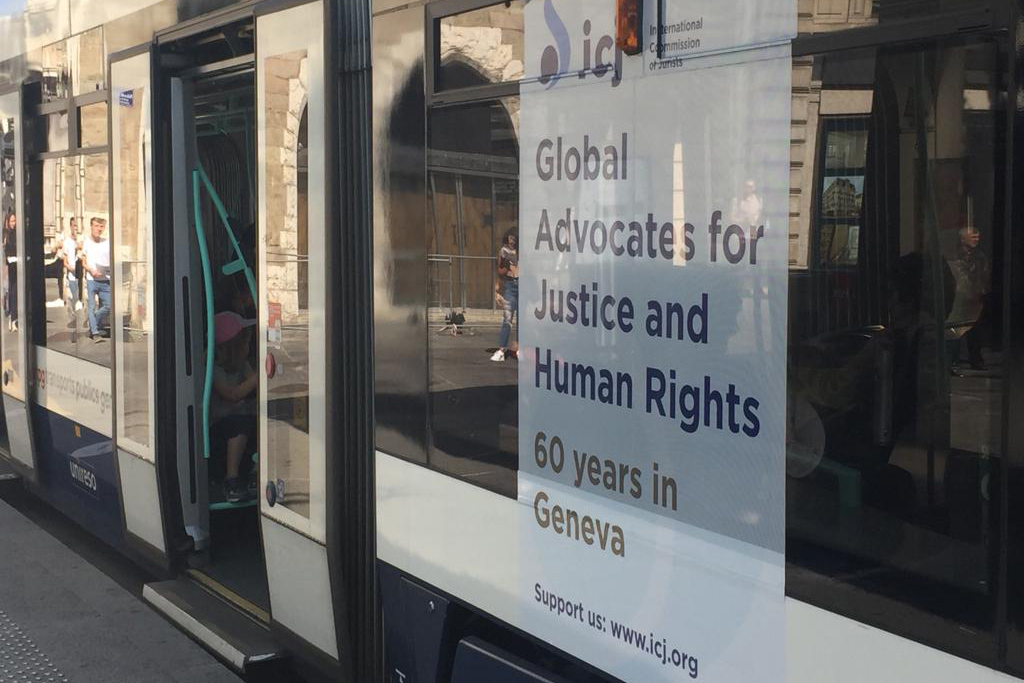
The International Commission of Jurists(ICJ) celebrates its 60th year in Geneva.
2018 marks the 60th anniversary of the ICJ’s move to Geneva thanks to the Swiss jurist Jean-Flavien Lalive, who was ICJ’s Secretary General in 1958. This makes the ICJ one of the earliest international organizations to establish its headquarters in Geneva. DISCLAIMER: I worked for the ICJ from 1977-1982. The ICJ was at that time a small organisation with less than 10 persons including the interns. As Executive Secretary – the grandiose title belied my real position as the personal assistant of the impressive Secretary General Niall MacDermot. Still, then as now the ICJ plays a preeminent role as a non-governmental organization seeking to defend human rights and the rule of law worldwide.
The ICJ will mark this event with two major initiatives:
A visibility campaign from 26th September to 9th October: the TV screens on the Geneva public transport network and five vehicles will carry the slogan “Global Advocates for Justice and Human Rights – 60 years in Geneva”
The launch of the “60th Anniversary Appeal” to all lawyers in the Republic and canton of Geneva to support the ICJ and, in turn, their less privileged colleagues, victims of persecution on five continents.
“Geneva can be proud of its image as the world human rights capital. It is a beacon for justice advocates around the world. We must continue to make it shine,” said Sam Zarifi, Secretary General of the ICJ. “Through its 60-year history, the ICJ has contributed significantly to Geneva’s human rights record: the campaigns that led to the creation of the post of UN High Commissioner for Human Rights in 1993 and the UN Human Rights Council in 2006, as well as the adoption of the United Nations Convention against Torture in 1984 are some emblematic examples,” said Olivier Coutau, Head of La Genève Internationale.
The international reputation of the ICJ rests on these pillars:
60 Commissioners – eminent judges and lawyers – from all regions of the world and all legal systems – with unparalleled knowledge of the law and human rights;
Cooperating with governments committed to improving their human rights performance;
Effective balance of diplomacy, constructive criticism, capacity building, and if necessary, ‘naming and shaming’;
Unmatched direct access to national judiciaries, implementing international standards and improved legislation impacting millions;
Guiding, training and protecting judges and lawyers worldwide to uphold and implement international standards (e.g.in 2018, the ICJ provided local trainings on five continents to assist 4,300 judges, lawyers and prosecutors strengthen their ability to protect and promote fundamental rights)
Working for access to justice for victims, survivors and human rights defenders, in particular from marginalized communities;
Following a strict result based management in project delivery.
The ICJ has been awarded, during its long history, some of the most prestigious international awards: the Council of Europe Human Rights Prize, the United Nations Award for Human Rights, Erasmus Prize, Carnegie Foundation Wateler Peace Prize.
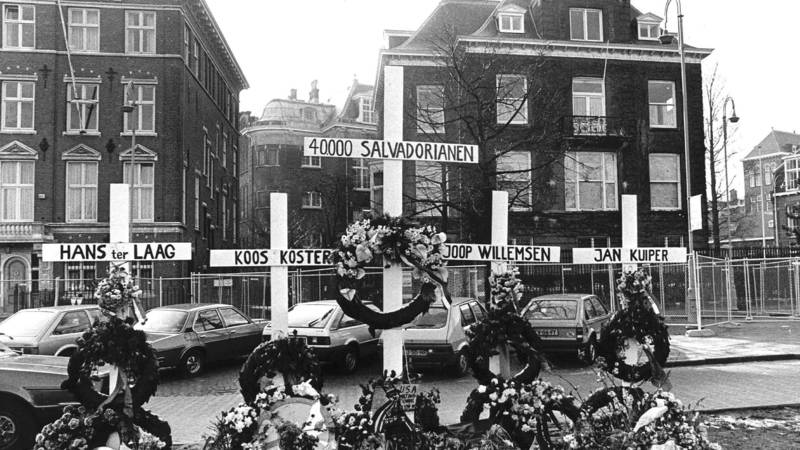
In the Dutch media a lot of attention is being paid at the moment to the 35-year old story of the IKON journalistswho were killed in El Salvador in 1982. Some years ago I started to write up ‘human rights stories’ that I had been closely involved in, with the idea that some day they would be of interest. This seems a good moment to ‘publish’ for the first time the chapter on my involvment with the case of the IKON journalists:
1982 IKON journalists killing and El Salvador
…On 17 March 1982, three months before I took up my post as thea first director of the new Netherlands Institute for Human Rights (SIM), the world – and especially the Netherlands – were shocked by the kiliing of a team of television journalists of the TV channel IKON in El Salvador. The very uncivil conflict there had already costs thousands of people their lives including the internationally known cases of the 4 American nuns and the progressive bishop Oscar Romero 1980. The USA under Reagan had clearly changed course and was openly supporting the Duarte regime against the left-wing rebels. The Dutch government – especially its ‘atlanticist’ Minister of Foreign Affairs Hans van de Broek[1]– was caught between its desire to appease the US government and to respond to the public outcry back home. The compromise reached was that the Dutch Ambassador from a neighbouring country (Jan Willem Bertens) was exceptionally allowed to undertake an investigation on Salvadoran territory, but – if no evidence of government involvement was found – that would be the end of the affair. The fact-finding mission by the Dutch Ambassador did not find any strong evidence; the report was left with the Salvador government and submitted to the Dutch parliament.
One of the first visitors to SIM was Yata Matsuzaki who was the partner of one of the journalists killed and on behalf of the families – who were not convinced by the inconclusive Bertens report. She asked me to take on the case and see whatever else could to done to keep the matter alive. There was even some money set aside for this by the families which was very useful as later – when the Dutch Minister Van der Stoel queried whether this kind of activity (i.e. second-guessing him) was within SIM’s mandate – I was able to refer to the fact that SIM was supposed to find externally funded projects and this had been one of them.
In fact, I had to scratch the bottom of the barrel to find ways to keep the case alive but fortunately the UN had just establish a “Special Rapporteur on extrajudicial, summary or arbitrary executions”and I submitted the case there. With the help of the Lawyers Committee for Human Rights in NY I also tried to obtain copies of relevant telexes from the US State Department but most was blacked out.
This involvement with El Salvador led SIM to start a project on how to count human rights violations in general (with initial focus on Central America) and we tried to solve difficult issues such as killings by non-state actors and defining indirect victims. One of the persons helping in El Salvador was Marianella Garcia Villas who had come to SIM in early 1983. I offered to help her with obtaining political asylum in the Netherlands, but she insisted on going back as she was most needed there. I felt not just sad and shocked but also ‘guilty’ when soon after her return she was murdered.
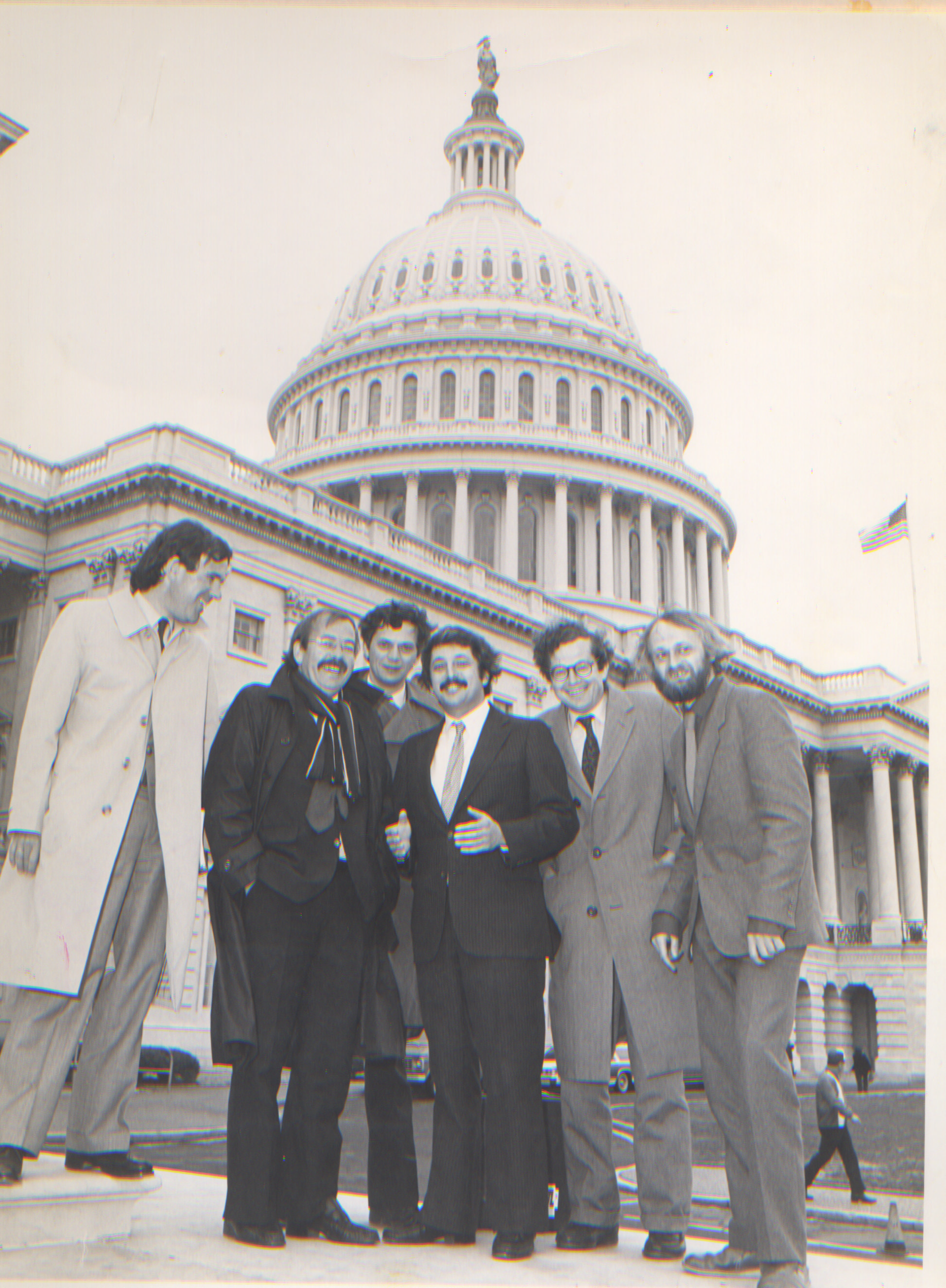
Then in May 1984 three Dutch parliamentarians (one from each main party) accepted to go on a mission to Central America (and the USA see picture) and I was asked to join as an independent ‘expert’. It became a memorable trip, including a shooting incident on the road in Nicaragua, but what crowned it was that in El Salvador I got a chance to meet with the Prosecutor’s office that was in charge of the IKON investigation. They kindly showed me the file and I was shocked to see that it contained almost nothing and especially that the report by the Dutch Ambassador – 2 years later! – had not been translated into Spanish.
Upon arrival in Schiphol airport, there was a well-attended press conference and when there were questions about the IKON investigation the parliamentarians agreed that I should answer as an independent expert. The journalists had clearly not forgotten their colleagues and fielded many questions. When asked what the Dutch government should do now, I replied that it is was time to re-open the investigation and that my colleagues on the mission representing a majority in parliament were well placed to formally ask for it, which they promptly said they would. When soon afterwards a majorly in parliament adopted a motion requesting this, the Minister of Foreign Affairs was not pleased and initially refused to carry out the motion. However, as this was not worth a government crisis the Prime Minster Lubbers engineered a compromise under which the Dutch government would follow up and at least translate the text.
In 1993 a Report of the Truth Commission of the United Nations on El Salvador concluded that the journalists had been killed in a planned ambush, that Reyes Mena was responsible and that El Salvador so far had failed to do research in order to sentence and punish those responsible. That same year an amnesty law was passed in El Salvador,…
and now (September 2018) I can add a final chapter:
A team of the Dutch television programme Zemblahas traced the former colonel of the Salvadoran army, Mario Reyes Mena, who ordered the killings. The now 79-year-old Reyes Mena has been living in the United States for four years. Zembla found him through his three adult children, who are active on social media.
When confronted he claimed that the amnesty pronounced by the government of El Salvador covers his actions. However this amnesty law was cancelled in 2016. In August 2017, the investigation into the murders was already reopened administratively. Two Salvadoran human rights organizations, ‘Fundación Comunicándonos’ and ‘Associacíon de Derechos Humanos’, urged the Salvadoran judiciary to carry out the investigation and the ensuing prosecution.Gert Kuiper, de brother of one of the killed journalists has also started a procedure against the colonel and the Dutch Ambassador in El Salvador supports the move.
It is not known where we stand with this investigation but interesting is to note that in November 2017 another former Salvadoran army colonel, Inocente [SIC] Orlando Montano, was extradited from the USA to Spain to face charges relating to the 1989 killings of the 6 Jesuits priests.
Killings cannot have happy endings but justice is the next best thing.
[1]He succeeded in May 1982 the socialist Van der Stoel whose initial reaction to the killing had been more forceful.
Global Geneva published today, 4 October 2017, an article by me called “[Geneva] The right place for the world’s human rights award“. Rather than summarizing it, here is the full article. There are lots of other interesting pieces in the issue, see: http://www.global-geneva.com.
——————
The 2017 Martin Ennals Award for Human Rights Defenders will be announced on Tuesday, 10 October, 2017 at the University of Geneva (UniDufour) in Geneva, Switzerland. For further information, go to MEA: This article also appears in the Oct-Nov 2017 edition of Global Geneva magazine.
WITHOUT INDIVIDUAL HUMAN RIGHTS DEFENDERS (HRDs), the Universal Declaration of Human Rights and other human rights law risk being a dead letter. Almost all human rights organisations have a mandate to come to the succour of threatened colleagues via urgent appeals and other campaigns. Some 150 now run an award and the number keeps growing – half were created since the beginning of the 21st century.
Curiously, however, the best known of these awards, the Nobel Peace Prize, is given out annually in Oslo and not in Geneva, the international hub for human rights. Alfred Nobel died on 10 December. Decades later, the United Nations declared 10 December as International Human Rights Day and designated 21 September as the International Day of Peace. The strange result is that the Nobel Peace Prize – intended for contributions to ‘peace’, not necessarily ‘human rights’ – is awarded every year in Oslo on 10 December, which is ‘Nobel Day’ in Sweden and Norway, and International Human Rights Day for the rest of the world.
The small volunteer secretariat operated out of Geneva, but many of the first award ceremonies were held abroad in places where the laureates are active. In 2001, it was decided to make Geneva the permanent location for the annual ceremony. By 2008, the lakeside city started offering serious support by making the award part of its “International Geneva” plan, an effort to galvanize the private and public sectors, including the rest of Switzerland, with regard to the region’s crucial importance as a hub for critical global issues. Since then, cooperation has grown into an admirable win-win partnership with the award run on a fully independent basis, while Geneva provides the infrastructure for the ceremony.
This suits all parties. The actual decisions are made by an autonomous jury of experts enabling the city to avoid having to deal with controversial aspects.
Mohamed Zaree of the Cairo Institute of Human Rights Studies (CIHRS) is one of the three finalists, and is subject to a travel ban to Geneva where he is supposed to attend the 10 October 2017 Martin Ennals Award Ceremony. Despite requests directly to Egyptian President Al-Sisi, the ban – at this time of writing – has yet to be lifted.
Presenting the awards: a matter of protection – and courage
The wisdom of this separation was reiterated in 2016 when the MEA went to an imprisoned scholar belonging to the Uyghur minority. China reacted furiously, but its target ended up being the UN High Commissioner for Human Rights, who courageously persisted in presenting the award at the ceremony as his predecessors have done over the years.
How effective are human rights awards? To answer this, one needs to know in which way they are intended to help human rights defenders. In the first place, all awards seek to offer recognition and encouragement at the psychological level. This goal should not be trivialized as activists often have to work in difficult environments. Furthermore, they may prove unpopular even within their own social circles.
Secondly, many awards come with some financial support. Even relatively small amounts go far in cash-strapped organizations, many based in developing countries.
Finally, the most important but also elusive goal is protection. The latter is not really possible without a fair degree of publicity. An example: On 13 May 2008, Mutabar Tajibaeva, a detained human rights activist in Uzbekistan, was announced as that year’s MEA Laureate. A few weeks later, on 2 June, she was released from prison on medical grounds, and a few months later, was allowed to travel abroad. She came to Geneva to receive the MEA in person, declaring publicly that the award saved her life. However, one cannot state categorically that her release was a direct result of the award; many other actors contributed to the pressure that resulted in her release from prison.
Karla Avelar 2017 FINALIST – EL SALVADOR: Karla Avelar has dedicated her life to defending, nationally and internationally, the Human Rights of LGBTI persons, HIV affected persons, migrants, persons deprived of liberty in situations of vulnerability as well as victims of discrimination due to their sexual orientation or gender identity.
For human rights abusers: embarrassment fueled by global press coverage
That such impact cannot be taken for granted is shown by the case of Ahmed Mansoor from the United Arab Emirates, the 2015 Laureate. The government did not lift his travel ban and he had to address the audience via a video link.
His case received further global coverage in August 2016. Flaws in Apple’s iOS operating system were discovered by Mansoor who alerted security researchers to unsolicited text messages he had received. Apple has since released a software update that addresses the problem. Then, on 20 March, 2017, around midnight, Ahmed Mansoor was arrested at his home in a raid by a large team of the Emirates’ security forces.
His importance as a human rights defender was demonstrated by the international response to this sudden arrest. In addition to many newspapers and social media, the UN Special Procedures and the EU Parliament quickly called for his release. But today, six months later, he continues to linger in jail.
FreeThe5KH 2017 FINALIST = CAMBODIA: Mr Ny Sokha, Mr Yi Soksan, Mr Nay Vanda, Ms Lim Mony and Mr Ny Chakrya, the “Khmer 5” are Cambodian human rights defenders who face judicial harassment and had spent 427 days in pre-trial detention, as a result of their legitimate human rights work.
Some believe that human rights awards can endanger the lives of laureates. Clearly, this is a danger, but the best judge of the balance between increased risk and greater protection remains the human rights defender in question. And generally, they seem to regard public exposure foremost as a form of protection, reflecting the increased importance of the media even in tense situations. The biggest problem with seeking increased protection through publicity is perhaps that the media are not automatically interested in all human rights awards.
That the media are increasingly referring to the MEA as the “Nobel prize for human rights” is perhaps the best sign that after almost 25 years, the award has found its status and place in Geneva. With the delivery of the 2017 prize on 10 October in Geneva, it will again be in the hope to go ‘from the front line to the front page’.
Hans Thoolen is a Dutch national who has worked for various NGOs and inter-governmental organizations, including 12 years in Geneva. He is now retired but not tired. Read his blog: https://humanrightsdefenders.blog/
False modesty should not prevent one from announcing a truly excellent piece written by Janneke Allers. She is the winer of the bi-annual Thoolen NJCM Dissertation Prize 2015 (sixth edition) with her dissertation ‘Cuts in the light of fundamental social rights. To what extent do treaties constrain the space for regressive measures?’
Three dissertations made the final cut and were assessed on the following criteria: the originality of the chosen human-rights based theme, the development thereof; the academic level; the degree of innovative insight; and accessibility.
The results were: Read the rest of this entry »
For a blog on Human Rights Defenders there is no better way to wish all my readers a happy new year than by referring you to the first electronic Newsletter produced by Michel Forst, the UN Special Rapporteur on Human Rights Defenders:
For this first newsletter, he would like to share three messages with which I whole heartedly agree:
an alarm call (as I feel extremely worried about the situation of those who seek to promote and defend our fundamental rights. While I am writing these words, numerous defenders are in danger in Burundi, Bahrain and in many other countries across the globe. In front of States that despise their own international commitments and firms that seem to have profits as a unique goal, the courageous people who take a stand to defend our rights and freedoms need more than ever our protection and recognition.}
a message of hope. {It is true that civil society has never seemed so visible and determined. In every meeting I held this year, I could see courageous women and men speaking up and dedicating their lives to fight against injustice and barbarism. Throughout the year, we have witnessed an unprecedented number of attacks and threats and I would like to celebrate once more the action of these countless ordinary people who defend human rights, sometimes at the expenses of their own lives.}
a call to action. {It is in our hands to make human rights defenders’ work more visible to the rest of the society. It is in our hands to prove that promoting and defending rights are essential to democracy and the rule of law. We all have a role to play in protecting rights defenders whether promoting their struggles or giving them our unconditional support.)
False modesty could have prevented me from making this announcement, but I think that getting the highest number of quality submissions is more important. So please pass this on:
The Dutch section of the International Commission of Jurists (NJCM) invites law graduates to participate in the sixth Thoolen NJCM Dissertation Prize (2015) for the best human-rights thesis on university and higher professional education level.
To be considered eligible, the dissertation must have been written in the last two academic years (2013-2014 or 2014-2015) and must have received at least a Dutch ‘8’ grade equivalency by an internationally recognized university. The submitted dissertation must be written in either Dutch or English, concern a human-rights based subject and be in a direct relation to internationally recognized human rights.
The winning dissertation will be published by the NJCM!
Deadline
The dissertation must be handed in before the 1st ofNovember 2015 at NJCM’s secretariat. Send four copies of your dissertation before this date to: NJCM P.O. box 778, 2300 AT Leiden.
The jury * Mr. H. (Hans) Thoolen Co-founder and first Chair of the NJCM; Secretary of the Board of the Martin Ennals Foundation * Dr. (Michiel) van Emmerik Associate Professor of Constitutional and Administrative Law at Leiden University * Prof. C. (Kees) Flinterman Honorary professor of human rights law at Utrecht University and Maastricht University * Prof. J.E. (Jenny) Goldschmidt Honorary professor of human rights law at Utrecht University; director Netherlands Institute of Human Rights (SIM) from 2007 to 2014 * Prof. N.M.C.P. (Nicola) Jägers Professor of International Human Rights Law of Tilburg Law School, Tilburg University; Commissioner of the Netherlands Institute for Human Rights * Prof. R.A. (Rick) Lawson Dean of the Leiden Law School; professor of European Law at Leiden University * Prof. B.E.P. (Egbert) Myjer Professor emeritus of human rights law at VU University Amsterdam; judge of the European Court of Human Rights from 2004 to 2012; Commissioner of the International Commission of Jurists from 2013
Previous prize winners are:
2013: Suzanne Poppelaars Het recht op bronbescherming: Hoe verder na Voskuil en Sanoma?
2011: Laura Henderson [https://thoolen.wordpress.com/2012/04/30/media-framing-and-the-independence-of-the-judiciary-the-case-of-water-boarding/] Tortured reality. How media framing of waterboarding affects judicial independence
2009: Erik van de Sandt A child’s story for global peace and justice. Best practices for a child-friendly environment during the statement- and testimony-period in respect of the Rome Statute and the International Criminal Code
2007: Shekufeh Jalali Manesh Het recht van het kind op behoorlijke huisvesting en het BLOEM-model
2005: Janine de Vries Sexual violence against women in Congo. Obstacles and remedies for judicial assistance
Copies of the winning dissertations can be purchased through NJCM’s secretariat: NJCM@law.leidenuniv.nl
OMCT and FIDH (within the framework of the Observatory for the Protection of Human Rights Defenders) in cooperation with the ISHR organise on 16 June (16:00-17:30, room XXII, Palais des Nations – Geneva) a side event on Attacks and Reprisals against Human Rights Defenders, focusing on the issue of reprisalsand accountability. As readers know by now, I believe that this is the topic which the human rights movement HAS TO TAKE more serious lest all progress of the last decades will be lost. My blog contains quite a few posts on reprisals (https://thoolen.wordpress.com/tag/reprisals/), but the key one is: https://thoolen.wordpress.com/2014/03/13/zero-tolerance-for-states-that-take-reprisals-against-hrds-lets-up-the-ante/.
Zhu Junqing, writing in the Shanghai Daily of 13 May 2015, is the prime example of how distorted the Chinese government’s view of the international human rights regime is. Under the title: “U.S. needs to work on own human rights record first before blaming others“, the author quite rightly points to the UN Human Rights Council findings on 11 May and the comments by UN High Commissioner for Human Rights, Zeid Ra’ad Al Hussein, which conclude that there a lot of human right problems remain unresolved in the USA (including excessive use of force by law enforcement agencies, racial, religious and sex discrimination, Guantanamo Bay detention, migrant rights, environmental issues and counterterrorism practices). Also he recalls correctly that the United States is one of the two countries in the world that have not ratified the UN Convention on the Rights of the Child, and is reluctant on other international instruments.
But then the article draws exactly the wrong conclusion. Instead of appreciating the UN’s courage to tackle a superpower, it call the USA the “ultimate human rights judge” (why??) and concludes that this “self-proclaimed human rights watchdog, needs to examine itself critically and improve its own human rights record before [!] blaming other countries for their violations”. Since “no country is perfect in its human rights record,” as Chinese Foreign Ministry Spokesperson Hua Chunying put it, “any country with human rights defects should work hard to resolve its own problems and improve its own human rights record before casting the first stone”.
China’s own extraordinary sensitivity to ‘interference’ of any level into what it considers its domestic affairs is well-known. I touched upon this ‘hot’ topic’in my own 2011 article “The international human rights movement: not perfect, but a lot better than many governments think” in the book ‘NGOs in China and Europe’(exceptionally also published in Chinese!): Yuwen Li (ed), Ashgate, 2011, pp 287-304 (ISBN: 978-1-4094-1959-4).
At the end of this year I want to wish my readers a very Happy New Year and to share – in the good tradition of transparency – the main statistics of my blog on human rights defenders in 2014. It clearly is a ‘niche blog’ and that is what it will remain. I am quite happy with the relatively large number of archives visitors, i.e. some 40 persons per day find something worthwhile in my older posts. Also the geographical spread is pleasing. Of course, a larger number of visitors would be even better and I would be grateful for any promotion you could undertake. All the best Hans
 Mohamed Zaree of the Cairo Institute of Human Rights Studies (CIHRS) is one of the three finalists, and is subject to a travel ban to Geneva where he is supposed to attend the 10 October 2017 Martin Ennals Award Ceremony. Despite requests directly to Egyptian President Al-Sisi, the ban – at this time of writing – has yet to be lifted.
 Karla Avelar 2017 FINALIST – EL SALVADOR: Karla Avelar has dedicated her life to defending, nationally and internationally, the Human Rights of LGBTI persons, HIV affected persons, migrants, persons deprived of liberty in situations of vulnerability as well as victims of discrimination due to their sexual orientation or gender identity.
 FreeThe5KH 2017 FINALIST = CAMBODIA: Mr Ny Sokha, Mr Yi Soksan, Mr Nay Vanda, Ms Lim Mony and Mr Ny Chakrya, the “Khmer 5” are Cambodian human rights defenders who face judicial harassment and had spent 427 days in pre-trial detention, as a result of their legitimate human rights work.
 Hans Thoolen on Human Rights Defenders and their awards