The Right Livelihood Foundation and partners have gone into the problems faced by Human Rights Defenders in exile:
Leaving your country means more than crossing a border. It means stepping into uncertainty, a place where language falters, futures blur and belonging must be rebuilt. But exile can also open doors. It can broaden perspectives, forge new alliances and inspire people to rebuild on their own terms.
Through the project “Reconceptualising exile”, Right Livelihood together with theGlobal Campus of Human Rights, work with a group of 14 fellows living in exile to rebuild life, regain identity and purpose while the ground they left behind remains too dangerous to return to. This visual story challenges what you think exile means. It invites you to see how it feels and how people rebuild from fragments, carrying language, memory and conviction across borders.
What forces someone into exile? Behind those numbers are real people punished for what they believe in:
For Natallia Satsunkevich, a human rights defender from Belarus, it was fighting for democracy in the face of the dictatorship.
For Viacheslav (Slava) Samonov, a Russian lawyer and LGBTQ+ activist, the dissolution of his NGO amid the post-invasion crackdown and the rapidly escalating repression against LGBTQ+ people.
For Askold Kurov, a Russian documentary filmmaker, it was promoting free media and LGBTQ+ rights.
For Helen Mack Chang, it was challenging the rampant corruption in Guatemala.
For Abdul Rahman Yasa, it was standing up for human rights, women’s issues and youth advocacy under the Taliban.
‘Water is to protected. Water is not for sale. Water is to be defended.’
Doris Ramírez is a fisherwoman and a fisherfolk’s union representative from Guatemala’s southern coast. She told ISHR how her late husband’s passing drove her to embrace activism and described her aspirations for the future for her coastal community.
In March 2025, Doris attended the 58th session of the UN Human Rights Council, delivering a statement calling on Guatemala to abide by its obligations to secure the protection of marine biodiversity, the traditional rights of fisherfolk and the protection of those who are protecting the environment.
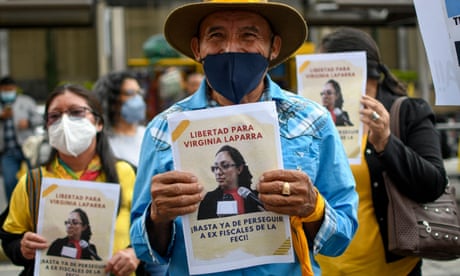
On 5 March 2025 Haroon Siddique in the Guardian wrote about Virginia Laparra, a Guatemalan anti-corruption prosecutor, who spent two years in prison after reporting her suspicion that a judge leaked sealed details of a case. She was forced into exile after being pursued by the country’s conservative elite.
Facing the prospect of going back to prison and further charges, Laparra left her two daughters behind to seek asylum across the border in Mexico.
In an interview with the Guardian in London after receiving the Alliance for Lawyers at Risk’s Sir Henry Brooke award honouring human rights defenders, Laparra said: “Nobody goes into exile voluntarily. Exile is the only thing left when nothing else has worked, it’s the only thing you’ve got left to defend your life and your freedom.
“Exile is just little bit different, a little bit less than death. [Your persecutors] take everything from you, take away your family, your children, your parents, your house, your way of life, your friends.’
Laparra headed a special prosecutor’s office working alongside the International Commission Against Impunity in Guatemala (Cicig), a UN anti-corruption mission that was controversially expelled in September 2019 by the then president, Jimmy Morales. Widespread reprisals followed against those who had worked with Cicig.
When Laparra was taken taken into preventive detention, she said it was as “if I were the worst drugs trafficker in Guatemala. When we drove out of the underground parking in my building there were soldiers, the police, hooded, with heavy weapons on both sides of the street. It was like in a film.”
She spent her first five months in solitary confinement in a windowless 2.5 sq meter cell in a high security jail in Guatemala City, 200 miles away from her Quetzaltenango home, and allowed out for only one hour a day.
She also endured bleeding to the womb in prison but waited months for treatment. Laparra eventually had a hysterectomy and four subsequent operations, during which she said police surrounded “the hospital, the gynaecology area, the operation room, and I had on each side of my bed a member of the police”.
She was later transferred to Matamoros prison, another notorious facility where drug traffickers and gang leaders are held, after she angered the authorities by speaking to a journalist. “My idea was that at least if I’m going to die [in jail], let’s make sure the world knows what happened,” said Laparra.
She considered pleading guilty in the hope that she might be released as both her sentences were commutable, which in Guatemala usually means no jail time is served, but her daughters told her: “Don’t do that, you’ve been here too long to give up now.”
When things reached their lowest ebb, Laparra said she decided to kill herself before remembering the promise she made to her daughters each time they visited – that she would be there the next time they came.
After her release on house arrest last year, she received an award from Guatemala’s current progressive president, Bernardo Arévalo, a surprise victor in the 2023 election. But Laparra believes the award only inflamed the pursuit of her by the public prosecutor’s office led by the attorney general, María Consuelo Porras, who had also tried to stop Arévalo from taking office.
Porras, who has pursued many other anti-corruption prosecutors and judges, also forced into exile her predecessor as attorney general and has been sanctioned by the US for corruption and the Council of the European Union for undermining democracy.
The Fund for Global Human Rights, which nominated Laparra for the Sir Henry Brooke award, and Amnesty International, which named her as a prisoner of conscience in 2022, said they were “deeply concerned about the systematic pattern of criminalisation imposed by the Guatemalan judiciary and the public prosecutor’s office against former judges, prosecutors, human rights defenders and journalists who have worked tirelessly for years to fight impunity and corruption in the country”.
Laparra says she feels proud to have received the award but adds that her persecutors reacted to the news with anger online. “I thought that it wasn’t possible to keep hate burning for so long,” she said. “Surely, two years in prison would have been enough for them, I thought, but it wasn’t.”
As we mark Nelson Mandela Day and #StandAsMyWitness campaign anniversary, the number of countries to legally harass and put activists behind bars nearly doubled in five years.
José Rubén Zamora is the latest defender featured in the international #StandAsMyWitness campaign calling for the release of 14 leading human rights defenders.
Earlier this week, two featured Eswatini activists, Bacede Mabuza and Mthandeni Dube, were brutally sentenced to long prison terms for pushing democratic reforms.
As we mark Nelson Mandela Day on 18 July and #StandAsMyWitness campaign anniversary, the number of countries abusing laws to harass and put activists behind bars has nearly doubled in five years. At least 66 countries prosecuted activists last year, up from 36 in 2019, according to the CIVICUS Monitor. In 2023, at least 63 countries detained human rights defenders (HRDs), up from 38 five years ago.
The jarring growth of repression comes as a stark contrast to the vision of President Mandela. #StandAsMyWitness, launched on Nelson Mandela Day four years ago, calls for the release of leading global human rights defenders who languish behind bars for speaking truth to power.
Guatemalan journalist José Rubén Zamora is now added as the 14th activist in the campaign. “As we add José Rubén Zamora to the #StandAsMyWitness campaign, we grow ever concerned that the world is becoming a more dangerous place for human rights defenders. He is a courageous journalist who has dedicated his life to exposing corruption and defending human rights in Guatemala,” said Isabel Rosales, Latin America advocacy officer at CIVICUS. Zamora has been languishing behind bars for two years and the newspaper he founded, el Periódico, was shut down.
Earlier this week, two #StandAsMyWitness Eswatini activists Bacede Mabuza and Mthandeni Dube were respectively sentenced to 25 and 18 years in jail. The two pro-democracy parliamentarians were convicted for demanding democratic reforms. Eswatini is an absolute monarchy where political parties are banned from elections and activists face jail, torture, and death for demanding their rights.
The 14 human rights defenders featured in the campaign represent a wave of persecution sweeping against civic freedoms and human rights around the world. Abuse of law for the prosecution of activists is ranked among the top ten rights violations according to CIVICUS Monitor.
Their stories are no different from many other activists who were silenced for standing up for human rights and justice. Among others still languishing behind bars are #StandAsMyWitness icons:
Nobel Peace Prize laureate Narges Mohammadi, who has received a total of 31 years of prison sentence for standing up for women’s empowerment and promoting the abolition of the death penalty in Iran.
Hong Kong Pro-democracy activist Chow Hang-Tung, who was arrested and detained on June 4, 2021, for publishing two social media posts calling on the public to join the peaceful vigil for the 1989 Tiananmen massacre of civilians and protesters in Beijing.
Khurram Parvez, voted one of the 100 most influential people by Time magazine in 2022, has dedicated his life to nonviolence in one of the most militarized regions in the world. He remains in jail under charges of terrorism and conspiracy in India.
This clampdown on defenders paints a bleak picture, with only two percent of the global population living in countries with open civic spaces. A staggering 72% of people in the world lived in authoritarian regimes in 2023. CIVICUS finds a discernible rise in the closure of civic spaces around the world, with the highest number of people living in closed countries since 2019.
Full list of HRDs featured in the #StandAsMyWitness campaign:
AFRICA:
Eswatini: Bacede Mabuza and Mthandeni Dube – MPs who campaigned for democratic reform
Burundi: Floriane Irangabiye – a journalist serving a 10-year prison sentence for her work
ASIA:
Hong Kong: Chow Hang-Tung – pro-democracy activist, sentenced for organising unauthorised Tiananmen Square Massacre commemoration vigil
India: Khurram Parvez – Kashmiri rights activist; listed in Time magazine’s 100 ‘Most Influential People 2022
CENTRAL ASIA:
Belarus: Viasna Human Rights Defenders – members of Viasna human rights centre; jailed for exercising their right to peaceful assembly and freedom of expression
Tajikistan: Buzurgmehr Yorov – human rights lawyer representing members of the opposition; recipient of Homo Homini human rights prize
Tajikistan: Manuchehr Kholiqnazarov – human rights lawyer serving a 16-year-long prison sentence in retaliation for his human rights work.
LATIN AMERICA:
Mexico: Kenia Hernandez – Indigenous and women’s rights activist; arrested after protest
Guatemala – José Rubén Zamora a journalist and founder of the newspaper elPeriodico. He has been detained since 29 July 2022.
MIDDLE EAST & NORTH AFRICA:
Algeria: Kamira Nait Sid – Indigenous and women’s rights activist campaigning for the rights of the Amazigh people in Algeria
Bahrain: Abdul-Hadi al-Khawaja – detained after democracy protests in 2011; recipient of the prestigious Martin Ennals Award 2022 for human rights defenders
Egypt: Hoda Abdel Moneim – human rights lawyer and former member of Egypt’s National Council for Human Rights
Iran: Narges Mohammadi – Journalist and human rights activist who received the Nobel Prize for Peace in 2023
United Arab Emirates: Ahmed Mansoor – on the advisory boards for Human Rights Watch and the Gulf Centre for Human Rights; imprisoned for publishing information on social media
To find out how to get involved, check out CIVICUS’s campaign webpage: Stand As My Witness.
‘My passion is the defence of the right to land and territory,’ says Lourdes Gómez, a land rights defender and professor working on issues affecting Indigenous women defenders and the impacts of palm oil production.
The ISHR had the chance to meet Lourdes Gómez during her Geneva visit to attend the Human Rights Council’s 55th session. Lourdes, a land right defender and professor working on issues of Indigenous women defenders and the impacts of oil palm production, delivered a powerful statement during the session. She was also one of the speakers at a side event about the human rights situation in Guatemala.
Lourdes recently participated into the ‘artivism’ project by journalist and photographer Teresa Ordás, ‘Paisojos de mujeres defensoras de derechos humanos de Guatemala‘ (‘Landscapes of women human rights defenders from Guatemala’). The project is a collection of beautiful photographs of the real reflections of the subjects’ eyes, where Teresa Ordás highlights ‘the world in people’s eyes.’ [Website: https://www.paisojos.com]
Here is how Lourdes introduces herself in the frame of ‘Paisojos’:
‘I am a Q’eqchi’ Mayan woman of African descent. I inherited my path of defending human rights from my mother Lucia Willis Paau, who since my childhood had joined the movement to defend the rights of Mayan women in the north of Guatemala. My passion is the defense of the right to land and territory. I have dedicated myself to denouncing the violence that the State of Guatemala exerts at the community level on Indigenous, rural and peasant women while they fight for access, use, control and protection of their land. These communities face racism, discrimination and machismo. I have dedicated myself to the defense of land rights, contributing through historical registry and communal research, to the restitution of land rights’.
In recent years, Guatemala has witnessed a concerning erosion of its State institutions. The co-optation of the judicial system has resulted in the persecution of human rights defenders and justice operators, many of whom have had to flee the country. Despite the election of President Bernardo Arévalo, who led a campaign promising to re-establish the rule of law and fight corruption, the international community must continue to monitor the human rights situation in the country.
A side event – Human rights situation in Guatemala: From Rescuing Democracy to Guaranteeing Justice – aims to shed light on the recent socio-political developments in Guatemala, with a particular focus on the 2023 presidential elections and the dynamics of peaceful protest. It will explore the fragile state of the rule of law in the country and the significant human rights challenges it faces. A critical discussion will centre on the co-optation of the judicial system by criminal groups, which has led to the persistent criminalisation of justice operators and human rights defenders.
Additionally, the event will address the pressing crisis of forced evictions in Indigenous communities. These evictions, often driven by the interests of non-State actors like extractive companies and large-scale development projects, represent a form of cruel, inhuman, and degrading treatment, amounting to torture.
Speakers:
Clément Nyaletsossi Voule, UN Special Rapporteur on freedom of peaceful assembly and of association (TBC)
Lourdes Gómez Willis, Q’eqchi’-afrodescendant professor working on issues of Indigenous women defenders and the impacts of palm oil production
Luis Haroldo Pacheco Gutiérrez, Ex-President of the Council of Communal Mayors of the 48 cantons of Totonicapán With the participation of
Margaret Satterthwaite, Special Rapporteur on the independence of judges and lawyers
Sponsors: Centre for Civil and Political Rights, Franciscans International, Impunity Watch, ISHR, Protection international Mesoamérica, and Peace Brigades International.
Thursday 7 March, 14:00 – 15:00 (CET), Room XXV, Palais des Nations – Geneva Language: English / Spanish
Following the decision of a judge in Guatemala City to authorize the immediate release of Virginia Laparra, former prosecutor of the Special Prosecutor’s Office against Impunity (FECI) on Tuesday, 3 January, Ana Piquer, Americas director at Amnesty International, said:
“Virginia Laparra should never have spent a day in jail. It’s great news that she can be reunited with her loved ones after nearly two years as a prisoner of conscience. Her release is a first step towards ending the terrible human rights violations she has faced in retaliation for her outstanding work as an anti-corruption prosecutor.”
“We lament, however, that Virginia Laparra remains convicted of a crime she did not commit and faces another unfounded trial, due to the regrettable use of criminalization against dozens of people who, like her, have led the fight against impunity. Amnesty International reiterates its call for the Guatemalan authorities to put an immediate end to the misuse of the criminal justice system to harass, intimidate and punish judges, prosecutors, human rights defenders and journalists”.
On 28 November 2022, Amnesty International named the former prosecutor as a prisoner of conscience, having found that her detention was solely due to her human rights work as head of FECI in Quetzaltenango, and requested her immediate and unconditional release. In May 2023, the United Nations Working Group on Arbitrary Detention declared that the detention of the former anti-corruption prosecutor was arbitrary and requested her immediate release. At the same time, the international mobilization of thousands of human rights activists on the case has not ceased.
“Amnesty International underscores the importance of international pressure in cases such as those of Virginia Laparra. Our movement in the Americas and around the world has not rested in demanding the release of the former prosecutor,” said Ana Piquer.
The unfounded criminal prosecution against Virginia Laparra took place in a context of attacks against dozens of people for their role in the investigation of high-profile cases of large-scale corruption and human rights violations. In 2022, there were 3,754 attacks against human rights defenders and at least 73 judicial workers, journalists and activists had to go into exile, according to data from Guatemala’s Human Rights Defenders Protection Unit (UDEFEGUA).
Guatemalan lawyer Claudia González Orellana will receive the Lawyers for Lawyers Award 2023. The Award will be presented at a ceremony co-hosted by Lawyers for Lawyers and the Amsterdam Bar in the Rode Hoed in Amsterdam on 11 May. Watch online, via the following link:https://www.youtube.com/watch?v=sIF9Im9wXVo from 5:30 PM until 6:00 PM CEST.
Jury: “By awarding Claudia González Orellana the Lawyers for Lawyers Award, the jury wants to highlight the important work of a lawyer who has bravely represented human rights defenders at high cost to her own personal life and safety. Despite the risk of arrest or physical harm to Claudia and her family, the submission to online harassment, threats, intimidation and the risk of persecution, Claudia bravely continues her work in order to protect human rights and the rule of law”.
After 36 years of internal warfare, Guatemala struggled for democracy and installed an International Commission against Impunity (CICIG). From 2011 to 2019, a period known globally for unprecedented accountability for corruption in Guatemala, Claudia González Orellana was a prosecutor with the CICIG. CICIG successfully prosecuted high level government officials, Supreme Court and Congress members, and other members of organized crime. This work threatened the interests of a corrupt network, the so-called ‘Pacto de corruptos’ a group of economic, military and political elites. In September 2019 CICIG closed down and the former team of lawyers faced several attacks.
As a prosecutor with CICIG Claudia González Orellana pursued accountability for corruption and human rights abuses. She and her family now face extremely high risks of arrest or physical harm for the work she did as a CICIG prosecutor and now as a superb, persistent and public-facing defense attorney for those being targeted. She is now subject to online harassment and threatening rhetoric, verbal threats indicating she may be criminally prosecuted herself, and physical acts of intimidation outside her home. Despite these pressures, Ms González has remained in Guatemala and continues to handle dozens of defense cases, representing individuals who are being prosecuted for their involvement in cases relating to the fight against corruption. For example, she is the lead defense attorney for Virginia Laparra, who has been arbitrarily imprisoned in retaliation for her work as a prosecutor and who has been designated as a prisoner of conscience by Amnesty International.
As a result of defending the lawyers and prosecutors who previously defended the right to a life free of corruption and impunity, Claudia González is now facing violent treatment during hearings and through social media, and she is also being subjected to harassment and intimidation. She has faced multiple instances of judicial harassment, the last one of which was a fake case in which they falsely accused her of forging the signature of the nation’s lead anti-corruption prosecutor. Despite this situation, Claudia is currently using her more than 20 years of experience to defend nine lawyers, all of whom worked on high profile anti-corruption cases for several years: six are former Prosecutors of the General Prosecutor’s Office and three are former CICIG lawyers.
Twenty-seven human rights lawyers from across the world were nominated for the Lawyers for Lawyers Award 2023. The independent expert jury which consisted of Mr Egbert Myjer (chair), Mr Cees Flinterman, Ms Jenny Goldschmidt, and Ms Channa Samkalden selected Claudia González Orellana as laureate. The independent expert jury selected lawyer Manuchehr Kholiknazarov from Tajikistan and lawyer’s collective Bufete Jurídico de los Pueblos from Honduras as shortlisted candidates.
Anuja Pathak was in Guatemala for a year, escorting threatened rights activists for International Peace Brigades. (Credit: Geneva Solutions/ML)
Michelle Langrand in Geneva Solutions of 1 July 2022 did a lengthy portrait of Anuja Pathak, the 27-year-old who had just returned from spending one year in Guatemala as an international observer for Peace Brigades International (PBI). The NGO provides protection to threatened human rights defenders in different Latin American countries and other regions by stationing volunteers whose presence is meant to discourage attacks. See also: https://humanrightsdefenders.blog/2021/01/04/we-start-2021-with-a-long-read-about-non-violence-and-pbi/
Along with other young volunteers, Pathak was sent to Guatemala to accompany indigenous and peasant rights groups persecuted for resisting mining, hydroelectric and farming projects in their lands. The Central American region, and particularly Guatemala carry a history of violent repression against land rights defenders. In 2020, the country ranked seventh worldwide in killings of environmental activists, according to the NGO Global Witness.
Pathak and her colleagues were based in Guatemala City, the national capital, and would oversee several organisations. Most of them were a six or eight hours ride away in the rural regions of Verapaces. The volunteers would make weekly visits and were on call 24/7 in case they were contacted by one of the NGOs.
“I’m a light sleeper,” Pathak says, in between laughs. Taking a more serious tone, she tells of the emergencies that they’re expected to handle citing the example of the Association of Neighbours of Chicoyogüito, Alta Verapaz (AVECHAV) – an organisation that she grew fond of.
Massacred and kicked out of their lands by the army in the 1980s, the group is still fighting to recover their territory. One night, the volunteers got a call, Pathak remembers.
“Members of AVECHAV had tried to take over one piece of land, and they had been arrested and taken into custody for trespassing, including children,” she explains.
“It’s a complex situation because we don’t support the fact that they trespassed, but we have to make sure that their rights are respected.”
The volunteers then call the police to obtain information and activate their network of organisations and embassies in order to raise the alarm, all in the hopes that international attention will deter authorities from abusing those in custody.
In the remote rural areas where these rights groups are based, impunity is rampant and criminalisation of human rights defenders has been institutionalised. One of the other organisations PBI supports, the Peasant Committee of Altiplano (PCA), has over 300 members with arrest warrants on them and seven in prison, according to their own figures. The Q’eqchi’ indigenous group has been in a land dispute with the government and business landowners for over 100 years.
Imelda Teyul, leader of PCA, gave a chilling account last month in Geneva about the harassment and abuse she and other members went through when they visited their imprisoned colleagues.
Pathak’s job was to accompany some of the defendants during their trials. “A lot of times you go to court, and you just wait for hours. I think I went to more court hearings that were postponed than those that went through. It’s part of the process of criminalisation in order to cause frustration,” she says, sharing the feeling.
In recent years, Guatemala has passed increasingly restrictive laws against civil society. The latest, the law of NGOs, gives the government the power to shut down any organisation that uses external funds to “alter public order”.
“It’s obviously a law that seeks to restrain the work of organisations,” Pathak stresses. It has also made it harder for organisations like PBI. Set up in the 1980s and inspired by Gandhi’s non-violence movement, PBI follows a non-partisan approach and abstains from making public statements.
“We would take measures in order to mitigate these risks, for example, by being very careful to always present clearly the work of PBI to avoid confusions.”
Questioning international aid
Brought up in Birmingham by Swiss and Indian parents, Pathak was drawn to the world of international aid. Before going to Guatemala, she worked in Tunisia, Lebanon and Palestine with refugee and minority rights organisations. She had also volunteered in refugee camps in Calais and Greece.
“In the jungle refugee camp, there was a massive feeling of community, and people supported each other, whereas other camps organised by the UN or other international organisations have a different feeling,” she says.
Through her different experiences, Pathak found herself interested in grassroot organisations, the topic of her bachelor’s degree thesis from the University of Leeds, and questioning the role of big international organisations in conflict-affected zones.
“The field of international development is crazy in the sense that we have countries supporting other countries, while also causing issues in those countries. It is ultimately based on racism and unequal wealth distribution. I was curious to understand how international organisations could change those power dynamics, rather than exacerbate them,” she reflects.
In Guatemala, Pathak got to experience a more horizontal approach, where the international organisation is only there to support local actors. “What will I take from this experience is the importance of a collaborative approach with different organisations and embassies and how that’s the only way to make changes,” she says.
Germany and France honoured this year 15 people who have made outstanding contributions to the protection of human rights, campaigning for causes including women’s rights in Afghanistan, the freedom of the press in South Africa and children who are born as a result of rape in wartime.
On 10 December, international Human Rights Day, Foreign Minister Annalena Baerbock and French Foreign Minister Jean‑Yves Le Drian presented fifteen people with the Franco-German Prize for Human Rights. This award recognises the efforts of all those who work tirelessly every day to advance the causes of human rights and the rule of law. It is presented decentralised by the French and German missions in various locations around the world.
Jake Epelle who works to combat the ongoing stigmatisation and discrimination faced by people with albinism in Nigeria.
Noelah Godfrey Msuya who promotes the rights of children and women in Tanzania.
Monika Borgmann who is a German-Lebanese documentary-maker.
Jacques Letang who is a judge and lawyer in Haiti.
Cristina Palabay from the Philippines who leads the national association Karapatan.
Alexandrine Victoire Saizonou who is an advocate for women’s and children’s rights in Benin.
Ajna Jusic from Bosnia discovered at the age of 15 that she was born as a result of rape during wartime, and since then she has advocated for others in the same situation.
Erika Lorena Aifán Dávila is a judge who has been the target of constant attacks from the authorities of Guatemala.
Nebahat Akkoc is the Managing Director of the NGO Kamer in Turkey.
The Venezuelan Education-Action Program on Human Rights or PROVEA.
Narges Mohammadi who is spokesperson and vice chairman of the Iranian organisation Defenders of Human Rights Center.
May Sabai Phyu is a Kachin activist from Myanmar/Burma.
Shaharzad Akbar is an Afghan human rights defender who campaigns in particular for the rights of women in Afghanistan.
Tabelo Timse is an investigative journalist and a member of an independent non‑profit media centre in South Africa.


 Hans Thoolen on Human Rights Defenders and their awards