Posts Tagged ‘funding restrictions’

Advice from one defender to another: what to do when your office is raided

October 25, 2017
 The Directorate of Criminal Investigations (CID) in Uganda has written to the Non-Government Organisation Bureau (established under the NGO Act of 2016 to register, regulate, and oversee all NGO operations in the country) about the three civil society organisations it is investigating. The CID is investigating ActionAid Uganda, the Uhuru Institute for Social Development and Great Lakes Institute of Strategic Studies (GLISS) for allegedly funding opposition projects that the government believe are intended to cause unrest in the country. Investigators have demanded from Non-Government Organisation Bureau work plans and budgets of the three organisations. The spokesman of CID, Mr Vicent Ssekate, said the detectives want to understand whether the three organisations are following the law. “After the search of the offices of these organisations, our investigators found evidence that we suspect doesn’t tally with their mandate they stipulated while registering with the NGO Bureau. The purpose of our letter to the bureau is to obtain officially what they committed themselves to do in Uganda,” Mr Ssekate said yesterday.

Two weeks ago, detectives raided ActionAid Uganda and GLISS on the same allegations. The offices of the two CSOs were searched and financial documents and mobile phones of the workers seized by detectives. Another CSO, Solidarity Uganda in Lira District, was raided and its workers arrested on September 21. All affected organisations deny allegations that they are funding projects to destabilise the country. Since the raids, police have not got back to the NGO managers on the offences they committed. The affected NGOs are still open, but their operations have been constrained since their financial departments were disrupted by the detectives.

Since then Arthur Larok, the country director of ActionAid Uganda, shared his view: Our offices were raided in Uganda. Here’s what to do if yours are, too. This may be useful advice for other NGOs in other countries:
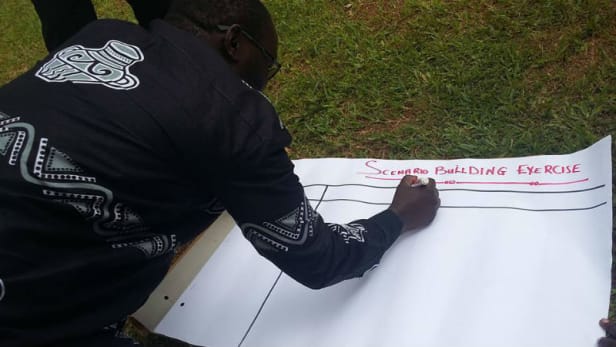
ActionAid Uganda leads a scenario building exercise. Photo by: ActionAid Uganda

The office raid appears to be part of a wider crackdown on legitimate protests against the plan to remove the presidential age limit from the Ugandan Constitution, thus allowing the current president to remain in power indefinitely.

We think these attacks have ulterior motives.

1. To delegitimize civil society. Police raids on our offices immediately present us as subversive elements. This could affect our public image, and that of civil society in general. It could also scare away our funding partners and threaten the stability of our work.

2. To compromise our systems and information. These attacks disrupt our work, and potentially sow seeds for future surveillance by targeting our communications systems and infrastructure.

3. To disrupt and derail us from our mission. Part of our mission as civil society is to help articulate public positions. We are opposed to regressive constitutional amendments. We will invest in organizing citizens to resist attempts to remove the age-limit, even though we know this puts us in direct conflict with the ruling party.

4. To threaten and demoralize civil society. In the hopes of driving us into self-censorship, weakening our resolve, and preventing us from tackling injustice.

5. To provide a justification for further action. Such as halting activities of civil society under the pretext that investigations are still ongoing. We have already seen this happening in the case of ActionAid, where two field activities have been halted by the police.

What can we learn from these attacks and what should civil society do to defend ourselves in ongoing efforts to protect civic space? How can we ensure that we are not derailed in our mission to tackle injustice and poverty?

Here are some tips if your office is at risk of being raided.

1. Always keep your house in order. You must update and back up all institutional information and documentation. During the impromptu siege, the police demanded documents without delay. If we had failed to do so, it may have caused unnecessary suspicion.

2. Staff and board members must understand all processes in the organization. If interrogated, we do not want colleagues to inadvertently arouse suspicion by saying inconsistent things about how we organize ourselves and what our business processes are.

3. Rapid legal response is necessary. As civic and political space continues to shrink in Uganda and globally, we must strengthen our legal response capabilities. The presence of competent lawyers is extremely important.

4. A positive relationship with the media is essential. The media were very helpful in reporting the siege — and established relations meant they did so in a manner that was both supportive and objective. Social media platforms were of increased importance during this crisis, and future investment here is key.

5. Being relevant to civil society and wider citizens’ struggles. The immense show of solidarity from other civil society organizations, politicians, and the public at our time of need demonstrated our value and relevance to civil society. The more outward looking an NGO, the more likely it is to receive much-needed solidarity from others. We were able to call upon our supporters both in Uganda and across the world to amplify our voice and provide solidarity.

6. Beware of potential informers. Finally, we have learned that the forces that seek to undermine our work are in our midst. It is therefore important to better understand our internal environment and partners with whom we work. We must remain vigilant and transparent and have the confidence to defend what we stand for.

The threat to civil society is far-reaching. We must learn from these attacks and work together to protect and defend the legitimacy and effectiveness of the work that we do.

196935scr
Arthur Larok is the current country director of ActionAid Uganda. He has previously worked with the Uganda National NGO Forum, the Forum for Education NGOs in Uganda and World Learning for International Development. He is the current chairperson of the Uganda National NGO Forum, the largest NGO platform in Uganda.

Sources:

Opinion: Our offices were raided in Uganda. Here’s what to do if yours are, too. | Devex
http://allafrica.com/stories/201710090056.html

“Breaking the Silence” received Danish Poul Lauritzen award

March 2, 2017

The banquet hall at the National Museum in Copenhagen played host to the presentation of the PL Foundation Freedom Award on 12 December 2016, an annual prize given in honour of a Danish resistance fighter that recognises the exercise of human rights in an extraordinary manner. The winner was Breaking the Silence, an Israeli organisation that collects and shares testimonies (some anonymous) from soldiers who have served in the West Bank and Gaza – over a thousand at the last count. “Breaking the Silence shows great personal courage to talk about their own experience in the West Bank” commented the PL Foundation, named after the Danish resistance fighter Poul Lauritzen. Previous winners include Turkish publisher Ragıp Zarakolu and Turkish playwright Ali Tuygan. One of Breaking the Silence’s co founders, Yehuda Shaul, 33, along with spokesperson Achiya Schatz, appeared in person to receive the award, which included a prize of 100,000 kroner, from Poul Søgaard, a leading judge at the Supreme Court.

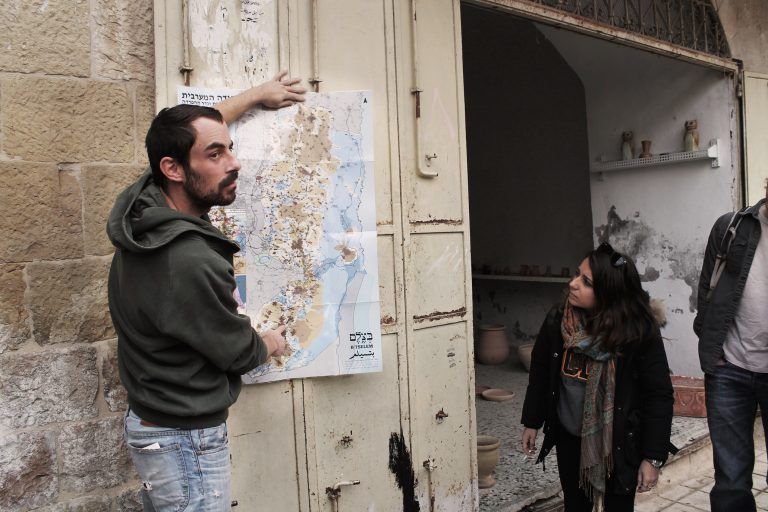
Founded in 2004, Breaking the Silence initially published the testimonies of the soldiers in an art gallery in Tel Aviv. Today, it publishes them in booklets and articles and shares them in lectures and guided tours of cities like Hebron in the West Bank.

israel1
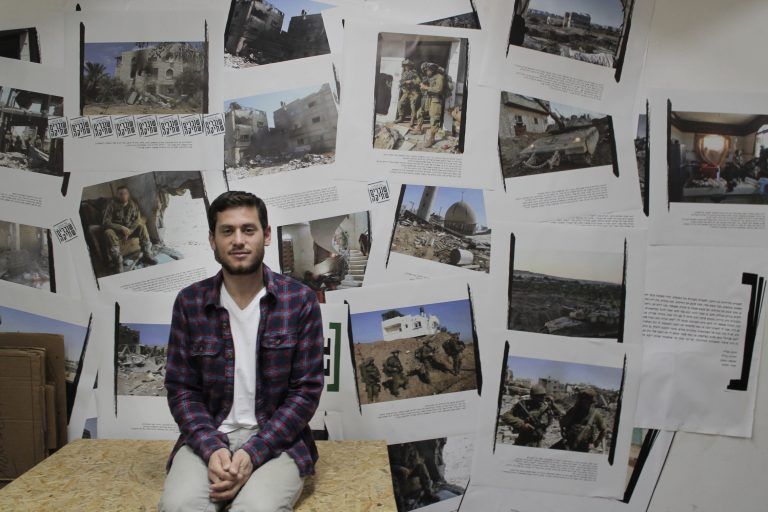
Achiya Schatz in front of the testimonies at the Breaking the Silence office in Tel Aviv. (all photos: Cornelia Mikaelsson)

Banned by the Israeli authorities from speaking to soldiers or schoolchildren, Breaking the Silence has been accused of spreading mistruths and of betraying the Israeli military. Threats are an occupational hazard. “To remain silent is no longer an option,” explains Achiya Schatz, 31, who did his national service in the Israeli army from 2005-08. Schatz recalls that many of his missions to search Palestinian residences were pointless – commanding officers would throw away the gathered intelligence without reading it. “After completing my service I got time to think. One question led to another and all of a sudden I asked myself: how can you ever occupy morally?”
Over half of Breaking the Silence’s funding comes from abroad (7 million kroner in 2014 alone) and one of its biggest supporters is Danish – Dan Church Aid, the humanitarian NGO. And this has led to extra suspicion in Israel. Earlier this year, the Israeli government passed a transparency bill forcing NGOs that receive more than half of their funding from foreign sources to declare them openly. Those who voted for the bill claimed that it served a democratic purpose. Critics, however, argued that it only was an attempt to target NGOs critical of Israel’s governmental policies. Israeli PM Benjamin Netanyahu wrote a statement on his Facebook page, claiming that the bill aims to “prevent an absurd situation, in which foreign states meddle in Israel’s internal affairs by funding NGOs, without the Israeli public being aware of it”. [see also: https://humanrightsdefenders.blog/2016/01/05/michael-sfardjan-israels-human-rights-activists-arent-traitors/]

israel3
Ido Even-Paz, one of the guides on the Breaking the Silence tour of Hebron

Source: Former Israeli soldiers pick up Danish freedom award in Copenhagen – The Post

UN rapporteurs urge India to repeal law restricting human rights defenders access to foreign funding

June 17, 2016

While most attention on the issue of foreign funding of NGOs has gone to Russia, which for this purpose invented the ‘foreign agent’ law, [https://thoolen.wordpress.com/tag/foreign-agent-law/], another big country – India – has been stepping up its own version through a law restricting civil society access to foreign funding:

UN Special Rapporteur on the situation of human rights defenders Michel Forst. Photo: MINUSTAH

On 16 June 2016 three United Nations rapporteurs on human rights called on the Government of India to repeal a regulation that has been increasingly used to obstruct civil society’s access to foreign funding. The experts’ call comes as the Indian Ministry of Home Affairs suspended for six months the registration of the non-governmental organization Lawyers Collective, under the Foreign Contribution Regulation Act (FCRA), according to a news release from the Office of the UN High Commissioner for Human Rights (OHCHR) in Geneva. [see also my post form 2013: https://thoolen.wordpress.com/2013/11/05/india-should-end-funding-restraints-on-human-rights-defenders-says-hrw/]

The suspension was imposed on the basis of allegations that its founders, human rights lawyers Indira Jaising and Anand Grover, violated the act provisions by using foreign funding for purposes other than intended.

We are alarmed that FCRA provisions are being used more and more to silence organisations involved in advocating civil, political, economic, social, environmental or cultural priorities, which may differ from those backed by the Government,” said UN Special Rapporteurs on human rights defenders, Michel Forst, on freedom of expression, David Kaye, and on freedom of association, Maina Kiai.

Despite detailed evidence provided by the non-governmental organization (NGO) to rebut all allegations and prove that all foreign contributions were spent and accounted for in line with FCRA, the suspension was still applied. “We are alarmed by reports that the suspension was politically motivated and was aimed at intimidating, delegitimising and silencing Lawyers Collective for their litigation and criticism of the Government’s policies,” the experts said noting that the NGO is known for its public interest litigation and advocacy in defence of the most vulnerable and marginalised members of Indian society.

Many civil society organizations in India now depend on FCRA accreditation to receive foreign funding, which is critical to their operations assisting millions of Indians in pursuing their political, cultural, economic and social rights. The ability to access foreign funding is vital to human rights work and is an integral part of the right to freedom of association. However, FCRA’s broad and vague terms such as ‘political nature’, ‘economic interest of the State’ or ‘public interest’ are overly broad, do not conform to a prescribed aim, and are not a proportionate responses to the purported goal of the restriction.

Human rights defenders and civil society must have the ability to do their important job without being subjected to increased limitations on their access to foreign funding and the undue suspension of their registration on the basis of burdensome administrative requirements imposed to those organizations in receipt of foreign funds,” the UN human rights experts concluded.

Source: United Nations News Centre – UN rights experts urge India to repeal law restricting civil society access to foreign funding

Asia and human rights defenders: the shrinking space for NGOs

May 26, 2015

In a few recent posts I drew attention to the trend of shrinking space for NGOs in countries such as Russia, Kyrgyzstan and Cambodia [https://thoolen.wordpress.com/2015/05/21/draft-laws-on-civil-society-restrictions-also-pending-in-kyrgyzstan-and-cambodia/]. On 9 May 2015, The Economist’s column on Asia (Banyan) was devoted to the same issue, concluding that “Democratic Asian governments as well as authoritarian ones crack down on NGOs“. Under title “Who’s afraid of the activists?” it mentions China, Cambodia, India, Pakistan, Sri Lanka, Bangladesh, Kyrgyzstan and Tajikistan.

It lists the usual ‘complaints’ that both authoritarian and democratic leaders use against the activities of NGOs, which range from:

  • threats to national sovereignty
  • promotion of ‘Western’ values
  • hidden agenda (such as conversion to Christianity)
  • blocking development through environmental objections.

E.g. the Indian home ministry claims that 13 billion $ in foreign money has gone to local charities over the past decade and that 13 of the top 15 donors were Christian outfits. Interestingly, similar complaints come from the biggest Indian NGO, Rashtriya Swayamsevak Sangh (RSS), which itself has “strong foreign links, draws on an Indian diaspora in America and elsewhere for support, and dishes out help across borders, such as in Nepal following last month’s earthquake”.

Quite rightly the article concludes that in the long run, such limitations only rally political opponents, while (local) NGOs may face close scrutiny themselves one day (when the Government has changed hands): “Battering-rams, after all, have two ends.”

Who’s afraid of the activists? | The Economist.

Human Rights First annual summit on 9-10 December 2014

October 28, 2014


HRF logo organises on 9-10 December 2014 its annual Human Rights Forum. It takes place in the Newseum in Washington DC, USA. Several panels are of direct relevance to human rights defenders, such as:

  • Show Them the Money: What are the Lifelines for Civil Society in a Sea of Restrictions? More and more governments – and not only authoritarian ones – are finding ways to close the space for independent civil society groups, especially those critical of government policies.  As part of this effort, governments have developed sophisticated methods to undermine the credibility of international –especially American – support for local human rights and democracy organizations. Russia and Egypt are leading the way; each has passed laws restricting access by independent civil society groups to foreign funding, which is essential to their existence. How should the U.S. government and other donors respond to these coordinated efforts to restrict human rights and democracy activists? Given the legal landscape, is foreign funding for NGOs even possible anymore?
  • Progress and Backlash in the Global Struggle for LGBT Equality Human rights advocates often describe achieving full equality for LGBT people as the next chapter in the struggle for universal human rights.  For many years, this movement appeared to be one of steady gains, but we are now facing a moment of profound backlash.  LGBT citizens of Russia, India, and Nigeria have seen a sharp curtailment of their rights. In many cases, this is part of a larger attack on civil society, marked by laws and policies aimed at limiting freedom of expression, freedom of association, and other basic rights.  The countries in question may see themselves as in conflict with the West and its values; support for such laws is often driven by anti-Western sentiment.  How can the United States respond to this development in ways that will improve the lives of LGBT people worldwide?
  • NGOs as the Enemy Within? Human rights defenders face particular challenges when their societies mobilize for war.  In such circumstances, questioning government policies can be characterized as disloyalty or siding with the enemy.  Human rights defenders become targets of defamation, persecution, and violence.  The universal values they are seeking to uphold are themselves called into question and undermined. Does the U.S. government have a role in preserving the rights of activists espousing what may be deeply unpopular points of view in times of public fear and conflict?


For more information and to enroll: http://www.humanrightsfirst.org/event/human-rights-summit

Russia’s Human Rights Defenders continue the struggle against foreign agents law and other repression

September 11, 2014

I have posted extensively on the ‘foreign agents” law in Russia (and a few other countries that got inspired by this bad example) [see: https://thoolen.wordpress.com/tag/foreign-agent/] and the article below in the Moscow Times is an excellent piece that sums up the current repression AND the resilience of the human rights defenders. Election-monitoring watchdog Golos won a rare victory among Russian NGOs on Tuesday 9 September when a Moscow court ruled it should not after all be labeled a “foreign agent.” But rights activists warn that the battle against the “foreign agents” label is only the tip of the iceberg in a far broader pressure campaign being waged by the authorities. Read the rest of this entry »

UN expert group on business and human rights on timely visit to Azerbaijan

August 18, 2014

In relation to my post this morning about the hot summer in Azerbaijan [https://thoolen.wordpress.com/2014/08/18/azerbaijan-a-hot-summer-in-summary/] it is relevant to note that the UN expert group on business and human rights is visiting this country for the first time. The information provided by the different NGOs clearly points to a huge problem in preventing and protecting against business-related human rights abuses.


The United Nations group of independent experts undertakes its first official visit to Azerbaijan from 18 to 27 August 2014 to examine the impact of business activities on human rights in the country. [The UN Guiding Principles on Business and Human Rights, unanimously endorsed by the UN Human Rights Council in 2011, offer clarity and guidance for authorities and companies to prevent and address adverse impacts of business activities on human rights. They re-affirm States’ existing obligations to protect against human rights abuse by third parties, including businesses. They also clarify the corporate responsibility to respect human rights, and the need to ensure that victims have access to effective remedy.]

They group will hold a press conference to share with the media preliminary observations from their visit at 13h30 on Wednesday 27 August 2014 at UN House, UN 50th Anniversary Street 3, Baku. The official report is to be presented to the Human Rights Council in June 2015.

(The Working Group on the issue of human rights and transnational corporations and other business enterprises was established by the UN Human Rights Council in June 2011. The five members are Mr. Michael Addo (Ghana), Ms. Alexandra Guáqueta (Colombia), Ms. Margaret Jungk (USA), Mr. Puvan Selvanathan (Malaysia) and Mr. Pavel Sulyandziga (Russian Federation). The Working Group is independent from any government or organization. Its members serve in their personal capacities. They are not UN staff members and do not receive a salary for their work.)

See: http://www.ohchr.org/EN/Issues/Business/Pages/WGHRandtransnationalcorporationsandotherbusiness.aspx


Bangladesh also to use funding controls to restrict human right defenders

June 14, 2014

Bangladesh is trying to restrict human rights defenders such as Adilur of the NGO ODHIKAR, final nominee of the MEA 2014. The cabinet has approved the “Foreign Donations (Voluntary Activities) Regulations Bill, 2014”, which will likely become law soon. The Bill empowers bureaucrats to decide the fate of NGOs. All individuals or collectives, from NGO’s to volunteer groups, receiving foreign funds for implementing projects will be under constant surveillance under this law.

In a statement of 13 June the Asian Legal Resource Centre says that the law will usher even more arbitrary executive actions in Bangladesh. Read the rest of this entry »

Russia’s export promotion to Armenia includes the foreign agents law

June 4, 2014

In TransConflict of 4 June 2014, Edgar Khachatryan writes a thoughtful piece on the “foreign agents” law and especially how Russia tries to expert this tool to silence human rights defenders to other countries, such as Armenia. 

I am sure that Russia should declare its presence in the information sphere of Armenia more actively. There is no doubt about it. However, other methods should be used to neutralize the NGOs which stick a wedge in the Armenian-Russian relations. By the way, Russia has adopted a law which clearly defines the activities of NGOs” – announced Russian ambassador to Armenia, Ivan Volinkin. Earlier this year, on 12 April, the same Volinkin announced in Yerevan that Russia will halt any attempts at aggressive intervention of third parties in the domestic affairs of its friendly states “in an effort to instil ideas alien to their mind soul”.

After briefly analyzing the Russian law and its application (at least 3 NGOs have already been affected: ‘Women of the Don’ ‘Memorial Anti-Discrimination Centre’ and the ‘Center for Social Policy and Gender Studies’), the author draws the conclusion that it is clear what effective interference the Russian Ambassador to Armenia is referring to. There is no doubt that human rights, democracy and peacebuilding seem alien and dangerous to the Russian authorities. By presenting the activities of human rights defenders as a betrayal of the nation and its values, the authorities are trying to silence those who think differently.

Ambassador Volinkin has called upon the Armenian authorities to use the ‘Russian experience’ in order to appease civil groups in Armenia. Moreover, the Ambassador warns that Russia itself will prevent the spread of such ‘alien’ ideologies in partner countries. A number of NGOs in Armenia qualified Volinkin’s announcements as a violation of accepted diplomatic norms and gross interference in the internal affairs of Armenia.

Claims made by NGOs the Armenian authorities to hold the Russian Ambassador to account fell on a deaf ear: the Ministry of Foreign Affairs announced that they do not see any validity to the claims. Thus, the threat that the civil groups opposed by the authorities will be silenced with the ‘power of law’ is becoming more tangible. The phrase “keep silent or confess that you are a foreign agent!” may soon become an acceptable idea in Armenia too.

Edgar Khachatryan is the director of Peace Dialogue, a member of the Global Coalition for Conflict Transformation.

Russia – keep silent or confess that you are a foreign agent | TransConflict.

For older posts on the foreign agents issue: https://thoolen.wordpress.com/tag/foreign-agent/

Defending human rights is increasingly dangerous activity in many parts of the world, states latest UN report

January 19, 2014

The most recent report by the UN Rapporteur on Human Rights Defenders, Margaret Sekaggya, has been made public and will be officially presented to the Human Rights Council in March 2014. It is the last report by this Rapporteur whose mandate will terminate. The report finds that human rights defenders – especially journalists, lawyers, trade unionists and those who work to promote women’s rights and the rights of gay, lesbian, bisexual and transgender persons – face ‘extraordinary risks’. It highlights cases of defamation, attacks, detention, torture and even killings. The report also documents an increased incidence of violations against people and communities opposed to mining, construction and development projects, with protesters attacked both by State and private security forces. Human rights defenders play a crucial role in exposing and seeking accountability for violations by both governments and corporations. Their work is crucial to transparency, good governance and justice for victims,’ commented Phil Lynch of the International Service for Human Rights in Geneva.ISHR-logo-colour-high

The report also documents the worsening ‘use of legislation in a number of countries to refrain the activities of human rights defenders and to criminalise them’, with cited examples including laws to ‘curb the promotion of homosexuality’ and to restrict NGO access to foreign funds. In the last four weeks alone, Nigeria, Russia, Uganda, Malaysia and the Ukraine have enacted or applied laws to criminalise human rights defenders and to silence their critical voice,’ Mr Lynch added.

In addition to documenting violations, the report makes a wide range of recommendations to ensure that human rights defenders are protected and can operate in a ‘safe and enabling environment.

For those too busy to read the whole new UN report [PDF]  here are the

V.    Conclusions and recommendations: Read the rest of this entry »