Over 50 NGOs have signed a joint letter to Aung San Suu Kyi requesting the immediate and unconditionally release of Wa Lone and Kyaw Soe Oo.
TO: Aung San Suu Kyi, State Counsellor, Myanmar
share information on human rights defenders, with special focus on human rights awards and laureates
Over 50 NGOs have signed a joint letter to Aung San Suu Kyi requesting the immediate and unconditionally release of Wa Lone and Kyaw Soe Oo.
TO: Aung San Suu Kyi, State Counsellor, Myanmar
On Monday 21 May 2018, the Lesotho High Court (sitting as a Constitutional Court), in a unanimous judgment declared the offence of criminal defamation unconstitutional with retrospective effect. The case of Basildon Peta v Minister of Law, Constitutional Affairs and Human Rights and 2 Others. The case was brought by Basildon Peta, the owner and publisher of the Lesotho Times. He was charged with the offence of criminal defamation after the Lesotho Times in 2016 published a satirical column (the Scrutator) relating to the then-Commander of the Lesotho Defence Force, Tlali Kamoli.
Section 104 of the Penal Code provides that a person who publishes defamatory matter concerning another person commits the offence of criminal defamation. Mr Peta submitted that the offence constituted an unjustifiable limitation of the right to freedom of expression. The Court in its judgment confirmed that the onus of proving that the impairment of a right was justified rests on the government. Of concern to the Court was the over breadth of the offence, with a charge being possible even if no person other than the complainant became aware of the supposedly defamatory statement, and with the offence further extending to defamation of deceased persons. The Court further held that the defence that a defamatory publication was for the public benefit was too vague and could lead, as in this instance, to cases where satirical comments are criminalised.
The Court held that criminalising defamation has a chilling effect on journalistic freedom of expression, resulting in self-censorship by journalists and a less informed public. The Court cited with approval calls by the African Commission and United Nations Special Rapporteur on Freedom of Expression which encouraged states to repeal criminal defamation laws. The Court’s judgment follows in the footsteps of other African courts, including the ECOWAS Court, the Zimbabwe Constitutional Court and the Kenya High Court, which recently declared that the offence of criminal defamation violated the right to freedom of expression.
“We commend the Lesotho Constitutional Court bench for its brave decision, which makes a significant contribution to freedom of expression jurisprudence in the region,” said Anneke Meerkotter, Litigation Director of the Southern Africa Litigation Centre. “We are concerned by the ongoing use of criminal defamation laws against journalists and human rights defenders and hope that this decision will also send a message to other governments to reform their laws.“
The judgment is available online at http://www.southernafricalitigationcentre.org/2018/02/13/lesotho-challenging-the-offence-of-criminal-defamation/
The Society of Publishers in Asia (SOPA) was established in 1982 to recognize and celebrate the highest standards of journalistic quality and integrity in Asia. Today, the SOPA Awards for Editorial Excellence are regarded as the gold standard against which Asia’s best journalists and publishers are measured. There are several categories and one of them is: Excellence in Human Rights Reporting, honoring the work that demonstrates high standards of reporting on a human rights topic of significance
The 2018 finalists include:
Reuters, Duterte’s war falters
The Associated Press, The Rohingya Exodus
The New York Times, A Humanitarian Crisis Unfolds
Frontier Myanmar, “We eat the same rice”
The Phnom Penh Post, The sky became white’
This Week In Asia, Rohingya: nowhere like home.
[The 2017 winners were:
https://www.sopawards.com/awards/award-categories/
https://frontiermyanmar.net/en/frontier-shortlisted-for-five-regional-media-awardshttps://frontiermyanmar.net/en/frontier-shortlisted-for-five-regional-media-awards
Reporters Without Borders (better known under its French acronym RSF) published its WORLD PRESS FREEDOM INDEX 2018. The rankings you can find by clicking here READ MORE. The regional chapters below give a quick overview of the main trends, including the disturbing downward turn in the USA, the further sinking in ex-sovjet states and China’s nefarious example in Asia.
North Africa’s performance in the 2018 World Press Freedom Index reflects the different pressures to which journalists are exposed. Restrictive laws, reporting problems (especially at protests), and subjects that are off limits all prevent journalists from being free to provide independently reported and pluralist news and information.
Despite having strong constitutional protections to the contrary, the latest World Press Freedom Index findings on the US and Canada reveal two countries whose journalists and media workers face constant challenges to the very freedom to exercise their profession.
The 2018 Index shows a slight overall improvement in respect for press freedom in Latin America but this should not divert attention from the continuing problems of violence, impunity, and authoritarian policies towards journalists in many Latin American countries.
The Chinese model of state-controlled news and information is being copied in other Asian countries, especially Vietnam and Cambodia. North Asia’s democracies are struggling to establish themselves as alternative models. Violence against journalists is increasingly worrying in Afghanistan, India, Pakistan and the Philippines.
SUB-SAHARAN AFRICA HAS MAINTAINED ITS THIRD PLACE IN THE RANKING BY GEOGRAPHICAL REGION, WITH A SLIGHTLY BETTER OVERALL INDICATOR THAN IN 2017. BUT THERE IS A WIDE RANGE OF SITUATIONS WITHIN THE REGION, AND JOURNALISTS ARE OFTEN THE VICTIMS OF INTIMIDATION, PHYSICAL VIOLENCE, AND ARREST.
THE FORMER SOVIET COUNTRIES AND TURKEY CONTINUE TO BE AT THE FOREFRONT OF THE WORLDWIDE DECLINE IN PRESS FREEDOM. ALMOST TWO-THIRDS OF THE REGION’S COUNTRIES ARE RANKED SOMEWHERE NEAR OR BELOW THE 150TH POSITION IN THE INDEX. THE REGION’S OVERALL INDICATOR HAS SUNK ALMOST AS LOW AS THAT OF MIDDLE EAST/NORTH AFRICA, THE REGION THAT IS LAST IN THE RANKING BY REGION.
The European model’s erosion, a trend visible in RSF’s most recent Indexes, has continued in the 2018 Index. The region has been shaken by two murders, as well as by threats to investigative reporters and unprecedented verbal attacks on the media. Even the countries at the top of the Index are affected by this alarming climate.
The Middle East’s countries are yet again at the bottom of RSF’s World Press Freedom Index. Armed conflicts, terrorism charges against independent journalists and media, and growing online surveillance and censorship make reporting extremely dangerous for the region’s journalists.
https://rsf.org/en/rsf-index-2018-hatred-journalism-threatens-democracies

The UN and AFP launched an award Thursday 22 March 2018 to honor journalists who risk their lives to cover human rights abuses in Mexico, in tribute to two celebrated reporters murdered last year. The Breach-Valdez Prize will honor journalists who follow in the footsteps of their slain colleagues Miroslava Breach and Javier Valdez, two of the more than 100 reporters murdered since 2000 in one of the world’s most dangerous countries for the press. (see also: https://humanrightsdefenders.blog/2018/01/05/front-lines-2017-report-confirms-worst-expectation-over-300-hrds-killed/)
Its aim is “to recognize the careers of Mexican journalists who have distinguished themselves in defending human rights,” said Giancarlo Summa, director of the United Nations Information Center in Mexico.
Valdez, an award-winning journalist who covered Mexico’s powerful drug cartels, was gunned down last May in broad daylight outside the offices of Riodoce, the newspaper he co-founded in Culiacan, the capital of his native Sinaloa state. He was also a long-time AFP collaborator.
Miroslava Breach, a correspondent for Mexican daily La Jornada in the state of Chihuahua, on the US border, was a celebrated investigative journalist known for hard-hitting reports on links between politicians and organized crime. She was shot dead in broad daylight last March as she drove her son to school.
The annual prize is also co-sponsored by UNESCO, the Ibero-American University and the French embassy in Mexico. The first edition will be awarded on May 3 in Mexico City. The winner will receive a grant and a trip to France to take part in a series of events on free speech.
(Breach and Valdez were among at least 11 journalists murdered in Mexico last year, making it the deadliest country in the world for the press after Syria, according to watchdog group Reporters Without Borders. The latest murder came just Wednesday, when journalist Leobardo Vazquez was gunned down outside his house in Veracruz state — the second killed in 2018.)
“There is no indication these crimes are going to stop. Let’s hope this prize will help all the country’s brave journalists keep up the fight,” Valdez’s widow, Griselda Triana, said at the launch of the award.
This is a national award. There are many awards for journalists and for freedom of expression at the international level, see: http://trueheroesfilms.org/thedigest/
https://www.yahoo.com/news/un-afp-launch-prize-honor-slain-mexican-journalists-034757524.html

“Ramon’s release from prison is a testament of the power of collective work of hundreds of artists, concerned citizens, and NGOs,” said Tutu Alicante, director of EG Justice, which promotes human rights in Equatorial Guinea. “But we must not forget that dozens of government opponents who are not as fortunate fill Equatorial Guinea’s jails; thus, the fight against human rights violations and impunity must continue.”
(The human rights groups are Amnesty International, Arterial Network, Association of American Editorial Cartoonists, Asociación Profesional de Ilustradores de Madrid, Cartoonists Rights Network International, Cartooning for Peace, Committee to Protect Journalists, Caoilfhionn Gallagher QC, Jonathan Price and Paul Mason, Doughty Street Chambers, UK, EG Justice, FIDH, within the framework of the Observatory for the Protection of Human Rights Defenders, Freemuse, Human Rights Watch, Index on Censorship, PEN America, PEN International, Reporters without Borders, Swiss Foundation Cartooning for Peace, World Organisation Against Torture (OMCT), within the framework of the Observatory for the Protection of Human Rights Defenders.)
(see also: https://humanrightsdefenders.blog/tag/cartooning-for-peace-award/)
https://pen.org/press-release/equatorial-guinea-artist-freed-prison/

A Vietnamese human rights defender and blogger – now under house arrest – says she will not travel outside the country to receive a human rights award in March, vowing instead to remain in Vietnam to work for change in the one-party communist state. Pham Doang Trang, author of a recently published book on political engagement that has angered Vietnamese authorities, wrote on Wednesday on her Facebook page that she will not attempt to go abroad to receive her prize, according to Radio Free Asia on 28 February 2018.
“I haven’t gone abroad and don’t plan to, not even for a few days to receive the Homo Homini Prize in the Czech Republic on March 5,” Trang said. “I will never leave Vietnam until Vietnam has changed.” “When one is like a fish that has been born in a dirty and polluted pond, one can either find one’s way to a nicer and cleaner pond nearby or to the vast ocean, or one can try to change one’s own pond to make it beautiful, breathable, and worth living in,” Trang said. “I choose this second option”.
[Trang received the 2017 Homo Homini Award from People in Need, an international human rights organization based in the Czech Republic. See : http://trueheroesfilms.org/thedigest/awards/homo-homini-award]
https://www.rfa.org/english/news/vietnam/change-02282018145831.html
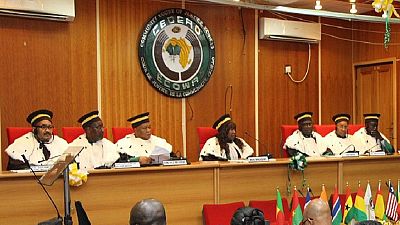
On 14 February 2018 the Economic Community of West African States (ECOWAS) Regional Court of Justice found that Jammeh-era media laws violated the right to freedom of expression in The Gambia. The Federation of African Journalists and four Gambian journalists filed a case in the court in December 2015. They argued that their rights, including their rights to freedom of expression, had been violated by Gambia through the enforcement of laws criminalising libel, sedition and false news in the country. Two of the journalists were also subject to torture whilst in the custody of the then notorious National Intelligence Agency following their arrests under these laws.
Arguments were heard by the court in October 2016. The case was supported by the Media Legal Defence Initiative (MLDI). Amnesty International filed an amicus brief in the case along with other freedom of expression organisations. Although press freedom has improved under the new government of President Barrow, who was inaugurated in January 2017, these restrictive laws are still in place.
The ruling will set an important precedent as many countries within West Africa continue to use similar repressive laws to silence freedom of expression, and hinder the vital work of journalists, in violation of international and regional human rights law. The ball is now in the court of the Adama Barrow government to repeal the said laws in order to realign the law to respect media freedoms. Amnesty International’s West Africa researcher has hailed the ruling as a historic day for The Gambian media landscape. “Today is an historic day for Gambia’s journalists and human rights defenders who, for decades, have suffered torture, imprisonment or exile just for exercising their right to freedom of expression,”Sabrina Mahtani said.
Having just blogged about the annual report of HRW and AI USA (see links below), I hasten to say that there are several other annual reports referring to President Trump’s damaging effect on human rights and democracy. Freedom House, for instance, issued its annual report 2017 which pointed out that Trump’s penchant for attacking civil society groups, the media, and even the courts have a tangible, negative impact, stating that, “the administration’s statements and actions could ultimately leave them weakened, with serious consequences for the health of U.S. democracy and America’s role in the world.” The report noted that under Trump, the United States has seen the sharpest drop in political rights and civil liberties in over 40 years.
and https://humanrightsdefenders.blog/2018/01/19/ai-welcomes-resistance-to-trumps-human-rights-policies/
——
https://freedomhouse.org/report/freedom-world/freedom-world-2017

https://asiancorrespondent.com/2017/12/singapore-human-rights-watch-repression/#CZ3VvbvQq6iQymK5.97

