Posts Tagged ‘FIDH’
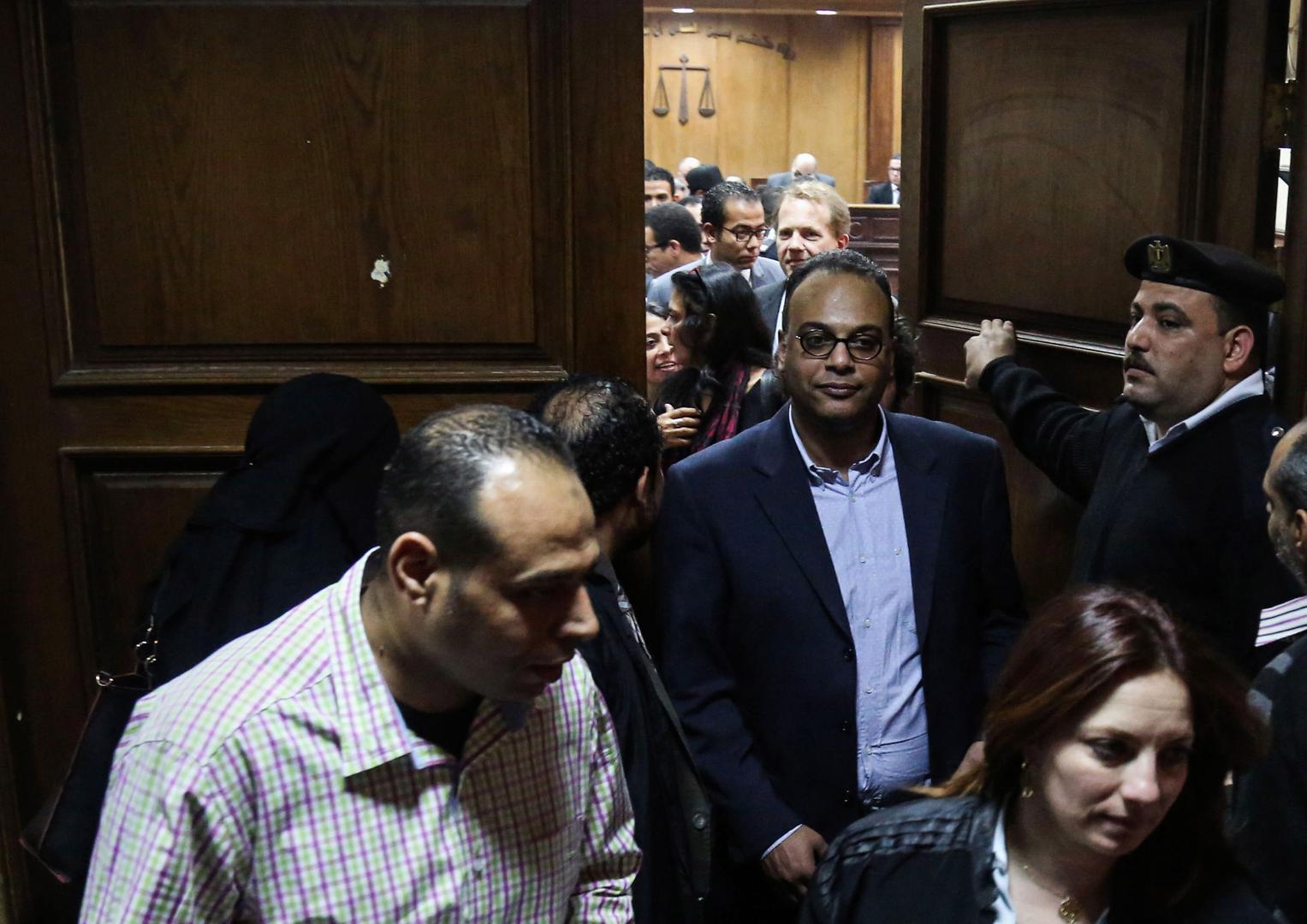
Egypt: crackdown and new NGO law dont augur well
July 25, 2019FIDH dares to publish a report on ‘key human rights issues of concern’ in Kashmir
March 17, 2019On 15 March 2019 the International Federation for Human Rights and its partner organizations Association of Parents of Disappeared Persons (APDP) and Jammu Kashmir Coalition of Civil Society (JKCCS) published a briefing note detailing key human rights issues of concern in Indian-administered Jammu & Kashmir. I use the term dare in the title as wading in to the issue of Jammu and Kashmir is always tricky and leads to furious reactions from governments and media.
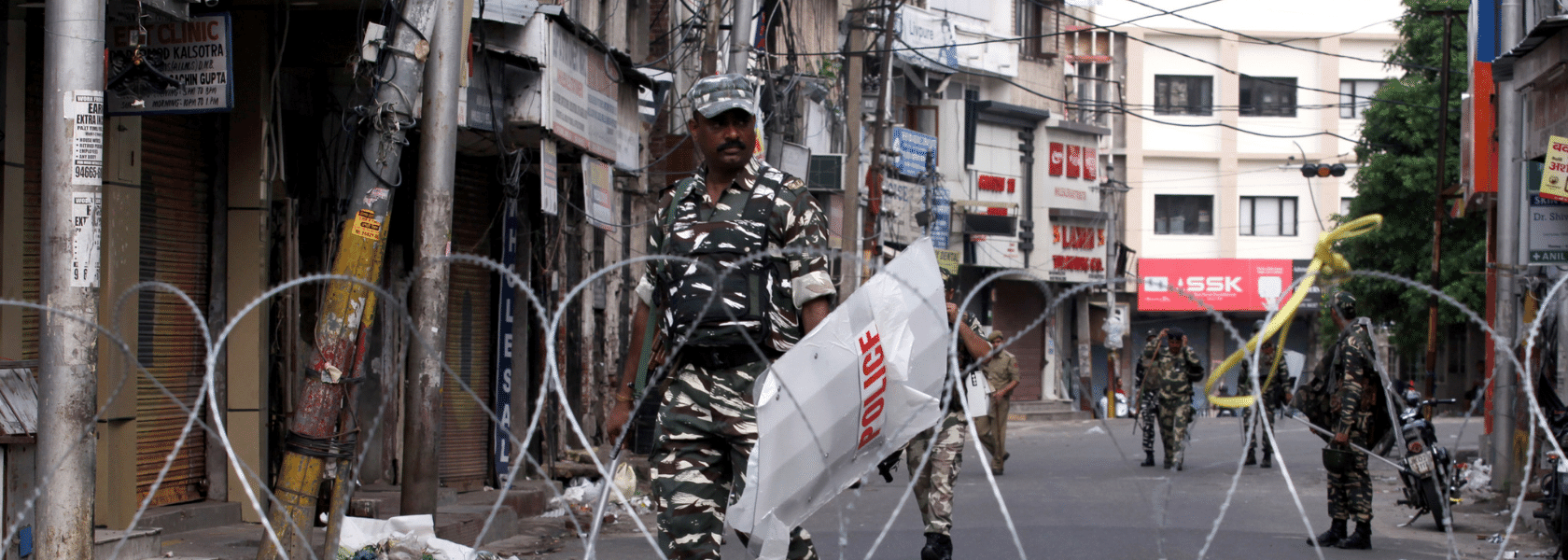
Human rights violations began to be formally reported in Indian-administered Jammu & Kashmir in 1990 in the midst of counter-insurgency operations by the Indian Army to contain an armed struggle against Indian rule. These military operations were marked by excessive and disproportionate use of force. Since 1990, more than 70,000 people have been killed, more than 8,000 have been subjected to enforced disappearances, several thousands have been arrested and detained under repressive laws, and torture and other acts of inhuman and degrading treatment against protestors and detainees have been routinely used by Indian security forces.

ILLUSTRATION: MIR SUHAIL QADRI.
The NGOs have demanded full and unfettered access to Jammu & Kashmir to UN bodies and representatives, foreign and domestic human rights organizations, and foreign and local journalists. The groups also called for establishing a Commission of Inquiry to investigate allegations of all human rights violations perpetrated in Jammu & Kashmir, as recommended in the report by the UN Office of the High Commissioner for Human Rights (OHCHR) and the establishment of a mechanism to monitor the human rights situation in Jammu & Kashmir through diplomatic missions in New Delhi and Islamabad.
The note details “continuing crime of enforced disappearance, extrajudicial killings, torture used as punitive action, systematic impunity for grave crimes, use of arbitrary and administrative detentions to curb dissent, military operations threatening human rights, rights to freedoms of expression, freedom of association, and freedom of religion or belief being curbed, human rights defenders under threat, sexual violence used a tool of repressions, lack of safeguards continue to place children in danger,” among other crimes.
FIDH collected Russia’s 50 anti-democracy laws
March 18, 2018Since re-election in 2012, the Russian president has overseen the creation of 50 laws designed to strangle opposition voices and raise the level of fear and self-censorship in society. FIDH with its Russian member organizations released a table of the latest 50 new anti-democracy laws since 2012. It explains the impact of each of them on the fundamental freedoms of Russian citizens, cutting down every day a little bit more the free exchanges with the outside world. It also provides some, far from exhaustive examples of the legal abuses it provokes in the every day life of citizens.
Not only the present but also the past gets filtered and controlled.
The laws and regulations range from increased surveillance and censorship powers, to laws banning “questioning the integrity of the Russian nation” – effectively banning criticism of Russia’s presence in Eastern Ukraine and the Crimea – broad laws on “extremism” that grant authorities powers to crack down on political and religious freedom, to imposing certain views on Russian history forbidding to think differently.
Bahrain: human rights protected but on paper only
March 12, 2018“The use of the judiciary in Bahrain to target human rights defenders and other activists” is a side event organised by CIVICUS and FIDH in co-operation with Americans for Human Rights & Democracy in Bahrain (ADHRB), the Gulf Centre for Human Rights (GCHR) and co-sponsored by ISHR.
It will take place on 13 March 2018 at 11:00 to 12:30 at Room XXIV. The event will address the politicisation of the judiciary to criminalise human rights defenders.
The context in which this event takes place should be well-known by now [see e.g. https://humanrightsdefenders.blog/tag/bahrain/], but some recent events can be added:
On 21 February human rights defender Nabeel Rajab, BCHR President and FIDH Deputy Secretary General, was sentenced to 5 years in prison under trumped-up charges in relation to tweets denouncing the torture against detainees at Jaw prison and exposing the killing of civilians in Yemen by the Saudi-led coalition. “This surrealistic verdict”, writes IFEX, “after a trial that was by itself a mockery of justice, illustrates once again the current crackdown on any dissenting voice in Bahrain, where scores of critics are currently jailed’.
Also the Observatory (FIDH-OMCT) and BCHR reiterate their call to the Bahraini authorities to immediately release him, as well as all detained human rights defenders.
Perhaps the most damning information comes from the Bahraini Government itself (8 March 2018) when it responded to the statement of the UN High Commissioner for Human Rights which had been ‘negative’ in his written review on the annual report on Bahrain. Dr. Yusuf Abdulkarim Bucheeri, Permanent Representative to the United Nations Office in Geneva, said in a statement that the review contained inaccurate information such as harassment of human rights defenders and other deleterious comments on the recent legal actions taken by Bahrain. ..They deliberately and unfairly side with malicious elements who have suspicious political agendas and sectarian tendencies and who want to inflict harm on the Kingdom of Bahrain and demean its achievements in the field of human rights, he said. “This is crystal clear from their support for the discourse of hatred and internal violence groups and for this reason, the Kingdom of Bahrain totally rejects the content of this statement with all the wrong and unacceptable descriptions it has given to the state.”
Bucheeri said that Bahrain’s constitution stipulates the right to freedom of opinion and expression in an unquestionable manner and in a way that guarantees everyone’s right to express their opinion and disseminate it by word, writing or otherwise, but within the legal framework and without inciting division or sectarianism or undermining national security.
……
He called on the Office of the High Commissioner for Human Rights to make concerted effort to understand the reality of human rights and the great challenges facing the Kingdom of Bahrain which faces terrorist acts aimed to destabilize its security and stability.
The kingdom, he explained, confronts a phenomenon of violent extremism and it is the duty of the Office of the High Commissioner to do its best to double check the credibility of the information it obtained and to seek such information only from neutral, objective and non-politicized sources…
https://www.ifex.org/bahrain/2018/02/22/nabeel-rajab-sentenced/
https://www.ifex.org/middle_east_north_africa/2018/03/05/revolutionary-anniversaries/
http://www.bna.bh/portal/en/news/829935
https://www.frontlinedefenders.org/en/case/case-history-nabeel-rajab
FIDH looks back at 2017 with its annual comic strip
February 1, 2018On 30 January 2018, FIDH publishes the comic strip version of its Annual Report created by graphic artist Romain Ronzeau and the graphic artists from Cartooning for Peace. Illustrating some of the victories and battles of 2017, the artists eloquently convey the essential: in times of crises, defending human rights is more necessary than ever. [for last year’s see: https://humanrightsdefenders.blog/2017/03/28/fidh-looks-back-at-2016-in-comic-strip/]. Good to see that the tradition is being kept up!
On the occasion of the comic strip Annual Report’s release, FIDH reaffirms its support for all graphic artists and caricaturists who are subjected to threats and attacks on a daily basis.
for the full version see: https://www.fidh.org/en/impacts/fidh-looks-back-at-2017-in-our-traditional-comic-strip
Antoine Bernard, former head of FIDH, joins Reporters Without Borders (RSF)
November 18, 2017
Bernard, 51, will help RSF secretary-general and director-general Christophe Deloire to consolidate and develop RSF’s work of defending journalistic freedom and independence at a time of great dangers for journalists.
Bernard said: “In a world dominated by opaqueness, propaganda and impunity for the powerful, journalism is in danger and, with it, human rights and democracy. RSF is waging a fight that is absolutely essential and Christophe Deloire has managed to put RSF at the international forefront of the defence of the freedom to inform and the protection of journalists. I am honoured to join Christophe and his team.”
[The past five years have seen very rapid growth in RSF’s activities and influence and enhancement of its image. It has launched major campaigns at the UN and in the field, reinforced and professionalized its headquarters in Paris, doubled its personnel worldwide, developed its bureaux in Washington and Tunis, and created new bureaux in Rio de Janeiro, London and Taiwan. It plans to open two new bureaux in 2018, one in San Francisco and one in Africa.]
https://rsf.org/en/news/former-head-fidh-appointed-rsf-deputy-director-general
Antoine Bernard has left FIDH after 26 years
October 12, 2017For those of you (like me) who missed the rather sudden departure of Antoine Bernard as head of the FIDH (International Federation for Human Rights), here is the 12 September statement called “Farewell Antoine” as seen on the FIDH website:
“Antoine Bernard is stepping down as Chief Executive Officer of the FIDH International Secretariat on September 15 after serving the organisation for 26 years. Antoine established and steered the International Secretariat, playing a fundamental role in the development and expansion of FIDH. Under his guidance, the organisation engaged in innovative and pioneering operations in the world of defending human rights.
The numerous victories he contributed to include the 1998 adoption of the United Nations Declaration on Human Rights Defenders; the 2002 establishment of the International Criminal Court (ICC) and the mobilisation that led to the ICC sentencing of Jean-Pierre Bemba in 2016, which was the first verdict to recognise rape as a crime against humanity and to hold those effectively in command responsible; the identifying of corporate responsibility on the part of economic players and their criminal prosecution as well as dialogue with some companies to encourage them to develop and assume their social responsibility; lastly, his work at FIDH, including in recent months, to usher in digital communication, to counter attacks aimed at delegitimising human rights, to organise the decentralisation of our organisation and to create transparent and faithful partnerships. FIDH is immensely grateful to Antoine for his tireless optimism, his audacity and tenacity, and the passion that he has for our organisation, serving and supporting FIDH member organisations and their defenders.
He is an iconic figure in the worldwide human rights movement. He embodies the patience that is needed for universal, steadfast commitment to practical and concrete progress, as well as a single-minded pursuit of justice and the audacity that this requires.
Following the departure of Antoine, a transition management team is being set up headed by Juliane Falloux, FIDH Executive Director.”
Source: Farewell Antoine
FIDH wants to recruit a Programme Officer for West and South Asia
April 11, 2017The International Federation for Human Rights (FIDH) is seeking a Program Officer, covering West and South Asia (Iran, Afghanistan, Pakistan, India, and Bangladesh). Although based in Paris, working under the responsibility of the Director of Operations, the Programme Officer comes under the supervision of the Head of Asia Desk (who is based in Bangkok, Thailand). Reference: CP-ASIE-04-17
EXPERIENCE
Minimum of 3 years work experience in the field of human rights (preferably for a national, regional and/or international NGO).
In-depth understanding of the human rights, political, social, and economic context in West and South Asia.
Familiarity with UN human rights standards and mechanisms.
COMPETENCE AND SKILLS
A university degree in a relevant field, such as political science, international relations, or human rights law.
Excellent writing skills and attention to details.
Fluency in oral and written English; basic knowledge of French desirable.
Ability to work as part of a team and independently, be rigorous, able to prioritize, and work under pressure and multiple deadlines.
TERMS AND CONDITIONS OF EMPLOYMENT
Gross monthly income: From EUR 2,500 per month (over 13 months), depending on experience. Possibility of recruitment at a different level based on a different job profile.
Source: Program Officer, covering West and South Asia (reference: CP-ASIE-04-17)
Universal Jurisdiction gathers momentum says group of NGOs
March 31, 2017After my post on Civitas Maxima [https://humanrightsdefenders.blog/2017/03/21/new-magazine-global-geneva-puts-civitas-maxima-in-the-limelight/] I feel that I should complete the picture with a reference to “Make Way for Justice #3” which argues that universal jurisdiction has gathered unprecedented momentum in 2016. In this annual report, ECCHR and its partners FIBGAR, FIDH, REDRESS and TRIAL International look back on its application through 47 recent cases. Five years of conflict, hundreds of thousands of dead. In Syria, large-scale war crimes are committed in all impunity. Effective prosecution has been repeatedly impeded at the international level, yet justice has found a way forward: universal jurisdiction. Thanks to this principle, States can prosecute criminals regardless of their nationality or where the crime was committed. The interest of such procedures for lawless regions is obvious.
2016 alone, five States have brought charges for alleged crimes in Syria. Investigations are ongoing in three others. For victims, these proceedings may be their only chance to obtain justice. Universal jurisdiction has proved a significant tool against impunity in Syria, but it also applies to many more situations: Rwanda, Nepal, Guatemala and Iraq, to name but a few.
To illustrate this breadth, ECCHR, FIBGAR, FIDH, REDRESS and TRIAL International released their annual report on universal jurisdiction, Make way for Justice #3. In 2016 alone, 13 States have made use of this principle in 47 cases – an unprecedented success.
Source: publications – ECCHR – EUROPEAN CENTER FOR CONSTITUTIONAL AND HUMAN RIGHTS (en)
FIDH looks back at 2016 in comic strip
March 28, 2017
looks back at 2016 in its traditional comic strip, done in cooperation with Cartooning for Peace.
To see it in a readable format go to: FIDH looks back at 2016 in our traditional comic strip
For last year’s cartoon: https://humanrightsdefenders.blog/2016/04/04/fidh-looks-back-at-2015-with-cartoons/