AFP reports from Geneva on 19 September how Belarus and several allies tried Friday to block a video message from opposition leader Svetlana Tikhanovskaya at the UN Human Rights Council, where she urged “the strongest” international response to Minsk’s abuses. Her short video message, in a rare urgent debate at the council, had barely begun before Belarus Ambassador Yuri Ambrazevich demanded it be switched off. He repeatedly interrupted the screening, raising procedural objections and insisting her words had “no relevance on the substance… on the events that are taking place today.”
Lukashenko, who has ruled the ex-Soviet state for 26 years and on Thursday warned of a possible “war” with some neighbouring countries, has turned to Russia for support.
“We have witnessed a brutal crackdown on peaceful protests,” said German ambassador Michael Freiherr von Ungern-Sternberg on behalf of the EU. He raised concerns at “reports of attacks on — and torture and cruel, inhumane or degrading treatment of — peaceful protesters as well as harassment, intimidation and detentions of opposition leaders.”
Minsk’s envoy Ambrazevich meanwhile slammed the “lopsided picture of reality presented by the losers in the election,” rejecting allegations of abuse by authorities. He insisted that protesters had been violent and had injured numerous police officers. Ambrazevich and his counterparts from Russia, Venezuela and China also voiced multiple objections to statements by the UN deputy rights chief Nada Al-Nashif and Anais Marin, the UN special rapporteur on the rights situation in Belarus, saying they had no place in the debate.
Marin told the council that more than 10,000 people had been “abusively arrested for taking part in peaceful protests”, and lamented that “over 500 cases of torture, committed by state agents, have been reported to us.” “I have been informed of allegations of rape, electrocution, and other forms of physical and psychological torture,” she told the council via video link, adding that the perpetrators appeared to be acting with “impunity“.
Friday’s debate ended with a vote approving a resolution submitted by the EU insisting that the vast array of serious abuses urgently require “independent investigation.”
The voting process was slowed down by Russia, which proposed 17 amendments to the text, all of which were rejected, and in the end the resolution was adopted unchanged by the 47-member council, with 23 in favour, 22 abstentions and only Venezuela and Eritrea voting against. The text calls on Belarusian authorities to “enable independent, transparent and impartial investigations into all allegations of human rights violations in the context of the election.” It also calls on Minsk to “guarantee access to justice and redress for victims as well as full accountability of the perpetrators.” And it calls on the office of UN rights chief Michelle Bachelet to closely monitor the situation in the country and to present her conclusions in a report during the next council session in March 2021.
The discussions mark only the sixth time in the council’s 14-year history that it has agreed to hold an “urgent debate” — a special debate within a regular session of the council.
Ebru Timtik, 42, died in an Istanbul hospital late Thursday 27 August 2020, the Progressive Lawyers’ Association said. She had been fasting for 238 days. The lawyer and 17 of her colleagues were accused of links to the outlawed Revolutionary People’s Liberation Party-Front, or DHKP/C, a militant group designated a terrorist organization by Turkey, the United States and the European Union. She was convicted in March 2019 and sentenced to 13 years and six months in prison. Her case was under review by an appeals court.
On Friday, police tried to prevent a crowd of her supporters from gathering outside the Istanbul Bar Association for a memorial, the Evrensel newspaper reported. Later, riot police used tear gas and rubber bullets to block a protest march. At least one lawyer was detained, the paper said. “Ebru Timtik is immortal” and “Aytac Unsal is our honor,” some of the mourners chanted, according to Evrensel.
European Commission spokesman Peter Stano said: “Ebru Timtik’s hunger strike for a fair trial and its tragic outcome painfully illustrate the urgent need for the Turkish authorities to credibly address the human rights situation in the country and the serious shortcomings observed in the Turkish judiciary,” Stano said.
“Ms. Timtik’s death is a tragic illustration of the human suffering caused by a judicial system in Turkey that has turned into a tool to silence lawyers, human rights defenders and journalists,” said Dunja Mijatovic, the Council of Europe’s human rights commissioner.
Hunger strikers in Turkey traditionally refuse food but consume liquids and take vitamins that prolong their protests. Timtik’s death comes months after two members of a left-wing popular folk group that is banned in Turkey also died of a hunger strike. They had also been accused of links to the DHKP/C.
Political leaders in the European Parliament will insist that the EU’s massive budget payouts be dependent on countries meeting human rights and media freedom standards, they said on Wednesday.26 August 2020. Targeted, but not named, were Hungary and Poland, countries that receive massive subsidies from the EU budget, but flout calls by Brussels to meet commitments on fundamental freedoms.
“The time has come to accelerate the fight against the erosion of democracy, the rule of law and fundamental rights in the very heart of the EU,” said the letter, signed by leaders from the centre-right, centre-left, centrist and green parties.
The letter was addressed to Chancellor Angela Merkel of Germany, which currently holds the EU’s rotating presidency, as well as Ursula von der Leyen, the head of the commission, the EU’s executive arm that hands out the cash. Unless there are changes, the European Parliament has already vowed to veto the multi-year, one-trillion-euro budget — along with a massive pandemic recovery fund — that was thrashed out between heads of government at a summit in July.
Parliament members are due to sit down with representatives from the member states on Thursday to seek a compromise, with MEPs insisting on stricter conditions around civil rights. The summit deal in July was seen by some as not putting enough pressure on countries to respect core EU values, especially after Hungarian Prime Minister Viktor Orban hailed a “huge victory” against conditionality after the talks.
In their letter on Wednesday, the MEPs insisted that EU member states approve a parliament proposal from April 2019 which would firmly link EU spending to the rule of law, which they vetoed at the time. Without its formal approval, “it will be impossible for us to move forward” on the EU budget, the group leaders said.
The EU budget is deeply intertwined with the 750 billion euro post-virus recovery fund, that parliament does not have a say over. But given the historic recession afflicting Europe, member states are under huge pressure to implement the plan and the budget as soon as possible, hopefully by the end of the year.
Recent events in Hungary and Poland suggest the countries have little intention of addressing EU concerns over attacks on media freedom, LGBTI rights and the independence of the courts. A day after the summit in July, the editor of Hungary’s top independent news site was fired, seen as another sign of the Orban government’s attacks on opposition media. In Poland, the UN’s AIDS programme this month voiced deep concern about the “intensifying persecution” of LGBTI people, as well as crackdowns on human rights defenders.
On 7 July 2020 Front Line Defenders made public the toolkit onwoman HRDs, a companion to the EU Guidelines of Human Rights Defenders (2004) which provide practical actions for EU staff in Brussels and in human rights defenders’ (HRDs) home countries to support and protect HRDs.
While useful, the Guidelines do not contain recommendations or actions that consider the varied experiences of women human rights defenders (WHRDs) with regard to gender, sexuality, race, class, family life, etc. This EU Toolkit on WHRDs provides practical steps for the EU to better meet the needs of WHRDs, from a gendered, intersectional perspective.
As outlined in the UN Resolution on Women Human Rights Defenders, WHRDs experience violence in differentiated ways because of the work they do and who they are, as women. The UN Special Rapporteur on HRDs reports that “women defenders often face additional and different risks and obstacles that are gendered, intersectional and shaped by entrenched gender stereotypes and deeply held ideas and norms about who women are and how women should be.” In addition, there are many economic, social, cultural and geographical factors that affect how WHRDs experience violations. These factors include class, religion, age, language, sexual orientation, location, race and ethnicity. The UN calls all actors to develop specific gendered protection measures, and the inclusion of WHRDs in their design and implementation. The need for the toolkit has arisen because many protection measures are difficult to access for WHRDs as they face not only societal barriers to their work, but also in accessing the international community. The toolkit will help bridge that divide.
Following consultations with international WHRD networks, the EU Office of Front Line Defenders drafted a Toolkit for diplomats on how to address the specific protection needs of women human rights defenders at risk. It was presented to the EU Council Working Group on Human Rights, bringing together the EU institutions and diplomats from the 28 Member States, in Helsinki in October 2019, and shared again on occasion of the preparation of the Guidance Note for Delegations and Embassies by the EU Council Working Group on Human Rights. There are plans to have it tested in collaboration with WHRDs and diplomats in one or two countries per continent; the goal is to have this Toolkit adopted as an annex to the EU Guidelines on HRDs.
The EU Reporterof 19 June 2020 comes with the good news that on 18 June, the Court of Justice of the European Union (CJEU) recognized that Hungary’s 2017 law “on the Transparency of Organisations Supported from Abroad” (i.e. receiving foreign funds) unduly restricts the freedom of movement of capitals within the European Union (EU) and amounts to unjustified interference with fundamental rights, including respect for private and family life, protection of personal data and freedom of association, as well citizens’ right to participate in public life. [see https://humanrightsdefenders.blog/2018/02/20/250-ngos-address-letter-to-hungarian-parliament-regarding-restriction-on-the-work-of-human-rights-defenders/]
The Observatory for the Protection of Human Rights Defenders (FIDH-OMCT) welcomes this decision and hopes it will put an end to the Hungarian government’s constant attempts to delegitimise civil society organisations and impede their work.
“This decision is more than welcome! It strongly asserts that stigmatizing and intimidating NGOs receiving funding from abroad and obstructing their work is not accepted in the European Union,” said Marta Pardavi, Co-Chair of the Hungarian Helsinki Committee (HHC), member organisation of FIDH and of OMCT’s SOS-Torture Network. “Today’s ruling is a victory not only for Hungarian civil society organisations, who have campaigned fiercely against this law since its adoption, but for European civil society as a whole. It is a clear reaffirmation of the fundamental role played by civil society in a democratic State founded on the rule of law.”
“Hungary should now withdraw this anti-NGO law and conform with the CJEU’s decision,” added OMCT Secretary General Gerald Staberock.
On 2 June 2020 many media (here Natasha Kuma) wrote about the ‘hot potatoe’ in the social media debate about which posts are harmful and should be deleted or given a warning. Interesting to note that the European Commission supported the unprecedented decision of Twitter to mark the message of the President Trump about the situation in Minneapolis as violating the rules of the company about the glorification of violence.
The EU Commissioner Thierry Breton said: “we welcome the contribution of Twitter, directed to the social network of respected European approach”. Breton also wrote: “Recent events in the United States show that we need to find the right answers to difficult questions. What should be the role of digital platforms in terms of preventing the flow of misinformation during the election, or the crisis in health care? How to prevent the spread of hate speech on the Internet?” Vice-President of the European Commission Faith Jourova in turn, said that politicians should respond to criticism with facts, not resorting to threats and attacks.
Some employees of Facebook staged a virtual protest against the decision of Mark Zuckerberg not to take any action on the statements of Trum,. The leaders of the three American civil rights groups after a conversation with Zuckerberg and COO Sheryl Sandberg, released a joint statement in which they say that human rights defenders were not satisfied with the explanation of Mark Zuckerberg position: “He (Zuckerberg) refuses to acknowledge that Facebook is promoting trump’s call for violence against the protesters. Mark sets a very dangerous precedent.”
————-
Earlier – on 14 May 2020 – David Cohen wrote about Facebook having outlined learnings and steps it has taken as a result of its Human Rights Impact Assessments in Cambodia, Indonesia, Sri Lanka
Facebook shared results from a human rights impact assessments it commissioned in 2018 to evaluate the role of its services in Cambodia, Indonesia and Sri Lanka.
Director of human rights Miranda Sissons and product policy manager, human rights Alex Warofka said in a Newsroom post, “Freedom of expression is a foundational human right that allows for the free flow of information. We’re reminded how vital this is, in particular, as the world grapples with Covid-19, and accurate and authoritative information is more important than ever. Human rights defenders know this and fight for these freedoms every day. For Facebook, which stands for giving people voice, these rights are core to why we exist.”
Sissons and Warofka said that since this research was conducted, Facebook took steps to formalize an approach to determine which countries require more investment, including increased staffing, product changes and further research.
Facebook worked with BSR on the assessment of its role in Cambodia, and with Article One for Indonesia and Sri Lanka.
Recommendations that were similar across all three reports:
Improving corporate accountability around human rights.
Updating community standards and improving enforcement.
Investing in changes to platform architecture to promote authoritative information and reduce the spread of abusive content.
Improving reporting mechanisms and response times.
Engaging more regularly and substantively with civil society organizations.
Increasing transparency so that people better understand Facebook’s approach to content, misinformation and News Feed ranking.
Continuing human rights due diligence.
…Key updates to the social network’s community standards included a policy to remove verified misinformation that contributes to the risk of imminent physical harm, as well as protections for vulnerable groups (veiled women, LGBTQ+ individuals, human rights activists) who would run the risk of offline harm if they were “outed.”
Engagement with civil society organizations was formalized, and local fact-checking partnerships were bolstered in Indonesia and Sri Lanka.
Sissons and Warofka concluded, “As we work to protect human rights and mitigate the adverse impacts of our platform, we have sought to communicate more transparently and build trust with rights holders. We also aim to use our presence in places like Sri Lanka, Indonesia and Cambodia to advance human rights, as outlined in the United Nations Guiding Principles on Business and Human Rights and in Article One and BSR’s assessments. In particular, we are deeply troubled by the arrests of people who have used Facebook to engage in peaceful political expression, and we will continue to advocate for freedom of expression and stronger protections of user data.”
But it is not all roses for Twitter either: On 11 May 2020 Frances Eve (deputy director of research at Chinese Human Rights Defenders) wrote about Twitter becoming the “Chinese Government’s Double Weapon: Punishing Dissent and Propagating Disinformation”.
She relates the story of former journalist Zhang Jialong whose “criminal activity,” according to the prosecutor’s charge sheet, is that “from 2016 onwards, the defendant Zhang Jialong used his phone and computer…. many times to log onto the overseas platform ‘Twitter,’ and through the account ‘张贾龙@zhangjialong’ repeatedly used the platform to post and retweet a great amount of false information that defamed the image of the [Chinese Communist] Party, the state, and the government.”…..
Human rights defenders like Zhang are increasingly being accused of using Twitter, alongside Chinese social media platforms like Weibo, WeChat, and QQ, to commit the “crime” of “slandering” the Chinese Communist Party or the government by expressing their opinions. As many Chinese human rights activists have increasingly tried to express themselves uncensored on Twitter, police have stepped up its monitoring of the platform. Thirty minutes after activist Deng Chuanbin sent a tweet on May 16, 2019 that referenced the 30th anniversary of the Tiananmen Massacre, Sichuan police were outside his apartment building. He has been in pre-trial detention ever since, accused of “picking quarrels and provoking trouble.”
…..While the Chinese government systematically denies Chinese people their right to express themselves freely on the Internet, … the government has aggressively used blocked western social media platforms like Twitter to promote its propaganda and launch disinformation campaigns overseas…
Zhang Jialong’s last tweet was an announcement of the birth of his daughter on June 8, 2019. He should be free and be able to watch her grow up. She deserves to grow up in a country where her father isn’t jailed for his speech.
I did several posts on the policy response of NGOs and the UN on human rights in the times of the corona virus pandemic [https://humanrightsdefenders.blog/tag/covid-19/]. Other intergovernmental bodies have of course also staked out their position. Here the EU through its High Representative, Josep Borrell:
… Respect for all human rights must remain at the heart of fighting the pandemic and supporting the global recovery.
The pandemic and its socio-economic consequences are having a disproportionate impact on the rights of women, children and elderly persons, and on all persons in vulnerable situations, including refugees, migrants, internally displaced persons, and are deepening pre-existing inequalities. Response measures should take account of the needs of those that are most at risk of marginalisation, stigmatisation, xenophobia and racism and other forms of discrimination. Prevention of, and protection from, all forms of sexual and gender-based violence, including through appropriate redress mechanism, and continued access to all essential health services, are particularly important in a time of confinement. All measures and actions taken in response should be inclusive and gender-responsive and ensure the women’s full and effective participation in decision-making processes and in all stages of response and recovery. The heavy impact of the crisis on economic and social rights also needs to be addressed.
The European Union reaffirms the need to pay special attention to the growing impact of the pandemic on all human rights, democracy and the rule of law. In emergency circumstances, international human rights law allows states to limit certain human rights provided that the measures are necessary, proportionate, temporary in nature, and non-discriminatory. The coronavirus pandemic should not be used as a pretext to limit democratic and civic space, the respect of the rule of law and of international commitments, nor to curtail freedom of expression, freedom of the press and access to information online and offline. The measures should not be used to restrict the work of human rights defenders, journalists, media workers and civil society organisations. Digital technologies that have the potential to help contain the pandemic should be used in full respect of human rights including the right to privacy.
Protecting the right of everyone to the highest attainable standard of health requires access to reliable information. People must be empowered to protect their own health and those of others. Misleading or false information can put lives in danger. It is therefore crucial to resolutely counter disinformation with transparent, timely and fact-based communication and thus reinforce the resilience of societies.
The European Union recognises that the role of civil society and human rights defenders is more important than ever to encourage solidarity, support those who are most in need, and defend human rights, fundamental freedoms and democratic space, and to promote accountability.
This is a time for solidarity and global cooperation through multilateral efforts. The European Union reaffirms its commitment to contribute to the global response to the pandemics. The European Union will promote coordination in all relevant multilateral fora, including working with the UN, WHO, the Council of Europe, the OSCE and other regional organisations. Measures taken at the national level are also of particular importance. The European Union supports the important role of the UN system in mobilising and coordinating the global response to the pandemic with human rights at the forefront. We strongly support the UN Secretary General’s call for an immediate global ceasefire, as well as the call to end gender-based violence, and the work of the High Commissioner for Human Rights and her Office……..
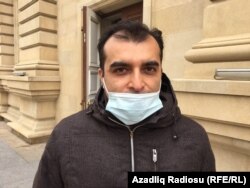
Ilqar Mammadov speaks to reporters on April 23 in Baku.
Ilqar Mammadov, chairman of the Republican Alternative Party (ReAL), and Rasul Jafarov, a prominent human rights defender and board member of ReAL, were acquitted by the Azerbaijani Supreme Court on April 23 after serving years in prison on charges that they and their supporters said were politically motivated. The EU greeted the court’s decision to acquit the two men and said that it “expects Azerbaijan to live up to its international commitments.” [see also: https://humanrightsdefenders.blog/2018/02/10/after-3-year-gap-eu-and-azerbaijan-meet-again-but-human-rights-remain-precarious/]
Rasul Jafarov
“This judgement, which overturns their previous convictions, is a welcome step that finally fully implements the respective decisions of the European Court of Human Rights. The European Union expects Azerbaijan to live up to its international commitments and to continue to implement the remaining decisions of the European Court of Human Rights,” the EU statement said. Mammadov, who served more than five years of a seven-year prison term, fought for his full acquittal since his early release in August 2018. He was detained in February 2013 and charged with helping stoke unrest in the town of Ismayilli, northwest of Baku. He was sentenced to seven years in jail in March 2014. Mammadov and his supporters insisted the case against him was politically motivated.
Jafarov was arrested in August 2014 and in April 2015 he was sentenced to 6 1/2 years in prison after a court in Baku found him guilty of tax evasion, illegal entrepreneurship, and abuse of office. He denied the charges, saying they were politically motivated. Jafarov was granted early release in March 2016 and worked on his full acquittal since then. [https://humanrightsdefenders.blog/2016/03/18/azerbaijan-pardon-jafarov-ismayilova-aliyev/]
Maria Arena and Pier Antonio Panzeri – a MEP and former MEP – write in an opinion piece in the EU Observer of 13 April 2020 that “Covid-19 is a gift for authoritarians and dictators“.
…..However, even in this emergency, it is necessary to maintain a very high level of attention to what is happening to democracy in this historical phase. The fight against the pandemic cannot be used as a pretext for a global attack on human rights and democracy, as is unfortunately happening in several parts of the world. We are not ‘diverting attention’. Quite the opposite. While we are doing everything we can to stop the contagion and start thinking about how to get out of the pandemic socially and economically, we also need to assess the risks for democracy and human rights at a global scale. It is essential to take care ‘now’ also of democracy and rights, because ‘later’ there is a real risk of regression, and without them our future can only be darker.
Second, many countries, on the pretext of Covid-19, are quietly taking advantage of the lack of world public opinion reaction to restrict the space and quality of democracy and eliminate opponents and human rights defenders.….
Finally, refugees in camps, detainees in every country in the world, homeless people, who have the right to be protected and safeguarded as far as possible against the epidemic, must not be forgotten in the emergency. In this context, Europe cannot waive its leading role in the protection of human rights.
We therefore welcome the joint proposal presented last Wednesday, 25 March, by the EU High Representative for Foreign Affairs and the European Commission to the European Council to adopt a decision on the “EU Plan on Human Rights and Democracy 2020-2024“. This includes, inter alia, strengthening the EU’s leadership in promoting and protecting human rights and democracy around the world, and identifying priorities for action, maximising the EU’s role on the world stage by expanding the “human rights toolbox”. [see: https://humanrightsdefenders.blog/2020/03/27/new-eu-action-plan-for-human-rights-and-democracy-2020-2024/]
An important move was the proposal that issues relating to the EU’s human rights policy in the world should no longer be subject to unanimity but to qualified majority voting, in order to avoid vetoes and denials by countries now in dangerous drift.
FRA accounces a discussion on the impact of COVID-19 measures on human rights defenders.
When:
17 April 2020
Where:
Online
Who:
EU Member States and Representatives from intergovernmental organisations and EU institutions responsible for cooperation with civil society and for supporting human rights defenders in Europe.
They will discuss the impact of COVID-19 measures for human rights defenders. FRA will look more closely into the effects of these measures on civil society organisations in the coming months.
The informal contact group on human rights defenders was set up a year ago. It allows ongoing, practical information exchange at the working level.
The aim is to enhance coordination and cooperation in supporting human rights defenders.
A very summary outline of the result of the 17 April meeting was published on 23 April:
In going forward, staff working on cooperation will continue to meet to exchange views on a range of issues on how best to support civil society and human rights defenders. These include: how Intergovernmental organisations can ensure continued participation by civil society during these times, including online; assessing the impact of COVID-19 measures on human rights defenders and civil society organisations; how donors could deal with the situation; digital security, safe communications, and the digital divide; and how do deliver capacity building and project support under the current circumstances.


 Hans Thoolen on Human Rights Defenders and their awards