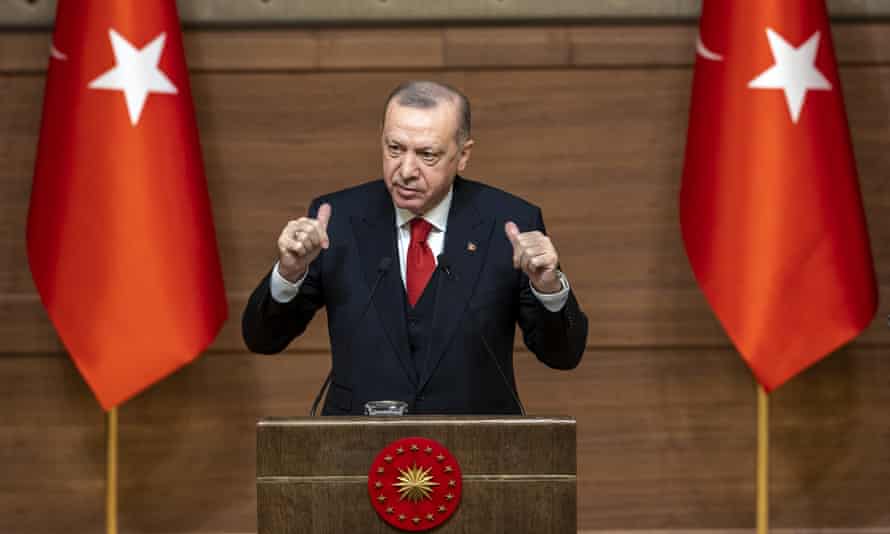
Ahval on 20 May 2021 reports that the European Parliament said the EU’s membership talks with Turkey should be formally suspended unless the country reverses its democratic backsliding.
Parliamentarians said they were alarmed by the “authoritarian nature of the presidential system” in Turkey in a report adopted on Wednesday. The resolution was probably the toughest and most critical yet of Turkey, said rapporteur Nacho Sánchez Amor.
“It reflects all that has unfortunately happened in the country in the last two years, in particular in the fields of human rights and rule of law, which remain the main concern for the European Parliament, and in its relations towards the EU and its members,” Amor said.
EU institutions should now make any positive agenda on Turkey conditional on democratic reform, he said.
Turkey began membership talks with the EU in October 2005. The negotiations were partly frozen a year later due to Turkey’s refusal to open its ports to ships from the Greek part of Cyprus. The EU informally approved a freeze in the membership process in 2016 citing a deterioration in democracy.
Turkey reacted angrily to the report, saying it was unacceptable in a period when relations with the EU were based on a positive agenda and a membership perspective.
The text contains “false allegations regarding human rights, democracy, the rule of law, our governmental system and political parties; and views Turkey’s effective, solution-oriented, humanitarian and enterprising foreign policy as a threat,” the Turkish Foreign Ministrysaid in a statement. See also my recent: https://humanrightsdefenders.blog/2021/03/22/turkey-arrests-and-backsliding-on-femicide/
EU lawmakers pointed to a “continued hyper-centralisation of power in the presidency” and called on Turkey’s relevant authorities to release all imprisoned human rights defenders, journalists, lawyers, academics and others, who it said the government had detained on unsubstantiated charges.
Turkey adopted a full presidential system of government at elections in 2018, awarding President Recep Tayyip Erdoğan vast executive powers, including the ability to rule by decree.
MEPS also highlighted Turkey’s “hostile” foreign policy, including towards Greece and Cyprus, and over its involvement in Syria, Libya, and the disputed region of Nagorno-Karabakh, which they said consistently collided with the EU’s priorities.
Lawmakers also urged Turkey to recognise the Armenian Genocide, which they said would pave the way for genuine reconciliation between the Turkish and Armenian people.
Differenceday.com of 5 May 2021 reports on how World Press Freedom Day was celebrated in Brussels as Difference Day
At a time when independent and free media reporting is more essential than ever, press freedom continues to be under threat. In a declaration ahead of World Press Freedom Day on Monday, EU High Representative Josep Borrell states that journalists continue to experience harsh working conditions with increasing financial and political pressure, surveillance, arbitrary prison sentences or violence for doing their work.
According to the UNESCO Observatory, 76 journalists were killed since 2020, while many more were arrested, harassed or threatened worldwide. Of particular concern is gender-based violence targeting women journalists.
“Press freedom is a fundamental value for the European Union underpinned by many recent initiatives. Media freedom and the safety of journalists are key priorities of the new Human Rights and Democracy Action Plan and of the European Democracy Action Plan.”
In 2020, more than 400 journalists benefited from the EU mechanism for protection of Human Rights Defenders, while the EU took important actions to support journalists, independent media and the fight against disinformation in the context of the pandemic in many regions.
The EU is determined to do more, in Europe and abroad, the declaration continues. The EU will continue coordinating with international organisations and mechanisms and pioneer new approaches. One example is the European Commission’s proposal for a Digital Services Act aimed at holding the major platforms accountable to make their systems fairer, safer and more transparent.
EU will also continue its action to counter disinformation and seek with all partners effective means to support sustainable business models for independent media.
“Press freedom means security for all,” the declaration concludes.
The World Press Freedom Day on 3 May was declared by United Nations General Assembly in 1993. The day raises awareness of the importance of freedom of the press and reminds governments of their duty to respect and uphold the right to freedom of expression enshrined under Article 19 of the 1948 Universal Declaration of Human Rights.
Freedom of expression implies the respect for opinions of others. In Brussels the day is commemorated annually as Difference Day because it recognises the difference in people and their convictions.
“To celebrate freedom of expression is to celebrate diversity,” the Free University of Brussels and other organisers of Difference Day in Brussels stated. In the past, investigative journalism has been in the focus of the event. This year the attention is drawn to women journalists behind the news and on the front line.
Noelyn Nassuuna in KFM of 30 April 2021 reports that Ugandan women’s rights activist Rita Aciro is the winner of the 2021 European Union Human Rights Defenders’ Award.
The award is given annually by the European Union and Norway to recognise a human rights defender in Uganda for their outstanding contribution.
Speaking during the award ceremony last evening, the Germany Ambassador to Uganda Matthias Schauer said human rights need to be defended all over the world especially for disadvantaged groups.
While receiving the award, Aciro said it was an honour of the invisible Human Rights Defenders in homes, and public spaces who never have the spot light yet do an incredible job in giving a voice to women and girls.
A long-awaited deal, the Comprehensive Agreement on Investment includes provisions for settling disputes and outlines clear rules against the forced transfer of technologies — a practice in which a government requires foreign investors to share their technology in exchange for market access.
The EU previously said the agreement should increase the transparency of Chinese state subsidies and make sustainable development a key element of the relationship between the two trading blocs.
China’s Ministry of Commerce said “both sides had made tremendous efforts” at a press conference following Wednesday’s meeting and that they had “overcome difficulties” to conclude talks. It said the deal focuses on institutional opening up with market access as the key principle of the deal, which will mean more investment opportunities for businesses on both sides and “a better business environment”.
But the EU expressed concerns about “the restrictions on freedom of expression, on access to information, and intimidation and surveillance of journalists, as well as detentions, trials and sentencing of human rights defenders, lawyers, and intellectuals in China.” The EU’s diplomatic agency, the European External Action Service, has called for the immediate release of Zhang Zhan, a former lawyer who reported on the early stage of the coronavirus outbreak in China and has been sentenced to four years in prison.
The issue of human rights could prove to be a sticking point for the deal clearing the EU Parliament, with critics drawing attention to reports of forced labour in some regions of China.
“The stories coming out of Xinjiang are pure horror. The story in Brussels is we’re ready to sign an investment treaty with China,” Guy Verhofstadt, a Belgian MEP for Renew Europe, said on Twitter. “Under these circumstances, any Chinese signature on human rights is not worth the paper it is written on”.
There could also be friction with the new US President-elect Joe Biden and his administration, as just weeks ago the EU proposed a trans-Atlantic dialogue to address “the strategic challenge presented by China’s growing international assertiveness.”
Amid concerns about the human rights situation in China, the EU said the seven-year-long negotiations were concluded in “principle” during a video conference involving Mr Xi, European Commission president Ursula von der Leyen and EU Council president Charles Michel. German chancellor Angela Merkel – whose country holds the rotating presidency of the EU – and French president Emmanuel Macron also took part in the discussions with the Chinese president, the EU said. Macron highlighted the “concerns” of EU countries regarding human rights and called for the “closure of internment camps”, according to the speech given by his office. He also pleaded in favor of “measures to ban forced labor” and called for “a visit of independent United Nations experts”.
According to the EU, the deal was negotiated after China pledged to continue ratifying the International Labor Organization’s rules on forced labor. “We are open for business but we are attached to reciprocity, level playing field and values,” Ms von der Leyen said.
French president Emmanuel Macron attends an EU-China video conference at the Fort de Bregancon in Bormes-les-Mimosas, southern France (Sebastien Nogier, Pool via AP)
The video conference launches a ratification process that will take several months. To enter into force, the agreement will need to be ratified by the European Parliament, and the issue of human rights could be a sticking point.
Simon Tisdall – in a strongly-worded opinion piece in the Guardian of 3 January 2021 entitled “‘Global Britain’ is willing to trade away everything. Including scruples” – attacks the UK’s new deal with Turkey which ignores its appalling human rights abuses and should have been scrutinised by parliament
Turkey’s ‘strongman’ president Recep Tayyip Erdoğan has hailed the trade deal with Britain as the start of a ‘new era’. Photograph: Anadolu Agency/Getty Images Sun 3 Jan 2021 07.00 GMT
The UK’s new trade agreement with Turkey, signed last week, ignores the Turkish government’s continuing human rights abuses, boosts its dangerous president, and undermines ministerial pledges that “global Britain” will uphold international laws and values. The deal took effect on 1 January without even rudimentary parliamentary scrutiny. Here, stripped of lies and bombast, is the dawning reality of Boris Johnson’s scruple-free post-Brexit world.
Recep Tayyip Erdoğan, Turkey’s “strongman” leader, is pleased as punch. He’s the new, biggest fan of Britain’s international trade secretary, Liz Truss, whose shabby work this is. Erdoğan hailed the deal as the start of a “new era” and a landmark for Turkey. After years of disastrous economic mismanagement and fierce rows with the US and EU over Turkish policy towards Russia, Syria, Libya, Greece and Cyprus, Erdoğan badly needed a win. Hapless Truss delivered….
This rushed deal rides roughshod over widely shared human rights concerns. It may be naive to think that the agreement, which replicates existing EU-Turkey arrangements, would allow matters of principle to imperil £18.6bn in two-way trade. Yet Britain is Turkey’s second-largest export market. Ankara was desperate to maintain tariff-free access. This gave Johnson and Truss leverage. It was a sovereign moment. But they failed to demand that Erdoğan change his ways.
Alive to these and similar problems relating to other post-Brexit trade partners, the House of Lords amended the government’s Trade Bill last month to require human rights risk assessments when making agreements – to ensure compliance with the UK’s international treaties and obligations. But the government is expected to scrap the amendment when the bill returns to the Commons. The Turkey deal contains no such safeguards.
In its scramble to replace lapsed EU arrangements, Johnson’s government has so far “rolled over” about 30 existing trade deals. Like the Turkey deal, they have not faced thorough parliamentary scrutiny. The list includes other countries or entities with contentious human rights records, such as Egypt, Tunisia, Israel and the Palestinian Authority. Bilateral deals with notorious rights abusers such as China and Saudi Arabia have not been attempted – yet…
This lucrative business, or the prospect of losing it, may help explain the haste in finalising the Turkey deal. Yet the fact that Erdoğan stands accused of using British-made equipment and technology to repress domestic opponents, attack Syria’s Kurds, intervene in Libya’s civil war, and stoke the Azerbaijan-Armenia conflict should have given serious pause. These actions run contrary to British interests, as does Erdoğan’s trouble-making in the eastern Mediterranean. Yet Johnson’s government, ever mindful of its Brexit needs, has kept its head down.
Full and timely parliamentary scrutiny of post-Brexit trade deals would help bring such omissions and contradictions to light – but is sadly lacking, as Emily Thornberry, Labour’s shadow trade secretary, said in November. She accused the government of “sheer bumbling incompetence” after Greg Hands, the trade minister, admitted there was not enough time for MPs to scrutinise trade deals before the 31 December deadline. So much for a sovereign parliament “taking back control” of Britain’s destiny and laws.
The Turkey deal illustrates a bigger, fundamental hypocrisy. Extolling a future “global Britain” in 2019, foreign secretary Dominic Raab promised that “once we’ve left the EU … human rights abusers anywhere in the world will face consequences for their actions”. In January 2020, Raab assured the Commons that “a truly global Britain is about more than just international trade and investment … Global Britain is also about continuing to uphold our values of liberal democracy and our heartfelt commitment to the international rule of law.”
Raab seems to mean well, but ne’er-do-wells such as Erdoğan are laughing fit to burst. Raab’s recent imposition of sanctions on individual rights abusers in Russia, Saudi Arabia and elsewhere does not affect the bigger picture. It is of a British government hellbent on cutting hasty, ill-considered deals with all manner of undesirable customers around the world, without proper regard for the political, legal, strategic and human consequences. And to think Tory aristocrats used to look down on trade.
TRT World published a summary of a report by the South Asia Collective “India and Pakistan no different on how they treat minorities”. Please note that Turkish Radio and Television Corporation is the national public broadcaster of Turkey. One looks there in vain for information on human rights violations in Turkey itself. Still the report referred to (produced with the financial support of the European Union and the Norwegian Agency for Development Cooperation) is of interest:
The past ten years have been abysmal for minorities and civil rights activists in South Asian countries including India, Pakistan and Sri Lanka, according to the South Asia State of Minorities Report 2020.
Governments have introduced repressive laws that curb freedom of expression, persecute journalists and bar people from organising peaceful demonstrations, says the report published by the South Asia Collective, an international group of activists and NGOs. Some laws disproportionately target minorities such as Muslims in India and Sri Lanka, and Christians in Pakistan. One policy that transcends almost all the regional governments is their attempt to restrict the role of NGOs – especially if they receive funding from abroad.
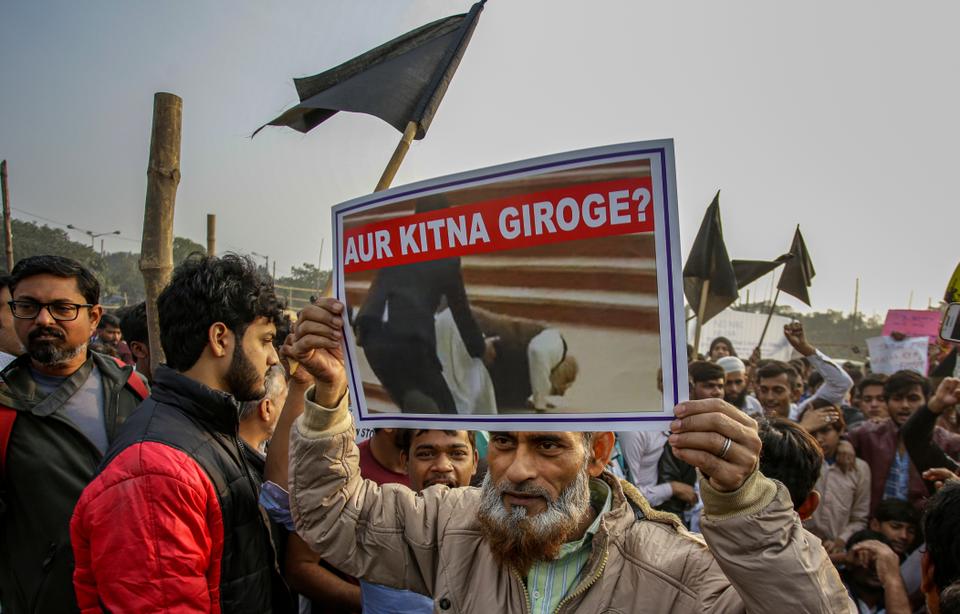
India, where minorities have faced state-sanctioned violence since the Hindu nationalist Bharatiya Janata Party (BJP) was re-elected last year, has handicapped foreign NGOs by setting limits on how they can spend money received from international donors. Most of the affected NGOs are the ones that work in areas which highlight abuse of power, government indifference towards the plight of minorities, and the brutality of security forces. [see also: https://humanrightsdefenders.blog/2020/07/06/istanbul-court-jails-four-human-rights-defenders-on-terror-charges-seven-acquitted/]
New Delhi’s discriminatory amendment to citizenship law has further alienated India’s Muslims. (AP Archive)
Other policy changes such as requiring NGOs to register with income tax authorities every five years are a similar tool of “administrative harassment”. ..
The intimidation is not limited to NGOs as journalists reporting on creeping BJP authoritarianism often feel the wrath of the state. “…between 25 March and 31 May 2020, at least 55 Indian journalists faced arrest, physical assaults, destruction of property, threats or registration of FIRs (police reports),” the report said.
New Delhi increasingly relies on internet controls to curb dissent. Internet shutdowns jumped to 106 in 2019 from only six in 2014 as authorities used different laws to control the flow of information. Kashmir faced a complete internet blackout for months after the Muslim-majority region’s nominal autonomy was withdrawn last year…
India is also using the draconian Unlawful Activities Prevention Act to target Dalits, a caste of Hindus who face widespread discrimination under the country’s hierarchical caste system… Changes in the Citizenship Act that target Muslim migrants and the brutal police reponse to subsequent protests — in which 22 people were shot dead in Utter Pradesh state in a single day — further illustrate the worsening status of minorities in India.
In neighbouring Pakistan, India’s archrival, minorities and those activists trying to help them, fare no better.
“NGOs and INGOs (international NGOs) are subject to extensive regulation involving multiple, lengthy procedures of registration, security clearance, and approvals for funding,” the report said.
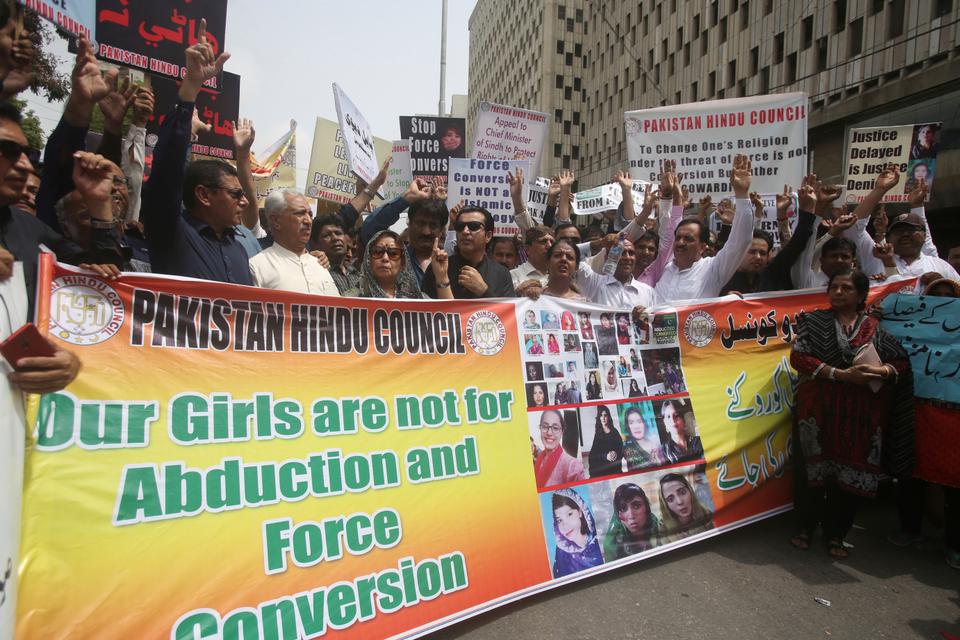
The Christians and Hindus in Pakistan regularly complain that young girls are forced to convert to Islam. (AP Archive)
In recent years, Islamabad has increased vigilance on NGOs which it fears might be working on a foreign agenda to promote dissent. What will particularly bother Pakistan’s policymakers is the report’s focus on how the country’s Blasphemy Law, meant to protect religious sentiments, continues to be misused against minorities.
“In reality, the law explicitly discriminates against Ahmadiyas since parts of it criminalise public expression of Ahmadiya beliefs and prohibit Ahmadiyas from calling themselves Muslims, praying in Muslim sites of worship and propagating their faith.” Just this week, a report by the United States Commission on International Rights Freedom pointed out that Pakistan accounts for nearly half of the incidents of mob violence against alleged blasphemers.
At times, people accused of blasphemy are killed in court in front of police and lawyers. Christians, another minority, are frequently targeted while authorities do little to protect them. For instance, a church constructed in the Toba Tek Singh district of Punjab province had to be sealed in 2016 after local Muslims agitated against it. This alienation doesn’t stop at the places of worship – young Chrsitan students are continuously harassed by their peers to convert to Islam, the report said.
Similarly, Sri Lanka witnessed rising levels of intolerance towards minorities in recent years, especially as successive governments tried to pacify extremist Buddhists to garner their votes. Muslims in Sri Lanka have felt a wave of discrimination and official apathy after the suicide attacks that killed more than 200 people last year. “After the Easter attacks, Muslims, particularly a large number of Muslim men, were arrested seemingly without reasonable cause.” Jingoistic government-aligned media has helped paint Muslims as the villain in Sri Lanka.
“The incitement of hatred and vitriol by media outlets continues unabated. For example, Muslim Covid-19 patients were identified by their faith, unlike other patients, and blamed by the media for spreading coronavirus.”
On 11 December 2020 Bernd Lange, Vice-chair of the Group of the Progressive Alliance of Socialists and Democrats in the European Parliament, wrote in New Europe the following piece about how after 6 years there has come an European agreement on stricter rules for the export of dual-use goods, which can be used for both civilian and military ends.
All good things are worth waiting for. After long six years negotiators from the European Parliament, the Commission and member states finally agreed on stricter rules for the export of dual-use goods, which can be used for both civilian and military ends. Parliament’s perseverance and assertiveness against a blockade by some of the European Union member states has paid off in the sense that as of now respect for human rights will become an export standard.
Up until now, export restrictions applied to aerospace items, navigation instruments or trucks. From now on, these rules will also apply to EU produced cyber-surveillance technologies, which demonstrably have been abused by authoritarian regimes to spy on opposition movements; for instance, during the Arab Spring in 2011.
This is a breakthrough for human rights in trade by overcoming years of various EU governments blocking the inclusion of cyber-surveillance technology in the export control rules for dual-use goods. Without a doubt: Technological advances, new security challenges and their demonstrated risks to the protection of human rights required more decisive action and harmonised rules for EU export controls.
Thanks to the stamina of the Parliament, it will now be much more difficult for authoritarian regimes to abuse EU produced cybersecurity tools such as biometric software or Big Data searches to spy on human rights defenders and opposition activists. Our message is clear: economic interests must not take precedence over human rights. Exporters have to shoulder greater responsibility and apply due diligence to ensure their products are not employed to violate human rights. We have also managed to increase transparency by insisting on listing exports in greater detail in the annual export control reports, which will make it much harder to hide suspicious items.
In a nutshell, we are setting up an EU-wide regime to control cyber-surveillance items that are not listed as dual-use items in international regimes, in the interest of protecting human rights and political freedoms. We strengthened member states’ public reporting obligations on export controls, so far patchy, to make the cyber-surveillance sector, in particular, more transparent. We increased the importance of human rights as licensing criterion and we agreed on rules to swiftly include emerging technologies in the regulation.
This agreement on dual-use items, together with the rules on conflict minerals and the soon to be adopted rules on corporate due diligence, is establishing a new gold standard for human rights in EU trade policy.
I want the European Union to lead globally on rules and values-based trade. These policies show that we can manage globalisation to protect people and the planet. This must be the blueprint for future rule-based trade policy.
Efi Koutsokosta in Euronews of 8 December 2020 writes that the European Union has agreed to establish a regime similar to the Magnitsky Act in America that will allow the 27 member bloc to sanction those responsible for human rights abuses. The decision came at a meeting of European foreign ministers in Brussels on Monday and will allow the EU to freeze assets and impose travel bans on individuals involved in serious human rights abuses. [see also: https://humanrightsdefenders.blog/2015/05/08/the-case-for-smart-sanctions-against-individual-perpetrators/]
The new measures will allow for travel bans on involved individuals and the freezing of their funds too. It could also be forbidden from making funds available to those being sanctioned.
“This unanimity rule is a real problem. Another problem with the EU Magnitsky Act is that it doesn’t include kleptocracy, it only includes human rights abuse. And what we found is that kleptocracy and human rights abuse go hand in hand, they are intertwined. Of course, we are celebrating today because this is a huge milestone but tomorrow the work begins to put pressure on sanctioning bad actors in countries like Russia and China and to make sure that the law that the EU has, is upgraded to include corruption,” Browder said.
The criteria for sanctions will apply to acts such as genocide, crimes against humanity, as well as. torture, slavery, extrajudicial killings, arbitrary arrests, or detentions.
It will then be up to the European Council, which consists of all 27 national governments, to act upon a proposal from a member state or from the High Representative of the EU for Foreign Affairs and Security Policy, to establish, review and amend the sanctions list.
The Council has approved conclusions on the EU Action Plan on Human Rights and Democracy 2020-2024. The Action Plan sets out the EU’s level of ambition and priorities in this field in its relations with all third countries.
The conclusions acknowledge that while there have been leaps forward, there has also been a pushback against the universality and indivisibility of human rights. The ongoing COVID-19 pandemic and its socio-economic consequences have had an increasingly negative impact on all human rights, democracy and rule of law, deepening pre-existing inequalities and increasing pressure on persons in vulnerable situations.
In 2012, the EU adopted the Strategic Framework on Human Rights and Democracy which set out the principles, objectives and priorities designed to improve the effectiveness and consistency of EU policy in these areas. To implement the EU Strategic Framework of 2012, the EU has adopted two EU Action Plans (2012-2014 and 2015-2019).
The new Action Plan for 2020-2024 builds on the previous action plans and continues to focus on long-standing priorities such as supporting human rights defenders and the fight against the death penalty.
By identifying five overarching priorities: (1) protecting and empowering individuals; (2) building resilient, inclusive and democratic societies; (3) promoting a global system for human rights and democracy; (4) new technologies: harnessing opportunities and addressing challenges; and (5) delivering by working together, the Action Plan also reflects the changing context with attention to new technologies and to the link between global environmental challenges and human rights.
European Parliament is deciding its position on what an EU law on corporate due diligenceshould look like. Richard Gardiner (a Senior Campaigner for Corporate Accountability at Global Witness) on 2 September 2020 explains more and more recently (11 November 2020) a group of 87 organisations and media freedom groups call on the EU to to protect journalists against gag lawsuits (SLAPPs)
As the European Parliament begins developing proposals for a new – and momentous – law to hold business to account for its impact on people and planet, Richard Gardiner sets out how this process came about and what needs to happen now to ensure this really delivers results.
Where are we now?
Following the publication of the European Commission study on due diligence requirements through the supply chain earlier this year, in April, European Commissioner for Justice Didier Reynders announced to the European Parliament Responsible Business Conduct Working Group that he will introduce EU rules on corporate accountability and corporate due diligence in early 2021.
In response to this announcement, Members of the European Parliament are now starting work to develop a European Parliament position on what an EU law on corporate due diligence could look like. This work will take place within the European Parliament Legal Affairs Committee and will be led by MEP Lara Wolters.
The goal of this work is to influence the final Commission legislative proposal and ensure that the Commissioner follows through on his commitment to present an ambitious framework for this law.
Potential to be a real game changer?
Global Witness has long advocated for mandatory corporate accountability rules to tackle corporate abuse against people and planet.
Our recently published report ‘Defending Tomorrow’ shows that while land and environmental defenders continue to act as the first line of defence against climate breakdown, far too many businesses, financiers and governments either fail to protect them or – in the worst examples – can be complicit in the violence they face.
These brave people play a vital role challenging companies operating recklessly, rampaging unhampered through virgin forests, protected wetlands, indigenous territories and biodiversity hotspots. They are on the frontline of our global, collective fight against climate change. However, despite their importance to the preservation of our planet, our report shows that 212 land and environmental defenders were murdered in 2019 – the bloodiest on record, with the deadliest sectors for this violence being mining, agribusiness and logging.
There is clearly a legislative gap when governments and citizens have no legal means to hold corporations accountable for their human rights and environmental abuses. As the world’s largest trading bloc, the EU is now looking to lead the global debate on corporate accountability and this new law will shape not only corporate behaviour within the EU but also globally.
What needs to be in this new law?
Civil society united in their calls for the EU to introduce legislation on corporate due diligence. We have consistently pointed to the fact that voluntary measures have proved to be vastly insufficient and new legislation is urgently needed to establish clear, robust and enforceable cross-sectoral requirements on all business enterprises, including financial institutions, to respect human rights and the environment.
As the European Parliament begins to discuss the details of corporate accountability legislation, Global Witness is part of a coalition of NGOs that has published its call to action for the key elements needed to hold businesses to account:
The new law must apply to all businesses, including finance, of all sizes and sectors acting in the EU.
Business must have a duty to address all the adverse human rights, environmental and governance impacts in their global supply chains.
Businesses must conduct Responsible Business Conduct (RBC) Due Diligence to identify, cease, prevent, mitigate, monitor and account for their adverse risks.
Businesses must engage and consult with all relevant stakeholders, including human rights defenders and indigenous peoples, as part of their RBC due diligence.
Businesses must be made liable for the human rights, environmental and governance adverse impacts in their global value chains.
The months between now and the end of the year promise to be extremely interesting on the topic of corporate accountability across all the EU institutions. Firstly, the European Parliament will aim to finalise its advice to the Commission by end 2020 in order to ensure that it can be taken into account in the Commission proposal. Secondly, the Commission has draft plans to release a public consultation on the new due diligence legislation in Autumn 2020 to get public input on how to draft their proposal.
And finally, the German Presidency of the European Council have indicated that due diligence is a key political priority for their Presidency and they will aim to have Council conclusions on this topic by the end of the year. At Global Witness, we will continue to engage with all the European institutions to ensure that EU policy makers live up to their commitments to introduce a meaningful and impactful new law.
SLAPPs: More and more journalists and civil society organisations are being sued by powerful businessmen and politicians. The International Press Institute (IPI) has joined a group of 87 organisations and media freedom groups calling on the EU to ensure those with a watchdog role are protected from gag lawsuits.
This scrutiny is the lifeblood of healthy democratic societies. The European Court of Human Rights and other national and regional courts have consistently and explicitly recognised in their judgments the important role a free press, and more broadly civil society, plays in holding the powerful to account. Their judgments reaffirm the obligation states have to create an environment that is conducive to free speech. Because without this, democracy weakens and dies.
The holes in our laws that allow powerful people to hammer their critics into submission are a hole in European democracy. Cases of abuse pepper the continent. Poland’s second-biggest daily newspaper, Gazeta Wyborcza, has received over 55 legal threats and lawsuits by a number of actors, including from Poland’s ruling party, since 2015.
French businessman Vincent Bolloré and companies affiliated with the Bollore Group have blanketed journalists and NGOs in libel suits to stop them covering his business interests in Africa. In Spain, meat producer Coren is demanding €1 million in damages from an environmental activist for criticising its waste management practices, having previously threatened activists and scientists who were researching nitrate levels in its local waters.
The people we depend on for information about what is happening around us are being distracted, impeded, or entirely blocked from pursuing their work by these costly and resource-intensive legal attacks. The situation is becoming skewed beyond recognition. When it comes to certain people, governments, companies and topics, it’s not writers, film makers or journalists who decide what we read, watch and talk about.
It’s not even the courts, for SLAPPs rarely make it to a hearing, let alone a court judgment. Rather, it’s the oligarchs and their associates in politics, through the lawyers they pay, who are shaping the narrative and preventing the truth from emerging.
We’ve seen a worrying pattern emerge in Europe of government officials or beneficiaries of large public contracts adopting the tactics of celebrities and oligarchs to shield themselves from the heightened level of scrutiny that their positions or financial links to government warrant. The fact that the threats are often cross-border ratchets up the costs for journalists and activists, who find themselves summoned to court far from home in Europe’s most expensive legal jurisdictions.
Awareness of this problem is growing. European Commission Vice-President Věra Jourová has promised to ‘look into all possible options’ to counter the threat SLAPPs pose to European democracy. One promising solution lies in the institutions of the European Union, and it could help realter the balance between pursuers of SLAPPs and the public’s right to be informed of matters in the public interest.
EU-wide legislation should be adopted to protect people across the European Union from SLAPPs. This has to be a priority. As in other parts of the world, rules should be in place across the EU to allow SLAPP suits to be dismissed at an early stage of proceedings, to sanction SLAPP litigants for abusing the law and the courts, and to provide measures to allow victims to defend themselves.
When we consider the importance of public watchdogs such as investigative journalists, activists, and whistleblowers to the rule of law and the fight against corruption, the absence of safeguards is a threat not only to press freedom but to the proper functioning of Europe’s internal market and, increasingly, to Europe’s democratic life.
The reality is that for every journalist or activist threatened with violence in Europe, a hundred more are silenced discreetly by letters sent by law firms, perverting laws meant to protect the reputations of the innocent from attacks by the powerful.
SLAPPs are a far less barbaric means of silencing someone than a car bomb or a bullet to the head, but their silencing effect is often just as destructive.