It has been 3 years since Floribert Chebeya and Fidèle Bazana were killed at the hands of the Police of the Democratic Republic of Congo, after been summoned by the Head of the Police, General John  Numbi. To date, the Congolese Military Justice, who deals with this matter, has refused to prosecute General Numbi and has merely judged his accomplices even though it knows the truth, thereby showing total allegiance to the political and military regime. Specific and detailed revelations of one of the protagonists on this case, Commander Paul Mwilambwe, leaves no doubt about on the subject. Read the rest of this entry »
Posts Tagged ‘Democratic Republic of Congo’
Death of Floribert Chebeya and Fidèle Bazana in DRC still unresolved after 3 years
June 10, 2013Threats and intimidatory acts against human rights defender Jean Pierre Muteba in DRC
April 22, 2013On 17 April 2013, human rights defender Jean Pierre Muteba reported to the Katanga provincial office of the ANR (National Intelligence Agency), a day after receiving a written notice signed by the new director of that agency in Katanga, DRC. The notice followed incidents in which the human rights defender noted being followed by members of the same agency and complained to colleagues of receiving several threatening telephone messages from anonymous callers. However, on this occasion he was not questioned and left after two hours.
Jean Pierre Muteba is the spokesperson for the “Cadre de Concertation de la Société Civile du Katanga” (Coalition of Civil Society Groups of Katanga), a network of civil society organisations active on issues related to human rights and justice as well as social accountability for extractive industries in the DRC’s copper-rich Katanga region.
On several different occasions after 23 March 2013, the day on which a group of Maï Maï fighters known as “Bakata Katanga” invaded Lubumbashi (Katanga’s regional capital), Muteba reported receiving anonymous intimidatory messages on his mobile phone. Three days after this invasion, which caused up to thirty-five deaths according to UN sources, ten organisations affiliated with Muteba’s coalition issued a report on the incident in which they accused certain personalities within Katanga’s security, business and political spheres of being behind the violent incident. It is believed that the threats and intimidatory acts that Muteba has faced since are closely related to the role his organisation played in denouncing those who are suspected of being behind the attack on Lubumbashi and in demanding an independent investigation of the violence.
Front Line Defenders believes that the threats against Jean Pierre Muteba are directly related to his human rights work with the Coalition of Civil Society Groups of Katanga.
Dutch Minister Ploumen demands protection for human rights defenders in Congo
February 9, 2013Emergency workers and human rights defenders in the Democratic Republic of the Congo DRC must be protected, stated Lilianne Ploumen, Minister for Foreign Trade and Development Cooperation on 5 February 2013. The Minister was speaking after talks with Alexandre Luba, the Congolese defence minister and deputy prime minister, and trade minister Jean-Paul Nemoyato. During those talks she focused on the position of Dr Denis Mukwege. Last year human rights defender Dr Mukwege fled to Europe after narrowly escaping an assassination attempt in which one of his security guards was killed (as I reported in an earlier post in this blog). The gynaecologist has now returned to DRC but his life remains in danger, and his work for female victims of rape and mutilation continues to be obstructed.During the talks, the defence minister acknowledged that military personnel have been guilty of sexual violence against women, including rape. The Netherlands is supporting the United Nations stabilisation and reconstruction plan aimed at combating violence, is helping to fund MONUSCO rape investigations, and will be spending one million euros this year on projects providing care and shelter to victims. The Minister is on a visit to the Great Lakes Region, where she is finding out about the conflict in eastern DRC, security, the humanitarian situation, human rights and economic developments.
via Ploumen: human rights defenders in Congo need protection | News item | Government.nl.
A Canadian Human Rights Defender teaching in the USA put in the limelight
January 31, 2013When writing about individual Human Rights Defenders the tendency is to give attention to those in the front line who are in immediate trouble. This time I want to refer to a HRD teaching at the University of Connecticut based on a blog post by Kenneth Best of 30 January 2013. It concerns Luis van Isschot, an assistant professor of history, who specializes in the study of human rights in Latin America ( photo by Peter Morenus/UConn Photo).
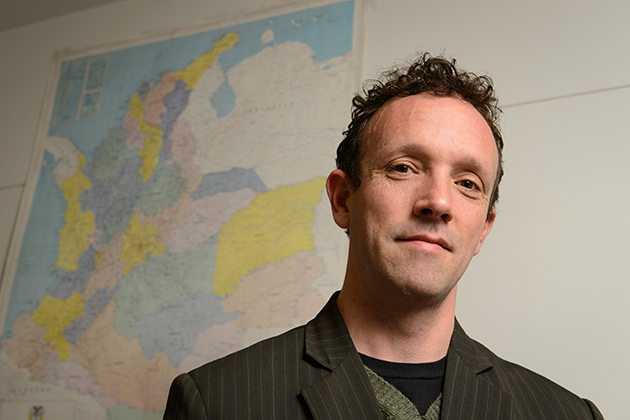
Conversation around the dinner table in the van Isschot home in Montreal was a bit different than in most Canadian homes. Growing up with a Spanish, Peruvian, and Dutch family heritage, Luis van Isschot listened to discussions about Latin American history and politics led by his father, a physician who treated families in a clinic based in Montreal’s Latino community…….
…His path to a doctoral degree developed from his volunteer work in Guatemala and later in Colombia, where he served as a human rights observer. It was during his time in Colombia that a friend who was a university professor and a historian told him that one of the most important books of Colombian history was written by a professor from his hometown of Montreal, Catherine Le Grand at McGill University, and that he should look her up. He did, and it led to his enrollment in the doctoral program. “She made it seem that you could be a wonderful teacher, a cutting-edge scholar, and have a balanced life of engagement in your community, and that the Ph.D. was a way of doing that,” van Isschot says. “The university is central to the community, not apart from it. That makes sense to me.”
He later became involved with MEA Laureate 2001 Peace Brigades International, a nonpartisan organization that sends international volunteers to areas of conflict to provide protective accompaniment to human rights defenders threatened by political violence in 11 nations, including in Asia, Africa, and Latin America. In addition to serving as a human rights observer in Colombia, he also traveled to the Great Lakes Region of Africa, doing research in the Democratic Republic of Congo, Rwanda, and Burundi.
“It was a really important experience for me to go somewhere where the language of human rights and social justice and the understanding of history really enriched my own understanding of what I was working on in Latin America,” he says. His experience in Colombia led him to focus his doctoral studies on human rights activities in that nation’s oil capital, Barrancabermeja, where he lived for a year. The city was the center of a major urban war between Colombian paramilitary groups and leftist guerillas. Between 1998 and 2002, in a city of 300,000 there were about 2,000 violent murders. “It was a devastating period. The relationships I made with Colombian human rights activists, teachers, and scholars convinced me that I needed to find some place to explore the issues,” he says.
His book, The Social Origins of Human Rights: Protesting Political Violence in Columbia’s Oil Capital, 1919-2010, is near completion, and scheduled to be published in early 2014. His new research project is titled “When the Courts Make History: the Impact of the Inter American Court of Human Rights in Latin America’s Conflict Zones,” and examines the historical changes set in motion by the pursuit of justice across borders.
http://today.uconn.edu/blog/2013/01/focusing-on-human-rights-with-a-latin-american-perspective/
Women Human Rights Defenders in 2012: Rosalyn Warren in the Huffington Post
January 7, 2013On 7 January 2013, Rosalyn Warren posted the following worthwhile round up of woman HRDs in 2012:
On Human Rights Day on the 10th December 2012, the UN called on the rights of all people — women, youth, minorities, persons with disabilities, indigenous people, the poor and marginalized — to make their “voice heard.” What Human Rights day also marked was the murder of Nadia Sadiqi, a women’s activist and an Afghan official in charge of women’s affairs, who was murdered by two unidentified gunmen while on her way to work.
This marked the end of a year in which attempts to brutally suppress human rights defenders continued: Nadia Sadiqi had only just taken over the job role after her predecessor, Hanifa Safi, was assassinated in a bomb attack in July. Women have long held a crucial and leading role in human rights advocacy, but living in a time where in some parts of the world human rights defenders are facing escalating levels of intimidation, harassment and attacks, and violence against women is endemic everywhere both at home and abroad, we heard the voices of women fighting for human rights loud and clear, and more so than ever before. As a young, female, human rights activist myself, this only reinforces my view that the fight for human rights led by girls and women is of even more importance moving into 2013.
United Nations officials marked Human Rights Day by declaring that everyone has the right to be heard: nevertheless, the next generation of women human rights defenders still face much of the same danger before them when they speak out. When journalist and human rights activist Natalya Estemirova was abducted and murdered by armed men in Grozny, Chechen Republic in 2009, it was a stark reminder of the dangerous consequences of being a vocal voice for human rights in Russia. Fast-forward three years, and human rights activism in Russia has a new face: Pussy Riot. Pussy Riot were not callously murdered for their activism, like the ever-growing list of journalists murdered for their human rights and political reporting, and justice for Natalia Estermedia is still being called for — but what Pussy Riot did do was wave a flag to the world that said that the women fighting for rights in their country will not be ignored, forgotten or silenced.
The next generation of females fighting for human rights is also getting younger. When 15 year-old schoolgirl Malala Yousafzai was shot by the Taliban for her efforts to defend the education of girls in October, a denunciation of targeting girls and women through violence in an attempt to silence them was echoed around the world. Michelle Bachelet the executive director of UN Women, marked Human Rights Day by commenting that this stifling of girls and women’s voices is hiding back progress for women and all members of society, stating: “Women’s participation is fundamental for sustainable development, peace and democracy.” They may have tried to silence Malala, but she continues to inspire her generation to participate in the struggle for basic rights such as education. This was shown with 21 year-old Afghan activist Noorjahan Akbar who says in a recent Daily Beast interview that Malala’s shooting only strengthens the fight for girls’ rights: “Maybe 10 to 12 years ago, people wouldn’t have held a protest because a young girl was attacked. But now it is happening and people are speaking up against it, fighting, and protesting. That gives me a lot of hope for the future. Not just for me and my work, but for other women.”
But 2012 was not a year in which women stood alone: many men joined them in standing for their human rights. In October, Dr. Denis Mukwege a leading women’s rights activist from the Democratic Republic of Congo escaped an assassination attempt, just one month after condemning impunity for mass rape in the DRC at a UN speech. But whether it be with Dr. Denis Mukwege, the Kachin women in Burma demanding an investigation into Kachin abuses, or the women and men that are taking to the streets in India today against rape and sexual violence, the message is the same: human rights advocacy is still just as important today as it has ever been.
I felt proud to see so many women as the driving force for human rights in 2012, particularly with the media showing them in their true state: as strong, powerful advocates of basic human rights, not as repressed women unable to speak out. Nadia Sadiqi did not die in vain. On Human Rights Day, the day that marked her murder, a special tribute was made to Malala Yousafzai by UNESCO and Pakistan, with the launch of Malala’s Fund for Girls Education. Let’s hope that 2013 continues to inspire girls and women to get involved with human rights advocacy wherever they are.
Follow Rossalyn Warren on Twitter: www.twitter.com/RossalynWarren
Threats against women’s rights advocate Denis Mukwege in DRC mobilize medical community
October 30, 2012I am referring to this blog post by Dr Jocalyn Clark because it is so good to see that the medical community comes out to support a Human Rights Defender in DRC and considers the attack on him as “another wake-up call for us all”.
“Last Thursday evening, as many of you will have seen via media reports, a true hero of women and human rights Dr Denis Mukwege narrowly escaped death during an assassination attempt on his life that killed his security guard. Amnesty International is now rightly calling for a full investigation and asking whether his recent criticisms of the Congolese government played a role. Attacks against human rights defenders and humanitarian workers are said to be increasing in DRC, where conflict has raged for years. Denis Mukwege, winner of many international accolades including the UN Human Rights Award, has long championed the rights of women and highlighted to the world the extent and the brutality of systemic rape against women in the conflict zones of DRC…”
Observatory for HRDs makes statement to 52nd session of African Commission on Human Rights
October 18, 2012In a recent document (18 October 2012) the FIDH and the OMCT, in the framework of their joint Observatory for the Protection of Human Rights Defenders, express their renewed concern about the situation of human rights defenders in Africa.
Since the last session of the African Commission in May 2012, the Observatory has not recorded any improvement of their situation on the continent. Quite on the contrary, human rights violations against defenders have continued, in particular judicial harassment, threats, intimidations, arbitrary detentions and unjustified condemnations. The situation of human rights defenders has even become alarming in situations of internal conflicts, such as for instance in the Democratic Republic of the Congo. For the full statement see:
Human Rights Watch honors HRDs from Congo, Libya
August 14, 2012
(Photo credit: Wikipedia)
Two courageous and tireless advocates for human rights have been selected as recipients of the prestigious Alison Des Forges Award for Extraordinary Activism. Abbé Benoît Kinalegu from the Democratic Republic of Congo and Salah Marghani from Libya are leading voices for justice in their countries, working relentlessly to protect the rights and dignity of others. They will join four other international recipients of the award as they are honored at the Human Rights Watch Voices for Justice Annual Dinners in 15 cities worldwide in November 2012.
The award is named for Dr. Alison Des Forges, senior adviser to Human Rights Watch’s Africa division for almost two decades, who died in a plane crash in New York on February 12, 2009. Des Forges was the world’s leading expert on Rwanda, the 1994 genocide, and its aftermath. Human Rights Watch’s annual award honors her outstanding commitment to, and defense of, human rights. It celebrates the valor of people who put their lives on the line to create a world free from abuse, discrimination, and oppression.
“These human rights defenders have spoken out and helped people who needed protection in some of the most dangerous and difficult situations in the world,” said Kenneth Roth, executive director of Human Rights Watch. “They show that courage and persistence can make a difference even during periods of conflict and violent transition.”
The recipients of Human Rights Watch’s 2012 Alison Des Forges Award for Extraordinary Activism are:
- Abbé Benoît Kinalegu, a Congolese priest and director of the Dungu-Doruma Diocesan Commission for Justice and Peace, who exposes abuses committed by the rebel Lord’s Resistance Army and works to rehabilitate its victims; and
- Salah Marghani, a Libyan human rights activist and lawyer, who has worked to reveal the truth about human rights atrocities under Muammar Gaddafi and abuses still happening.
Recipients of the 2011 award, who will also be touring North America and Europe this year, are:
- Sihem Bensedrine, a Tunisian journalist and activist who heads the Arab Working Group for Media Monitoring and serves as a spokesperson for the National Council for Liberties in Tunisia, traveling to Amsterdam and Geneva;
- Anis Hidayah, executive director of Migrant Care, a leading Indonesian organization working to protect the rights of millions of migrant workers, traveling to Oslo and Zurich;
- Farai Maguwu, director of the Center for Research and Development in eastern Zimbabwe and a leading voice against the abuses taking place in the Marange diamond fields, traveling to London, Munich, and Paris; and
- Consuelo Morales, director of Citizens in Support of Human Rights, based in Monterrey, which brings abuses in Mexico’s “war on drugs” to light, traveling to Chicago, New York and Toronto.
Human Rights Watch staff members work closely with the human rights defenders as part of the organization’s research into some 90 countries around the world. The defenders will be honored at the 2012 Voices for Justice Human Rights Watch Annual Dinners in Amsterdam, Beirut, Chicago, Geneva, London, Los Angeles, Munich, New York, Oslo, Paris, San Francisco, Santa Barbara, Silicon Valley, Toronto, and Zurich.
Awards for Rights Activists from Congo, Libya | Human Rights Watch.
 Hans Thoolen on Human Rights Defenders and their awards