The North-South Prizeis awarded to two candidates who have stood out for their exceptional commitment to promoting North-South solidarity. The 2015 Laureates are:
Ms Lora Pappa is the founder of METAdrasi, Action for Migration and Development. Through the creation of METAdrasi, Ms. Pappa aimed to address long-standing gaps in the area of refugee protection and migration management in Greece. METAdrasi’s main focus has been primarily community interpretation and the care for unaccompanied minors. METAdrasi and Ms Pappa personally, have based their work on the highest standards of professionalism and ethics, developing specialist training methods, recruiting dedicated and committed staff, bringing pioneering methods and approaches benefitting refugees and vulnerable groups in multiple ways. Biography
Chairperson of the Joaquim Chissano Foundation, an organisation that promotes peace, social and economic development and culture in Mozambique, Joaquim Chissano has campaigned for peace in the African continent through his work as an envoy and peace negotiator for the United Nations. He has received the highest awards from many countries and has received several prizes, including the Chatham House in 2006 and the inaugural Mo Ibrahim Prize for Achievement in African Leadership in 2007. He is the founding member of the Mozambique Liberation Front (FRELIMO) and played a fundamental role in the 1974 negotiations on the independence of Mozambique, between FRELIMO and the Portuguese Government. Biography
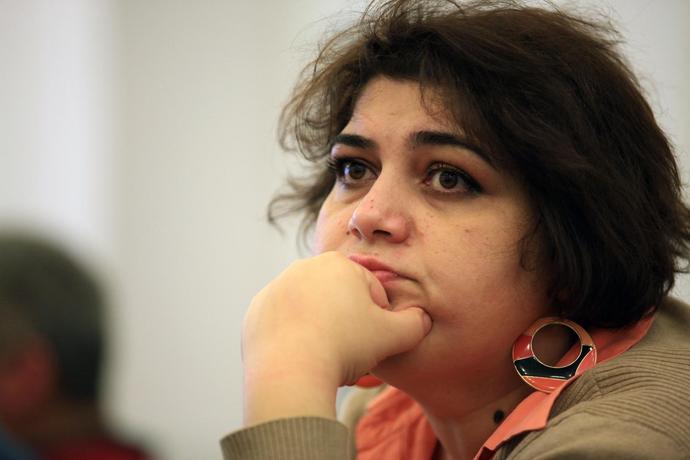
On Wednesday 25 May 2016 Azerbaijan finally released investigative journalist Khadijah Ismayilova[https://thoolen.wordpress.com/2015/12/18/azerbaijan-khadija-ismayilova-remains-in-jail-but-council-of-europe-takes-exceptional-step/] after a number of other human rights defenders were released bit by bit over the last months. Ismayilova was serving a seven-and-a-half year sentence on charges which included embezzlement, illegal business activities and tax evasion. The Supreme Court has now amended her imprisonment to 3 1/2 years of suspended sentence and released her from prison. She vowed to continue to fight to clear her name. “I will continue to fight until complete acquittal,” Ismayilova told reporters after her release. “I will also continue to work as a journalist.” The British-Lebanese lawyer Amal Clooney is representing Khadija Ismayilova at the European Court of Human Rights.
As an independent reporter and journalist of the Azerbaijani radio Azadliq (“Radio Freedom”) she has shown great courage (see: https://thoolen.wordpress.com/2014/12/11/khadija-ismayilova-azerbaijan-is-not-deterred/), and received several international prizes, such as the 2015 Alison Des Forges Award for Extraordinary Activism (HRW), the 2015 Freedom to Write Award, the 2012 Fritt Ord/Zeit Press Prize, and the 2012 Courage of Journalism Award by the Washington-based International Women’s Media Foundation.
Although there are still human rights defenders and journalists in prison, Azerbaijan provides a fine example of how awards and the combined international pressure from a variety of sources (States, NGOs and international organizations) can have an impact:
Calls of nomination for two major human rights awards are now open:
The Front Line Defenders Award for Human Rights Defenders at Risk was established in 2005. The Award seeks to focus international attention on the human rights defender’s work, thus contributing to the recipient’s personal security, and a cash prize of Euro 15,000 is awarded to the Award recipient and his/her organisation in an effort to support the continuation of this important work. If you would like to nominate a human rights defender for the Twelfth Annual Front Line Defenders Award for Human Rights Defenders at Risk (2016), please click on the following link to access a secure online nomination form: https://www.frontlinedefenders.org/secure/nomination.php (English). Age deadline is Friday 19 February 2016.
The Parliamentary Assembly of the Council of Europe (PACE), in partnership with the Vaclav Havel Library and the Charta 77 Foundation, has today issued a call for nominations for the 2016 Václav Havel Human Rights Prize, which will be awarded on 10 October in Strasbourg. The Prize aims to reward outstanding civil society action in defending human rights in Europe and beyond. Candidates should have made a real difference to the human rights situation of a given group, been instrumental in uncovering systemic violations on a large scale, or have successfully mobilised public opinion or the international community for a given cause. The Václav Havel Human Rights Prize consists of a sum of €60,000. The deadline is 30 April 2016. More details can be found at http://assembly.coe.int/nw/xml/News/News-View-EN.asp?newsid=5976&lang=2&cat=37.
—-
For more on these and other awards see True Heroes’ awards Digest:
While there has been a small let up in the incarceration of human rights defenders in Azerbaijan [see e.g. https://thoolen.wordpress.com/tag/leyla-yunus/], it remains the worst place in Europe for human rights defenders. On 25 November the appeal lodged by investigative journalist and human rights defender Khadija Ismayilova was dismissed. She has to remain in jail for 7.5 years!
[Ms. Ismayilova was arrested on December 5, 2014 on charges of “inciting” her ex-partner “to commit suicide”. Although in April 2015 the alleged victim retreated his accusations, claiming his testimony was given under pressure, blackmail and torture, the prosecution did not take it into account and maintained the charges. In February 2015, Ms. Ismayilova was further accused of embezzlement, illegal entrepreneurship, tax evasion and abuse of office. During the hearings in first instance, no evidence of these accusations was presented.On September 1, 2015, the Baku Court of Grave Crimes had sentenced Ms. Khadija Ismayilova to 7,5 years imprisonment on charges of “embezzlement”, “illegal entrepreneurship”, “tax evasion”, and “abuse of office].
As an independent reporter and journalist of the Azerbaijani radio Azadliq (“Radio Freedom”) she has shown great courage (see: https://thoolen.wordpress.com/2014/12/11/khadija-ismayilova-azerbaijan-is-not-deterred/), and received several international prizes, such as the 2015 Alison Des Forges Award for Extraordinary Activism (HRW), the 2015 Freedom to Write Award, the 2012 Fritt Ord/Zeit Press Prize, and the 2012 Courage of Journalism Award by the Washington-based International Women’s Media Foundation. Read the rest of this entry »
An interesting read is the latest report to the Council of Europe’s Parliamentary Assembly by Rapporteur: Ms Mailis REPS, Estonia, Alliance of Liberals and Democrats for Europe. The (draft) report is entitled: “Strengthening the protection and role of human rights defenders in Council of Europe member States“.
[On 19 March 2013, the Committee on Legal Affairs and Human Rights appointed Ms Mailis as rapporteur, following the departure from the Assembly of the previous rapporteur, Mr György Frunda.]
The Draft resolution and draft recommendation (AS/Jur (2015) 37) were adopted by the Committee on Legal Affairs and Human Rights on 8 December 2015 and here are some highlights:
“Azerbaijan‘s Foreign Ministry has accused some officials of international organizations of abusing their status to discredit Azerbaijan. Hikmet Hajiyev, Azerbaijani foreign ministry spokesperson, said on June 4 that officials of some international organizations abuse their status and act as the elements of a sponsored campaign to discredit Azerbaijan on the eve of the First European Games.”
Who is ‘sponsoring’ and with what inducements remains unstated except that they serve “the interests of certain political circles”.
He noted that the first European Games in Baku will serve to the development of intercultural and inter-religious dialogue, friendship, partnership and peace, which is topical in the European continent nowadays. All true, but human rights are not topical? Yes, but only when it comes to the “infringed rights of over a million Azerbaijani refugees and internally displaced persons as a result of Armenian aggression against Azerbaijan.”
Every time I now see one of the many flashy television announcements for the Baku Games starting next week, I have to think of the human rights defenders in detention there. So the effortd by many NGOs and experts to link the holding of these Games to Azerbaijan’s terrible human rights record seem to bear fruit. I have written myself several times along these lines [recently: https://thoolen.wordpress.com/2015/04/21/azerbaijan-a-formula-for-combining-sports-and-repression/], so I will not repeat all the arguments. Just to note that several heavyweights have added their voices: Read the rest of this entry »
During the last 2 days of March 2015 it decided to detain a Georgian trial observer in the airport. As ‘non co-operation’ (to use a euphemism) tends to get underreported – which is exactly why it is so attractive – here in full the interview which Giorgi Lomsadze of EurasiaNet.org had with the Giorgi Godia, the Human Rights Watch’s South-Caucasus representative who is the one who came to observe the trials of imprisoned human-rights lawyer Intigam Aliyev and rights-activist Rasul Jafarov. [The Azerbaijani government, as yet, has not provided a reason for Gogia’s detention and subsequent deportation back home.] Azerbaijan may be willing to host sports events, but fair play is not part of it.
Here is his side of the story:
EN: What happened when you arrived in Baku?
Gogia: I flew into Baku at about 1:30 on Monday afternoon [on March 30, 2015].
When I gave my passport to the border-control officer, he unthinkingly stamped it like they probably often do when they see a Georgian passport. But then something appeared to turn up on his computer screen, and he went pale. He called to some other people, and they began making calls, while I was asked to step aside.
Then they took me back through security control, took me to the transit zone and said ‘Sit here.’ They would end up taking me back and forth through security control three times on that day, and each time I had to take off my belt and shoes, and each time they went through my bag.
EN: Were you given any explanation?
Gogia: To my enquiries, they would simply respond “Mы изучаем” [We are studying this]. Time and again, they asked me: “Who are you? What is this organization you are working for? Have you been here before?” And I told them that I was there to attend the trials of [imprisoned] human-rights defenders Intigam Aliyev [a human-rights lawyer imprisoned in August 2014 and facing charges of alleged tax evasion, illegal business activities, abuse of power, embezzlement and misappropriation of funds] and Rasul Jafarov [an activist imprisoned in August 2014 and facing charges of alleged tax evasion, illegal business activities,abuse of power,embezzlement and forgery — ed].
There was not much I could do for Intigam and Rasul other than just be there for them, to show solidarity. The trials would probably be included in my reports on the human-rights situation in Azerbaijan.
As they kept making calls, it was clear they were trying to decide what to do to me. When I said I had to use the facilities, one official followed me there. As the hours went by, I was asked if I had eaten anything yet. “Here’s a pizza place,” I was told.
EN: At that point, did you tell your work or the Georgian embassy about your situation?
Gogia: I did. I had two phones, American and Georgian. We [at Human Rights Watch] decided not to go public with it quite yet.* With all the arrests in Azerbaijan, we thought that it may make things worse for me. I hoped that they would still eventually let me in and I’d get the opportunity to attend the trials.
But then two of my minders disappeared, and I was left with this guy who did not speak Russian or English. Then, even he left. It was getting late and the airport became empty.
After some communication with the Georgian consulate and their communications with the Azerbaijani side . . . I was told that I would be deported. But they did not put me on the flight back that night or the morning after.
So, I spent the night in the airport. I did not sleep a wink and was quite exhausted by the morning. Then, I thought that I was going to be arrested. It was only late in the night, 31 hours after my arrival, that I was eventually put on a flight back to Tbilisi . . .
EN: The news was that you were arrested . . .
Gogia: I was effectively detained, as they would not let me in or out for two days and one night. I am still much luckier that my Azerbaijani friends like Leyla [Yunus], Arif [Yunus], Intigam [Aliyev], Rasul [Jafarov] and Khadija [Ismayilova]. [Rights-activist Leyla Yunus, her husband, conflict-analyst Arif Yunus, and investigative journalist Khadija Ismayilova are among a number of other imprisoned government-critics — ed].
I am not sure how the news got out. In hindsight, what they did made no sense. Had they simply let me in, I would have written another report, which would have had its limited audience. The New York Times would not be reporting about it. But suddenly I was everywhere in the news and tweets kept going out, and they got much more damage to their reputation. . .
EN: Will you try to get into Azerbaijan again?
Gogia: I hope that I will be allowed into Azerbaijan. I am hoping, and I am working on it, that the Georgian embassy will pass a note [diplomatique] to the Azerbaijani side, and that a solution will be found.
EN: You’ve long followed Azerbaijan. What is the human rights situation in Azerbaijan?
Gogia: Azerbaijan was never an easy place to work. But it was relatively recently that things started getting really bad. I long monitored the situation in Azerbaijan and for the past two years I watched how the country has been closing up.
First, they began preventing transfers of foreign grants for human right projects. The local chiefs of party for international democracy watchdogs like ISFED [International Society for Human Rights and Democracy] were arrested. They shut down major international groups like World Vision, the Soros Foundation, IREX.** Then, they went after lawyers, journalists, activists . . .
EN: Why do you think this is happening?
Gogia: I think it is a combination of factors. First, there was the Arab Spring and the authorities became wary of youth activists and began arresting them in droves, like the NIDA [youth] activists. Then, there was [in 2012] Eurovision, which was largely a vanity-project for the government, but human-rights organizations seized the opportunity to put rights-violations in the spotlight then and Azerbaijan got so much bad press that they began another civil society and media clampdown. Later, came Euromaidan [in Ukraine], prompting more fears among the élites that such upheavals can spill over.
Now, they are preparing for the “Olympics” [this June]; the European Games that Azerbaijan pretty much invented. It is designed as another success story for the government and they don’t want to take any chances about getting bad press and are silencing everyone that they can silence. I don’t expect it to get any better after the Games, as then there will be parliamentary and, later on, presidential elections.
EN: The response from the international community to the situation in Azerbaijan is often considered to be too soft . . .
Gogia: The thing is that Azerbaijan’s geopolitical importance has been increasing in the light of the Ukrainian-Russian war. The West could use a strategic partner in the region and Azerbaijan’s energy resources, too. So, Azerbaijan speaks to Europe from this vantage point.
The European Union stops short of taking it to task, even if it runs counter to the EU’s own commitments to working on promoting human rights internationally. Previously, the EU sought a Strategic Partnership for Modernization agreement with Azerbaijan. Then, Baku made it clear that it not that interested in closer ties with the EU; at least, not to a degree to take up a commitment to modernize and change the way things are done. Since then, the EU has switched to discussing a less ambitious Strategic Partnership Agreement.
With only mild criticism coming from the EU, the Azerbaijani authorities are proceeding with impunity . . . Not only was Baku not taken to task for this, but went on to become the chair of the Committee of Ministers of the Council of Europe, one of the world’s main human-rights organizations.
When [President] Ilham Aliyev spoke to the Parliamentary Assembly of the Council of Europe last June, he was defiant and responded sharply to criticism. Then I wrote in a report that “if President Aliyev is this belligerent when addressing such a high tribune and assembly members, we should all be really worried what future holds for his critics at home.”
Unfortunately, those words proved prophetic. And until Azerbaijan’s authorities see that there is a price for what they are doing, it will only get worse.
This video clip is an excellent introduction to the the question of whether Azerbaijan still belongs in the Council of Europe.
Azerbaijan wrapped up its chairmanship on November 13 of the Committee of Ministers of the Council of Europe. Azerbaijan took over as chair of the Committee of Ministers, the Council of Europe’s executive arm and decision-making body, back in May. Over the course of its six-month term, authorities in Baku bullied and imprisoned scores of journalists and human rights defenders, jailing some of the country’s most prominent such as Leyla and ArifYunus, on trumped-up charges. Azerbaijani Foreign Minister Elmar Mammadyarov attended a ceremony in Strasbourg on November 13 marking the transfer of the chairmanship from Azerbaijan to Belgium. A document posted on the Council of Europe’s website states that “Azerbaijan deployed considerable efforts in furthering the objectives of the Council of Europe around its three key pillars – human rights, rule of law and democracy.”
This assertion makes a mockery of reality as shown by the statements of a great many actors from international NGOs, OSCE to regional defenders networks:
Giorgi Gogia, senior researcher at Human Rights Watch: “It can be said without exaggeration that Azerbaijan’s tenure represented an assault on the institution and everything it [the Council of Europe] stands for”.
Two regional networks, the Human Rights House Network and the South Caucasus Network of Human Rights Defenders, addressed an open letter to President Ilham Aliyev, detailing government rights abuses and calling for immediate changes. “We specifically call upon you [Aliyev] to immediately and unconditionally release all civil society actors currently detained due to their engagement in human rights activities and for raising critiques against Azerbaijan’s authorities”.
Another rights network called the Civic Solidarity Platform released the No More Business as Usual video at the top of this post, urging policymakers in European Union member states to hold Azerbaijan accountable for its rights violations. “It is a disgrace Azerbaijan used its chairmanship … not to improve its human right record, but, on the contrary, to jail activists and journalists and to get further away from international standards of democracy and rule of law.”
Dunja Mijatovic, media representative of the normally careful 57-nation Organisation for Security and Cooperation in Europe (OSCE), said in a statement “Practically all independent media representatives and media NGOs have been purposefully persecuted under various, often unfounded and disturbing charges“. [She spoke after Azeri blogger Mehman Huseynov was detained at Baku international airport earlier in the day while trying to depart for Georgia to attend the 11th South Caucasus Media Conference on the invitation of the OSCE. Huseynov was released after several hours of questioning. In 2012 he was hit with a three-year travel ban after being convicted of resisting and insulting police.
Michael Georg Link, Director of the OSCE Office for Democratic Institutions and Human Rights (ODIHR), on 31 October cited the case of Azerbaijani human rights defender and journalist Khadija Ismayilova in calling on OSCE participating States to refrain from pressuring or harassing individuals for their legitimate activities in supporting the promotion and protection of human rights. “Ismayilova was detained and questioned at the end of September upon returning from the OSCE Human Dimension Implementation Meeting in Warsaw, where she raised concerns over failures by the Azerbaijani authorities to meet the country’s commitments in the area of human rights and fundamental freedoms,” Link said. “I raised her case yesterday in my first report to the OSCE Permanent Council, stressing that human rights defenders have to be able to work free of harassment and intimidation.” A clear case of reprisal!
Several other human rights defenders were sentenced to varying prison terms earlier this year on charges included tax evasion, illegal business activity and hooliganism. Defense lawyers called the charges unfounded and politically motivated. https://thoolen.wordpress.com/2014/08/18/azerbaijan-a-hot-summer-in-summary/
October is awards season, so you should know that the 2014 Andrei Sakharov Freedom Award recognizes 98 political prisoners in Azerbaijan. [Note : there is also the European Parliament’s Sakharov Prize – of more info please go to: http://www.trueheroesfilms.org/thedigest/awards]
The Norwegian Helsinki Committee’s Secretary General, Bjørn Engesland, announced the award in Oslo on 6 October, noting the sad fact that Azerbaijan’s political prisoners “are too numerous to all be mentioned here.” The Committee has documented 98 political prisoners, among them 13 journalists and bloggers. In addition, the prisoners include 10 human rights defenders and civil society activists, nine youth activists, a prominent opposition leader, “and many other opposing voices and religious activists.” The Committee noted that Azerbaijan assumed the Presidency of the Council of Europe’s Committee of Ministers this year.“Just weeks after Azerbaijan took over the chairmanship in May 2014, a new wave of detention of activists started. In what appears as a sign of contempt against the Council of Europe institutions, this wave in particular hit human rights defenders who have worked hard with the Council for the recognition and release of Azerbaijani political prisoners.




 Hans Thoolen on Human Rights Defenders and their awards