Posts Tagged ‘Belarus’

Winners of 2023 UN Human Rights Prize Announced

July 22, 2023
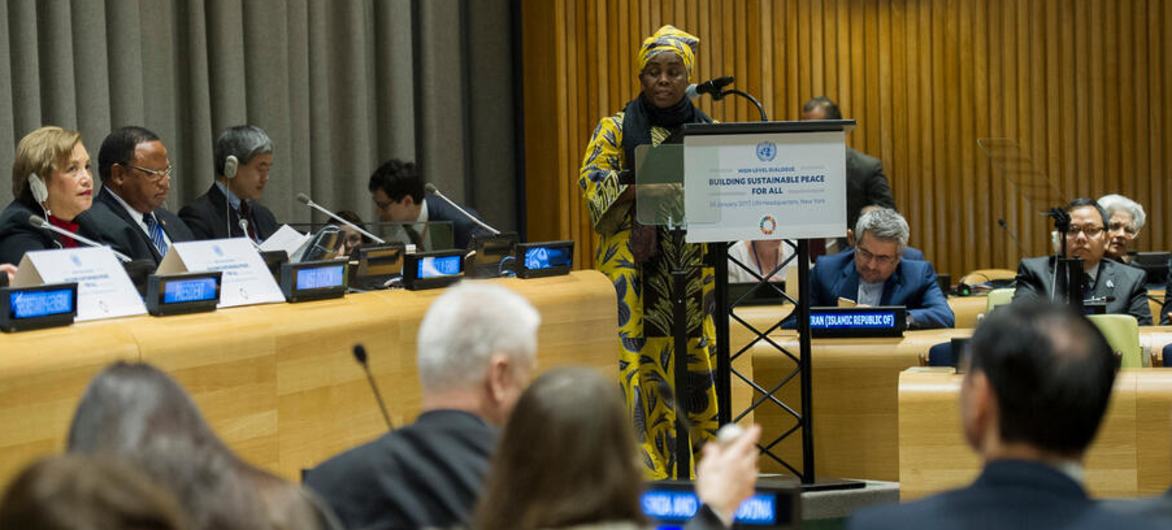
Julienne Lusenge, one of the 2023 UN Human Rights Prize winners speaking at the General Assembly high-level dialogue on “Building Sustainable Peace for All” earlier this year.

Julienne Lusenge, one of the 2023 UN Human Rights Prize winners, speaking at the General Assembly high-level dialogue on “Building Sustainable Peace for All” earlier this year. UN Photo/Manuel Elías

On 20 July 2023 the President of the General Assembly Csaba Kőrösi announced the winners of the United Nations Prize in the Field of Human Rights for 2023. 

For more on this prize which is awarded every five see: https://trueheroesfilms.org/thedigest/awards/74A3B502-F3DF-4DDB-8D6F-672C03B4A008

This year’s winners were the Human Rights Center “Viasna”, based in Belarus, Julienne Lusenge from the Democratic Republic of the Congo [see also: https://humanrightsdefenders.blog/2021/10/11/congolese-julienne-lusenge-wins-1-million-2021-aurora-prize/], Amman Center for Human Rights Studies from Jordan, Julio Pereyra from Uruguay and the Global Coalition of civil society organizations, Indigenous Peoples, social movements and local communities.

The recipients of the Prize were chosen by a Special Committee from more than 400 nominations received from Member States, the UN system, and civil society. 

The Committee is chaired by the President of the General Assembly, and its members include the President of the Economic and Social Council, the President of the Human Rights Council, the Chair of the Commission on the Status of Women, and the Chair of the Advisory Committee of the Human Rights Council

The Office of the UN High Commissioner for Human Rights (OHCHR) provided support to the special committee.  The award ceremony for the 2023 Prize will take place at UN Headquarters in New York in December 2023, as part of activities to commemorate Human Rights Day. 

The members of the Special Committee also acknowledged the important role played by human rights defenders and activists, praising them for their courage and dedication while strongly condemning any attempts to “silence and intimidate” them.

They expressed solidarity with those who are detained in retaliation for their work in defending human rights and pursuing the implementation of all the provisions of the Universal Declaration of Human Rights, marking it’s 75th birthday this year.

https://news.un.org/en/story/2023/07/1138957

https://www.ohchr.org/en/about-us/what-we-do/un-human-rights-prize/2023-recipients

State of Human Rights in Belarus called ‘Catastrophic’ at the UN

July 12, 2023
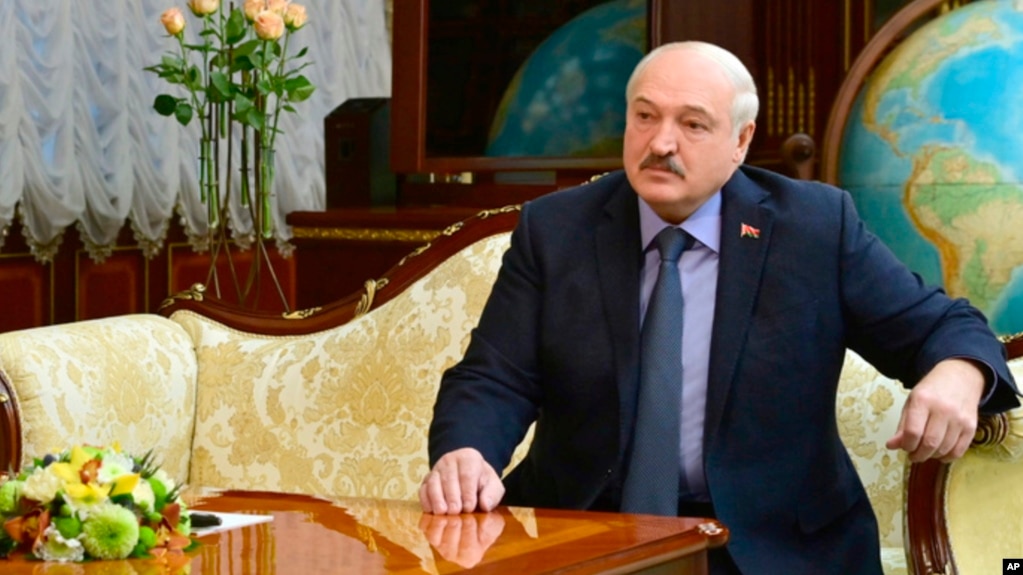
The regime of Belarusian President Alexander Lukashenko — seen here in Minsk, Belarus, on April 10, 2023 — is deliberately purging civil society of its last dissenting voices, a United Nations special rapporteur told the U.N. Human Rights Council on Tuesday.

The human rights situation in Belarus is catastrophic, and only getting worse, the United Nations special rapporteur on the country said on 4 July 2023, according to AFP.

Belarusian leader Alexander Lukashenko’s regime in Minsk is deliberately purging civil society of its last dissenting voices, Anais Marin told the U.N. Human Rights Council.

“The situation remains catastrophic. Unfortunately, it keeps on worsening,” said the special rapporteur on the human rights situation in Belarus. “The Belarusian government amended an already restrictive legislation aimed at dismantling civic freedoms, leading to a surge in politically motivated prosecutions and sentencing.

“The lack of accountability for human rights violations fosters a climate of fear among victims and their families,” Marin said. Marin has been in post for five years and reminded the council that she alerted them two years ago to the “totalitarian turn” taken by Minsk, evidenced by the “disregard for human life and dignity” during the crackdown on peaceful protesters in 2020. In her annual report, the French political scientist said more than 1,500 individuals were still being detained on politically motivated charges, with a daily average of 17 arbitrary arrests since 2020.

“I have good reasons to believe that prison conditions are deliberately made harsher for those sentenced on politically motivated grounds, by placing them in punishment cells for petty infraction to prison rules,” said Marin.

“No one has been held accountable in Belarus for arbitrarily detaining tens of thousands of peaceful protesters in 2020, nor for the violence or torture many of them have been subjected to.

“This general impunity, and the climate of fear resulting from ongoing repression, have compelled hundreds of thousands of Belarusians into exile.

Human rights defenders face ongoing persecution, she said, with more than 1,600 “undesirable organizations forcibly dissolved, including all remaining independent trade unions.

“This illustrates a deliberate state policy of purging civic space of its last dissenting elements,” she said.

Marin said independent media outlets had been labelled as “extremist organizations,” while academic freedom is “systematically attacked.”

“Ideological control and disciplinary measures restrict freedom of opinion and their expression,” she said.

Primary and secondary education is also subject to “ideological control,” with children “discouraged from expressing their own opinions” and facing “threats and consequences” for holding dissenting views.

Consequences for speaking out

As for the Russian invasion of Ukraine, individuals face challenges when trying to speak out against it or question Belarus’s role in facilitating the 2022 invasion.

“Anti-war actions led to numerous detentions and arrests, some on charges of planning terrorist attacks — a crime which can now be punished by death,” she said.

Belarus was immediately offered the Human Rights Council floor to respond to Marin’s comments but was not present.

On 11 July HRW underlined this with the case of Belarusian lawyer Yulia Yurhilevich and journalist Pavel Mazheika who ace up to seven years in prison

https://www.eeas.europa.eu/delegations/un-geneva/hrc53-interactive-dialogue-situation-human-rights-belarus-eu-statement_en?s=62

https://www.voanews.com/a/state-of-human-rights-in-belarus-catastrophic-un-told-/7167606.html

https://www.hrw.org/news/2023/07/11/travesty-justice-reaches-new-low-belarus

Ales Bialiatski sentenced to 10 years in jail

March 9, 2023

Belarus court sentences Ales Bialiatski to 10-year jail term, The sentencing of the Nobel Peace Prize winner and human rights defender has triggered protests. Media and human rights defenders across the world said that his arrest is ‘politically motivated’. See also: https://humanrightsdefenders.blog/2022/10/08/meet-ales-bialiatski-nobel-peace-prize-2022/

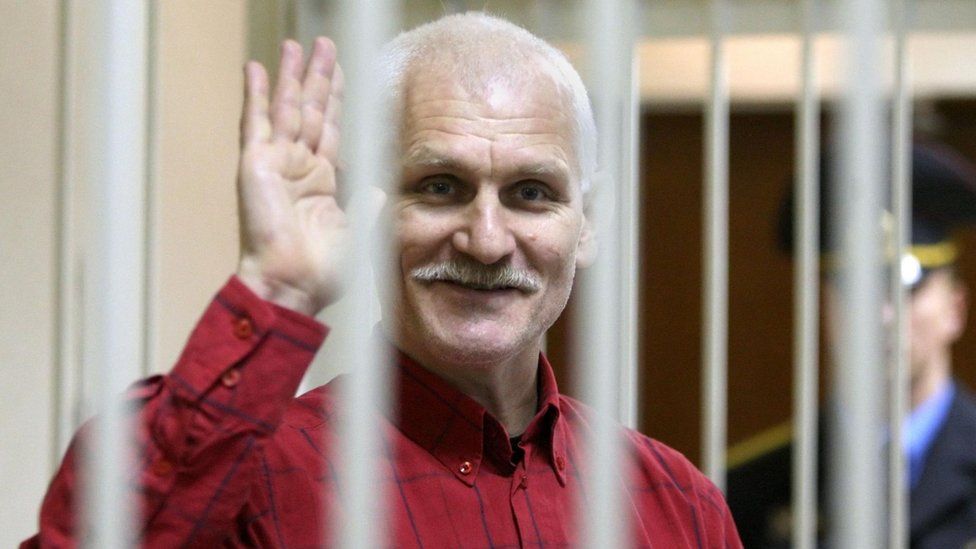
Ales Bialiatski pictured in November 2021
Image caption, Ales Bialiatski pictured in November 2021

Oliver Slow of BBC News reported as follows¨

…Supporters of Mr Bialiatski, 60, say the authoritarian regime of Belarusian leader Alexander Lukashenko is trying to silence him. He was arrested in 2021 following massive street protests over widely disputed elections the previous year, and accused of smuggling cash into Belarus to fund opposition activity. Demonstrators were met with police brutality and Lukashenko critics were regularly arrested and jailed during the demonstrations, which started in 2020.

Mr Bialiatski was in court alongside two fellow campaigners, Valentin Stefanovich and Vladimir Labkovich.

Mr Stefanovich was sentenced to nine years in prison, while Mr Labkovich received seven years, according to Viasna, the group Mr Bialiatski founded in 1996. All three had pleaded not guilty.

Mr Bialiatski’s wife, Natalya Pinchuk, said the trial was “obviously against human rights defenders for their human rights work”, describing it as a “cruel” verdict.

Referring to her husband’s letters from prison, where he has been held since arrest, she said: “He always writes that everything is fine. He doesn’t complain about his health – he tries not to upset me.”

Kostya Staradubets, a spokesperson for Viasna, said the sentences imposed on the three activists were “breaking our hearts”.

Speaking to the BBC World Service’s Newshour programme, he said: “We knew that our three colleagues would get long prison terms but anyway it’s still a shock, it’s breaking our hearts, not only the [prison] terms are long but the conditions also very horrific.

Belarus’s exiled opposition leader Svetlana Tikhanovskaya said the sentencing was “simply appalling”. “We must do everything to fight against this shameful injustice and free them,” she said.

Berit Reiss-Andersen, chair of the Norwegian Nobel Committee that awards the Nobel Peace Prize, said the verdict was a “tragedy” for Mr Bialiatski and described the charges as “politically motivated”.

In awarding the 2022 Nobel Peace Prize to Mr Bialiatski, Ms Reiss-Anderson said the Belarusian government had “for years tried to silence him”. “He has been harassed, he has been arrested and jailed, and he has been deprived of employment,” she said.

European Union foreign policy chief Josep Borrell condemned what he described as “sham trials”, adding they were “yet another appalling example of the Lukashenko regime trying to silence those who stand up in defence of human rights and fundamental freedoms of the people in Belarus”.

There are currently 1,458 political prisoners in Belarus, according to Viasna. Authorities claim there are none.

Mr Bialiatski is a veteran of the human rights movement in Belarus, establishing Viasna in 1996 in response to the brutal crackdown of street protests that year by Mr Lukashenko, who has been president of Belarus since the office was established in 1994. See: ¨https://humanrightsdefenders.blog/2022/10/07/nobel-peace-prize-2022-goes-to-well-recognised-human-rights-defenders/

This was followed by the sentencing of women journalists: https://www.theguardian.com/world/2023/mar/18/belarus-jails-senior-staff-at-independent-news-site-in-crackdown-on-lukashenko-critics

https://www.bbc.com/news/world-europe-64833756

https://www.livemint.com/

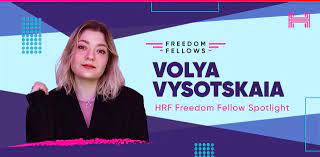
Meet Volya Vysotskaia, a Belarusian human rights defender

January 12, 2023

Meet HRF Freedom Fellow Volya Vysotskaia, a Belarusian human rights activist who exposes repression and torture by state officials. 

Vysotskaia is currently part of the 2022 Freedom Fellowship, a programme of the Human Rights Foundation, a one-year program that provides hands-on, expert mentorship across seven critical areas: leadership, movement-building, organizing, fundraising, media, mental health, and digital security.

On September 27, the Investigative Committee of the Republic of Belarus announced that five people would be tried in absentia — Vysotskaia is one of them. She has since been denied information about the trial, and her request to appear virtually was rejected. Should she return to Belarus, a country where torture and inhuman treatment is routine, officials will likely detain her.

Learn more about Vysotskaia’s case.

Q: Can you tell us about your activism protecting democracy in Belarus?

A: From August 2020 to October 2021, I was an editor of the Telegram channel, the “Black Book of Belarus.” Our work “de-anonymized” or identified law enforcement officers and other government authorities who committed human rights violations, hiding behind their high-power statuses. We published the pictures and personal data of riot police officers, prosecutors, judges, and other officials to hold them accountable for their repression of Belarusian citizens demanding democracy and freedom. 

Q: What led to the criminalization of the Black Book of Belarus’ editors and readers? 

A: In October 2020, a special service agent infiltrated our team and leaked information about members. Previously, he was part of the special operation that hijacked a Ryanair flight in May 2021 to imprison Sofia Sapega, another team member. After we uncovered the agent, my team and I were chased down in Vilnius, and dozens of people in the Telegram group were also imprisoned. 

Q: What is unique about your criminal case? 

A: The case brought against my four colleagues and me is the first trial in absentia in the country’s history. We have been accused of “exasperation of enmity” and “social disagreement,” as well as illegal actions relating to private life and personal data. The Belarusian KGB has also added us to the list of individuals engaging in “extremist activities.” Belarusian courts recognize almost all civil society organizations as extremists, but we will be the first to be tried and sentenced without the opportunity to defend ourselves. 

Belarusian authorities are undoubtedly denying us the right to a fair trial. Notably, I was denied access to information about my criminal case, and I never met the lawyer assigned to me, nor did the lawyer ever respond to my calls. 

Q: What is the scope of legal harassment against Belarusian pro-democracy activists in exile? 

A: The Lukashenko government changed the criminal procedural law back in July and invented a special proceeding for trying in absentia those who are engaged in “anti-state activities,” and living in exile. The addendum of this new procedural law provides that defendants are no longer aware of the content of their cases. It is sufficient for the legislative body to post this information on official websites, which clearly violates Article 14 of the International Covenant on Civil and Political Rights (ICCPR).

Q: What should the international community learn from your case? 

A: The violations of the right to a fair trial, among other rights, didn’t start in Belarus with our case. It just brings back the attention of the international community to the fact that the repressions in Belarus haven’t stopped. They continue every day. The power, the judicial system, and the independence of Belarus with Lukashenko are fake. The regime represses and scares the Belarusians inside the country, and while the international community doesn’t react to the severe violations of human rights, the regime spreads its attention to those living in exile. Because silence allows them to do that.

The international community has to learn that there have to be efficient mechanisms for bringing perpetrators to trial until they destroy whole nations, as well as to guarantee the defense for the victims of violations. International justice can’t be built on the international ignorance of injustice. Being concerned doesn’t stop dictators.Repression in Belarus. HRF condemns the actions of Alexander Lukashenko’s regime and stands with Volya and all Belarusians who speak truth to power, even when their lives are at risk

The Freedom Fellowship is a one-year program that gives human rights advocates, social entrepreneurs, and nonprofit leaders from challenging political environments the opportunity to increase the impact of their work. Through mentorship and hands-on training sessions, fellows develop critical skills and join a growing community of human rights activists.

https://hrf.org/category/freedom-fellows/

Belarusian Human Rights defender Aleh Hulak dies

December 18, 2022
Aleh Hulak
Aleh Hulak © 2022 Belarusian Helsinki Committee

On 16 December, 2022 Human Rights Watch published “In Memory of Aleh Hulak“, chair of the Belarusian Helsinki Committee (BHC) and a long-time leader of the Belarus human rights movement. Hulak, 55, led the Helsinki Committee with courage and unwavering commitment, including through the country’s recent, vicious crackdown on rights and the entrenchment of President Aliaksandr Lukashenka’s autocracy.

The BHC, one of the country’s oldest human rights groups, has a broad mandate to advance civil and political, and social and economic rights. Hulak was a strong voice for free speech and the release of political prisoners and also for fair work conditions, and upholding human rights in business, trade union operations and health care.  

The Belarusian government liquidated the BHC in 2021, along with hundreds of other independent groups. Hulak for years had pursued, against all odds, the group’s accreditation at the United Nations Economic and Social Council. In a bittersweet victory, his efforts succeeded less than two months ago.

https://www.hrw.org/news/2022/12/16/belarus-memory-aleh-hulak

Meet Ales Bialiatski, Nobel Peace Prize 2022

October 8, 2022

True Heroes Films (THF) has published a timely portrait of Ales Bialiatski, winner of the Nobel Peace Prize 2022, drawn from an in-depth interview with him at the Paris Summit for Human Rights Defenders in Paris, October 2018.

See also: https://humanrightsdefenders.blog/2022/10/07/nobel-peace-prize-2022-goes-to-well-recognised-human-rights-defenders/

Nobel Peace Prize 2022 goes to well-recognised human rights defenders

October 7, 2022

On 7 September 2022 The Norwegian Nobel Committee decided to award the Nobel Peace Prize for 2022 to one individual and two organisations, who represent civil society in their home countries. They have for many years promoted the right to criticise power and protect the fundamental rights of citizens. They have made an outstanding effort to document war crimes, human right abuses and the abuse of power. Together they demonstrate the significance of civil society for peace and democracy.

This year’s Peace Prize is awarded to human rights advocate Ales Bialiatski from Belarus, the Russian human rights organisation Memorial and the Ukrainian human rights organisation Center for Civil Liberties. The first two are well-known and received many important human rights awards.

Ales Bialiatski was the winner of 11 other awards, see: https://www.trueheroesfilms.org/thedigest/laureates/72682FFF-628F-4A5D-B6B3-52A776FF0E47, while Memorial got 7 awards earlier [see: https://www.trueheroesfilms.org/thedigest/laureates/BD12D9CE-37AA-7A35-9A32-F37A0EA8C407], Oleksandra Matviichuk, the chair of the Ukrainian Center for Civil Liberties received a few days ago the Right livelihood award [see: https://www.trueheroesfilms.org/thedigest/laureates/75690f04-7a51-4591-8e18-0826b93959b3]

Ales Bialiatski founded the organisation Viasna (Spring) in 1996 in response to the controversial constitutional amendments that gave the president dictatorial powers and that triggered widespread demonstrations. In the years that followed, Viasna evolved into a broad-based human rights organisation that documented and protested against the authorities’ use of torture against political prisoners. Government authorities have repeatedly sought to silence Ales Bialiatski. He was imprisoned from 2011 to 2014. Following large-scale demonstrations against the regime in 2020, he was again arrested. He is still detained without trial. Despite tremendous personal hardship, Mr Bialiatski has not yielded an inch in his fight for human rights and democracy in Belarus. See also: https://humanrightsdefenders.blog/tag/viasna-human-rights-centre/

The human rights organisation Memorial was established in 1987 by human rights activists in the former Soviet Union who wanted to ensure that the victims of the communist regime’s oppression would never be forgotten. Nobel Peace Prize laureate Andrei Sakharov and human rights advocate Svetlana Gannushkina were among the founders. Memorial is based on the notion that confronting past crimes is essential in preventing new ones. After the collapse of the Soviet Union, Memorial grew to become the largest human rights organisation in Russia. In addition to establishing a centre of documentation on victims of the Stalinist era, Memorial compiled and systematised information on political oppression and human rights violations in Russia. Memorial became the most authoritative source of information on political prisoners in Russian detention facilities. The organisation has also been standing at the forefront of efforts to combat militarism and promote human rights and government based on rule of law. During the Chechen wars, Memorial gathered and verified information on abuses and war crimes perpetrated on the civilian population by Russian and pro-Russian forces. In 2009, the head of Memorial’s branch in Chechnya, Natalia Estemirova, was killed because of this work. [see also: https://humanrightsdefenders.blog/2019/07/15/ngos-remember-10th-anniversary-of-natalia-estemirovas-murder/]

Civil society actors in Russia have been subjected to threats, imprisonment, disappearance and murder for many years. As part of the government’s harassment of Memorial, the organisation was stamped early on as a “foreign agent”. In December 2021, the authorities decided that Memorial was to be forcibly liquidated and the documentation centre was to be closed permanently. The closures became effective in the following months, but the people behind Memorial refuse to be shut down. In a comment on the forced dissolution, chairman Yan Rachinsky stated, “Nobody plans to give up.” [see also: https://humanrightsdefenders.blog/2021/12/29/russias-supreme-court-orders-closure-emblematic-memorial/]

The Center for Civil Liberties was founded in Kyiv in 2007 for the purpose of advancing human rights and democracy in Ukraine. The center has taken a stand to strengthen Ukrainian civil society and pressure the authorities to make Ukraine a full-fledged democracy. To develop Ukraine into a state governed by rule of law, Center for Civil Liberties has actively advocated that Ukraine become affiliated with the International Criminal Court. After Russia’s invasion of Ukraine in February 2022, Center for Civil Liberties has engaged in efforts to identify and document Russian war crimes against the Ukrainian civilian population. In collaboration with international partners, the center is playing a pioneering role with a view to holding the guilty parties accountable for their crimes.

By awarding this Nobel Peace Prize for 2022 the Norwegian Nobel Committee is honouring outstanding champions of human rights and consistent efforts in favour of humanist values, anti-militarism and principles of law.

https://www.nobelprize.org/prizes/peace/2022/press-release/

#EndReprisals campaign continues throughout HRC 51

September 20, 2022

Human rights defenders promote dignity, fairness, peace and justice in their homes, workplaces, communities and countries. They challenge governments that fail to respect and protect their people, corporations that degrade and destroy the environment, and institutions that perpetuate privilege and patriarchy. For many, the United Nations (UN) is the last arena in which they can confront abuses. 

Human rights defenders must be able to share crucial information and perspectives with the UN safely and unhindered. Yet some States try to escape international scrutiny by raising obstacles – such as intimidation and reprisals – aimed at creating fear and systematically hindering defenders’ access to and cooperation with human rights mechanisms. See my post of today: https://humanrightsdefenders.blog/2022/09/20/human-rights-defenders-at-the-51st-session-of-the-un-human-rights-council/

This needs to change! Join the campaign of the International Service for Human Rights today so human rights defenders have a seat at the UN table.

What can you do? ISHR and partners have worked to support individual defenders and organisations that have endured multiple forms of reprisals and intimidation. Take action for them now and help #EndReprisals!

Here are two quick, impactful actions you can take:

Write to State representatives at the UN and urge them to take up cases from Belarus, Burundi, China, Egypt, and Venezuela
Click to tweet a message in solidarity with the individuals or groups described in a specific case:

 Tweet for Viasna in Belarus

Tweet for human rights lawyers in Burundi

Tweet for Jiang Tianyong in China

Tweet for Ibrahim Metwally Hegazy in Egypt

Tweet for NGOs in Venezuela

Join the campaign

Aarhus Convention on environmental information gets especially experienced rapporteur

July 22, 2022

Michelle Langrand wrote in Geneva Solutions of 20 July 2022 that the “Michel Forst was elected special rapporteur for environmental defenders in June by the Aarhus Convention on environmental information.”

The newly appointed special rapporteur on environmental defenders Michel Forst will be able to intervene when environmentalists in the pan-European region are at risk of being attacked or penalised.

Defending the planet’s health can be a dangerous line of work – at times deadly. Two thirds of defenders murdered worldwide are environmental advocates, with 227 killings reported in 2020. While attacks in Europe and Central Asia are not as frequent as in other parts of the world, industries and governments publicly exposed for polluting or turning a blind eye to environmental crimes have been known to retaliate with harassment, legal action and even violence.

Environmental defenders in Ukraine documenting the impacts of the war or campaigners in Switzerland practising civil disobedience to alert the public about the climate threat can now turn to a UN expert to rapidly intervene on their behalf.

Elected at the end of June by parties to the Aarhus convention on the right to information about environmental issues, Michel Forst is the world’s first UN special rapporteur on environmental defenders. The nomination follows a 2021 decision by European and central Asian countries to create a rapid response mechanism amid a rise in attacks against defenders. [see https://humanrightsdefenders.blog/2021/10/26/aarhus-convention-gets-new-mechanism-to-protect-environmental-defenders/]

The French 71-year-old was UN special rapporteur on human rights defenders from 2014 to 2020.

Forst’s plans for the next four years are still being concocted. “It’s a very new mandate,” he told Geneva Solutions. To develop the tools and mechanisms he’ll be using throughout his term, he won’t have to look very far.

“I’ll be looking at how the working methods developed by the Office of High Commissioner of Human Rights could be implemented in this mandate, for instance, receiving complaints, sending communications to states when we know that rights have been violated and issuing public statements as well,” he said.

The complaints system will be one of Forst’s flagship measures and a chance to take it one step further. When UN experts under the Human Rights Council receive a complaint and write to a state asking for an explanation, the government has 60 days to reply, rendering it ineffective when a person’s life or security is at risk, he noted.

“We need to understand how it could be made effective because rapid response means that the special rapporteur has the possibility to intervene immediately by different means.”

The expert will also resort to what he calls “quiet diplomacy”, meeting with ambassadors both in Geneva and abroad, where there might be “systemic attacks against defenders”.s

Forst was elected by consensus by the parties to the Aarhus convention – an encouraging start for the expert. But not all governments will be easy to approach when they’re the ones in the hot seat. The most notable one is Belarus, sanctioned last year by fellow party members for closing down an anti-nuclear NGO that was collaborating with an expert body of the Convention. The country has deployed one of the most severe crackdowns in recent years in the region against civil society, and is on Forst’s to-do list. The country did not support the idea of creating a mechanism in the beginning, according to observers, although it did not oppose the proposal during the formal adoption last year. Last week, it was a no-show for the French expert’s nomination.

“​​Belarus is one of the last countries that I visited as special rapporteur on human rights defenders and on that occasion I met with a number of environmental defenders. I also had lengthy discussions with both the minister for foreign affairs and the minister of justice about the cases and to look at how my mandate at that time could help support government efforts to convict the perpetrators of attacks against defenders,” he said.

“Security forces employed by companies are the main perpetrators against environmental defenders. Part of the mandate is not only to speak to states, but also to companies and to draw attention to them, and to the countries in which they have their seat, over cases of maladministration, corruption or acts against defenders,” Forst said.

His efforts could add pressure on European countries to toughen corporate responsibility laws that could help protect defenders in countries beyond the convention’s jurisdiction. Within the country borders of the agreement, campaigners would also like to see Forst tackle legal abuses against environmental defenders that fall in a grey zone.

Yves Lador, Geneva representative for EarthJustice, told Geneva Solutions: “We see a worrying trend in democratic countries of targeting environmental activists directly through laws through different levels.

https://genevasolutions.news/climate/threatened-environmentalists-have-a-new-protector

Polish Border NGO Granica receives 2022 Zabel award

May 20, 2022

Human Rights First announced that it will present Grupa Granica with the William D. Zabel Human Rights Award 2022 in recognition of its commitment to human rights at the Poland-Belarus border.

For more about this award and its laureates, see: https://www.trueheroesfilms.org/thedigest/awards/984CA015-FE02-4992-8AED-4EB1AEC7D0EE

Grupa Granica are front-line human rights defenders working at a flashpoint for human rights and freedom of migration,” said Michael Breen, president and CEO of Human Rights First. “We hope that Human Rights First’s presentation of the William D. Zabel Award provides additional recognition to the importance of their work and helps to stem this humanitarian and geopolitical crisis.

Formed in 2021 in response to the humanitarian crisis at the Polish-Belarusian border, Grupa Granica is an informal network of Polish NGOs, activists, and inhabitants of the border region that provides humanitarian, medical, and legal aid to migrants stranded in the forests there.  They monitor the situation on the ground, provide assistance to people searching for missing family members, document human rights violations and educate Polish society on the situation at the border.

Our network was formed in August last year in response to the humanitarian crisis at the Polish-Belarusian border. It consists of local inhabitants, activists, NGO staff, doctors, lawyers, interpreters, psychologists, public figures and many others working hand in hand to save the lives of migrants stranded at the border,” says Marta Górczyńska of Grupa Granica.  “This prestigious award sends a clear message to the public that despite the recent attempts by the Polish authorities, providing humanitarian aid and defending human rights must never be criminalized. We hope it will also make it more difficult for the international community to turn a blind eye to the violations at the border.”

The 2022 award will be officially presented to Grupa Granica on June 8. 

For last year’s, see: https://humanrightsdefenders.blog/2021/05/27/william-zabel-human-rights-award-2021-to-philippines-ngo-karapatan/

https://www.humanrightsfirst.org/press-release/human-rights-first-present-poland-s-grupa-granica-2022-william-d-zabel-human-rights