Posts Tagged ‘Arab spring’

AWID report on illegal detention of Women Human Rights Defenders in Sudan

June 3, 2013

AWID_logo

 Via Protection on Line I got this fairly detailed report by Katherine Ronderos done for AWID on the situation of women human rights defenders in Sudan. It tells how the Sudanese people, inspired by the Arab spring and led by women and youth, took the streets of Sudan demanding regime change in 2011. Authorities violently cracked down on these demonstrations, detaining more than 150 women, who were sexually abused or tortured, injured and beaten in the protests. Since June 2012, new protests against the Sudanese regime have intensified violence against women human rights defenders.

via Illegal detention of Women Human Rights Defenders in the midst of the border conflict of Sudan | | ProtectionlineProtectionline.

Mona Seif continues her work: campaign to free Hassan Mustafa

May 4, 2013

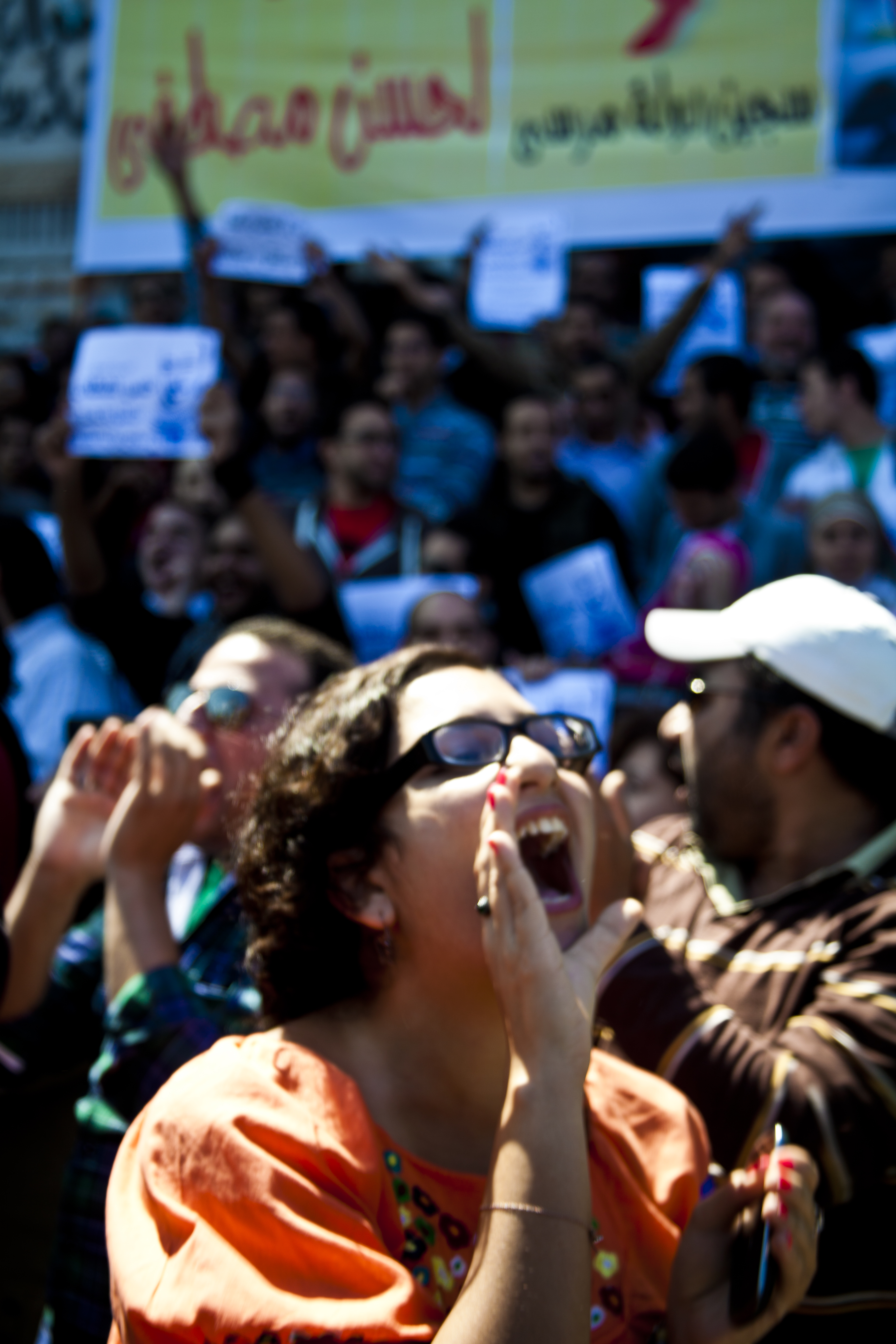
Mona Seif – on of the 2013 MEA nominees – calls on people to campaign for the liberation of Hassan Mustafa, a leading human rights defender in Alexandria, Egypt, who was sentenced 2 years in prison.

Hassan was arrested on 21 January 2013 as he was filing a complaint inside Mansheyya Courts Complex, at the prosecutor general’s office, against the random detention of protesters & children from a protest outside the same Court on the previous day. The protest was taking place during the trial of police officers accused of killing protesters in the 25 January Revolution. He was then falsely accused of attacking a prosecutor causing prosecutors cheeks to turn red (“the prosecutor actually supplied a medical report claiming so !”). Read the rest of this entry »

Breaking News: Final Nominees Martin Ennals Award 2013 made public

April 24, 2013

The Martin Ennals Jury just announced today (at 11h00 local time) the three Final Nominees for the Martin Ennals Award 2013. The MEA is the main award of the whole human rights movement thanks to its international Jury composed of 10 well-known human rights organisations (see below). The aim of the award is to provide protective publicity.  The Final Nominees are:

Mona Seif, Egypt - Final Nominee MEA 2013

Mona Seif, Egypt – Final Nominee MEA 2013

Mona Seif, Egypt: Core founder of the ”No To Military Trials for Civilians”, a grassroots initiative which is trying to stop military trials for civilians. Since February 2011, Mona has brought together activists, lawyers, victims’ families,local stakeholders and started a nationwide movement against military trials.  As part of the recent crackdown on the freedom of speech in Egypt she has been charged along with other Human Rights activists. She noted that “International solidarity, and I mean people’s support not governments’, empowers us to continue our battle and stop military trials for civilians“.
JMG final nominee MEA 2013

Read the rest of this entry »

Recent situation of human rights defenders in Africa; overview by the Observatory for the Protection of Human Rights Defenders

April 19, 2013

Intervening at the 53rd ordinary session of African Commission on Human and Peoples Rights, on  18 April 2013, the FIDH and the OMCT, in the framework of their Observatory for the Protection of Human Rights Defenders, expressed their grave concern about the situation of human rights defenders in Africa, which they stated had not observed an improvement. Violations of human rights targeting defenders have continued, notably in Algeria, Cameroon, Chad, Democratic Republic of Congo DRC, Djibouti, Egypt, Gambia, Sudan and Zimbabwe. Judicial harassment based on false accusations, accompanied by arbitrary arrests and detentions, remains the most common harassment technique, especially in Algeria and Zimbabwe, but also in Cameroon, Djibouti, Egypt, The Gambia and Sudan. In several countries, including The Gambia and DRC, defenders have also been subjected to threats and smear campaigns. In late December 2012 / early January 2013, the presence in Goma in the Kivu region of non-State armed groups notably led to increased threats against local defenders, forcing many of them to hide or flee into exile. The targeted defenders are, inter alia, members of NGOs and lawyers in Chad, DRC, Zimbabwe, journalists in Djibouti, trade unionists fighting against impunity in Algeria, Djibouti, DRC, Zimbabwe or defending land rights and the right to a healthy environment in Cameroon; defenders of the right to work in Algeria and the right to health care in Sudan; advocates for the abolition of the death penalty in The Gambia, women’s rights in DRC, The Gambia, and free and fair elections in Zimbabwe; and activists campaigning against arbitrary detention in Egypt. Some excerpts follow but the reference to the full report is below:logo FIDH_seul

OMCT-LOGO

Read the rest of this entry »

Egypt restricts freedom of Association of Human Rights Defenders

February 24, 2013

Amnesty-InternationaA move by Egyptian authorities to prohibit national NGOs’ contact with foreign organizations without prior permission from security bodies represents a new low for freedom of association, said Amnesty International.  In a letter to an NGO (Egyptian Organization for Human Rights) Egypt’s Ministry of Social Affairs stated that no “local entity” is permitted to engage with “international entities” in any way without the permission of the “security bodies”, referring to instructions issued by the Prime Minister.

Read the rest of this entry »

Bahrain’s Nabeel Rajab in video clip

February 18, 2013

Further to yesterday’s post regarding the trial of Nabeel Rajab, I just came across an older (2012) 10-mn video clip where he speaks himself. In case you want to hear it:

Oman: arbitrary arrest of Said Jaddad

January 16, 2013

One does near much about Oman and the impression could be that it is doing relatively well (the position of women is acknowledged to be good; there is a governmental Human Rights Commission and limited democracy) but after reports in 2012 by AI, HRW and Freedom House amongst others, Frontline now, 14 January 2013, reports the arbitrary arrest of human rights defender and blogger Said Jaddad by the Special Division of Muscat Police Station, where he is currently being detained. Said Jaddad’s work includes the documenting of human rights violations as well as writing critical blog posts about human rights violations in Oman.Frontline NEWlogos-1 condensed version - cropped

On 14 January, Said Jaddad received a call from the Special Division of Muscat Police Station, requesting that he present himself to the Station. No legal basis was provided for this request. Upon his arrival, the HRD was detained. He has been denied visitation rights and access to a lawyer, while no formal charges have yet been presented. Furthermore, Said Jaddad, who reportedly suffers from heart problems, has not been provided with medical attention. He has previously been subjected to interrogation by police, on each occasion he was requested to sign an undertaking to cease working in the field of human rights, which he rejected. In February 2011, the human rights defender was threatened if he did not cease his contact with international non-governmental organisations. Said Jaddad has also been officially banned from publishing in the Omani media, including in newspapers, such as Al Zaman and Ru’aya.

Front Line Defenders expresses serious concern at the arbitrary detention of Said Jaddad, and at his physical and psychological integrity, in particular given his reported medical condition. Front Line Defenders believes Said Jaddad’s detention to be solely motivated by his human rights work and views this act as part of an ongoing crackdown on human rights defenders in Oman, including continued acts of judicial harassment. For further information on this situation, please see Front Line Defenders’ appeal dated 15 June 2012 http://www.frontlinedefenders.org/node/18650 .

Egyptian National Council for Human Rights not a place for Human Rights Defenders

January 7, 2013


Ragab Saad, a researcher at the Rowaq Arabi Journal of the Cairo Institute for Human Rights Studies (CIHRS) just published an sharp piece criticizing the latest developments at Egypt’s National Council for Human Rights, which make the Council a lot less independent and cast doubt on whether it should be recognized as such by the UN.  Good read!

The National Council for Human Rights, Lacking Human Rights Defenders | Cairo Institute for Human Rights Studies.

Human Rights First to hold Human Rights Summit: 4-5 December

November 29, 2012


On December 4-5, 2012, Human Rights First will convene the inaugural Human Rights Summit: American ideals. Universal values, marking the 64th anniversary of the Universal Declaration of Human Rights.

The Summit is designed to bring international civil society activists, U.S. policymakers, military and business leaders together to look at U.S. global leadership on human rights. Human Rights First believes that American leadership is necessary to secure human rights around the world. We hope you will join us as we celebrate progress and address the challenges ahead. Sessions during the two-day Summit will cover human rights issues including the Arab Spring, emerging technologies, immigration reform, and more. Senators Richard Durbin (D – IL) and John McCain (R-AZ), Chairman of the United Civil Front Garry Kasparov, President of the Ethics & Religious Liberty Commission Dr. Richard Land, and Vice President of Communications and Public Policy at Facebook Elliot Schrage will join us as guest speakers.

Human Rights First also invites you to the screening of the award-winning film THE HOUSE I LIVE IN on Tuesday, December 4, at 7 p.m. The screening will be followed by a discussion with acclaimed filmmaker Eugene Jarecki, who received the Grand Jury Prize at this year’s Sundance Film Festival for this film. This event is free and open to the public


Space is limited. Reserve <http://salsa.wiredforchange.com/dia/track.jsp?v=2&c=kHQZD8AfBaT%2FEULL8Hi1yi%2BQnID0Npd%2F>  your spot today!

Register for sessions now! <http://salsa.wiredforchange.com/dia/track.jsp?v=2&c=3twClNNnpynWcNjK3OOtRy%2BQnID0Npd%2F>


New international training institute for online tactics for HRDs being set up in Florence

November 6, 2012

Normally I would not feel that BBC news (5 November – by Sean Coughlan, BBC News education correspondent) needs to be repeated in my blog but this story is so specifically linked to Human Rights Defenders and so much ‘hidden’ in the education/business section that I want to alert you all anyway. This is a shortened version.

An international training institute to teach online tactics for human rights campaigners is being set up in the Italian city of Florence. The first students, starting in the new year, will be drawn from human rights activists around the world – with the aim of arming them with the latest tools for digital dissent. There is a dangerous, high-stakes, hi-tech game of cat and mouse being played – with protesters needing to balance their secrecy and safety with their need to achieve the maximum public impact.

This training centre, being set up by the European wing of the US-based Robert Kennedy Center for Justice and Human Rights, wants to combine academic study with practical skills and training. With a good dose of irony, the training institute is based in a former prison building, donated by the city of Florence.

Murate, FlorenceFederico Moro, the director of the project, says the intention is to use “technology to promote democracy, human rights and justice”. “The idea is that with social media you can achieve change,” he says. He says campaigners might have passion and belief in their struggles, but they also need practical knowledge. These students will be blog writers and campaigners, who will be able to study in Florence on scholarships provided by the Robert Kennedy Center. Recruiting will be complicated by the need to protect the privacy of people who might be put at risk even by applying.

As well as teaching individuals, the institute wants to provide information for organisations and businesses, advising on areas such as human rights legislation and ethical investment. But what does a digital activist – or a so-called “smart dissident” – need to know? Chris Michael, from the Brooklyn-based human rights group Witness, describes the practical steps that protesters are using to stay ahead.

There are websites that allow for anonymous internet access, allowing people to organise without revealing identities. There are also means of circumventing censors’ attempts at blocking websites. The Tor project software, an unexpected spin-off from military technology, is favoured by human rights campaigners. Mr Michael says there are also “work arounds” to make online video and phone calls more secure from surveillance.

Another practical development is software that can easily pixellate faces in video footage, protecting bystanders who might be put at risk by identification. In terms of posting videos of protests or repression, Witness is working with YouTube on a dedicated human rights channel. It’s already hosting hundreds of user-generated videos from a wide number of countries, at the moment including Syria, Pakistan, Libya, Burma, Chile, Spain, Russia, China and the United States. There’s a daily update of video reports which include anything from student protests to forcible evictions. Selecting and showcasing the most relevant videos is important to make an impact on YouTube’s global audience, Mr Michael says. “Very few people are going to watch for hours. You might be able to get their attention for 45 seconds, that’s the world people live in,” he says.

The spread of mobile phones means there is an unprecedented ability for recording and distributing evidence of violence against citizens. We’re living in a global goldfish bowl. But is this making the world a safer place? Can cheap video and social networking defrost dictatorships? To put it bluntly, could Hitler and Stalin have been exposed at an earlier stage by Twitter and YouTube?

Facebook poster in Cairo protestThe Arab Spring saw social networking becoming a forum for protest. But the question remains whether Facebook really enabled Arab revolutions, or whether it enabled the rest of the world to find out more about a revolution that was going to happen anyway. Stephen Bradberry, a community activist in New Orleans in the wake of Hurricane Katrina, uses the word “slacktivism” – as a caution for the idea that clicking on a “like” button is a sufficient alternative to grassroots organisation. He also makes the point that while the internet makes so much information accessible, the power to find it is handed over to the search engines and their algorithms.

Rana Husseini, a Jordanian activist and journalist who uncovered stories about honour killings, says the internet has given a voice to public opinion. She also shares concerns that digital technology can be used as tools for surveillance and control as well as openness and investigation. But she speaks passionately about the way that ordinary people risk their lives to record video clips on their mobile phones in conflicts such as Syria. “This couldn’t have happened in the past – and probably this person will vanish.”

But the act of documenting is an important statement in its own right, she says. The idea of so many individuals making their own video history in this way is “something new and important”.

As an educational project, the human rights training institute project in Florence is an unlikely collision of influences. It’s a highly individual project. Stephen Bradberry warns of the risk of relying on online campaigns instead of grassroots protests. Inside the sturdy medieval prison walls, in the birthplace of the European renaissance, there is this hi-tech centre for online civil rights, awaiting students from around the world. Into this mix is added the legacy of Robert Kennedy’s 1960s idealism. The foundation was set up in memory of the assassinated senator and is now headed by his daughter, Kerry Kennedy.

The article finishes with a good question “Does online technology help to protect the rights of the individual?” and a range of reactions. Read it and participate.