2018 is the year of the Human Rights Defenders! The Norwegian Human Rights Fund (NHRF) celebrates its 30th anniversary by showcasing some of the brave human rights defenders it supports through out the year. Iván Madero is a human rights defender from Colombia. Iván Madero Vergel is the director of CREDHOS, an organization that documents violations and accompanies human rights defenders. For him becoming a human rights defender was a natural response to the difficult circumstances in his hometown Barrancabermjea. For more than three decades he has been a leader that stands up for the rights of others. In this video, he tells how it is to work in a country where people who stand up for human rights are risking their lives:
Posts Tagged ‘20th anniversary UN Declaration on HRDs’
Human Rights Defender Profile: Iván Madero from Colombia
June 30, 2018To say it again clearly: assaults on human rights defenders are incompatible with international human rights treaties
June 27, 2018In a ground-breaking joint statement on 23 May 2018, the UN Special Rapporteur on human rights defenders and representatives from all of the UN human rights treaty bodies have affirmed that all forms of abuse or undue restrictions against human rights defenders constitute violations of States’ parties obligations towards the realisation of rights set out in the Treaties. The statement was adopted on the eve of the 30th annual meeting of Treaty Body chairs on the occasion of a consultation initiated by the UN Special Rapporteur on human rights defenders and ISHR in New York.

“This pronouncement constitutes a major step forward in the protection of human rights defenders and lays the ground for substantial enhancement of treaty body recommendations and jurisprudence in that area” says ISHR head of treaty body advocacy Vincent Ploton.
The statement reiterates the vital and central role played by human rights defenders to promote and support the application of the fundamental rights enshrined in the core international human rights treaties. It further contextualises the importance and relevance of the UN Declaration on human rights defenders which “reaffirms, is underpinned by, and elaborates binding human rights obligations, including rights set out in the Treaties, and is relevant to the interpretation and implementation of the Treaties”.
The Committee on economic, social and cultural rights (CESCR) was the first to adopt in 2016 a statement affirming that threats and violence against human rights defenders amount to violations of the Covenant. “We are delighted that fellow Treaty Bodies are now following suit with the adoption of this new joint statement”, says ISHR’s New York Director Madeleine Sinclair.
Marking the 20th anniversary of the UN Declaration on human rights defenders, the statement confirms that the core international human rights treaties and the Declaration prohibit discrimination against individuals and groups who champion such human rights norms and standards. It reaffirms that all individuals should be able to engage with treaty bodies free from all forms of interference, intimidation, abuse, threat, violence, reprisal, or undue restriction. It concludes with a series of practical measures that States ought to take to guarantee the protection of human rights defenders, including the adoption of specific legislation to protect and recognise defenders, and the revocation of legislation which restricts or hinders their work.
Read the full statement: http://www.ohchr.org/EN/NewsEvents/Pages/DisplayNews.aspx?NewsID=23154&LangID=E
[The statement was endorsed by the Committee on Enforced Disappearances, the Special Rapporteur on Human Rights Defenders, and the following Treaty Body members in their individual capacity: Virginia Brás-Gomes, CESCR Chair; Dalia Leinarte, CEDAW Chair; Noureddine Amir, CERD Chair; Ahmadou Tall, CMW Chair; Danlami Basharu, CRPD Vice-Chair; Felice Gaer, CAT Vice-Chair; Marcia Kran, HRCttee member; Olga Khazova, CRC Vice-Chair and Satyabhooshun Gut Domah, SPT member.]
ISHR Annual Report 2017: how the Service serves
May 2, 2018On 1 May 2018 the International Service for Human Rights (ISHR) published its 2017 annual report (“Time for ambition, cause for hope”), outlining its impacts during 2017 and vision for 2018 and the years ahead.

Here are just a few examples of major achievements:
- Through its Human Rights Defender Advocacy Programme, ISHR helped defenders from across the world develop networks of support and influence, build energy and resilience, and become even more effective advocates for national-level change.
- In consultation with LGBTI persons and organisations from all regions, and with input from eminent legal experts from across the world, ISHR developed and launched the Yogyakarta Principles Plus 10.
- Following a three year campaign undertaken in partnership with the Burkina Faso Coalition of Human Rights Defenders and the West African Human Rights Defenders Network, in June ISHR secured the adoption of a national law on the protection of defenders in Burkina Faso.
- ISHR provided human rights defenders with international and regional advocacy platforms by supporting them in giving evidence and testimony at the Human Rights Council in Geneva and the African Commission on Human and Peoples’ Rights in Banjul.
- ISHR provided defenders with comprehensive and practical guidance to leverage the UN, with a new manual on engaging with the Third Committee of the General Assembly in English, Spanish and French, and a fully revised manual on navigating the UN Committee on NGOs in Arabic, Spanish, French and English.
- ISHR also provided defenders with access to the most up-to-date information and advice via social media in Chinese, French, English and Spanish.
[for some of my earlier posts on the ISHR: https://humanrightsdefenders.blog/tag/ishr/]
For the future the ISHR says:
We’ll leverage the 20th anniversary of the Declaration on Human Rights Defenders to strengthen the recognition and protection of human rights defenders under international and regional law, and through the development and effective implementation of corporate policies on defenders.(eg, https://humanrightsdefenders.blog/2018/04/17/20th-anniversary-un-work-on-human-rights-defenders-assessed-by-ishr/) We’ll ensure that national mechanisms for the protection of defenders are adapted and respond to the particular risks faced by women human rights defenders. Our Human Rights Defender Advocacy Programme will substantially strengthen the skills, networks, resilience and impact of defenders working on women’s rights, LGBTI rights and in restrictive environments. Additionally we’ll provide human rights defenders from across the world with an innovative online e-learning platform, giving them access to training and tactical support and linking them with a community of practice and solidarity. And through our Human Rights Defender Fellowship Programme, we will provide at least three defenders at risk with up to six months of intensive training and strategic advocacy support.
20th anniversary: UN work on human rights defenders assessed by ISHR
April 17, 2018Since the adoption of the Declaration on Human Rights Defenders (1998), UN bodies have developed approaches to promoting the work of defenders and ensuring their protection. However, this response has been insufficiently robust or coordinated, says the International Service for Human Rights (ISHR), one of the world’s foremost observers of the UN human rights system, in a piece published on 16 April 2018. Twenty years on, the situation for defenders in many countries around the world remains grave. [For earlier posts re the 20th anniversary of the HRD Declaration see: https://humanrightsdefenders.blog/tag/20th-anniversary-un-declaration-on-hrds/]

UN country missions and human rights mechanisms have developed some good practice in regard to the protection of human rights defenders (HRDs) but there is still much to be done to ensure a coherent, coordinated and courageous response. ISHR submitted findings on some aspects of the UN’s work on HRDs, to the Office of the UN High Commissioner on Human Rights (OHCHR) following its call for input. At country level, ISHR – along with partners Colombian Commission of Jurists and Ligue Tunisienne for Human Rights – found positive practice by OHCHR in encouraging the State to implement the Declaration.
‘In Colombia OHCHR has contributed to a collective understanding of who defenders are and what institutional changes may be needed to counter attacks against them,’ said ISHR’s Eleanor Openshaw. ‘While in Tunisia OHCHR has developed a database to systematise the process of follow up on UN recommendations.’ In other contexts, guidelines to steer bodies and representatives in country are often vague, with no mention of the Declaration as a key UN standard.
‘UN Resident Coordinators need to have an understanding of the Declaration on HRDs so they can ensure the protection of defenders is effectively integrated into their work,’ said Openshaw. ‘There is a gap between developments in key human rights mechanisms and country responses.’
Whilst there have been some positive developments connecting different parts of the UN system – for example the new UN Environment focus on environmental defenders, developed with the Special Rapporteur on HRDs – there is a lack of an informed or coordinated response in others. This points to the need for comprehensive UN-wide policies on the protection of defenders.
‘Ensuring coherence and effectiveness throughout the UN system in regard to the protection of defenders requires a strong steer from the very top – the UN Secretary General,’ said ISHR’s Tess McEvoy. ‘We hope Mr Guterres will commit this year – the 20th anniversary of the Declaration– to providing such leadership.’ The Special Rapporteur on Human Rights Defenders, Michel Forst has spoken of attacks against defenders ‘multiplying everywhere’.
Openshaw also stated: ‘The dangers for defenders are known. The UN system has good practice to build on – and it must – to fulfil its role in encouraging and demanding States realise their obligations to defenders.’
Contacts: Eleanor Openshaw e.openshawATishr.ch; Theresa McEvoy t.mcevoyATishr.ch
http://www.ishr.ch/news/promising-patchy-un-work-human-rights-defenders
“I Defend Rights”: Shifting the Narrative about Human Rights Defenders
March 24, 2018I Defend Rights: Shifting the Narrative about Human Rights Defenders and Civil Society Globally is a project of the Norwegian Human Rights Fund and Memria.org, in collaboration with numerous partners around the world (see the list of partners below).
It is about collecting audio accounts from human rights defenders to create a global archive of recordings of their experiences working on the front lines defending the rights of others. We will then develop multiple ways to share many of these audio recordings with much broader audiences, such as through exhibits and using social media platforms. Any defender (including you!) can participate and easily:
- It only takes a few minutes.
- You can re-record as many times as you want.
- We will ask you a few simple questions.
- You can remain anonymous.
- We will not ask you to reveal sensitive information.
Partners:
Asian Forum for Human Rights and Development (Forum-ASIA)
Amnesty International (Stand Up for the Brave)
Réseau Ouest Africain des Défenseurs des Droits Humains/West African Human Rights Defenders Network;
World Organization Against Torture (OMCT)
ESCR-Net – International Network for Economic, Social and Cultural Rights
———
Michel Forst the United Nations Special Rapporteur endorses the project with the following message:
The “I Defend Rights” project will make audible the voices of hundreds of Human Rights Defenders from every part of the world. By collecting these recordings, the project team will build a massive public audio archive. They are then committed to working with defenders and other partners to disseminate and share these narratives through creative communications strategies. This project will contribute to our shared goal of shifting the global narrative about the thousands of ordinary women and men who promote human rights.
This project helps show how diverse and multiple the human rights community is and how courageous and valuable human rights defenders are in securing rights for all of us, sometimes at great risk. Human rights activists are not enemies of the societies they live in, they are not anti-development or threats to national security as many governments try to depict them. On the contrary, they actively contribute to peace, democracy, and sustainable development. They are agents of positive change. The project will also help us understand why we need to collectively recognize and protect them.
If you peacefully defend human rights, I urge you to take a few moments to sign up at the top of this website. You will then receive an email and be able to respond to a few questions and add your audio recording to this archive and project. It only takes a few minutes.
With thanks.

Michel Forst
Save the date 20 March 2018: side event on UN Declaration on HRDs
March 15, 2018In the month of the International Women’s Day and in the year of the 20th Anniversary of the Declaration on Human Rights Defenders, this event will highlight the experience of women human rights defenders and the implementation of the Declaration.
It will also share findings and recommendations related to a recent joint researchon implementation carried out by the Colombian Commission of Jurists, the Tunisian League for Human Rights and ISHR.
Confirmed panellists include:
- Ana Maria Rodriguez – Colombian Commission of Jurists
- Djingarey Maiga – Femmes et Droits Humains Mali
Other panellists and co-sponsors will be announced soon.
20 March, 16h00 – 17h30 Room XXII, Palais des Nations, Geneva.
Attendance with UN identification pass only!
UN Declaration on HRDs at 20: important event on 19 March in NY
March 8, 2018The UN Declaration on Human Rights Defenders has played an important role in expressly stating the right to defend human rights, and outlines the duties of States in this regard. As it forms the basis of key protection mechanisms, such as national and regional guidelines for the protection of human rights defenders, it has thus legitimated the work of human rights defenders. Twenty years on, women human rights defenders are marking this anniversary year to reflect on the significance of the Declaration to their work, movements and identities.
Therefore a number of NGOs are jointly organizing an event “The UN Declaration on HRDs at 20: Legitimating the work of Women Human Rights Defenders” on 16 March 2018 13:15-14:30 in Conference Room 11, UNHQ, New York
Opening remarks by Ms Ine Eriksen Søreide, Minister of Foreign Affairs, Norway
Evdokia Romanova, Youth Coalition
Weaam Youssef, Gulf Centre for Human Rights
Alma Sinumlag, Cordillera Women’s Education Action Research Center
Lopa Banerjee, UN Women
Closing remarks by Ms Neziha Labidi, Minister of Women, the Family and Childhood, Tunisia
UDHR at 70: human rights defenders are the key to celebration
March 6, 2018The ISHR on 28 February 2018 made the following statement which seem obvious to the readers of this blog but it cannot be stressed enough: Human rights defenders risk their freedom and sometimes their lives to advocate for the rights of fellow human beings. On the occasion of the Human Rights Council’s High-Level panel commemorating the 70th anniversary of the Universal Declaration on Human Rights (UDHR) and the 25th anniversary of the Vienna Declaration and Programme of Action, ISHR stressed that the realisation of the UDHR depends on the work of human rights defenders and that States who restrict the work of defenders are in turn violating their obligations under the UDHR.
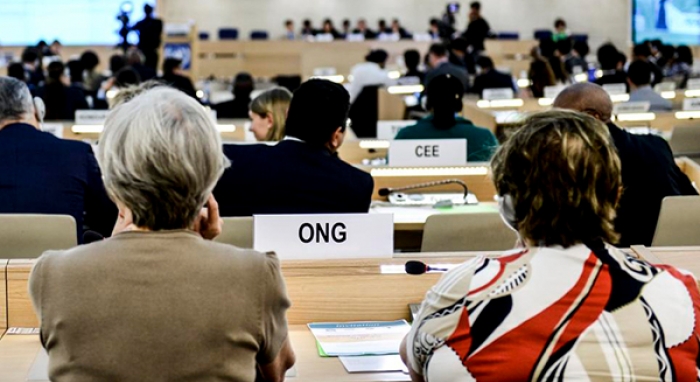
2018 is not only the 70th anniversary of the Universal Declaration of Human Rights (UDHR) and the 25th anniversary of the Vienna Declaration and Programme of Action (VDPA), it also marks the 20th anniversary of the Declaration on human rights defenders which was adopted by consensus by the General Assembly in 1998.
The rights enshrined in the UDHR cannot be guaranteed without a safe and enabling environment for the people exercising and fighting to defend those rights. States who commit to guarantee the UDHR cannot restrict the work of defenders, nor fail to act upon their obligation to protect them.
20 years after the adoption of the Declaration, human rights defenders have perhaps never been more under threat. They are subjected to judicial harassment, arbitrary arrest and detention, torture, enforced disappearance, physical violence and even murder.
Defenders are also attacked when they bring their voices to the international community. Last year, a report by the Secretary-General found evidence of a strategy on the part of some States to prevent the activities of individuals cooperating with the UN. The report also highlights that the incidence of reprisals is becoming broader and that the means used are increasingly blunt…
“The realisation of the UDHR depends on the work of defenders, who risk their lives and their freedom to advocate for the rights of others,” said Salma El Hosseiny, ISHR’s Human Rights Council Advocate. “It is alarming that States are increasingly shrinking civil society space on one hand, and professing their commitment to guarantee the UDHR on the other hand“. These unprecedented attacks against civil society and defenders amount to violations of the same rights to which they are advocating for.
States must translate their commitment to the UDHR by taking immediate and effective measures to ensure that defenders are able to carry out their legitimate human rights activities without any hindrance, to ensure accountability for all perpetrators, and access to remedies for victims.
The Human Rights Council plays an important role in contributing to the realisation of the UDHR on the ground. Accordingly, any proposals to strengthen or enhance the efficiency of the Council should be measured through the lens of increasing its impact, rather than the relatively insignificant time or money it may save. Finally, it is imperative that any legitimate process to strengthen the Council include the meaningful participation of civil society in all stages.
https://www.ishr.ch/news/hrc37-defenders-are-key-realise-universal-declaration-human-rights
see also: https://www.ishr.ch/news/hrc-consultation-civil-society-key-if-council-be-reformed-fit-purpose
9 December, Human Rights Defenders Day, ‘celebrated’ in Uganda
December 13, 2017In an article in the Ugandan paper The Independent entitled “Activists mark Human Rights Defenders day” (13 December 2017), Robert Kirenga, the Executive Director of the National Coalition of Human Rights Defenders in Uganda spoke to Flavia Nassaka about his perspective on international human rights defenders day and the general human rights situation in the country. He made some interesting points such as (excerpts): Read the rest of this entry »
Good introduction to the Anniversary of the UN Declaration on HRDs in 2018
December 11, 2017
COMMENTARY 05 December 2017
In “Defending Rights, Fighting Fatalism“ Janika Spannagel makes the point that we should take a long-term view in assessing human rights progress. I plead guilty by having started 2017 with a series of ten posts on the indeed gloomy outlook for human rights (e.g. https://humanrightsdefenders.blog/2017/02/24/2017-10-need-to-reset-for-human-rights-movement/). Perhaps it is fitting to end the year with a bit more ‘optimistic’ long term view:
In 2017, both activists and political pundits embraced a rhetoric of doom and gloom about the global state of human rights. But faced with a world painted in ever darker colors, we risk losing sight of the bigger picture. This month marks 19 years since the UN Declaration on Human Rights Defenders was adopted. Its troubled story can teach us something about the long arc of history when it comes to the advancement of human rights worldwide.
There is no doubt that human rights defenders are under attack today. But that is not new. Defending human rights is and always has been a highly political and often dangerous undertaking. People who have raised their voices against injustice, from totalitarianism and colonial oppression to capitalist exploitation, have been persecuted and silenced throughout human history. Repressive regimes and groups in power seem just as quick and clever in adapting methods of control as their opponents are in carving out new spaces.
However, rather than giving in to fatalism we should learn from history that counter-discourse and pushback is an inevitable part of the human rights success story. On December 9, 1998, the United Nations (UN) member states unanimously declared that everyone has a right to defend human rights. This consensus in the UN General Assembly, however, did not mean that states were in wide agreement. Born out of a context of intense persecution of dissidents in the late 1970s, the lengthy negotiation process for what eventually became the Declaration on Human Rights Defenders was at the verge of collapsing time and again over surprisingly topical issues like foreign funding, supremacy of domestic law, or national security.
Stories like that of the Declaration illustrate how writing human rights history requires both perseverance and the prompt use of political windows of opportunity. These stories teach us not to submit to pessimistic rhetoric that can easily cloud our judgment, but to remain committed to multilateral cooperation on rights issues, particularly during challenging times.
To learn more about how the Declaration on Human Rights Defenders was adopted against all odds, what difference it has made and why the term “human rights defenders” was omitted from the document, see my recent analysis of the 1998 Declaration on Human Rights Defenders. (http://www.geschichte-menschenrechte.de/en/schluesseltexte/erklaerung-zu-menschenrechtsverteidigern-1998/ in english, in spite of title)
With the 20th anniversary of the UN Declaration on Human Rights Defenders coming up on 9 December 2018 [https://humanrightsdefenders.blog/2017/11/01/20th-anniversary-of-un-declaration-on-human-rights-defenders-starts-with-crucial-draft-resolution-in-the-ga/], the article above makes good reading.
———-
http://www.gppi.net/publications/human-rights/article/defending-rights-fighting-fatalism/
 Hans Thoolen on Human Rights Defenders and their awards